Textile · Medieval Art in Normandy
The Bayeux Tapestry
A strip of linen about 68 metres long, embroidered in coloured wool, that tells the story of how William, Duke of Normandy, took the English throne in 1066.
Medieval artists built cathedrals, painted books small enough to hold in one hand, and turned ivory, glass and cloth into intricate images. Their work served worship, royal power and daily life across a thousand years of changing societies.
Medieval art includes the buildings, images and objects made across Europe and much of the Mediterranean during the Middle Ages. This period runs roughly from the fifth to the fifteenth century. It includes the interlaced pages of the Book of Kells, Byzantine icons, Romanesque church portals, Gothic cathedrals, embroidered vestments, ivory carvings and books small enough to fit into the palm of a hand. Across these thousand years, many societies developed distinct styles and ways of making art. Religious belief, political ambition, trade and craft traditions shaped what artists made and how people used it.[1][2][3]
Paris and its surrounding region were particularly important to the development of Gothic art. At Saint-Denis, a twelfth-century abbot used architecture, stained glass and precious materials to transform the experience of entering a church. At the Sainte-Chapelle, a French king built a palace chapel around relics that had cost more than the building itself. In Parisian workshops, painters and carvers translated the same elaborate visual culture into prayer books and portable objects. These works belong to a wider medieval world in which a manuscript, a reliquary and a cathedral could be equally ambitious artistic achievements.[4][5][6][7][8]
The term medieval describes an extended historical period, not an organization of artists with a shared program. A Byzantine mosaic and a fifteenth-century French manuscript can both be medieval without looking alike or having served the same purpose. Their makers worked under different political systems, spoke different languages and inherited different artistic traditions. The usefulness of the term lies in bringing these histories into conversation, not in making them uniform.[1][9][10]
The boundaries are necessarily approximate. The Getty Research Institute’s Art & Architecture Thesaurus begins medieval European art with the Christianized Roman Empire in the fifth century and allows the transition to the Renaissance to fall between the thirteenth and fifteenth centuries, depending on the country. Museums often include earlier Christian objects because the transformations that shaped medieval art had already begun in late antiquity. Gothic forms also continued well into the sixteenth century in some regions. Neither the collapse of Roman imperial government in the West nor the emergence of the Renaissance produced an immediate, universal change in artistic practice.[1][2][11]
Several older traditions remained active throughout these changes. Artists adapted the architectural forms, figure types and ornament of the Greco-Roman world; Christian patrons commissioned new imagery for churches and worship; and the makers of Celtic and Germanic objects contributed complex systems of pattern and animal decoration. The growth of towns and urban workshops eventually added new kinds of patrons and markets. Medieval art was not simply what remained after antiquity declined: it was also the result of successive attempts to preserve, reinterpret and transform that inheritance.[1][12][13][14]
Christianity accounts for much of the surviving art of medieval western Europe, particularly its monumental architecture and the treasures preserved by churches. It does not account for all medieval artistic production. Jewish communities commissioned illuminated Hebrew books, while the cities and courts of the Islamic Mediterranean supported their own traditions of architecture, calligraphy, ceramics, textiles and metalwork. The Byzantine Empire connected Europe with the eastern Mediterranean, and objects crossed political and religious boundaries through commerce, diplomacy, conquest and collecting.[2][9][15][16]
A history of medieval art can therefore concentrate on European churches without treating the rest of the world as absent. A Mamluk basin later used in the French royal household, or a Hebrew manuscript decorated with courtly figures and fantastic animals, reveals connections that a sequence of purely national styles would miss. These objects did not lose their original histories when they acquired new owners or functions.[16][15]
The principal divisions overlap because they describe different things. Byzantine identifies a long-lived imperial culture; Carolingian and Ottonian refer to ruling dynasties and their artistic worlds; Romanesque and Gothic describe styles that crossed political borders. Early Christian and Byzantine art overlap in both date and geography, while Romanesque and Gothic work could be produced at the same time in neighboring regions. The dates below are guides, not boundaries that every object obeys.[1][9][13][17][14][11]
The broad terms Early Medieval and Late Medieval sit across these more specific categories. In the Getty’s terminology, the early medieval bracket extends approximately from the Migration period to the Romanesque, roughly the fourth to eleventh centuries, while late medieval can cover the period from about 1250 to 1500. Such labels are most useful when a more precise stylistic or regional description would be misleading.[18][19]
| Period or tradition | Approximate dates | Principal setting | Characteristic features |
|---|---|---|---|
| Early Christian | From the third century; commonly discussed within late antiquity, although the Getty’s catalog category extends to the mid-ninth century | Italy and the Mediterranean, with substantial overlap with the early Byzantine world | Classical buildings and imagery adapted for Christian worship; decorated churches, mosaics, sarcophagi and manuscripts.[20] |
| Byzantine | Conventionally 330–1453, with continuations into the sixteenth century and beyond in eastern Europe | The eastern Roman Empire and neighboring regions | Icons, mosaics, churches and luxury objects; both formal religious imagery and repeated engagement with classical naturalism.[9] |
| Migration period | About 370–800 | Much of the former western Roman Empire and northern Europe | Portable ornaments, gold and garnet work, enamel and patterned metalwork; geometric and animal designs.[12] |
| Insular, traditionally called Hiberno-Saxon | Especially from the seventh century | Ireland and Britain, with connections to continental monasteries | Interlace, brilliant color, intricate initials, animal ornament and highly structured manuscript pages.[21][3] |
| Carolingian | About 768–900 | The Frankish empire of Charlemagne and his successors | An ambitious revival of Christian imperial Rome through architecture, manuscripts, ivory and metalwork.[13] |
| Ottonian | From 919 through much of the eleventh century | The Ottonian and early Salian imperial world, especially in German-speaking lands | Monumental churches, expressive manuscript painting and costly ecclesiastical objects combining Carolingian, Early Christian and Byzantine models.[17] |
| Romanesque | Mainly the eleventh and twelfth centuries | Western Europe | Round arches, substantial masonry, vaults and richly carved portals; vigorous figure styles and elaborate ornament across media.[14] |
| Gothic | From the mid-twelfth century; continuing into the sixteenth in some regions | First northern France, then much of Europe | Pointed arches, rib vaults and increasingly elaborate systems of support; extensive glazing, changing sculptural naturalism and sophisticated courtly and urban arts.[11] |
The date 330 marks the dedication of Constantinople as the Roman emperor Constantine I’s new capital. It is a convenient starting point for Byzantine history, but it did not inaugurate a wholly separate empire or instantly create a new artistic style. The people now called Byzantines understood themselves as Romans. Their empire preserved and repeatedly reworked Roman institutions, Christian traditions and the artistic inheritance of antiquity.[9]
Byzantine art is often recognized through frontal saints, gold backgrounds and carefully regulated gestures. These devices could distinguish a sacred presence from an ordinary encounter in physical space, but Byzantine artists did not simply abandon observation or the human body. Different periods cultivated different relationships with classical models. Solemn, hieratic images coexisted with refined modeling, animated narrative and luxurious objects intended for courtly use.[9]
The importance of images also made them contentious. During the eighth and ninth centuries, Byzantine rulers and churchmen disputed whether sacred images should be venerated or rejected as improper objects of devotion. The episodes conventionally called Iconoclasm interrupted the production and survival of certain kinds of religious imagery; the restoration of image veneration in 843 became a major event in the Orthodox tradition. An icon was consequently not just a recognizable painting style. It stood within arguments about the relationship between matter, representation and the divine.[22]
During the Migration period, conventionally about 370–800, some of the most accomplished work took the form of objects that could be worn, carried or buried with their owners. Brooches, belt fittings, weapons and ornaments combined precious metals with garnets, glass and enamel. Repeated chevrons, crosses, lines and dots could organize a surface, while animals were stretched and interwoven into patterns that demanded close attention. Portability mattered, but it should not be mistaken for a lack of technical complexity or settled artistic traditions.[12][23]
The objects from the early seventh-century Sutton Hoo ship burial in England show both accomplished craftsmanship and connections with distant regions. A silver platter bears stamps identifying Constantinople as its place of manufacture, linking this English burial with the Byzantine capital. The gold-and-garnet purse-lid, with its carefully arranged animals and patterned glass, demonstrates that ornament could carry the same concentration of invention and labor that later viewers associate with a large painting.[24][23]
In Ireland and Britain, related interests in line, color and intricate pattern entered the decoration of Christian manuscripts. The older term Hiberno-Saxon is still encountered, but Insular is often more useful because it does not imply a simple division between Irish and Anglo-Saxon contributions. Pages of interlace, enlarged initials, birds, animals and stylized human figures could transform the act of reading into an encounter with densely organized visual design.[21][3]
The Book of Kells, made around 800 and now at Trinity College Dublin, is a celebrated example. Its Gospel text is embedded in a system of ornament that can turn an initial into an entire pictorial field. Its place of production remains debated; neither an Irish nor an Iona origin should be presented as an uncontested fact. Scientific study has also challenged older assumptions about its materials: the extraordinary color does not depend on the once-frequently claimed use of imported lapis lazuli. The achievement lies as much in the handling and combination of pigments as in their supposed rarity.[3][25]
Charlemagne, king of the Franks from 768 to 814 and crowned emperor in Rome in 800, supported an artistic renewal that deliberately looked back to the Christian Roman Empire. The models included the world of Constantine I and Theodosius I, the fourth-century emperors associated with the establishment and consolidation of Christian imperial rule. Architecture, manuscripts and ceremonial objects helped make a political claim visible: the Frankish court could present itself as the heir to a prestigious imperial past.[13]
Carolingian artists did more than copy surviving Roman objects. At Aachen around 800, the palace chapel drew on earlier imperial architecture while serving Charlemagne’s court. Manuscript painters studied and transformed older models of the human figure, drapery and the representation of the evangelists. The classical inheritance was something to investigate and put to work, not a single style that had survived unchanged.[13]
Ottonian art developed in a later imperial setting from the tenth century. Emperors, bishops and religious communities commissioned manuscripts, ivories, metalwork and buildings that combined earlier western models with renewed Byzantine connections. Bernward, bishop of Hildesheim, is particularly associated with monumental bronze commissions, including doors whose biblical scenes give the human figure unusual expressive force. The period’s art can be solemn and ceremonial, but it can also be dramatic, gestural and intensely concerned with the relationship between earthly authority and sacred history.[17]
During the eleventh and twelfth centuries, the expansion of monasteries and pilgrimage helped sustain an extraordinary program of building and decoration. The Burgundian monk and chronicler Rodulfus Glaber famously described the landscape as being covered in a “white mantle of churches.” The phrase captures the sense of renewal, although the surviving buildings vary enormously in scale, structure and regional character.[14]
Romanesque churches often use round arches, substantial supports and masonry vaults, but the term is not restricted to architecture. Carved capitals, monumental portals, painted interiors, illuminated books and precious church furnishings belong to the same history. Figures can be elongated, compressed or sharply bent to fit a capital or doorway. Their arrangement is frequently governed by the building, the narrative and the expressive demands of the subject rather than by the proportions of an isolated human body.[14]
Large sculpted entrances made the church threshold a site of encounter. A worshiper might pass beneath a vision of divine judgment or between figures from sacred history. These were not independent statues subsequently placed beside a building; their scale, placement and meaning were conceived in relation to the act of entering it. The close association of sculpture and architecture continued into Gothic art, even as sculptors gave figures more varied, lifelike poses and the architectural framework changed.[14][11][26]
The word Gothic was not chosen by the medieval builders whose work it describes. Renaissance Italian commentators used the association with the Goths to characterize architecture they regarded as barbarous, irregular or contrary to the classical tradition they admired. The historical accusation was wrong: the architectural style that emerged in twelfth-century northern France was not the work of the peoples who had invaded the Roman Empire centuries earlier. A hostile judgment eventually became a largely neutral art-historical name.[11]
A medieval expression, opus francigenum, meaning approximately “French work,” is sometimes used to show how contemporaries understood the new architecture. It does indicate recognition of a French connection, but it should not be treated as the universal name used by everyone building a cathedral. Like most broad stylistic labels, Gothic brings together practices that their makers described in more local, practical or institutional terms.[4][11]
Early Gothic developed in the Île-de-France during the middle decades of the twelfth century. Its novelty lay less in the invention of a single feature than in the combination and refinement of features already being explored: pointed arches, rib vaults, slender supports, more open interior planning and larger areas of glass. By coordinating the different parts of a building’s support system, masons could reduce some stretches of massive wall and change the relationship between structure, space and light.[27][4]
High Gothic, associated especially with the later twelfth and thirteenth centuries, brought greater scale and increasingly systematic architectural solutions. In sculpture, the long column-like figures of earlier portals could give way to bodies that turn, shift their weight and engage with one another. The return to classical balance and naturalism noted in accounts of High Gothic was a development within medieval art, not a sudden discovery that had to wait for the Renaissance.[28][11][29]
The French term Rayonnant is associated with radiating patterns, especially in rose windows, and with an increasingly delicate treatment of window tracery and wall surfaces. It developed in the thirteenth century and continued into the fourteenth. Pierre de Montreuil, a Parisian master mason associated with Saint-Germain-des-Prés and Notre-Dame, was one important practitioner, rather than the sole inventor of the style. He died in 1267; older catalog descriptions sometimes give 1266.[30][31]
Flamboyant refers to the flame-like shapes created by curving and counter-curving lines of tracery. In France it is generally associated with the later fourteenth century, from around 1370, through the fifteenth and into the sixteenth. The antiquarian Arcisse de Caumont, who lived from 1802 to 1873, helped establish the terminology used to distinguish these phases of French Gothic. Their names belong to later attempts to classify medieval buildings, not to declarations issued by the builders themselves.[32][30]
International Gothic describes something different: an elegant courtly style found across painting, manuscripts and luxury objects, particularly in the later fourteenth and early fifteenth centuries. Its elongated figures, flowing lines, costly surfaces and interest in courtly life traveled between centers rather than remaining confined to one kingdom. The Getty traces its development to French and Burgundian courts in the mid-fourteenth century and its wide dissemination by about 1425, while also noting that some scholars consider the term too broad. It is not simply the final architectural phase after Flamboyant; the categories describe overlapping aspects of medieval art.[10]
Much medieval art was made for a particular action or setting: reading, praying, processing through a church, celebrating a religious feast, remembering the dead or displaying authority. A gilded reliquary was not merely a container admired from a distance. It could be carried, approached, touched or used in a blessing. A book’s appearance changed as its owner turned the pages, while a window changed with the light outside. Understanding the use of an object often explains choices that look strange when it is isolated in a photograph.[33][34][35]
In Christian art, the lives of Christ, the Virgin Mary and the saints supplied recurring subjects, but their representation was not fixed. Artists could emphasize triumph, suffering, maternal affection, judgment or intercession. Saints were often identified through attributes connected with their lives or martyrdoms. Such details worked within a shared religious culture, although a particular image might also require familiarity with local devotion or learned interpretation.[36][37][38]
It is too simple to describe all church imagery as a Bible for people who could not read. Images certainly helped communicate stories, but many were made for highly literate clergy, monastic communities or educated patrons. At Saint-Denis, for example, the relationship between Old Testament events and Christian fulfillment could be expressed through elaborate visual correspondences. The same window could offer narrative, theological argument and an overwhelming experience of colored light without every viewer understanding each level in the same way.[39][40][41]
A large central figure may be large because of its importance, not because it stands closer to the viewer. Gold may replace landscape because the image is not attempting to describe an ordinary setting. A body may be elongated to fit a narrow architectural space, while a gesture may be enlarged to make an emotion or action legible. These are artistic decisions, but they do not explain every object in the same way. Training, regional conventions, materials, intended viewing distance and individual ability also mattered.[11][14][38]
The familiar opposition between “flat medieval art” and “realistic Renaissance art” obscures more than it explains. Medieval artists repeatedly explored volume, space, physical observation and human emotion. Byzantine classicism, the naturalism of thirteenth-century sculpture and the work of the Italian painters Giotto di Bondone and Duccio di Buoninsegna belong to different parts of that history. Neither naturalism nor stylization was the possession of a single century.[9][28][38]
Many medieval objects have lost part of the surface that once defined them. Stone sculpture could be painted; ivory could be colored and gilded; metal could gleam beneath enamel and gems. The Soissons Diptych is cataloged as painted and gilt ivory, a useful reminder that its surviving pale material was not necessarily intended to be seen in isolation. Nevertheless, the extent of color has to be established object by object: not every ivory was covered in paint, and not every apparently bare surface has the same history.[8][42]
A similar caution applies to architecture. The medieval interior was not invariably a world of exposed gray stone. At Chartres, conservation has revealed the importance of painted surface decoration, including patterns that imitate carefully ordered masonry. The building’s color, glass, furnishings and sculpture once belonged to a coordinated environment, only part of which survives in its original form.[29][43]
An illuminated manuscript is a handwritten book enriched with painted decoration, ornament or images. Gold and silver could make the page glitter, but they are not necessary for every decorated manuscript to be described as illuminated. The finished book combined the work of several specialists: preparing the writing material, ruling and copying the text, planning the decoration, painting, gilding and binding. Some makers performed more than one task; others worked as part of a larger division of labor.[44][34][7]
The scale of the most accomplished work is easily misunderstood in reproduction. Jean Pucelle, an illuminator working in Paris, painted the Hours of Jeanne d’Évreux around 1324–1328 for the French queen of that name, the wife of Charles IV. Its pages measure only 9.2 × 6.2 centimeters. The manuscript, now at The Met Cloisters in New York, uses grisaille—painting largely in shades of gray—alongside tempera and ink on vellum. It achieves extraordinary richness without gold.[7]
The tiny pages of Jean Pucelle’s Hours of Jeanne d’Évreux also bring solemn devotion into contact with a livelier world. The principal religious scenes are accompanied by hundreds of marginal figures: people engaged in everyday activity, performers and fantastic creatures. These images are not evidence that the book’s religious purpose was insincere. They show how a private devotional object could accommodate several registers of experience within one carefully designed page.[7]
The Belles Heures of Jean de France, duc de Berry has pages measuring 23.8 × 17 centimeters, larger than those of Jean Pucelle’s Hours of Jeanne d’Évreux. Made by the brothers Paul, Jean and Hermann de Limbourg around 1405–1408/1409, it uses tempera, gold and ink on vellum and is also at The Met Cloisters. It is especially valuable for understanding the brothers because it is the book of hours they completed, unlike the later and unfinished Très Riches Heures.[45]
A third example, the Hours of Charles the Noble, was made in Paris around 1404 for Charles III, king of Navarre. The Cleveland Museum of Art attributes its decoration to the Master of the Brussels Initials and associates. Gold reinforces the manuscript’s luxurious appearance. The museum’s account emphasizes the expense and prolonged labor involved in making such a book: costly materials were only one part of a process that could take years. The name of the “master” is a modern scholarly label for an artistic personality, while “associates” acknowledges collaborators rather than pretending that every page came from a single hand.[34]
Medieval stained glass was made from separate pieces of glass assembled into a design. Color could be introduced during manufacture by adding metallic compounds to a mixture based on sand and ash. The cut pieces were held together by strips of lead with an H-shaped cross-section, known as cames. Painted details, fired onto the surface, could supply faces, folds and other information that the outlines of the glass alone could not express. Stained glass was particularly prominent in European architecture between about 1150 and 1550.[35]
Its appearance was shaped by technical problems as well as artistic preference. Ruby-red glass could be too dark to transmit sufficient light if used at normal thickness, so a thin layer of red was combined with clearer glass in the process known as flashing. From the fourteenth century, silver stain offered another way to alter a pane’s color, producing yellows and oranges from silver compounds applied to its surface. This expanded the painter’s control over a single piece; it was not the first occasion on which different colors could occur within one pane.[35]
The early twelfth-century technical writer known as Theophilus described methods used by craftspeople, including glass painters. His account helps recover an industry that depended on planning and repeated testing, not on spontaneous assembly. The finished window also required metalworkers, glaziers and the building’s structural supports. What appears from the floor as an almost immaterial field of color is the result of a precise and materially demanding construction.[35]
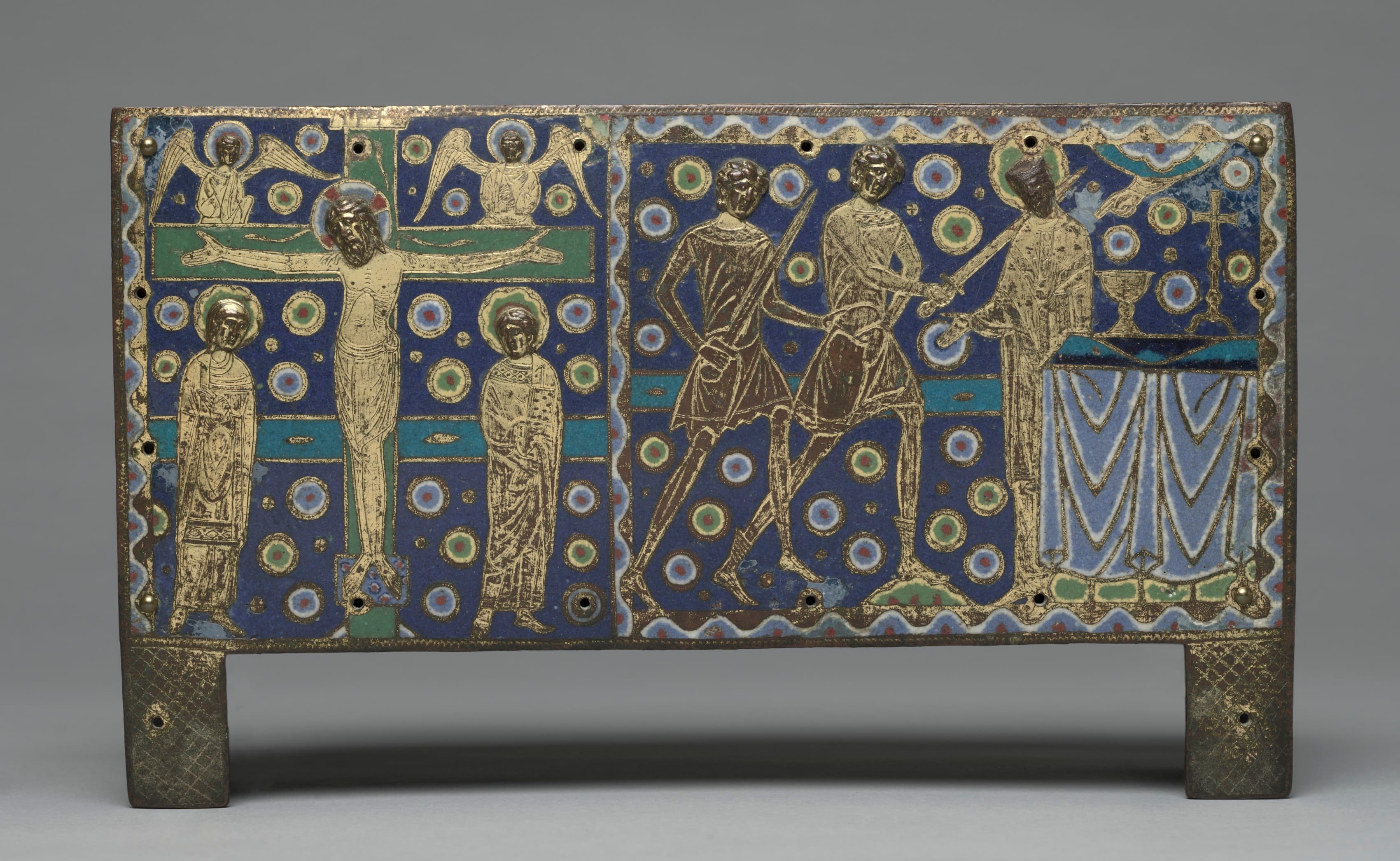
In champlevé enameling, recesses are cut into a metal surface and filled with powdered glass, which is fused by heat. The French name refers to the raised metal areas left between the enameled compartments. It differs from cloisonné, in which thin metal partitions form the compartments on the surface. Between about 1100 and 1250, workshops around Cologne, Liège and Limoges were especially important suppliers of enameled objects, including chalices, crosses, candlesticks, altarpieces, shrines and other church furnishings.[46]
Limoges became closely associated with the cult of Thomas Becket, the archbishop of Canterbury murdered in his cathedral on 29 December 1170. His canonization in 1173 and the rapid growth of devotion to him created demand for reliquary caskets that could preserve a connection with the new saint. These objects also repeated the story of his death in images, allowing the cult to circulate far beyond Canterbury.[47][48][49]
The V&A’s Becket Casket, made around 1180–1190, combines copper alloy, champlevé enamel, crystal and glass over a wooden core. It is described by the museum as the largest and most elaborate of the surviving Becket caskets, and possibly the earliest. Its comparison is with that particular group of reliquaries, not with every medieval shrine. The extraordinary survival of these portable objects contrasts with the fate of Becket’s great shrine at Canterbury: established in 1220, it was destroyed on the orders of Henry VIII in 1538.[48][50][51]
A reliquary could also take the shape of the body part it enclosed. The Arm Reliquary of the Apostles, made at Hildesheim around 1190 and now in Cleveland, is constructed from gilt silver, champlevé enamel and oak. It contains a piece of an unidentified saint’s arm bone. Objects of this kind could be used in services and processions to bless or touch the faithful, bringing sacred remains into an encounter that was physical as well as visual.[33]
A surviving panel in Cleveland makes the relationship between a saint’s story and the wider Christian narrative explicit. The Plaque from a Chasse for Relics of Saint Thomas Becket, made at Limoges in 1220–1225, pairs Becket’s martyrdom with the Crucifixion. Gilded and engraved copper forms the setting for champlevé enamel. The museum attributes it to Master G. Alpais and his workshop, identifying a Limoges enameler by the name preserved in the catalog; the initial is not expanded there. The panel once formed the main face of a reliquary and is an example of how a reliquary could connect a recent martyr with the Crucifixion.[49]
The Gloucester Candlestick, now at the V&A, is conventionally dated to 1107–1113. Its Latin inscription names Peter, the abbot of the Benedictine community at Gloucester, as its donor. Peter was the abbot associated with the commission, not the otherwise unidentified metalworker. The inscription is unusually useful evidence because it connects an elaborate surviving object with a specific institutional setting and a limited span of years.[52]
The Gloucester Candlestick’s tangled arrangement of figures and creatures also demonstrates how much sculptural invention could be concentrated in an object intended for practical use. A candlestick need not have been a plain support for a candle. Its surfaces could invite close scrutiny, associate light with religious meaning and display the resources of the community that owned it. The categories “useful object” and “work of art” are not opposites in this context.[52]
The Gloucester Candlestick was cast in three sections using the lost-wax process. Its copper-alloy body has gilding, glass and niello, a dark material used to fill engraved decoration. Dragons support the base, and the four Evangelists’ symbols appear around the central knob. A later inscription records a gift by Thomas de Poche, whose identity remains unknown, to the cathedral of Le Mans in France. According to the V&A, the candlestick remained there until the French Revolution. Its inscriptions preserve stages in its history that its style alone could not establish.[53][54]
Ivory was suited to close, precise carving and to objects that could be held, opened or carried. The Soissons Diptych, traditionally dated to around 1270 and made in Paris, brings scenes into a compact, hinged format. Its painted and gilded surface originally added to the effects produced by the carving itself. Today it is in the Victoria and Albert Museum.[8]
The relationship between this kind of object and cathedral sculpture is especially revealing. The stacked narratives and architectural frames of the Soissons group have been connected with the great portals of Reims, Amiens, Rouen and Notre-Dame de Paris. A portable carving could make aspects of that monumental imagery available to patrons who had never seen the buildings. Its smallness helped the style travel. The connection is an art-historical explanation supported by comparison, rather than proof of a single, documented route of transmission.[8][42]
Opus anglicanum, Latin for “English work,” became a name for exceptionally elaborate embroidery made in England. Particularly admired in the later thirteenth and early fourteenth centuries, it used silk and metal thread to create figures, foliage and architectural settings on costly textiles. London was a major center of production, and the embroiderers were skilled professionals, women and men.[55][56]
The brilliance of the metal thread depended on ingenious construction. Very thin strips of silver, often gilded, were wound around a silk core. In underside couching, the metal thread was fastened so that the stitches securing it were largely concealed beneath the surface. The result could shimmer as a vestment moved during worship. Its visual effect depended on the wearer as well as on the embroiderer.[57]
A modern reconstruction helps measure the labor involved in medieval embroidery. In a project documented by the V&A, the embroiderer Rosie Taylor-Davies spent about thirty-five hours making a single small figure using medieval techniques. That is a modern practical estimate, not a surviving medieval time sheet, but it gives a sense of the work concealed within an apparently effortless image.[56]
The Syon Cope, made in England around 1310–1320 and now at the V&A, is a particularly rich example. A cope is a ceremonial cloak, and its figures were arranged with the worn garment in mind: their relationships cannot be fully understood when it is treated as a flat textile. Two small kneeling figures may represent the monk who commissioned or owned it. The individual remains unidentified, showing that the names of patrons can disappear as completely as those of makers.[57]
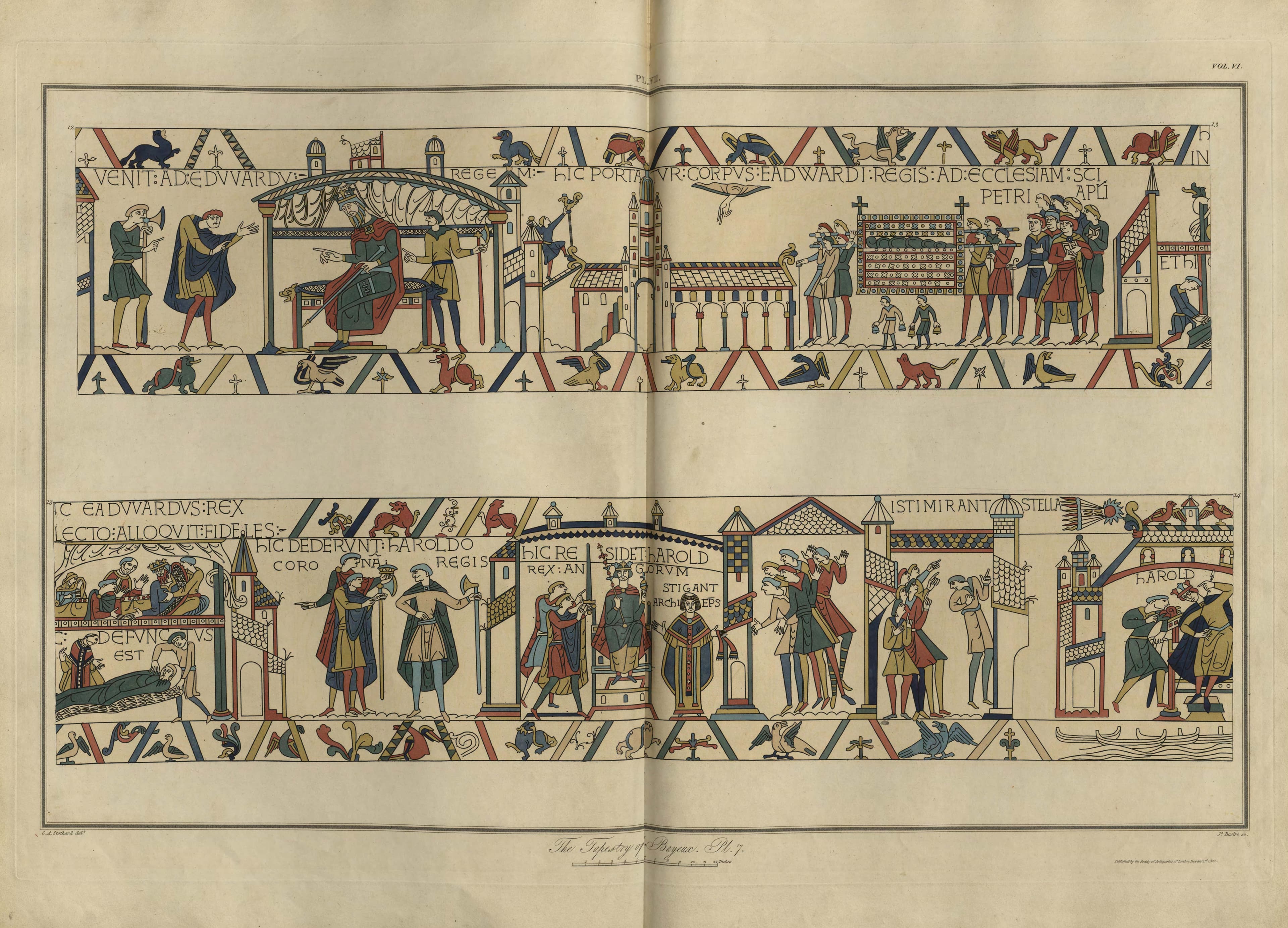
Despite its familiar name, the Bayeux Tapestry is an embroidery, not a woven tapestry. Woolen thread was stitched onto joined lengths of linen to tell the story of the Norman conquest of England in 1066. The surviving work is about 68.3 meters long. Its scenes turn preparation, travel, feasting and battle into a continuous narrative in which movement and repeated figures carry the story forward.[58]
The old attribution of the Bayeux Tapestry to Queen Matilda and her ladies is a tradition, not an established account of its manufacture. Odo, bishop of Bayeux and half-brother of William, duke of Normandy and later king of England, is generally considered the likely commissioner. The association with the cathedral consecrated at Bayeux in 1077 helps explain its setting, but the precise date and circumstances of production remain matters of investigation. The embroidery is both an extraordinary record and a constructed presentation of the Norman conquest of England in 1066, not a neutral illustrated chronicle.[58]
The Bayeux Tapestry belongs to Bayeux in Normandy, outside the Paris region. Its London exhibition at the British Museum runs from 10 September 2026 to 11 July 2027, during redevelopment of its French museum. Visitors planning a trip should check the museum’s current information, since the original is on loan during this period.[59]
Manuscripts and metalwork are especially prominent in medieval museum galleries, but painting also occupied the walls of churches and other buildings. Fresco, in which pigment is applied to wet plaster, offered a means of creating extensive narrative cycles. Painting on dry plaster required a different binding method and could be more vulnerable to loss. Wooden panels, meanwhile, supported images ranging from small devotional pictures to large, multi-part altarpieces.[38]
In Italy, preparation could involve glue, cloth and layers of gesso before drawing, gilding and painting in tempera. Gold backgrounds were worked surfaces, capable of being polished and patterned, rather than simply flat yellow substitutes for a landscape. The survival of a hinge, a painted reverse or an original frame can reveal that a panel now displayed alone was once part of an object opened and closed during use.[38][60]
The absence of a name on a museum label can have several explanations. An object may never have been signed; its documents may have been destroyed; a signature may have been damaged; or it may have been produced by several people whose individual contributions cannot be separated. Medieval workshops did not always distinguish between design, skilled execution and supervision in the way a modern catalog would prefer. The patron or institution could also leave a much clearer documentary trace than the people who made the work.[38][34][37][52]
It is therefore misleading to say that medieval artists were anonymous because they were all modest craftsmen who refused personal recognition. Some left names, records or unmistakably assertive signatures. Others were celebrated in their own time but have become difficult to identify. “Unknown” describes the present state of knowledge; it is not, by itself, an explanation of a maker’s social standing or intentions.[26][15][61][16]
The Cleveland Museum of Art’s Crucifix with Scenes of the Passion, made in Pisa around 1230–1240, is a vivid example of how a name can survive and still fail to identify its owner. An inscription at the bottom once named the painter, but it is now difficult to read; the museum suggests that the name may have been Michael. The work itself is much more legible. Its upright, living Christ presents the Crucifixion as victory over death rather than concentrating exclusively on a visibly dead or collapsing body.[37]
Where an artist’s identity is unknown, scholars may group related works under a conventional name derived from a patron, place or characteristic object. The Boucicaut Master, active in Paris around 1410–1425, is named after a book of hours made for the French marshal Jean II Le Meingre, called Boucicaut, who was captured by the English at Agincourt in 1415. The label distinguishes an identifiable body of work without claiming to reveal the painter’s civil name.[62]
Scholars use names derived from characteristic works to group the output of unidentified makers, including the Master of the Soissons Diptych and the Master of the Brussels Initials. Such names can be revised as knowledge changes. Moreover, an object labeled “workshop of,” “follower of” or “associates of” a master is not automatically a work made by that individual personally. Cleveland’s book of hours of around 1420, for example, is currently attributed to a follower of the Boucicaut Master. These small distinctions describe different levels of confidence and different relationships between surviving works.[8][34][62]
Berlinghiero, a painter active in Lucca and dead by 1242, belongs to the better-documented group. He headed an important workshop that included his sons. His Virgin and Child with Saints, painted in the 1230s and now in Cleveland, can be folded into a small, portable triptych. The strong lines of its figures and garments reflect Byzantine connections without making the work an anonymous product of a supposedly uniform medieval style.[63]
At Santiago de Compostela in Galicia, the sculptor and master builder known as Master Mateo left an unusually substantial historical presence. A royal grant from Ferdinand II, king of León, places him at the cathedral in 1168. His best-known achievement is the Pórtico de la Gloria, a sculptural and architectural ensemble in which sacred figures inhabit the entrance to the church. He is known from the surviving records as Mateo, without a securely established surname.[26]
An inscription dates the laying of the lintels of the Pórtico de la Gloria at Santiago de Compostela Cathedral to 1 April 1188. That is a firm and valuable date, but it is not the same as a certificate that every sculpture and every part of the cathedral had been completed. The cathedral was consecrated in 1211. The distinction illustrates a wider problem in medieval chronology: a payment, inscription, dedication and final completion may mark different stages of a long project.[26]
Women participated in medieval artistic production as embroiderers, illuminators and patrons, even when their work survives under the name of a workshop or institution. Jeanne de Montbaston, active in fourteenth-century Paris, is one documented illuminator. Her presence in the history of Parisian bookmaking is a useful corrective to the assumption that every decorated manuscript was made by a monk or by an unnamed male artisan.[64][56]
Hebrew manuscripts provide especially striking evidence of named collaborators. The Cervera Bible, now in the National Library of Portugal, was copied in 1299–1300 by Samuel ben Abraham ibn Nathan, who recorded that he worked while recovering from a broken leg. Its illuminator, Joseph Hazarfati, whose name means “the Frenchman,” gave his signature an entire decorated page. A third contributor, Joshua bar Abraham ibn Gaon, used tiny written letters to create animals and patterns in the technique called micrography, concealing his name repeatedly within the designs. Religious learning, skilled decoration and personal recognition coexist within the same book.[15]
Another scribe and illuminator, Joel ben Simeon, signed and dated the Washington Haggadah on 29 January 1478. A Haggadah is used at the Passover seder, the ritual meal commemorating the Exodus. This manuscript, now at the Library of Congress, belongs to a group of surviving signed works by the same maker. Medieval artistic identity is not always absent; sometimes it is written plainly on the page.[61]
Not every costly object was intended for religious worship. A Table Fountain made in Paris around 1320–1340, now in the Cleveland Museum of Art, transforms Gothic architectural forms into an elaborate work of gilt silver and translucent enamel. Its maker is unknown, but the object displays a close awareness of the buildings and ornamental vocabulary of its own time.[65]
The fourteenth-century table fountain now in the Cleveland Museum of Art also provided entertainment during meals. Flowing water operated small mechanisms, including wheels and bells, turning a meal into a display of wealth, ingenuity and controlled motion. The object invites admiration of engineering as well as precious materials. Medieval craftsmanship could produce delight, surprise and amusement in a courtly setting, just as it could support solemn religious ceremonies.[65]
The Louvre’s basin traditionally called the Baptistère de Saint Louis demonstrates how later use can obscure an object’s origin. It was made in the Mamluk world, probably Egypt or Syria, around 1325–1340, and signed by the metalworker Muhammad ibn al-Zayn. Its inlaid metal decoration includes human and animal imagery, undermining the blanket assumption that medieval Islamic objects never represented living creatures.[16]
The name Baptistère de Saint Louis, or “Baptistery of Saint Louis,” belongs to the Mamluk basin’s later French history. It does not establish that Louis IX commissioned the vessel: the king died in 1270, before its accepted production date of about 1325–1340. The work became associated with royal baptism in France, but its maker, technique and original setting remain essential to its identity. It is both a masterpiece of Mamluk metalwork and an object with a long French collecting history, not an artifact whose history begins when it reaches a European court.[16][5]
Paris’s importance was not confined to one famous building. Royal patronage, religious institutions and urban workshops brought together demand for monumental architecture and for small, technically demanding objects. The Sainte-Chapelle belonged to a royal palace, while books such as the Hours of Jeanne d’Évreux served private devotion. Ivory carvers and goldsmiths adapted forms that could also be seen in architectural settings. These different scales of production formed connected parts of the city’s artistic culture.[6][7][8][65]
The surrounding region is equally important. Saint-Denis, immediately north of Paris, was an abbey with deep royal associations; Chartres was a major pilgrimage cathedral; and the Très Riches Heures, now at Chantilly, preserves a courtly view of a world shaped by estates, ceremony and the calendar. They should not be collapsed into a single Parisian school, but together they reveal the unusually rich range of medieval art that can be studied in and around the city.[66][29][67]
Suger, elected abbot of Saint-Denis in 1122, was a Benedictine churchman and an adviser to the French kings Louis VI and Louis VII. He was a patron and organizer of building, not a securely identified architect. His writings are unusually important because they describe both the practical circumstances of his rebuilding and the meanings he attached to its splendor.[4][66][68]
One practical reason for enlarging Saint-Denis was crowding: the old church could not comfortably accommodate the crowds attending major occasions. Suger recalled people pressed together so tightly that women moved toward the altar over the heads of the crowd. The account comes from an abbot justifying his works, not from a neutral observer, but it gives the project a human setting often lost in a purely stylistic history. A more spacious church was intended to change the movement and experience of worshipers as well as the building’s appearance.[68]
Abbot Suger rebuilt the western entrance of Saint-Denis between about 1130 and 1140, including a prominent rose window, and then turned to the eastern end. On 14 July 1140, the first stone of the new chevet—the eastern termination containing the choir and surrounding spaces—was laid. His account of the ceremony connects the physical act of construction with devotion: participants offered precious stones as biblical language about walls of jewels was sung.[4][39]
The new eastern end joined rib vaults, slender supports and an unusually open arrangement of radiating chapels. Instead of being experienced as a succession of strongly separated compartments, the spaces could be perceived in relation to one another. Glass and architecture worked together to draw light around the sanctuary. The novelty was the coherent handling of the whole, not the sudden invention of each component at Saint-Denis.[4]
The church of Saint-Denis combined rib vaults, slender supports and extensive glazing in its eastern rebuilding of 1140–1144, making it a landmark in the emergence of Gothic. Its structure differed from the mature system of later cathedrals. Rib vaults had earlier precedents, and the history of external buttressing developed through successive experiments. It is too simple to say that fully developed flying buttresses, rib vaults and complete walls of glass all appeared together in 1140. Nor did Gothic engineering make walls entirely cease to carry loads: vaults, piers, walls and buttresses formed an interacting structural system.[4][11]
The chevet at Saint-Denis contains the choir and adjoining chapels at the church’s eastern end. It was consecrated on 11 June 1144, in the presence of Louis VII, Eleanor of Aquitaine, then queen of France, and twenty-four bishops and archbishops. The Centre des monuments nationaux preserves the memorable formulation that the work took “three years, three months and three days.” That formulation is part of the monument’s account of the project. The recorded foundation date, 14 July 1140, falls almost four years before the consecration.[4][39]
In his account of the decoration of Saint-Denis, the twelfth-century abbot Suger argued that beautiful materials could direct the mind toward spiritual understanding. On the entrance portal, Suger had an inscription explaining that material beauty could lead toward spiritual truth. He expressed a similar idea about light in the church’s eastern end, or chevet, calling it lux mirabilis et continua: wonderful and continuous light. The radiance of the interior acquired meaning through its relationship with worship, scriptural imagery and the contemplation of precious materials.[68][4]
At Saint-Denis, precious stones, shining metal and colored glass helped create the experience of worship that Abbot Suger valued in the twelfth century. The church could be admired for its workmanship while also being interpreted as an image of a sacred order. This does not mean that all medieval churchmen shared his enthusiasm for magnificence, but it explains why an abbot could write so carefully about materials and visual effects.[68][39]
The basilica of Saint-Denis seen today is not simply Suger’s building preserved intact. Its twelfth- and thirteenth-century fabric belongs to several campaigns. The basilica is approximately 108 meters long, with vaults reaching 29 meters, and its transept contains two rose windows more than 12 meters in diameter. These dimensions describe the developed medieval building, not a single campaign completed in 1144.[66]
The surviving twelfth-century stained glass at Saint-Denis has a complicated conservation history. Fragile panels were removed in 1997, and copies were installed in April 2023. Removal does not mean that all the originals have been destroyed; it means that their preservation could not be reconciled with continued exposure in the same position. Much of the high glazing belongs to nineteenth-century restoration associated with the architects François Debret and Eugène Viollet-le-Duc.[39][66]
Saint-Denis’s role as a royal burial place extends far beyond the Gothic rebuilding. From the burial of Dagobert I, king of the Franks, in 639, through the nineteenth century, the site received the burials of some forty kings and twenty-six queens. The Centre des monuments nationaux counts about seventy tombs and recumbent effigies in the monument. They form a history of changing ideas about royal identity and remembrance, not merely an architectural furnishing. The basilica became a cathedral only in 1966, when the new diocese of Saint-Denis was established.[66]
The north spire of the basilica of Saint-Denis has undergone damage, repairs and dismantling. Lightning struck the roughly 90-meter spire on 9 June 1837, but it was repaired rather than immediately removed. Further storm damage in 1845 led to the dismantling of the north tower and spire in 1846–1847. The foundation stone for their reconstruction was laid on 14 March 2025. The project recreates the missing tower and spire while the rest of the basilica remains open to visitors.[66][69]
In 1239, after approximately two years of negotiation, Louis IX, the French king later canonized as Saint Louis, obtained the relic believed to be Christ’s Crown of Thorns from Baldwin II of Courtenay, the Latin emperor of Constantinople. Further relics followed in 1241, including a fragment believed to come from the Cross. The collection eventually comprised twenty-two relics. Their identification with the Passion rested on the traditions through which they had been preserved and venerated.[5][6]
Louis IX paid 135,000 livres tournois in 1239 to obtain the Crown of Thorns after it had been pledged as security for a loan. The Musée de Cluny’s catalogue identifies this transaction. The Centre des monuments nationaux compares the sum with approximately half the French kingdom’s annual revenue. Such figures cannot be translated straightforwardly into modern purchasing power, but the comparison conveys the exceptional scale of the undertaking. The relics were more expensive than the chapel built to house them. Sainte-Chapelle was, in that sense, an architectural reliquary surrounding a still more costly sacred treasure.[6][5][70]
Louis IX’s acquisition of the Crown of Thorns in 1239 and other Passion relics in 1241 also had political meaning. Housing relics associated with the Passion placed the French monarchy in a privileged relationship with Christian sacred history. The king’s private devotion and his presentation of royal authority were not separate projects. The Sainte-Chapelle’s architecture and imagery gave both a permanent and highly visible setting within the palace.[5][40][41]
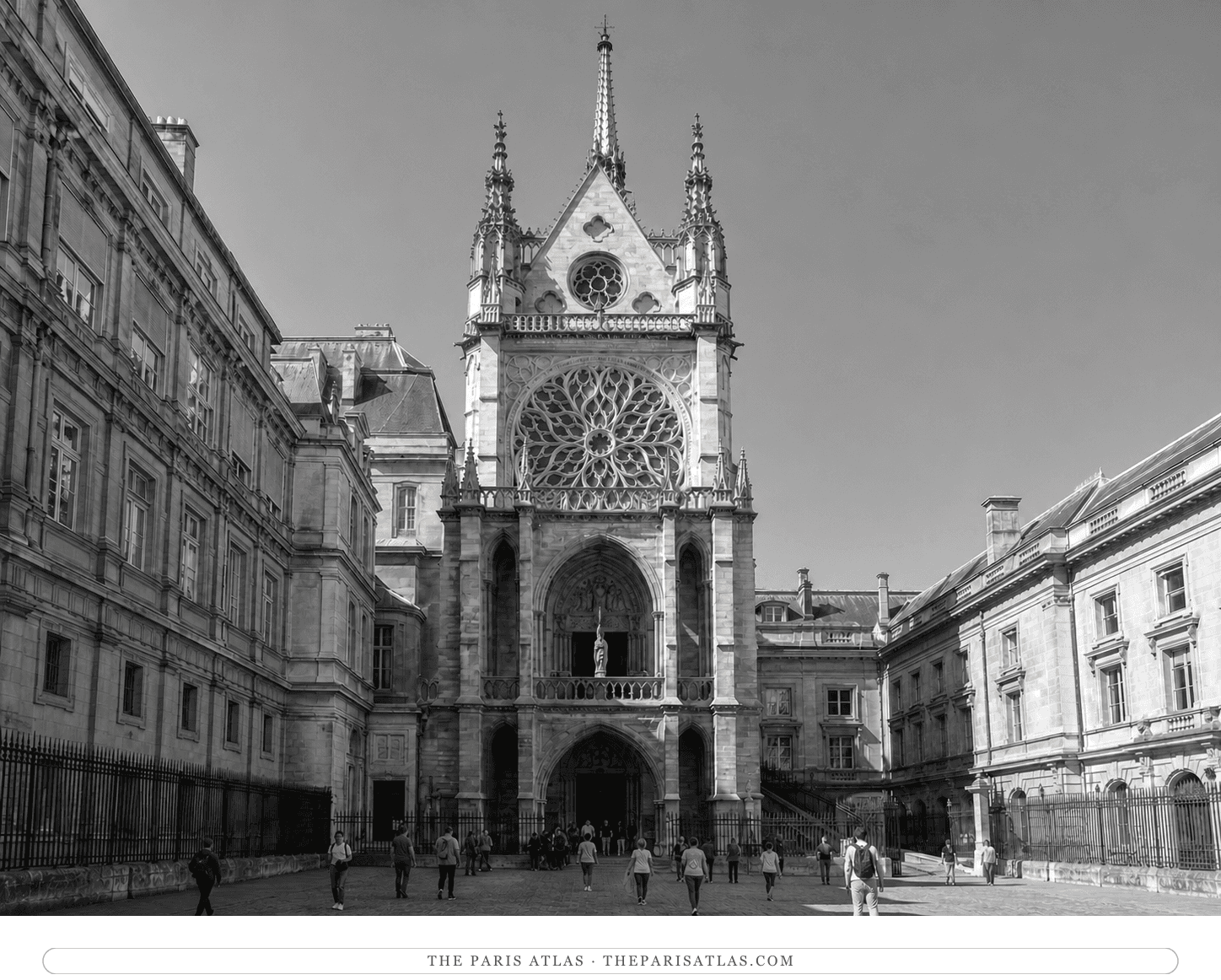
The chapel was built within the Palais de la Cité, the royal residence on the Île de la Cité. Its construction is often dated to 1241–1248, although the precise starting point is not securely established. It was completed and consecrated in 1248, with the principal work accomplished in less than seven years. Its architect is not securely known, despite a longstanding attribution to Pierre de Montreuil.[6][5]
The Sainte-Chapelle, in the medieval royal palace on the Île de la Cité in Paris, consists of a lower and an upper chapel. The lower level served the palace community, while the upper chapel provided the spectacular setting for the royal household and the relics. Slender supports, colored surfaces and extensive glazing create the impression that the upper room is enclosed by light. Its relative intimacy is important: this was a palace chapel conceived for a particular institution and purpose, not a vast cathedral reduced in size.[6]
The Sainte-Chapelle’s upper chapel has fifteen great windows that contain 1,113 scenes. The taller nave windows rise to about 15 meters, while those in the choir are lower; their different proportions follow the architecture of the room. Approximately two-thirds of the glazing is medieval. The surviving ensemble therefore combines a remarkable amount of thirteenth-century work with the consequences of damage, replacement and restoration.[6][40][41]
The palette of the Sainte-Chapelle’s stained-glass windows is more controlled than the abundance of images might suggest: red, blue, two greens, two purples, yellow and areas of translucent glass establish visual coherence across a complicated program. The effect depends on repetition and balance as much as on individual narrative details. Seen from the floor, the windows act together before every small scene can be distinguished.[40][41]
The biblical sequence in the Sainte-Chapelle’s stained-glass windows begins on the north side with Genesis and includes Adam and Eve, Noah, Abraham, Moses, the kings of Israel and Joshua. Judith, Job, Esther and David appear in the southern cycle. Around the sanctuary, prophetic material frames the central Passion window, whose narrative extends from Christ’s arrest to Pentecost. The western rose presents the Apocalypse. Rebuilt around 1485, during the reign of Charles VIII, king of France, it uses Flamboyant tracery, window stonework with flame-like curves, and a palette in which yellow and green are especially prominent. It retains the subject of its thirteenth-century predecessor while giving it a late medieval form.[40][41][71]
Royal imagery runs through the Sainte-Chapelle’s stained-glass program. Coronations, fleurs-de-lis, Castilian castles and the representation of Louis IX connect the chapel’s sacred history with the Capetian dynasty. The windows can be studied as ordered narratives, but that does not mean that every medieval observer stood below them and read each panel consecutively. The Centre des monuments nationaux itself emphasizes the importance of seeing the glass and experiencing its light, not merely decoding it.[40][41]
The Sainte-Chapelle’s later history was considerably less orderly than its appearance might suggest. It suffered fires in 1630 and 1776, damage during the French Revolution and the loss of its original sacred furnishings. Its subsequent uses included storage; the period 1803–1838 is associated with the storage of legal archives, following earlier use as a flour store. It was not continuously maintained as the medieval royal chapel familiar from its foundation story.[6]
A major restoration of the Sainte-Chapelle between 1840 and 1863 involved the architects Félix Duban, Jean-Baptiste Lassus and Émile Boeswillwald. The present spire, rising approximately 75 meters above the ground, belongs to the nineteenth-century history of the monument rather than surviving untouched from Louis IX’s reign. The chapel remains an outstanding medieval ensemble, but its preservation is inseparable from later decisions about what to repair, replace and reconstruct.[6]
Chartres Cathedral is exceptional for the survival of architecture, sculpture and glass in a coherent relationship. Its history nevertheless includes several buildings and campaigns. The work dated to 1145 belongs to an earlier phase of the cathedral, not the beginning of Christianity or church building on the site. After a major fire in 1194, reconstruction over approximately twenty-six years produced much of the cathedral’s present form.[29]
Chartres Cathedral’s mid-twelfth-century west front survived the fire of 1194 and was incorporated into the rebuilt cathedral. Its Royal Portal, with elongated statue-columns, the two towers, the southern spire and three great windows preserve an earlier phase of Gothic art within the thirteenth-century whole. A visitor can therefore compare stages of development without leaving the building. The figures at the entrance and those on the later transept portals do not belong to a single moment.[29]
The six portals and two porches at the north and south transepts, dating from around 1210, display a rich range of sculptural types. Their figures and reliefs show the changing balance between architectural discipline and the increasingly independent presence of the human body. The importance of Chartres lies not only in the quality of individual statues but also in the survival of large programs in their architectural setting.[29]
The glass is even more remarkable. Chartres preserves much of a coordinated glazing scheme made between approximately 1210 and 1250, alongside the three twelfth-century windows above the Royal Portal. Its great thirteenth-century roses present the Last Judgement in the west, the Glorification of the Virgin in the north and the Glorification of Christ in the south. These differences matter: the roses are not interchangeable decorative circles but parts of distinct iconographic programs.[29]
At Chartres Cathedral, studying the building as a whole helps explain how its different forms of decoration work together. Sculpture, glass and painted decoration do not merely occupy the same space. They direct attention, establish relationships between parts of sacred history and mark the movement from an exterior threshold into an interior shaped for worship. The cathedral’s historical importance rests partly on how much of that relationship can still be studied.[29]
The architectural solutions developed at Chartres became a point of reference for other major churches. Reims, Amiens and Beauvais elaborated aspects of its design, while its influence extended to Cologne, Westminster and León. This was not the wholesale copying of a single plan. Builders adapted a successful architectural language to different sites, patrons, ambitions and local traditions.[29]
Its glass workshops likewise participated in a wider network. UNESCO identifies connections reaching Bourges, Sens, Le Mans, Tours, Poitiers, Rouen and Canterbury. The spread of Gothic depended on people, objects, techniques and models moving between centers, not on a succession of isolated local inventions. Chartres was a powerful participant in that exchange.[29]
Even Chartres Cathedral, with its unusually well-preserved medieval architecture and decoration, has changed. Its medieval rood screen—the barrier separating parts of the church—was demolished in the seventeenth century. A roof fire in 1836 was followed by the installation of a metal roof structure in 1837, itself an important work of nineteenth-century engineering. Later additions and conservation campaigns form part of the building’s historical identity.[29]
The distinction between an exceptionally well-preserved ensemble and an untouched interior is essential. Chartres retains an extraordinary concentration of medieval work, but the experience of entering it today is not identical to entering it in 1250. Furnishings, surfaces, circulation, lighting conditions and the surrounding town have all changed. Its survival makes close historical study possible; it does not remove the need for it.[29]
The Très Riches Heures du duc de Berry was commissioned by Jean de France, also known as Jean de Valois, duke of Berry, who lived from 1340 to 1416. He was the brother of Charles V, king of France, and an exceptionally ambitious collector. The manuscript’s familiar title derives from the description used in the inventory made after his death, rather than from a title formally placed on the completed book by its original makers.[72][67]
Around 1411, Jean de France, duke of Berry, entrusted the decoration of the Très Riches Heures to Paul, Jean and Hermann de Limbourg, three brothers from Nijmegen who had previously worked for the Burgundian court. They had already made the Belles Heures for him. The later manuscript developed a still more ambitious relationship between devotion, the calendar, courtly life and the depiction of the surrounding world.[72][45][67]
In 1416, Paul, Jean and Hermann de Limbourg and Jean de France died. The Très Riches Heures remained unfinished and unbound, so the duke never saw the completed volume. He already had other books for private prayer: the Metropolitan Museum of Art counts fifteen books of hours in his collection at his death.[72][73]
The Très Riches Heures is particularly famous for its calendar images, in which courtly ceremony and seasonal labor unfold within carefully described settings. They helped shape the modern visual imagination of medieval life: a world of magnificent buildings, elaborate clothing, cultivated land, horses and recurring annual tasks. Yet the images are not an unfiltered survey of society. They were made within the culture of a princely patron and organize the world through the concerns and expectations of that setting.[67][74]
The calendar in the Très Riches Heures served the manuscript’s function as a book of hours. A book of hours arranged private prayer around recurring devotional observances; the representation of the year linked sacred time with seasonal and social rhythms. The enormous modern fame of the calendar can obscure the fact that these images form part of a much larger religious manuscript, not an independent album of medieval landscapes.[45][67]
In the early fifteenth century, the Limbourg brothers gave Jean de France, duke of Berry, a block of wood decorated to look like a luxuriously bound volume. Wendy A. Stein, a specialist in medieval art at the Metropolitan Museum of Art, places the gift within the Valois court’s New Year exchanges. Such presents could reward wit and workmanship as well as expensive materials.[73]
Work on the Très Riches Heures continued after the Limbourg brothers’ campaign ended with their deaths in 1416. A mid-fifteenth-century contribution is commonly associated with Barthélémy d’Eyck, a painter active in courtly circles whose precise role remains an attribution rather than a fully documented division of labor. Later, Jean Colombe, an illuminator based in Bourges, worked on the book for Charles I, duke of Savoy, who inherited it around 1480. Colombe’s campaign is associated with the 1480s, including work in 1485.[72][67][75]
The Très Riches Heures combines the Limbourg brothers’ early fifteenth-century work with later contributions commissioned for the same manuscript. The Musée Condé’s library has described it as a livre-cathédrale, a “cathedral of a book.” The comparison is apt because a long-lived manuscript, like a cathedral, can contain the contributions of different generations without ceasing to be a recognizable whole.[67]
On 20 January 1856, the collector Henri d’Orléans, duke of Aumale, bought the Très Riches Heures in Genoa from Baron Felice de Margherita, also called Félix in French accounts. It first went to the duke’s home in Twickenham, England, where he was living in exile. Chantilly’s museum dates its arrival in Twickenham to around 18 February 1856. The manuscript later joined his collection at Chantilly and is now held by the Musée Condé.[72][67][75][76]
The Très Riches Heures’ familiarity through reproductions should not be confused with unrestricted access to the physical volume. Medieval manuscripts are vulnerable to light, handling and environmental change. The Musée Condé’s digital presentation makes it possible to examine pages that cannot all be displayed simultaneously, while the original must be managed as a fragile object rather than as a permanently open picture gallery.[74][67]
The six tapestries known as The Lady and the Unicorn, made around 1500 and now at the Musée de Cluny in Paris, show how misleading it can be to imagine medieval art as exclusively ecclesiastical or austere. Each presents a richly dressed woman, accompanied by a lion and a unicorn, within a densely ornamented setting. The ensemble was woven in wool and silk; its design is associated with Paris and its manufacture with workshops in the southern Netherlands. The heraldry connects it with the Le Viste family.[77][78]
Five of the six Lady and the Unicorn tapestries are conventionally understood through the senses: touch, taste, smell, hearing and sight. The sixth bears the inscription “À mon seul désir” and is less securely explained. It has been interpreted in relation to desire, the heart, free choice or the ordering of the senses, but no single reading should be presented as if a surviving explanatory document settled the question. Its ambiguity is part of the work’s continuing interest.[77]
The Lady and the Unicorn series, made around 1500, consists of genuine tapestries, in which the image is created through weaving, unlike the embroidered Bayeux narrative. Their scale and material richness belong to the furnishing and display of an elite interior. They also complicate any attempt to place a clean boundary at the year 1500: late medieval courtly imagery, sophisticated workshop production and the artistic changes associated with the Renaissance existed alongside one another.[78][58][1]
The Wilton Diptych, painted around 1395–1399 in egg tempera on oak and now in the National Gallery in London, is one of the relatively few English medieval panel paintings to survive. It was made for Richard II, king of England, and combines private devotion with a carefully constructed image of royal identity. The king kneels before the Virgin and Child, accompanied by saints, within a world dominated by gold and brilliant color.[60]
The painter of the Wilton Diptych remains unknown. The National Gallery’s designation “English or French (?)” makes the uncertainty explicit rather than concealing it behind a confident national attribution. The work’s documented provenance does not begin in Richard II’s court: its first secure record is in the collection of Charles I, king of England, in 1639. A convincing interpretation of the original patronage and a complete chain of ownership are different kinds of evidence, and one does not automatically provide the other.[60]
The Soissons Diptych is traditionally associated with the abbey of Saint-Jean-des-Vignes at Soissons, but the V&A notes the absence of firm documentary proof for that origin. The traditional name nevertheless became the label for the object and, through it, for a group of related Gothic ivories. A museum name can preserve an old attribution even when the institution has qualified the historical claim on which it originally depended.[8]
Uncertainty about the Soissons Diptych’s original location does not make the carving itself impossible to study. Its material, workmanship, imagery and relationships with other objects can be investigated independently. It does mean that an attractive history of where an object came from should not be repeated with greater certainty than the surviving evidence allows.[8][42]
An object long known as the Eltenberg Reliquary, now cataloged by the V&A as a tabernacle, combines work made in Cologne around 1180 with substantial additions made in France between 1853 and 1855. Two of its four supporting griffins are nineteenth-century replacements. Its current appearance therefore cannot be treated as a completely intact medieval design.[79]
Evidence for the Eltenberg tabernacle’s restoration extends beyond stylistic comparison. A parchment dated 1855, found within the tabernacle, records intervention by Jean-Baptiste Carrand and his son Louis Carrand, collectors and dealers involved in its restoration. Their work altered what later viewers could easily assume to be original. Modern study has also revised its likely function: it may have housed a vessel containing the consecrated host rather than saints’ relics. A connection with Saint Pantaleon in Cologne is considered more plausible than the traditional Eltenberg provenance, although the history is not fully settled.[79]
Research on the Eltenberg tabernacle shows why conservation can change an object’s name, date and interpretation at once. Once described as a medieval reliquary, it combines medieval parts with nineteenth-century additions and may have held the consecrated host rather than relics. Its proposed origin has also shifted from Eltenberg to Cologne. These are improvements in knowledge, not reasons to disregard the work.[79]
Medieval art survives unevenly. Metal objects could be melted down, textiles and manuscripts damaged by light or moisture, and church sculpture broken for political or religious reasons. The great shrine of Thomas Becket disappeared while smaller caskets associated with his cult survived in scattered collections. At Saint-Denis and the Sainte-Chapelle, restoration has preserved essential parts of the monuments while also adding new material to their visible history.[51][66][6]
The heads of the kings of Judah from Notre-Dame de Paris, now at the Musée de Cluny, offer a particularly striking example. Sculptures from the cathedral’s façade were destroyed during the Revolution, but a group of twenty-one medieval heads was rediscovered in 1977. Their recovery returned substantial works of medieval sculpture to public view long after they had been assumed lost. The museum object and the sculpture visible on a restored façade can therefore belong to different moments in the history of the same monument.[80]
The transition to the Renaissance was neither a uniform date nor a simple replacement of symbolic art by realistic art. In different regions, painters, sculptors and builders changed their practices at different rates. The renewed study of antiquity and increasingly systematic ways of representing space were important developments, but they drew upon traditions of observation, workshop expertise and engagement with classical models that had not been absent during the Middle Ages.[1][13][9][38]
The persistence of Gothic architecture into the sixteenth century, the production of the Lady and the Unicorn around 1500 and the continuing use of illuminated books all show how medieval artistic traditions continued alongside the Renaissance. A late medieval object did not become artistically obsolete because a different style had emerged elsewhere. Patrons could continue to value established forms for their beauty, associations and suitability to a particular use.[11][77][10]
Medieval art’s later history is equally important. The Renaissance gave it some of its dismissive labels; nineteenth-century antiquarians and restorers created much of the vocabulary and many of the reconstructed settings through which it is now encountered. Modern museums, laboratories and digital libraries continue to change what can be seen and understood. The field is not simply a collection of surviving masterpieces. It is also the history of how objects were used, dispersed, misidentified, repaired and recovered.[11][30][32][79][74]
The following selection brings together monumental buildings and objects discussed in this article. Dates describe the relevant work or principal campaign, not necessarily every component of an altered building or composite object. Dimensions are given where they help explain an object’s scale and have been identified in its collection record.
| Work or ensemble | Date and maker | Material or distinguishing feature | Holding institution or location |
|---|---|---|---|
| Book of Kells | Around 800; several unidentified makers | Decorated Gospel manuscript; a major example of Insular art | Trinity College Dublin.[3] |
| Bayeux Tapestry | Later eleventh century; embroiderers unnamed, probably commissioned by Bishop Odo | Wool embroidery on linen narrating the Norman conquest | Bayeux, Normandy; on loan to the British Museum from 10 September 2026 to 11 July 2027.[58][59] |
| Gloucester Candlestick | 1107–1113; maker unknown, associated by inscription with Abbot Peter | Elaborate metalwork with intertwined figures and creatures | Victoria and Albert Museum, London.[52] |
| Saint-Denis chevet | 1140–1144; commissioned by Abbot Suger | Open radiating chapels, rib vaults and stained glass | Basilica Cathedral of Saint-Denis, north of Paris.[4][39] |
| Becket Casket | Around 1180–1190; Limoges workshop | Champlevé enamel, copper alloy, crystal, glass and a wooden core | Victoria and Albert Museum, London.[48] |
| Pórtico de la Gloria | Lintels dated 1 April 1188; Master Mateo and workshop | Monumental carved and originally colored portal ensemble | Cathedral of Santiago de Compostela, Spain.[26] |
| Arm Reliquary of the Apostles | Around 1190; Hildesheim | Gilt silver, champlevé enamel and oak; contains a bone relic | Cleveland Museum of Art.[33] |
| Chartres Cathedral and its glazing | Major rebuilding from 1194; much glass around 1210–1250 | A substantially surviving ensemble of Gothic architecture, sculpture and glass | Chartres, France.[29] |
| Plaque from a Becket chasse | 1220–1225; Master G. Alpais and workshop | Champlevé enamel on gilded copper | Cleveland Museum of Art, accession 1951.449.[49] |
| Crucifix with Scenes of the Passion | Around 1230–1240; signed, possibly by a painter named Michael | Painted crucifix with a damaged signature | Cleveland Museum of Art.[37] |
| Virgin and Child with Saints | Around the 1230s; Berlinghiero | Folding triptych, tempera and gold on poplar panel | Cleveland Museum of Art.[63] |
| Sainte-Chapelle | Completed in 1248; commissioned by Louis IX, architect uncertain | Royal palace chapel with fifteen great stained-glass windows | Île de la Cité, Paris.[6][40][41] |
| Soissons Diptych | Around 1270 in the traditional dating; Parisian workshop | Painted and gilt elephant ivory | Victoria and Albert Museum, London.[8] |
| Cervera Bible | 1299–1300; Samuel ben Abraham ibn Nathan, Joseph Hazarfati and Joshua bar Abraham ibn Gaon | Hebrew manuscript with illumination and micrography | National Library of Portugal, Lisbon.[15] |
| Syon Cope | Around 1310–1320; English embroiderers | Silk and metal-thread embroidery | Victoria and Albert Museum, London.[57] |
| Table Fountain | Around 1320–1340; Parisian maker unknown | Gilt silver, translucent enamel and water-driven mechanisms | Cleveland Museum of Art.[65] |
| Hours of Jeanne d’Évreux | Around 1324–1328; Jean Pucelle | Grisaille, tempera and ink on vellum; 9.2 × 6.2 cm | The Met Cloisters, New York.[7] |
| Basin called the Baptistère de Saint Louis | 1325–1340; Muhammad ibn al-Zayn | Mamluk inlaid metalwork, made in Egypt or Syria | Musée du Louvre, Paris; display availability varies.[16] |
| Wilton Diptych | Around 1395–1399; unidentified English or French painter | Egg tempera on oak; private royal devotional image | National Gallery, London.[60] |
| Hours of Charles the Noble | Around 1404; Master of the Brussels Initials and associates | Illuminated book of hours made in Paris | Cleveland Museum of Art.[34] |
| Belles Heures of Jean de France, duc de Berry | Around 1405–1408/1409; Paul, Jean and Hermann de Limbourg | Tempera, gold and ink on vellum; 23.8 × 17 cm | The Met Cloisters, New York.[45] |
| Très Riches Heures du duc de Berry | Begun around 1411; Limbourg brothers, with later artists | Book of hours and celebrated calendar; completed through later campaigns | Musée Condé, Chantilly.[72][67] |
| Washington Haggadah | Dated 29 January 1478; Joel ben Simeon | Illustrated Hebrew manuscript for the Passover seder | Library of Congress, Washington, DC.[61] |
| The Lady and the Unicorn | Around 1500; designers and weavers not securely identified | Six wool-and-silk tapestries associated with the senses and desire | Musée de Cluny, Paris.[77][78] |
The Musée de Cluny — musée national du Moyen Âge, in the Latin Quarter, offers the broadest introduction to medieval objects within Paris. The Lady and the Unicorn tapestries, sculpture from Notre-Dame, stained glass, ivories, metalwork and other collections make it possible to compare media that are often discussed separately. It is particularly valuable for understanding that medieval art was not only cathedral architecture or painting.[81][77][80]
On the Île de la Cité, the Sainte-Chapelle preserves an exceptional relationship between a royal chapel and its stained glass. Notre-Dame de Paris, which reopened in December 2024 after the fire and restoration, offers a different kind of experience: a major cathedral with a long sequence of medieval and later interventions. The two buildings should be compared for their distinct functions as well as their architectural forms.[6][40][41][82]
The Musée du Louvre holds medieval sculpture, decorative arts and objects whose histories intersect with the Islamic and Byzantine worlds, alongside the remains of the medieval fortress beneath the later palace. A visit can connect the city’s physical history with the movement of objects into royal and national collections. Individual works and galleries are not always accessible; the collection entry for the Baptistère de Saint Louis, for example, should be checked rather than assuming that ownership means continuous display.[83][16]
Saint-Denis, immediately north of Paris, combines the early history of Gothic with a major collection of royal tombs. Chartres, farther southwest, is essential for its surviving relationship between cathedral architecture, sculpture and glass. Chantilly, north of Paris, holds the Très Riches Heures within the Musée Condé’s library, although access to the original manuscript is limited by conservation requirements. Each offers a different setting for medieval art: a royal burial church, a pilgrimage cathedral and a later collector’s library.[66][29][74]
Collection ownership is more stable than display arrangements. Opening conditions, conservation work, temporary loans and access to particular rooms should be checked with the relevant institution before a visit focused on one object.
Textile · Medieval Art in Normandy
A strip of linen about 68 metres long, embroidered in coloured wool, that tells the story of how William, Duke of Normandy, took the English throne in 1066.
330
Constantinople becomes an imperial capital. Constantine I dedicates the city as a new center of the Roman Empire. The date conventionally opens Byzantine history, rather than marking the instant invention of a separate empire or artistic style.[9]
About 370–800
Migration-period art develops across changing political territories. Gold, garnet, enamel and complex geometric or animal ornament feature prominently in portable objects.[12]
From the seventh century
Insular manuscript traditions flourish. Irish and British communities produce decorated books with elaborate initials, interlace, animals and brilliant color.[21]
768–814
The reign of Charlemagne. The Frankish king, crowned emperor in 800, supports an artistic revival associated with the Christian imperial past.[13]
Around 800
The Book of Kells is made. Its precise place of production remains disputed.[3][25]
843
Image veneration is restored in Byzantium. The event marks the conclusion of the principal period of Byzantine Iconoclasm, the movement against sacred images.[22]
From 919
The Ottonian era begins. Imperial and ecclesiastical patronage sustains major work in architecture, manuscripts, ivory and metal.[17]
Later eleventh century
The Bayeux Tapestry is embroidered. It narrates the events surrounding the conquest of England in 1066; the exact date and original commission remain debated.[58]
1107–1113
The Gloucester Candlestick is made. Its inscription connects it with Abbot Peter and provides the basis for its conventional dating.[52]
1122
Suger becomes abbot of Saint-Denis. He subsequently organizes major rebuilding at the abbey church.[4]
14 July 1140
The foundation stone of the new chevet at Saint-Denis, the church’s eastern end, is laid. Suger records gifts of precious stones and a ceremony shaped by biblical language.[39]
11 June 1144
The chevet at Saint-Denis, the church’s eastern end containing the choir and chapels, is consecrated. Louis VII, Eleanor of Aquitaine and twenty-four bishops and archbishops attend.[4]
1145
A building campaign at Chartres is underway. The surviving west front belongs to the cathedral’s mid-twelfth-century history, before the major rebuilding after 1194.[29]
29 December 1170
Thomas Becket is murdered. His canonization in 1173 is followed by widespread devotion and the production of enamel reliquaries associated with his cult.[47][48]
1 April 1188
The lintels of the Pórtico de la Gloria are laid. The dated inscription identifies a stage of Master Mateo’s work at Santiago de Compostela, not the completion of the entire cathedral.[26]
1194
Fire devastates Chartres Cathedral. Major rebuilding over approximately twenty-six years produces the principal thirteenth-century structure.[29]
1239
Louis IX acquires the Crown of Thorns. Further relics follow in 1241; their purchase leads to the construction of Sainte-Chapelle.[5][6]
Traditionally 1241–1248
Sainte-Chapelle is built. Its precise starting date is uncertain, but the chapel is completed and consecrated in 1248.[6]
1299–1300
The Cervera Bible is produced. Its named collaborators record their contributions to the text, illumination and micrography, images and patterns formed from tiny written letters.[15]
Around 1324–1328
Jean Pucelle paints the Hours of Jeanne d’Évreux in Paris. Its pages measure only 9.2 × 6.2 centimeters.[7]
From around 1370
Flamboyant Gothic develops in France. Its later name refers to flame-like patterns in window tracery.[32]
Around 1411–1416
The Limbourg brothers work on the Très Riches Heures. Their deaths and that of the duke of Berry in 1416 leave the manuscript unfinished; other painters continue it later in the century.[72][67]
29 January 1478
Joel ben Simeon dates the Washington Haggadah. The signed book is an important example of named medieval Jewish artistic production.[61]
Around 1500
The Lady and the Unicorn tapestries are made. The ensemble embodies a late medieval courtly culture that overlaps chronologically with the Renaissance.[77][78]
1538
Becket’s shrine at Canterbury is destroyed. Royal agents act under Henry VIII against a cult whose great shrine had been established in 1220.[50][51]
Late fifteenth to seventeenth centuries
“Gothic” develops as a derogatory label. Italian Renaissance and later writers associate the non-classical architecture with the supposed barbarism of the Goths; the term subsequently becomes a standard classification.[11]
Medieval art is the art made during the Middle Ages, conventionally around 500–1500, although its beginnings and endings vary by region. It includes architecture, sculpture, mosaics, illuminated manuscripts, stained glass, paintings, metalwork, ivory carving and textiles. It is a historical category rather than one unified style: a Byzantine icon, a Romanesque portal and a Gothic prayer book can all be medieval while looking very different.[1][2][9]
The principal categories are Early Christian, Byzantine, Migration-period, Insular or Hiberno-Saxon, Carolingian, Ottonian, Romanesque and Gothic. Their dates overlap because some describe regions or political cultures rather than a strict chronological sequence. Gothic is further divided into phases such as Early and High Gothic, with Rayonnant and Flamboyant used especially for French architecture. International Gothic describes a related courtly style across several media, not simply the last architectural phase.[20][9][12][21][13][17][14][11][10]
No single feature appears in all medieval art. Common characteristics include religious subject matter, symbolic imagery, intricate ornament, costly materials and a close relationship between an object and its intended use. Some works emphasize stylized figures and gold backgrounds; others explore lifelike bodies, expressive faces and convincing space. The most useful approach is to ask when and where a work was made, who commissioned it and what it was meant to do, rather than assuming that every medieval image was flat, anonymous or exclusively religious.[9][11][38][33][15]
The name originated as a criticism. Renaissance Italian writers associated architecture they considered non-classical or barbarous with the Goths, the peoples linked in their minds with the destruction of ancient Rome. The attribution was historically mistaken: Gothic architecture developed in twelfth-century northern France, many centuries after the Gothic invasions. The insulting name remained in use and eventually became a neutral term for a major artistic tradition.[11]
Many are unnamed today because their work was unsigned, made collaboratively or separated from documents that once identified them. Some signatures have become illegible. Others survive, and there are important named painters, sculptors, scribes, illuminators and metalworkers. Labels such as “Boucicaut Master” are conventional names used to group related works; they are not the artist’s recovered legal identity. Anonymity is therefore often a problem of surviving evidence, not proof that medieval makers were uninterested in recognition.[37][62][26][61][16]
Gothic developed in northern France, particularly the Île-de-France, during the twelfth century. The abbey church of Saint-Denis is a central landmark: under Abbot Suger, its new eastern end was built from 1140 and consecrated in 1144. It brought together rib vaults, more open chapels, slender supports and extensive stained glass in an influential arrangement. The style emerged through several related experiments, however; Suger and his builders did not invent every Gothic feature at once.[27][4]
An illuminated manuscript is a handwritten book decorated with painted images, initials, borders or ornament. Some contain gold and silver, but metal leaf is not essential to every example. Their production required skilled preparation, writing and painting, often involving several specialists. Jean Pucelle’s Hours of Jeanne d’Évreux, made in Paris around 1324–1328, shows how elaborate the result could be on a tiny scale: its pages measure 9.2 × 6.2 centimeters, and its gray-toned paintings achieve their effects without gold.[44][34][7]
Start with the Musée de Cluny for medieval objects and the Lady and the Unicorn tapestries. The Sainte-Chapelle offers stained glass, and Notre-Dame de Paris has cathedral architecture and sculpture. The Louvre holds medieval collections and the remains of its earlier fortress. Just outside Paris, Saint-Denis combines early Gothic architecture with royal tombs. Chartres and Chantilly are separate excursions farther from the city. Check the relevant institution before traveling for a particular manuscript or object, since collection ownership does not guarantee that it is currently on display.[81][77][40][41][82][83][66][29][74]
The sources below include histories, manifestos, scholarly research, and primary materials that informed this page. They document Medieval Art, its development, and the artists and works associated with it.


Early Medieval, record 300020760
Late Medieval, record 300111307
The Anglo-Saxon ship burial at Sutton Hoo
Pierre de Montreuil
Saints in Medieval Christian Art
La restauration du décor polychrome du choeur de la cathédrale de Chartres
How was it made? Champlevé enamelling
The Gloucester Candlestick
A Technical Note on Niello
Copistes et enlumineurs au 14e siècle
Basilique cathédrale de Saint-Denis — official site
La Sainte-Chapelle du Palais de la Cité à Paris
La Rose de l’Apocalypse
The Très Riches Heures of Jean, Duke of Berry

The Getty's period definition and date range for medieval European art, including its refusal to fix a single end date.
Getty scope note on Early Christian art and its move away from classical physical ideals.
Getty scope note on Byzantine culture and style, 330 to 1453.
Getty scope note on the Migration period and its portable metalwork.
Getty scope note on the Hiberno-Saxon style of the Irish monastic communities.
Getty scope note on Carolingian art as a deliberate revival of imperial Rome.
Getty scope note on Ottonian art, 919 through most of the eleventh century.
Getty scope note on Romanesque architecture and the flat, stylised forms of its other arts.
Getty scope note dating the Gothic style's beginning to mid-twelfth-century northern France.
Getty scope note on Early Gothic in the Île-de-France.
Getty scope note recording High Gothic's return to classical naturalism.
Getty scope note on Rayonnant, developed in Paris by Pierre de Montreuil and named by Arcisse de Caumont.
Getty scope note on Flamboyant tracery and its nineteenth-century naming.
Getty scope note on International Gothic, including the scholarly objection to the term.
The V&A's Syon Cope record, including the metal thread technique and the anonymous kneeling donor.
The Met's catalogue data for Jean Pucelle's Hours of Jeanne d'Évreux, including the page dimensions.
The Met's catalogue data for the Limbourg brothers' Belles Heures, 1405 to 1409.
Getty scope note for the Early Medieval bracket, the Migration period to the Romanesque.
Getty scope note for the Late Medieval bracket, about 1250 to as late as 1500.
These references provide the documented foundation for this movement's history and interpretation. Claim-level citations remain attached to the specific claims they support.
 Explore more resources