The Paris AtlasCharting the artists, works, and places worth returning to.
  • Painter
  • Sculptor
  • Printmaker
  • Designer
· French · 1880–1954

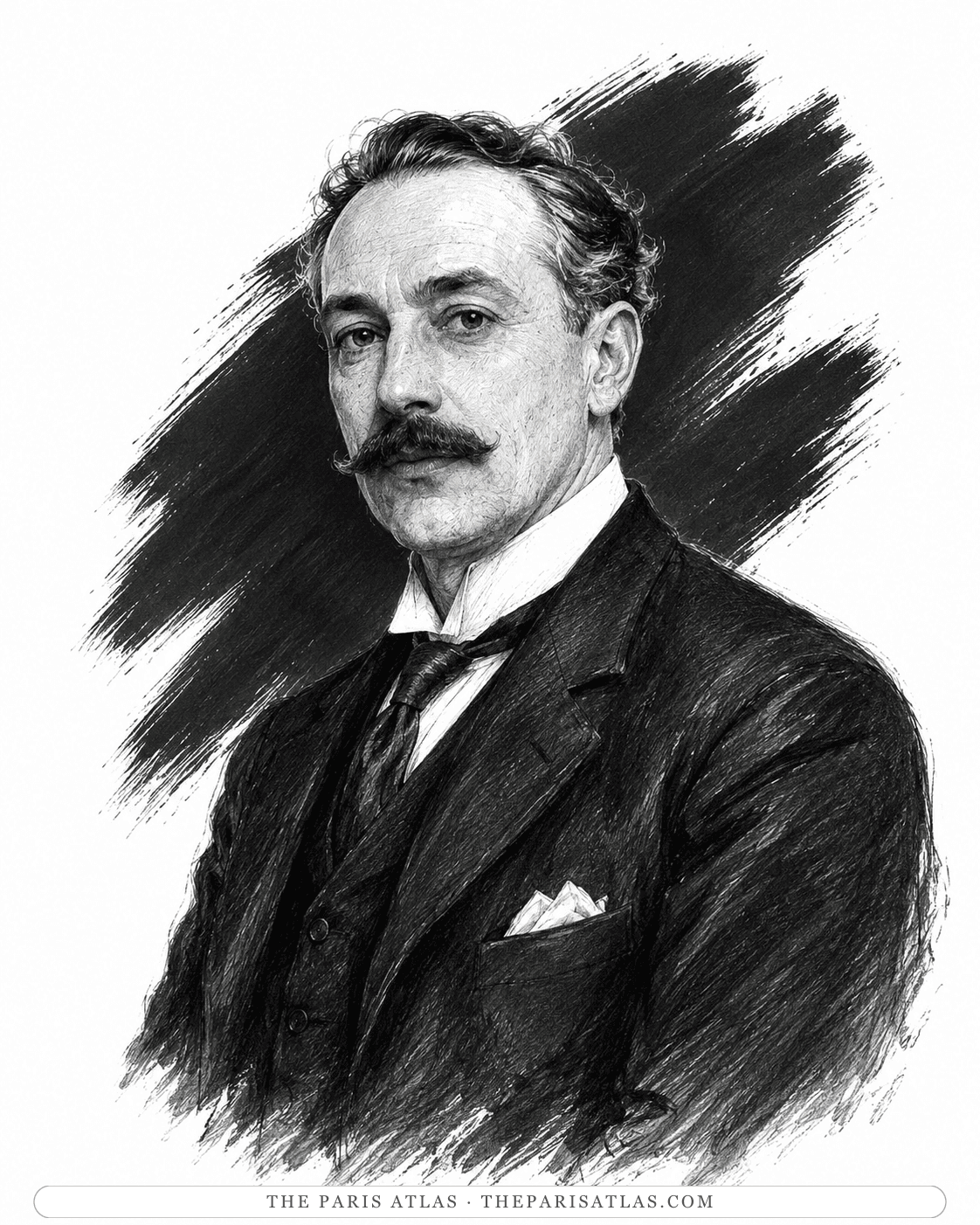
André Derain

French painter who helped invent Fauvism with Henri Matisse at Collioure, translated London into explosive colour, and then turned toward an increasingly classical art.

Details

Lived
1880–1954
Born
1880
Birthplace
Chatou, France
Died
1954
Place of death
Garches, France
Nationality
French
Profession
Painter, sculptor, printmaker, and stage designer
Major works
Charing Cross Bridge (1906), The Pool of London (1906), The Dance (1906), Portrait of Paul Guillaume (1919)
Roles
PainterSculptorPrintmakerDesigner

About André Derain

André Derain was a French painter, sculptor, printmaker, collector, and stage designer who helped create Fauvism, the first avant-garde movement of the twentieth century. Working beside Henri Matisse at Collioure in the summer of 1905, he treated colour as an independent force rather than a tool for describing nature. The paintings they brought back to Paris helped earn their circle the name les Fauves — the wild beasts.[1]

Derain refused to remain the painter that his most famous summer had made him. His London views of 1906 transformed the Thames with scarlet water, green skies, and hard contrasts of complementary colour; within a few years, however, he had moved through the orbit of Cubism and toward older European painting. That turn made him internationally admired in the 1920s and difficult to place later: neither a lifelong Fauve nor a Cubist, but an artist who repeatedly tested modern painting against the art of the past.[2]

His career also ran beyond the canvas. He carved sculpture, made woodcuts for Guillaume Apollinaire, designed for Serge Diaghilev's Ballets Russes, built an encyclopedic art collection, and worked in theatre until the early 1950s. His participation in a French artists' trip to Nazi Germany in 1941 permanently complicated his reputation. Derain died in 1954, leaving a career whose radical first decade still shapes the history of modern colour.[3]

Chatou: painting beside the Seine

Derain was born in 1880 at Chatou, a town on the Seine west of Paris. His family expected a practical career, and he studied engineering while taking painting classes at the Académie Camillo in Paris under the Symbolist painter Eugène Carrière. There he met Henri Matisse. Around the same time he formed a close friendship with the self-taught Maurice de Vlaminck, with whom he shared a studio on the Île de Chatou.[1]

Derain and Vlaminck painted the river, bridges, boats, and industrial edges of the town in increasingly direct colour. Their work became known as the School of Chatou. Military service interrupted the partnership from 1901 to 1904, but after Derain returned, Matisse helped persuade his family to accept painting as his profession and introduced him to Paris dealers.[4]

Collioure, summer 1905

In July 1905 Matisse invited Derain to Collioure, a fishing town on the Mediterranean near the Spanish border. For roughly nine weeks they painted the harbour, beaches, hills, and one another, exchanging ideas each day. Derain returned to Paris with about thirty canvases. In them, red, blue, yellow, and green no longer record the local colour of things: they organize the picture and carry its heat and light.[5]

Their paintings appeared that October at the Salon d'Automne. The critic Louis Vauxcelles described a conventional sculpture standing among the violently coloured canvases as a Donatello among wild beasts — les fauves. The insult supplied a name. Derain, Matisse, and Vlaminck became the central figures of a movement that lasted only a few years but permanently released colour from the obligation to imitate nature.[6]

London in unnatural colour

In March 1906 the dealer Ambroise Vollard sent Derain to London to make a modern answer to Claude Monet's celebrated Thames series. Derain worked along the river and returned on later visits, painting bridges, wharves, streets, and the Houses of Parliament. Vollard ultimately bought the complete group of thirty paintings; twenty-nine are known today.[2]

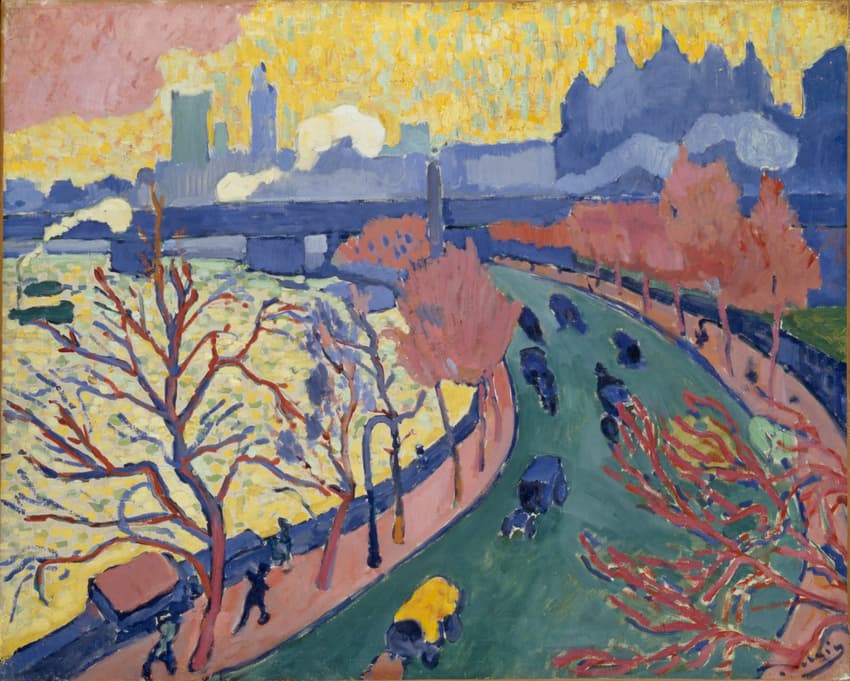
Where Monet had dissolved London in mist, Derain rebuilt it in brilliant oppositions: orange against blue, red against green, the river turned into a field of active marks. Charing Cross Bridge shows how little his colour depends on the city's actual weather. He also studied objects from Africa and Oceania at the British Museum, part of a wider engagement with non-European art that entered both his work and his collection.[2]

At the edge of Cubism

After 1907 Derain's colour darkened and his forms grew more solid. Paul Cézanne's example mattered, as did his contact with Pablo Picasso and Georges Braque. He participated in the experiments surrounding early Cubism, but never accepted its analytic system completely. His landscapes of 1908–10 are austere and architectural, close to Cubism without becoming interchangeable with it.[4]

Daniel-Henry Kahnweiler began buying Derain's work and in 1909 commissioned woodcuts for Guillaume Apollinaire's L'Enchanteur pourrissant. By 1911 Derain was already moving elsewhere. He studied Romanesque sculpture, old-master painting, and the work of Corot and Courbet, looking for a durable pictorial tradition rather than continued membership in an avant-garde group.[4]

War and a return to tradition

Derain served at the front during the First World War and largely stopped painting. His reputation nevertheless grew in Paris: the young dealer Paul Guillaume gave him an exhibition in 1916. After demobilization, Derain's figures, landscapes, and still lifes adopted weightier modelling, muted colour, and deliberate references to European museum art.[3]

The change was once described as a retreat from modernism. It can also be understood as Derain's central question: whether an artist who had helped break painting apart could rebuild it without simply returning to academic convention. In the 1920s collectors and critics often considered him the leading representative of a renewed French tradition. He received the Carnegie Prize in 1928, bringing substantial international prestige.

The stage and Paul Guillaume

In 1919 Serge Diaghilev asked Derain to design the sets and costumes for the Ballets Russes production La Boutique fantasque. It began a parallel career in theatre that continued until 1953. Derain approached the stage as a complete visual environment, carrying his study of historical painting into scenery and costume rather than treating design as secondary work.[3]

Derain remained under contract to the dealer Paul Guillaume from 1923 until Guillaume's death in 1934. Portrait of Paul Guillaume records the partnership. The Musée de l'Orangerie now holds thirty-one paintings by Derain in the Walter-Guillaume collection, the largest group by any artist in that ensemble.[3]

The collector

Derain collected as broadly as he worked. By his death he owned more than four hundred paintings by contemporaries, alongside old masters, works on paper, ceramics, bronzes, and objects from Africa and Oceania. The collection makes visible the historical field inside his later painting: modern Paris, Dutch genre scenes, nineteenth-century France, and art from cultures that European museums of his generation had grouped under colonial categories.[1]

In 1935 he bought a country house at Chambourcy, west of Paris, and increasingly withdrew from the city's artistic scene. He continued to paint and exhibit, but his position had changed. The artist once identified with the newest possible colour now worked among the objects and images of a private museum assembled over decades.[1]

The 1941 trip

In November 1941, during the German occupation of France, Derain joined a group of French artists on a state-managed visit to Nazi Germany. German cultural authorities used the trip for propaganda. Whatever the participants' individual motives, appearing in the official photographs carried a public meaning, and the decision left a lasting stain on Derain's reputation.[3]

The controversy matters because it cannot be separated from the later reception of his art. Derain continued working after the war, especially for the theatre, but never regained the uncontested standing he had held in the 1920s. A full biography has to hold both histories at once: the painter whose 1905 colour helped open modernism, and the established cultural figure who accepted that compromised journey in 1941.

Death and afterlife

Derain died at Garches in 1954 after a road accident. The following year his enormous collection was exhibited at the Galerie Charpentier and dispersed in major sales at the Hôtel Drouot. The sale broke apart the private history he had assembled around himself, but museum collections preserve every phase of his own work.[1]

His place in modern art rests most securely on the decade before the First World War: Chatou, Collioure, London, the early woodcuts and sculpture, and the tense landscapes made alongside the rise of Cubism. Those works show an artist moving unusually quickly between visual languages. Derain's importance lies not in having maintained one signature style, but in how decisively his early experiments changed what colour could do.[7]

Life events

  1. 1880

    Born at Chatou, on the Seine west of Paris.

    — André Derain — Modern Art Index Project

  2. 1898–1901

    Studies painting under Eugène Carrière at the Académie Camillo while preparing for an engineering career; meets Henri Matisse.

    — André Derain — Modern Art Index Project

  3. 1900

    Forms a close friendship with Maurice de Vlaminck and begins sharing a studio with him at Chatou.

    — André Derain — Modern Art Index Project; Sabine Rewald, Fauvism

  4. 1901–1904

    Completes military service, interrupting his work at Chatou.

  5. 1905

    Spends roughly nine weeks painting with Matisse at Collioure; their intensely coloured work helps give Fauvism its form and its name at the Salon d'Automne.

    — Vertigo of Color: Matisse, Derain, and the Origins of Fauvism — Visiting Guide; André Derain, Fishing Boats, Collioure

  6. 1906–1907

    Works in London on Vollard's commission, eventually producing thirty views of the Thames, bridges, streets, and parks.

    — André Derain: The London Paintings

  7. 1907–1910

    Moves away from Fauvist colour toward Cézanne, early Cubism, sculpture, and increasingly austere landscapes.

    — André Derain 1904–1914: The Radical Decade; Sabine Rewald, Fauvism

  8. 1909

    Makes woodcuts for Guillaume Apollinaire's L'Enchanteur pourrissant at Daniel-Henry Kahnweiler's commission.

    — André Derain

  9. 1914–1918

    Serves at the front during the First World War and largely stops painting.

    — André Derain

  10. 1916

    Paul Guillaume exhibits Derain's work at his Avenue de Villiers gallery in Paris.

    — André Derain

  11. 1919

    Designs La Boutique fantasque for Serge Diaghilev's Ballets Russes, beginning a stage-design career that lasts until 1953.

    — André Derain

  12. 1923–1934

    Works under contract to Paul Guillaume until the dealer's death.

    — André Derain

  13. 1928

    Receives the Carnegie Prize at the height of his international reputation as a representative of modern French tradition.

    — André Derain

  14. 1935

    Buys a country home at Chambourcy and increasingly distances himself from the Paris art scene.

    — André Derain — Modern Art Index Project

  15. 1941

    Takes part in a controversial French artists' visit to Nazi Germany, permanently damaging his reputation.

    — André Derain

  16. 1954

    Dies at Garches following a road accident.

    — André Derain — Modern Art Index Project

  17. 1955

    His collection is exhibited at the Galerie Charpentier and dispersed in two major sales at the Hôtel Drouot.

    — André Derain — Modern Art Index Project

Selected works

Cataloged from the holding institutions' records. Reproductions appear only where the rights are verified.

Paintings

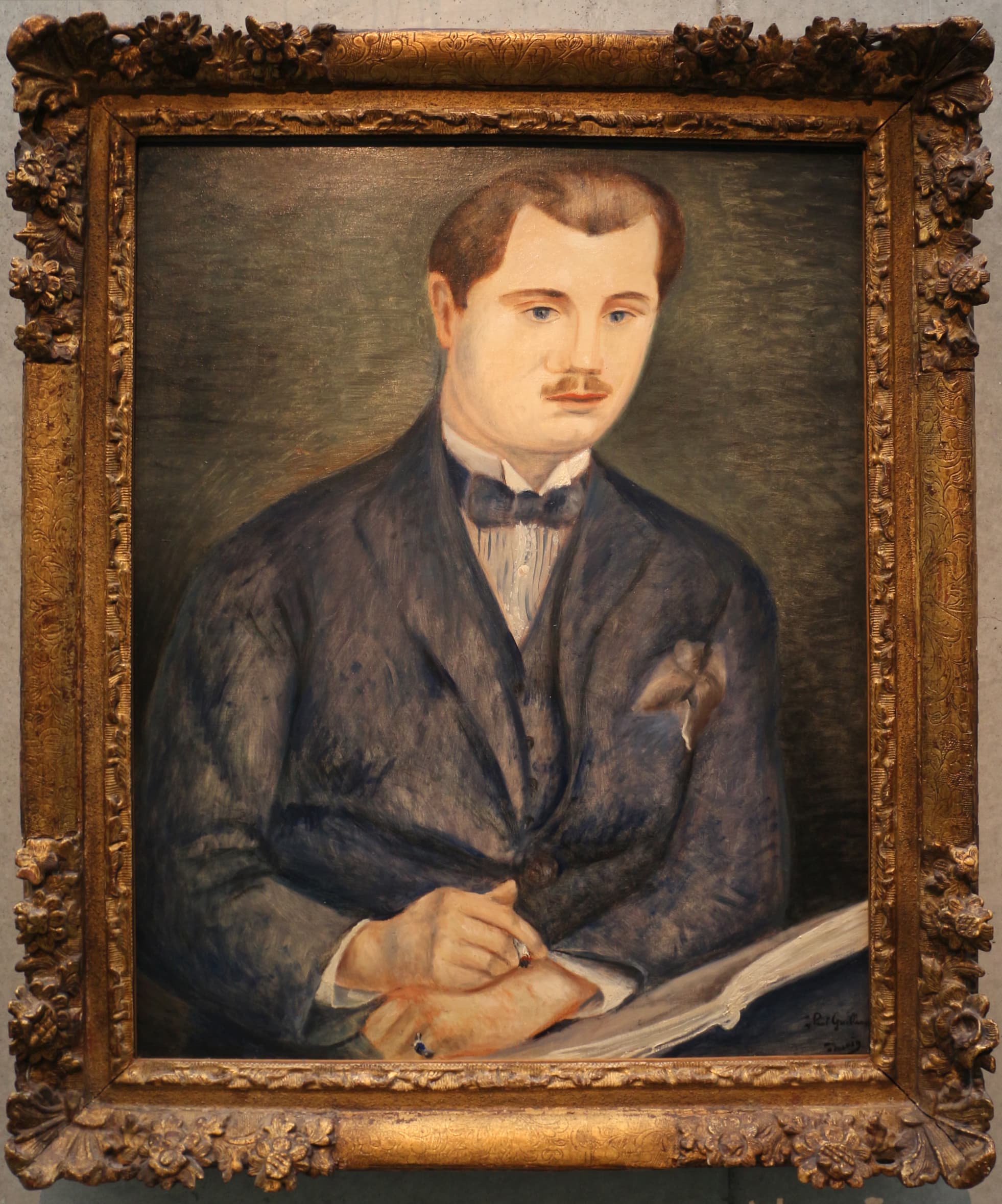
Framed portrait of Paul Guillaume in three-quarter view, blue suit and bow tie, cigarette in his left hand, leaning on an open book against a blue-green ground

Artwork reproduction

Painting · The dealer portraits

Portrait de Paul Guillaume

1919 · Oil on canvas

Derain's 1919 portrait of his dealer Paul Guillaume — elegant, detached, dressed in his favorite blue — painted by the artist whose 31 canvases now form the largest group in the Orangerie's collection.
Musée de l'Orangerie, Paris

André Derain, Portrait de Paul Guillaume, 1919. Musée de l'Orangerie, Paris.

André Derain's Charing Cross Bridge: a curving London embankment, distorted traffic, river, bridge, and distant towers are transformed into flat bands and broken strokes of red, orange, green, blue, and violet

Artwork reproduction

Painting · Fauvism

Charing Cross Bridge

c. 1906 · Oil on canvas

A London riverside view transformed through intense colour, flattened forms, and altered perspective.

Musée d’Orsay, Paris

André Derain, Charing Cross Bridge, c. 1906. Musée d’Orsay, Paris. Image: public domain.

People André Derain Knew

Relationships with other people, with sources for each connection.

Illustrated portrait of Paul Guillaume

Paul Guillaume

  • Art dealer
  • Collector
  • Publisher

Supported by · 1916

They met through Max Jacob on Apollinaire's advice, and from 1916 Guillaume gave Derain a solo show at the rue de Miromesnil gallery. The backing never stopped: Derain's 31 canvases are the largest group in the Walter-Guillaume collection, and his 1919 portrait of the dealer hangs among them.

— Portrait de Paul Guillaume (André Derain) — Musée de l'Orangerie; Paul Guillaume — Modern Art Index Project, Leonard A. Lauder Research Center

Movements

The artistic and literary currents this life ran through.

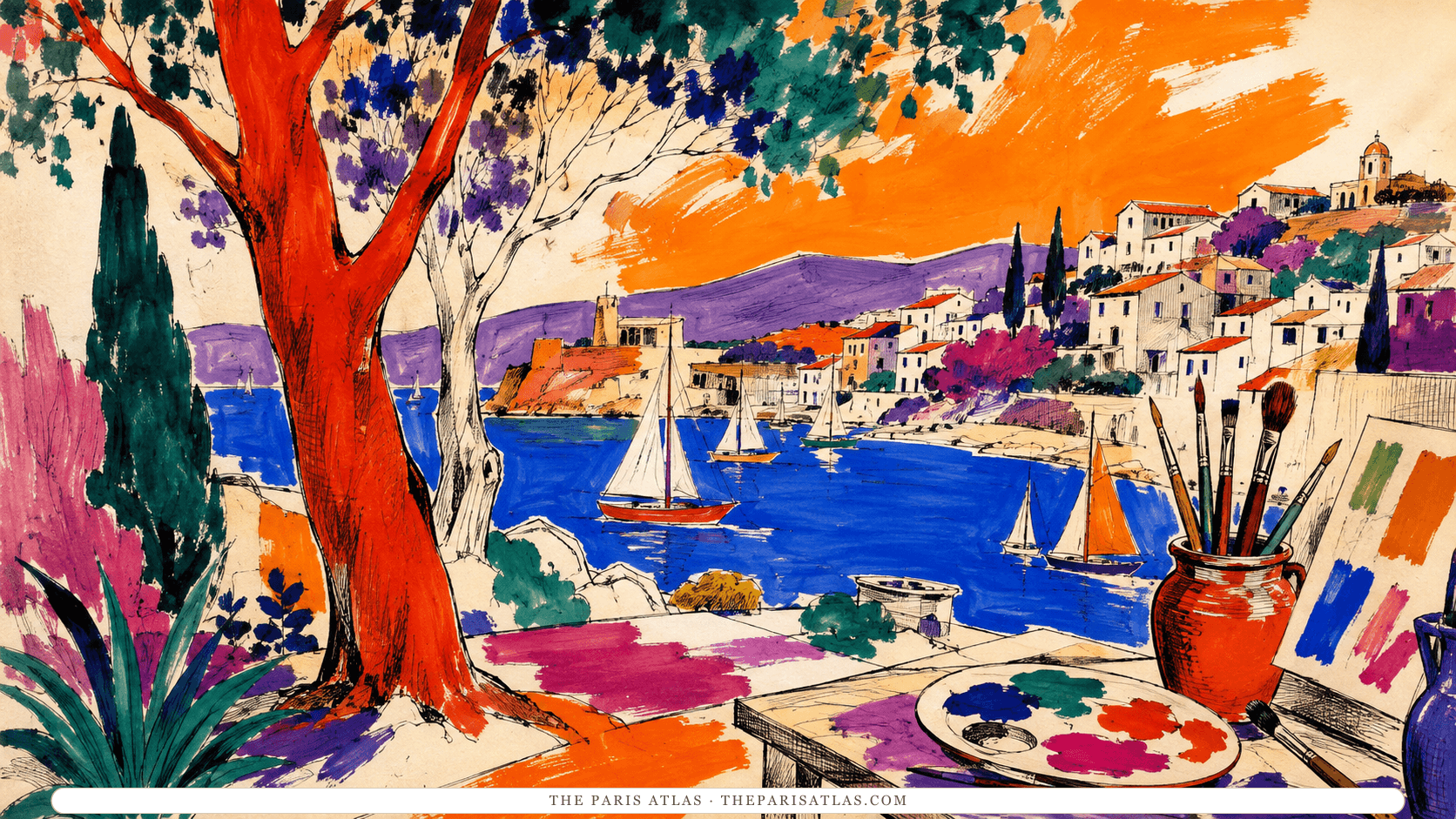
Ink-and-gouache Mediterranean harbor with a vermilion tree, cobalt water, orange sky, white hillside houses, sailboats, brushes, and a paint palette

Art movement · c. 1905–1908

Fauvism

Painted beside Matisse at Collioure in the summer of 1905 and hung with him in the Salon d'Automne room that named the movement.

— Fauvism — art term; Vertigo of Color: Matisse, Derain, and the Origins of Fauvism

Questions about André Derain

Who was André Derain?

André Derain was a French painter, sculptor, printmaker, collector, and stage designer. He helped create Fauvism with Henri Matisse at Collioure in 1905, painted the celebrated London series of 1906–07, and later turned toward a more classical art grounded in European painting traditions.

What was André Derain's role in Fauvism?

He was one of its three central painters, alongside Henri Matisse and Maurice de Vlaminck. Derain and Matisse's work at Collioure in summer 1905 made colour independent of natural appearance. When those pictures were shown at the Salon d'Automne, a critic's phrase about wild beasts — les Fauves — gave the movement its name.

Why did Derain paint London?

The dealer Ambroise Vollard sent him there in 1906 to produce a modern response to Claude Monet's Thames paintings. Derain replaced London's familiar grey atmosphere with extreme colour contrasts. Vollard bought all thirty paintings in the resulting series; twenty-nine are known today.

Was André Derain a Cubist?

He worked close to the birth of Cubism and absorbed Cézanne's structural influence, but he never fully adopted the analytic system developed by Picasso and Braque. His austere landscapes around 1908–10 sit at Cubism's edge. By 1911 he was already turning toward Romanesque sculpture and older European painting.

Why did Derain change his style?

Derain did not believe Fauvism's explosive colour could answer every problem in painting. He looked for permanence and structure in Cézanne, old masters, and historical sculpture. The resulting return to tradition made him highly admired during the 1920s, although later histories often treated it as a retreat from his radical early work.

Why is André Derain controversial?

In 1941, during the occupation of France, he joined other French artists on a state-managed visit to Nazi Germany. German authorities used the trip for propaganda. His participation left a lasting stain on his reputation and has to be included in any complete account of his life.

Where can you see André Derain's work in Paris?

The Musée de l'Orangerie holds thirty-one Derain paintings in the Walter-Guillaume collection, including Portrait of Paul Guillaume. The Centre Pompidou also holds paintings, drawings, and other works from several phases of his career.

Connections and Sources

André Derain’s connections to people, places, and works, with the sources behind each one.

Associated with

Fauvism

Painted beside Matisse at Collioure in the summer of 1905 and hung with him in the Salon d'Automne room that named the movement.

— Fauvism — art term; Vertigo of Color: Matisse, Derain, and the Origins of Fauvism

Supported by · 1916

Paul Guillaume

They met through Max Jacob on Apollinaire's advice, and from 1916 Guillaume gave Derain a solo show at the rue de Miromesnil gallery. The backing never stopped: Derain's 31 canvases are the largest group in the Walter-Guillaume collection, and his 1919 portrait of the dealer hangs among them.

— Portrait de Paul Guillaume (André Derain) — Musée de l'Orangerie; Paul Guillaume — Modern Art Index Project, Leonard A. Lauder Research Center

References

References

The sources below include biographies, scholarly essays, interviews, and primary materials that informed this page. They reflect both the historical record and ongoing critical conversations about André Derain and their work.

  1. 1abcdeAndré Derain — Modern Art Index Project

    Website
    The Metropolitan Museum of Art
    Used for

    Museum research record on Derain's training, artistic circle, collecting, later years, and estate.

    View source
  2. 2abcAndré Derain: The London Paintings

    Website
    The Courtauld
    Used for

    Exhibition history of Vollard's commission and the thirty-painting London series.

    View source
  3. 3abcdeAndré Derain

    Website
    Musée de l'Orangerie
    Used for

    Museum biography covering the war, theatre designs, Paul Guillaume, the Carnegie Prize, and the 1941 Germany trip.

    View source
  4. 4abcAndré Derain 1904–1914: The Radical Decade

    Website
    Centre Pompidou
    Used for

    Exhibition account of Derain's work across Fauvism, early Cubism, sculpture, printmaking, and photography before 1914.

    View source
  1. 5↑André Derain, Fishing Boats, Collioure

    Website
    The Metropolitan Museum of Art
    Used for

    Collection essay on Derain and Matisse at Collioure and the formation of Fauvism.

    View source
  2. 6↑Vertigo of Color: Matisse, Derain, and the Origins of Fauvism — Visiting Guide

    Website
    The Metropolitan Museum of Art
    Used for

    Museum exhibition guide on the Collioure partnership and Derain's 1905 paintings.

    View source
  3. 7↑André Derain — Artist and Collection Record

    Website
    The Museum of Modern Art
    Used for

    Museum artist and collection record.

    View source
  4. 8Fauvism

    Website
    The Metropolitan Museum of Art
    Used for

    Web source consulted for documented facts and historical context presented on the André Derain page.

    View source
i
Why these sources are here

These references anchor the page in the documented record and in the scholarly conversations around André Derain. Every claim on this page traces back to one or more of the works listed here.

Explore more resources