The Paris AtlasCharting the artists, works, and places worth returning to.

In their own words

Charles Baudelaire quotes

8 quotations, each verified against its source and credited to the work it comes from — the wording as Charles Baudelaire wrote or said it, not as the internet passes it around.

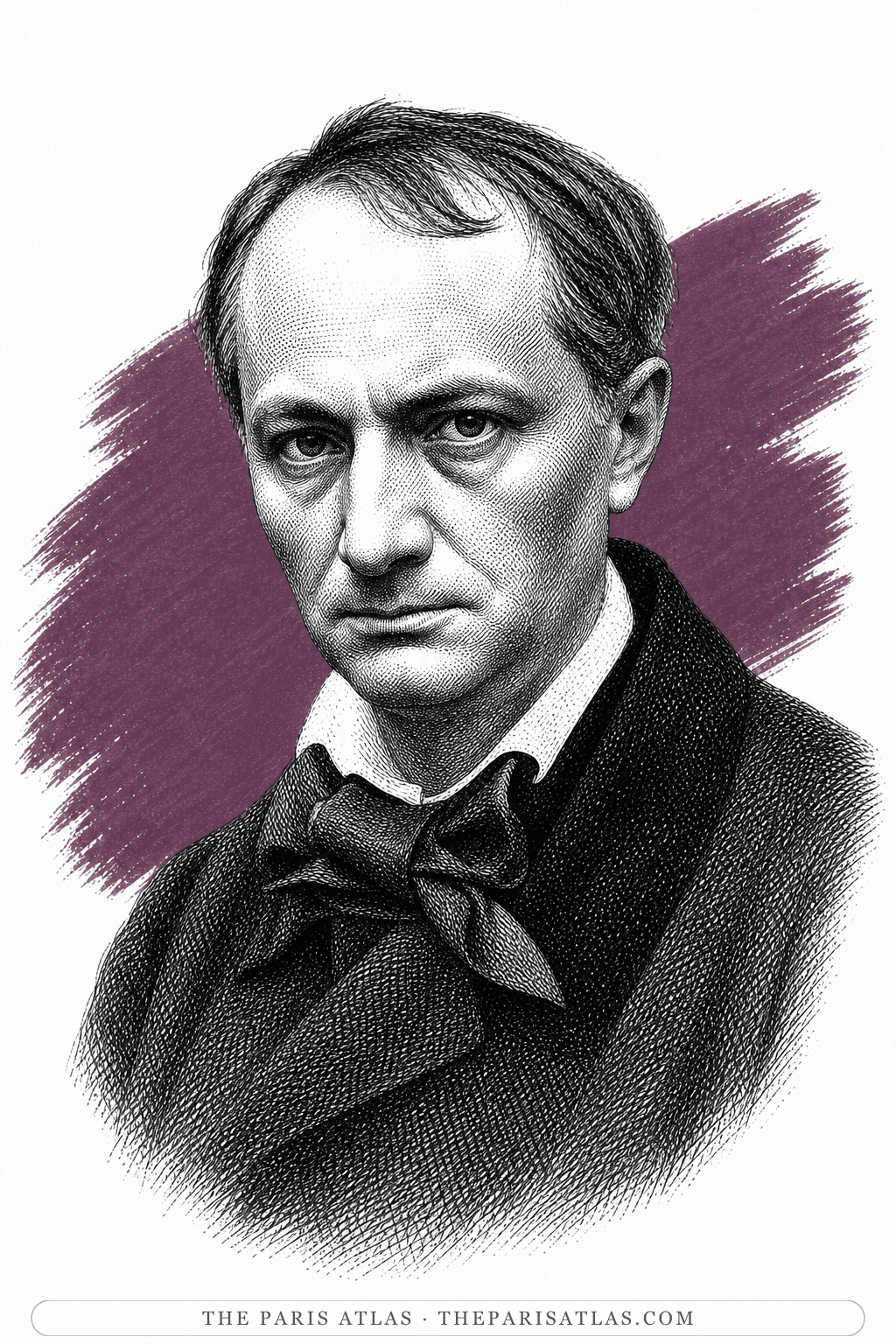
Illustrated portrait of Charles Baudelaire
Pen-and-ink illustration of manuscript pages, pressed flowers, and rain-dark Paris rooftops

How these quotes were checked

How we decide whether a quote is genuine

Les Fleurs du Mal is public domain in French, so every line here is checked against the complete text of the book. The English under each quotation is a plain prose rendering of the French beside it, made to carry the sense rather than the rhyme — the published verse translations in the public domain are selections, and they leave out most of these poems.

The line most often attached to Baudelaire in English is not his at all, and it is documented below.

One famous Charles Baudelaire quote, fact-checked

A sentence linked to Charles Baudelaire may be exact, shortened, remembered by someone else, or unsupported. Each label below explains what the available evidence actually proves.

Common paraphrase

“The greatest trick the devil ever pulled was convincing the world he didn't exist.”

This is the wording from the 1995 film The Usual Suspects, spoken by Kevin Spacey's character. Baudelaire wrote something close in “Le Joueur généreux,” a prose poem in Le Spleen de Paris: the devil's finest ruse is to persuade you that he does not exist. The idea is his; the famous sentence is the screenwriter Christopher McQuarrie's.

  • — Charles Baudelaire, Project Gutenberg text of Les Fleurs du Mal (#6099), the French original
The Poet is like the prince of the clouds, who rides the storm and laughs at the archer; exiled on the ground amid the jeering, his giant's wings prevent him from walking.

Le Poète est semblable au prince des nuées Qui hante la tempête et se rit de l'archer; Exilé sur le sol au milieu des huées, Ses ailes de géant l'empêchent de marcher.

— Charles Baudelaire, “L'Albatros,” Les Fleurs du Mal (1857)
Hypocrite reader — my likeness — my brother!

Hypocrite lecteur,—mon semblable,—mon frère!

— Charles Baudelaire, “Au lecteur,” Les Fleurs du Mal (1857)
I am beautiful, O mortals, as a dream of stone.

Je suis belle, ô mortels! comme un rêve de pierre

— Beauty personified · Charles Baudelaire, “La Beauté,” Les Fleurs du Mal (1857)
Free man, you will always cherish the sea! The sea is your mirror; you contemplate your soul in the endless unrolling of its swell.

Homme libre, toujours tu chériras la mer! La mer est ton miroir; tu contemples ton âme Dans le déroulement infini de sa lame

— Charles Baudelaire, “L'Homme et la mer,” Les Fleurs du Mal (1857)
Be good, O my Sorrow, and hold yourself more still. You asked for the Evening; it is coming down; here it is.

Sois sage, ô ma Douleur, et tiens-toi plus tranquille, Tu réclamais le Soir; il descend; le voici:

— Charles Baudelaire, “Recueillement,” Les Fleurs du Mal
And yet you will be like this filth, like this horrible corruption — star of my eyes, sun of my nature, you, my angel and my passion!

Et pourtant vous serez semblable à cette ordure, A cette horrible infection, Etoile de mes yeux, soleil de ma nature, Vous, mon ange et ma passion!

— Charles Baudelaire, “Une Charogne,” Les Fleurs du Mal (1857)
You must always be drunk. That is everything: it is the only question. So as not to feel the horrible burden of Time breaking your shoulders and bending you toward the earth, you must get drunk without respite. But on what? On wine, on poetry or on virtue, as you please. But get drunk.

Il faut être toujours ivre. Tout est là: c'est l'unique question. Pour ne pas sentir l'horrible fardeau du Temps qui brise vos épaules et vous penche vers la terre, il faut vous enivrer sans trêve. Mais de quoi? De vin, de poésie ou de vertu, à votre guise. Mais enivrez-vous.

— Charles Baudelaire, “Enivrez-vous,” Petits Poèmes en prose (1869)
O Death, old captain, it is time! let us raise the anchor! This country bores us, O Death! Let us set sail! If the sky and the sea are black as ink, our hearts, which you know, are filled with light!

O Mort, vieux capitaine, il est temps! levons l'ancre! Ce pays nous ennuie, ô Mort! Appareillons! Si le ciel et la mer sont noirs comme de l'encre, Nos coeurs que tu connais sont remplis de rayons!

— Charles Baudelaire, “Le Voyage,” Les Fleurs du Mal (1861)

Questions about Charles Baudelaire quotes

Did Baudelaire write “the greatest trick the devil ever pulled”?

Not in that form. The sentence people quote is from the film The Usual Suspects (1995). Baudelaire's version, in the prose poem “Le Joueur généreux,” is that the devil's finest ruse is to persuade you he does not exist — the same thought, different words, and a different author for the famous phrasing.

Why are these quotations printed in French as well as English?

Because the French is the poetry. The English lines here are plain prose renderings meant to carry the sense; the public-domain verse translations are selections that omit most of these poems, so pairing each quotation with the verified French is the honest way to show what Baudelaire actually wrote.

What is “L'Albatros” about?

Sailors catch an albatross for amusement, and the bird that was magnificent in the air becomes clumsy and absurd on deck. The final stanza says the poet is the same creature: his giant's wings, which carry him above the storm, keep him from walking on the ground.

What does “hypocrite lecteur” mean?

“Hypocrite reader” — the closing address of the poem that opens Les Fleurs du Mal, which has just accused the reader of sharing every appetite it catalogues, and then calls him its likeness and its brother. T. S. Eliot borrowed the line, untranslated, for The Waste Land.

Was Les Fleurs du Mal banned?

Prosecuted rather than banned outright. In 1857 Baudelaire and his publisher were fined for offence to public morals, and six poems were ordered removed from the book; they were not legally restored in France until 1949.

References

References

The sources below are the editions, archives, and full-text searches used to verify the quotations on this page. Every line was checked against one or more of them before it appeared here.

  1. 1Project Gutenberg text of Les Fleurs du Mal (#6099), the French original

    Website
    Charles Baudelaire
    Used for

    Web source consulted for documented facts and historical context presented on the Charles Baudelaire page.

    View source
i
Why these sources are here

Verification is the point of this collection: a quotation is listed only when its wording has been checked against the sources above, and the attribution notes record what each check found about the famous lines that failed.

Explore more resources

Newsletter

Join our newsletter

New stories about art, literature and famous places around the world.

Unsubscribe anytime.