Finnish modernist painter whose long career moved from the realism of the Paris Salon to some of the most radically simplified portraits and self-portraits of twentieth-century European art.
In images
Details
Lived
1862–1946
Born
10 July 1862
Birthplace
Helsinki, Finland
Died
23 January 1946 · aged 83
Place of death
Saltsjöbaden, Sweden
Nationality
Finnish
Profession
Painter and drawing teacher
Major works
The Door (1884), The Convalescent (1888), Self-Portrait, Black Background (1915)
Roles
Painter
Also known as
Hélène Schjerfbeck
About Helene Schjerfbeck
An artist between distance and modernism
Helene Schjerfbeck spent much of her life far from the great centers of European art, but isolation never made her provincial. As a young woman she studied in Paris, worked in artists' colonies in Brittany and Cornwall, visited Italy, exhibited at the Paris Salon, and absorbed everything from Renaissance painting to the newest experiments of modern art. Later, living quietly with her mother in a small Finnish town, she continued that education through books, magazines, reproductions, letters, and memory.
Over a career of more than sixty years, Schjerfbeck gradually removed almost everything from her paintings that she considered unnecessary. Detailed rooms became empty backgrounds. Carefully modeled bodies became flat shapes. Faces were reduced to a handful of lines and shadows. In her final self-portraits, painted when she was in her eighties, even her own face seems to dissolve.[1]
The change was so great that her earliest and latest pictures can appear to have been painted by different artists. Yet the same concerns run through them: observation, restraint, the physical surface of paint, and an intense curiosity about what can remain after details are stripped away. Today Schjerfbeck is regarded as one of Finland's most important artists and an increasingly significant figure in the wider history of European modernism.
Childhood in Helsinki
Helena Sofia Schjerfbeck was born in Helsinki on 10 July 1862, when Finland was still an autonomous grand duchy within the Russian Empire. Her parents were Svante Schjerfbeck, who worked as an office manager for the railway workshops, and Olga Johanna Printz. The family had once had greater financial security, but her father had lost much of his fortune in unsuccessful business ventures before taking his railway position. Helene grew up with her older brother Magnus, who later became an architect.[2]
Her childhood was shaped by a serious accident. At four years old, she fell down a staircase and badly injured her hip. The injury never healed properly, leaving her with a permanent limp and periods of pain throughout her life. She spent years recovering and could not attend an ordinary school in the usual way. Drawing became an important part of her childhood, although it would be misleading to reduce her artistic career to the accident alone. What mattered just as much was the extraordinary ability she demonstrated once someone recognized it.[2]
That person was her teacher Lina Ingman. Seeing how unusually well the young girl could draw, Ingman brought her work to the attention of the painter and teacher Adolf von Becker. Schjerfbeck was only eleven when, in 1873, she entered the Finnish Art Society's Drawing School. She was exceptionally young for a serious art student.
Her father died of tuberculosis in 1876, when Helene was thirteen. Money became even tighter. Her mother took on work to support the household, while Helene continued her training. From 1877 she studied at Adolf von Becker's private academy, where she developed the technical foundation that allowed her to compete professionally while still a teenager.
In 1879, at seventeen, she entered the Finnish art world as an exhibiting painter. Within a year, one of her history paintings helped secure the travel grant that changed her life.[3]
Paris
Schjerfbeck arrived in Paris in 1880, still only eighteen.[4]
For a young Finnish artist, Paris offered something that Helsinki could not: museums filled with European masterpieces, private galleries, enormous annual exhibitions, international artists, new movements in painting, and art schools where women could obtain forms of professional training often closed to them elsewhere.
She first studied at a women's atelier run by Madame Trélat de Vigny and then, in 1881, moved to the Académie Colarossi, where she studied under the French painter Gustave Courtois. Unlike the more conservative official schools, private academies such as Colarossi attracted international students and offered women unusually serious opportunities to study art.[3]
Paris also gave Schjerfbeck a community.
Among the women around her were the Finnish artists Helena Westermarck and Maria Wiik, along with Ada Thilén and the Austrian-born painter Marianne Preindlsberger, later Marianne Stokes. Schjerfbeck eventually referred to several of these women as her “sisters of the brush.” They studied together, discussed painting, posed for one another, traveled and maintained friendships and correspondence long after their student years ended.[4]
This network mattered. A woman trying to establish herself as a professional painter in the nineteenth century faced practical and social restrictions that did not apply equally to men. Paris offered these Nordic women a degree of anonymity and independence. They could take their work seriously and encounter other artists doing the same.
Schjerfbeck was not content simply to master the accepted academic style. In an 1881 letter from Paris, she complained that she wanted something other than the conventional heads she was being asked to copy. Even at nineteen, she was looking for a way out of the formula.
Brittany and the Paris Salon
Paris became a base from which Schjerfbeck explored France.
In 1881 she traveled with Marianne Preindlsberger to Concarneau in Brittany. She later worked at Pont-Aven, where artists were increasingly drawn by the region's landscape, villages, traditional dress, relatively inexpensive living, and distance from metropolitan life. This was before Paul Gauguin made Pont-Aven famous as a center of experimental modern painting, but an international artists' community was already forming there.[2]
Her paintings were beginning to loosen.
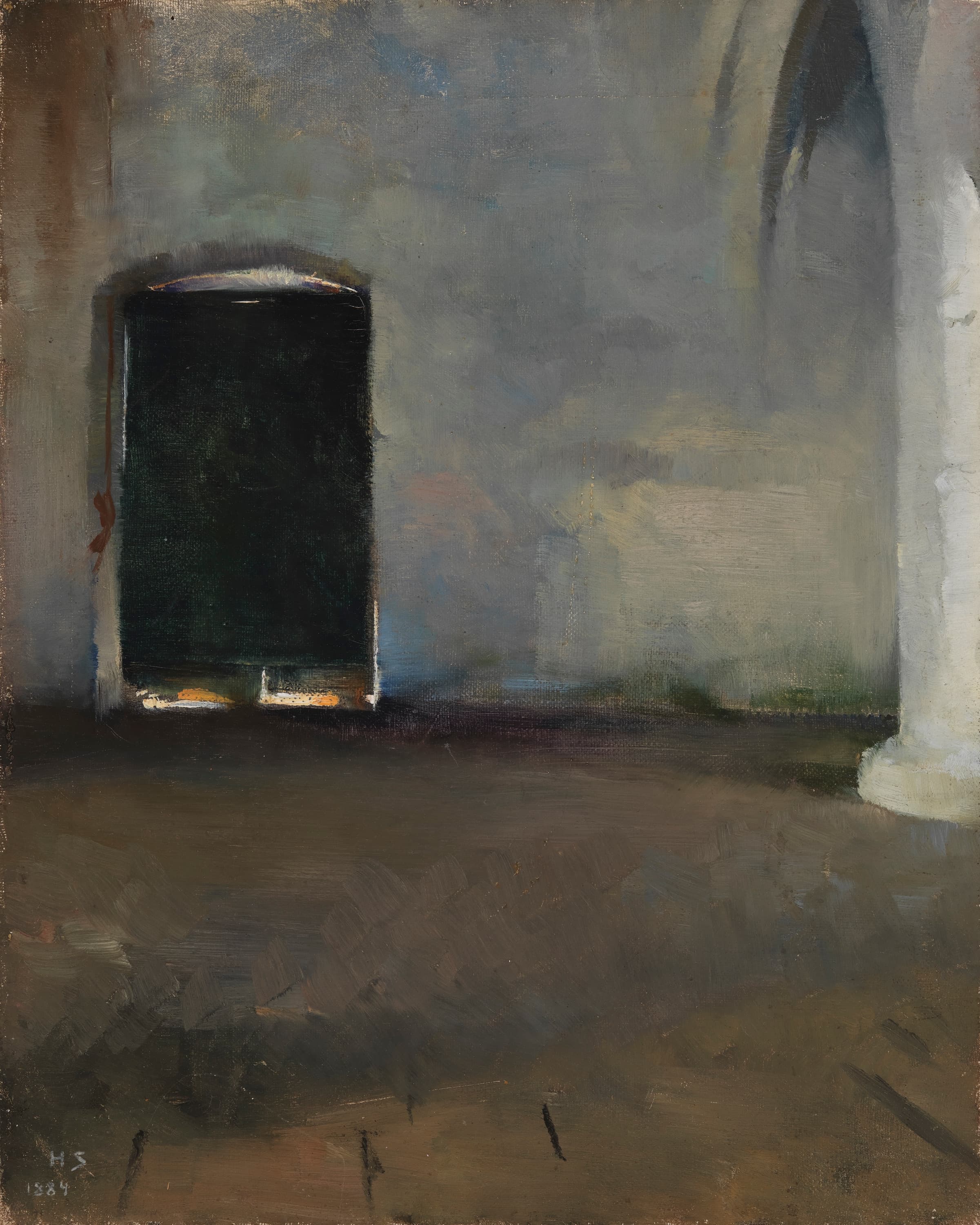
In Clothes Drying (1883), laundry lies across the landscape without the kind of conventional narrative viewers expected. In The Door (1884), an almost empty architectural scene becomes the subject itself. These paintings can look surprisingly modern beside her more academic historical pictures. The Metropolitan Museum of Art has described them as quietly subversive works in which seemingly ordinary places resist easy interpretation.
She was also achieving success within the official Paris art world.
Her large painting Fête juive—generally translated as Jewish Festival or identified with the Jewish festival of Sukkot—was accepted for the Paris Salon in 1883. It was Schjerfbeck's first appearance at the prestigious juried exhibition. She returned to the Salon the following year with Un enterrement, Finistère, a Breton funeral scene.
These achievements are important because Schjerfbeck is sometimes remembered primarily as a solitary painter working in rural Finland. Before she turned thirty, however, she had already been trained in Paris, exhibited at the Salon, traveled independently through Europe and worked inside a genuinely international community of artists.
Paris also exposed her to art far older than modernism. She studied Old Master paintings closely. When Renaissance frescoes by Sandro Botticelli were acquired by the Louvre in the early 1880s, Schjerfbeck studied and copied from them. The pale colors, matte surfaces and worn appearance of old fresco painting became part of the visual vocabulary she would eventually transform into something distinctly her own.
St Ives and The Convalescent
Another important journey began in 1887, when Marianne Stokes encouraged Schjerfbeck to visit St Ives, the fishing town in Cornwall that was developing into an international artists' colony.
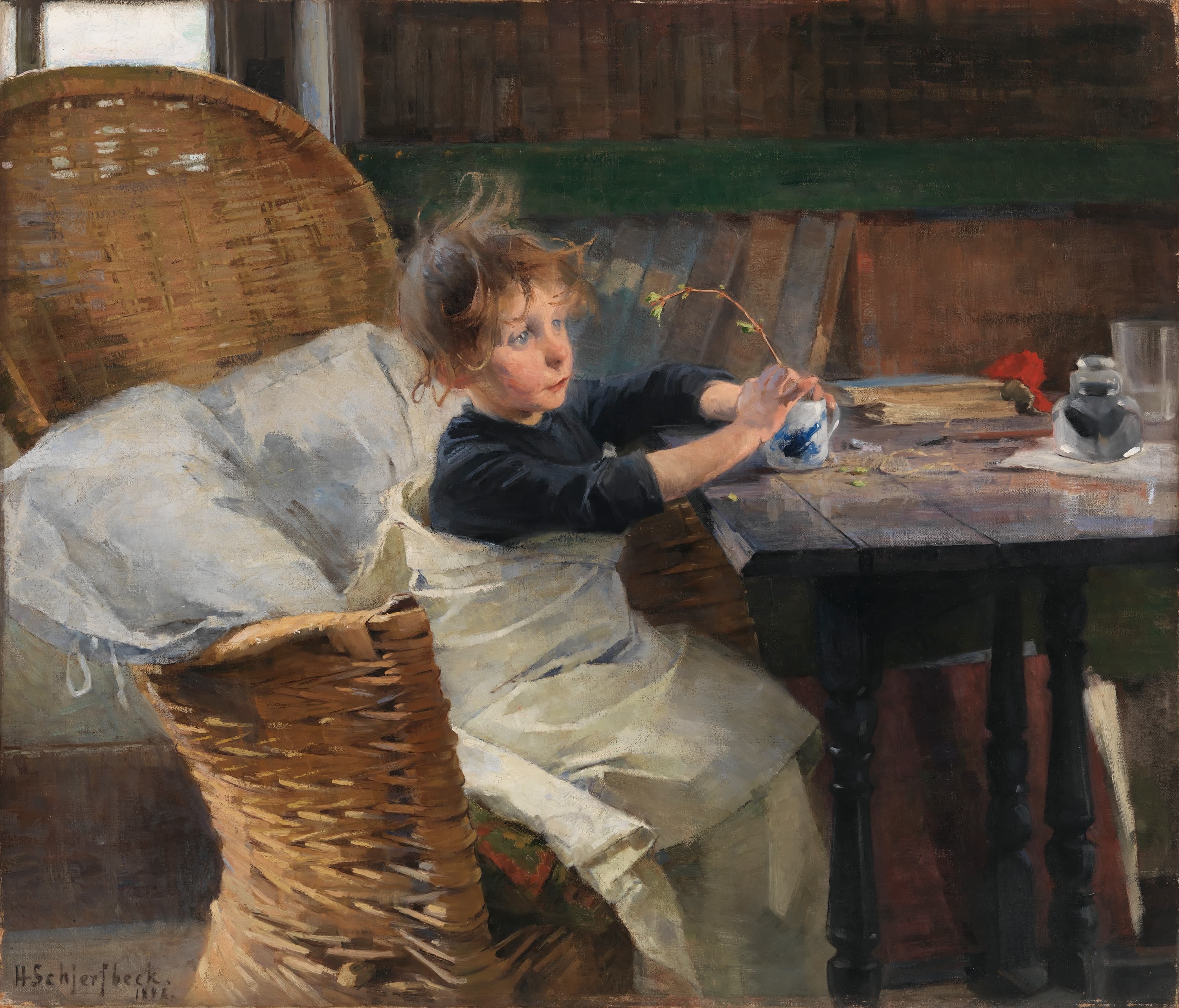
There Schjerfbeck painted one of the defining works of her early career, The Convalescent (1888).
The painting shows a child recovering from illness, sitting in a wicker chair and concentrating on a small budding branch. Rather than making sickness itself the spectacle, Schjerfbeck directs attention toward the child's absorbed examination of the new leaves. The branch suggests returning life.
The picture was exhibited at the Paris Salon in 1888 under the French title Première verdure—“First Greening.” Its loose brushwork and unconventional composition already point beyond strict academic naturalism. Modern scholarship often treats it as a transitional painting: still recognizably nineteenth-century in subject, but moving toward the psychological ambiguity and simplification of Schjerfbeck's mature work.
Its reception in Finland was mixed. Some critics thought the work too modern or too roughly painted. Nevertheless, the Finnish Art Society purchased it, and it entered what is now the Ateneum collection. It later became one of the best-known paintings in Finnish art.
Returning to Finland
By the early 1890s, Schjerfbeck's long period of European travel was ending.
She returned to Finland and taught during the 1890s at the Finnish Art Society's drawing school. Teaching provided income, but it was physically exhausting, and her health remained fragile. Her position within the Finnish art establishment was also becoming uncomfortable. Finnish art was increasingly tied to a national cultural movement, while Schjerfbeck's interests remained strongly international and personal.
In 1902 she left Helsinki and moved with her mother to Hyvinkää, a small town north of the capital.
It might have looked like a retreat from the art world.
Instead, it became the setting for her transformation.
Hyvinkää and the making of a modernist
In Hyvinkää, Schjerfbeck had fewer professional models and less direct contact with exhibitions. She painted the people around her: her mother, working women, neighbors, schoolgirls and local children.
The reduced circumstances changed what she painted, but they also changed how she painted.
Works such as My Mother (1902), The Seamstress (The Working Woman) (1905), Reading Girls (1907) and The Woodcutter (1911) become quieter and increasingly spare. Backgrounds disappear. Clothes flatten into broad areas of tone. Faces sometimes contain only the minimum information needed to remain faces.
Schjerfbeck was not simply reproducing what she saw. She would paint, remove, scrape, rub and repaint. The physical process of subtraction became essential to her art. A finished surface could look faded, damaged or centuries old even when the work had just left her studio.
Nor was she intellectually isolated.
Friends sent her books, magazines and reproductions. She followed modern painting closely and thought about artists including Paul Cézanne, Vincent van Gogh, Paul Gauguin, Henri Matisse and others while continuing to study painters from centuries earlier, particularly El Greco and the Renaissance masters. The result was not imitation. Schjerfbeck took fragments of what interested her—an elongated face, a color relationship, the worn surface of a fresco—and absorbed them into her own increasingly recognizable language.
Painting herself
No subject reveals Schjerfbeck's development more clearly than her own face.
She made self-portraits across roughly six decades, producing more than forty. An early Self-Portrait of 1884–85 still belongs to the tradition of nineteenth-century portraiture. The young artist is clearly recognizable, carefully observed and physically present.
Decades later, almost everything has changed.
In 1914, Schjerfbeck was the only woman among ten artists invited to provide a self-portrait for the Finnish Art Society. The resulting Self-Portrait, Black Background of 1915 is already startlingly economical: pale skin against darkness, sharp lines, asymmetries and a direct but strangely distant presence.
The self-portraits were not simply diaries of her appearance. Schjerfbeck used her own face as a permanent available model through which she could experiment with paint, form, age and recognition itself.
That experiment became increasingly radical as she grew older.
Recognition at last
Schjerfbeck had been exhibiting for decades when the art dealer Gösta Stenman sought her out in 1913. He became one of the most important advocates for her work and helped bring it before a new audience.
Two years later, the forester, writer and amateur artist Einar Reuter visited Schjerfbeck in Hyvinkää. They spent hours discussing art, beginning a close friendship and extensive correspondence that lasted for the rest of her life. Reuter later wrote about her under the pseudonym H. Ahtela.
In 1917, Stenman organized Schjerfbeck's first solo exhibition in Helsinki.
It was enormous: 159 works spanning decades of her career. The exhibition attracted such interest that its run was extended. For viewers who remembered the young naturalist painter of the 1880s, the modern Schjerfbeck could be astonishing. Her career had effectively been rediscovered.
Schjerfbeck was fifty-five.
Recognition had arrived late, but she still had almost thirty years of painting ahead of her.
Ekenäs and the later paintings
Schjerfbeck's mother died in 1923 after the two women had lived together for many years. In 1925 Schjerfbeck moved permanently to Ekenäs, now known as Tammisaari.
Her work continued to change.
She painted portraits, flowers, fruit and increasingly abstracted human figures. At Stenman's suggestion, she also returned to subjects she had first painted decades earlier and created new versions of them. These were not straightforward copies. Schjerfbeck reconsidered her younger self through the language of her older one, often stripping a nineteenth-century composition down to a few shapes and tones.
A successful Stockholm exhibition organized by Stenman in 1937 further expanded her reputation in Sweden. Even in her seventies she continued experimenting, learning lithography at an age when many artists would have considered their working methods settled.
The final self-portraits
War forced one last displacement.
In 1944, with Finland caught in the upheavals of the Second World War, the eighty-one-year-old Schjerfbeck left for Sweden with Stenman's assistance. She eventually stayed at a spa hotel in Saltsjöbaden, near Stockholm.
There she kept painting.
The final self-portraits are among the strangest works of her career. Her head becomes a pale oval. Hair disappears. One eye may be little more than a dark cavity; the mouth a mark; the outlines of the skull increasingly visible.
Yet these pictures are not simply records of physical decline. Schjerfbeck was still making artistic decisions—reducing, distorting, rubbing away and searching for new forms. The face became a laboratory in which the difference between portrait and abstraction almost disappears.
In Self-Portrait with Red Spot (1944) and the works that followed, she appears to be testing how little of a human face can remain before identity itself vanishes. The Met has described the paintings of these final Swedish years as an extraordinary confrontation with mortality.
Helene Schjerfbeck died at Saltsjöbaden on 23 January 1946. She was eighty-three. Her body was returned to Finland for burial. She had continued painting almost until the end.
Schjerfbeck's place in modern art
For many years, Schjerfbeck's reputation was much larger in Finland and Sweden than elsewhere. That imbalance has gradually begun to change.
Her importance lies partly in the unusual arc of her career. She did not become modern by making a clean break with the past. She carried the past with her. Parisian naturalism, Manet, Botticelli, El Greco, Cézanne, fashion magazines, old frescoes and faces encountered in small Finnish towns could all coexist inside the same artistic imagination.
Paris was therefore crucial to Schjerfbeck without fully explaining her.
It gave the young painter professional training, female colleagues, museums, exhibitions, independence and firsthand experience of the European art world. But the style for which she is now best known emerged slowly, after she had left Paris behind. She spent decades reconsidering what she had seen there.
The remarkable thing about Schjerfbeck is not that she withdrew from Europe and somehow invented modernism alone. It is that she never really stopped participating in the conversation. She simply learned to do so from a distance.
By the end of her life, the ambitious eighteen-year-old who had arrived in Paris hoping to master contemporary painting had become something much harder to categorize. She had pared portraiture down until faces hovered between presence and disappearance, and had turned the worn, scraped surface of a canvas into part of its meaning.
That late work is one reason her international reputation continues to grow. The Ateneum holds the world's largest collection of her art, numbering more than 200 works, while major exhibitions in London, Frankfurt, Japan and New York have increasingly placed her within the broader history of modernism. In 2023, The Metropolitan Museum of Art acquired her 1920 painting The Lace Shawl, its first work by a Finnish artist; in 2025–26 the museum presented Seeing Silence: The Paintings of Helene Schjerfbeck, the first major Schjerfbeck exhibition at a United States museum.
More than a century after her Paris years, the journey visible across Schjerfbeck's paintings remains extraordinary: from a teenager learning how to render the world correctly to an elderly artist asking how much of the visible world a painting actually needs.
That question became the work of her life.
Life events
1862
Born in Helsinki.
— Seeing Silence: The Paintings of Helene Schjerfbeck
1880
Arrives in Paris at eighteen and continues her professional art training.
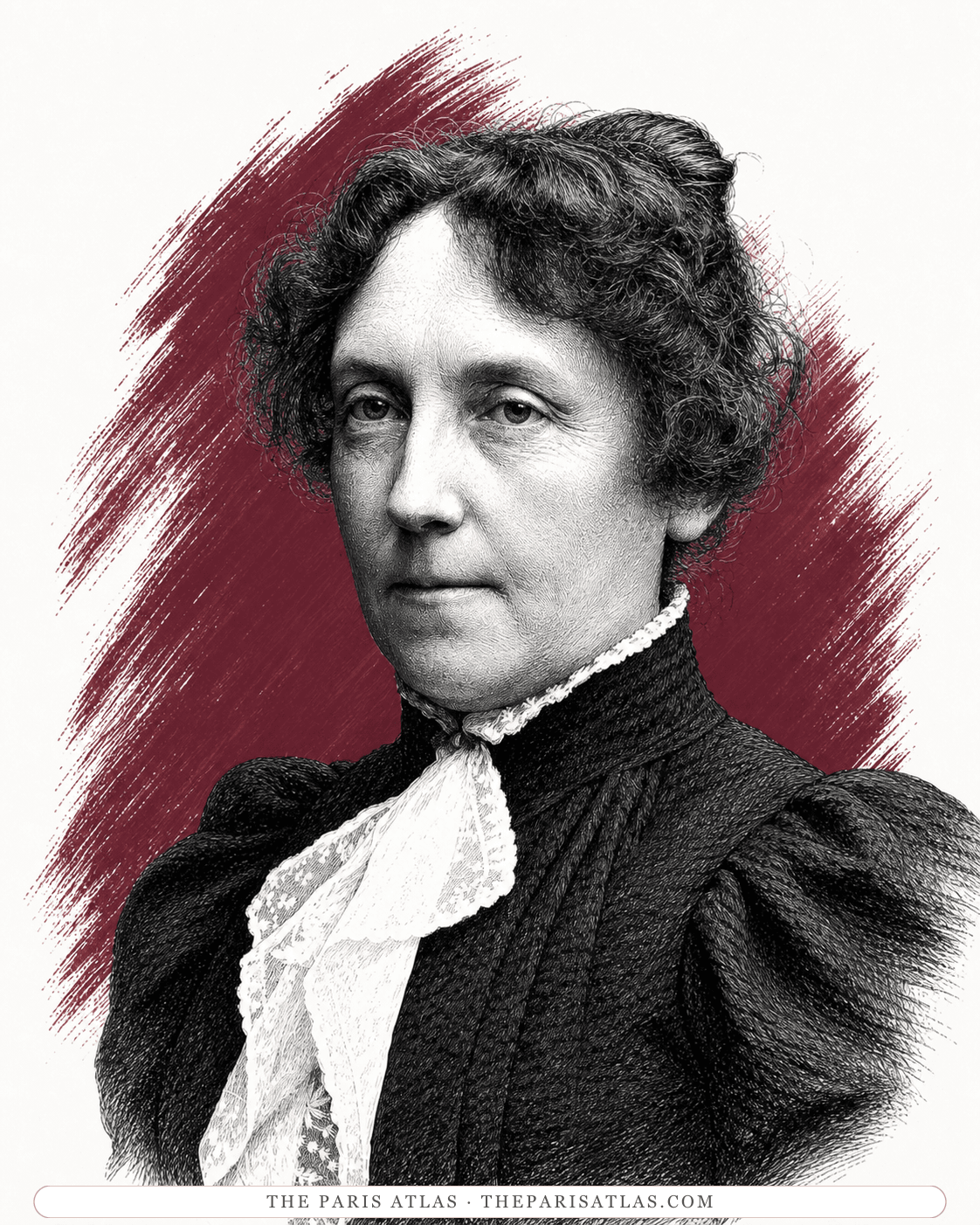
Schjerfbeck at eighteen, shortly before her first journey to Paris. (Daniel Nyblin, Finnish Heritage Agency)
— Marja Lahelma, Helene Schjerfbeck: An Artist's Life — screen PDF (2023)
1881–1889
Works in Brittany, St Ives, Italy, and Paris, exhibiting repeatedly at the Paris Salon.
— Through My Travels I Found Myself
1902 onward
Moves to Hyvinkää and develops an increasingly simplified modernist style, including an extended sequence of self-portraits.
Self-Portrait, Black Background (1915), from the long sequence through which Schjerfbeck studied her own changing face. (Helene Schjerfbeck, Finnish National Gallery)
— Seeing Silence: The Paintings of Helene Schjerfbeck
1946
Dies in Saltsjöbaden, Sweden.
— Seeing Silence: The Paintings of Helene Schjerfbeck
Selected works
Cataloged from the holding institutions' records. Reproductions appear only where the rights are verified.
A boy in a blue smock sits on a low stool and spoons food from a green bowl for a small girl in a white cap who leans against his knee. Helene Schjerfbeck painted the two children at Concarneau in Brittany in the summer of 1881, at nineteen, as her first large picture in the French Naturalist manner. It went to Helsinki that autumn, where critics called it ugly, and it is now at the Ateneum Art Museum.
A pale face looks straight out from a black ground, under the name HELENE SCHJERFBECK in worn silver capitals, with a pot of brushes at the lower left. The Finnish Art Society asked ten artists for self-portraits in October 1914, and Helene Schjerfbeck, the only woman among them, sent this one in 1915. It is at the Ateneum Art Museum in Helsinki.
A small girl with tousled hair sits wrapped in a white blanket in a high-backed rattan chair, holding a twig with a few green buds in a cup on the table beside her. Helene Schjerfbeck painted it at St Ives in Cornwall in 1888 and sent it to the Paris Salon that spring under the title Première verdure, First Greenery. The Finnish Art Society bought it the same year, and it is at the Ateneum Art Museum in Helsinki.
A closed door, painted almost black, stands in a pale gray wall, with light leaking in a thin line along its top and in two patches at its foot. Helene Schjerfbeck painted it in 1884 in the Trémalo chapel outside Pont-Aven, in Brittany, on her second stay in the village. It is one of a small group of pictures from those months that have no figures and no story, and it is at the Ateneum Art Museum in Helsinki.
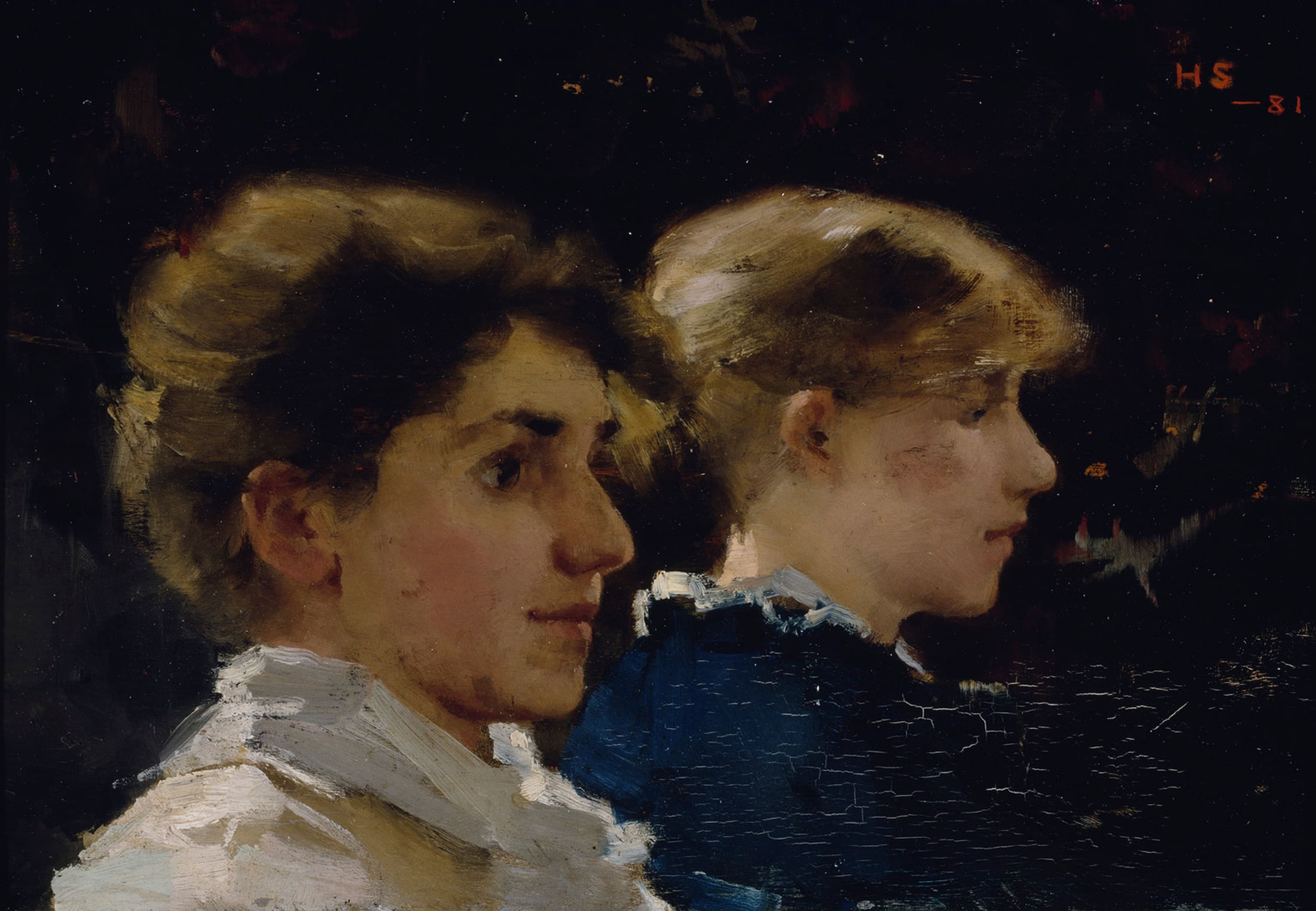
Two young women sit in profile, facing right, against a black ground on a small wooden panel. The nearer one is Marianne Preindlsberger, an Austrian painter who was Helene Schjerfbeck's closest friend at the Académie Colarossi in Paris. Schjerfbeck painted it in 1881, her first full year in Paris, and it is at the Ateneum Art Museum in Helsinki.
The Finnish National Gallery identifies Cézanne among the foreign artists Schjerfbeck treated as important models while developing her own modernist painting.
— The Ateneum's winter season 2019–2020
Connections and Sources
Helene Schjerfbeck’s connections to people, places, and works, with the sources behind each one.
Collaborated with · 1880
Helena Westermarck
Schjerfbeck and Westermarck studied, traveled, and worked in Paris together and maintained a long friendship and correspondence.
— Marja Lahelma, Helene Schjerfbeck: An Artist's Life — screen PDF (2023)
Collaborated with · 1880
Maria Wiik
Wiik belonged to the circle of Finnish women artists with whom Schjerfbeck studied and worked during her French periods.
The Finnish National Gallery identifies Cézanne among the foreign artists Schjerfbeck treated as important models while developing her own modernist painting.
— The Ateneum's winter season 2019–2020
References
References
The sources below include biographies, scholarly essays, interviews, and primary materials that informed this page. They reflect both the historical record and ongoing critical conversations about Helene Schjerfbeck and their work.
1↑Helene Schjerfbeck's Portraiture — French edition
Website
The Metropolitan Museum of Art
Used for
The Met's analysis of Schjerfbeck's portraiture and the development of her self-portraits.
These references anchor the page in the documented record and in the scholarly conversations around Helene Schjerfbeck. Every claim on this page traces back to one or more of the works listed here.



 View source