
The Paris AtlasCharting the artists, works, and places worth returning to.

In their own words

Malcolm X quotes

23 quotations, each verified against its source and credited to the work it comes from — the wording as Malcolm X wrote or said it, not as the internet passes it around.

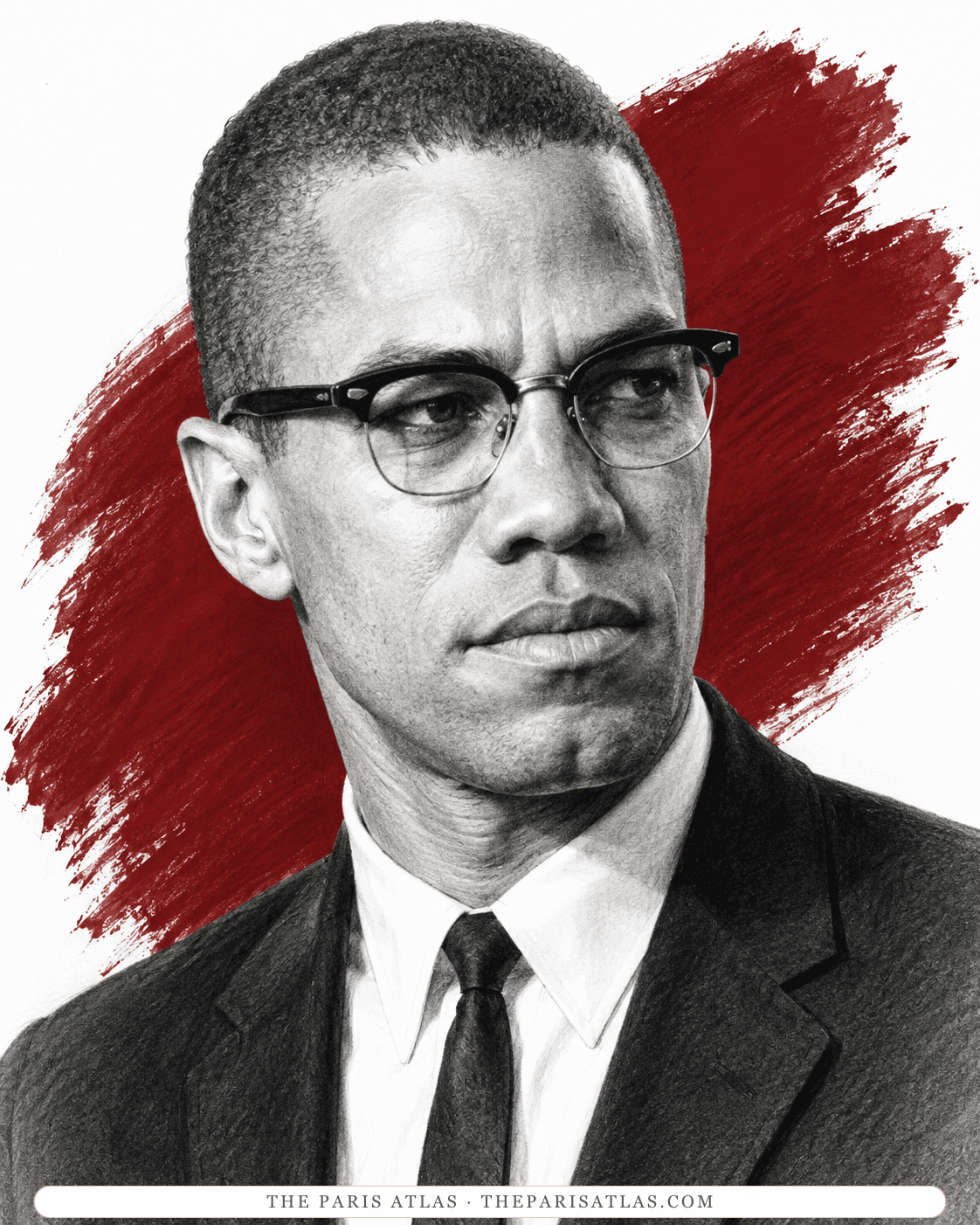
Illustrated portrait of Malcolm X
Pen-and-ink illustration of an open book, reading glasses, index cards, and a vintage microphone

How these quotes were checked

How we decide whether a quote is genuine

Malcolm X is quoted constantly and checked almost never. A line enters this collection only when its wording can be verified against a printed text: the speech collections Malcolm X Speaks and By Any Means Necessary, and The Autobiography of Malcolm X.

Two of the most shared “Malcolm X” sentences fail that check in different ways — one is a real speech line that circulates with its wording quietly rewritten, and one appears nowhere in his published words at all. Both are documented below.

Two famous Malcolm X quotes, fact-checked

A sentence linked to Malcolm X may be exact, shortened, remembered by someone else, or unsupported. Each label below explains what the available evidence actually proves.

Common paraphrase

“Education is the passport to the future, for tomorrow belongs to those who prepare for it today.”

The thought is genuinely his, but this is not the sentence he said. At the founding rally of the Organization of Afro-American Unity on 28 June 1964, the printed text reads: “Education is our passport to the future, for tomorrow belongs only to the people who prepare for it today.” The poster version trades “our passport” for “the passport” and drops “only to the people.” The collection above carries the wording as printed.

  • — Malcolm X, edited by George Breitman, By Any Means Necessary: Speeches, Interviews and a Letter (1970)

Unproven

“A man who stands for nothing will fall for anything.”

No text in Malcolm X's published speeches, interviews, or the Autobiography contains this sentence — a full-text search across his authored volumes returns nothing. The maxim was circulating before his public career began: a 1951 public-speaking handbook already prints “stand for something or you will fall for anything,” written while Malcolm was still in prison. It attached to him later, as memorable sayings attach to famous voices.

  • — Mark W. Lee, So You Want to Speak: Hints and Helps for Public Speakers (1951)
Nobody can give you freedom. Nobody can give you equality or justice or anything. If you're a man, you take it.
— Malcolm X, Malcolm X Speaks (1965), p. 111
You can't separate peace from freedom because no one can be at peace unless he has his freedom.
— Malcolm X, Malcolm X Speaks (1965), p. 148
It's got to be the ballot or the bullet.
— Malcolm X, “The Ballot or the Bullet,” 3 April 1964, printed in Malcolm X Speaks (1965)
I don't see any American dream; I see an American nightmare.
— Malcolm X, “The Ballot or the Bullet,” 3 April 1964, printed in Malcolm X Speaks (1965)
Education is our passport to the future, for tomorrow belongs only to the people who prepare for it today.
— Malcolm X, speech at the founding rally of the Organization of Afro-American Unity, 28 June 1964, printed in By Any Means Necessary (1970)
There were tens of thousands of pilgrims, from all over the world. They were of all colors, from blue-eyed blonds to black-skinned Africans. But we were all participating in the same ritual, displaying a spirit of unity and brotherhood that my experiences in America had led me to believe never could exist between the white and the non-white.
— Malcolm X, letter written during the Hajj, April 1964
You may be shocked by these words coming from me. But on this pilgrimage, what I have seen, and experienced, has forced me to re-arrange much of my thought-patterns previously held, and to toss aside some of my previous conclusions.
— Malcolm X, letter written during the Hajj, April 1964
We need to expand the civil-rights struggle to a higher level — to the level of human rights. Whenever you are in a civil-rights struggle, whether you know it or not, you are confining yourself to the jurisdiction of Uncle Sam.
— Malcolm X, “The Ballot or the Bullet”, Cleveland, 3 April 1964
Revolution is based on land. Land is the basis of all independence. Land is the basis of freedom, justice, and equality.
— Malcolm X, “Message to the Grass Roots”, Detroit, 10 November 1963
It's just like when you've got some coffee that's too black, which means it's too strong. What you do? You integrate it with cream; you make it weak. If you pour too much cream in, you won't even know you ever had coffee.
— Malcolm X on the March on Washington, “Message to the Grass Roots”, 10 November 1963
We want freedom by any means necessary. We want justice by any means necessary. We want equality by any means necessary.
— Malcolm X, founding rally of the Organization of Afro-American Unity, 28 June 1964
I don't believe in any form of unjustified extremism. But I believe that when a man is exercising extremism, a human being is exercising extremism, in defense of liberty for human beings, it's no vice. And when one is moderate in the pursuit of justice for human beings, I say he's a sinner.
— Malcolm X, Oxford Union debate, 3 December 1964
I was in a house last night that was bombed, my own. It didn't destroy all my clothes, not all, but you know what happens when fire dashes through — they get smoky. The only thing I could get my hands on before leaving was what I have on now.
— Malcolm X, Ford Auditorium, Detroit, 14 February 1965, hours after his house was firebombed
So before I get involved in anything nowadays, I have to straighten out my own position, which is clear. I am not a racist in any form whatsoever. I don't believe in any form of racism. I don't believe in any form of discrimination or segregation. I believe in Islam. I am a Muslim.
— Malcolm X, Ford Auditorium, Detroit, 14 February 1965
My alma mater was books, a good library.
— Malcolm X (narration) · Malcolm X, The Autobiography of Malcolm X (1965)
We want freedom by any means necessary. We want justice by any means necessary. We want equality by any means necessary.
— Malcolm X, founding rally of the Organization of Afro-American Unity, Audubon Ballroom, 28 June 1964, in By Any Means Necessary (1970)
We declare our right on this earth to be a man, to be a human being, to be respected as a human being, to be given the rights of a human being in this society, on this earth, in this day, which we intend to bring into existence by any means necessary.
— Malcolm X, founding rally of the Organization of Afro-American Unity, Audubon Ballroom, 28 June 1964, in By Any Means Necessary (1970)
Education is our passport to the future, for tomorrow belongs only to the people who prepare for it today.
— Malcolm X, reading the aims of the Organization of Afro-American Unity at its founding rally, 28 June 1964, in By Any Means Necessary (1970)
I'm not going to sit at your table and watch you eat, with nothing on my plate, and call myself a diner.
— Malcolm X, "The Ballot or the Bullet", Cleveland, 3 April 1964, in Malcolm X Speaks (1965)
You can't hate Africa and not hate yourself.
— Malcolm X, "After the Bombing", Detroit, 14 February 1965, in Malcolm X Speaks (1965)
I don't see any American dream; I see an American nightmare.
— Malcolm X, "The Ballot or the Bullet", Cleveland, 3 April 1964, in Malcolm X Speaks (1965)
Many of you probably read last week I made an effort to go to Paris and was turned away. And Paris doesn't turn anybody away.
— Malcolm X, "Not just an American problem, but a world problem", Rochester, New York, 16 February 1965, in Malcolm X: The Last Speeches (1989)
Any kind of movement for freedom of Black people based solely within the confines of America is absolutely doomed to fail.
— Malcolm X, "Not just an American problem, but a world problem", Rochester, New York, 16 February 1965, in Malcolm X: The Last Speeches (1989)

Questions about Malcolm X quotes

Did Malcolm X say “education is the passport to the future”?

Almost — the circulating version rewrites him. At the founding rally of his Organization of Afro-American Unity in June 1964 he said, as printed in By Any Means Necessary: “Education is our passport to the future, for tomorrow belongs only to the people who prepare for it today.”

Did Malcolm X say “a man who stands for nothing will fall for anything”?

There is no evidence he did. The sentence appears nowhere in his published speeches, interviews, or the Autobiography, and it was already in print in a 1951 public-speaking handbook, before his public career began.

What does “the ballot or the bullet” mean?

It is the title and refrain of the speech Malcolm X gave in Cleveland on 3 April 1964, weeks after leaving the Nation of Islam: in an election year, either Black Americans' votes would be honored or the struggle would move beyond voting. The speech is printed in Malcolm X Speaks.

What did Malcolm X say about the American dream?

In “The Ballot or the Bullet” he said: “I don't see any American dream; I see an American nightmare.” The line answers the era's official optimism with the view from Black America in 1964.

What did Malcolm X say about books and reading?

In the Autobiography he recalls telling a reporter that “my alma mater was books, a good library.” The book's prison chapters describe the self-education behind the line — copying out a dictionary page by page and reading until lights-out and after.

References

References

The sources below are the editions, archives, and full-text searches used to verify the quotations on this page. Every line was checked against one or more of them before it appeared here.

  1. 1Malcolm X Speaks: Selected Speeches and Statements

    Nonfiction
    Grove Press, 1965
    Used for

    Published analysis and historical context used in preparing the Malcolm X page.

  2. 2By Any Means Necessary: Speeches, Interviews and a Letter

    Nonfiction
    Pathfinder Press, 1970
    Used for

    Published analysis and historical context used in preparing the Malcolm X page.

    View source
  1. 3The Autobiography of Malcolm X

    Memoir
    Grove Press, 1965
    Used for

    First-person evidence and historical context used in preparing the Malcolm X page.

  2. 4So You Want to Speak: Hints and Helps for Public Speakers

    Nonfiction
    Zondervan, 1951
    Used for

    Published analysis and historical context used in preparing the Malcolm X page.

    View source
i
Why these sources are here

Verification is the point of this collection: a quotation is listed only when its wording has been checked against the sources above, and the attribution notes record what each check found about the famous lines that failed.

Explore more resources

Newsletter

Join our newsletter

New stories about art, literature and famous places around the world.

Unsubscribe anytime.