The Paris AtlasCharting the artists, works, and places worth returning to.

In their own words

Marcel Proust quotes

7 quotations, each verified against its source and credited to the work it comes from — the wording as Marcel Proust wrote or said it, not as the internet passes it around.

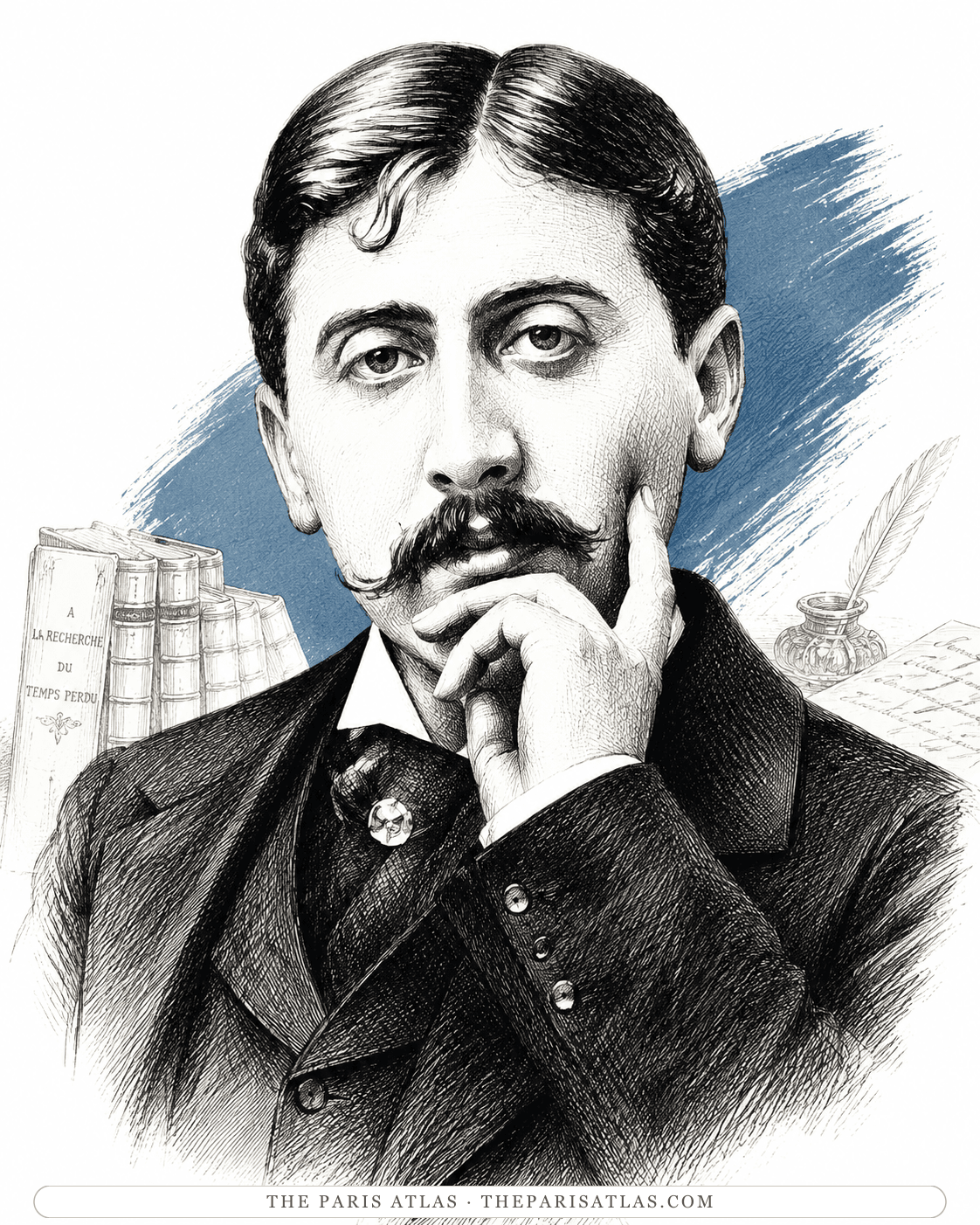
Illustrated portrait of Marcel Proust
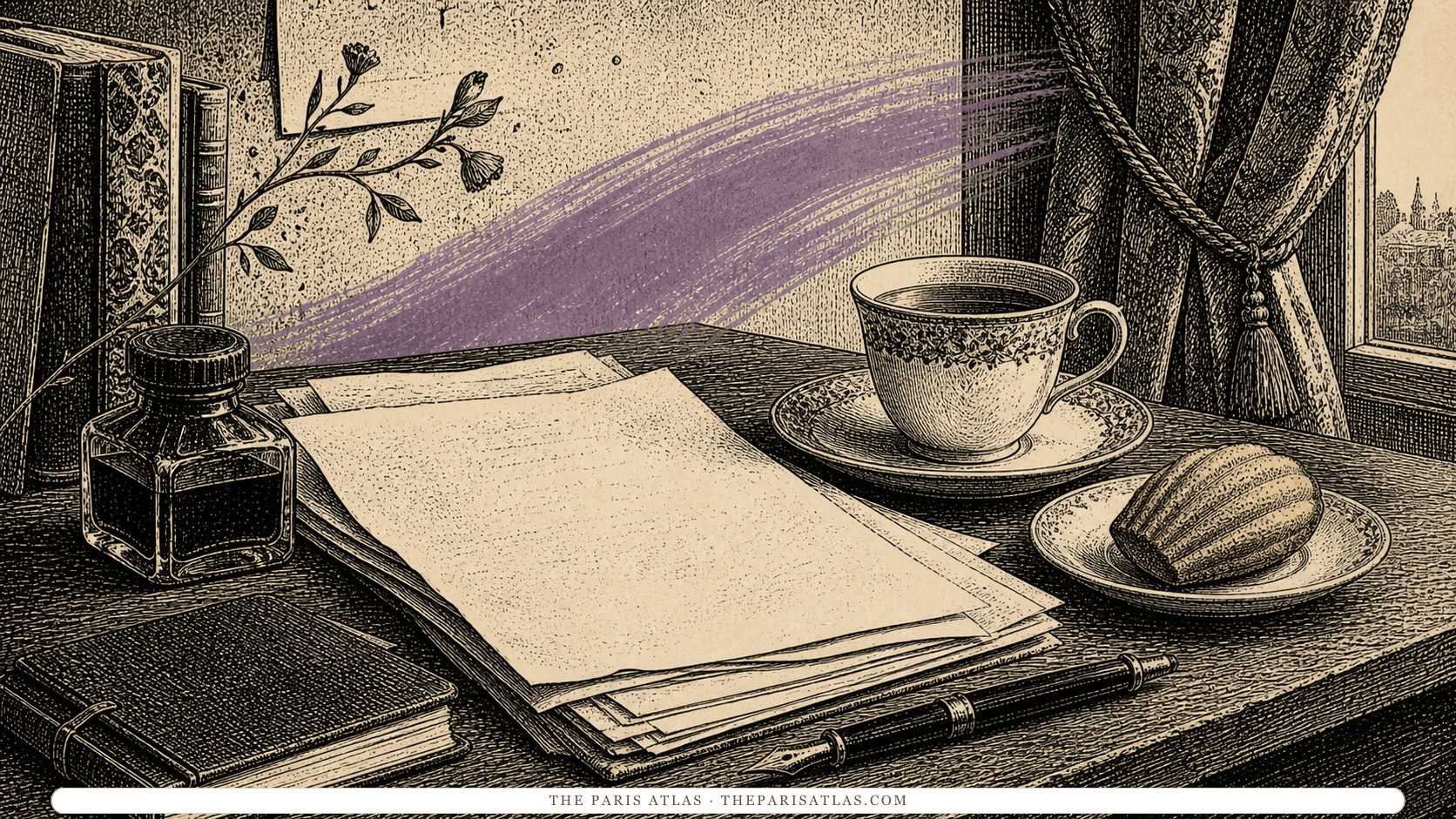
Pen-and-ink illustration of manuscript pages, tea, and a madeleine in a curtained bedroom

How these quotes were checked

How we decide whether a quote is genuine

Marcel Proust's novel runs to seven volumes, and the sentences everyone knows come mostly from the first two. Every line here is checked against the complete texts — the French originals and C. K. Scott Moncrieff's translation, the one that carried Proust into English.

The most shared “Proust” sentence in English is not quite his, and it is documented below.

One famous Marcel Proust quote, fact-checked

A sentence linked to Marcel Proust may be exact, shortened, remembered by someone else, or unsupported. Each label below explains what the available evidence actually proves.

Common paraphrase

“The real voyage of discovery consists not in seeking new landscapes, but in having new eyes.”

A modern smoothing of a real passage in The Prisoner. What the printed translation carries is “The only true voyage of discovery…” — a phrase that appears in more than a hundred volumes on HathiTrust, always in that form. The idea is Proust's; the wording that circulates is not.

  • — HathiTrust full-text phrase searches for Marcel Proust quote verification, 31 August 2026
For a long time I used to go to bed early.

Longtemps, je me suis couché de bonne heure.

— Marcel Proust, Swann's Way (1913), the opening sentence, translated by C. K. Scott Moncrieff
And suddenly the memory returns. The taste was that of the little crumb of madeleine which on Sunday mornings at Combray (because on those mornings I did not go out before church-time), when I went to say good day to her in her bedroom, my aunt Léonie used to give me, dipping it first in her own cup of real or of lime-flower tea.

Et tout d'un coup le souvenir m'est apparu. Ce goût c'était celui du petit morceau de madeleine que le dimanche matin à Combray (parce que ce jour-là je ne sortais pas avant l'heure de la messe), quand j'allais lui dire bonjour dans sa chambre, ma tante Léonie m'offrait après l'avoir trempé dans son infusion de thé ou de tilleul.

— Marcel Proust, Swann's Way (1913), translated by C. K. Scott Moncrieff
To think that I have wasted years of my life, that I have longed for death, that the greatest love that I have ever known has been for a woman who did not please me, who was not in my style!

Dire que j'ai gâché des années de ma vie, que j'ai voulu mourir, que j'ai eu mon plus grand amour, pour une femme qui ne me plaisait pas, qui n'était pas mon genre !

— Charles Swann (dialogue, spoken in his heart) · Marcel Proust, Swann's Way (1913), the closing of “Swann in Love,” translated by C. K. Scott Moncrieff
The time which we have at our disposal every day is elastic; the passions that we feel expand it, those that we inspire contract it; and habit fills up what remains.
— Marcel Proust, Within a Budding Grove (1919), translated by C. K. Scott Moncrieff
…that little phrase by Vinteuil which was, so to speak, the national anthem of their love.
— Marcel Proust, Swann's Way (1913), translated by C. K. Scott Moncrieff
But when from a long-distant past nothing subsists, after the people are dead, after the things are broken and scattered, still, alone, more fragile, but with more vitality, more unsubstantial, more persistent, more faithful, the smell and taste of things remain poised a long time, like souls, ready to remind us, waiting and hoping for their moment, amid the ruins of all the rest; and bear unfaltering, in the tiny and almost impalpable drop of their essence, the vast structure of recollection.

Mais, quand d'un passé ancien rien ne subsiste, après la mort des êtres, après la destruction des choses, seules, plus frêles mais plus vivaces, plus immatérielles, plus persistantes, plus fidèles, l'odeur et la saveur restent encore longtemps, comme des âmes, à se rappeler, à attendre, à espérer, sur la ruine de tout le reste, à porter sans fléchir, sur leur gouttelette presque impalpable, l'édifice immense du souvenir.

— Marcel Proust, Swann's Way (1913), trans. C. K. Scott Moncrieff
The places that we have known belong now only to the little world of space on which we map them for our own convenience. None of them was ever more than a thin slice, held between the contiguous impressions that composed our life at that time; remembrance of a particular form is but regret for a particular moment; and houses, roads, avenues are as fugitive, alas, as the years.

Les lieux que nous avons connus n'appartiennent pas qu'au monde de l'espace où nous les situons pour plus de facilité. Ils n'étaient qu'une mince tranche au milieu d'impressions contiguës qui formaient notre vie d'alors; le souvenir d'une certaine image n'est que le regret d'un certain instant; et les maisons, les routes, les avenues, sont fugitives, hélas, comme les années.

— Marcel Proust, Swann's Way (1913), trans. C. K. Scott Moncrieff

Questions about Marcel Proust quotes

What is the first line of In Search of Lost Time?

“Longtemps, je me suis couché de bonne heure” — “For a long time I used to go to bed early,” in C. K. Scott Moncrieff's translation. It opens Swann's Way, published in 1913.

What is the madeleine passage?

The scene early in Swann's Way where the narrator tastes a crumb of madeleine soaked in tea and an entire childhood at Combray returns to him unbidden. It is the founding example of what the novel calls involuntary memory, and the reason a small shell-shaped cake became a byword for remembering.

Did Proust write “the real voyage of discovery consists not in seeking new landscapes, but in having new eyes”?

Not in those words. The printed translation of the passage, from The Prisoner, begins “The only true voyage of discovery…” The popular version is a modern paraphrase.

Which translation do these quotations use?

C. K. Scott Moncrieff's, the translation that introduced Proust to English readers and the one in the public domain. Later translators word several of these lines differently — Swann's closing cry is the clearest case — and where that matters it is noted on the quote.

Who is Vinteuil?

A composer Proust invented. His sonata contains the “little phrase” that Swann and Odette adopt as the anthem of their affair, and which returns through the novel as a measure of what has changed.

Where should a new reader start with Proust?

Swann's Way, the first volume. The overture and the madeleine come in its opening pages, and “Swann in Love” inside it works almost as a self-contained novel.

References

References

The sources below are the editions, archives, and full-text searches used to verify the quotations on this page. Every line was checked against one or more of them before it appeared here.

  1. 1Project Gutenberg texts of Swann's Way (#7178), Within a Budding Grove (#63532) and The Guermantes Way (#73425), in C. K. Scott Moncrieff's translation

    Website
    Marcel Proust
    Used for

    Web source consulted for documented facts and historical context presented on the Marcel Proust page.

    View source
  2. 2Project Gutenberg text of Du côté de chez Swann (#2650), the French original

    Website
    Marcel Proust
    Used for

    Web source consulted for documented facts and historical context presented on the Marcel Proust page.

    View source
  3. 3HathiTrust full-text phrase searches for Marcel Proust quote verification, 31 August 2026

    Website
    Used for

    Web source consulted for documented facts and historical context presented on the Marcel Proust page.

    View source
i
Why these sources are here

Verification is the point of this collection: a quotation is listed only when its wording has been checked against the sources above, and the attribution notes record what each check found about the famous lines that failed.

Explore more resources

Newsletter

Join our newsletter

New stories about art, literature and famous places around the world.

Unsubscribe anytime.