The Paris AtlasCharting the artists, works, and places worth returning to.

In their own words

Voltaire quotes

22 quotations, each verified against its source and credited to the work it comes from — the wording as Voltaire wrote or said it, not as the internet passes it around.

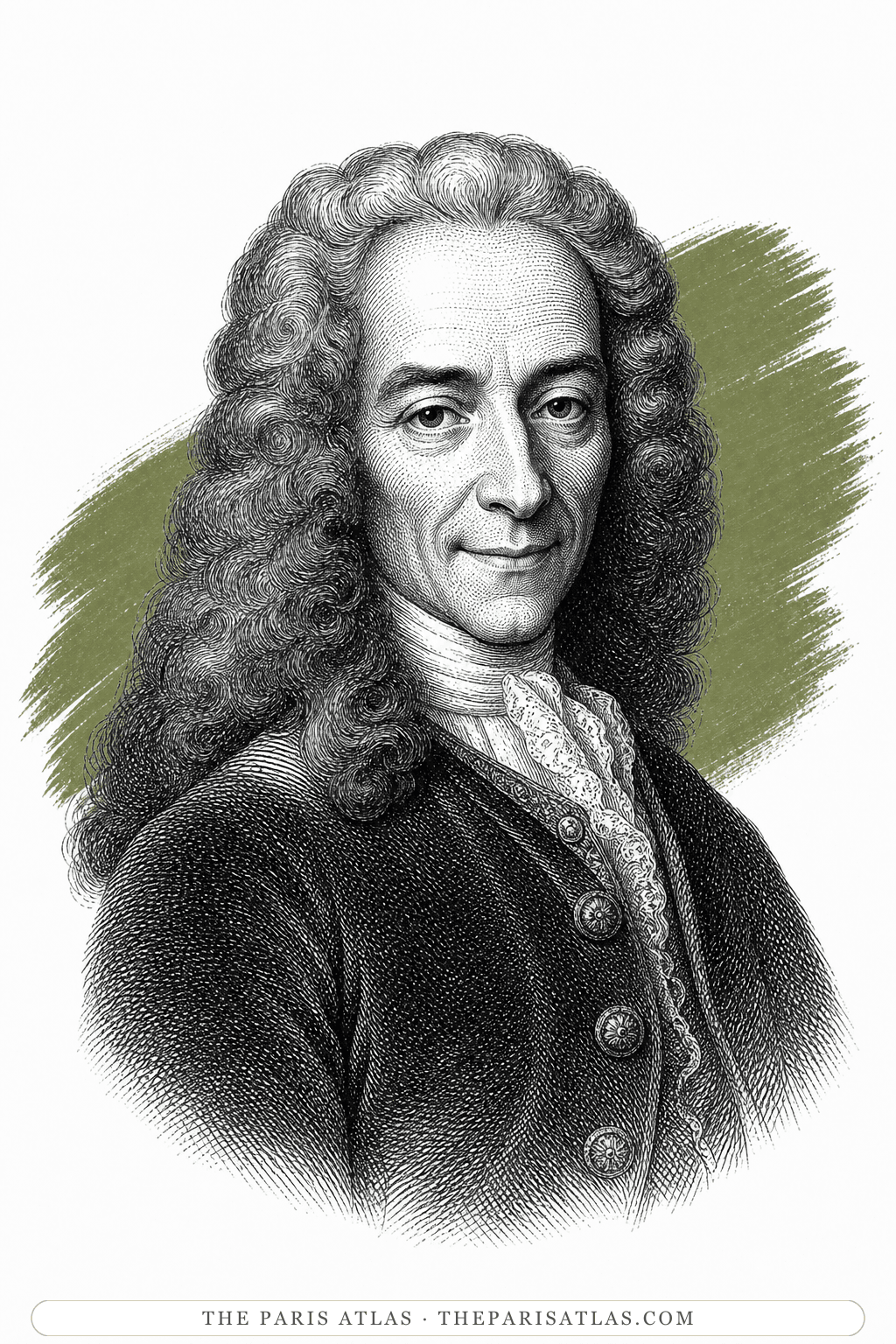
Illustrated portrait of Voltaire
Pen-and-ink illustration of a quill, manuscript pages, spectacles, and an Enlightenment garden

How these quotes were checked

How we decide whether a quote is genuine

Voltaire wrote tens of thousands of pages, which somehow was not enough: the most famous sentence attached to his name was written by someone else, a hundred and twenty-eight years after he died. A line enters this collection only when its wording is verified against his works and correspondence in their collected editions, French or English.

The great case is documented below.

One famous Voltaire quote, fact-checked

A sentence linked to Voltaire may be exact, shortened, remembered by someone else, or unsupported. Each label below explains what the available evidence actually proves.

Misattributed

“I disapprove of what you say, but I will defend to the death your right to say it.”

The sentence was written by Evelyn Beatrice Hall in her 1906 book The Friends of Voltaire — as her own summary of Voltaire's attitude in the Helvétius affair, not as a quotation. Hall said so herself when asked. It has been the world's favorite Voltaire quote ever since, and he never wrote it; modern Voltaire collections print it mainly to debunk it.

  • — Garson O'Toole, I Disapprove of What You Say, But I Will Defend to the Death Your Right to Say It (2015)
I know also, said Candide, that we must cultivate our garden.

Je sais aussi, dit Candide, qu'il faut cultiver notre jardin.

— Candide (dialogue) · Voltaire, Candide (1759), Chapter XXX
If God did not exist, it would be necessary to invent him.

Si Dieu n'existait pas, il faudrait l'inventer.

— Voltaire, “Épître à l'auteur du livre des Trois imposteurs” (1768)
Doubt is not a pleasant condition, but certainty is an absurd one.
— Voltaire, letter to Frederick William, Prince of Prussia, 28 November 1770
Common sense is very rare.

Le sens commun est fort rare.

— Voltaire, “Sens commun,” Dictionnaire philosophique (1764)
Écrasez l'infâme.
— Voltaire, the closing formula of his letters from the 1760s
If this is the best of possible worlds, what then are the others?
— Candide in Voltaire's Candide, anonymous English translation (1918)
but let us cultivate our garden.
— Candide in Voltaire's Candide, anonymous English translation (1918)
an opinion without judgment
— Voltaire, Philosophical Dictionary, translated by H. I. Woolf (1924)
Virtue among men is an interchange of kindness;
— Voltaire, Philosophical Dictionary, translated by H. I. Woolf (1924)
All Men neglect it in the Passage; and all regret the Loss of it when 'tis past.
— Zadig in Voltaire's Zadig, anonymous English translation (1749)
there is no such Thing as Chance
— Jesrad in Voltaire's Zadig, anonymous English translation (1749)
An Englishman, as one to whom liberty is natural, may go to heaven his own way.
— Voltaire, Letters on the English, Letter V, translated by John Lockman (1733)
There the Jew, the Mahometan, and the Christian transact together, as though they all professed the same religion, and give the name of infidel to none but bankrupts.
— Voltaire, Letters on the English, Letter VI, translated by John Lockman (1733)
If one religion only were allowed in England, the Government would very possibly become arbitrary; if there were but two, the people would cut one another's throats; but as there are such a multitude, they all live happy and in peace.
— Voltaire, Letters on the English, Letter VI, translated by John Lockman (1733)
The English are the only people upon earth who have been able to prescribe limits to the power of kings by resisting them
— Voltaire, Letters on the English, Letter VIII, translated by John Lockman (1733)
It is inadvertently affirmed in the Christian countries of Europe that the English are fools and madmen.
— Voltaire, Letters on the English, Letter XI, translated by John Lockman (1733)
He had left the world a plenum, and he now finds it a vacuum. At Paris the universe is seen composed of vortices of subtile matter; but nothing like it is seen in London.
— Voltaire, Letters on the English, Letter XIV, translated by John Lockman (1733)
I tell you once for all, nature is like nature, and comparisons are odious.
— Micromégas · Micromégas in Voltaire's Micromégas (1752), anonymous English translation (Peter Eckler, 1889)
I am now more than ever convinced that we ought to judge of nothing by its external magnitude.
— Micromégas · Micromégas in Voltaire's Micromégas (1752), anonymous English translation (Peter Eckler, 1889)
we measure lines, we make calculations, we agree upon two or three points which we understand, and dispute upon two or three thousand that are beyond our comprehension.
— A philosopher on the ship · A human philosopher in Voltaire's Micromégas (1752), anonymous English translation (Peter Eckler, 1889)
it is but reasonable we should quote what we do not comprehend in a language we do not understand.
— An old follower of Aristotle · An old follower of Aristotle in Voltaire's Micromégas (1752), anonymous English translation (Peter Eckler, 1889)
Accordingly, before his departure, he made them a present of the book, which was brought to the Academy of Sciences at Paris, but when the old secretary came to open it he saw nothing but blank paper
— Voltaire, Micromégas (1752), anonymous English translation (Peter Eckler, 1889)

From the books

Every book with a quote collection of its own, each line verified against the text.

Questions about Voltaire quotes

Did Voltaire say “I disapprove of what you say, but I will defend to the death your right to say it”?

No. Evelyn Beatrice Hall wrote the sentence in 1906 in The Friends of Voltaire, summarizing his attitude in her own words, and later confirmed the phrasing was hers. Voltaire's documented views on tolerance are real; this sentence is not his.

What does “il faut cultiver notre jardin” mean?

“We must cultivate our garden” — the closing reply of Candide, the fictional hero of Voltaire's 1759 tale of the same name, setting patient, concrete work against the systems of his tutor Pangloss. It is the book's last word and Voltaire's most quoted line of fiction.

Did Voltaire say “if God did not exist, it would be necessary to invent him”?

Yes — “Si Dieu n'existait pas, il faudrait l'inventer,” from his 1768 verse epistle answering an atheist tract. In its poem the line argues for belief's usefulness, not against belief.

What did Voltaire say about doubt and certainty?

In a 1770 letter to Frederick William, Prince of Prussia: “Doubt is not a pleasant condition, but certainty is an absurd one.”

What does “Écrasez l'infâme” mean?

“Crush the infamous thing” — Voltaire's battle-cry against religious persecution and fanaticism, used as the sign-off of his campaign letters through the 1760s and often abbreviated to “Écr. l'inf.”

Did Voltaire say “common sense is not so common”?

That is a loose rendering of a real sentence: “Le sens commun est fort rare” — common sense is very rare — from the “Sens commun” entry of his Philosophical Dictionary (1764).

References

References

The sources below are the editions, archives, and full-text searches used to verify the quotations on this page. Every line was checked against one or more of them before it appeared here.

  1. 1Candide

    Novel
    Project Gutenberg ebooks #19942 (English) and #4650 (French), 1759
    Used for

    Primary text included as part of the documented record for Voltaire.

    View source
  2. 2I Disapprove of What You Say, But I Will Defend to the Death Your Right to Say It

    Website
    Quote Investigator, 1 June 2015, 2015
    Used for

    Web source consulted for documented facts and historical context presented on the Voltaire page.

    View source
i
Why these sources are here

Verification is the point of this collection: a quotation is listed only when its wording has been checked against the sources above, and the attribution notes record what each check found about the famous lines that failed.

Explore more resources

Newsletter

Join our newsletter

New stories about art, literature and famous places around the world.

Unsubscribe anytime.