
Bonjour Tristesse
France, heat, leisure, and desire create a temporary world outside ordinary obligations.
Read our take
by James Salter
James Salter’s dreamlike 1967 novel of an intense affair, provincial France, and a temporary life imagined from the outside.
An American observer imagines the sexual relationship between a young American man and a French woman in provincial France. The result moves deliberately between fact, fantasy, desire, and the temporary freedom of travel.
A footloose American and a young French woman pursue an intense affair in provincial France while another man narrates and imagines their private life.
The train journey establishes how readily this narrator converts observation into a story about someone else. Clothing, gestures and a caramel wrapper are visible; a stranger’s passion, resignation or wish to remain silent are interpretations. His feeling that the world is becoming clearer does not make those interpretations certain. Salter places precise physical details beside unverifiable inward states, making them seem equally available. The passenger’s silence matters because she never supplies the account of herself that might challenge his: the encounter reveals the observer’s imagination as well as its object.
Reaching the Wheatlands’ house fulfills an idea formed on an earlier visit, but arrival does not arrest time. The gate’s martial inscription, commanding victory or death, has itself lost a letter. Worn stone and a sinking roof likewise make the desired refuge a place subject to decay. The chapter then moves from the apparent endlessness of September’s luminous days to autumn chill and the narrator’s awareness of aging. His return brings remembered promise and present change together: finding the place again cannot restore the moment in which he first wanted it.
It shares the heat, leisure, erotic freedom, and unreality of Sagan’s summer, but it is more explicit, dreamlike, and male-centered.
The observer’s fantasies make the limits of his knowledge part of the novel, rather than something readers can ignore.
Provincial places give the imagined relationship a particular social and physical world beyond the couple’s desire.
1967
Doubleday publishes Salter’s novel of an imagined love affair in France.
1980
Penguin Books issues a paperback edition.
1985
North Point Press reissues the novel, extending its life beyond the original Doubleday edition.

France, heat, leisure, and desire create a temporary world outside ordinary obligations.
Read our take
Another erotic experiment in France that gradually changes the people conducting it.
Read our take
Beautiful European settings, sexual relationships, and emotional damage beneath leisure.
Read our takeIt is set in France, with provincial places central to its imagined affair. This is not principally a novel of the Paris expatriate café circle.
An American observer narrates and imagines the relationship between a young American man and a French woman. His distance from the couple is essential to the book.
No. Fantasy and observation deliberately overlap. Readers need to notice when the narrator’s desires may be shaping the private scenes he describes.
Yes. Sexual intimacy is central to its account of desire and imagination. Readers seeking a discreet romantic travel story should expect something more explicit.
No. The novel is as interested in the observer’s imagination and the temporary freedom of travel as in the couple’s relationship. Its uncertainty resists an uncomplicated love story.
Explore authors with a similar voice, perspective, and influence.
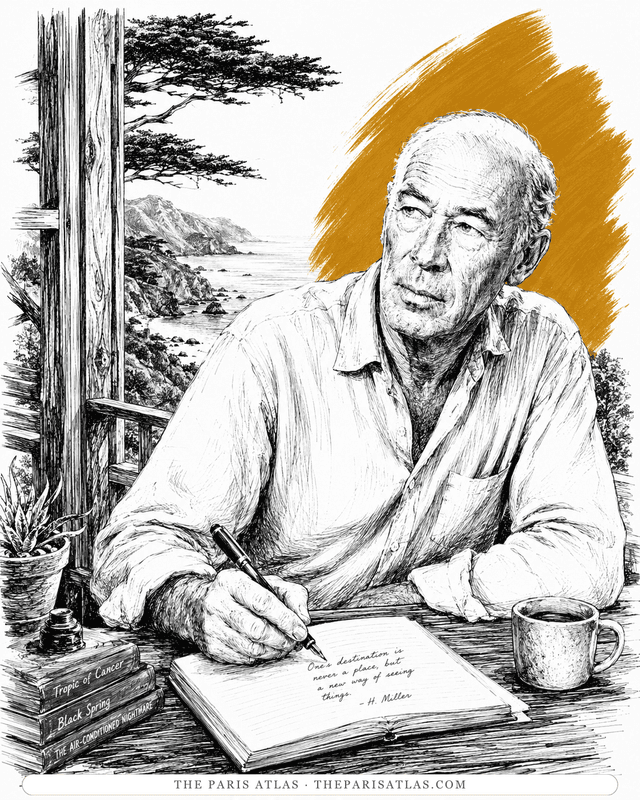
The Brooklyn dropout who arrived in Paris broke at thirty-eight and wrote the exuberant, banned books that ended American censorship.
View author
French Algerian novelist, essayist, journalist and playwright who used the absurd and revolt to ask how people should live without false consolation.
View author
French writer and philosopher whose novels, memoirs, and social analysis examined freedom, gender, responsibility, aging, and the material conditions that shape a life.
View authorThe sources below include the primary text, editions, scholarship, archival materials, and other records that informed this page. They document A Sport and a Pastime, its publication, and its place in literary history.


Official record used to verify names, dates, institutional details, or other factual information on this page.
Official record used to verify names, dates, institutional details, or other factual information on this page.
Archival evidence used to document the historical record connected to A Sport and a Pastime.
Official record used to verify names, dates, institutional details, or other factual information on this page.

Web source consulted for documented facts and historical context presented on the A Sport and a Pastime page.
Primary text included as part of the documented record for A Sport and a Pastime.
The primary text is the baseline reference for every book page. Additional references document publication history, interpretation, and historical context where that evidence is available.
 Explore more resources