
Lady Lazarus
A dramatic speaker who turns repeated returns from death into a confrontation with her audience.
The book

The figure in the poem
Close readingLady Lazarus is the theatrical speaker of Sylvia Plath's poem, a woman who describes repeated encounters with death and turns her return into a public confrontation. She is exposed to an audience, but she also addresses, mocks, and threatens it. Her voice repeatedly changes the terms on which other people may look at her.
A persona who controls the account
The Poetry Foundation's discussion of Lady Lazarus emphasizes the speaker's mixture of sincerity and irony. Details that resemble Plath's biography become material for a performance. That distinction matters because the poem's force depends on deliberate changes of tone, not on a reader proving that every claim reports an event in the poet's life.
Plath's own introduction to a BBC reading, reproduced by Emily LaBarge, describes the speaker's ability to be reborn as both a gift and a terror. Return is therefore more complicated than a reassuring recovery. The persona has extraordinary power, but she must repeatedly encounter the conditions that make that power necessary.
The audience is part of the violence
Spectators do not remain outside the drama. They crowd around an exposed woman and seek privileged access to her suffering. The speaker's language of admission charges makes that appetite explicit: her body, voice, and injuries are treated as things that can be consumed.
The Poetry Foundation reading identifies the resulting discomfort as a central achievement. A reader who comes looking only for scandal or biographical revelation begins to resemble the audience inside the poem. Lady Lazarus can sound entertaining and accusing within the same passage. The performance implicates the people it attracts.
Who claims ownership of her?
EBSCO's analysis follows the poem's movement through religious resurrection, public spectacle, and figures of male authority. The speaker addresses doctors and masters who claim authority over her body. Her accusations challenge their power to define her.
The Holocaust imagery gives this struggle an extreme historical scale. It is also ethically troubling: private suffering is compared with the persecution and murder of a people. The comparisons belong to the poem's rhetoric, not to a claim that Plath experienced the Holocaust. Recognizing their force does not require accepting the equivalence they propose.
The final return and its cost
The last transformation is impossible in ordinary life: the speaker returns from ash with destructive power. EBSCO reads the ending as a reversal of the authority exercised over her. The woman who was displayed as an object becomes a threat to those who would control her.
LaBarge's account resists smoothing Plath's conflicting voices into a single, consistent identity. That approach is useful here. Lady Lazarus can be wounded, calculating, comic, and terrifying without one quality explaining away the others. Her victory remains disturbing because she adopts a destructive power resembling the authority she has resisted.
Sources and passages
- Sylvia Plath, Lady Lazarus
Primary text, including the audience, charges, forms of address, and final transformation.
- Sylvia Plath: Selections
Poetry Foundation commentary on the poem's theatrical voice and its transformation of personal material.
- Lady Lazarus: The Poem; Forms and Devices
Critical discussion of resurrection, authority, historical imagery, and the ending.
- Emily LaBarge, I Am No Shadow
Royal College of Art repository: Plath's BBC introduction and the difficulty of reducing her voices to a single identity.
Voice, imagery, and form
- An opening already in progressHer first statement presumes repetition. The audience arrives after a history she chooses how to tell.
- A named ageThe speaker says she is thirty and arranges her account around ten-year intervals.
- Abrupt changes of addressShe shifts among spectators, doctors, and masters, directing attention toward different kinds of power.
- The language of a showEntertainment and bodily exposure make the crowd's curiosity uncomfortable.
- Payment for accessCharges for looking and touching expose the exchange beneath the spectators' interest.
- Return from ashThe ending gives the speaker an impossible form of power and a threatening final voice.
If you like Ariel


If you like Sylvia Plath
Explore authors with a similar voice, perspective, and influence.
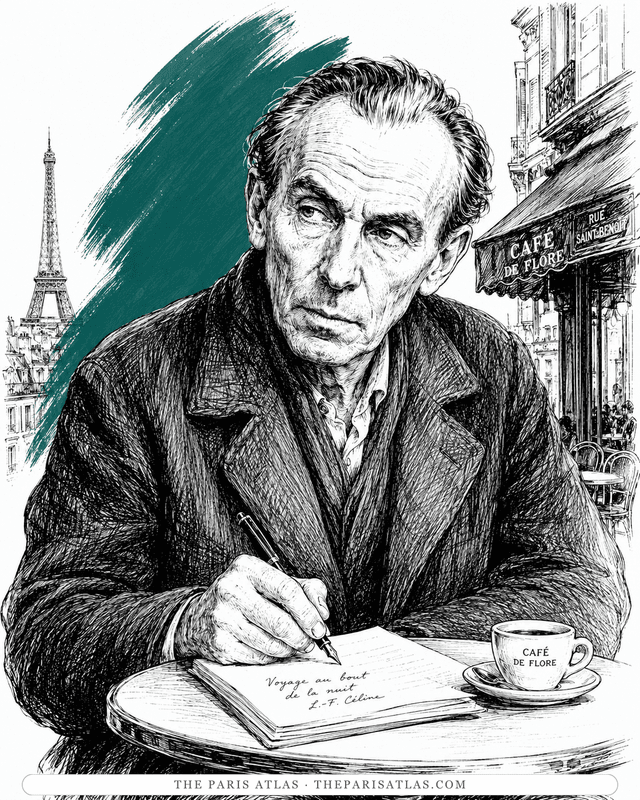
Louis-Ferdinand Céline
The doctor of the Paris slums who wrote the century's blackest, funniest novel — and changed the sound of French prose.
View author
Henry Miller
The Brooklyn dropout who arrived in Paris broke at thirty-eight and wrote the exuberant, banned books that ended American censorship.
View author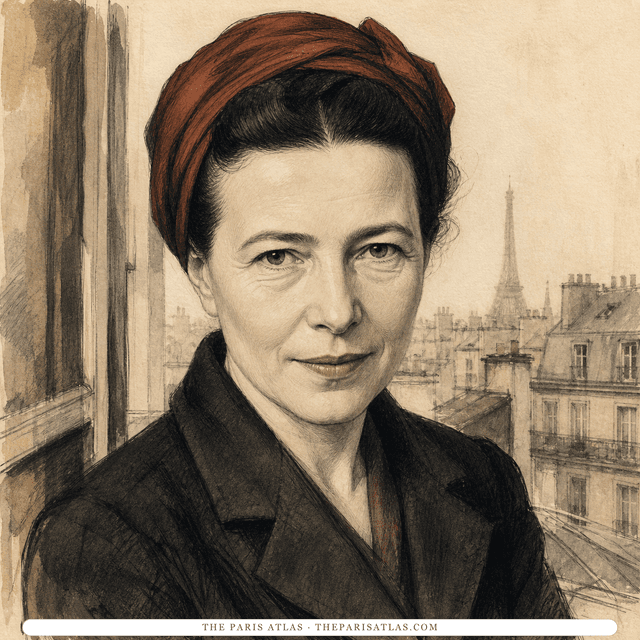
Simone de Beauvoir
French writer and philosopher whose novels, memoirs, and social analysis examined freedom, gender, responsibility, aging, and the material conditions that shape a life.
View author