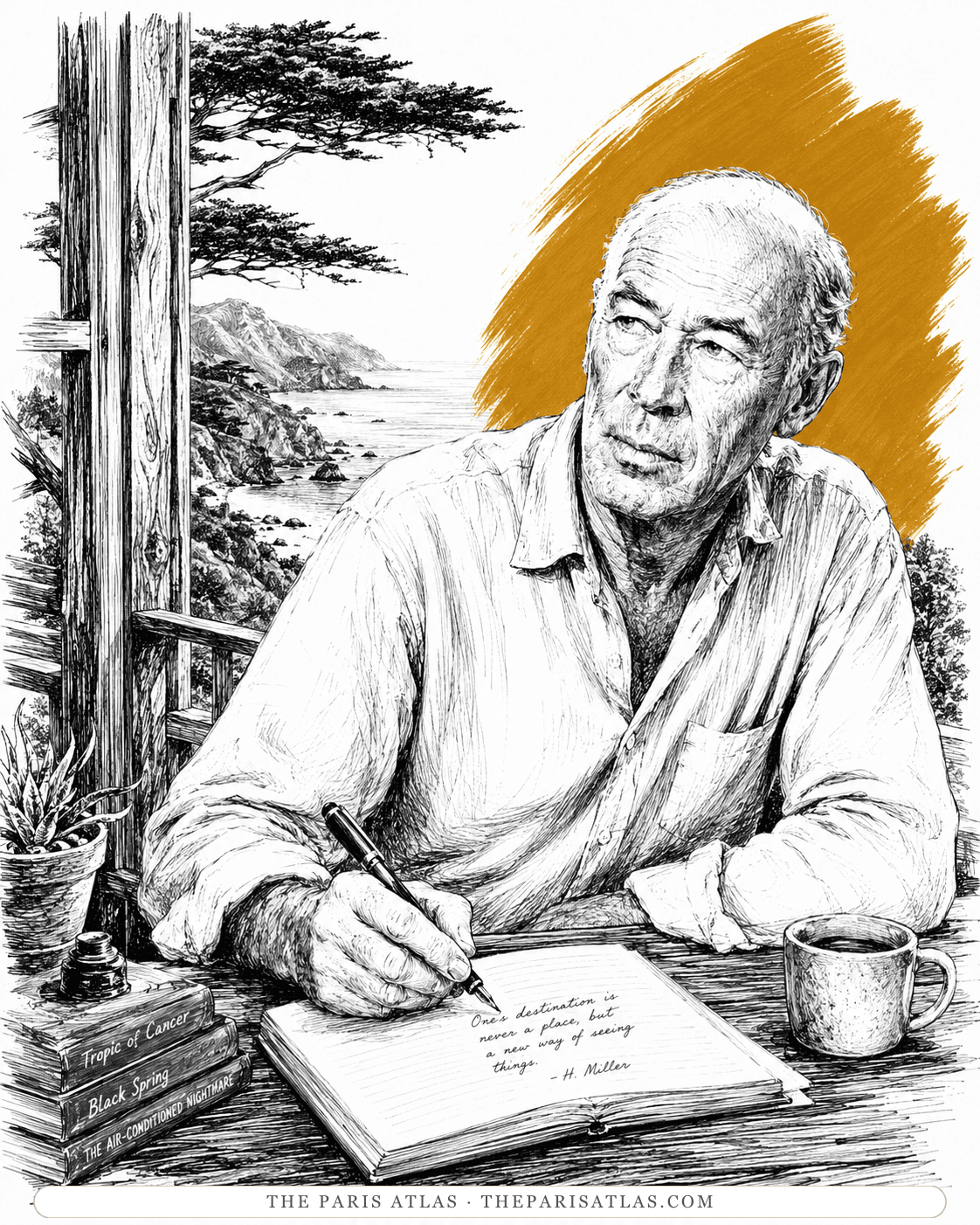


Mother, China, and the World Beyond
by Henry Miller
A late dream of death and reconciliation, followed by Miller’s imaginative China: the lifelong quarrel with his mother finally released.
- 1977
- 32
- Hallucinatory
- Elegiac
- autobiographical
- lyrical
- experimental
About Henry Miller
The story, briefly
Spoiler-freeMother, China, and the World Beyond is a late Henry Miller chapbook that joins a dream encounter with his mother after death to a meditation on the China of his childhood imagination. In the dream, the mother who had occupied so much adversarial space in his autobiographical writing asks forgiveness; the aging Miller finds that the old war has lost its force. Capra Press published the thirty-two-page book in 1977, and the piece was also collected in Sextet.
The story, in more detail
The opening moves through a posthumous waiting place rather than a realist scene. Miller meets his mother beyond ordinary life and is offered a reconciliation neither of them achieved while living. What matters is not a new verdict on the past but the disappearance of the need to prosecute it. The dream gives his late writing one of its clearest images of acceptance.
The China section turns toward a place Miller knew through reading, report, objects, and childhood association rather than travel. The word itself had once suggested something vast, remote, marvelous, and magical. Read together, the parts make a small book about destinations reached imaginatively: the world beyond, the mother beyond grievance, and a country long present in the mind before it could be understood as geography.
Themes and analysis
The dream’s reconciliation
The opening places Miller after his own death, meeting his mother before returning to another life. She seeks forgiveness for her treatment of him in childhood. His discovery is that the grievance has already loosened its hold: forgiveness is not a victory he must extract from her.
This is a narrated dream, not evidence of an actual conversation or a factual account of an afterlife. It allows the elderly writer to imagine a different ending to a relationship repeatedly portrayed through anger in his autobiographical work. The change lies in his response to the remembered mother.
In the dream passage reproduced by Jennifer Cowe, Miller’s mother describes the interval before rebirth as time for learning from mistakes. The scene imagines a kind of school without a deadline: people leave when they are ready. That changes the terms of judgment. Past injury is acknowledged, but the conversation looks toward what its participants might become rather than a final punishment. Death does not close off the possibility of change.
The country imagined from afar
China supplies another kind of distant world. Miller considers what its name has meant to him, rather than offering observations from a visit. His associations belong to personal memory and an imaginative geography that also includes other places felt to be remote from ordinary American life.
That distinction is essential to reading the essay critically. An imagined China can carry Miller’s hopes for peace and release from familiar social divisions without describing the lives of Chinese people. The attraction of the image tells us more securely about the writer’s longings than about the country.
The China passage quoted by Cowe gives the elderly writer and his childhood self the same response to a name. Wonder is not something maturity has taught him to discard; it connects the two ages. Miller then reverses the comparison, presenting the West as immature beside much older cultures. Age supplies humility rather than authority here. Yet grouping Chinese, Hindu and Egyptian traditions together also simplifies the societies he invokes to challenge American self-importance.
A late work with two movements
The family episode and the meditation on China both concern a departure from habitual ways of seeing. In the first, a once-hostile relation becomes available to compassion. In the second, a place outside Miller’s direct experience offers an alternative to the world he knows.
Capra published the thirty-two-page chapbook in 1977 as number 41 in its series. Its later place in Sextet brings it beside other short reflections from widely separated periods of Miller’s life. The dream gives this small work an emotional conclusion that should not be confused with a complete reconciliation of every conflict in his biography.
Why we recommend it
The mother war’s armistice
A conflict that energized decades of Miller’s writing ends not in victory but in release.
Late style at chamber scale
The small chapbook holds dream, memory, geography, and mortality without losing the directness of Miller’s voice.
Dreams as a form of autobiography
The work approaches family memory through dream associations, offering a different structure from a chronological account of Miller’s life.
What this book explores
Timeline
1977
Capra Press publishes Mother, China, and the World Beyond separately as a chapbook.
1977
The essay joins five other works in Capra’s collected volume Sextet.
2010
New Directions reissues Sextet, returning the essay to circulation within the six-work collection.
Book editions

- Paperback
- Capra Press
- 1977
- 9780884961048

- Hardcover
- Capra Press
- 1977
- 9780884961031
Reader reviews
Readers may also like

Tropic of Capricorn
The early autobiographical book where Miller’s grievance against his mother is at its most forceful.
Read our take
On Turning Eighty
A companion Capra chapbook about aging, gratitude, and the approach of death.
Read our takeMother, China, and the World Beyond: frequently asked questions
What happens in Mother, China, and the World Beyond?
Miller narrates a dreamlike meeting with his mother after death, where their lifelong conflict gives way to forgiveness, then turns to the China of his imagination and memory.
Did Henry Miller travel to China?
No. The China in this book is assembled from reading, hearsay, objects, and childhood associations rather than direct travel.
Is the essay also in Sextet?
Yes. Capra Press published it separately as a chapbook and also included it in Miller’s 1977 collection Sextet.
Is the book a travelogue about China?
No. China belongs to the work’s imaginative and dream material, not to an account of Miller traveling there.
How long was the original chapbook?
Capra’s 1977 chapbook ran to thirty-two pages.
If you like Henry Miller
Explore authors with a similar voice, perspective, and influence.
Louis-Ferdinand Céline
Miller's acknowledged master at making literature out of the gutter. Journey gave him permission; Cancer is what he did with it.
View author
Ezra Pound
Pound read Cancer and sent Miller a famously backhanded postcard. Both believed literature's job was to wake the reader by any means necessary.
View author
Simone de Beauvoir
French writer and philosopher whose novels, memoirs, and social analysis examined freedom, gender, responsibility, aging, and the material conditions that shape a life.
View author
References
References
The sources below include the primary text, editions, scholarship, archival materials, and other records that informed this page. They document Mother, China, and the World Beyond, its publication, and its place in literary history.
1Mother, China, and the World Beyond
MemoirHenry Miller, 1977Used forThe primary text represented by this page, used for descriptions of the work’s contents and for any quoted passages shown here.
2Sextet by Henry Miller — review
WebsiteEuropean Beat Studies NetworkUsed forWeb source consulted for documented facts and historical context presented on the Mother, China, and the World Beyond page.
3Mother, China, and the World Beyond — printed-book record
Official recordThe Morgan Library & MuseumUsed forOfficial record used to verify names, dates, institutional details, or other factual information on this page.
4Henry Miller signed Mother, China, and the World Beyond
WebsiteRR AuctionUsed forWeb source consulted for documented facts and historical context presented on the Mother, China, and the World Beyond page.
5Henry Miller and the search for spiritual transformation
WebsiteUniversity of GlasgowUsed forWeb source consulted for documented facts and historical context presented on the Mother, China, and the World Beyond page.
6The Happiest Man Alive: A Biography of Henry Miller
BiographySimon & Schuster, 1991Used forBiographical evidence used to verify chronology, relationships, and historical context connected to Mother, China, and the World Beyond.
i
Why these sources are here
The primary text is the baseline reference for every book page. Additional references document publication history, interpretation, and historical context where that evidence is available.
 Explore more resources