

The World of Lawrence
Miller’s sustained appreciation of the friend and writer at the other end of these letters.
Read our take
by Lawrence Durrell, Henry Miller
Forty-five years and nearly a million words — the expanded correspondence that restored lost letters and passages cut from the 1963 selection.
In 1935 the twenty-three-year-old Lawrence Durrell wrote Henry Miller an ecstatic letter about Tropic of Cancer. Miller answered, and the exchange continued until his death in 1980. Ian S. MacNiven’s 1988 edition makes an extensive selection from a correspondence approaching one million words, restoring previously lost letters and passages omitted from the earlier Lawrence Durrell and Henry Miller: A Private Correspondence. Both editions belong to one publication history, with their different editorial scopes kept clear. (Letters — nothing to spoil.)
The correspondence begins with a reader finding the writer he needs. Durrell, then living on Corfu and still years from The Alexandria Quartet, praised Tropic of Cancer in 1935; Miller recognized an ideal reader and replied. What followed was not a short fan exchange but a working literary friendship conducted across four and a half decades.
The letters move through the Villa Seurat circle, the Second World War, Miller’s return to America, Durrell’s diplomatic and island years, and the long composition of both writers’ major books. Each becomes the other’s reader, promoter, confessor, and occasional critic. Geography separates them for most of the period; the mailbox supplies continuity.
George Wickes’s 1963 Lawrence Durrell and Henry Miller: A Private Correspondence offered the first large public selection, covering the correspondence through 1959. MacNiven’s 1988 Durrell–Miller Letters is not simply a retitled reprint. New Directions states that almost half its contents had not appeared in the earlier volume, including recovered letters and passages previously cut; its chronology also extends to Miller’s final year.
The opening years trace Durrell’s response to Tropic of Cancer, the meeting of the writers’ circles, and the publications and arguments that grew around the Villa Seurat. The war scatters the group and turns the exchange into a long-distance workshop linking Corfu, Egypt, Paris, California, and later Durrell’s homes around the Mediterranean and in southern France.
The later letters follow diverging kinds of fame, marriages and losses, changing health, paintings, manuscripts, and the repeated business of urging one another to keep working. Read continuously, the selection becomes the dual creative biography MacNiven described: two writers aging inside the same conversation.
Durrell's early-November 1936 letter makes the disorder of packing a setting for critical thought rather than an obstacle to it. His reading of Hamlet separates the prince's public obligations from an inner life that those obligations cannot contain. But the letter is also a record of an argument still being made: he asks Miller to tell him whether it makes sense and to keep the note for an essay he has not yet written. Correspondence gives the provisional idea both a reader and a place to survive. The sweeping judgments are Durrell's, not settled conclusions about Shakespeare; their force belongs partly to the excitement of trying them on a trusted correspondent.
In the letter of 8 March 1937, reproduced in The Paris Review's earlier selection, Miller's extravagant response to The Black Book quickly becomes a practical problem of preservation. The only typescript is unnumbered, and sending it onward might endanger the work he wants others to read. His proposal to arrange and pay for copies translates admiration into labor, money and responsibility. He still asks Durrell what to do, leaving the decision with the author. Literary friendship here is neither praise alone nor a mentor taking possession of a younger writer's work: it depends on making the manuscript shareable without making it disposable.
Few correspondences run from a first fan letter through forty-five years of books, marriages, wars, arguments, visits, and old age.
Each man becomes the other’s first serious reader, so the letters preserve books while they are still decisions rather than finished monuments.
Recovered letters and restored passages change the texture of the relationship; this is why both editorial histories belong on one page.

The young admirer who becomes Miller’s ideal reader, closest literary ally, critic, and correspondent for forty-five years.
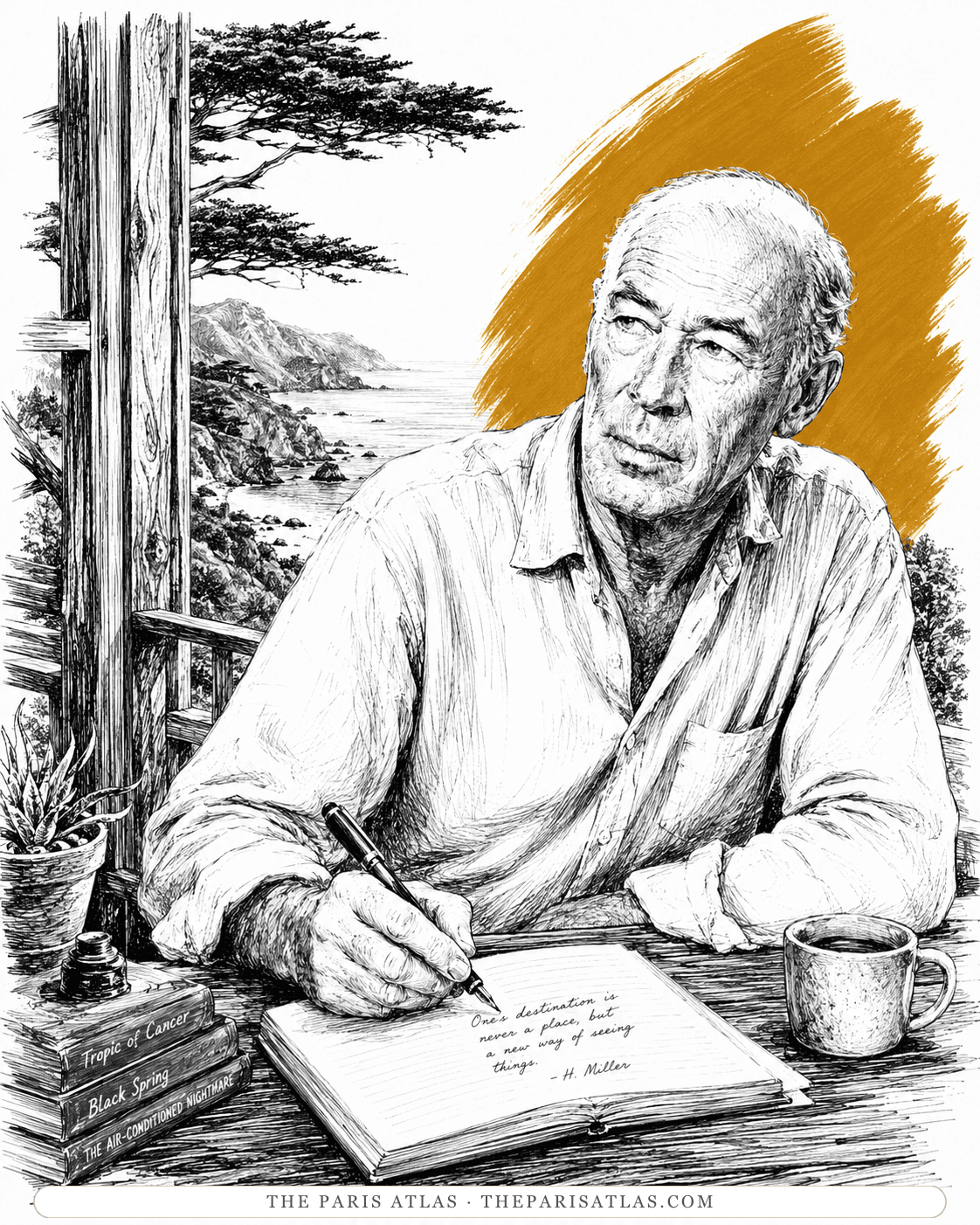
The established Paris writer who answers one intelligent fan letter and finds the reader, advocate, and friend he keeps for the rest of his life.
1935
Durrell writes to Miller from Corfu after reading Tropic of Cancer; Miller replies.
1937
Durrell visits the Villa Seurat circle in Paris, turning the correspondence into an in-person literary alliance.
1963
George Wickes edits Lawrence Durrell and Henry Miller: A Private Correspondence, selecting letters through 1959.
1980
The exchange ends with Miller’s death.
1988
New Directions publishes Ian S. MacNiven’s expanded 528-page Durrell–Miller Letters.


Miller’s sustained appreciation of the friend and writer at the other end of these letters.
Read our take
The Greek journey made possible by Durrell’s invitation and threaded through the early correspondence.
Read our take
Anaïs Nin’s side of the Villa Seurat triangle, addressed to the same correspondent.
Read our take
Durrell first wrote to Miller from Corfu in 1935 after reading Tropic of Cancer. They met in person later, and the correspondence continued until Miller’s death in 1980.
No. It is an extensive representative selection from a surviving exchange New Directions describes as nearly one million words.
George Wickes’s 1963 book selected letters through 1959. Ian S. MacNiven’s 1988 edition extends the story to 1980, adds recovered and previously unpublished letters, and restores passages omitted from the earlier selection.
Ian S. MacNiven edited the expanded 1988 volume. George Wickes edited the earlier Lawrence Durrell and Henry Miller: A Private Correspondence.
The expanded collection covers 1935 to 1980, from the beginning of their correspondence to the year of Miller’s death.
Explore authors with a similar voice, perspective, and influence.

The doctor of the Paris slums who wrote the century's blackest, funniest novel — and changed the sound of French prose.
View author
The Brooklyn dropout who arrived in Paris broke at thirty-eight and wrote the exuberant, banned books that ended American censorship.
View author
Author of The Sun Also Rises and A Moveable Feast; his pared-down style, developed in 1920s Paris, became the most imitated in American prose.
View authorThe sources below include the primary text, editions, scholarship, archival materials, and other records that informed this page. They document The Durrell–Miller Letters, 1935–1980, its publication, and its place in literary history.

Official record used to verify names, dates, institutional details, or other factual information on this page.
Official record used to verify names, dates, institutional details, or other factual information on this page.
Official record used to verify names, dates, institutional details, or other factual information on this page.

First-person evidence and historical context used in preparing the The Durrell–Miller Letters, 1935–1980 page.
The new Hamlet reading uses the presented early-November 1936 excerpt, explicitly credited to the 1988 New Directions selection. Its bracketed letter date is less precise than the webpage title; no original book pagination is claimed.
The manuscript reading uses Miller's visible letter of 8 March 1937 in The Paris Review's 1963 selection. Its exact inclusion and pagination in the expanded 1988 volume were not independently collated; the two publication histories remain distinct.
The primary text is the baseline reference for every book page. Additional references document publication history, interpretation, and historical context where that evidence is available.
 Explore more resources