The Paris AtlasCharting the artists, works, and places worth returning to.
  • Painter
  • Illustrator
  • Educator
· American · 1899–1979

Aaron Douglas

The painter who gave the Harlem Renaissance — the flowering of Black American writing, music and art between the world wars — its look, in flat purple silhouettes in profile, ringed by bands of light. He moved to Harlem in 1925 with Paris as the eventual destination, got there in 1931, spent a year at the Académie Scandinave, a private art school in the city, and came home to paint the four murals that are still the centrepiece of the Schomburg Center, the New York Public Library's Harlem research library on Black history.

Details

Lived
1899–1979
Born
1899
Birthplace
Topeka, Kansas
Died
1979
Place of death
Nashville, Tennessee
Nationality
American
Profession
Painter, illustrator, and art teacher
Major works
Aspects of Negro Life (1934), illustrations for God's Trombones (1927)
Roles
PainterIllustratorEducator

About Aaron Douglas

If you have seen one image of the Harlem Renaissance — the flowering of Black American writing, music and art between the world wars — it is probably an Aaron Douglas: flat figures in hard profile, cut out in violet and grey, drums and skyscrapers and raised arms, everything rippling under concentric rings of light. He made the movement a visual style almost single-handed, first in magazine illustrations and book jackets, then in murals.

The Paris fact is not a detour but the plan. When Douglas left a Kansas City schoolroom for Harlem in June 1925, the Kansas Historical Society records his intention plainly: he meant to pursue an art career ultimately in Paris. It took six years to get there, and the delay included a year spent studying inside the private art collection of Albert C. Barnes, a Philadelphia chemist who had made a fortune from a patented medicine. In 1931 he finally went, spent about a year in the city studying at the Académie Scandinave — the Scandinavian Academy, one of the private art schools of Paris — and came back to New York to paint Aspects of Negro Life: the four panels, finished in 1934 for the 135th Street branch library in Harlem, that are the best-known murals of Black American art.

Topeka to Harlem, with Paris at the end of the plan

Aaron Douglas was born in Topeka, Kansas, in 1899, and paid his way through an ordinary American series of jobs — a nursery, a railroad materials yard, a spell at the Cadillac car plant in Detroit after he left Topeka High School in 1917, waiting tables as a student. He took a bachelor of fine arts at the University of Nebraska in 1922, spent the following year at the University of Kansas, and then taught art for two years at Lincoln High School in Kansas City, Missouri.[1]

In June 1925 he moved to Harlem — intending, the Kansas Historical Society's account says, to pursue an art career ultimately in Paris. He arrived at the exact moment the neighbourhood became the centre of Black American culture, and the Paris plan was put aside for six years. He won a two-year scholarship to study under Winold Reiss, a German-born illustrator working in New York, who told him to stop looking at Europe and look instead at Africa — advice that produced the style everyone now recognises.[1]

What the silhouettes actually are

Douglas's method is easy to describe and was extremely hard to invent. He drew figures as flat silhouettes, seen from the side, with the eye left as a blank almond — a way of drawing the human body borrowed from ancient Egyptian relief carving and West African sculpture rather than from European life drawing. He then laid over them a system of hard-edged geometric shapes and concentric circles, so that light seems to spread across the picture in rings, like sound. The Smithsonian American Art Museum sums up the combination as angular cubist rhythms — Cubism being the early twentieth-century style that broke objects into flat angular planes — art deco styling, the sleek geometric fashion of the 1920s and 1930s, and traditional African and African American imagery. The palette is usually narrow: violets, greys, ochres, a single hot accent.

The style went out into the world on paper first. Douglas drew for The Crisis, the magazine of the National Association for the Advancement of Colored People, the country's leading civil rights organisation, and for Opportunity, the journal of the National Urban League, which worked on jobs and housing for Black families arriving in northern cities, and then for the general-interest magazines Harper's and Vanity Fair. He illustrated the books that defined the decade: the poet James Weldon Johnson's God's Trombones (1927), a cycle of Black folk sermons in verse; the 1927 reissue of Johnson's novel The Autobiography of an Ex-Colored Man; and the poet Langston Hughes's second collection, Fine Clothes to the Jew (1927), whose title — argued about then and since — comes from a line in one of the poems about pawning clothes when the money runs out. That is why the Harlem Renaissance has a look at all: a reader in Ohio met the movement as a Douglas drawing on a book jacket.

A year inside Albert Barnes's collection

In 1927 the Philadelphia chemist Albert C. Barnes — who had made a fortune from an antiseptic and spent it on one of the great private collections of modern painting — set up a scholarship programme for young Black artists, writers and musicians. Barnes was already deep in the movement, working with the philosopher Alain Locke, the Howard University professor whose 1925 anthology The New Negro announced the Harlem Renaissance to the country, to argue that African sculpture was major art rather than ethnographic curiosity. Douglas was among the people he funded.

What the Barnes fellowship bought was a year at the foundation's galleries in Merion, Pennsylvania, outside Philadelphia, awarded by Barnes personally: a year looking at modern European and American paintings hung deliberately alongside African carvings, which is to say a year being shown the argument Douglas's own pictures were already making. It was not, despite the shorthand that sometimes attaches to it, a travel grant to France. Paris came later, and how it was paid for is not something the surviving institutional record says.

Paris, 1931

He made it in 1931, and stayed about a year — studying, in the Kansas Historical Society's phrase, classical art. The school was the Académie Scandinave, the Scandinavian Academy: one of the private Paris art academies that took foreign students straight into a studio, as opposed to the École des Beaux-Arts, the French state art school with its competitive entrance examination. The Amistad Research Center at Tulane University in New Orleans, which keeps an artist file on him, is the archive that records the enrolment.[2]

He was not alone, and the company matters. Three other African American painters were working in and out of Paris in those years: Palmer C. Hayden, who painted Black working life in New York; Hale Woodruff, later the muralist of the Amistad panels at Talladega College; and Archibald J. Motley Jr., the portraitist of Black Chicago. In May 2024 the Institut Giacometti in Paris — the museum and research centre devoted to the sculptor Alberto Giacometti — devoted a lecture by the Duke University art historian Richard J. Powell to exactly this group of four, under the title La Renaissance de Harlem et Paris, the Harlem Renaissance and Paris: on the city as a central place and a source of inspiration for all of them, and on what the encounter between a European capital and these American painters produced. Douglas came home to New York after about a year.

It is worth being honest about the size of it. A year is a short stay, next to the decades that the American dancer and singer Josephine Baker or the painter Beauford Delaney spent in the city. Douglas did not settle, did not join any recorded circle in Montparnasse — the Left Bank district where the city's foreign artists gathered — and did not come back a French painter. What the year gave him, on the evidence of the work, was scale and confidence: he had gone over as an illustrator of books and came back and painted walls.

Aspects of Negro Life, 1934

The 135th Street branch of the New York Public Library had opened in 1905 and, since May 1925, had housed the Division of Negro Literature, History and Prints — the collection that grew into the Schomburg Center for Research in Black Culture. In 1934, paid by one of the New Deal art programmes with which the federal government kept artists in work through the Depression, the economic collapse that put a quarter of American workers out of a job, Douglas painted four murals for it.

Aspects of Negro Life runs the whole history in four panels: The Negro in an African Setting, drummers and dancers ringed with light; An Idyll of the Deep South; From Slavery Through Reconstruction, Reconstruction being the years after the Civil War when the freed population briefly held political power in the South; and Song of the Towers, in which a saxophone rises against the skyline of the industrial North that the Great Migration — the movement of millions of Black Americans out of the rural South to northern cities from about 1916 — was carrying people toward. They are still in the building, the centrepiece of the room in the Schomburg Center that carries Douglas's name.

He became the first president of the Harlem Artists Guild and pressed the Works Progress Administration — the federal agency that employed artists on public commissions — to recognise African American artists as it recognised white ones. In 1936 he painted a four-panel mural for the Texas Centennial Exposition in Dallas, the fair marking a hundred years of Texan independence. And in 1937 and 1938 he applied to the Julius Rosenwald Fund, the Chicago philanthropy that financed Black education and Black artists, with references from James Weldon Johnson and Winold Reiss and a proposal in his own words: to create a contemporary portrait of the American Negro, consisting of portraits, character studies, and scenes of Negro environments. When the fund renewed the fellowship, he used it to go and paint in Haiti.

Fisk: twenty-seven years of teaching

In 1939 the sociologist Charles S. Johnson — an old Harlem mentor of Douglas's, and the first African American president of Fisk University in Nashville, Tennessee, one of the historically Black universities founded to educate Black Americans at a time when most American colleges would not admit them — invited him to build Fisk an art department. Douglas took the job while still finishing a master's degree at Columbia University's Teachers College in New York, which he received in 1944, and stayed until he retired in 1966. He founded the department, chaired it, and established the university's Carl Van Vechten Gallery, named for the white writer and photographer who documented the Harlem Renaissance and helped bring its collection to Fisk; his murals of African American history, from the Middle Passage — the sea crossing that carried enslaved Africans to the Americas — onward, are in Fisk's Cravath Hall.

He died in Nashville on 2 February 1979. Nearly thirty years later the Spencer Museum of Art at the University of Kansas organised the first retrospective to tour the country — more than eighty works, shown at the Smithsonian American Art Museum in Washington in 2008 under the title Aaron Douglas: African American Modernist. The museum's own summary of him is the short version of this page: one of the most influential visual artists of the Harlem Renaissance.[1]

Life events

  1. 1899

    Born in Topeka, Kansas.

    — Aaron Douglas; Douglas, Aaron

  2. 1922

    Takes a bachelor of fine arts at the University of Nebraska, then a year at the University of Kansas and two years teaching art at Lincoln High School in Kansas City, Missouri.

    — Douglas, Aaron

  3. 1925

    Moves to Harlem in June, intending to pursue an art career ultimately in Paris, and wins a two-year scholarship to study with the illustrator Winold Reiss.

    — Douglas, Aaron

  4. 1927

    Illustrates James Weldon Johnson's God's Trombones and Langston Hughes's Fine Clothes to the Jew; Albert C. Barnes sets up the Philadelphia scholarship programme for young Black artists that Douglas will hold.

    — Douglas, Aaron; Albert C. Barnes and Black Communities

  5. 1928

    Spends a year at the Barnes Foundation in Merion, Pennsylvania, on a fellowship awarded by Albert Barnes himself, studying modern European and American painting hung alongside African sculpture.

    — Aaron Douglas: From Harlem to Philly

  6. 1931

    Reaches Paris at last and spends about a year there studying, enrolled at the Académie Scandinave.

    — Douglas, Aaron; Aaron Douglas

  7. 1934

    Finishes Aspects of Negro Life — four panels, from an African setting to the industrial North — for the 135th Street branch library in Harlem, under a New Deal programme. They remain there, in the Aaron Douglas room of the Schomburg Center.

    — Schomburg Center Centennial Timeline; Douglas, Aaron

  8. 1936

    Paints a four-panel mural for the Texas Centennial Exposition in Dallas.

    — Aaron Douglas

  9. 1937

    Applies to the Julius Rosenwald Fund, with references from James Weldon Johnson and Winold Reiss, to make a contemporary portrait of the American Negro; a renewal takes him to Haiti.

    — Application for Aaron Douglas, Julius Rosenwald Fund Fellowship, 1937-1941

  10. 1939

    Charles S. Johnson, the first African American president of Fisk University, invites him to Nashville to build an art department.

    — Douglas, Aaron

  11. 1944

    Takes a master's degree from Columbia University's Teachers College, which he had been completing while teaching at Fisk.

    — Douglas, Aaron

  12. 1966

    Retires from Fisk, having founded and led its art department and established its Carl Van Vechten Gallery.

    — Douglas, Aaron; Aaron Douglas

  13. 1979

    Dies in Nashville on 2 February.

    — Douglas, Aaron

  14. 2008

    Aaron Douglas: African American Modernist, the first nationally touring retrospective — more than eighty works, organised by the Spencer Museum of Art at the University of Kansas — is shown at the Smithsonian American Art Museum.

    — Aaron Douglas: African American Modernist (2008)

Selected works

Cataloged from the holding institutions' records. Reproductions appear only where the rights are verified.

Paintings

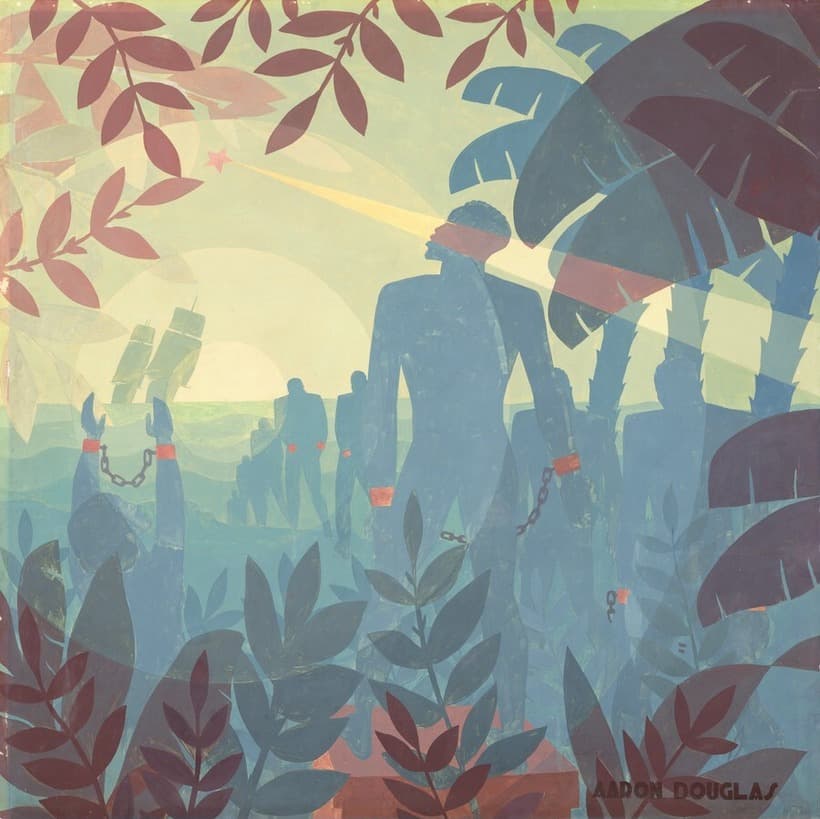
A square painting in greens, blues and plum. A broad-shouldered man stands near the centre on a brick-red box, seen from behind with his head turned in profile and his eye a narrow slit, terracotta-orange shackles on both wrists joined by a black chain. A woman at the left kneels with her shackled hands raised overhead, and a line of smaller bowed figures walks away towards banded green water. Two tall green sailing ships stand on the horizon, and a small red star in the upper left throws a yellow beam across the standing man's face. Concentric rings spread from the horizon across the whole canvas, and palm fronds and leaves in plum, slate and blood red frame the scene at the top and both edges

Artwork reproduction

Painting

Into Bondage

1936 · Oil on canvas

A line of shackled men and women walks down a shore towards two ships waiting on the horizon. Aaron Douglas painted the canvas in 1936 for the Hall of Negro Life at the Texas Centennial Exposition in Dallas, and the National Gallery of Art in Washington has owned it since 2014. The museum's own account of the subject is plain: the outcome of the journey is enslavement in a distant country.
National Gallery of Art

Aaron Douglas, Into Bondage, 1936. National Gallery of Art. Image © the rights holder, shown under fair use.

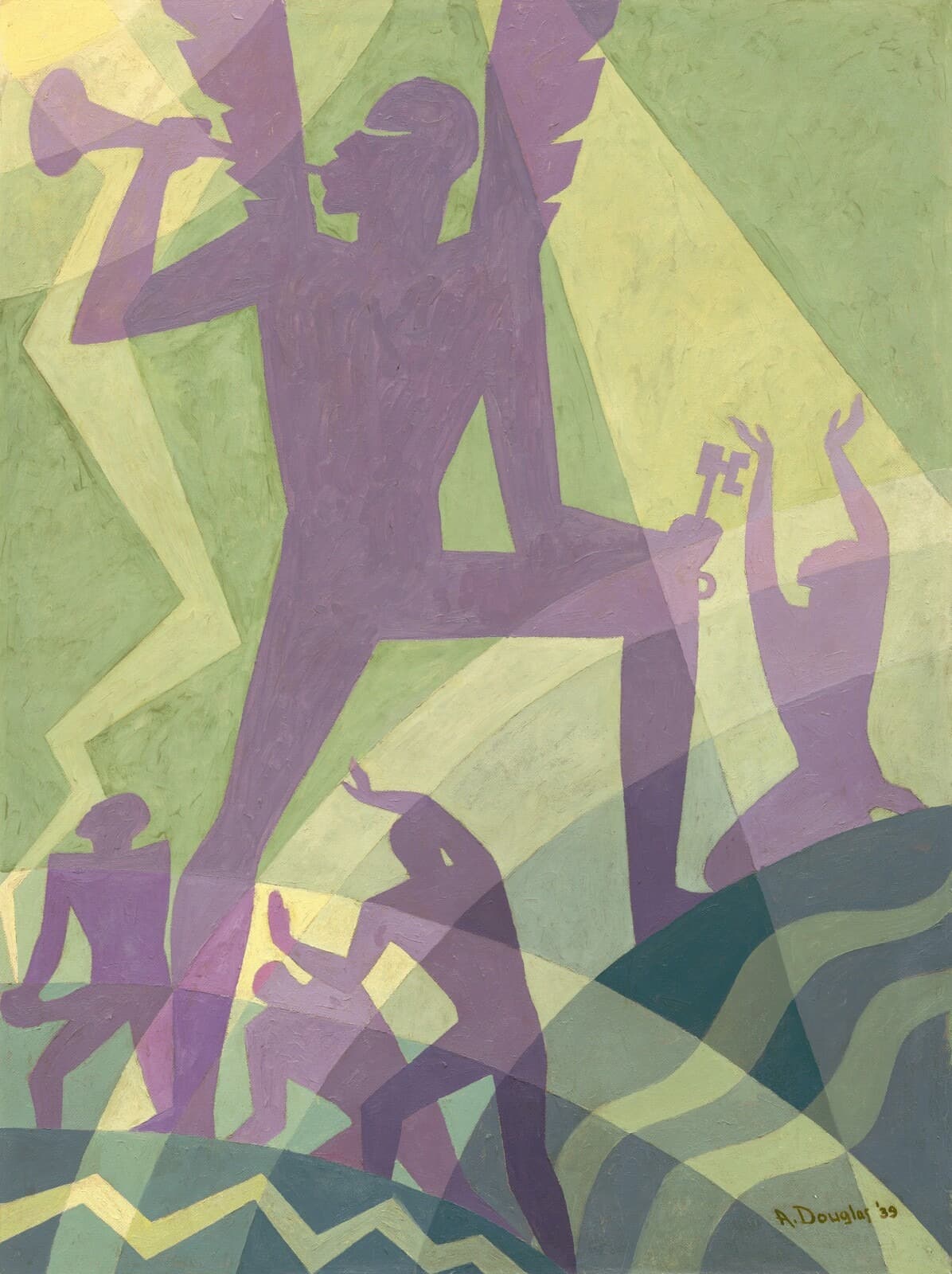
A tall winged figure in flat lilac purple stands with one foot on each of two rounded green hills, body facing forward and head turned in profile with the eye a shallow slit, raising a horn to his lips whose bell reaches the top left corner. A skeleton key hangs from the hand propped on his bent right knee. Four smaller amethyst-purple silhouettes stand behind him, one kneeling with both hands raised, two framed between his legs and one with hands clasped, all looking up. The ground is a field of alternating celery and lime-green bands, with concentric arcs of lemon yellow and pale green in the upper left corner

Artwork reproduction

Painting

The Judgment Day

1939 · Oil on tempered hardboard

A winged figure in lilac purple stands with one foot on each of two green hills, a horn at his lips and a key in his lowered hand. Aaron Douglas painted it in 1939 from a drawing he had made twelve years earlier for James Weldon Johnson's book of verse sermons, God's Trombones. The National Gallery of Art in Washington calls it the last painting in that series and has owned it since 2014.

National Gallery of Art

Aaron Douglas, The Judgment Day, 1939. National Gallery of Art. Image © the rights holder, shown under fair use.

Drawings

A black-and-white drawing. A figure drawn to the shoulders stands near the centre, the head in hard profile facing right with the eye cut out as a thin white slit, a blocky collar below it and a jagged white crack running down through the black mass beneath. Long tapering black beams radiate outward and down, each holding white five-pointed stars with thin white tails, about twenty in all. Two wide black wedges lie across the upper right carrying eight more falling stars. A figure lies at the lower right with the head in profile facing left and a limb bent above it, a smaller head with a white eye is at the lower centre below a bare leg and foot, and a heavy angular mass ending in a hooked curl fills the upper left corner. Printed below: By Douglas, and the caption "An' the stars began to fall."

Artwork reproduction

Drawing

An' the stars began to fall

1925 · Drawing printed as a full-page plate in a book; no physical original is catalogued

A standing figure looks up while about twenty white stars fall through black beams that cross the page. Aaron Douglas drew it for The New Negro, the anthology Alain Locke edited in 1925, where it is printed at page 198 and captioned with a line from a spiritual. The plate faces the first page of Alain Locke's essay on the spirituals.

Aaron Douglas, An' the stars began to fall, 1925. Image: public domain (US).

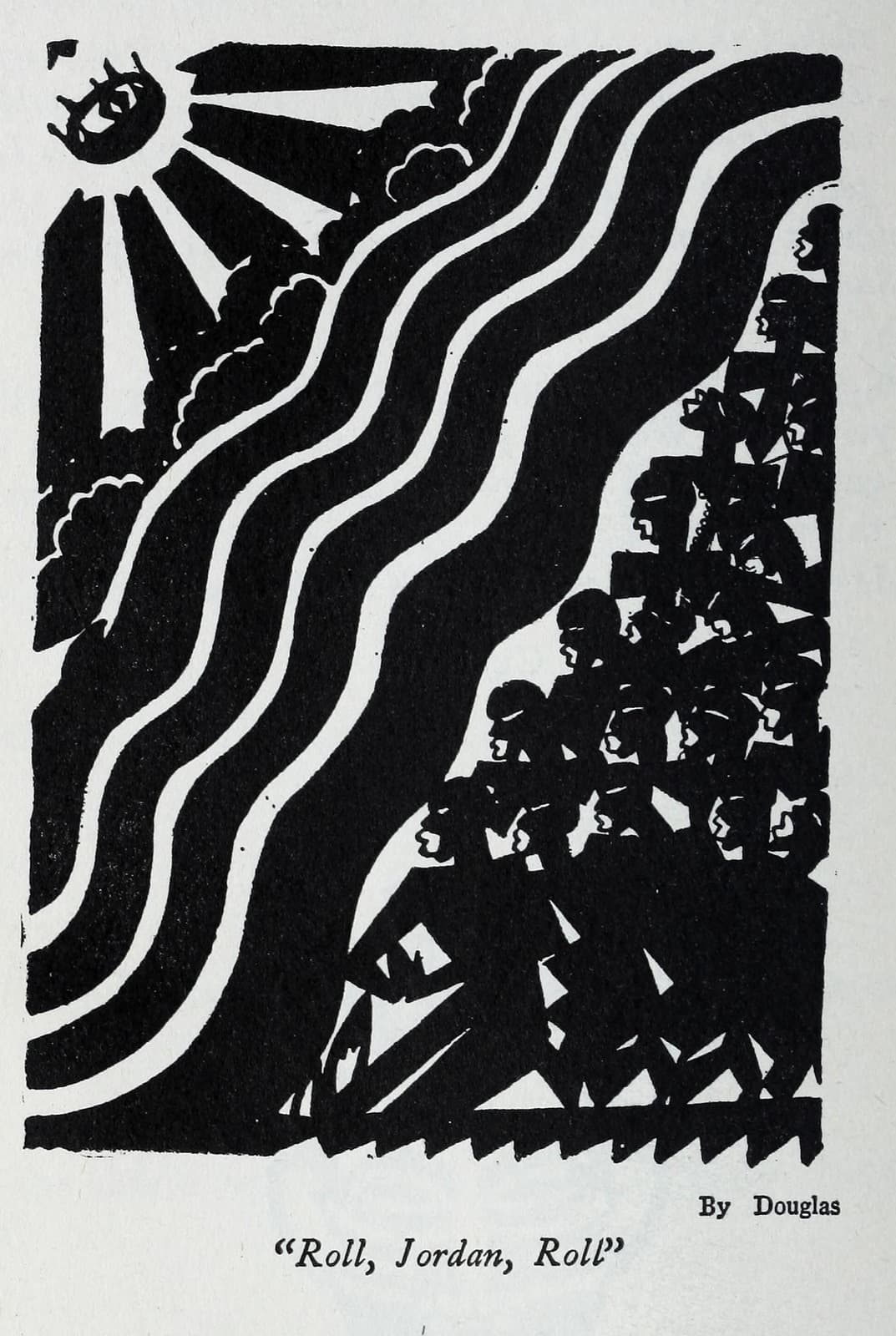
A black-and-white drawing. A heavy black ring with a spiked form inside it sits in the upper left corner as a sun, with straight tapering rays fanning down to the right and scalloped cloud shapes banked below them. Five broad black waves separated by thin white channels run diagonally from the upper right to the lower left. On the right a column of people climbs to the top corner, every head in profile facing left with the eye left as a white slit, hands with splayed fingers raised among them. Striding legs open white triangles at the foot of the crowd, and a row of small black sawteeth closes the bottom edge. Printed below: By Douglas, and the caption "Roll, Jordan, Roll"

Artwork reproduction

Drawing

Roll, Jordan, Roll

1925 · Drawing printed as a full-page plate in a book; no physical original is catalogued

A crowd of figures in profile presses up the right-hand side of the page while a river runs across it in thick black waves. Aaron Douglas drew it for The New Negro, the anthology Alain Locke edited in 1925, where it is printed at page 196 and captioned with the name of the spiritual. It is one of the earliest published pictures in the style he is now known for.

Aaron Douglas, Roll, Jordan, Roll, 1925. Image: public domain (US).

A gouache study in violet, plum, grey-mauve and slate blue, photographed inside a grey painted frame. Flat silhouettes in profile fill the sheet: a figure at the left bends over a drum held between the knees, a dancer at the centre throws one leg high and arches backward with pale bands at wrists and ankles, and a carved figure with a headdress stands on a plinth inside a disc of pale light at the top centre. A row of tilted spear points crosses the upper half. A seated figure at the lower left holds a white oval against the body, another at the lower right raises both open palms before a white disc, and two sprigs of pointed leaves grow from a band of cobalt blue at the bottom centre

Artwork reproduction

Drawing

Study for Aspects of Negro Life: The Negro in an African Setting

1934 · Gouache, with touches of graphite, on illustration board

Drummers, a dancer and a carved figure on a stand, worked in violet, grey and blue gouache on a board little bigger than a sheet of paper. Aaron Douglas made it in 1934 as the finished design for the first panel of Aspects of Negro Life, the mural cycle he painted for the 135th Street branch of the New York Public Library in Harlem. The Art Institute of Chicago bought it in 1990.

Art Institute of Chicago

Aaron Douglas, Study for Aspects of Negro Life: The Negro in an African Setting, 1934. Art Institute of Chicago. Image © the rights holder, shown under fair use.

People Aaron Douglas Knew

Relationships with other people, with sources for each connection.

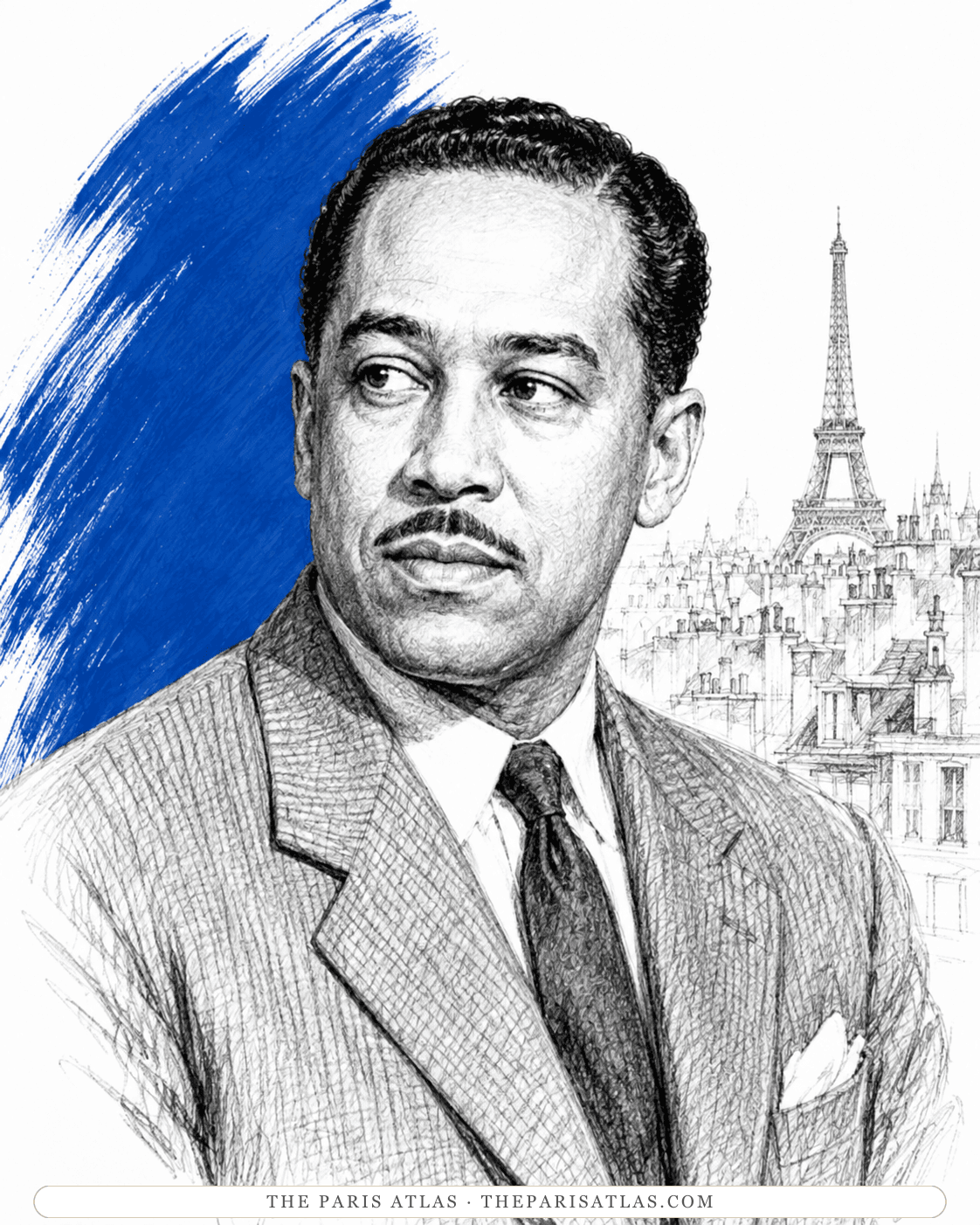
Illustrated portrait of Langston Hughes

Langston Hughes

  • Poet
  • Author
  • Playwright
  • +1

Collaborated with · 1927

Douglas illustrated Hughes's second book of poems, Fine Clothes to the Jew (1927), in the same year he illustrated James Weldon Johnson's God's Trombones — the run of commissions that put his silhouettes on the covers a generation of readers met the Harlem Renaissance through.

— Douglas, Aaron

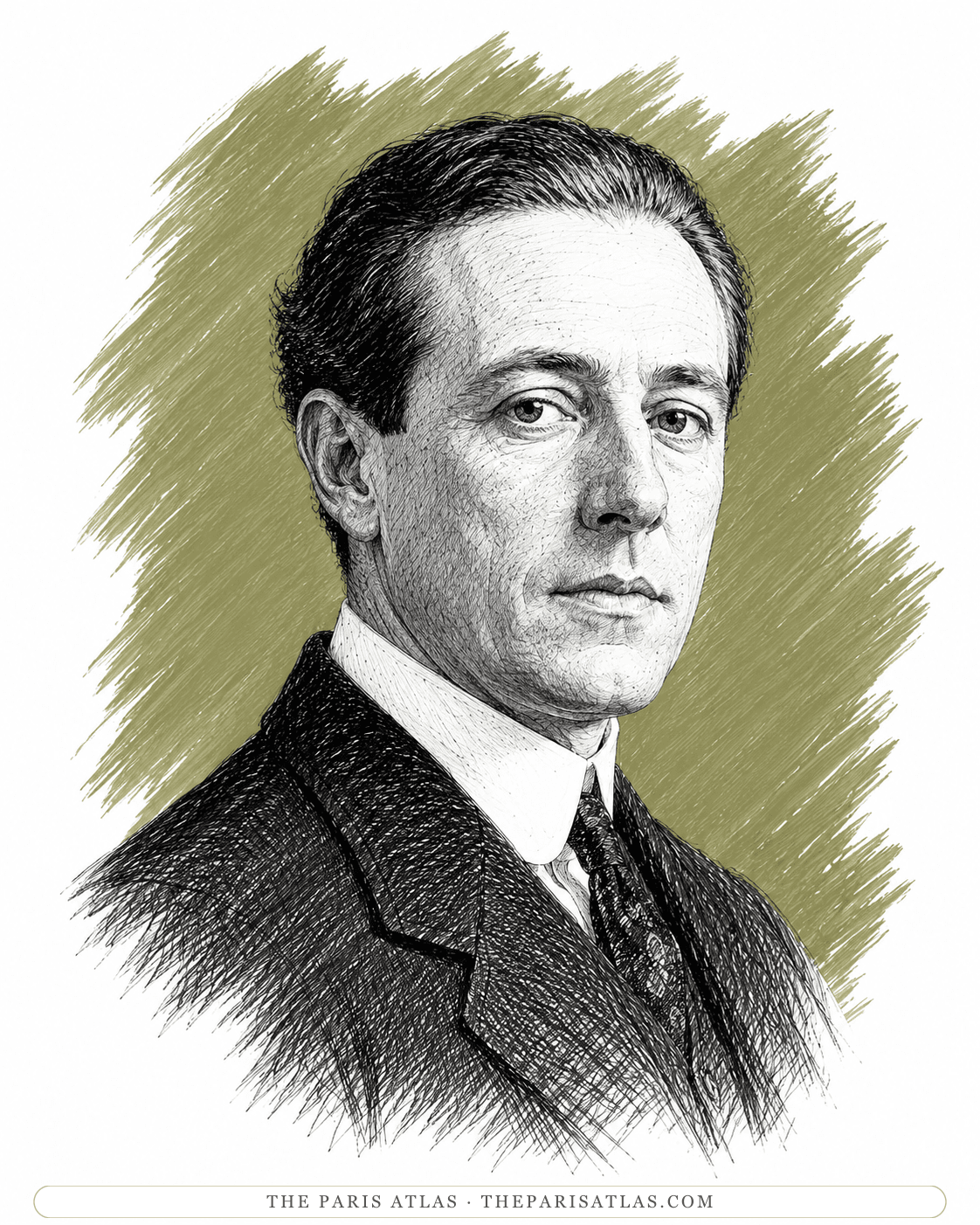
Illustrated portrait of Albert C. Barnes

Albert C. Barnes

  • Collector

Supported by · 1927

Barnes established a scholarship programme in 1927 for young Black artists, writers and musicians, and the Barnes Foundation names Douglas among those it supported. The award was a year at the foundation's galleries in Merion, Pennsylvania — granted by Barnes himself — studying modern European and American painting hung alongside African sculpture. It was not, despite the shorthand, funding for Douglas's later year in Paris.

— Albert C. Barnes and Black Communities; Aaron Douglas: From Harlem to Philly

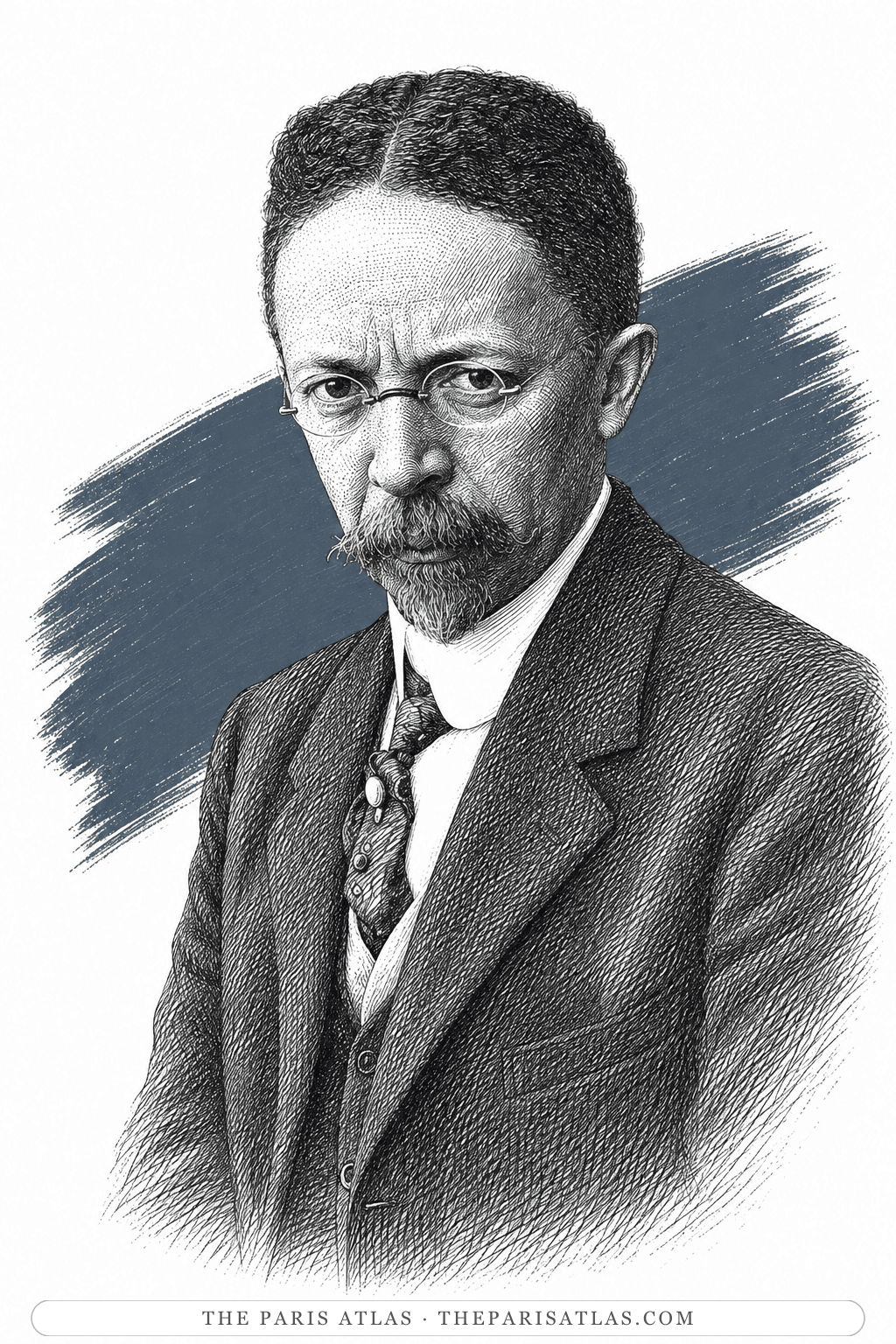
Illustrated portrait of Henry Ossawa Tanner

Henry Ossawa Tanner

  • Painter

Met · 1931

Aaron Douglas met Tanner after arriving in Paris for further study in September 1931. Tanner was then the best-established Black American painter living in France.

— American Paintings, 1900–1945 — Aaron Douglas entry, p. 187

Movements

The artistic and literary currents this life ran through.

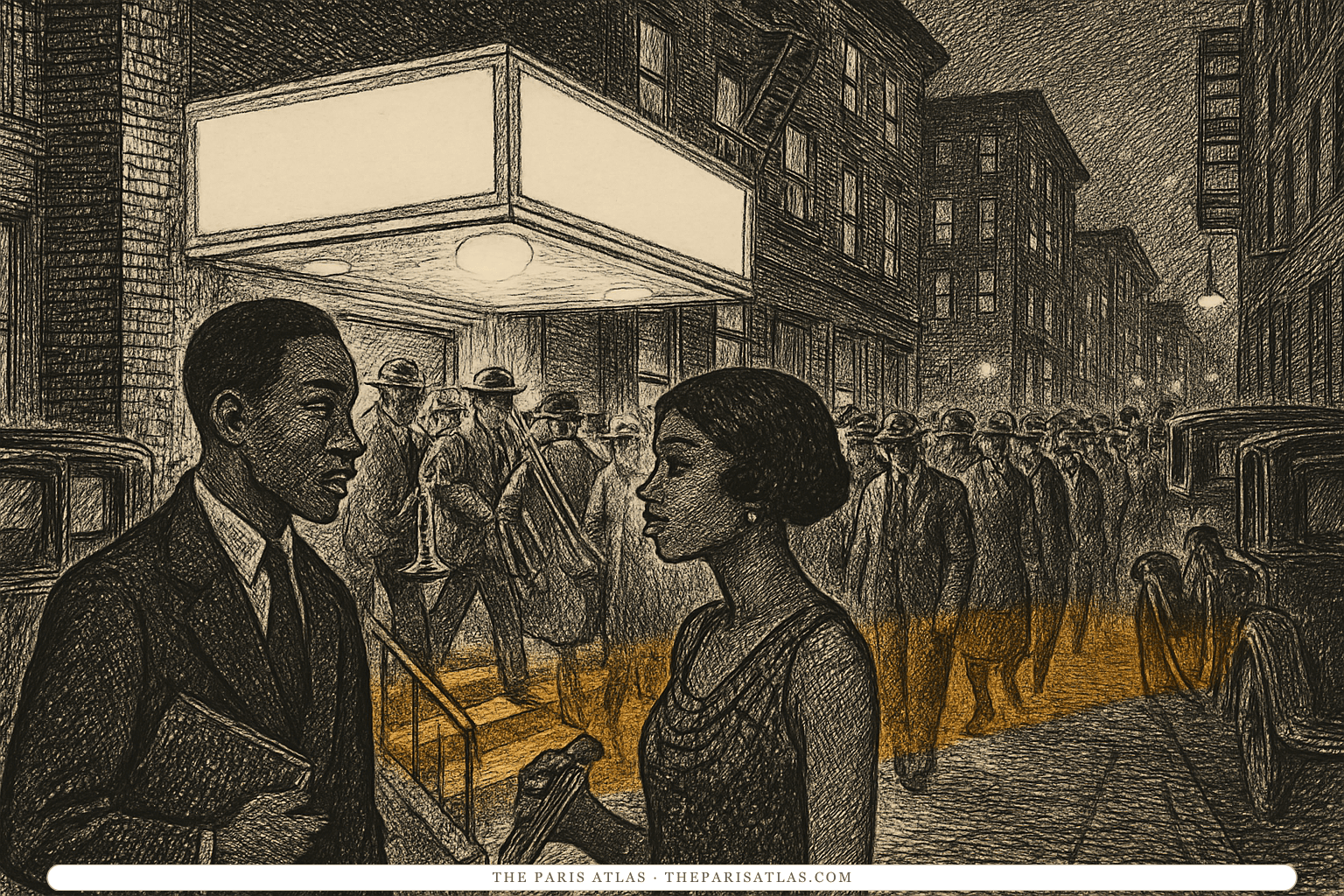
Pen-and-ink illustration of a 1920s Harlem avenue at night: a young Black poet holding a book talks with a woman in a beaded dress while musicians carry a trumpet and trombone into a club under a glowing marquee, the crowd and brownstones behind them swept with one gold brush stroke

Cultural movement · c. 1918 – mid-1930s

The Harlem Renaissance

The Smithsonian American Art Museum calls him one of the most influential visual artists of the Harlem Renaissance; the Kansas Historical Society calls him its most prominent artist-illustrator. He moved to Harlem in June 1925 and gave the movement its visual style — the flat silhouettes of the magazine illustrations, the book jackets for James Weldon Johnson and Langston Hughes, and the 1934 murals Aspects of Negro Life.

— Aaron Douglas: African American Modernist (2008); Douglas, Aaron

Questions about Aaron Douglas

Who was Aaron Douglas?

An American painter and illustrator, born in Topeka, Kansas, in 1899 and died in Nashville in 1979, who created the visual style of the Harlem Renaissance — the flowering of Black American writing, music and art between the world wars. He is best known for the four murals Aspects of Negro Life (1934), painted for the 135th Street branch library in Harlem and still in the building, now the Schomburg Center for Research in Black Culture, and for the illustrations he drew for magazines and for books by the writers James Weldon Johnson and Langston Hughes. He later founded the art department at Fisk University in Nashville and led it until 1966.

Why do Aaron Douglas's figures look like flat silhouettes?

Because that is what he wanted them to be. He drew bodies in hard profile, filled as flat shapes with the eye left as a blank almond — a way of seeing borrowed from ancient Egyptian relief carving and from West African sculpture rather than from European academic drawing — and then overlaid the scene with geometric shapes and concentric rings, so light appears to travel across the picture in waves. The Smithsonian American Art Museum describes the mix as angular cubist rhythms, art deco style, and traditional African and African American imagery. The teacher who first pushed him toward African sources was the German-born illustrator Winold Reiss, with whom he studied on a scholarship from 1925.

Did Aaron Douglas study in Paris?

Yes, for about a year from 1931, at the Académie Scandinave — the Scandinavian Academy, a private art school in Paris — after which he returned to New York. The Kansas Historical Society records that he had planned on Paris since before he moved to Harlem in 1925, and that the year there was spent studying classical art; the Amistad Research Center at Tulane University is the archive that names the school. Three other African American painters were in and out of Paris in the same years — Palmer C. Hayden, Hale Woodruff and Archibald J. Motley Jr. — and in 2024 the Institut Giacometti in Paris devoted a lecture to the four of them together.

Did the Barnes Foundation pay for Aaron Douglas to go to Paris?

No, though the two facts sit close together and are often merged. Albert C. Barnes, the Philadelphia collector, established a scholarship programme in 1927 for young Black artists, writers and musicians, and Douglas was one of the recipients. What that fellowship bought was a year at the Barnes Foundation itself, in Merion outside Philadelphia — studying the modern European and American paintings Barnes had hung alongside African sculpture. Paris came three years later, and no institutional source we could find states who paid for it.

What are the Aspects of Negro Life murals, and where can you see them?

Four panels Douglas finished in 1934 under a New Deal work programme for the 135th Street branch of the New York Public Library in Harlem: The Negro in an African Setting; An Idyll of the Deep South; From Slavery Through Reconstruction; and Song of the Towers. Together they narrate African American history from Africa through slavery, emancipation and the Great Migration — the movement of millions of Black Americans out of the rural South — to the industrial cities of the North. They are still in the building, which is now the Schomburg Center for Research in Black Culture, where they are the centrepiece of the room named after him.

What did Aaron Douglas do at Fisk University?

He built its art department from nothing. Charles S. Johnson, the sociologist who became Fisk's first African American president, invited him to Nashville in 1939; Douglas joined the faculty while completing a master's degree at Columbia's Teachers College, took the degree in 1944, chaired the department, founded the university's Carl Van Vechten Gallery, and retired in 1966. Murals of his, running African American history from the Middle Passage — the sea crossing that carried enslaved Africans to the Americas — onward, are in Fisk's Cravath Hall.

Which books did Aaron Douglas illustrate?

The central ones of the Harlem Renaissance. James Weldon Johnson's God's Trombones (1927), a sequence of Black folk sermons written as verse; the 1927 reissue of Johnson's novel The Autobiography of an Ex-Colored Man; and Langston Hughes's poetry collection Fine Clothes to the Jew (1927). He also drew regularly for The Crisis, the magazine of the National Association for the Advancement of Colored People, and for Opportunity, the National Urban League's journal, and for Harper's and Vanity Fair.

Connections and Sources

Aaron Douglas’s connections to people, places, and works, with the sources behind each one.

Associated with · 1925

The Harlem Renaissance

The Smithsonian American Art Museum calls him one of the most influential visual artists of the Harlem Renaissance; the Kansas Historical Society calls him its most prominent artist-illustrator. He moved to Harlem in June 1925 and gave the movement its visual style — the flat silhouettes of the magazine illustrations, the book jackets for James Weldon Johnson and Langston Hughes, and the 1934 murals Aspects of Negro Life.

— Aaron Douglas: African American Modernist (2008); Douglas, Aaron

Collaborated with · 1927

Langston Hughes

Douglas illustrated Hughes's second book of poems, Fine Clothes to the Jew (1927), in the same year he illustrated James Weldon Johnson's God's Trombones — the run of commissions that put his silhouettes on the covers a generation of readers met the Harlem Renaissance through.

— Douglas, Aaron

Supported by · 1927

Albert C. Barnes

Barnes established a scholarship programme in 1927 for young Black artists, writers and musicians, and the Barnes Foundation names Douglas among those it supported. The award was a year at the foundation's galleries in Merion, Pennsylvania — granted by Barnes himself — studying modern European and American painting hung alongside African sculpture. It was not, despite the shorthand, funding for Douglas's later year in Paris.

— Albert C. Barnes and Black Communities; Aaron Douglas: From Harlem to Philly

Met · 1931

Henry Ossawa Tanner

Aaron Douglas met Tanner after arriving in Paris for further study in September 1931. Tanner was then the best-established Black American painter living in France.

— American Paintings, 1900–1945 — Aaron Douglas entry, p. 187

References

References

The sources below include biographies, scholarly essays, interviews, and primary materials that informed this page. They reflect both the historical record and ongoing critical conversations about Aaron Douglas and their work.

  1. 1abcDouglas, Aaron

    Website
    Kansas Historical Society, Kansapedia
    Used for

    The Kansas Historical Society's life of him, from Topeka to Fisk.

    View source
  2. 2↑Aaron Douglas

    Website
    Amistad Research Center, Tulane University
    Used for

    The archive that records the Académie Scandinave enrolment.

    View source
  3. 3Aaron Douglas: African American Modernist

    Website
    Smithsonian American Art Museum, 2008
    Used for

    The Smithsonian on the 2008 retrospective and the style.

    View source
  4. 4Schomburg Center Centennial Timeline

    Website
    The New York Public Library
    Used for

    The library's own chronology of the murals and the building.

    View source
  5. 5Albert C. Barnes and Black Communities

    Website
    The Barnes Foundation
    Used for

    The 1927 scholarship programme that funded him.

    View source
  1. 6Application for Aaron Douglas, Julius Rosenwald Fund Fellowship, 1937-1941

    Archive
    Julius Rosenwald Fund Collection, Fisk University
    Used for

    His Rosenwald fellowship application, in his own words.

    View source
  2. 7La Renaissance de Harlem et Paris: Aaron Douglas, Palmer Hayden, Hale Woodruff et Archibald J. Motley

    Website
    Fondation Giacometti, Institut Giacometti, Paris, 2024
    Used for

    A Paris institution on Douglas and three fellow painters in the city.

    View source
  3. 8Aaron Douglas Murals

    Website
    Fisk University Galleries
    Used for

    Fisk on the Cravath Hall murals.

    View source
  4. 9Aaron Douglas: From Harlem to Philly

    Website
    The Barnes Foundation
    Used for

    Web source consulted for documented facts and historical context presented on the Aaron Douglas page.

    View source
  5. 10Aaron Douglas

    Website
    Smithsonian American Art Museum
    Used for

    Web source consulted for documented facts and historical context presented on the Aaron Douglas page.

    View source
i
Why these sources are here

These references anchor the page in the documented record and in the scholarly conversations around Aaron Douglas. Every claim on this page traces back to one or more of the works listed here.

Explore more resources