American painter known for intimate scenes of African American life and luminous biblical paintings; one of the first African American artists to achieve international acclaim.
In images
Details
Lived
1859–1937
Born
21 June 1859
Birthplace
Pittsburgh, Pennsylvania
Died
25 May 1937 · aged 77
Place of death
Paris, France
Nationality
American
Profession
Painter and printmaker
Major works
The Banjo Lesson (1893), The Resurrection of Lazarus (1896), The Annunciation (1898)
Married
Jessie Macauley Olssen · 1899–1925
Children
Jesse Ossawa Tanner
Roles
Painter
About Henry Ossawa Tanner
Between worlds
Henry Ossawa Tanner spent much of his life moving between worlds. He was born in the United States only a few years before the Civil War, the son of a prominent Black minister and a woman who had escaped slavery. He trained as an artist in Philadelphia, struggled to make a living in the American South, and eventually crossed the Atlantic hoping to continue his education in Europe.
He intended to go to Rome.
Instead, he reached Paris and stayed.
The decision changed his life. In France, Tanner entered one of the most competitive artistic cultures in the world, studied at the Académie Julian, exhibited at the Paris Salon, received medals and government recognition, and gradually established a career that had seemed almost impossible to build in the United States. France eventually awarded him the Legion of Honor. He married, raised a family, maintained studios in Paris and a country home in northern France, and died in Paris in 1937.
His paintings changed as dramatically as his circumstances. Early in his career, Tanner created some of the most important nineteenth-century representations of ordinary African American life, including The Banjo Lesson and The Thankful Poor. In Europe he increasingly turned toward biblical subjects, transforming familiar religious stories through unusual lighting, restrained emotion, archaeological observation, and an intense interest in the humanity of the people inside the stories.
From Pittsburgh to PAFA
Henry Ossawa Tanner was born in Pittsburgh, Pennsylvania, on June 21, 1859. His father, Benjamin Tucker Tanner, was an educated minister who later became a bishop in the African Methodist Episcopal Church. His mother, Sarah Miller Tanner, had been born into slavery and escaped north through the Underground Railroad.[1]
Even Tanner's middle name carried a connection to abolitionism. “Ossawa” was derived from Osawatomie, Kansas, associated with abolitionist John Brown and his violent confrontation with pro-slavery forces there in the 1850s.
The Tanner family eventually settled in Philadelphia. According to the Smithsonian, Tanner decided while still a boy that he wanted to become an artist after seeing a painter working outdoors in Fairmount Park. He began drawing constantly and visiting Philadelphia's galleries whenever he could. His father initially hoped that he would pursue a more conventional trade and arranged for him to work in a flour mill, but the physically demanding work was a poor fit for Tanner, whose health was often fragile.[1]
Art won.
In 1879 Tanner entered the Pennsylvania Academy of the Fine Arts, one of America's leading art schools. PAFA records his period of study there as extending from 1879 to 1885. His most important teacher was Thomas Eakins, the uncompromising American realist known for his intense study of anatomy, perspective, and the human figure.[2]
Eakins's influence can be felt throughout Tanner's career. Even when Tanner's paintings later became dreamlike and spiritual, the people inside them remained physically convincing. They sit, bend, pray, listen and work like actual human beings rather than idealized symbols.
Tanner's years in America were nevertheless complicated by racial prejudice. Later in life he acknowledged that racism was one of the forces that had pushed him abroad. France did not magically erase prejudice, but Paris gave him considerably more freedom to participate in the professional art world as an artist rather than constantly being judged first by his race.
Atlanta and the patrons who made Europe possible
After his Philadelphia training, Tanner struggled to establish himself professionally.
He moved to Atlanta and opened a photography studio, hoping photography could provide an income while allowing him to remain connected to art. The business was unsuccessful. He also taught drawing at Clark University, where he became the institution's first art professor.
Atlanta nevertheless produced one of the most important relationships of Tanner's early career. He met Bishop Joseph Crane Hartzell and Hartzell's wife, who became patrons of the young artist. In 1890 they helped organize an exhibition of his paintings in Cincinnati. None sold. Rather than allow the exhibition to become a complete disaster, the Hartzells purchased the collection themselves, giving Tanner enough money to pursue the dream he had been unable to finance on his own: studying in Europe.[3]
He meant to go to Rome
In January 1891, Tanner sailed for Europe.
His destination was supposed to be Rome.
Tanner traveled through Liverpool and London before reaching Paris. He intended Paris to be another stop on the way to Italy, but the city immediately impressed him. It contained museums, private academies, exhibitions, dealers and thousands of artists from across Europe and the United States.[4]
He abandoned the Rome plan and enrolled instead at the Académie Julian, studying with Jean-Joseph Benjamin-Constant and Jean-Paul Laurens. He joined the American Art Students' Club and began participating in the expatriate artistic community.
During his early French summers he also left Paris for Brittany, spending time among artists and rural communities including Pont-Aven. French peasants entered his paintings much as Black workers and families he had observed in the American South had entered his earlier work. Paintings such as The Bagpipe Lesson and The Young Sabot Maker came from this period.
Paris was giving Tanner new artistic possibilities, but some of his most important paintings still looked back toward America.
The Banjo Lesson and The Thankful Poor
In 1893 Tanner created the painting that would eventually become his best-known work: The Banjo Lesson.
It depicts an older Black man patiently helping a boy learn to play the banjo. There is no performance and almost no spectacle. The boy concentrates on the instrument while the older man's hands steady it.
This quietness was important.
Nineteenth-century American popular culture frequently used the banjo in racist caricatures of Black musicians and minstrel performers. Tanner did something radically different. He turned the instrument into the center of a private lesson between generations. Music becomes knowledge being handed down rather than entertainment being performed for an outside audience.
The light is equally important. Tanner illuminates the small interior selectively, drawing attention to the child's face and hands while allowing much of the room to disappear into cooler shadow. The technique anticipates the fascination with luminous darkness that would later characterize his biblical paintings.
The Banjo Lesson is now held by Hampton University Museum, whose African American art collection began in part with its acquisition of Tanner paintings in the 1890s.
A year later Tanner painted The Thankful Poor, another intimate scene centered on an older man and a young boy.
Here the two sit at a modest table while the elderly man bows his head in prayer. Rather than presenting poverty as spectacle, Tanner focuses on the relationship between the figures: family, gratitude, religious faith and quiet dignity.
It was the last known major painting in Tanner's early group of African American genre scenes.
After returning to France, his attention increasingly moved elsewhere.
Religion would become the great subject of his career.
The Paris Salon breakthrough
For an ambitious painter in late nineteenth-century Paris, acceptance by the annual Salon could transform a career. Hundreds of thousands of people might attend, and critics, collectors and government officials watched the exhibition closely.
Tanner began getting work into the Salon during the mid-1890s.
His breakthrough came with Daniel in the Lions' Den, which received an honorable mention at the Salon of 1896. The painting showed the biblical Daniel imprisoned among lions, but Tanner avoided turning the story into theatrical melodrama. Light and darkness created much of the emotional tension.
The original Salon painting is now lost. A later Tanner painting of the same subject survives at the Los Angeles County Museum of Art and is sometimes mistaken for the 1896 canvas.
The following year came the victory that established Tanner internationally.
Tanner's The Resurrection of Lazarus, painted in 1896, was shown at the Paris Salon in 1897.
It received a third-class medal.
More importantly, the French government purchased the painting directly from Tanner at the Salon for the Musée du Luxembourg, the museum devoted at the time to living artists. It later passed through French national collections and is now held by the Musée d'Orsay.
For Tanner, this was extraordinary validation. A Black artist born in Pennsylvania before the American Civil War had produced a painting important enough to be purchased by the French state.
The success also led to another major development. Philadelphia businessman and patron Rodman Wanamaker financed Tanner's travel to the Middle East so that he could study the landscapes, architecture, clothing and people associated with the biblical world he was painting.
Painting the biblical world
Tanner traveled through Palestine and Egypt beginning in 1897 and returned to the region again. He also later traveled in North Africa.
The journeys deeply affected his religious paintings.
Rather than inventing ancient Palestine entirely from European artistic conventions, Tanner wanted to study actual environments. He observed buildings, clothing, light, landscapes and local people, sometimes using local residents as models.
Yet his religious paintings were never simply archaeological reconstructions. Tanner used observation as a starting point and then transformed what he had seen through color and light.
That combination became his signature.
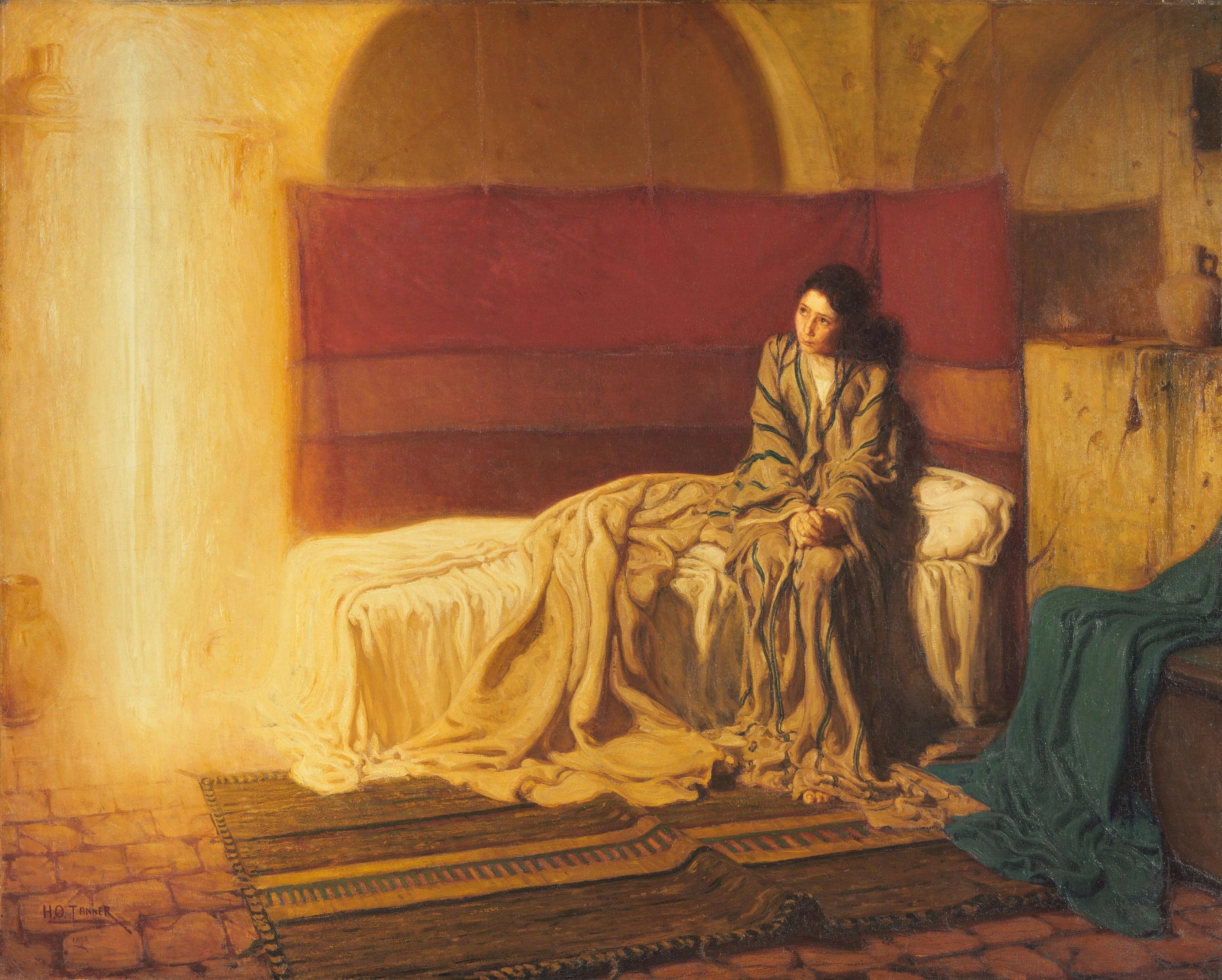
One of Tanner's finest examples is The Annunciation of 1898.
The subject was among the most familiar in Christian art: the angel Gabriel tells Mary that she will give birth to Jesus. European painters had represented the scene for centuries, usually with Gabriel appearing as a recognizable winged angel.
Tanner removed the angel's human body.
Instead, Gabriel becomes a vertical burst of brilliant light.
Mary, meanwhile, appears not as an idealized queen but as a young woman sitting on a bed in a simple interior, dressed in clothing influenced by Tanner's recent travels through Palestine. She looks startled, uncertain and intensely human.
This balance between the ordinary and supernatural is central to Tanner's religious art. Miracles happen in rooms that feel inhabitable. Biblical heroes experience fear, exhaustion and wonder. Divine light enters darkness without erasing it.
The painting was exhibited at the Paris Salon of 1898 and was acquired by the Philadelphia Museum of Art the following year.
Tanner continued exploring biblical subjects for decades: Christ, Mary, Lazarus, Nicodemus, the disciples at Emmaus, the Flight into Egypt and scenes from Jerusalem.
His Nicodemus of 1899, for example, depicts the nighttime meeting between Jesus and the Pharisee Nicodemus. Tanner had spent months in Jerusalem and used local people as models. The work won the Walter Lippincott Prize at the Pennsylvania Academy and entered PAFA's collection.
In paintings like these, Tanner increasingly moved away from the hard-edged realism of his early training. Blues, violets, greenish shadows and golden light wash across his surfaces. Figures sometimes seem to emerge slowly from darkness.
He remained a representational painter, but the atmosphere could approach abstraction.
Light became both something physical and something spiritual.
Paris became his city
Paris also became the center of Tanner's personal life.
In 1899 he married Jessie Macauley Olssen, an American from San Francisco whom he had met in Europe. Their son, Jesse Ossawa Tanner, was born in New York in 1903. After a short period in the United States, the family returned to France and made it their permanent home.
They divided their lives between Paris and Trépied, near Étaples in northern France, where Tanner maintained a country property known as Edgewood. Photographs preserved by the Smithsonian show the Tanner home surrounded by trees.
Paris, however, remained essential to his professional identity.
Archival material places Tanner at 70 bis rue Notre-Dame-des-Champs, in the Montparnasse artistic district. A surviving exhibition catalogue also records him at 51 boulevard Saint-Jacques, and Smithsonian photographs show him working in a Paris studio there around 1900.
Late in his life he lived at 43 rue de Fleurus, only a short distance from the part of Montparnasse associated with generations of expatriate painters and writers.
Paris was no temporary exile. It became Tanner's city.
War, honors, and loss
The First World War disrupted the family's life in France.
Tanner's artistic production slowed, and he eventually worked with the American Red Cross in France between 1917 and 1919. His wartime drawings and paintings recorded aspects of relief work rather than scenes of battlefield heroism.
After the war he returned to painting, although the international art world around him was changing rapidly. Cubism, abstraction, Fauvism and other forms of modernism had transformed Paris.
Tanner belonged to an earlier generation, but his own paintings had never stopped evolving. His late biblical images became increasingly atmospheric, their figures surrounded by shifting fields of blue, violet and green.
By then Tanner had become an important figure for younger African American artists visiting Europe.
He maintained connections with Black intellectual and cultural life in the United States. Booker T. Washington visited him in Paris in 1899, and Tanner painted his portrait. He supported the NAACP after its creation and later met younger artists who traveled to Paris, including Aaron Douglas.
France gave Tanner one of his greatest official honors in 1923, when he was named a chevalier of the Legion of Honor.
Four years later he became a full academician of the National Academy of Design in the United States, the first African American artist to receive that distinction.
The honors were significant because Tanner's career had begun in an America where racial discrimination had repeatedly limited his opportunities. By old age he was an internationally decorated painter whose works had entered major French and American collections.
Tanner suffered a devastating personal loss when Jessie died in 1925. According to the Smithsonian's Archives of American Art, he was grief-stricken and suffered increasingly poor health afterward, although he continued to paint intermittently.
He remained in France.
On May 25, 1937, Henry Ossawa Tanner died at his home in Paris.
He was seventy-seven.
What Tanner changed
Tanner occupies an unusual place in art history because several histories meet in his work at once.
He belongs to the history of nineteenth-century American realism through his training with Thomas Eakins. He belongs to African American art through groundbreaking paintings such as The Banjo Lesson and The Thankful Poor. He belongs to the history of American expatriate Paris, where artists crossed the Atlantic seeking training and recognition. And he belongs to the history of modern religious painting, where he found ways of representing ancient stories without simply repeating the conventions of European Old Masters.
His career also helped establish a path that later generations would follow. African American painters including Aaron Douglas, Hale Woodruff and others came to Paris during the twentieth century and found in Tanner an important predecessor: an artist who had crossed the Atlantic decades earlier and built an international career there. PAFA has described him as both a pioneering artist and an important model for generations of Black artists who followed.
But Tanner's significance is ultimately visible in the paintings themselves.
An old man steadies a banjo while a child learns where to place his fingers. Mary sits uncertainly on a bed while impossible light enters her room. Lazarus rises while the people around him struggle to understand what they are witnessing.
Again and again, Tanner returned to moments when something passes from one person to another: knowledge, faith, music, revelation, hope.
Paris gave him the freedom and professional stage on which to develop that vision. And Tanner, in return, became part of the history of Paris itself.
Essential paintings
The Banjo Lesson — 1893. Tanner's most famous depiction of African American family life, showing an older man teaching a boy to play the banjo. Hampton University Museum.
The Thankful Poor — 1894. An intimate scene of an elderly Black man and child praying before a meal.
The Young Sabot Maker — 1895. One of Tanner's paintings of rural French life, showing the influence of his time in Brittany.
Daniel in the Lions' Den — 1895–1896. The original version received an honorable mention at the 1896 Paris Salon and is now lost. Tanner later returned to the subject.
The Resurrection of Lazarus — 1896. Awarded a medal at the 1897 Salon and purchased by the French government; now in the Musée d'Orsay.
The Annunciation — 1898. Tanner's unconventional depiction of Gabriel as a column of supernatural light. Philadelphia Museum of Art.
Nicodemus — 1899. A nocturnal conversation between Christ and Nicodemus informed by Tanner's travels in the Holy Land. Pennsylvania Academy of the Fine Arts.
Lions in the Desert — c. 1897–1900. A desert landscape connected to Tanner's interest in the Middle East and his long study of lions.
Life events
1859
Born June 21 in Pittsburgh, Pennsylvania.
— Henry Ossawa Tanner
1860s
The Tanner family settles in Philadelphia, where Henry develops an early interest in drawing and painting.
— Henry Ossawa Tanner
1879
Enters the Pennsylvania Academy of the Fine Arts and studies under Thomas Eakins.
— Henry Ossawa Tanner — artist biography; Henry Ossawa Tanner: Modern Spirit
1880s
Attempts to establish himself professionally, eventually moving south and operating a photography studio in Atlanta.
— Henry Ossawa Tanner
c. 1888–1890
Teaches drawing at Clark University and meets Bishop Joseph Crane Hartzell and his wife, who become important patrons.
— Henry Ossawa Tanner; Henry Ossawa Tanner Papers — Biographical Note
1891
Travels to Europe intending to study in Rome, reaches Paris and decides to remain there. Enrolls at the Académie Julian.
— Henry Ossawa Tanner; Henry Ossawa Tanner — artist biography
1892–1893
Spends time painting in rural Brittany.
— Henry Ossawa Tanner
1893
Paints The Banjo Lesson and gives a paper titled “The American Negro in Art” in Chicago.
— Henry Ossawa Tanner, The Banjo Lesson; Collection History
1894
Paints The Thankful Poor and returns to Paris.
— The Thankful Poor
1896
Daniel in the Lions' Den receives an honorable mention at the Paris Salon.
— Henry Ossawa Tanner; Daniel in the Lions' Den
1897
The Resurrection of Lazarus receives a third-class Salon medal and is purchased by the French government. Tanner travels to Palestine and Egypt.
— The Resurrection of Lazarus; Henry Ossawa Tanner — artist biography
1898
Exhibits The Annunciation at the Paris Salon.
— The Annunciation
1899
Marries Jessie Macauley Olssen. Booker T. Washington visits Tanner in Paris.
— Henry Ossawa Tanner Papers — Biographical Note
1903
His son, Jesse Ossawa Tanner, is born in New York.
— Henry Ossawa Tanner Papers — Biographical Note
1904
The family returns permanently to France and later divides its time between Paris and Trépied.
— Henry Ossawa Tanner Papers — Biographical Note
1917–1919
Works with the American Red Cross in France during the First World War.
— Henry Ossawa Tanner Papers — Biographical Note
1923
France names Tanner a chevalier of the Legion of Honor.
— Henry Ossawa Tanner — artist biography
1925
His wife Jessie dies, a loss that deeply affects Tanner's remaining years.
— Henry Ossawa Tanner Papers — Biographical Note
1927
Becomes a full academician of the National Academy of Design, the first African American artist to receive that distinction.
— Henry Ossawa Tanner; Henry Ossawa Tanner — artist biography
1937
Dies in Paris on May 25 after more than four decades of life and work in France.
— Henry Ossawa Tanner Papers — Biographical Note
Selected works
Cataloged from the holding institutions' records. Reproductions appear only where the rights are verified.
Daniel stands with his hands bound in a pool of pale light while lions pace and lie in the blue-green dark around him. Henry Ossawa Tanner painted this version in Paris between about 1907 and 1918, more than a decade after the Daniel in the Lions' Den that won him an honourable mention at the Salon of 1896. The Los Angeles County Museum of Art has owned it since 1922 and records that it is often mistaken for the earlier picture.
A girl in striped peasant clothes sits on the edge of an unmade bed and looks at a tall column of light standing in the corner of the room. Henry Ossawa Tanner painted it in Paris in 1898, after his first journey to Egypt and Palestine, and showed it at that year's Salon. The Philadelphia Museum of Art bought it in 1899 with the W. P. Wilstach Fund and calls it the first of his works to enter an American museum.
An old man sits on a wooden chair with a boy on his knee, steadying a banjo while the boy picks at the strings. Henry Ossawa Tanner painted it in 1893, and it is the best-known picture he made of Black American life before he turned to biblical subjects. It has belonged to Hampton University Museum in Virginia since 1894, when the trustee Robert C. Ogden gave it to the school.
Christ stands over the shrouded body of Lazarus in a dark tomb, one hand pointing down at him, while an old man lifts the dead man's head and a crowd presses in from the left. Henry Ossawa Tanner painted it in Paris through the summer and autumn of 1896. At the Salon of 1897 it won a third-class medal and was bought by the French state for the Musée du Luxembourg, the museum of living artists. It now belongs to the Musée d'Orsay, which lists it as not currently exhibited.
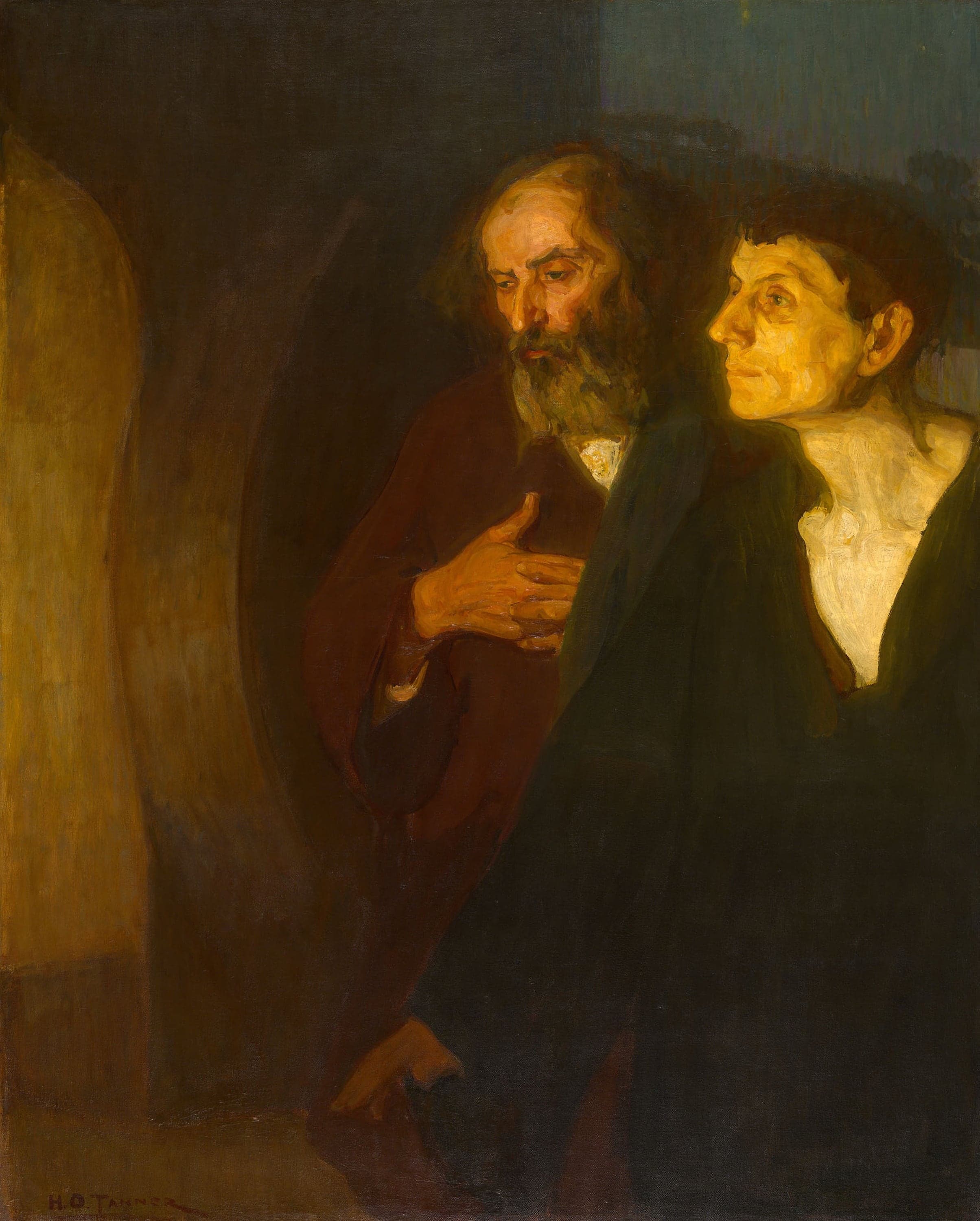
Two men stand side by side in the dark, looking into a light that falls from the left. The older one, bald and grey-bearded, clasps his hands and looks down; the younger one lifts his lit face towards the light. Henry Ossawa Tanner painted the scene in Paris around 1906, and the Art Institute of Chicago bought it from him that year after showing it in its annual exhibition of American art. It hangs in Gallery 273.
Aaron Douglas met Tanner after arriving in Paris for further study in September 1931. Tanner was then the best-established Black American painter living in France.
— American Paintings, 1900–1945 — Aaron Douglas entry, p. 187
Aaron Douglas met Tanner after arriving in Paris for further study in September 1931. Tanner was then the best-established Black American painter living in France.
— American Paintings, 1900–1945 — Aaron Douglas entry, p. 187
Tanner studied at the Pennsylvania Academy of the Fine Arts under Thomas Eakins, whose anatomical and realist teaching shaped his early practice.
— Henry Ossawa Tanner — artist biography
References
References
The sources below include biographies, scholarly essays, interviews, and primary materials that informed this page. They reflect both the historical record and ongoing critical conversations about Henry Ossawa Tanner and their work.
These references anchor the page in the documented record and in the scholarly conversations around Henry Ossawa Tanner. Every claim on this page traces back to one or more of the works listed here.





 View source