Hungarian-Indian modernist painter whose Paris training and radical rethinking of Indian art helped establish a new language for twentieth-century painting in India.
In images
Details
Lived
1913–1941
Born
30 January 1913
Birthplace
Budapest, Hungary
Birth name
Dalma-Amrita Sher-Gil
Died
5 December 1941 · aged 28
Place of death
Lahore, British India
Nationality
Hungarian-Indian
Profession
Painter
Major works
Young Girls (1932), Three Girls (1935), Bride's Toilet (1937), South Indian Villagers Going to Market (1937)
Married
Victor Egan · 1938–1941
Roles
Painter
About Amrita Sher-Gil
Amrita Sher-Gil had only about a decade in which to become a major artist.
She died at twenty-eight.
Yet within that extraordinarily short career, she moved through several artistic worlds: childhood in Hungary, adolescence in the Himalayan foothills of British India, a brief education in Florence, five formative years in Paris, summers among relatives in the Hungarian countryside, and finally an intense period of travel and painting across India.
Paris taught Sher-Gil how to paint. India gave her a reason to reinvent what she had learned.[1]
That distinction is important. Her mature art was not simply a mixture of “East and West.” Sher-Gil actively questioned both traditions. She learned anatomy, oil painting, composition and the European nude in Paris; studied Post-Impressionism and artists such as Paul Gauguin and Paul Cézanne; then returned to India and confronted Ajanta frescoes, Mughal and Pahari miniatures, ancient sculpture, rural poverty, women’s domestic lives and the landscape around her. From those encounters she developed something recognizably her own.
Her paintings rarely tell elaborate stories. People sit, stand, rest, wait, prepare a bride, walk to market or stare into space. Yet Sher-Gil gave these seemingly uneventful moments enormous psychological weight. Her women in particular appear to have interior lives that remain unavailable to the viewer.
Today she is regarded as one of the foundational figures of modern Indian painting. The National Gallery of Modern Art in New Delhi holds the largest collection of her work and describes her place in Indian modernism as pre-eminent.[2]
A childhood between Hungary and India
Amrita Sher-Gil was born in Budapest on 30 January 1913. The National Gallery of Modern Art records that she was christened Dalma-Amrita. Her younger sister, Indira, was born the following year.[3]
Their parents were an unusual pair.
Her father, Umrao Singh Sher-Gil Majithia, came from an aristocratic Sikh family. He was a scholar with interests in Sanskrit, Persian, philosophy and religion, and he became an accomplished photographer. His thousands of photographs of himself and his family would eventually form an extraordinary visual record of Amrita's childhood and the intellectual world in which she grew up.
Her mother, Marie Antoinette Gottesmann, came from a Hungarian family and had trained as an opera singer. The marriage connected two cultures that remained equally real to Amrita. Hungarian was her first language, and she spent the First World War years in Hungary, where her earliest drawings were inspired by Hungarian fairy tales and folk stories.
In 1921, when Amrita was eight, the Sher-Gils returned to India and settled in Simla, now Shimla, in the Himalayan foothills.[3]
For a girl accustomed to Hungary, India represented another world. She learned English, studied piano and violin and continued drawing. By 1923 she was already painting women she encountered in films and novels.
Art was becoming less a childhood hobby than an identity.
Florence and the discovery of European art
In 1924 Sher-Gil's mother took Amrita and Indira to Florence.
Amrita briefly attended a school there, giving the eleven-year-old her first sustained encounter with Italian art. The stay lasted only a matter of months, but Italy would become significant because it introduced her to a European artistic past far older than the fashionable painting she later encountered in Paris.
Back in Simla, another relative recognized just how serious her ability was becoming.
Her maternal uncle Ervin Baktay, a Hungarian Indologist who had himself studied painting, visited in 1926. Instead of allowing Amrita simply to invent figures from imagination, he encouraged her to work from observation and living models.
She also received instruction from artists including Beven-Petman and Whitmarsh. Beven-Petman believed that she needed professional European training.
That advice eventually changed her life.
Paris at sixteen
In February 1929, the Sher-Gil family left India for Europe.
Amrita was sixteen.
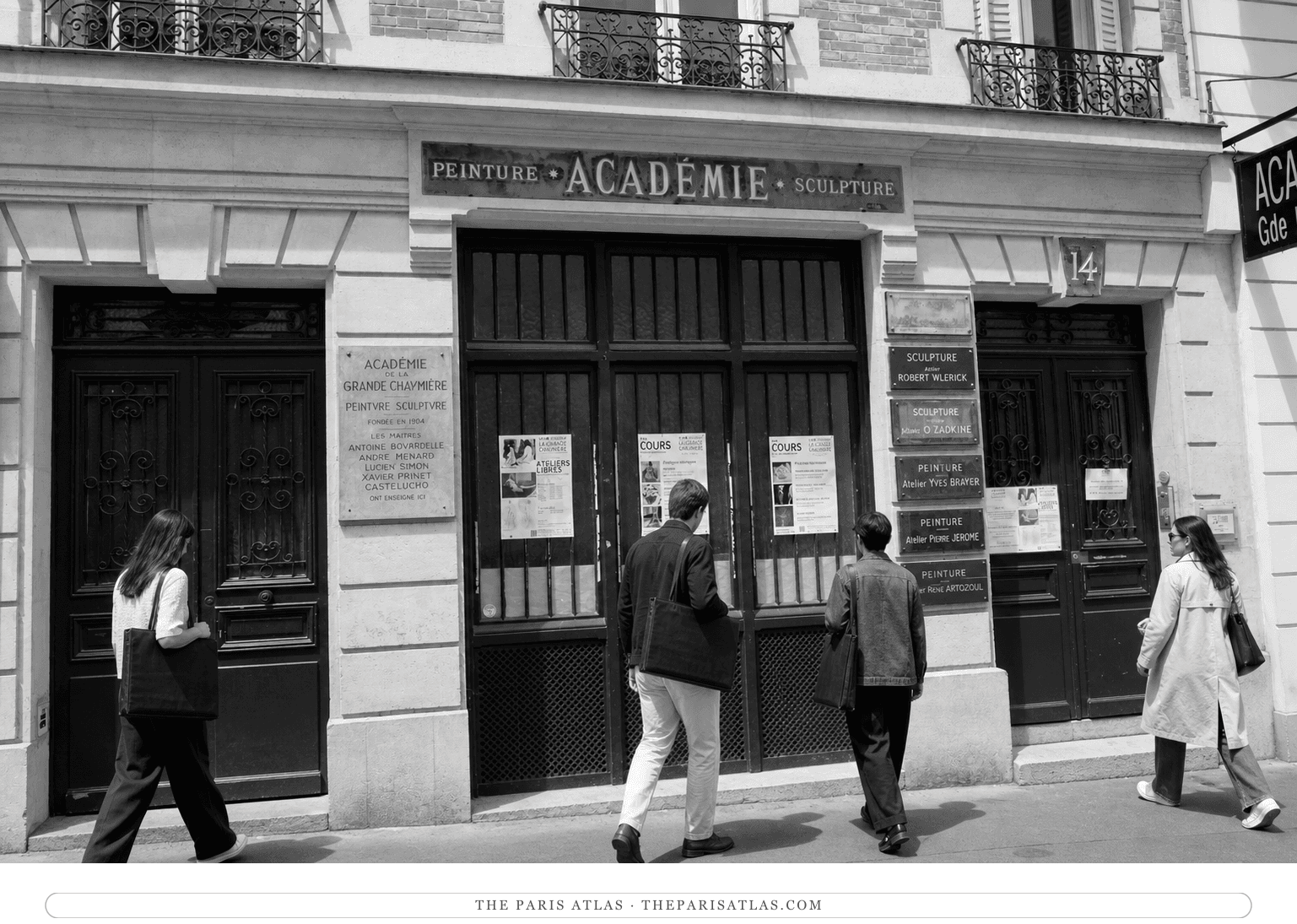
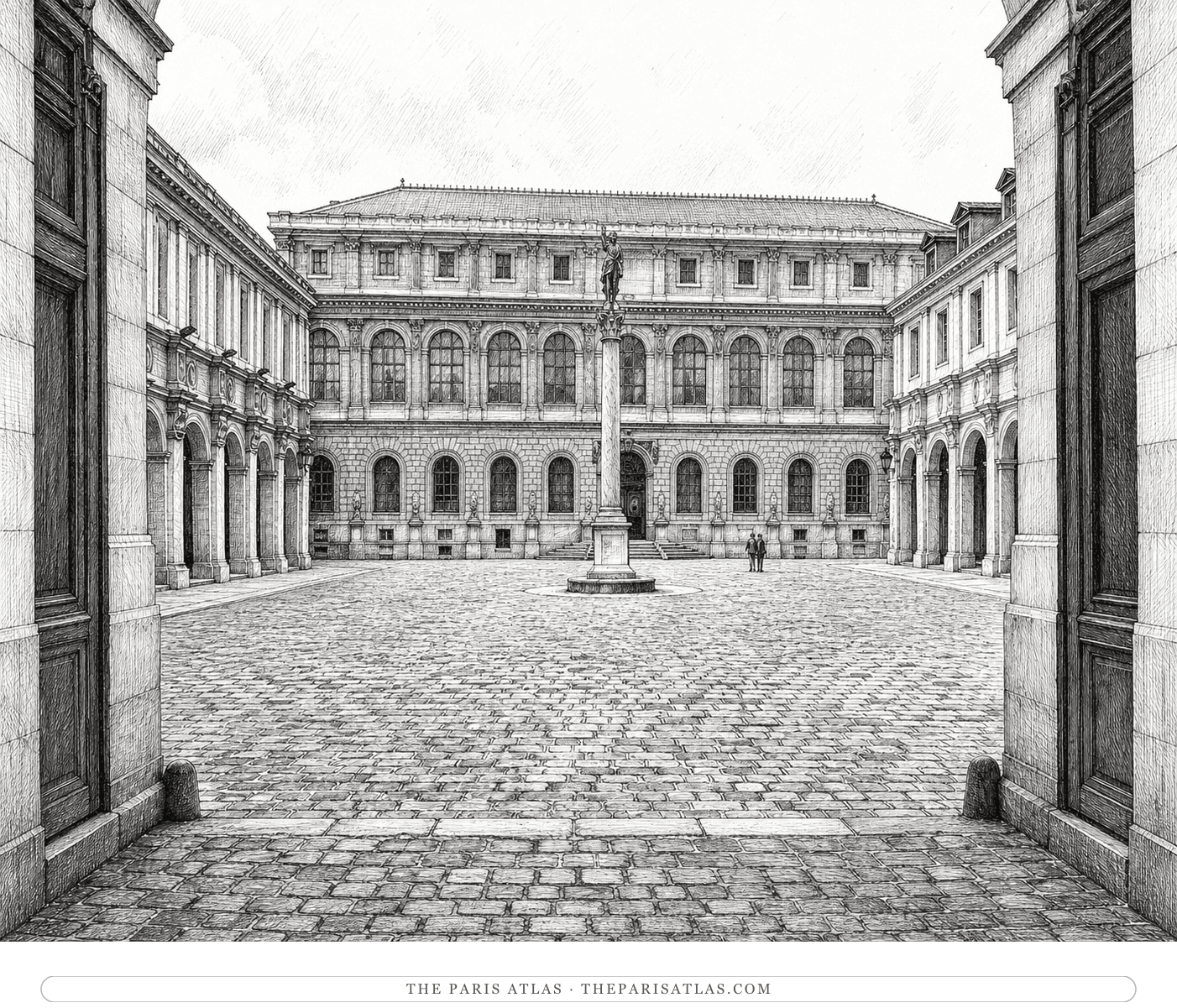
By April she was studying in Paris at the Académie de la Grande Chaumière, in Montparnasse, under Pierre Vaillant. In October she entered the studio of Lucien Simon at the École nationale supérieure des Beaux-Arts.
Paris gave Sher-Gil exactly what her previous education had lacked: disciplined daily access to professional models, anatomy, figure drawing, composition and oil painting.
Her family lived for a period on the rue de Bassano, and surviving photographs place Amrita inside their Paris apartment surrounded by her paintings. She later shared studio space near the rue de la Grande-Chaumière, placing her directly within the artistic environment of Montparnasse.
The location mattered.
Paris in 1929 was still one of the world's great magnets for artists. Picasso was there. Surrealism was flourishing. The School of Paris had brought painters from across Europe and beyond into the same cafés, academies, galleries and neighborhoods.
Sher-Gil entered that world as both an insider and an outsider: European by upbringing and education, Indian through her father and family, born in Hungary, living in France and not entirely reducible to any one of them.
Learning to paint the human body
At the École des Beaux-Arts, Sher-Gil concentrated on people.
She painted professional models, classmates, friends, family members and herself. The NGMA's surviving Paris works include male and female nude studies, portraits, still lifes and a remarkable series of self-portraits.
Lucien Simon gave her a traditional grounding in figurative painting, but Sher-Gil's interests soon moved beyond strict academic naturalism.
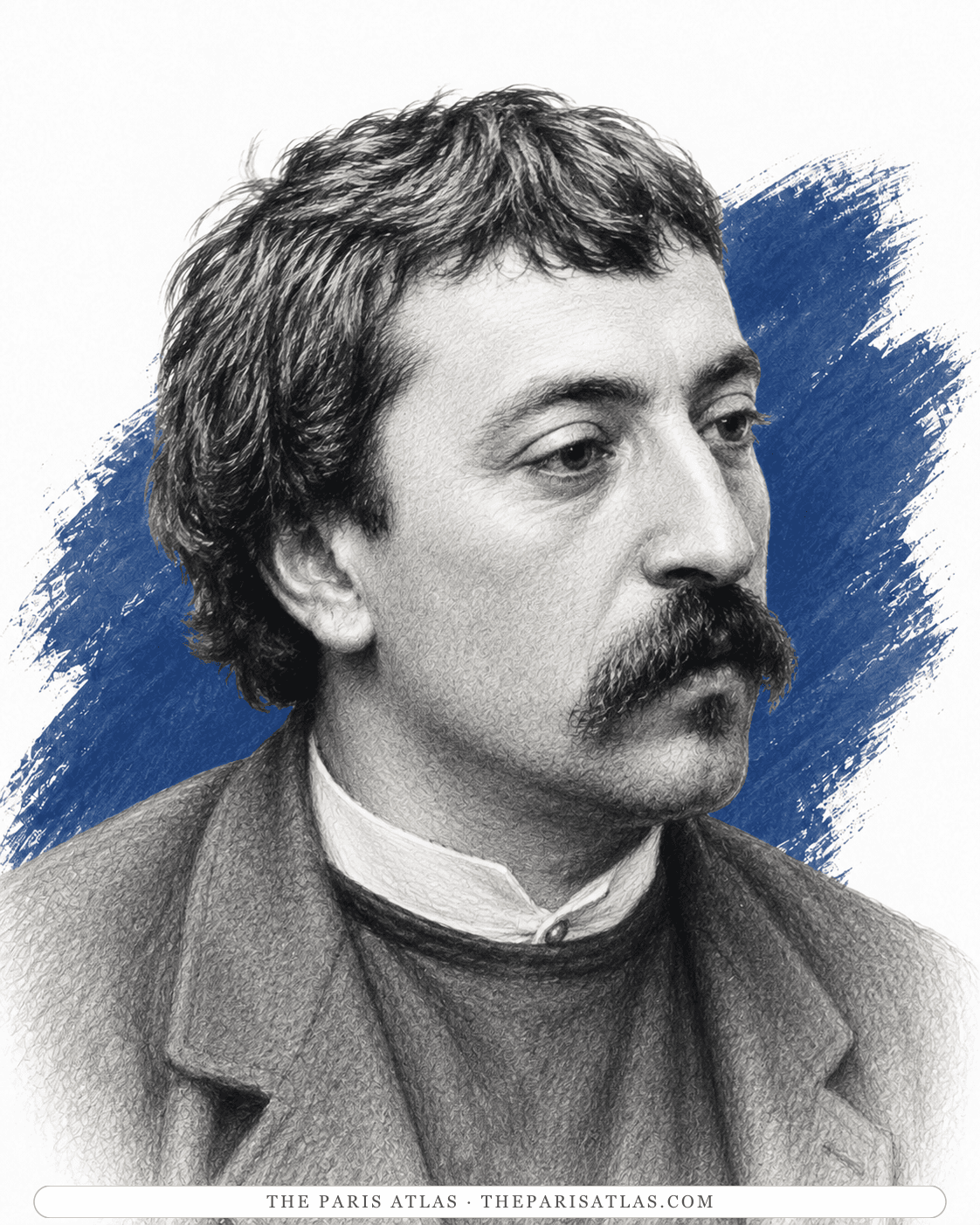
She encountered the work of Paul Cézanne, Amedeo Modigliani and especially Paul Gauguin. Gauguin's simplified bodies, large areas of color and rejection of conventional modeling became particularly important.
Paris also gave Sher-Gil friends who became subjects.
The painter Boris Taslitzky was a fellow student and for a period her lover. Marie-Louise Chassany, another fellow student, was a close friend whom Sher-Gil painted. Her circle also included Denyse Proutaux, a young French art writer and critic who became close to Amrita and Indira and posed repeatedly for Amrita.
These relationships mattered because Sher-Gil's Paris paintings are intensely personal. She did not build her early career primarily through grand historical subjects. She painted the people immediately around her.
And she painted herself relentlessly.
The self-portraits
Beginning around 1930, Sher-Gil produced a remarkable series of self-portraits.
She appears glamorous in one, confrontational in another, melancholy in another. Sometimes she shows herself working, deliberately presenting herself not merely as a young woman but as a painter.
That distinction matters.
Female artists had been painted by men for centuries. Sher-Gil repeatedly reversed that relationship by making herself simultaneously observer and subject.
Her self-portraits are also experiments in identity. Depending on the picture, she can emphasize her European surroundings, her dark skin, fashionable clothing, sexuality or professionalism. The paintings resist the idea that there was one stable version of Amrita Sher-Gil waiting to be discovered.
She was constructing herself through paint.
Rabindranath Tagore in Paris
An intriguing collision between her European education and India's emerging modernism occurred in Paris in May 1930.
Sher-Gil went to see an exhibition of paintings by Rabindranath Tagore at the Théâtre Pigalle. At the same time, she herself was exhibiting at the venue with a women's student circle from the Beaux-Arts.
Tagore was internationally famous as a poet and Nobel laureate but had begun painting seriously relatively late in life.
Sher-Gil admired the drawings.
The encounter is significant because she was already discovering that “Indian art” did not have to mean a return to traditional styles. Modern Indian painting could be experimental, individual and international.
She would eventually pursue that problem much more aggressively herself.
Young Girls
Sher-Gil's Paris breakthrough came with Young Girls, painted in 1932.
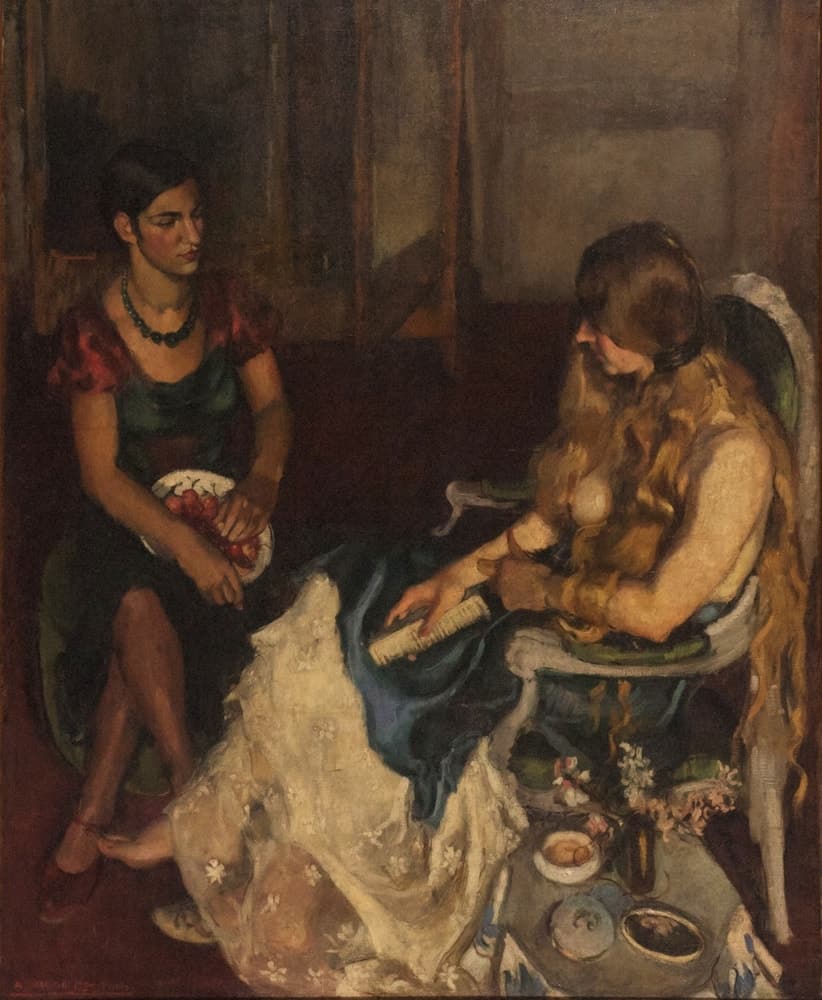
The painting shows two women sitting together. One is Sher-Gil's younger sister Indira, formally dressed. The other is her French friend Denyse Proutaux, partially undressed. Neither woman performs for the viewer. The emotional relationship between them remains difficult to define.
The quietness is precisely what makes it powerful.
Rather than creating a conventional portrait of two attractive young women, Sher-Gil turns their physical proximity into psychological distance.
Young Girls received major recognition at the Grand Salon in Paris, and in 1933 Sher-Gil was elected an associate of the Salon—an exceptional achievement for such a young foreign artist.
She was about twenty.
Paris had validated her.
And almost immediately afterward, she began thinking about leaving it.
Self-Portrait as a Tahitian
One of the most fascinating paintings of Sher-Gil's Paris years is Self-Portrait as a Tahitian, painted in 1934.
The title directly invokes Gauguin, whose paintings of Tahitian women Sher-Gil had studied.
But Sher-Gil changed the relationship.
Gauguin had been a European man representing Polynesian women as exotic subjects. Sher-Gil placed her own brown body at the center of the canvas and controlled its representation herself. The painting can therefore be read simultaneously as admiration for Gauguin and an interrogation of the tradition he represented.
That makes the painting particularly revealing of the question she was beginning to ask:
What was she supposed to do with everything Paris had taught her?
The answer was not to remain in Paris.
Leaving Paris
Toward the end of 1933 Sher-Gil became increasingly convinced that her future as a painter lay in India.
This was not because she had failed in Europe.
Quite the opposite.
She had received professional training, exhibited publicly and earned Salon recognition. She could plausibly have continued trying to build a European career.
Instead, she believed staying in Europe might actually limit what she could become.
In letters to her family she argued that European modern art had paradoxically helped her recognize the value of Indian painting and sculpture. She had begun looking at Indian objects in European museum collections differently.
She returned to India with her parents in December 1934.
The decision divides her career almost perfectly.
There is Amrita before India.
And Amrita after.
Seeing India again
The India Sher-Gil encountered as a twenty-one-year-old painter was not the India she had imagined from Europe.
She later described being struck by a winter landscape of yellow-gray earth and by thin, dark figures moving through it with a profound melancholy.
Her palette changed.
So did her people.
The Paris pictures often contain individual sitters positioned within studios. In India, groups become increasingly important: women gathered together, men standing together, villagers walking, workers resting.
The colors become earthier—ochres, reds, browns, greens.
Most importantly, Sher-Gil began looking closely at ordinary Indian people whom elite art often ignored.
Group of Three Girls
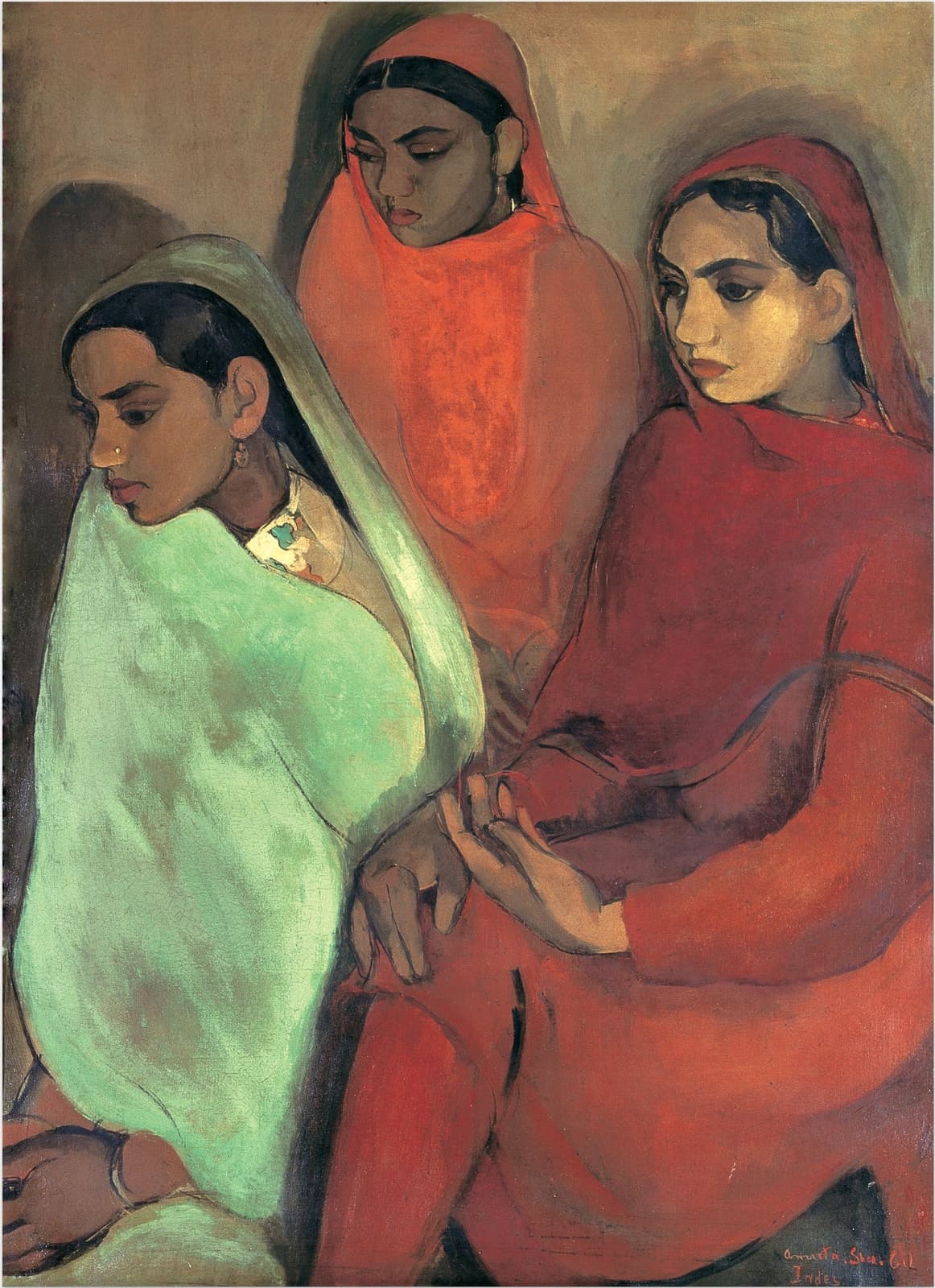
One of the first great paintings of this new period was Group of Three Girls, painted in 1935 and also known simply as Three Girls.
Three young women sit together.
Nothing obvious is happening.
Their eyes are lowered. Their bodies are close, yet each seems alone with her thoughts.
There is no picturesque background, no elaborate narrative and little attempt to turn rural India into an exotic spectacle.
Instead Sher-Gil gives weight to waiting.
The women possess a monumentality that owes something to her European figure training, yet the composition no longer feels like a Paris studio exercise.
This combination became central to her mature work: large, simplified bodies; reduced settings; carefully arranged color; and faces carrying emotions that the viewer cannot completely penetrate.
Group of Three Girls later received a gold medal at the Bombay Art Society's 1937 annual exhibition.
Searching for an Indian language
Sher-Gil did not solve the problem of modern Indian painting simply by returning home.
She traveled.
In 1936 she exhibited in Bombay and met the critic and collector Karl Khandalavala, who helped introduce her more deeply to Pahari, Basohli, Rajput and Mughal miniature painting.
She then visited Ajanta and Ellora with the artist Barada Ukil.
Ajanta was transformative.
The ancient Buddhist cave paintings offered a completely different model of the human figure from the European academic tradition in which she had trained.
Bodies could be simplified without becoming lifeless. Color could carry form. Figures could possess sensuality and monumentality without the detailed modeling expected at the Beaux-Arts.
Sher-Gil was deeply impressed.
And she kept moving south.
The journey through South India
Late in 1936 and early in 1937 Sher-Gil traveled through southern India.
She went through Trivandrum, Cape Comorin—today Kanyakumari—and Cochin. At the Mattancherry Palace she studied seventeenth-century mural paintings.
The landscape itself overwhelmed her: red earth, green tropical vegetation, palms, banana trees, clay houses and people moving through environments far removed from Paris.
The journey produced one of the clearest stylistic breakthroughs of her career.
After returning to Simla, she painted the works generally known as her South Indian trilogy:
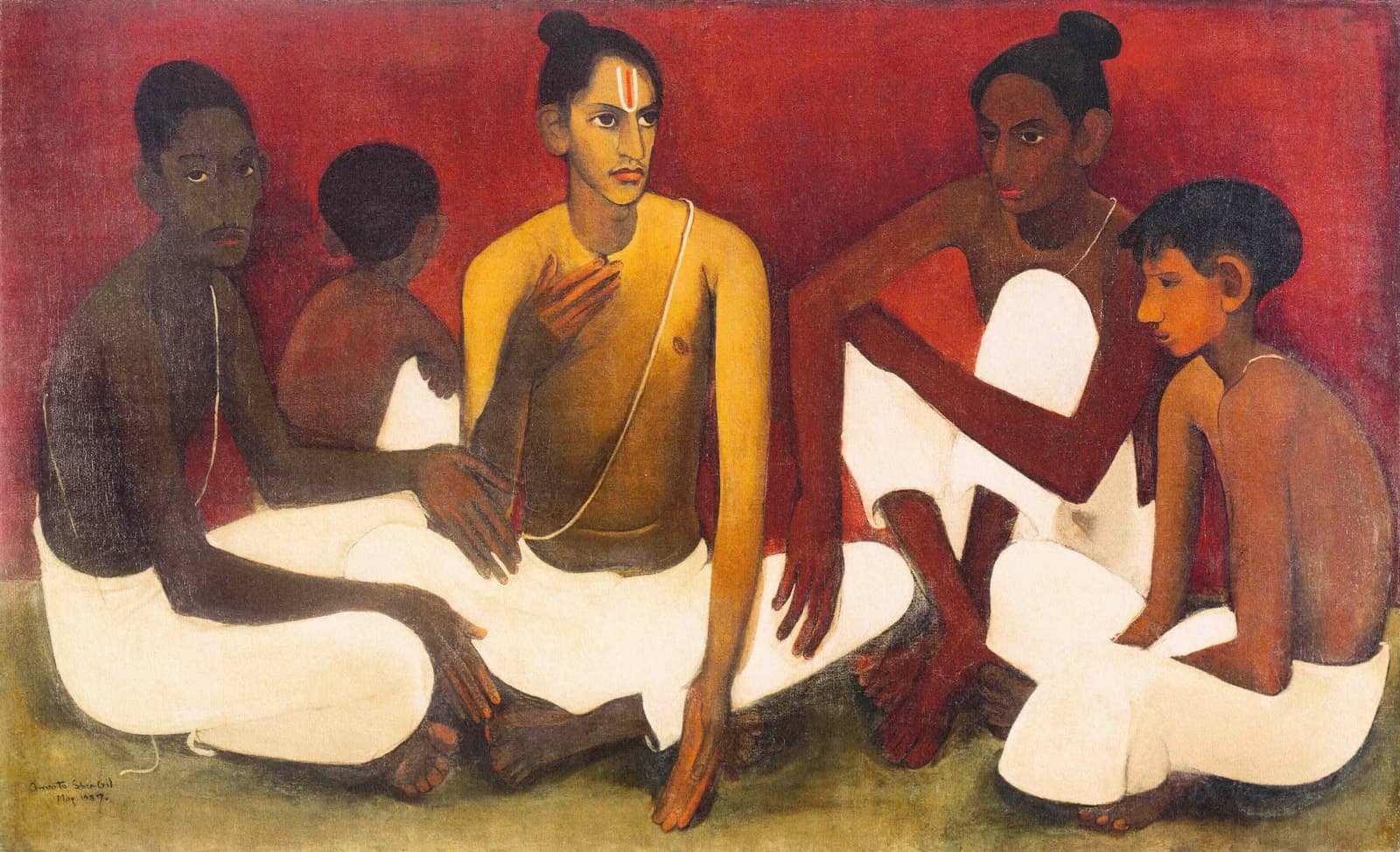
Bride's Toilet, Brahmacharis, and South Indian Villagers Going to Market.
The pictures combine lessons that had once seemed incompatible.
Her figures still possess the solidity she learned through European oil painting. But their simplified shapes, rhythmic arrangements and flattened spaces increasingly respond to Indian murals and miniature traditions.
The result belongs fully to neither tradition.
That was the point.
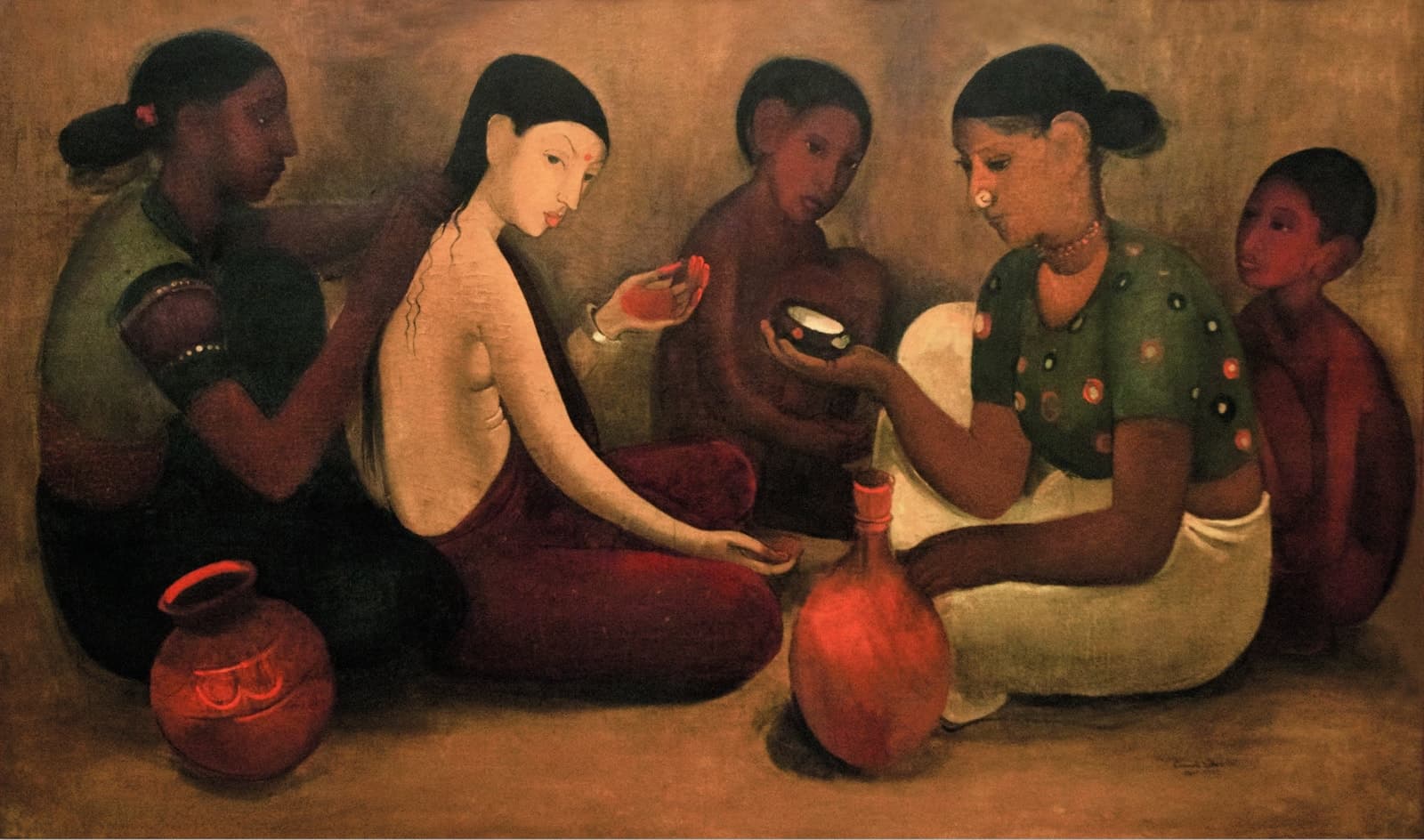
Bride's Toilet
In Bride's Toilet of 1937, women gather around a bride during preparations for marriage.
Sher-Gil could easily have treated the subject as a colorful ethnographic scene.
She did not.
The painting is restrained and psychologically quiet. The women perform ordinary actions, but festivity is not the central emotion. Their monumental bodies and lowered expressions transform the preparation into something more private.
This is characteristic of Sher-Gil's women.
They are rarely merely decorative.
They appear to think.
They wait.
They endure.
Their inner lives do not belong to the viewer.
That ability to treat women as psychologically self-contained subjects rather than accessories to a narrative became one of Sher-Gil's most important contributions to modern Indian painting.
A painter traveling through India
The year 1937 was extraordinarily productive.
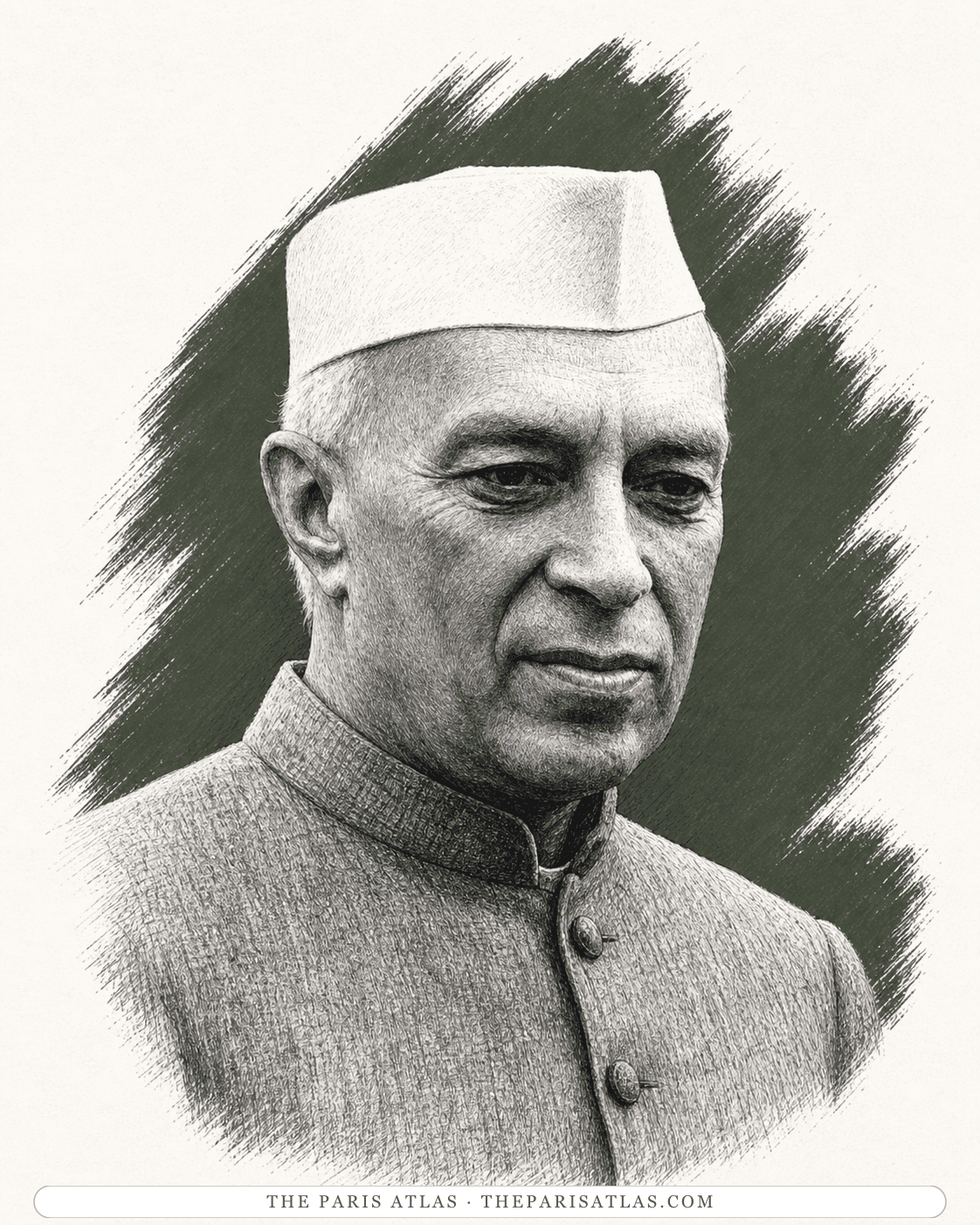
Sher-Gil exhibited at Allahabad University. She held another exhibition at the Imperial Hotel in New Delhi, where she met Jawaharlal Nehru. She had already met the poet and political activist Sarojini Naidu in Hyderabad.
At the end of the year she staged an important exhibition at Faletti's Hotel in Lahore.
She was becoming a public figure as well as a painter.
Sher-Gil was young, glamorous, outspoken and resistant to established artistic hierarchies. That personality sometimes threatened to eclipse discussion of the paintings themselves, even during her lifetime.
But beneath the public image was a remarkably disciplined painter continually reconsidering her technique.
She had not settled.
Marriage to Victor Egan
In June 1938 Sher-Gil returned to Hungary.
The following month she married Dr. Victor Egan, her Hungarian cousin, in Budapest.
She continued working in Hungary, producing paintings such as Two Girls, Potato Peeler and Hungarian Market Scene.
These pictures are useful reminders that her mature career cannot be cleanly divided into “European” and “Indian” styles.
She carried lessons between the two.
The simplified forms and increasingly condensed compositions she had developed in India now entered her Hungarian pictures. Meanwhile the technical understanding she acquired in France never disappeared from her Indian work.
She was building one visual language out of several histories.
Saraya
Amrita and Victor returned to India in 1939.
Eventually they settled at Saraya, in the Gorakhpur district of what is now Uttar Pradesh, where the Sher-Gil family had an estate and Victor worked as a doctor for the local sugar factory.
The setting gave Sher-Gil another collection of subjects.
Her later paintings include village women, domestic interiors, animals, people resting on charpoys, brides, storytellers and scenes of rural life.
Among the major works of these years are Ancient Story Teller, Woman Resting on Charpoy, The Swing and Bride.
Her compositions became increasingly compressed and colorful.
The influence of Indian miniature painting became more visible, particularly in the way figures and architecture could be stacked or distributed across the picture rather than arranged according to conventional European perspective.
Sher-Gil was still changing.
That is one of the tragedies of her early death: there is no settled “late Sher-Gil style” because she never lived long enough to have one.
Lahore and the unfinished painting
In September 1941, Sher-Gil and Victor moved to Lahore, then one of the great cultural centers of British India.
She intended to establish herself there and was preparing another important exhibition.
She began a new painting seen from her Lahore surroundings—a bright, dramatically simplified composition that remained unfinished.
It is now commonly known as The Last Unfinished Painting.
The work suggests that another transformation was underway.
Sher-Gil had already passed through Paris academicism, Post-Impressionism, Indian frescoes, miniatures, rural figuration and increasingly condensed compositions.
At twenty-eight, she was still experimenting.
Then she suddenly became ill.
Her death at twenty-eight
Amrita Sher-Gil died in Lahore around midnight on 5–6 December 1941.
She was twenty-eight.
The exact cause of her death has never been established beyond dispute. Numerous theories have circulated over the decades, but the National Gallery of Modern Art describes the cause as obscure and records that she died after a brief illness. It is more accurate to leave it there than to present later speculation as fact.
A posthumous exhibition of her paintings was held in Lahore later that month.
Her career—from arriving at the Grande Chaumière as a sixteen-year-old student to her final unfinished canvas—had lasted little more than twelve years.
Amrita Sher-Gil and Paris
Paris occupies an unusual place in Sher-Gil's story because she ultimately had to leave it in order to understand what it had given her.
At the Grande Chaumière, she learned from the live model.
At the École des Beaux-Arts, she gained technical mastery over oil paint and the human figure.
In museums and galleries she encountered Cézanne, Gauguin and European modernism.
On the rue de Bassano and around Montparnasse, she developed friendships, painted lovers and classmates and experimented repeatedly with her own image.
At the Théâtre Pigalle, she saw Rabindranath Tagore exhibiting modern Indian art in Paris.
And at the Grand Salon, Young Girls proved that she could compete successfully within the European system.
Yet her most consequential Paris discovery may have been that she did not want simply to become another Paris painter.
European modernism taught her to reconsider tradition. She then applied that skepticism to Europe itself.
When she returned to India in 1934, she did not discard Paris.
She carried it with her.
A modern Indian painter
Sher-Gil's importance lies partly in refusing an easy answer to the question of what modern Indian art should look like.
She did not imitate European modernism.
She did not simply revive traditional Indian painting.
And she did not paint an idealized India designed to satisfy European expectations of exotic color and spirituality.
Instead she looked at real people around her—particularly women, villagers and workers—and gave them pictorial weight.
The figures in her mature paintings can appear solemn, exhausted, detached or simply lost in thought. They often do very little.
But Sher-Gil made that stillness monumental.
The NGMA argues that her use of oil paint, her representations of women, her domestic scenes and her integration of miniature-painting structures introduced important new possibilities into pre-Independence Indian modernism.
Her influence only increased after her death.
In December 1976, the Government of India formally designated works by Sher-Gil as national art treasures, meaning that works covered by the designation in India are subject to strict export restrictions.
The National Gallery of Modern Art now possesses the world's principal institutional collection of her paintings; its digital Sher-Gil project presents 103 works from its holdings.
But numbers make the achievement sound larger in time than it actually was.
She had barely begun.
She was sixteen when she reached Paris.
Twenty-one when she returned to India.
Twenty-four when she painted the South Indian trilogy.
Twenty-five when she married.
Twenty-eight when she moved to Lahore.
And twenty-eight when she died.
The extraordinary question raised by Amrita Sher-Gil's career is therefore not merely what she accomplished.
It is how much she managed to change before she had the chance to finish.
Life events
1913
Born Dalma-Amrita Sher-Gil in Budapest on 30 January to the Indian scholar and photographer Umrao Singh Sher-Gil Majithia and the Hungarian opera singer Marie Antoinette Gottesmann.
— An Unfinished Journey: Amrita Sher-Gil
1921
Moves with her family from Hungary to India, settling in Simla in the Himalayan foothills. She begins learning English while continuing music and drawing.
— An Unfinished Journey: Amrita Sher-Gil
1924
Travels to Florence with her mother and sister and briefly attends school there, giving her an early encounter with Italian Renaissance art before returning to Simla.
— An Unfinished Journey: Amrita Sher-Gil
1926
Her maternal uncle, the Hungarian Indologist Ervin Baktay, visits Simla and encourages her to draw directly from living models. Artist Hall Beven-Petman recommends that she receive professional art training in Europe.
— An Unfinished Journey: Amrita Sher-Gil
1929
At sixteen, moves to Paris. She studies first at the Académie de la Grande Chaumière under Pierre Vaillant and then enters Lucien Simon's studio at the École nationale supérieure des Beaux-Arts.
— An Unfinished Journey: Amrita Sher-Gil
1930
Begins the extensive series of self-portraits, portraits and figure studies that define her Paris student years. In May she also sees Rabindranath Tagore's exhibition at the Théâtre Pigalle while exhibiting there with a women's student group from the Beaux-Arts.
— An Unfinished Journey: Amrita Sher-Gil
1932–1933
Paints Young Girls in Paris in 1932, using her sister Indira and her French friend Denyse Proutaux as models. The painting brings her major recognition, and in 1933 she is elected an associate of the Grand Salon.
— An Unfinished Journey: Amrita Sher-Gil
1933
Leaves the École des Beaux-Arts and establishes a studio with her friend Marie-Louise Chassany. During this period she produces works including Professional Model, Reclining Nude and Sleep.
— An Unfinished Journey: Amrita Sher-Gil
1934
Paints Self-Portrait as a Tahitian, one of the clearest examples of her engagement with Gauguin and European modernism. By the end of the year she has become convinced that her future as a painter lies in India and returns there with her parents in December.
— An Unfinished Journey: Amrita Sher-Gil
1935
Paints Group of Three Girls, one of the first major works of her new Indian period. Its simplified figures, subdued colors and introspective women mark a decisive departure from her Paris studio paintings.
— An Unfinished Journey: Amrita Sher-Gil
1936
Travels widely through India. In Bombay she meets art historian and collector Karl Khandalavala, who introduces her more deeply to Pahari, Basohli, Rajput and Mughal miniature painting. She visits Ajanta and Ellora with Barada Ukil, then continues south through Hyderabad and Trivandrum.
Sher-Gil in a sari in 1936, three years after leaving Paris to make her career in India. (Probably Umrao Singh Sher-Gil)
— An Unfinished Journey: Amrita Sher-Gil
1937
Travels through southern India, visiting Cape Comorin, Cochin and the Mattancherry Palace murals. Back in Simla she paints several of the masterpieces associated with her mature Indian style, including Bride's Toilet, Brahmacharis, The Story Teller and South Indian Villagers Going to Market. Group of Three Girls also wins a gold medal at the Bombay Art Society's annual exhibition.
— An Unfinished Journey: Amrita Sher-Gil
1937
Holds exhibitions at Allahabad University and the Imperial Hotel in New Delhi, where she meets Jawaharlal Nehru. In December she stages an important exhibition at Faletti's Hotel in Lahore, standing among paintings that demonstrate the dramatic change from her Paris work to her Indian period.
Sher-Gil among her paintings at her Lahore exhibition in November 1937. (Unidentified photographer)
— An Unfinished Journey: Amrita Sher-Gil
1938
Returns to Hungary and in July marries her cousin, the physician Dr. Victor Egan, in Budapest. She continues painting during the Hungarian period, producing works including The Potato Peeler, Two Girls and Hungarian Market Scene.
— An Unfinished Journey: Amrita Sher-Gil
1939
Returns to India with Victor. After traveling through Madurai and Mathura, the couple eventually settles at the Sher-Gil family estate at Saraya near Gorakhpur, where Victor works as a doctor for the local sugar factory.
— An Unfinished Journey: Amrita Sher-Gil
1940–1941
At Saraya, paints some of her final major works, including Ancient Story Teller, Woman Resting on Charpoy, The Swing, Bride, Elephants and Camels. Her compositions become increasingly compressed and show the influence of Indian miniature painting.
— An Unfinished Journey: Amrita Sher-Gil
1941
Moves with Victor to Lahore in September, intending to establish herself there and prepare a new exhibition. She begins what is now known as The Last Unfinished Painting, suggesting another stylistic change that she would not live to complete.
— An Unfinished Journey: Amrita Sher-Gil
1941
Dies in Lahore during the night of 5–6 December, after a brief illness. She is only twenty-eight. A posthumous exhibition of her paintings is held in Lahore later that month.
— An Unfinished Journey: Amrita Sher-Gil
Selected works
Cataloged from the holding institutions' records. Reproductions appear only where the rights are verified.
Five young men and boys in white dhotis sit on a grey-green ground against a wall of flat vermilion red. The one in the centre, lighter-skinned than the rest, wears a white and red mark on his forehead, a sacred thread across his chest and his hair in a topknot, and raises a hand to his chest. Amrita Sher-Gil painted it in Simla in May 1937 as the second canvas of her South Indian trilogy. The National Gallery of Modern Art, which holds it as accession number 70, says many scholars count it among her greatest works.
Five figures sit on the ground in a bare brown room. A pale-skinned young woman, bare to the waist, sits in profile at the centre-left while a dark-skinned woman behind her dresses her long black hair. Facing her, a woman in a green spotted blouse holds out a dark bowl of white paste; two children look on, and two red clay pots stand in the foreground. Amrita Sher-Gil painted it in Simla in April 1937, after her journey through South India, and it is one of the three canvases the National Gallery of Modern Art calls her South Indian trilogy. It is accession number 69 in that museum in New Delhi.
Three young women wrapped head to lap in pale green, orange-red and crimson sit close together against a bare brown wall, and none of them looks at the others. Amrita Sher-Gil painted it in Amritsar in January 1935, a month after coming home from Paris, and the National Gallery of Modern Art calls it the first painting she made after Europe. It won the Bombay Art Society's gold medal in 1937. The museum catalogues it as Group of Three Girls; most writing calls it Three Girls.
Amrita Sher-Gil stands bare to the waist, turned to her left, a pale blue-grey cloth wrapped round her hips and her arms crossed low in front of her. Behind her is a wall painted with East Asian figures, women in kimono, a seated man in a black cap and a pagoda roof, and over it falls the grey shadow of a standing figure. She painted it in Paris in 1934, her last year there, and named it after the Tahitian women of Paul Gauguin. It belongs to the Kiran Nadar Museum of Art in New Delhi.
Two young women sit in a dim Paris room. On the left, in a green dress with crimson sleeves, the artist's younger sister Indira Sher-Gil holds a plate of cherries and looks across at her companion. On the right her friend Denyse Proutaux slumps bare-shouldered in a white chair, her long fair hair over her face and a comb in her hands. Sher-Gil painted it in June 1932, at nineteen, and showed it at the Grand Palais in 1933 as Jeunes filles, in the Salon of the Société nationale des Beaux-Arts. That May the society elected her an associate. It is accession number 29 at the National Gallery of Modern Art in New Delhi.
Sher-Gil encountered Post-Impressionist painting during her Paris training, and the National Gallery of Modern Art identifies Gauguin as a particular influence on her early development.
— An Unfinished Journey: Amrita Sher-Gil
Movements
The artistic and literary currents this life ran through.
Historical period and art category · circa 1860s–1970s
Sher-Gil became a foundational figure in modern Indian art, bringing her European training into dialogue with the people and visual traditions of India — one of the interacting modernisms that make a single path spreading outward from Paris an inaccurate description of the period.
— Amrita Sher-Gil — Tate Modern; Modern Art — glossary
Amrita Sher-Gil’s Places
The cataloged places connected to Amrita Sher-Gil — through the books, and through the documented record.
Places you can enter today appear first, followed by addresses to see from outside and sites that have vanished.
Sher-Gil was admitted to the Académie de la Grande Chaumière in April 1929 and studied there under Pierre Vaillant before entering the École des Beaux-Arts.
Sher-Gil became a foundational figure in modern Indian art, bringing her European training into dialogue with the people and visual traditions of India — one of the interacting modernisms that make a single path spreading outward from Paris an inaccurate description of the period.
— Amrita Sher-Gil — Tate Modern; Modern Art — glossary
Sher-Gil encountered Post-Impressionist painting during her Paris training, and the National Gallery of Modern Art identifies Gauguin as a particular influence on her early development.
— An Unfinished Journey: Amrita Sher-Gil
References
References
The sources below include biographies, scholarly essays, interviews, and primary materials that informed this page. They reflect both the historical record and ongoing critical conversations about Amrita Sher-Gil and their work.
These references anchor the page in the documented record and in the scholarly conversations around Amrita Sher-Gil. Every claim on this page traces back to one or more of the works listed here.






 View source