Historical period and art category · Paris · circa 1860s–1970s
Modern Art
A century of artists reconsidering what art should depict, how it should be made, and what counts as an artwork at all.
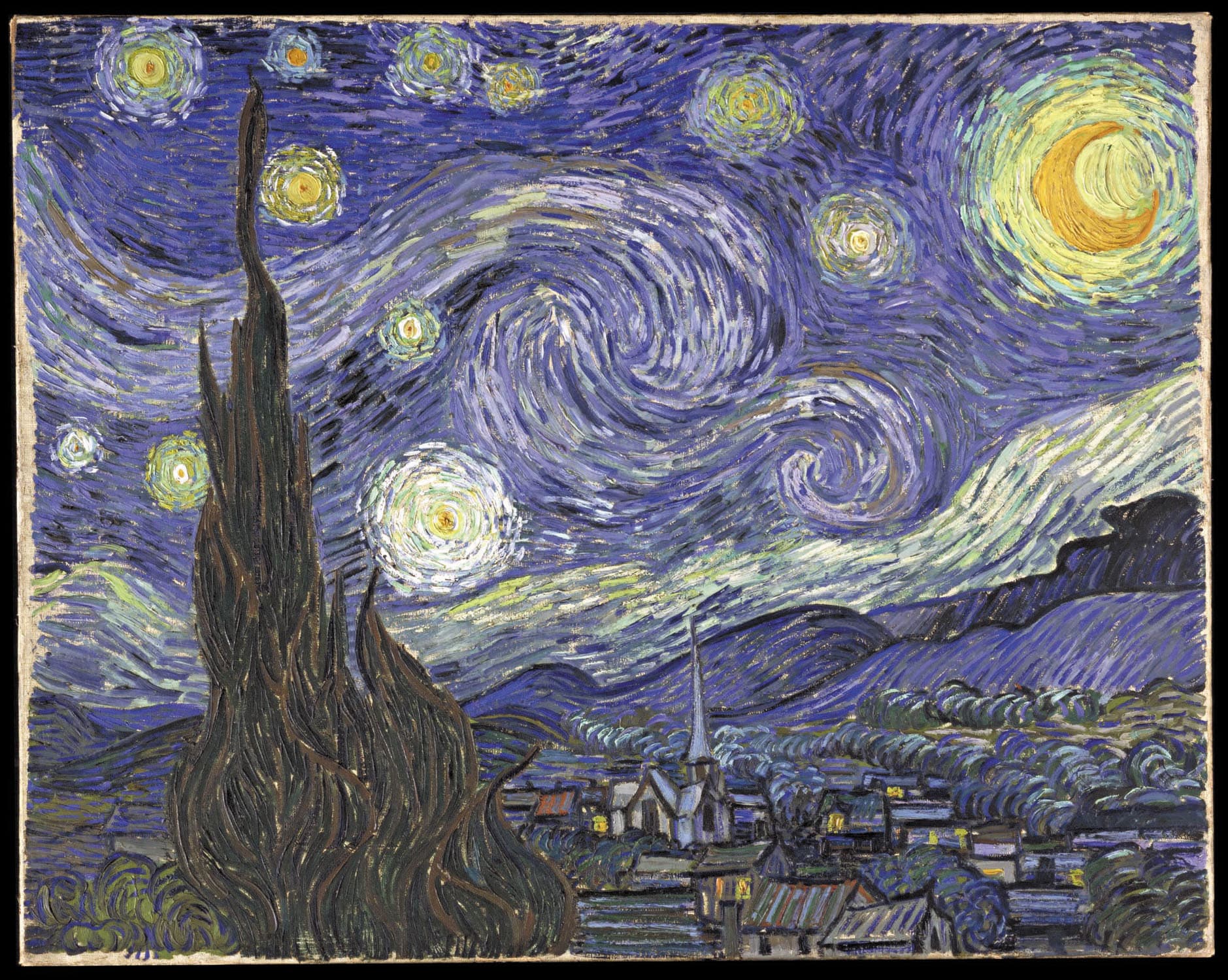
Artwork reproductionVincent van Gogh, The Starry Night, 1889 — a landscape whose sky is not a record of the weather but an intensely constructed image. Museum of Modern Art, New York.
What Is Modern Art?
Modern art is the broad category of art associated with the experimental movements that developed from the nineteenth century into the later twentieth century, particularly from around the 1860s to the 1970s. It includes artists who reconsidered what art should depict, how it should be made, and what purposes it might serve. Rather than accepting inherited conventions as fixed rules, they experimented with color, perspective, materials, subject matter, and eventually the definition of an artwork itself. Modern art is therefore not a single movement like Impressionism or Cubism: it is the larger historical category to which many different, sometimes opposing movements belong.[1][2]
Its range is unusually wide. A recognizable landscape by Claude Monet, a fractured figure by Pablo Picasso, a geometric composition by Piet Mondrian, and a manufactured object selected by Marcel Duchamp can all belong to its history. What connects such different works is not a shared appearance but their participation in a sustained reconsideration of artistic traditions. Modern artists asked whether a painting had to resemble the visible world, whether sculpture had to represent a recognizable subject, and whether an artist needed to make an object by hand for it to become art.
When Did Modern Art Begin and End?
There is no universally agreed starting date. Some histories trace modern art to the Realism of Gustave Courbet in the mid-nineteenth century; others emphasize Édouard Manet and the Impressionists in the 1860s and 1870s. The Museum of Modern Art in New York uses a narrower working definition, identifying modern art with the period from the 1880s to the 1970s. These differences reflect competing interpretations of when the decisive changes occurred, rather than an error that can be resolved by choosing one exact year.[1]
The ending is similarly flexible. The experiments of the 1960s and 1970s overlap with the beginnings of what museums and historians call contemporary art. Modern art did not stop because artists abandoned abstraction, painting, or experimentation. Instead, the intellectual framework changed, and the idea that art history should progress through a succession of leading movements became increasingly difficult to sustain.[3][4]
Modern Art, Modernism, and Contemporary Art
Term
Meaning
Modern art
A broad historical category encompassing the experimental art movements of the nineteenth and much of the twentieth century.
Modernism
The larger set of cultural approaches associated with rethinking inherited traditions. In visual art, the term often overlaps with modern art, but modernism also extends into architecture and other creative fields.
Contemporary art
Art of the present and recent past. Its starting point varies by institution and context; MoMA currently uses approximately 1980 onward in its glossary.
Abstract art
Art that departs from straightforward representation, sometimes removing recognizable subjects altogether. Abstraction is an important part of modern art, but the two terms are not interchangeable.
A painting made today is therefore not automatically “modern art” in the historical sense, even when it looks experimental. Conversely, a nineteenth-century painting can belong to modern art despite being more than a century old. The word modern identifies a historical formation, not simply whatever happens to be new.[3]
Why Did Modern Art Develop?
Industrialization and the Experience of Modern Life
Modern art developed alongside profound changes in everyday experience. Expanding cities, industrial production, railway travel, electric lighting, and new communications technologies altered both the appearance of the world and the pace at which people encountered it. Artists responded to these changes by treating contemporary life as a subject worthy of serious attention and by exploring visual forms that could express its unfamiliar rhythms.[5]
In France, the Impressionists painted railway stations, theaters, cafés, fashionable clothing, suburban recreation, and the changing environments around Paris. Their pictures were not simply pleasant records of outdoor leisure. They also documented a society in which urban expansion, commerce, and new patterns of work and recreation were transforming how people occupied public and private space.[6]
Challenges to Academic Authority
In nineteenth-century France, the official Salon was an enormously important route to recognition. Its juries selected works for exhibition, and acceptance could affect an artist's reputation and opportunities. The independent exhibitions associated with modern art challenged this concentration of authority by creating alternative ways to reach audiences.[6]
This institutional change was as important as any particular style. An artist could contest not only how a body should be painted but also who had the right to decide whether the painting deserved to be seen. Modern art developed through exhibitions, publications, dealers, and artist-led initiatives as well as through the individual achievements of painters and sculptors.
Photography and Encounters with Other Artistic Traditions
Photography introduced new ways of recording and framing the visible world, while other technologies offered artists unfamiliar subjects and tools. It would be misleading, however, to say that cameras simply made realistic painting unnecessary. Modern artists explored many responses to technological change, from renewed attention to everyday observation to experiments with movement, unusual viewpoints, and the relationship between an image and the world it represents.[7]
European artists also encountered artistic traditions that challenged the apparent universality of their own conventions. Japanese prints offered striking examples of asymmetry, bold contours, flat color, and unconventional compositions. The enthusiasm known as Japonisme influenced artists including Edgar Degas, Mary Cassatt, and Henri de Toulouse-Lautrec, demonstrating that a compelling image did not need to follow the spatial rules of European academic painting.[8]
What Are the Main Characteristics of Modern Art?
Experimentation with Form
Modern artists frequently made the means of representation conspicuous. Brushstrokes could remain visible, colors could depart from natural appearances, and objects could be flattened, fragmented, or rearranged. Instead of concealing the process of construction, a work might invite viewers to notice how its surface, shapes, and materials produced an experience. These approaches varied greatly: the broken brushwork of Impressionism was not the same experiment as the fractured forms of Cubism.[9]
Greater Freedom from Literal Representation
A modern artwork might represent an actual place while transforming its appearance, or it might dispense with recognizable objects altogether. Expressionist distortion, Cubist fragmentation, and geometric abstraction offered different alternatives to straightforward description. None of this meant that recognizable subjects disappeared; modern art continued to include portraits, landscapes, interiors, historical narratives, and scenes of ordinary life.
Attention to Inner Experience
For many artists, the visible world was only part of reality. Emotions, dreams, spiritual beliefs, memories, and unconscious associations could also become subjects. Expressionists used intensified forms and colors to communicate psychological experience, while Surrealists explored dreams and unexpected connections. Such work often asked viewers to recognize a state of mind rather than identify a precisely described scene.[10][11]
Questions About Art Itself
Some of modern art's most consequential experiments concerned the boundaries of the category. Could a manufactured object become sculpture? Could choosing, naming, or presenting something be an artistic act? Could an idea matter more than the physical object through which it was communicated? Duchamp's readymades and later Conceptual art made these questions central, shifting attention from representation alone to the conventions through which art acquires meaning.[12]
The History of Modern Art and Its Major Movements
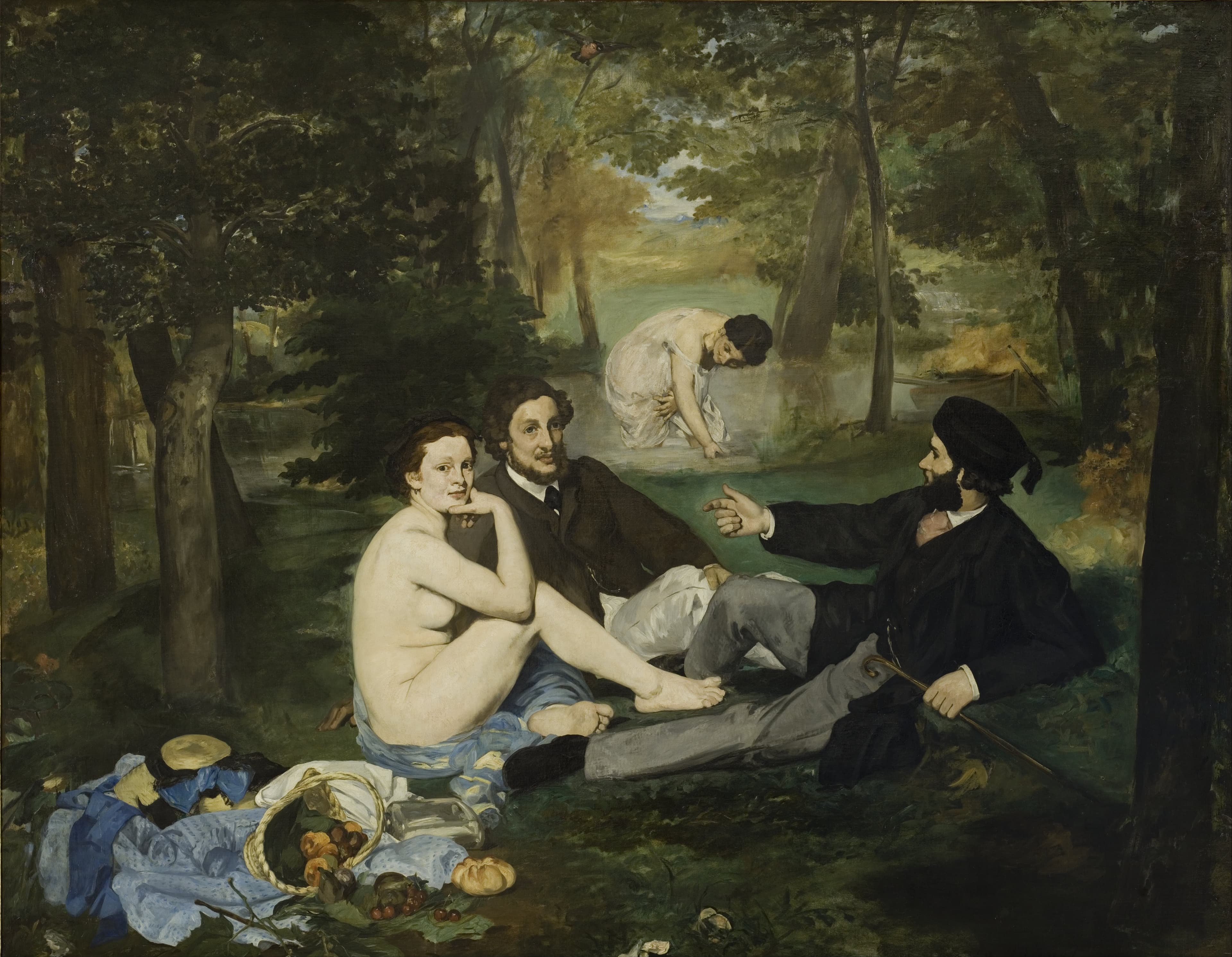
Artwork reproductionÉdouard Manet, Le Déjeuner sur l'herbe, 1863 — rejected by the Salon jury and shown at the Salon des Refusés. Musée d'Orsay, Paris.
Realism: Ordinary Life on an Unprecedented Scale
Realism provided an important foundation by challenging the hierarchy of subjects considered suitable for ambitious art. Gustave Courbet's A Burial at Ornans (1849–1850) depicted a provincial funeral on a monumental scale. Instead of presenting idealized heroes, it gave sustained attention to ordinary people, their physical presence, and the shared fact of death. Its ambition lay partly in refusing to treat everyday existence as a lesser subject.[13]
Courbet's example also complicates the idea that modern art simply rejected the past. His painting drew upon earlier traditions, including Dutch group portraiture, while using those precedents for a different purpose. Innovation often involved reworking existing artistic languages rather than erasing them.[13]
Manet and the Scandal of Modern Painting
Édouard Manet brought this confrontation into especially sharp focus. His Le Déjeuner sur l'herbe—The Luncheon on the Grass—was rejected by the Salon jury in 1863 and exhibited at the Salon des Refusés, an exhibition authorized that year for rejected works. Its nude woman seated beside clothed men became a source of public laughter and scandal.[14]
The painting was unsettling not merely because it contained nudity, which was familiar in academic art, but because its subject and treatment disrupted expectations. Manet drew upon prestigious artistic precedents while presenting a scene that resisted a reassuring mythological explanation. His handling of space and paint also challenged polished academic illusion. The result was a work that made the relationship between tradition and contemporary experience conspicuously unstable.[14]
Impressionism: An Independent Exhibition Becomes an Art-Historical Turning Point
On April 15, 1874, a group of independent artists opened an exhibition in premises formerly occupied by the photographer Nadar in Paris. Participants included Claude Monet, Pierre-Auguste Renoir, Edgar Degas, Camille Pissarro, and Berthe Morisot. Their decision to organize outside the official Salon created an alternative public platform for work that did not conform to established expectations.[15]
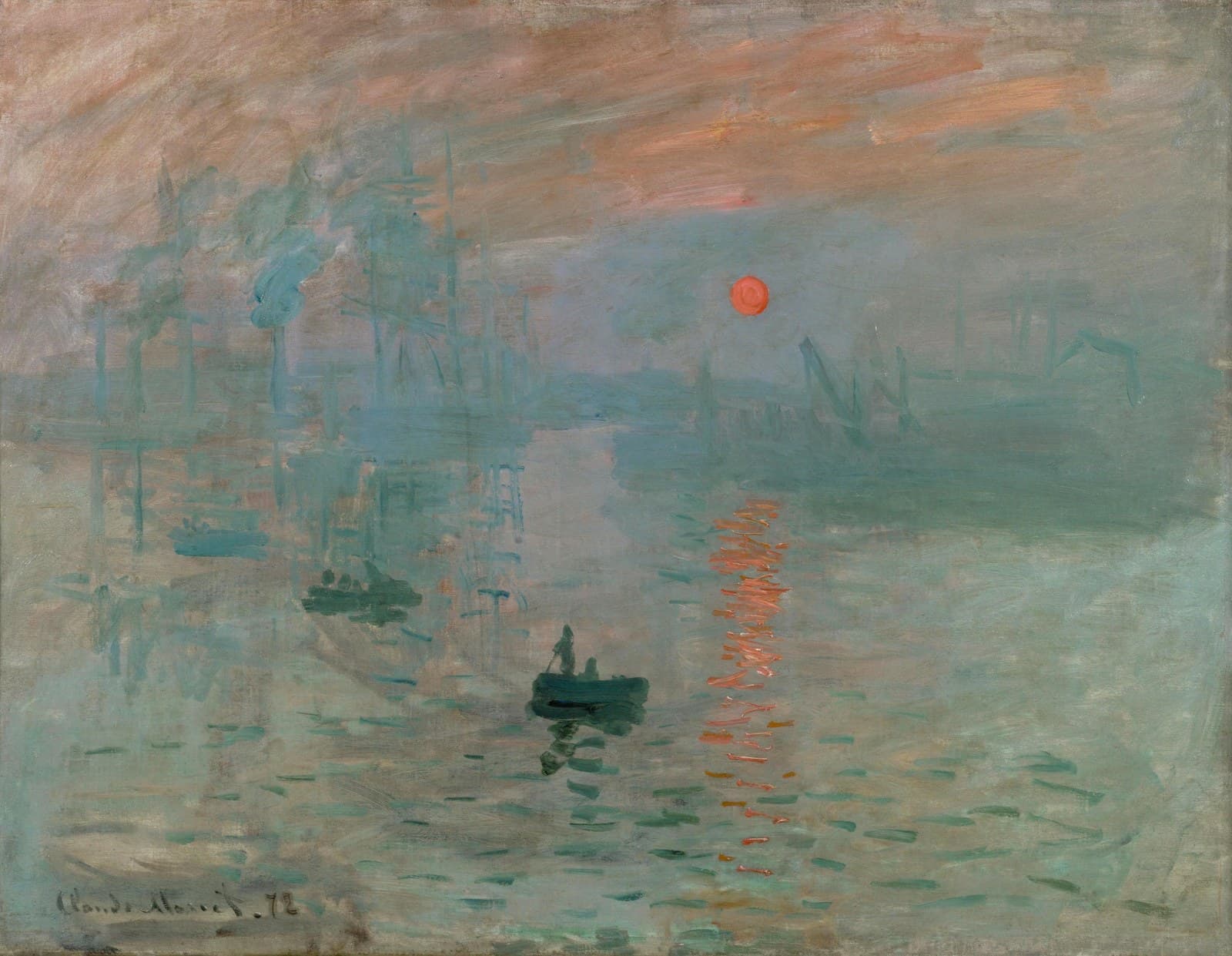
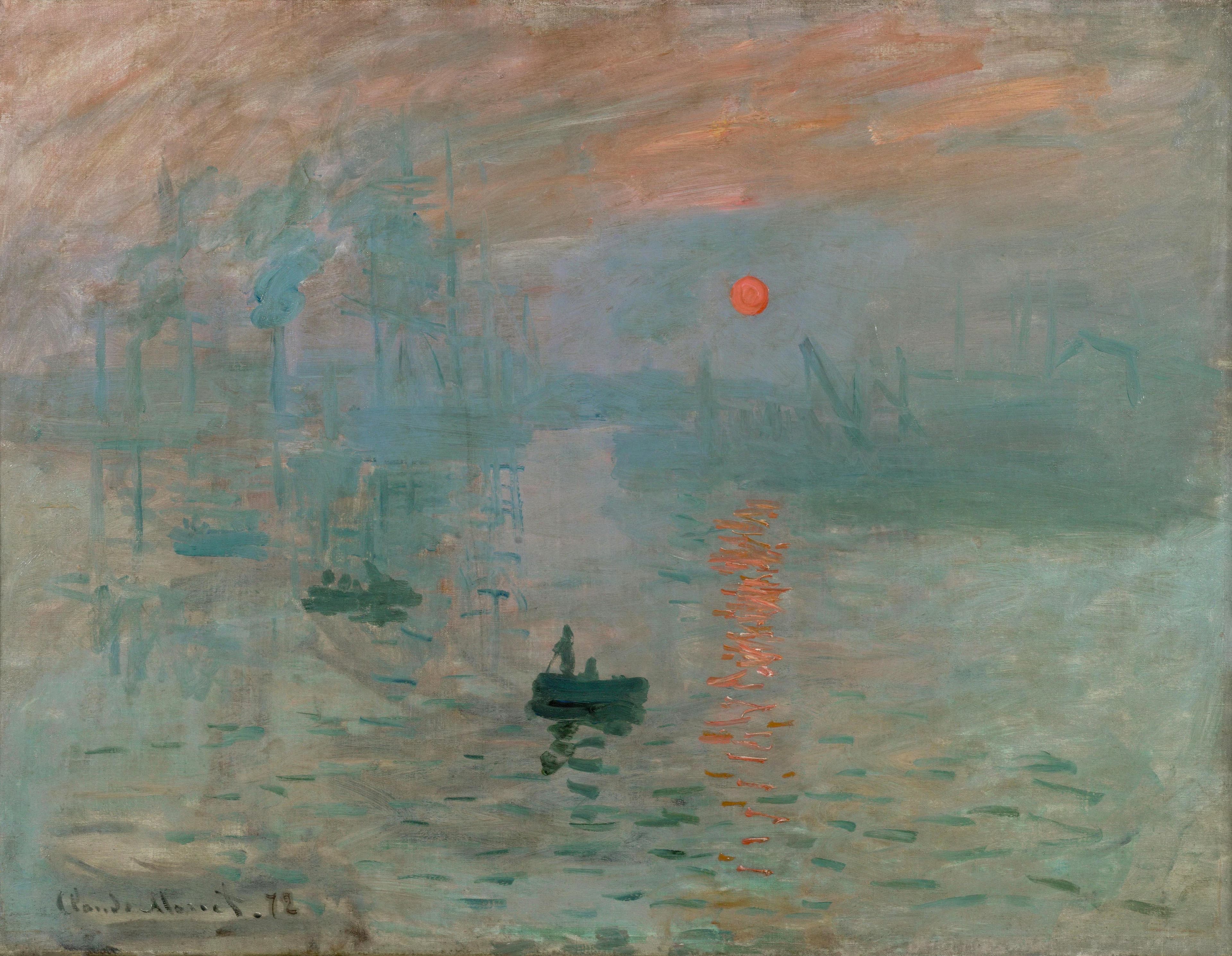
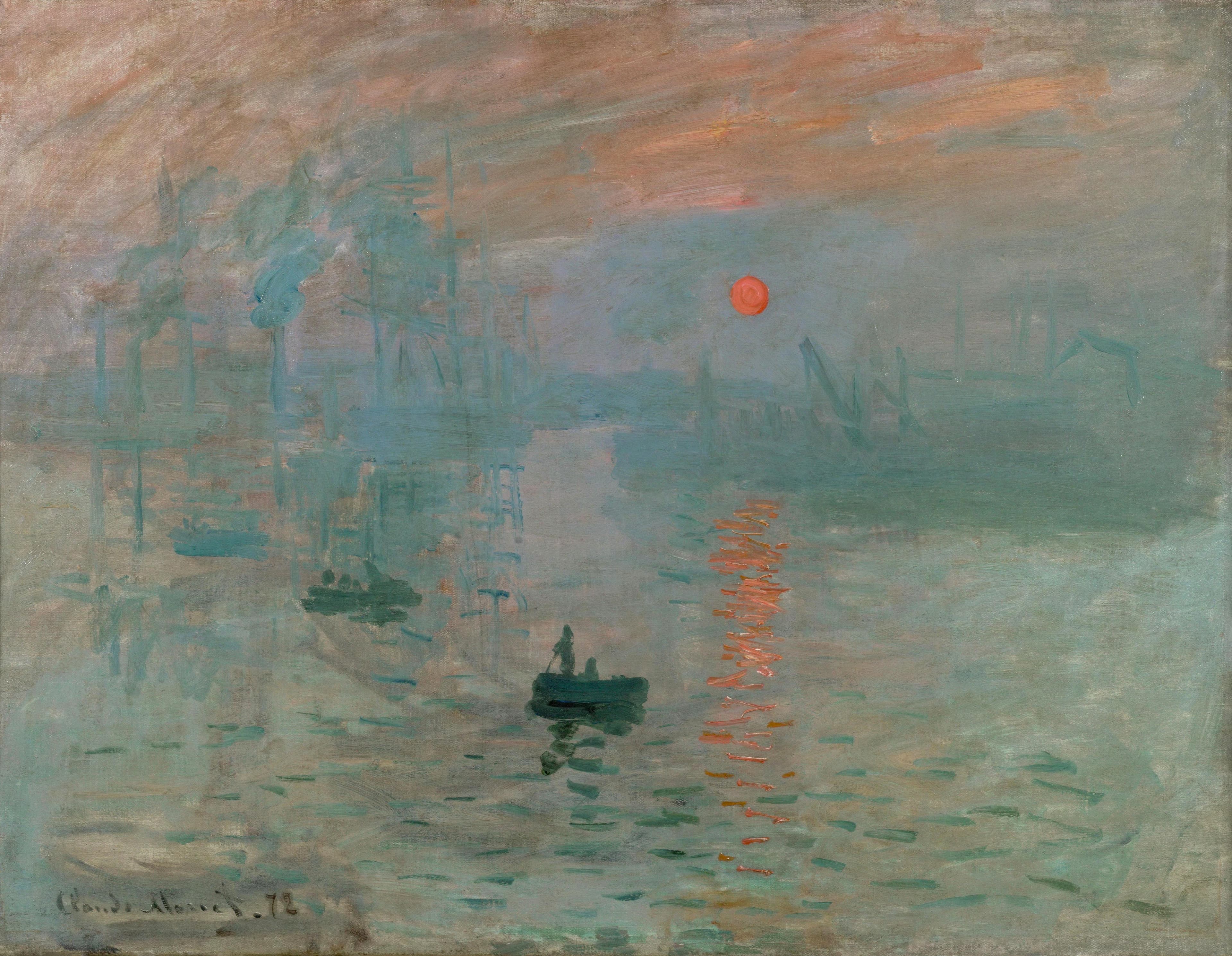
One painting helped supply the movement's eventual name: Monet's Impression, Sunrise. The critic Louis Leroy used the language of “impression” mockingly, suggesting that these pictures were unfinished rather than fully realized paintings. What had been presented as a defect—an immediate, abbreviated encounter with a subject—became central to how Impressionism was understood.[16]
The artists were not identical in their aims. Some concentrated on landscapes and changing light; others examined performance, social interaction, or domestic life. Their shared independence mattered more than a rigid visual formula, and the movement's history is better understood as a network of related experiments than as a set of rules every member followed.[6]
Post-Impressionism is a retrospective label for artists who developed different responses to Impressionism rather than the name of one unified group. Paul Cézanne explored structure and the organization of pictorial space. Vincent van Gogh intensified the expressive possibilities of color and brushwork. Georges Seurat developed a systematic approach to color relationships, while Paul Gauguin pursued simplified forms and symbolic meaning.[17]
Van Gogh's The Starry Night (1889) makes the distinction particularly clear. Its sky is not simply a neutral record of atmospheric conditions: swirling marks, luminous circles, and rhythmic movement make it an intensely constructed image. The painting remains a landscape, but observation has been transformed into an expressive visual experience.[18]
Fauvism and Expressionism: Color Beyond Natural Appearance
At the beginning of the twentieth century, Fauvist painters including Henri Matisse and André Derain pushed color away from descriptive accuracy. Their intense hues and forceful handling of paint attracted the label fauves, or “wild beasts,” in connection with the 1905 Salon d'Automne. Color could organize a composition or establish an emotional atmosphere without faithfully reproducing the local color of a face, tree, or building.[19]
Expressionism developed through related but distinct experiments, especially in Germany and Austria. The group Die Brücke, established in 1905, explored distorted forms and contemporary experience. Der Blaue Reiter, formed in Munich in 1911 around Wassily Kandinsky and Franz Marc, placed particular emphasis on the expressive and spiritual possibilities of color and form. These artists did not share one doctrine, but they helped establish that visual distortion could be a deliberate method rather than a failure of observation.[20][21][22]
Developed by Pablo Picasso and Georges Braque in Paris between approximately 1907 and 1914, Cubism challenged the convention of presenting a coherent scene from a single stable viewpoint. Objects and figures were broken into interlocking planes, and the relationship between foreground, background, and surface became difficult to separate. A painting could suggest several aspects of an object without resolving them into a familiar illusion of depth.[23]
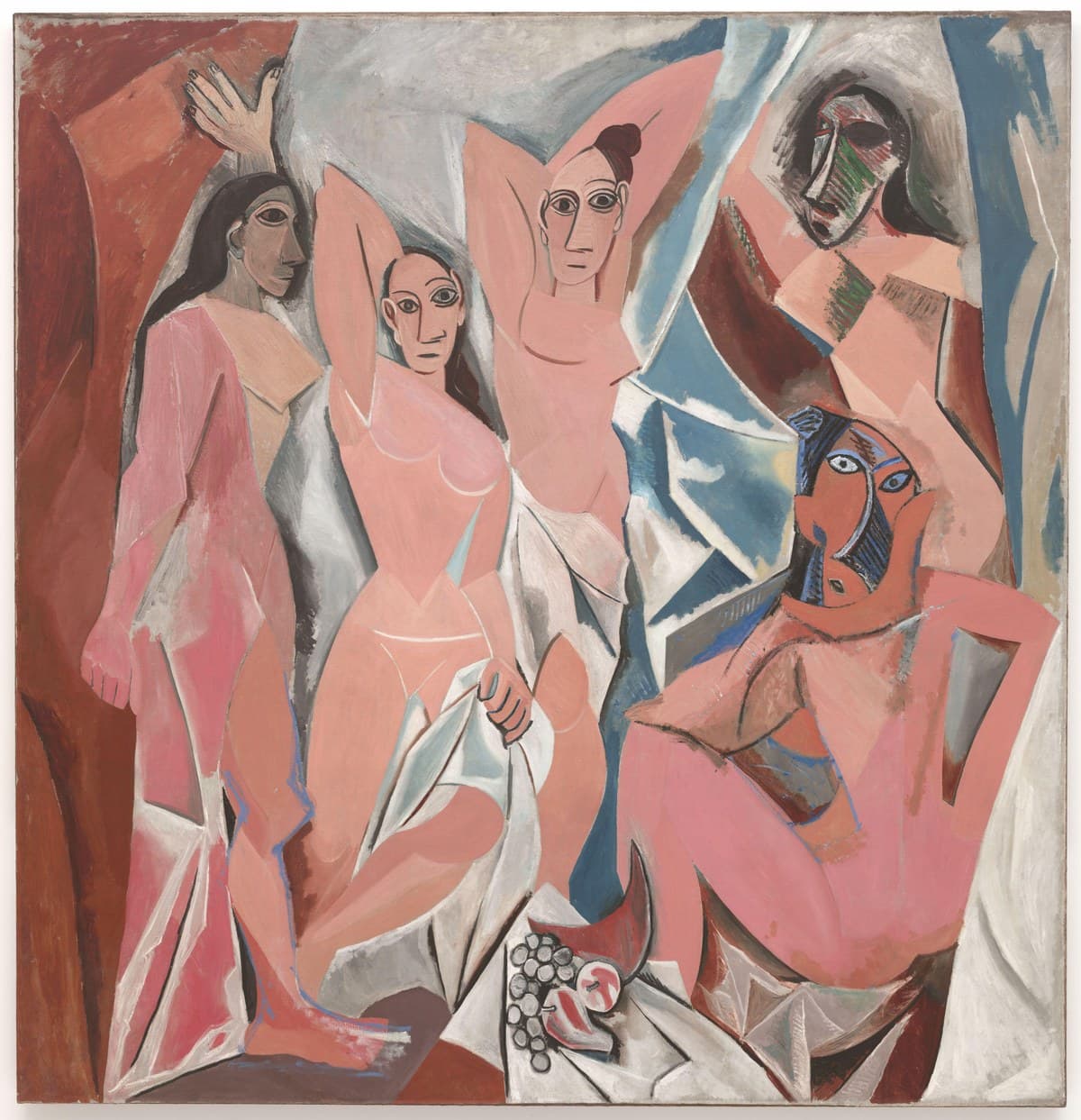
Picasso's Les Demoiselles d'Avignon (1907), an important precursor to fully developed Cubism, brought this disruption into the representation of the human body. Its angular figures and unstable space departed dramatically from conventional ideals of beauty. Later Cubist experiments with collage introduced pieces of printed paper and other materials into compositions, making the relationship between an actual object, a material fragment, and a painted representation part of the work's subject.[24][25]
Futurism: Speed, Machines, and a Troubling Politics
Futurism announced itself through Filippo Tommaso Marinetti's manifesto, prominently published in the Paris newspaper Le Figaro in 1909. Its advocates called for a new aesthetic associated with speed, industry, machinery, and the rejection of inherited cultural authority. Futurist experiments extended across painting, sculpture, typography, poetry, performance, photography, and film.[26][27]
The movement also demonstrates why artistic innovation should not automatically be equated with humane or progressive politics. Marinetti's manifesto celebrated violence and war alongside technological change. Futurism's desire to break with the past could produce inventive forms, but it also carried destructive ideals within its rhetoric of renewal.[26]
Abstraction: Art Without a Recognizable Subject
Several artists approached abstraction through different routes. Kandinsky connected form and color with spiritual experience. Kazimir Malevich's Suprematism emphasized elementary geometric forms, while artists associated with De Stijl, including Piet Mondrian, pursued relationships among horizontals, verticals, and carefully controlled colors. Constructivists explored another direction, connecting abstract form with materials, construction, and the possibilities of modern production.
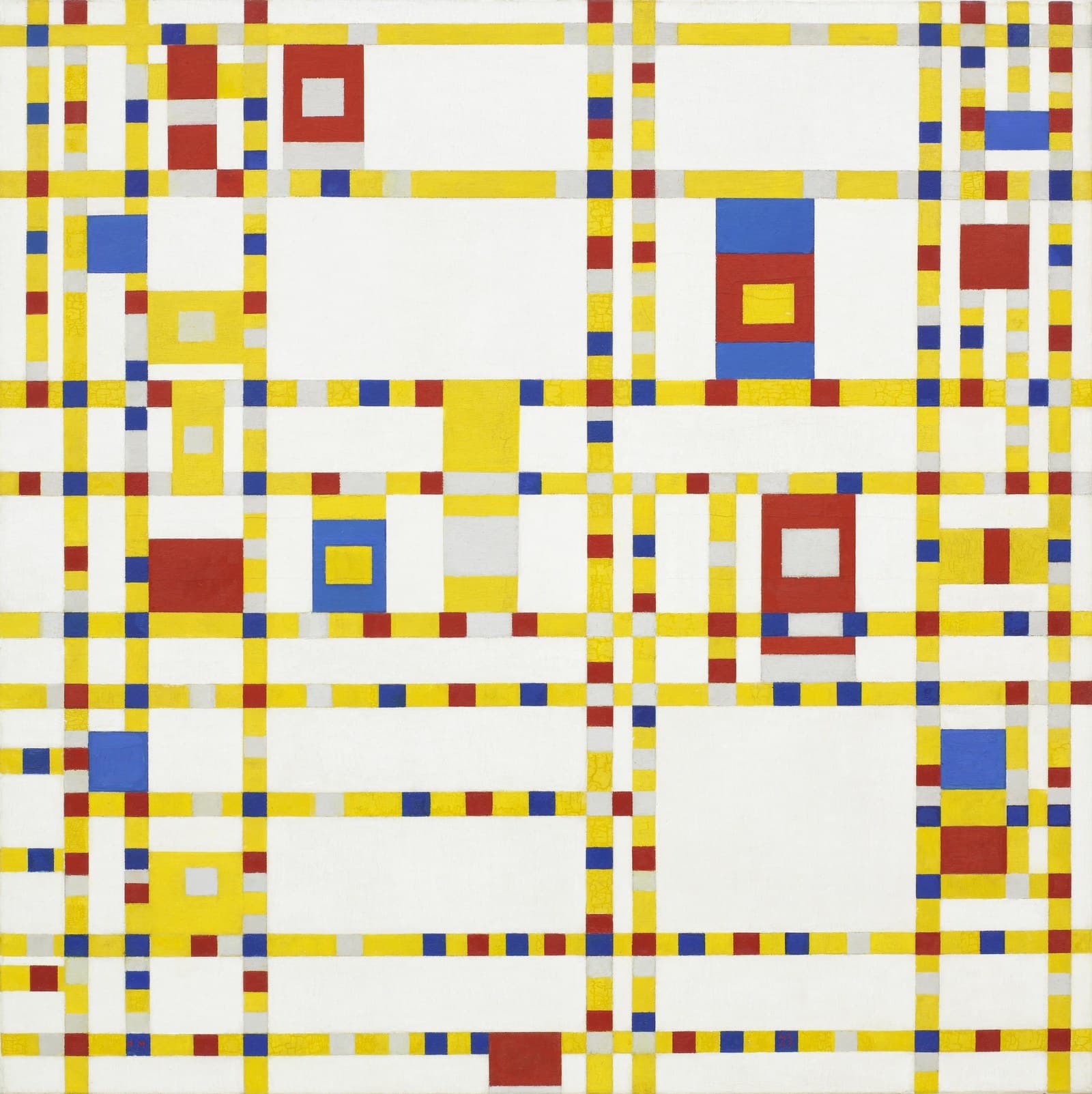
Abstraction did not necessarily mean withdrawal from the world. Mondrian's Broadway Boogie Woogie (1942–1943), for example, connects geometric organization with the rhythms of New York and the music that fascinated him. Its colored intervals suggest movement and interruption without illustrating a street scene or a group of musicians.[28]
Hilma af Klint and the Difference Between Innovation and Recognition
The Swedish artist Hilma af Klint complicates any simple account of abstraction's origins. Beginning in 1906, she produced radically nonfigurative works connected with spiritual inquiry, working largely outside the public networks through which abstraction became internationally recognized. Her conventional paintings were exhibited during her lifetime, but her esoteric work circulated much more narrowly.[29][30]
Af Klint even marked certain notebooks to remain unopened until twenty years after her death. Her work attracted substantial international attention only decades later. Her story makes an important distinction visible: creating an innovation, making it publicly influential, and receiving historical recognition are not the same event. It also warns against describing abstraction as the invention of one universally agreed founder.[30]
Dada emerged during the First World War, with the Cabaret Voltaire in Zurich becoming an important gathering place in 1916 for artists, writers, and performers who had sought refuge in neutral Switzerland. Its activities challenged conventional expectations through performance, provocation, and the refusal of established artistic seriousness. The movement's history belongs as much to events and publications as to objects preserved in museums.[31]
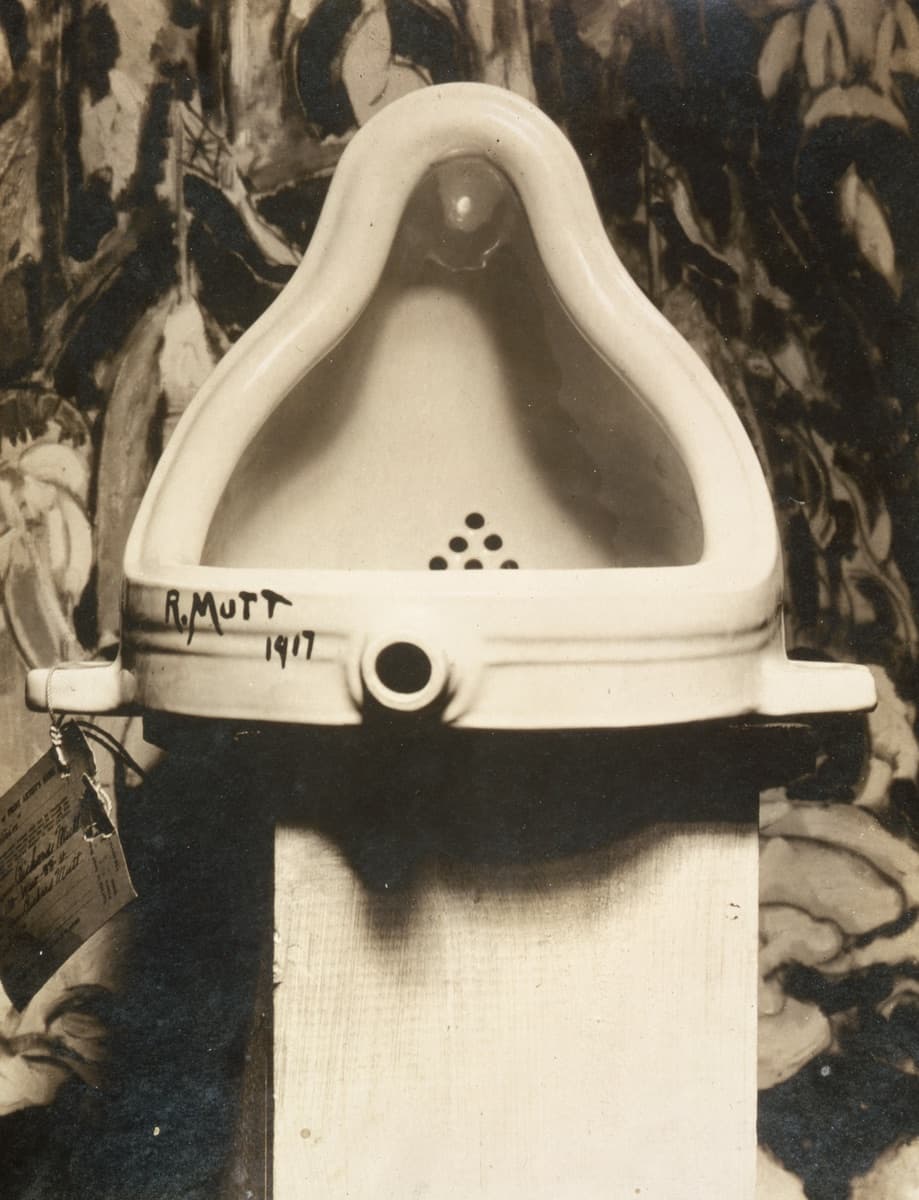
Its most famous challenge to artistic authority came through Marcel Duchamp's Fountain. In 1917, a manufactured urinal signed “R. Mutt” was submitted to an exhibition organized by the Society of Independent Artists in New York. Although the organization advertised a “no jury” policy, the work was withheld from display, and Duchamp resigned in protest. The confrontation exposed a boundary that even an apparently open exhibition was unwilling to cross.[32]
The original object subsequently disappeared. Its significance survived through documentation and later authorized versions, making Fountain a particularly striking example of an artwork whose historical importance cannot be reduced to one surviving original. The central issue was whether selection and presentation could constitute artistic creation, even when the artist had not manufactured the object.[33]
Surrealism: Dreams, Desire, and the Unfamiliar Within the Familiar
Surrealism took organized form around André Breton's 1924 manifesto and explored dreams, unconscious associations, and alternatives to ordinary rational thought. Its artists did not adopt one shared appearance. Salvador Dalí could use painstaking illusionism to depict impossible situations, while other artists developed automatic methods or more abstract imagery.[11]
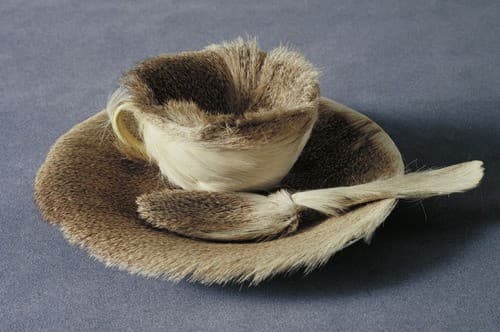
Meret Oppenheim's Object (1936), a fur-covered cup, saucer, and spoon, offers one of the movement's most memorable encounters between the familiar and the disturbing. Its origin lay in a café conversation with Picasso and Dora Maar: a remark about Oppenheim's fur-covered bracelet led to the suggestion that other objects could receive the same treatment. The resulting work transformed something associated with comfort and civilized sociability into an object that is inviting to touch but unsettling to imagine using.[34]
Abstract Expressionism: Painting as Action and Environment
In the 1940s and 1950s, Abstract Expressionism became a major force in New York. Artists including Jackson Pollock, Willem de Kooning, and Mark Rothko developed large-scale paintings that could surround the viewer with gesture, color, and psychological intensity. Their work drew on several earlier traditions, including Surrealism, rather than appearing as an entirely isolated American invention.[35]
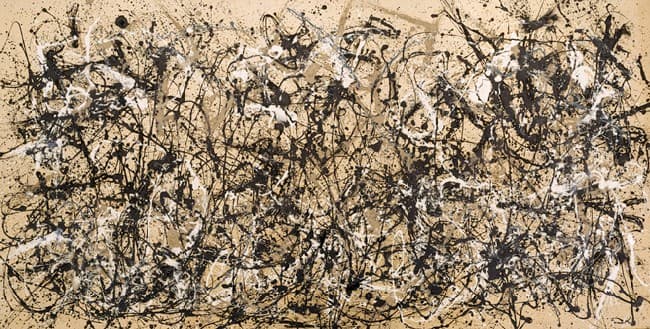
Pollock's poured and dripped paintings made the movement of paint across a surface central to the image. Rothko pursued a markedly different approach through expansive fields of color. The category therefore embraces contrasting practices rather than a single technique: its importance lies partly in the new scale of ambition it gave to abstract painting and the kinds of encounter it created between a work and its viewer.[36]
Pop Art: Consumer Culture Enters the Gallery
Pop artists drew imagery from advertising, comic books, television, celebrity culture, and manufactured goods. Instead of treating commercial imagery as something necessarily beneath serious art, they made it a subject through which to examine contemporary experience. The relationship could be celebratory, critical, ironic, or deliberately difficult to resolve.[37]
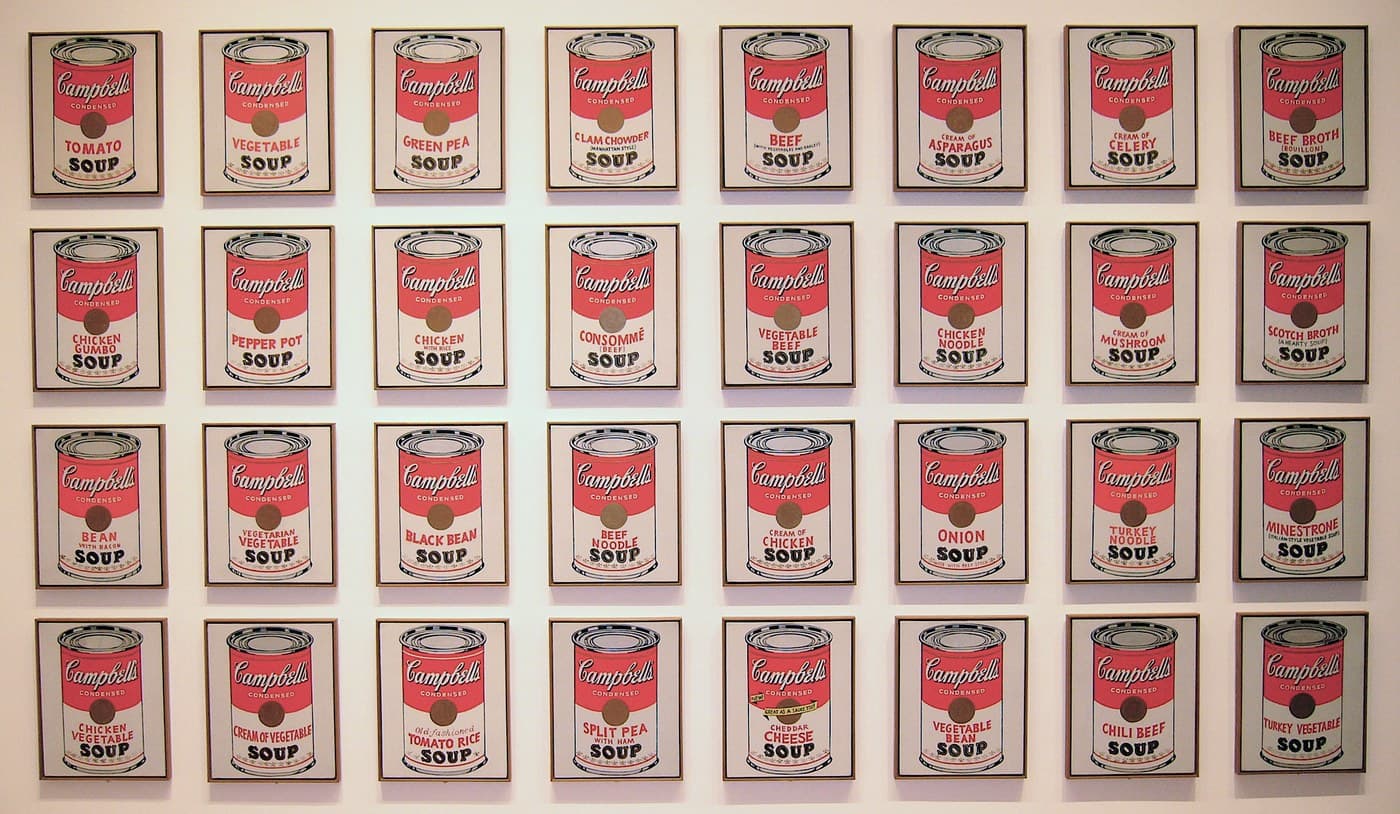
Andy Warhol's Campbell's Soup Cans (1962) is especially revealing. Its thirty-two canvases were initially displayed on shelves in a manner recalling supermarket products. Although the images evoke industrial repetition, the original paintings were made by hand, with stamped details. The contrast between handmade artwork and mass-produced appearance is part of their significance, not an incidental technical fact.[38]
Minimalism and Conceptual Art: The Object, the Space, and the Idea
Minimalism, especially prominent in the United States during the 1960s, used simplified geometric forms and avoided conventional representational content. Rather than asking what a sculpture depicted, viewers were encouraged to attend to its physical presence, proportions, repetition, and relationship to surrounding space. Its apparent simplicity shifted attention toward the conditions of looking.[39]
Conceptual art placed greater emphasis on the idea organizing a work than on a traditionally crafted object. Language, instructions, documentation, and other forms could become central. These developments helped establish the transition toward contemporary art by challenging the assumption that artistic significance needed to reside primarily in a discrete painting or sculpture.[12]
Modern Art Beyond Painting
Sculpture and the Bird That Went to Court
Modern sculpture generated its own debates about representation. Constantin Brâncuși's Bird in Space reduced the suggestion of a bird to an elongated, polished form intended to communicate flight rather than describe feathers, wings, or anatomy. Its abstraction was not simply the removal of detail; it concentrated attention on a particular experience of movement.[40]
When one version entered the United States in 1926, customs officials refused to recognize it as a work of art eligible for duty-free entry. The dispute led to a court case in which artists and experts were asked to explain why an object that did not resemble a conventional bird could nevertheless be sculpture. In 1928, the court found in Brâncuși's favor. The episode made an abstract question unexpectedly practical: a disagreement about artistic form could determine how an object was classified at a national border.[41]
Photography and Film
Photography and film were not merely outside forces that influenced painting. They became important fields of modern artistic experimentation in their own right, offering possibilities involving framing, sequencing, light, motion, and duration. The experiments collected under modern art therefore include camera-based images and moving pictures as well as works made with paint, stone, or bronze.[42]
This broader view matters because an account organized only around famous paintings can conceal how extensively artists crossed boundaries between media. MoMA's treatment of experimentation, for example, places film alongside painting, sculpture, and other practices rather than presenting it as a separate technological footnote.[43]
Architecture, Design, and the Bauhaus
Modernist experimentation also entered buildings, furniture, textiles, and everyday objects. Founded by Walter Gropius in Weimar in 1919, the Bauhaus sought to bring the arts together and rethink their relationship to the material world. Its history joined artistic education with practical questions about design, craft, architecture, and production.[44][45]
The school's ambitions developed over time, including a growing emphasis on designing models suitable for industry. Its importance lies not simply in a recognizable “Bauhaus look,” but in its attempt to reorganize how artistic skills could shape everyday environments.[45]
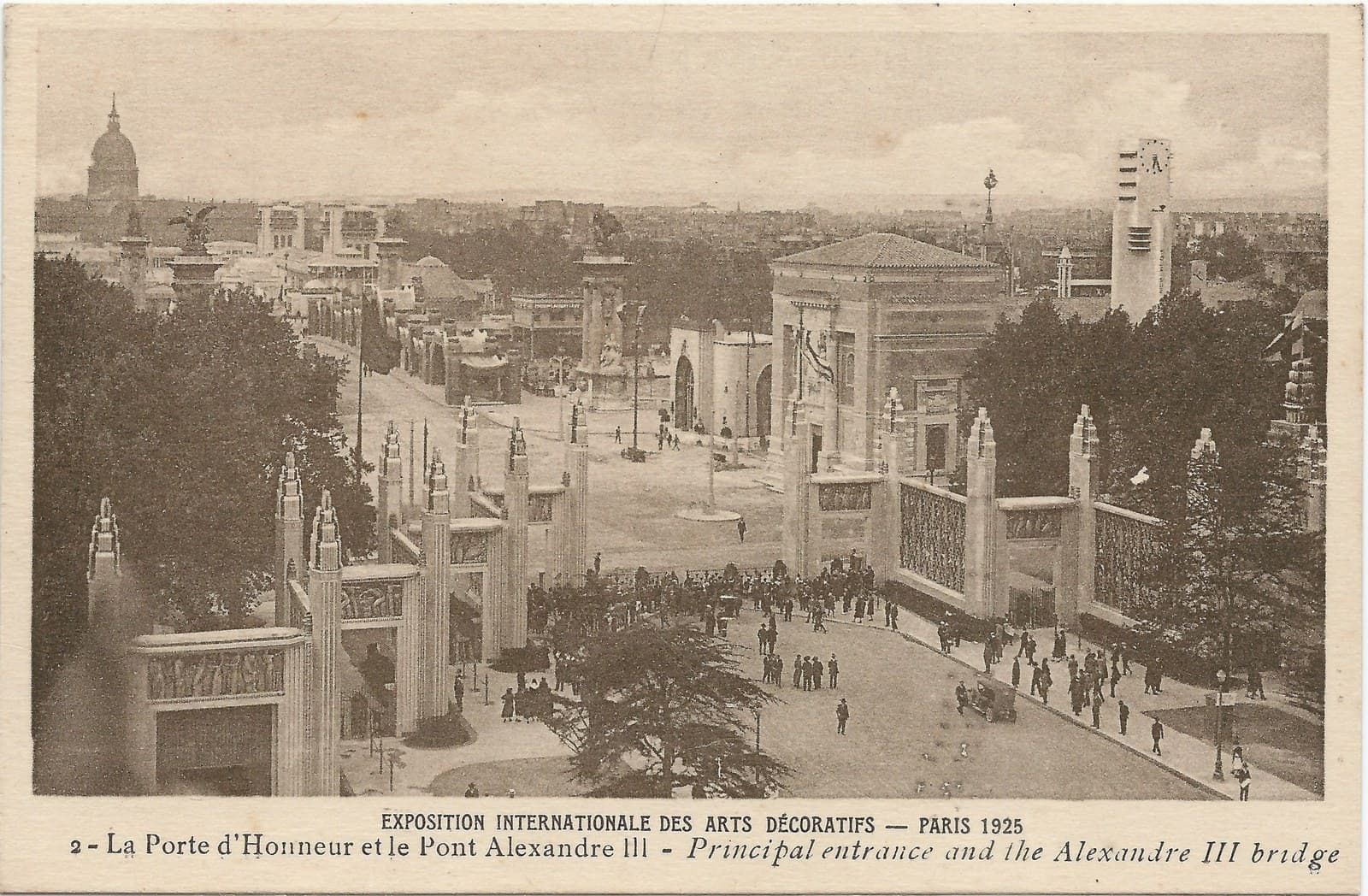
Art Deco is part of the history of modern design and the decorative arts, but it is not another name for modern art. Particularly associated with the 1920s and 1930s, it brought together geometric pattern, stylization, decorative richness, and imagery drawn from modern life as well as historical and global sources. The 1925 Paris exhibition of decorative and industrial arts was an important event in its development.[46]
Art Deco also demonstrates that modernity did not have to mean the rejection of ornament. Its objects could combine luxurious craftsmanship with machine-age imagery, while its influence extended from interiors and furniture to fashion and commercially produced household goods. It belonged to the modern period while pursuing different priorities from movements that placed greater emphasis on functional austerity or the elimination of decoration.[46]
Modern Art and Paris
Artwork reproductionClaude Monet, Impression, Sunrise, 1872 — shown at the 1874 independent exhibition in Paris, and the painting whose title a hostile critic turned into the name of a movement. Musée Marmottan Monet, Paris.
Paris played a central role in the development of modern art, both as a place artists represented and as an environment in which new artistic ideas could circulate. Its exhibitions, studios, private collections, and gathering places brought artists into contact with potential collaborators, supporters, and rivals. During the late nineteenth and early twentieth centuries, the city helped make experimentation a public activity: something that could be exhibited, criticized, purchased, debated, and developed further by others.
Yet “modern art in Paris” should not be confused with art made exclusively by French artists. The city's importance depended heavily on migration. Picasso, Modigliani, Brâncuși, Chagall, and numerous others arrived with experiences and artistic interests that were not simply absorbed into a single national tradition. Paris became influential partly because it brought these differences into close proximity.[47]
A Changing City Became a New Subject for Art
Paris offered modern artists more than picturesque scenery. Its railway stations, theaters, cafés, and expanding suburbs provided subjects through which they could examine contemporary experience. Impressionist paintings of recreation along the Seine, for example, belonged to a world transformed by railway travel and new patterns of leisure. The relationship between city and countryside was changing, and artists followed people into the places where those changes became visible.[6]
Claude Monet's paintings of the Gare Saint-Lazare make this relationship especially clear. In 1877, Monet obtained permission to work inside the station, where locomotives, steam, iron structures, and shifting light offered an environment quite different from the gardens now most closely associated with his name. He approached the station through multiple views rather than treating it as a single architectural portrait. Industrial activity supplied the changing atmospheric effects that interested him. These paintings demonstrate that Impressionism could find its subject in the infrastructure of modern Paris, not only in apparently unspoiled nature.[48]
The Salon and the Struggle to Be Seen
Paris was also where artists confronted institutions powerful enough to shape their careers. The official Salon offered access to a large audience and potential patrons, while its jury determined which submissions would appear. Rejection was therefore more than a private disappointment: it could obstruct an artist's route to recognition and financial survival.[6]
The Salon des Refusés of 1863 made that conflict unusually visible. Among the rejected works exhibited there was Édouard Manet's Le Déjeuner sur l'herbe. Its combination of a nude woman and clothed men, together with its unconventional handling of pictorial space, provoked ridicule and controversy. Manet had drawn on prestigious artistic precedents, but he refused to make those precedents reassuring. The confrontation occurred in public, turning an argument about painting into an event in Parisian cultural life.[14]
A more independent approach followed on April 15, 1874, when thirty artists opened an exhibition in Nadar's former photographic premises at 35 boulevard des Capucines. This became the first Impressionist exhibition. Its immediate reception was far from triumphant: the National Gallery of Art records approximately 3,500 visitors, compared with roughly half a million at that year's Salon. Its historical importance lay less in instant popularity than in establishing an alternative route to an audience. Artists were no longer merely asking an existing institution to change its judgment; they were organizing a different exhibition themselves.[15]
Dealers Made Artistic Independence More Sustainable
Independent exhibitions did not eliminate the need to sell paintings. Modern art also depended on intermediaries willing to support work before it had achieved widespread acceptance. The dealer Paul Durand-Ruel, who began backing the Impressionists in the early 1870s, was particularly important in this respect. His activities combined purchases, promotion, and the development of markets for artists whose reputations remained uncertain.[49]
Durand-Ruel's role complicates the familiar story of rebellious artists succeeding through determination alone. Experiment required time, materials, visibility, and buyers. Dealers helped connect private studio practice with a public capable of sustaining it. The emerging market could impose pressures of its own, but it also offered an alternative to relying entirely on official exhibitions and established patronage.
In the early twentieth century, Montmartre became an important setting for artistic exchange. One of its best-known addresses was the Bateau-Lavoir, a collection of studios at what is now place Émile-Goudeau. Picasso worked there between 1904 and 1909. The building was not simply a workplace: artists, writers, intellectuals, and dealers met there, making it part of the informal network through which emerging work became known.[50]
Picasso's collaboration with Georges Braque developed within this wider Parisian environment. Between approximately 1907 and 1914, the two artists transformed the depiction of objects and space through the experiments that became known as Cubism. Their work drew on several sources, including Cézanne and African sculpture, while developing through sustained exchange between the artists themselves. Paris mattered here not because it supplied a single doctrine, but because it brought works, people, and competing visual ideas into contact.[23]
Matisse and the Scandal of the “Wild Beasts”
Parisian exhibitions could give a new artistic approach both its notoriety and its name. At the Salon d'Automne of 1905, Henri Matisse exhibited Woman with a Hat, a portrait of his wife, Amélie, in which patches of green, yellow, and other unexpected colors disrupted the conventions of naturalistic portraiture. According to SFMOMA's account, colleagues and the Salon president had discouraged him from showing it, fearing that he would embarrass himself. Matisse exhibited it anyway.[51]
The resulting controversy helped establish the label Fauvism, associated with critic Louis Vauxcelles's description of the painters as fauves, or “wild beasts.” What disturbed viewers was not simply bright color but its application to a recognizable human face without obedience to observed appearances. The episode shows how a Paris exhibition could transform an individual artistic decision into a larger public argument about what painting was allowed to do.[19]
The Steins' Paris: Modern Art Before Museum Acceptance
Private homes could be as consequential as public exhibitions. At 27 rue de Fleurus, Gertrude and Leo Stein assembled a collection that brought adventurous painting into a domestic setting. Their brother Michael and his wife, Sarah, were also important collectors, with their own home on rue Madame. Together, these American expatriates became significant early supporters of artists including Matisse and Picasso.[52]
The Steins' Saturday gatherings allowed international artists, collectors, and dealers to encounter and discuss recent work. Admission was not simply unrestricted: the Metropolitan Museum describes visitors arriving with a reference. Nevertheless, the gatherings created an unusually influential setting in which pictures that had not yet gained broad institutional acceptance could be examined seriously. Their apartments functioned as meeting places between artistic experiment and a developing audience.[52]
Picasso's Portrait of Gertrude Stein, painted in 1905–1906, records something of this relationship between artist and patron. Its simplified masses and masklike treatment of the face place Stein herself within Picasso's changing approach to representation. She was not merely a later admirer of an already established master; her patronage belonged to the period in which his work was still developing its new visual language.[53]
During the early 1910s, much of the international artistic activity associated with Montmartre shifted toward Montparnasse. The loosely defined School of Paris, or École de Paris, encompassed artists working in different styles rather than members of one organized movement. What connected them was their participation in the city's artistic life, not adherence to a shared method or manifesto.[47][54]
Cafés such as La Rotonde and Le Dôme served practical purposes within this community. Newcomers could establish contacts, meet other artists, and consult international newspapers carrying news from home. For people without spacious or well-equipped accommodation, these establishments extended the places in which social and professional life could occur. Their importance was not simply that famous people eventually drank there, but that they helped people become less isolated in an unfamiliar city.[54]
Another important setting was La Ruche, the artists' residence established by the sculptor Alfred Boucher. Its buildings incorporated elements salvaged from the 1900 Paris Exposition, connecting an international spectacle of modernity with the everyday accommodation of working artists. Residents included Chagall, Soutine, and Léger. Affordable studios and close neighbors made La Ruche a material foundation for artistic exchange, rather than merely a picturesque address associated with later celebrity.[55]
Marie Vassilieff's Canteen and the Work of Sustaining a Community
The history of artistic Paris becomes more revealing when it includes the people who organized its daily life. Marie Vassilieff, a Russian-born artist, established an academy on avenue du Maine and, during the First World War, turned her studio into a canteen in response to the hardship experienced by fellow artists. Picasso, Braque, Modigliani, and Soutine were among those who frequented it. The space also accommodated performances, discussions, and other cultural activities.[56]
Vassilieff was an artist in her own right, working across painting, decorative objects, and other forms. Her significance should therefore not be reduced to feeding more famous men. Her canteen illustrates how artistic communities depend on organizational work alongside the production of individual artworks. A history concerned only with masterpieces can miss the spaces that enabled artists to continue working, meeting, and exchanging ideas during periods of acute difficulty.[56]
An International City, but Not an Equal One
Paris's cosmopolitan reputation coexisted with exclusion. Foreign artists encountered xenophobia and hostility, and the term “School of Paris” could carry conflicting meanings: it could recognize immigrant artists as essential participants or distinguish them from supposedly national traditions. In 1924, the Salon des Indépendants introduced an arrangement by nationality, prompting protests from foreign artists who felt marginalized by the new presentation. Internationalism was therefore something artists and their supporters had to defend, not an uncomplicated condition of Parisian life.[54]
The city's relationship with art from outside Europe was similarly unequal. African sculptures entered European collections and museums through processes connected with colonial conquest and expeditions. In Paris, institutions such as the Musée d'Ethnographie du Trocadéro made these works accessible to European artists, who often admired their forms without understanding their original functions or cultural meanings.[57]
These encounters contributed to modern art, but describing them solely as European “discoveries” obscures the achievements of the objects' makers. The sculptures already possessed artistic sophistication and histories of their own. Paris's importance as a place of exchange must therefore be understood alongside the inequalities that determined which artists received recognition, which objects circulated, and whose interpretations became authoritative.
Surrealist Paris: The Unexpected in Everyday Life
Surrealism developed an especially close relationship with the possibility of finding the extraordinary within ordinary experience. Organized around André Breton's 1924 manifesto, the movement explored dreams, unconscious associations, and encounters that challenged conventional reason. Paris provided a setting in which writers and visual artists could develop these ideas through both organized activity and informal exchange.[11]
One memorable example began with a café conversation in 1936. Meret Oppenheim was with Picasso and Dora Maar when Picasso noticed her fur-trimmed bracelet and joked that almost anything could be covered in fur. Oppenheim extended the suggestion to a cup and saucer. She subsequently bought a tea service at a department store and covered it with fur, creating Object, one of Surrealism's best-known sculptures.[34]
The story connects modern art to the everyday city without making the artwork seem accidental. A conversation supplied a possibility; Oppenheim's decisions turned it into a precise and disturbing object. Something associated with civilized comfort became attractive to touch but unpleasant to imagine placing against the mouth. The café and department store were not merely background scenery: they were part of the circumstances from which the work emerged.
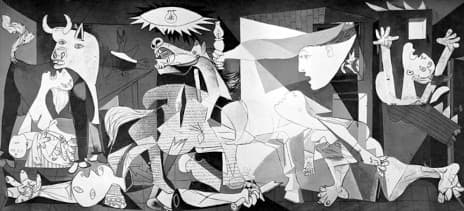
Paris also provided an international stage on which modern art could address political catastrophe. Picasso painted Guernica in the city between May and June 1937 for the Spanish Pavilion at that year's international exposition. The bombing of the Basque town, reported through newspaper accounts and photographs, redirected the commission toward the suffering of civilians.[58]
Although its subject was an attack in Spain, the painting was made for presentation in Paris to an international audience. Its fractured bodies, compressed space, and predominantly monochrome palette turned artistic experimentation into a means of communicating terror and grief. This was not a documentary reconstruction of the bombing but a public response to it, showing how a visual language developed through modernist experiments could carry urgent political meaning.[59]
The Second World War subsequently dispersed many of the artists and writers who had sustained European modernism. Figures including Breton, Ernst, Masson, Mondrian, and Léger sought refuge in the United States. Their presence helped intensify the encounters between European experimentation and the American artists who would become associated with Abstract Expressionism.[35]
After 1945: Paris Did Not Simply Stop Mattering
The rise of New York during the 1940s and 1950s changed the international balance of artistic influence. Abstract Expressionism established a powerful new center of activity, and accounts of modern art often describe this development as a shift away from Paris. Yet the movement itself drew on European art encountered through museums, exhibitions, teaching, and wartime migration. The relationship was more interconnected than a simple replacement of one city by another.[35]
Artists also continued moving in the opposite direction. Joan Mitchell, already associated with the New York art world, divided her time between New York and France from 1955 and settled permanently in Paris in 1959. Her career demonstrates that participation in American abstraction did not require remaining in the United States. Paris could continue to serve as a working base within an increasingly international artistic life.[60]
Postwar Paris also supported important networks of Black artists from Africa, the Americas, and the Caribbean. Studios, galleries, schools, and gathering places enabled exchanges that do not fit neatly into the older story of a predominantly white European avant-garde. Beauford Delaney, for example, worked in a studio on rue Vercingétorix during the 1950s. The Centre Pompidou's research into these artistic networks places such addresses within a broader history of creation, migration, and cultural exchange across the city.[61]
Why Paris Matters to the History of Modern Art
Paris's importance is best understood through the relationships it made possible. Exhibitions provided audiences and provoked arguments; collectors gave uncertain work sustained attention; studios and gathering places helped artists exchange ideas. The city's modern-art history was created through these interactions, not through a single unified style or an exclusively French tradition.
Seen this way, Paris was more than a backdrop for famous paintings. Its institutions, neighborhoods, and international communities were part of the conditions under which those paintings—and many other forms of modern art—became possible.
Modern Art Was an International History
Cultural Exchange and Colonial Inequality
European modernism drew extensively on art from beyond Europe, but those encounters occurred within unequal political conditions. African sculptures reached European collections and ethnographic museums through processes connected with colonial conquest and expeditions. Artists such as Picasso and Matisse recognized expressive possibilities in objects whose makers, original uses, and cultural meanings were often poorly understood by European audiences.[57]
Acknowledging these influences requires more than adding a sentence about “inspiration.” It changes how the history is understood: modern European artists were not creating in isolation, and the artworks they encountered were not anonymous raw material without histories of their own. Questions about attribution, appropriation, and colonial collecting belong within the account of modern art, not outside it.
Modernisms in Latin America, Asia, and Africa
Modern art outside Europe was not simply a delayed copy of European developments. In Brazil, Tarsila do Amaral helped define a modernist tradition through work shaped by her movement between São Paulo and Paris. In Mexico, muralists including Diego Rivera, José Clemente Orozco, and David Alfaro Siqueiros developed forms of public art closely concerned with social and national history. These practices demonstrate that experimentation could serve very different cultural purposes.[62]
Amrita Sher-Gil became a foundational figure in modern Indian art, bringing her artistic training and experience into dialogue with the people and visual traditions of India. Sudanese artist Ibrahim El-Salahi developed another distinctive modernism through relationships among painting, Arabic calligraphy, and African and Islamic traditions. Such examples make it more accurate to speak of interacting modernisms than of one universal path beginning in Paris and spreading unchanged elsewhere.[63]
The Harlem Renaissance belongs within this international history rather than beside it as a separate cultural appendix. Black artists developed modern representations of everyday life, identity, movement, and aspiration through networks that extended beyond Harlem and across the Atlantic.[64]
Jacob Lawrence's Migration Series (1940–1941) provides a particularly powerful example. Completed when he was twenty-three, its sixty painted panels and accompanying captions recount the Great Migration of African Americans from the rural South to northern cities. Lawrence combined simplified forms and rhythmic color with historical narrative, showing that modern art could be formally inventive while remaining committed to telling a legible, collective story.[65][66]
Modern Art, Politics, and Censorship
Modern art was never politically uniform. Futurism's celebration of war, Mexican muralism's public engagement, and Surrealism's challenges to convention represent different relationships between artistic experimentation and social life. It is therefore misleading to assign the entire period one political philosophy or to assume that formal radicalism always implied the same political commitments.
Picasso's Guernica (1937) demonstrates how an experimental visual language could become a public statement against violence. Painted for the Spanish Pavilion at the Paris International Exposition, it responded to the bombing of the Basque town of Guernica. Its distorted bodies and compressed space communicate suffering without presenting a straightforward documentary reconstruction of the attack.[58]
That same year, the Nazi regime organized the “Degenerate Art” exhibition in Munich, displaying confiscated modern works as objects of condemnation. The campaign formed part of a broader effort to control German cultural life. Modern art's history thus includes not only arguments in galleries and newspapers but also state persecution, confiscation, and attempts to determine which forms of expression could legitimately exist.[67]
Major Works of Modern Art
The following selection illustrates the range of modern art rather than offering a definitive ranking. Collection information identifies the institution associated with a work; it does not necessarily indicate that the work is currently on display.
How Should Modern Art Be Understood?
Begin with What the Work Is Doing
A useful first question is not necessarily “What does it represent?” but “What is this work asking me to notice?” A painting may organize color and rhythm rather than tell a story. A sculpture may change how its surrounding space is experienced. A readymade may turn attention toward assumptions about authorship and artistic value. Different kinds of work require different kinds of questions.
Historical context can also recover something of an artwork's original force. An Impressionist painting may now look familiar, but its abbreviated handling once invited accusations that it was unfinished. A manufactured object in a museum may no longer be surprising, but Fountain emerged from a confrontation over whether such an object could be admitted at all. Familiarity with later art can make earlier innovations look less consequential than they were.
Difficulty of Execution Is Not the Only Measure
Modern art challenged the idea that value should be determined primarily by visible technical difficulty or accurate imitation. Brâncuși's sculpture and Duchamp's readymade raised very different questions, but both required audiences to look beyond resemblance to a recognizable subject. Understanding those questions does not oblige a viewer to admire every work; it makes a more informed judgment possible.
A productive assessment can consider the relation between an artwork's intention, material form, and historical setting. Does the work sustain attention? Are its decisions consequential? Does knowing how and why it was made change the experience of looking at it? These questions allow room for both appreciation and criticism without reducing the entire period to a contest between realistic skill and apparent simplicity.
Who Decided What Counted as Modern Art?
Modern art's reputation was shaped by collectors, critics, dealers, and museums as well as by artists. The establishment of institutions devoted to modern work helped determine which experiments were preserved, exhibited, and incorporated into widely repeated histories. The Museum of Modern Art, founded in 1929 through the initiative of Lillie P. Bliss, Mary Quinn Sullivan, and Abby Aldrich Rockefeller, became an especially influential institution in that process.[68]
The contrast between early recognition and later rediscovery remains important. Hilma af Klint's changing reputation and the recognition of figures such as Tarsila do Amaral demonstrate why the history cannot be treated as a permanently settled list of great names. The record changes as works are studied, collections are reconsidered, and previously marginalized contributions receive sustained attention.
The Legacy of Modern Art
Modern art expanded the possibilities of artistic practice without replacing older forms once and for all. It made room for abstraction alongside representation, manufactured objects alongside modeled sculpture, and conceptual questions alongside visual experience. It also established debates—about originality, authorship, cultural borrowing, public meaning, and artistic authority—that remain central to contemporary art.
Its enduring importance is therefore not that every modern artist agreed on what art should become. They did not. Rather, the period made disagreement and experimentation fundamental to artistic life, producing a history in which a landscape, a geometric grid, a public mural, and an ordinary object could each propose a different answer to the question of what art might do.
Major Works of Modern Art
Paintings and objects from the movement, each with the collection that holds it today. Pictures appear where the rights allow.
Édouard Manet's Le Déjeuner sur l'herbe places a nude woman beside two dressed men in a wooded setting. Rejected by the official Salon in 1863, the painting was shown that year at the Salon des Refusés.
A confrontation between prestigious artistic precedents, contemporary subject matter, and unconventional painting.
Édouard Manet, Le Déjeuner sur l'herbe, 1863. Musée d'Orsay, Paris. Image: public domain.
Claude Monet's 1872 view of the Le Havre harbor at dawn, whose catalogue title at the first independent exhibition of 1874 gave Impressionism its name. It hangs at the Musée Marmottan Monet in Paris.
Its treatment of atmosphere and its title became central to the naming and understanding of Impressionism.
Claude Monet, Impression, Sunrise, 1872. Musée Marmottan Monet, Paris. Image: public domain.
Vincent van Gogh painted The Starry Night while living at Saint-Paul-de-Mausole in southern France. Its bright stars, dark cypress, and small village combine observed features with changes made in the studio.
Transforms landscape through rhythmic brushwork, heightened color, and an intensely animated sky.
Vincent van Gogh, The Starry Night, June 1889. Museum of Modern Art, New York. Image: public domain.
Acquired by the Museum of Modern Art in 1939. Gallery displays change, so check the museum's own object record before making a special visit.
Pablo Picasso painted Les Demoiselles d'Avignon in Paris in 1907, in a studio at the Bateau-Lavoir in Montmartre. Five women stand and crouch in a shallow space, their bodies and the curtains around them broken into hard planes, the two on the right wearing masklike faces. It is nearly two and a half metres square, and hangs at the Museum of Modern Art in New York.
A crucial precursor to Cubism that challenged conventional anatomy, perspective, and idealized beauty.
The original is lost; later authorized versions survive, including a 1950 version in Philadelphia. Displays change, so check the holding museum's own record before making a special visit.
A mass-produced porcelain urinal, turned on its back, signed “R. Mutt 1917,” and submitted to an open New York exhibition that refused to show it. The lost original survives through Alfred Stieglitz's photograph and later replicas authorized by Duchamp.
Made selection, presentation, and institutional acceptance central questions in the definition of art.
Marcel Duchamp, Fountain, 1917; Tate replica 1964. Original lost; authorized replicas in Tate, the San Francisco Museum of Modern Art, the Centre Pompidou and other collections. Image: public domain.
Gallery displays change, and the museum rotates its Mondrian holdings. Check the museum's own object record before making a special visit.
A square canvas, 59.5 centimetres each way, divided by black lines into rectangles of red, yellow, blue, black and several different whites. Piet Mondrian sold it in Paris within the year he finished it. The first thing to notice in front of it is that several of the black lines stop before they reach the edge. The painting is at the Kunstmuseum Den Haag.
A mature neoplastic grid in which the black lines still stop short of the canvas edge.
Piet Mondrian, Composition with large red plane, yellow, black, gray and blue, 1921. Kunstmuseum Den Haag. Image: public domain.
Acquired by the Museum of Modern Art in 2019. Gallery displays change, so check the museum's own object record before making a special visit.
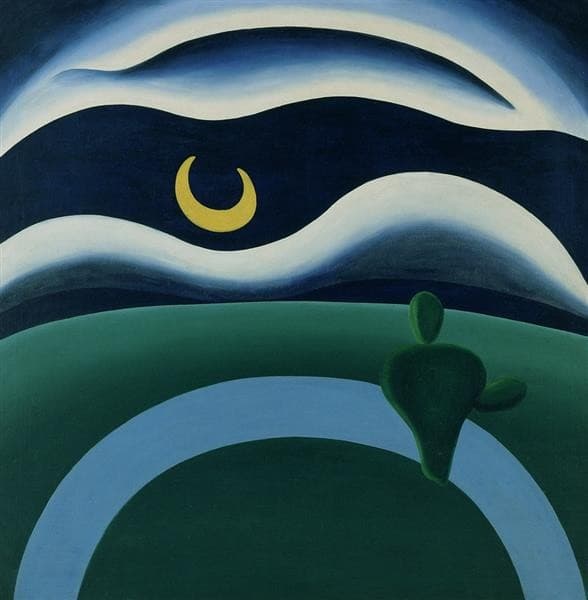
Tarsila do Amaral painted The Moon, or A Lua, in Brazil in 1928. A green form that could be a cactus or a person stands beside a curving stream, under dark hills, undulating clouds and a small crescent moon. The Museum of Modern Art in New York acquired it in 2019.
Represents a major artist's contribution to the development of Brazilian modernism.
Gallery displays change, and the museum rotates its Mondrian holdings. Check the museum's own object record before making a special visit.
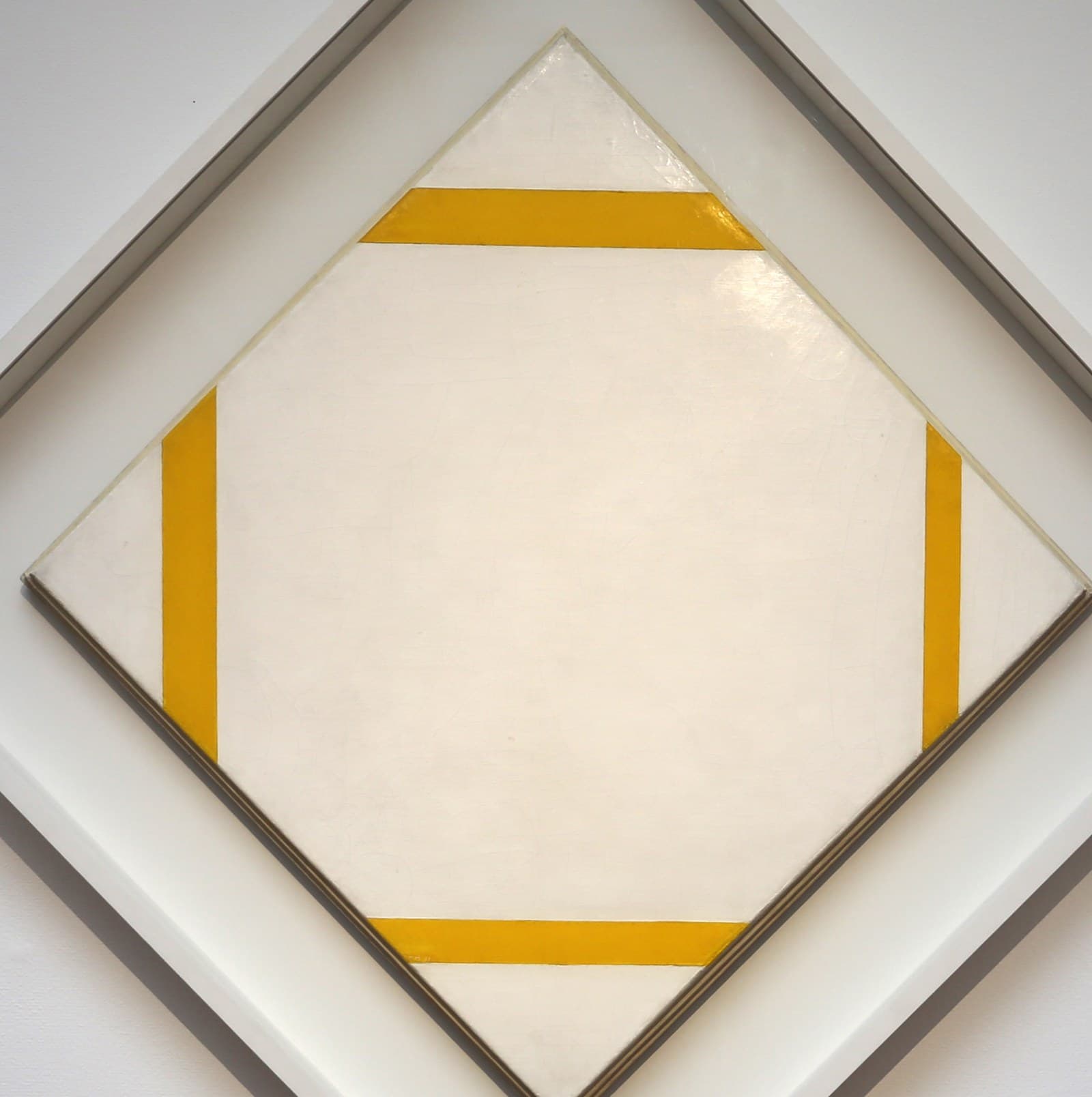
A square canvas hung on its corner, so it reads as a diamond, with four yellow lines across an off-white ground and no black anywhere. Piet Mondrian painted it in 1933, and the Kunstmuseum Den Haag calls it atypical in his work for using only yellow and white. The painting reached the museum the same year, bought by a subscription that the painter Charley Toorop organised among his admirers.
The grid reduced to four yellow lines on white, with the black removed and the square hung on its corner.
Held by the Museum of Modern Art. Gallery displays change, so check the museum's own object record before making a special visit.
Meret Oppenheim made Object in Paris in 1936 by covering a bought cup, saucer and spoon in gazelle fur. The set is instantly recognizable as tableware and immediately impossible to imagine drinking from. It is at the Museum of Modern Art in New York, and André Breton gave it a second title, Le Déjeuner en fourrure.
A fur-covered tea service that turns an ordinary object into an unsettling Surrealist encounter.
The painting arrived in Spain in 1981 and moved to the Reina Sofía in 1992. Displays change, so check the museum's own object record before making a special visit.
Picasso's mural-sized response to the bombing of the Basque town of Gernika, painted in five weeks in his Paris studio for the Spanish Republic's pavilion at the 1937 World's Fair. Now in the Museo Reina Sofía in Madrid.
Connects formal experimentation with a monumental response to violence against civilians.
The sixty panels are divided between the Phillips Collection in Washington, D.C. and the Museum of Modern Art in New York, so the series is not held complete in one place. Displays change; check each museum's own record before making a special visit.
Jacob Lawrence painted The Migration Series in 1940 and 1941, when he was twenty-three: sixty small panels, each with a caption, following the movement of African Americans from the rural South to the cities of the North. He worked across all sixty at once, one colour at a time. The panels are divided between the Phillips Collection in Washington and the Museum of Modern Art in New York.
Uses sixty panels to connect modern visual design with the history of the Great Migration.
Listed as not on view by the Smithsonian American Art Museum in September 2026. Displays change, so check the museum's own record before making a special visit.
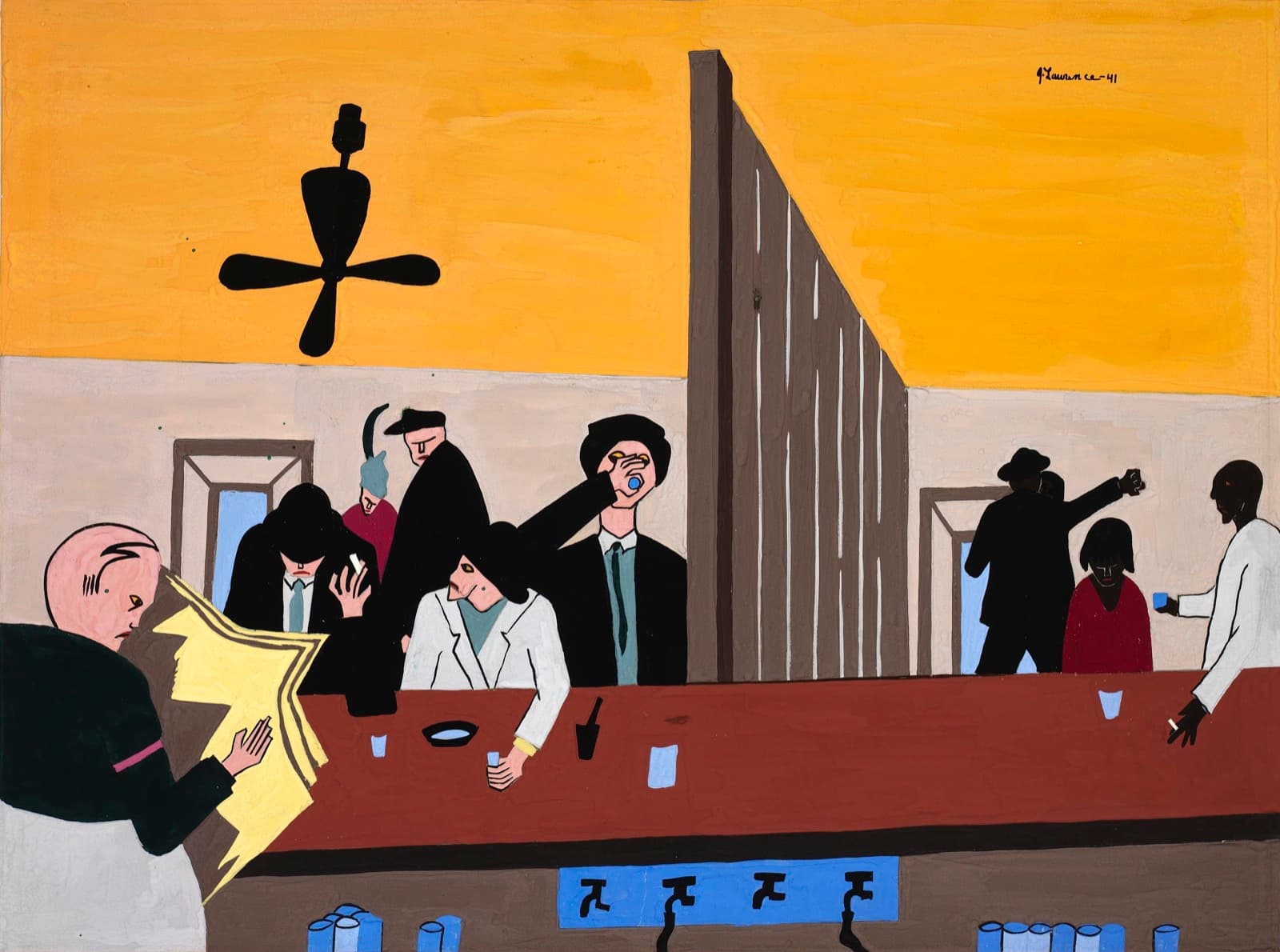
A café in New Orleans, split down the middle by a wall of wooden boards. On the left, white customers drink under a ceiling fan while the bartender reads his paper. On the right, a smaller room of Black customers has no fan and no ashtray. Jacob Lawrence painted Bar and Grill in 1941, soon after arriving in the South for the first time. The painting belongs to the Smithsonian American Art Museum.
Held by the Museum of Modern Art. Gallery displays change, so check the museum's own object record before making a special visit.
Piet Mondrian painted Broadway Boogie Woogie in New York in 1942 and 1943, two years after leaving wartime Europe. Yellow bands cross a white square canvas, broken by small blocks of red, blue and grey. The heavy black lines of his earlier work are gone. It is at the Museum of Modern Art in New York.
Connects geometric abstraction with the rhythms of a modern city and music.
Piet Mondrian, Broadway Boogie Woogie, 1942–1943. Museum of Modern Art. Image: public domain.
Listed as not on view by the Whitney Museum of American Art in September 2026. Displays change, so check the museum's own record before making a special visit.
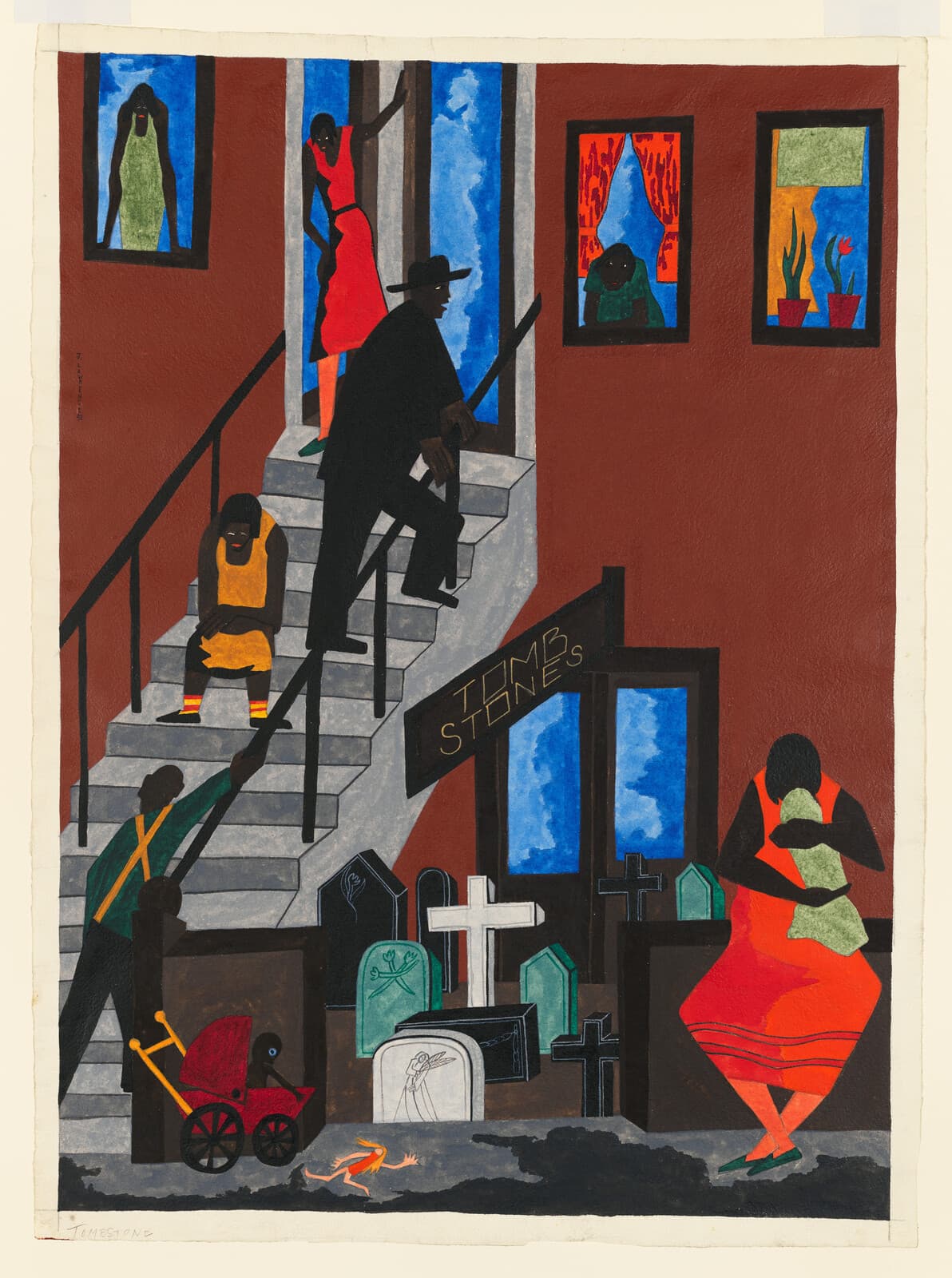
A Harlem apartment building on a hot day, with neighbours on the stoop and at the windows, and a shop in the basement selling gravestones. A baby sits in a carriage at one side and a mother rocks an infant at the other, with the stones for sale in between. Jacob Lawrence painted Tombstones in 1942. The Whitney Museum of American Art showed the painting in its 1943 annual exhibition and owns it today.
The Whitney shows a changing selection of the fourteen panels. In September 2026 several were listed on view on Floor 7 and Going Home was listed as not on view. Check the museum's own records before making a special visit.
Fourteen small panels on what the Second World War did to the men who fought it, from Shipping Out to Victory. Jacob Lawrence had served in the Coast Guard, first as a steward's mate and then as a combat artist, and all the paintings he made during the war were lost. He painted the War Series in 1946 and 1947, soon after he came home. Mr. and Mrs. Roy R. Neuberger gave all fourteen panels to the Whitney Museum of American Art.
Acquired by the Metropolitan Museum of Art in 1957. Gallery displays change, so check the museum's own object record before making a special visit.
Jackson Pollock made Autumn Rhythm: Number 30, 1950 by pouring paint onto canvas laid on the floor of his Long Island studio. It is more than five metres wide, worked in a narrow range of colours, with large areas of bare canvas left open between the black lines. The Metropolitan Museum of Art bought it in 1957, the year after Pollock's death.
A major example of poured painting, emphasizing the movement and distribution of paint across an expansive surface.
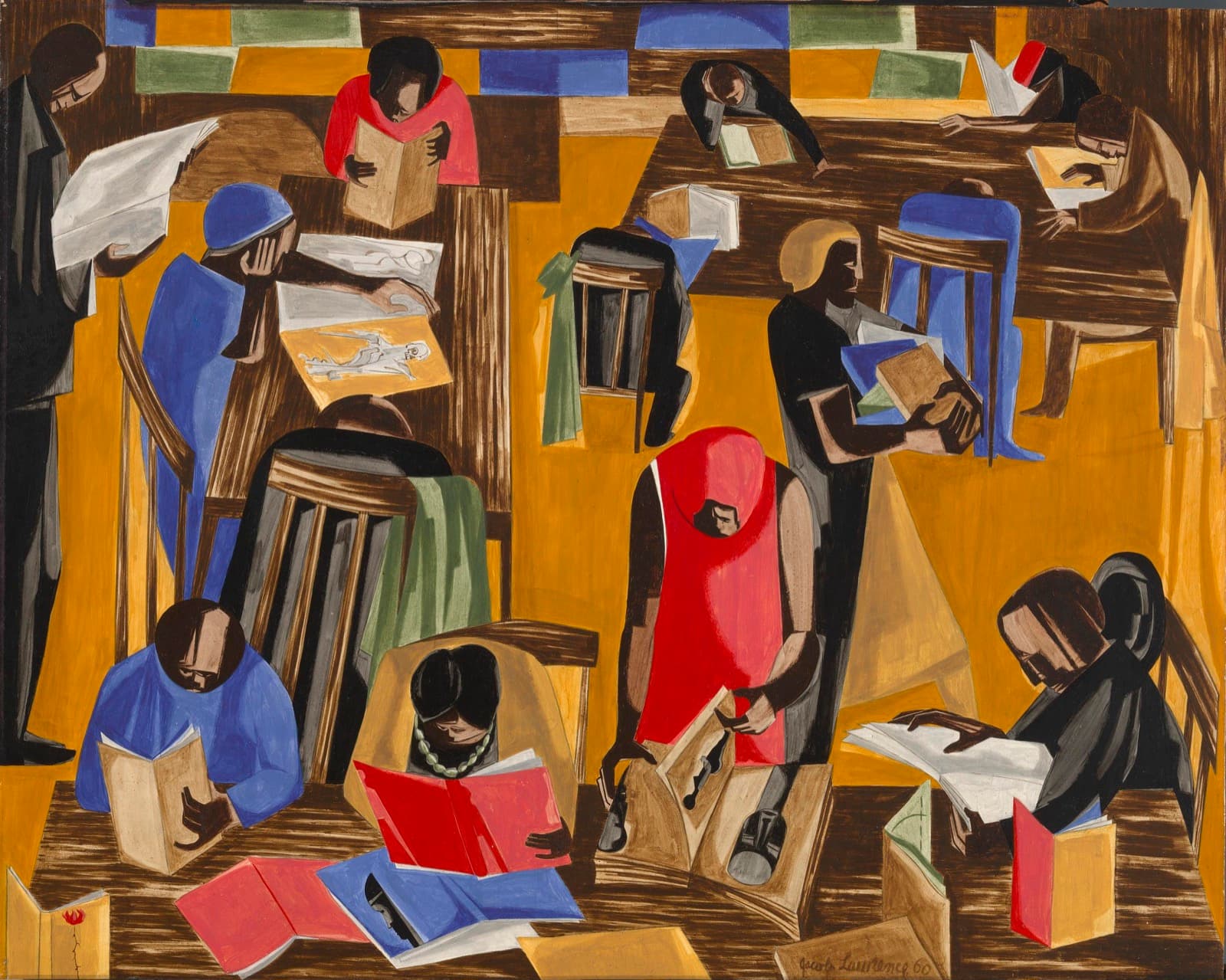
Listed as not on view by the Smithsonian American Art Museum in September 2026. Displays change, so check the museum's own record before making a special visit.
A crowded reading room, painted in flat blocks of red, blue, ochre and brown, where almost everyone has their head down in a book. Jacob Lawrence painted The Library in 1960. The Smithsonian American Art Museum thinks the room may be the 135th Street library in Harlem, now the Schomburg Center for Research in Black Culture. The museum also suggests the reader standing at the front with a book of African sculpture may be Jacob Lawrence himself as a young man.
Acquired complete by the Museum of Modern Art in 1996. Gallery displays change, so check the museum's own object record before making a special visit.
Andy Warhol painted Campbell's Soup Cans in 1962: thirty-two canvases, one for each variety of soup the company then sold. They were made by hand, before the silkscreens he became known for. The dealer Irving Blum bought the whole set back for $1,000 to keep it together, and the Museum of Modern Art acquired it in 1996.
Brings commercial packaging, repetition, and the appearance of mass production into painting.
Listed as on view by the Whitney Museum of American Art. Gallery displays change, so check the museum's own object record before making a special visit.
One hundred and twelve Coca-Cola bottles stand in seven rows of sixteen, with the red Coca-Cola logo alone in an empty band at the foot of the canvas. Andy Warhol made it in the summer of 1962, the year he began using screen printing to make paintings. No two bottles came out the same: the green is heavy in some and missing in others, and on several the green and the black outline do not line up. The Whitney Museum of American Art bought it in 1968.
Listed as not on view by the Whitney Museum of American Art. Gallery displays change, so check the museum's own object record before making a special visit.
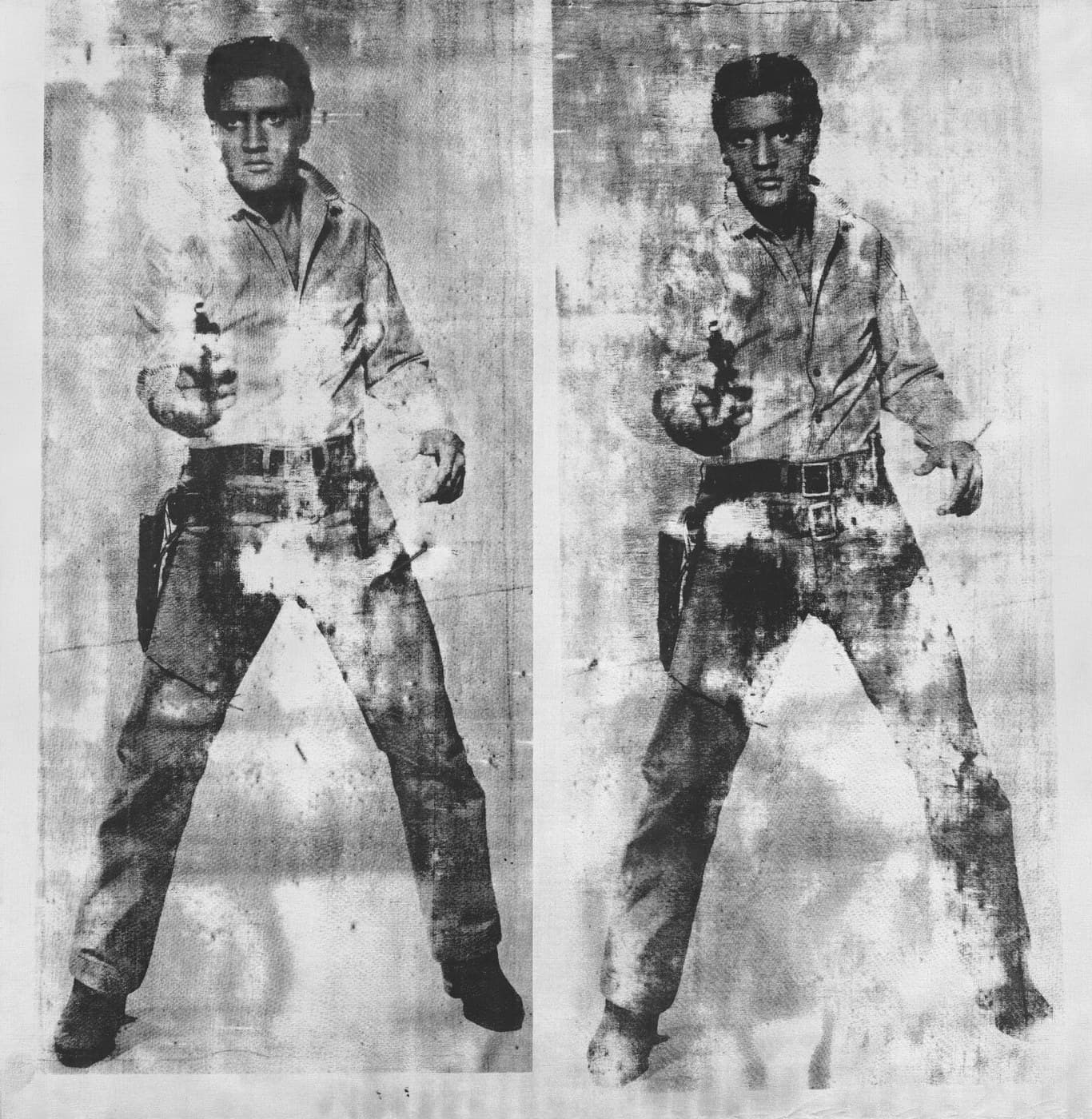
Elvis Presley stands twice on a canvas painted silver, nearly seven feet tall, in film costume, holding a revolver out towards the viewer. Both figures came off the same screen and the same photograph. Andy Warhol made it in 1963, and the two printings came out so differently that one figure keeps its boots and its belt buckle while the other loses both. The Whitney Museum of American Art received it in 2002.
Gallery displays change, so check the museum's own object record before making a special visit.
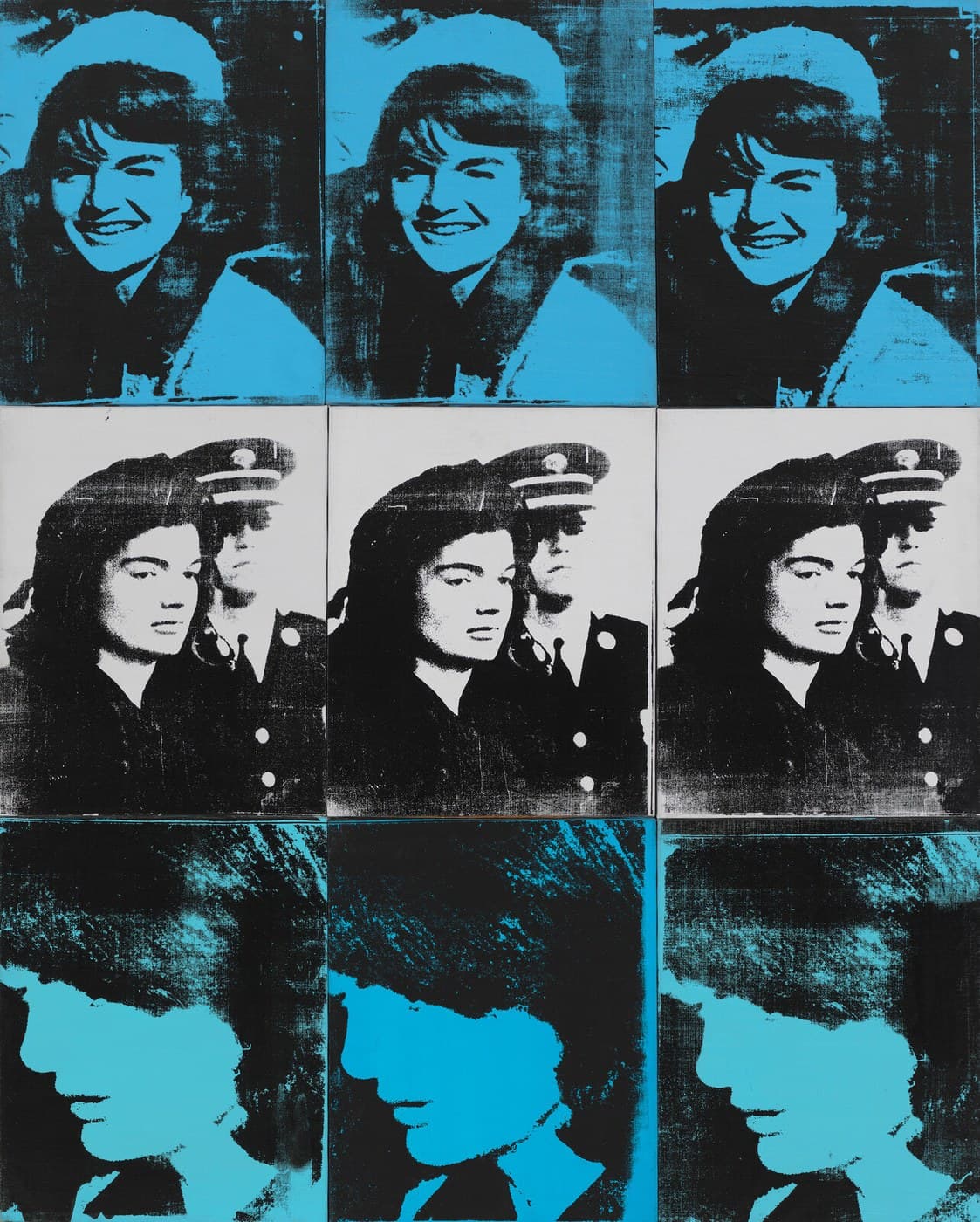
Nine canvases in three rows of three, carrying three photographs of Jacqueline Kennedy taken around the assassination of President John F. Kennedy on 22 November 1963. Each photograph is printed three times across its row. Andy Warhol took all three from newspapers, cropped them down to her head, and screened them onto linen. The Metropolitan Museum of Art owns a second painting of the same title and format, so the two need telling apart. The Whitney Museum of American Art owns the painting described here.
Gallery displays change, so check the museum's own object record before making a special visit.
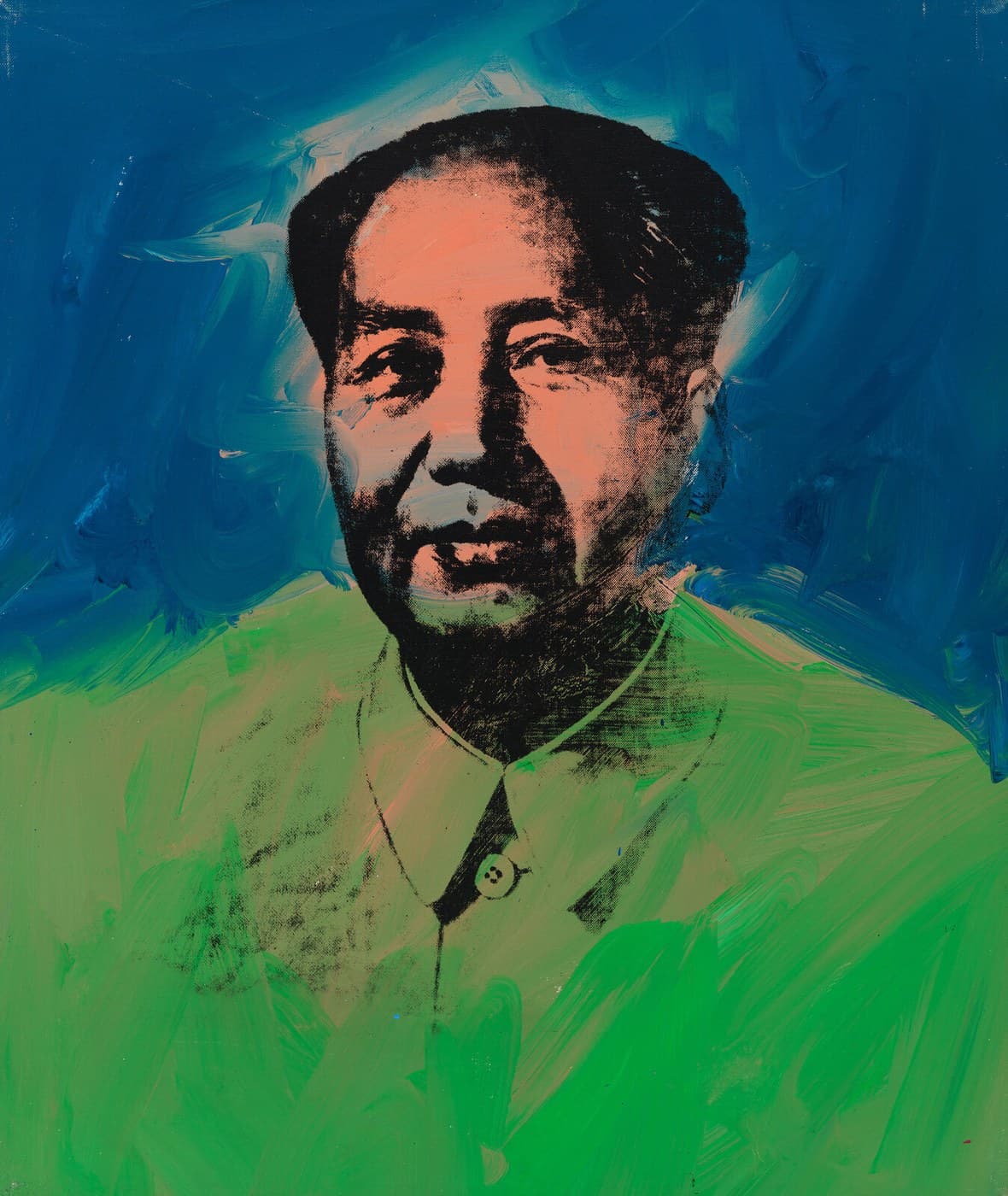
A head-and-shoulders portrait of Mao Zedong, small enough to hold in two hands, with a cobalt blue ground and a bright green tunic laid on in broad brushstrokes and the photographic image screened in black on top. The paint and the photograph do not line up, and on the right-hand side the blue background covers a cheek the printed photograph still draws. The source is the frontispiece portrait of the Little Red Book, whose photographer no institution can name. Andy Warhol made about 199 Mao paintings in 1972 and 1973; this is one of the small ones.
No date starts modern art and none ends it; the entries below are the moments museums and historians most often use to mark the shifts.
1849–1850
Courbet paints a village funeral
A Burial at Ornans gives a provincial funeral the scale reserved for history painting, and refuses to treat ordinary life as a lesser subject.
1863
The Salon des Refusés
Manet's Le Déjeuner sur l'herbe is rejected by the Salon jury and shown among the refused works, where its nude woman beside clothed men draws public laughter.
1874
The first independent exhibition
On 15 April, Monet, Renoir, Degas, Pissarro and Morisot open a show in Nadar's former premises in Paris; the critic Louis Leroy turns the title of Monet's Impression, Sunrise into a mockery that becomes a name.
1907
Les Demoiselles d'Avignon
Picasso's angular figures and unstable space break with conventional anatomy and perspective, a step toward the Cubism he and Braque develop through 1914.
1909
The Futurist manifesto
Marinetti publishes it in Le Figaro in Paris, calling for an art of speed and machinery — and celebrating violence and war alongside them.
1916
Cabaret Voltaire
Dada gathers in Zurich, in a neutral country, around performance and provocation rather than around objects.
1917
Fountain is withheld
A manufactured urinal signed “R. Mutt” is submitted to the Society of Independent Artists in New York, which advertised no jury; it is kept from display and Duchamp resigns.
1919
The Bauhaus opens
Walter Gropius founds the school in Weimar to bring the arts together and rethink their relationship to the material world.
1924
Breton's Surrealist manifesto
Surrealism takes organized form around dreams, unconscious association, and alternatives to rational thought.
1928
Brâncuși wins in court
After US customs refused in 1926 to admit Bird in Space as art, the court finds in the sculptor's favour — a disagreement about form settled at a national border.
1929
MoMA is founded
Lillie P. Bliss, Mary Quinn Sullivan and Abby Aldrich Rockefeller establish the museum that will shape which experiments get preserved and repeated in the histories.
1937
Guernica, and “Degenerate Art”
Picasso paints Guernica for the Spanish Pavilion at the Paris International Exposition; in Munich the Nazi regime shows confiscated modern works as objects of condemnation.
1940–1941
The Migration Series
Jacob Lawrence, aged twenty-three, completes sixty panels and captions recounting the Great Migration.
1962
Campbell's Soup Cans
Warhol's thirty-two canvases are first shown on shelves like supermarket stock, though the paintings were made by hand.
Modern Art: frequently asked questions
What is modern art?
The broad historical category covering the experimental art movements from roughly the 1860s to the 1970s — Realism, Impressionism, Post-Impressionism, Fauvism, Expressionism, Cubism, Futurism, abstraction, Dada, Surrealism, Abstract Expressionism, Pop, Minimalism and Conceptual art. It is not one movement. A Monet landscape and a Duchamp readymade both belong to it.
When did modern art start and finish?
There is no agreed date. Some histories start with Courbet's Realism in the 1850s, others with Manet and the Impressionists in the 1860s and 1870s; MoMA works with the 1880s to the 1970s. The end is equally soft — the experiments of the 1960s and 1970s run into what museums call contemporary art.
What is the difference between modern art and contemporary art?
Modern art is a historical period; contemporary art is art of the present and recent past. MoMA's glossary puts the contemporary from roughly 1980 onward. A painting made this year is not “modern art” in the historical sense just because it looks experimental, and an 1870s canvas is modern art despite being over a century old.
Why was Paris so important to modern art?
It concentrated artists, dealers, critics, exhibitions and buyers in one place, and drew artists of many nationalities — the loose term School of Paris describes that international community rather than a school with a curriculum. Montparnasse was its centre. The label could also be used to set foreign artists apart from supposedly national French traditions.
Is abstract art the same as modern art?
No. Abstraction is one part of modern art, not a synonym for it. Modern art kept producing portraits, landscapes, interiors, historical narratives and scenes of ordinary life throughout the period; abstraction was one of several answers to the question of what a painting had to represent.
Where does Art Deco fit into modern art?
Art Deco belongs to the history of modern design and the decorative arts of the 1920s and 1930s, not to modern art as a synonym. It shows that modernity did not have to mean giving up ornament: it combined luxury craftsmanship with machine-age imagery, where other strands of the period pressed toward austerity and the elimination of decoration.
References
References
The sources below include histories, manifestos, scholarly research, and primary materials that informed this page. They document Modern Art, its development, and the artists and works associated with it.
These references provide the documented foundation for this movement's history and interpretation. Claim-level citations remain attached to the specific claims they support.








 View source