American sculptor, teacher, and arts organizer of the Harlem Renaissance whose portraits of Black Americans, years of study in Paris, and extraordinary work as a teacher helped reshape twentieth-century American art.
In images
Details
Lived
1892–1962
Born
29 February 1892
Birthplace
Green Cove Springs, Florida
Died
26 March 1962 · aged 70
Place of death
New York City
Nationality
American
Profession
Sculptor, arts educator, and community arts director
Major works
Gamin (1929), Realization (1938), The Harp (1939)
Children
Irene Connie Moore
Roles
SculptorEducator
About Augusta Savage
A childhood made from red clay
Before Augusta Savage had a studio, a teacher, or even proper sculpting materials, she had the earth.
She was born Augusta Christine Fells on February 29, 1892, in Green Cove Springs, a small Florida town southwest of Jacksonville. She was the seventh of fourteen children of Cornelia Murphy Fells and Edward Fells. The region's naturally occurring clay became Augusta's first artistic material. As a girl she molded it into ducks, pigs, animals, and small human figures, sometimes becoming so absorbed in making things that she neglected school.[1]
Her father, a Methodist minister, regarded sculpture very differently. He considered his daughter's figures dangerously close to the biblical prohibition against making “graven images” and repeatedly punished her for making them. Savage later remembered that he had “almost whipped all the art out of me.” He did not succeed.
Art was not the only adult responsibility that arrived unusually early. Savage married John T. Moore while still a teenager, and in 1908 gave birth to her only child, Irene Connie Moore. Her husband died a few years later. Around 1915 she married a carpenter named James Savage. That marriage eventually ended, but she kept the surname by which she would become famous. She later married a third time, to Robert Lincoln Poston, a journalist associated with Marcus Garvey's movement; Poston died in 1924.
When the Fells family relocated to West Palm Beach around 1915, Augusta temporarily lost access to the clay she had used as a child. Eventually she found a local potter willing to give her material. She began sculpting again, and the response was very different from the one she had received at home.
At a county fair, a group of her figures won a special prize and a ribbon of honor. The fair's superintendent, George Graham Currie, recognized that she possessed unusual ability and encouraged her to pursue art professionally. For perhaps the first time in Savage's life, someone with authority was telling her not to stop sculpting, but to go farther.[2]
She tried.
Savage moved to Jacksonville hoping that prosperous Black residents would commission portrait busts from her. The business never became sustainable. After briefly studying in Tallahassee, she made a much greater gamble: she left her daughter with family and headed north.
New York with $4.60
Savage arrived in New York City in 1921 with $4.60.[1]
It is one of the defining facts of her biography because the distance between those few dollars and what she accomplished during the next twenty years is enormous.
She worked as an apartment caretaker and entered the Cooper Union School of Art, a tuition-free institution. Her ability quickly became apparent. She completed its four-year art program in only three years, and when financial trouble threatened her studies, the school helped support her living expenses.[3]
New York also placed Savage at the center of an extraordinary cultural moment.
Harlem in the 1920s was becoming the gathering point for writers, musicians, intellectuals, political activists, photographers, and visual artists whose work would eventually be grouped under the name Harlem Renaissance. Savage built her reputation there primarily as a portrait sculptor.
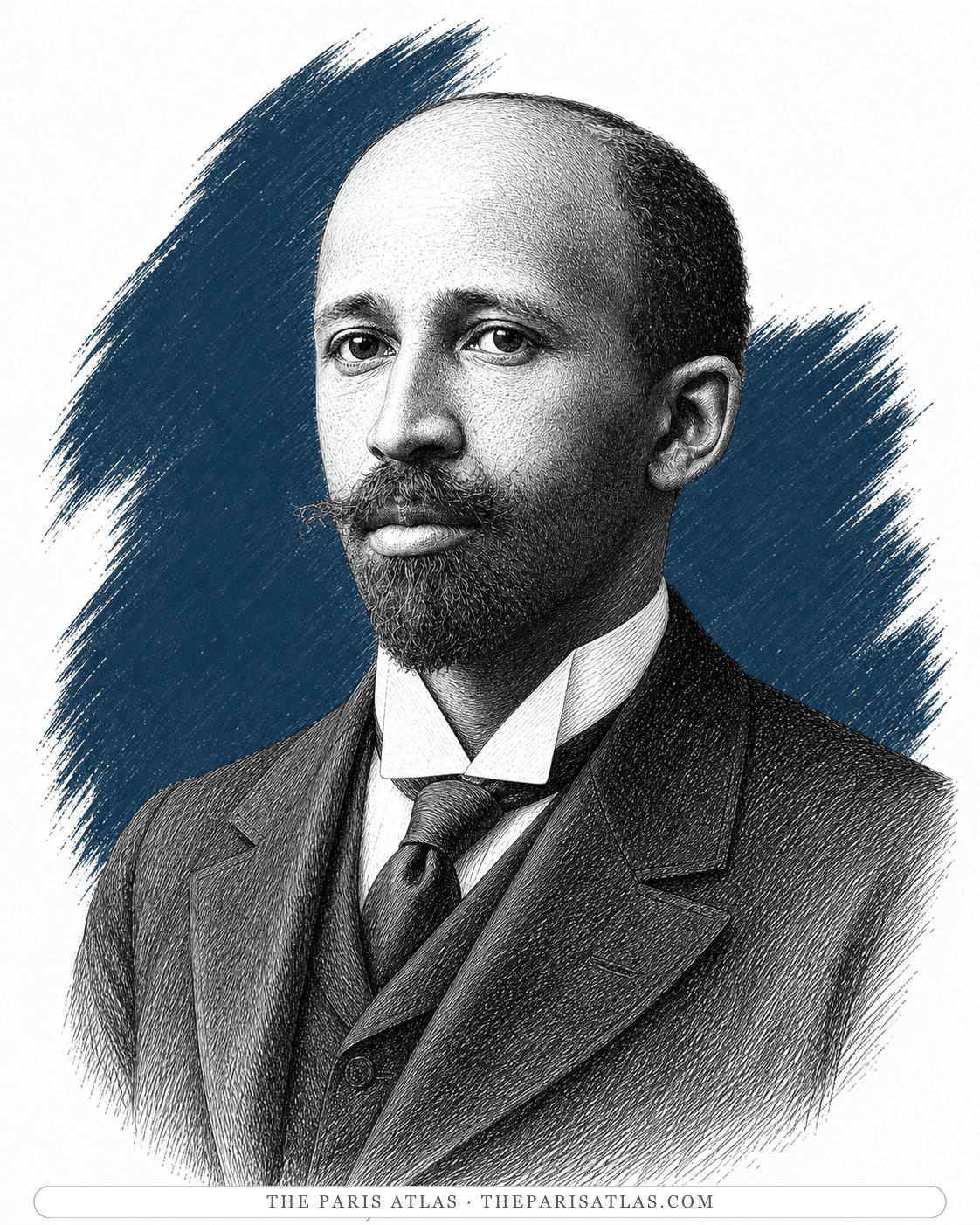
Among her subjects were W. E. B. Du Bois and Marcus Garvey. Rather than treating Black features as something to generalize, caricature, or force toward European conventions, Savage approached the faces of Black sitters with close observation and seriousness. The Smithsonian describes her as one of the early American artists who consistently centered Black physiognomy in her sculpture.[3]
Her portraits were recognizably individuals, but the larger significance of the work was cultural. Portrait busts had traditionally been associated with rulers, statesmen, wealthy patrons, and celebrated historical figures. Savage used the form for Black intellectuals, activists, children, workers, and ordinary people. The very act of modeling these faces carefully and presenting them as worthy of sustained attention challenged the visual stereotypes that surrounded Black Americans in popular culture.
Yet professional recognition did not remove racism from her path.
The French scholarship that was taken away
In 1923, Savage was selected for a summer art program at the Fontainebleau School of Fine Arts in France.[2]
Then the selection committee discovered that she was Black.
Her place was withdrawn.
Savage did not quietly accept the decision. She protested publicly and wrote about the discrimination, turning the episode into a controversy reported by newspapers. One member of the selection committee, sculptor Hermon A. MacNeil, disagreed with the decision and subsequently offered Savage instruction in his own studio. But she did not get to go to France.[4]
The episode is particularly important in understanding her later relationship with Paris. Paris did not simply appear in Savage's life as a glamorous destination for an ambitious American artist. France had first represented an opportunity deliberately denied to her.
She continued working.
Another chance to study in Europe appeared in the mid-1920s, but Savage could not afford the travel and living expenses. Her family was experiencing serious financial problems, and she worked jobs outside the art world, including in a steam laundry. Artistic talent alone could not pay for bronze casting, international travel, studio rent, or a family's expenses.[5]
Then she made the sculpture that changed everything.
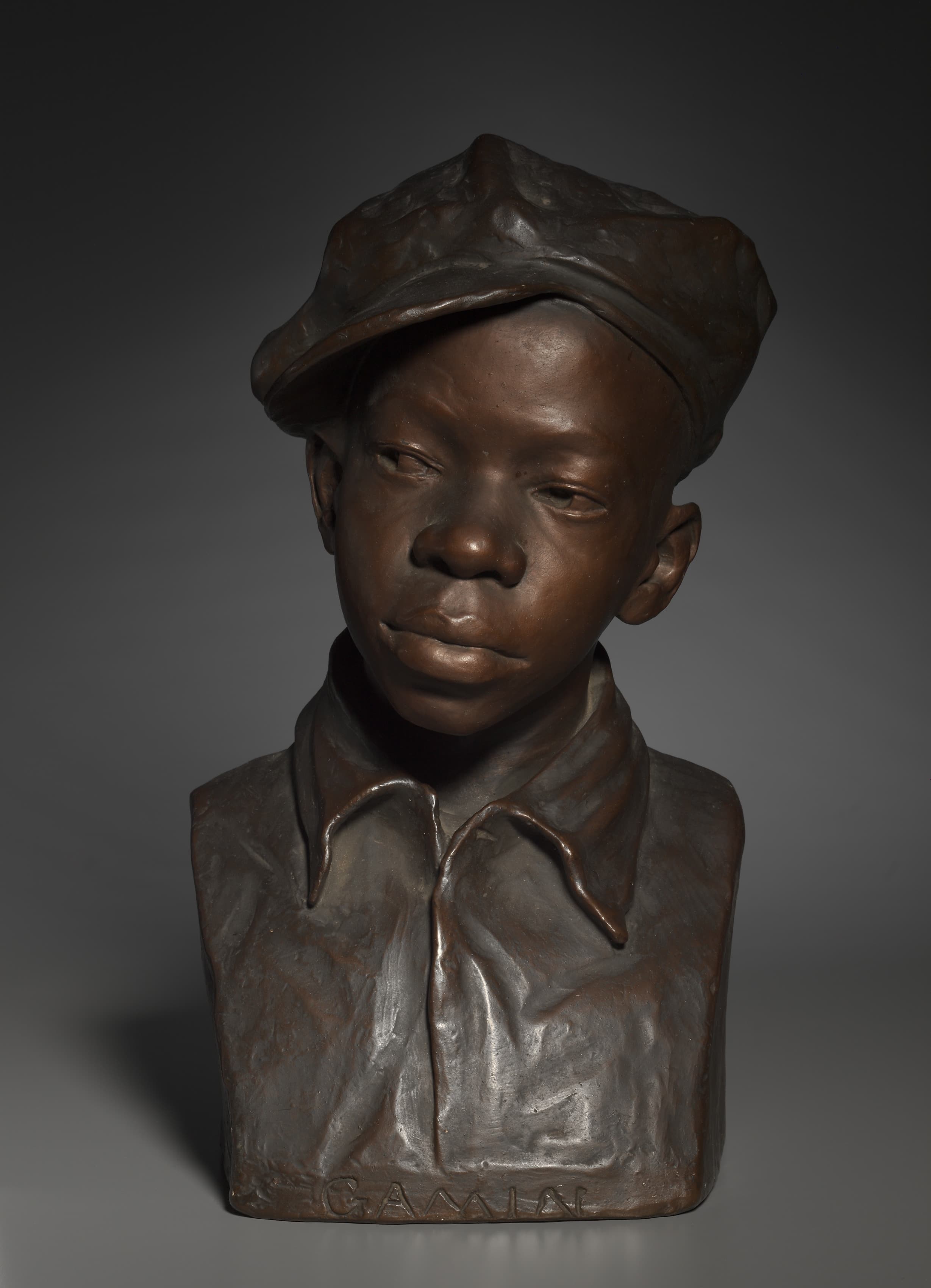
Gamin
In 1929 Savage modeled the head and shoulders of a young Black boy wearing a soft cap tilted slightly to one side.[6]
The boy was her nephew, Ellis Ford, who had come to stay with Savage's family in Harlem after a hurricane damaged the family's Florida home. Savage reportedly modeled him rapidly, but the resulting portrait feels intensely observed. His shirt is rumpled. His cap sits casually on his head. His expression is neither sentimental nor heroic. He appears thoughtful, wary, self-possessed and completely individual.[7]
Savage called the work Gamin, using a French word associated with a streetwise child.
Technically, the sculpture demonstrates much of what made Savage's portraiture distinctive. She retained visible marks in the modeled surface instead of polishing the boy into an idealized figure. Yet she organized the head and shoulders within the long tradition of classical portrait busts. In surviving plaster versions she painted the surface dark and glossy so that the inexpensive material resembled bronze.
That substitution tells another part of Savage's story. Sculpture is an expensive art. Clay and plaster may be relatively accessible; casting a finished sculpture in bronze is not. Savage's financial circumstances meant that many works remained in temporary materials. Some were lost entirely.
Gamin, fortunately, survived in multiple versions.
The sculpture became widely admired and helped establish Savage beyond Harlem. Most importantly, it helped her receive a Julius Rosenwald Fellowship.
Six years after France had rejected her because of her race, Augusta Savage was finally going to Paris.
Augusta Savage in Paris
Savage arrived in France in 1929, entering a city already crowded with American expatriate writers, painters, musicians, and sculptors.
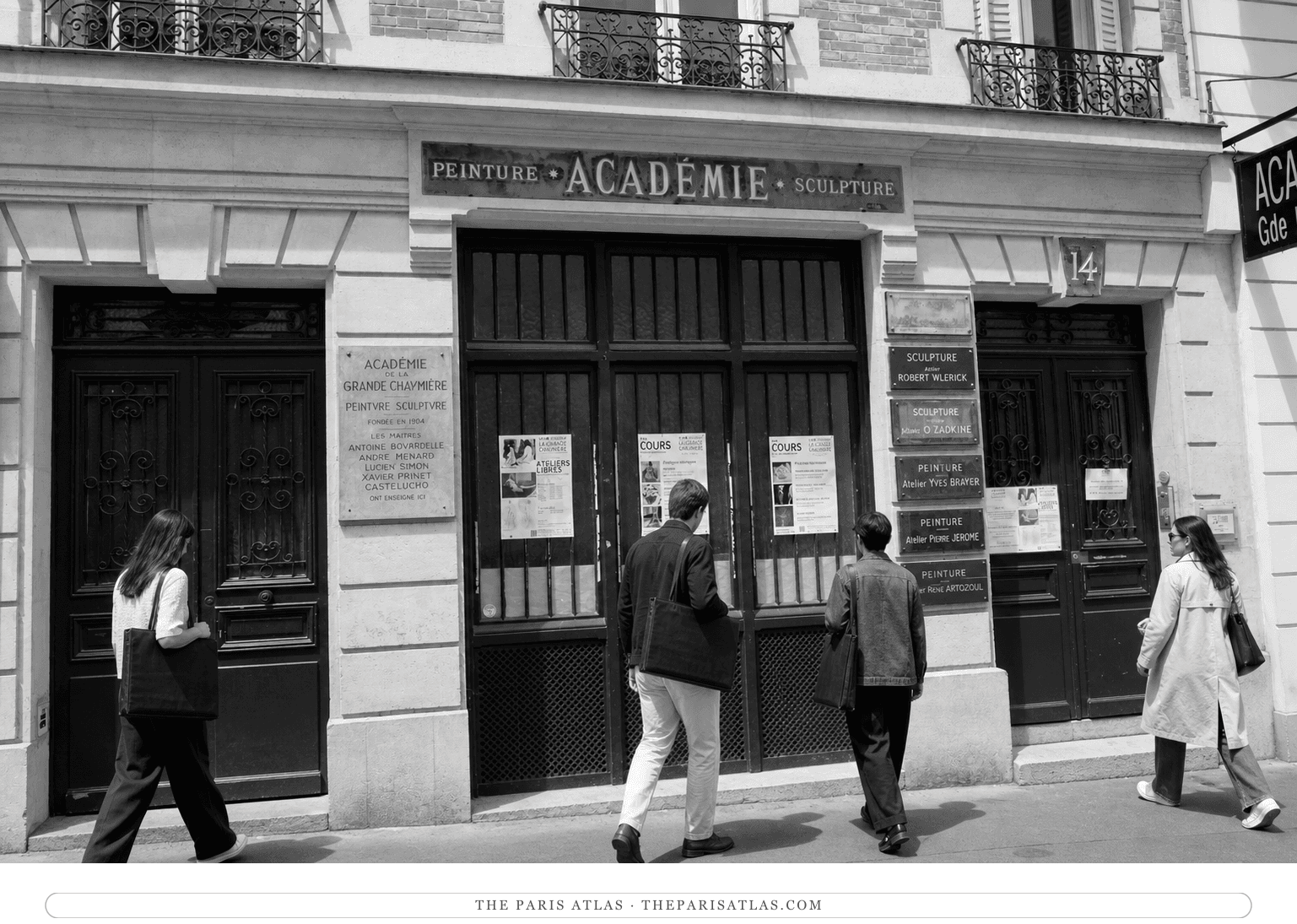
She lived in Montparnasse, the Left Bank district whose cafés, inexpensive studios, academies, and artists' hotels had made it one of the centers of international modern art. She studied at the Académie de la Grande Chaumière, at 14 rue de la Grande-Chaumière, an independent academy frequented by artists who wanted an alternative to the more rigid official French system.
Savage worked for a time with the sculptor Félix Benneteau-Desgrois and also studied with Charles Despiau. But she was not an unquestioning student. She became frustrated with instructors who wanted students to conform to their individual methods and increasingly pursued her own direction.
Her Paris years were productive.
She created portrait studies, nudes, and sculptures that increasingly engaged with Black identity and the African diaspora. Works associated with her European period include Woman of Martinique and other studies of Black female figures. Her interests ranged from naturalistic portraiture to more symbolic and formally experimental figures.
More importantly, she began exhibiting in institutions that had once seemed impossibly distant.
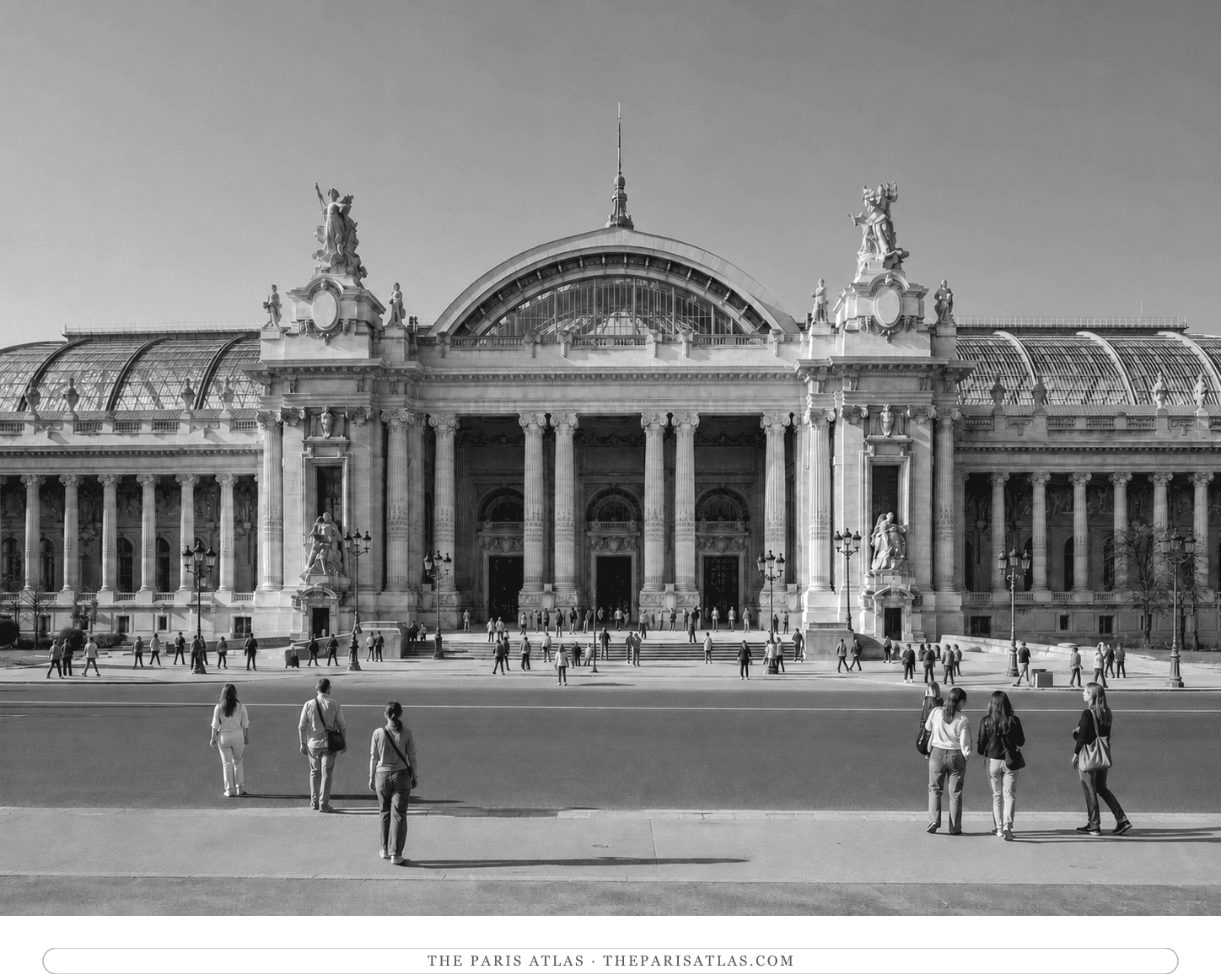
Her sculpture was accepted by the Salon d'Automne, and works were shown at the Grand Palais, one of Paris's most prestigious exhibition buildings. She later had works accepted by the Salon de Printemps. The Martinican writer and intellectual Paulette Nardal—herself an important figure in the Black intellectual circles of interwar Paris—wrote about Savage in the French-language La Dépêche africaine.
The significance is difficult to miss. In 1923, an American committee had prevented Savage from studying in France because she was Black. By the beginning of the next decade, she was exhibiting her sculpture in Paris.
A second Rosenwald Fellowship allowed her to extend her European stay. A Carnegie grant supported further travel through France, Belgium, and Germany, where she studied sculpture in museums, churches, and cathedrals. By the time she returned to the United States, she reportedly brought ten sculptures back with her.
Paris had given Savage international exhibition experience, advanced training, and time to work. But she did not choose the life of a permanent expatriate.
She went back to Harlem.
The artist becomes a teacher
Savage returned to New York during the Great Depression, when making a living from portrait commissions had become even more difficult.
Her response was characteristic: if the existing art world would not provide enough opportunities, she would help build another one.
In 1932, she founded the Savage Studio of Arts and Crafts in Harlem. The studio offered art education to young people who otherwise had little access to professional training. Over time it became one of the most consequential teaching spaces in twentieth-century Black American art.
Artists who passed through Savage's orbit included Jacob Lawrence, Gwendolyn Knight, Norman Lewis, Charles Alston, Ernest Crichlow, Robert Blackburn, Selma Burke, and Morgan and Marvin Smith. Some came as students; others belonged to the larger community of artists that gathered around her work and institutions. Future psychologist Kenneth Clark also spent time there.
Savage did not merely teach technique. She helped young artists find employment, introduced them to institutions, advocated for them with federal arts administrators, and treated art as something that should be available to an entire community rather than a wealthy minority.
In 1934 she became the first African American member of the National Association of Women Painters and Sculptors. She helped organize the Harlem Artists Guild, which pressed for Black artists to receive jobs and support through federal New Deal programs. Then in 1937 she became the first director of the Harlem Community Art Center, supported by the Works Progress Administration.
The center became enormously successful. Roughly 1,500 people participated in its programs, and its approach became a model for federally supported community art centers elsewhere in the United States.
By then Savage had reached an unusual position: she was simultaneously an important sculptor and one of the people creating the infrastructure that allowed other Black artists to become professionals.
That success came at a price. The more Savage taught, organized, administered, and fought for opportunities for other artists, the less uninterrupted time remained for her own sculpture.
Then came the largest work she ever made.
Lift Every Voice and Sing — The Harp
For the 1939 New York World's Fair, Savage received a commission to create a monumental sculpture representing the musical contributions of Black Americans.
She turned to Lift Every Voice and Sing, the song written by brothers James Weldon Johnson and J. Rosamond Johnson that had become one of the most important songs in Black American public life.
Savage transformed music into sculpture.
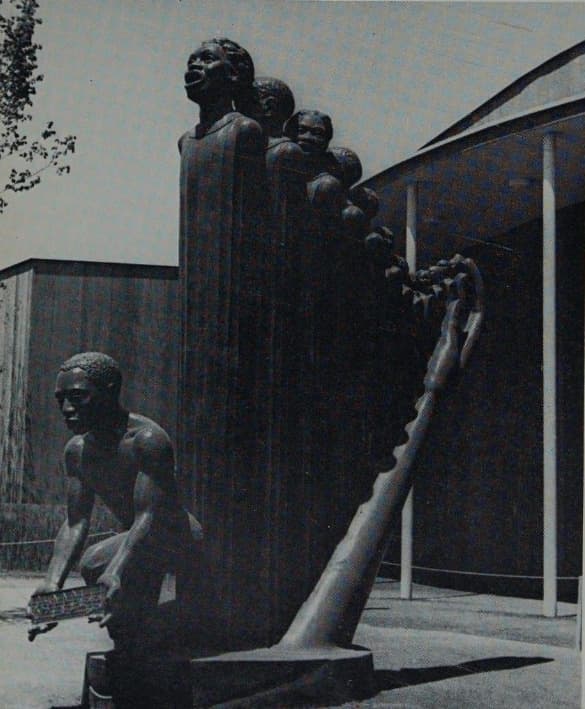
Her finished work stood approximately sixteen feet high. Twelve elongated Black singers rose upward in a sequence, their bodies forming the strings of a giant harp. A great curving arm and hand formed part of the instrument's structure, while a kneeling figure at the front held music in his hands.
Officially called Lift Every Voice and Sing, the sculpture quickly became known as The Harp.
It was monumental, theatrical, instantly legible from a distance and extremely popular with visitors. It also represented an important departure from Savage's intimate portrait busts. Here individual figures had become a collective body. Human voices became strings. Music became architecture.
But the material was plaster.
Savage did not have the money to cast the enormous sculpture in bronze, and no institution stepped forward with the funds necessary to preserve it. When the World's Fair ended, The Harpwas destroyed along with other temporary structures.
Today the great sculpture survives primarily through photographs and small souvenir versions.
Its destruction has become almost inseparable from Savage's biography because it represents the larger disappearance of her work. Sculpture is vulnerable when an artist cannot afford permanent materials. Much of Savage's work was made in clay or plaster, and many originals vanished, broke, were discarded, or were never cast.
The scarcity of her surviving work is therefore not evidence that she produced little. It reflects, in part, the economic conditions under which she was forced to produce it.
Success followed by collapse
The World's Fair might have marked the beginning of an even larger public career.
Instead, it marked something close to the end.
Savage had taken leave from the Harlem Community Art Center to complete The Harp. When she returned, she discovered that her position had been filled. Federal arts programs soon contracted as American government spending shifted toward the coming war.
In 1939 she opened the Salon of Contemporary Negro Art, a gallery devoted to exhibiting and selling work by Black artists. It was a pioneering enterprise but struggled financially and closed. She also held a solo exhibition at the Argent Galleries that year.
The pattern must have been painfully familiar. Savage could build institutions, attract students, receive excellent reviews and produce art admired by enormous audiences, yet the financial structure required to sustain those achievements repeatedly disappeared beneath her.
Her production gradually diminished.
Saugerties and the quiet years
In 1945, Savage left Harlem for Saugerties, a small town in New York's Catskill region.
Her life became much quieter. She reconnected closely with her daughter and family. She tended a garden, raised animals, sold poultry and eggs, taught children at summer camps and occasionally produced portrait sculptures. She also began writing—children's stories, mysteries, and short pieces—although none of those manuscripts were published.
It would be easy to describe these years simply as retirement, but that makes her disappearance from the major art world sound more voluntary than it probably was. By the mid-1940s Savage had endured decades of unstable patronage, racial exclusion, financial strain, collapsing institutions, and the physical destruction of major works.
She did not entirely abandon creativity. What disappeared was the public career that had once placed her at the center of Harlem's art world.
When her health deteriorated in the early 1960s, Savage returned to New York City to live near her daughter.
She died of cancer on March 26, 1962, at the age of seventy.
She died far less famous than many of the artists whose careers she had helped begin.
The art Augusta Savage left behind
Only a fraction of Savage's sculpture survives, which makes evaluating her career unusually difficult.
Gamin remains the best-known surviving work and perhaps the clearest introduction to her artistic gifts: close observation, expressive modeling, psychological subtlety and an insistence that an ordinary Black child deserved the dignity historically reserved for socially important portrait subjects.
Her portrait busts of figures such as W. E. B. Du Bois, Marcus Garvey, James Weldon Johnson, and Gwendolyn Bennett connect her sculpture directly to the intellectual world of the Harlem Renaissance. Other surviving and documented works show that her interests were wider than portraiture alone, extending to the nude figure, movement, religious imagery, African diasporic identity and increasingly symbolic compositions.
And then there is The Harp, a masterpiece that technically no longer exists.
Its disappearance has ironically made the work even more emblematic of Savage's career: an enormous achievement that the institutions around her admired but would not pay to preserve.
The Schomburg Center for Research in Black Culture now holds the largest public collection of Savage's surviving sculpture as well as photographs and archival material documenting works that have disappeared.
Her real monument
Augusta Savage once made a striking assessment of her own career.
She believed that the most lasting thing she might create would not necessarily be a sculpture.
My monument will be in their work.
She was speaking about her students.
It is difficult to find a more accurate description of what happened.
Jacob Lawrence became one of the defining American painters of the twentieth century. Norman Lewis became a major figure in American abstraction. Gwendolyn Knight, Charles Alston, Selma Burke and other artists connected to Savage's teaching and advocacy built substantial careers of their own.
Savage's influence therefore runs along two parallel lines.
One is visible in the surviving objects: the sensitive face of the boy in Gamin, the photographs of The Harp, the portraits, figures and fragments preserved in museums.
The other is much larger and harder to place inside a gallery. It exists in the artists she taught, the institutions she created, the opportunities she fought to open, and the idea that professional art education could belong to Black children in Harlem just as completely as it belonged to students in the established academies of New York or Paris.
Her life began with a girl secretly shaping figures from Florida clay while being told she should stop.
It passed through poverty, three marriages and widowhood, Cooper Union, the Harlem Renaissance, a scholarship taken away because of her race, a triumphant return to France, studios in Montparnasse, exhibitions at the Grand Palais, classrooms in Harlem, a sixteen-foot sculpture seen by crowds and then demolished, and finally a quiet house in the Catskills.
What survived was not everything she made.
But it was enough to reveal how much she changed.
And in the work of the artists who came after her, Augusta Savage's largest sculpture may still be standing.
Life events
1892
Born in Green Cove Springs, Florida.
— Augusta Savage — artist biography
1921
Moves to New York and enrolls at Cooper Union.
— Augusta Savage — artist biography
1929
Travels to Paris on a Rosenwald Fellowship and studies at the Académie de la Grande Chaumière.
— Augusta Savage — artist biography
1931
Receives a second Rosenwald Fellowship and remains in Paris for another year.
— Augusta Savage — artist biography
1937
Becomes the first director of the Harlem Community Art Center.
— Oh Freedom! Augusta Savage
1939
Creates The Harp for the New York World's Fair.
The Harp, Savage's monumental 1939 World's Fair commission, which was destroyed after the fair closed. (Carl Van Vechten; published in Cedric Dover, American Negro Art (1960))
— Augusta Savage — artist biography
1962
Dies in New York City.
— Augusta Savage — artist biography
Selected works
Cataloged from the holding institutions' records. Reproductions appear only where the rights are verified.
A boy in a soft flat cap and an open-collared shirt, modelled from the chest up and painted a warm coppery brown so that plaster would read as bronze. The sitter was Augusta Savage's nephew Ellis Ford, who was living with her in Harlem after a hurricane damaged the family's house in Florida. The sculpture survives. The Cleveland Museum of Art holds the life-size hand-painted plaster as 2003.40, and the Smithsonian American Art Museum holds a smaller painted plaster as 1988.57.
Twelve singing children stand in descending height, their bodies forming the strings of a harp, with a huge forearm and open hand as the soundboard and a kneeling young man holding a bar of music at the front. Augusta Savage made it in plaster for the 1939 New York World's Fair, sixteen feet high. It no longer exists. She could not pay to have it cast in bronze or moved and stored, and the sculpture was destroyed when the fair closed, so only photographs, postcards and small metal souvenir copies survive.
Augusta Savage, Lift Every Voice and Sing, 1939. No collection — the sculpture was destroyed when the 1939 New York World's Fair closed. Image: public domain (US).
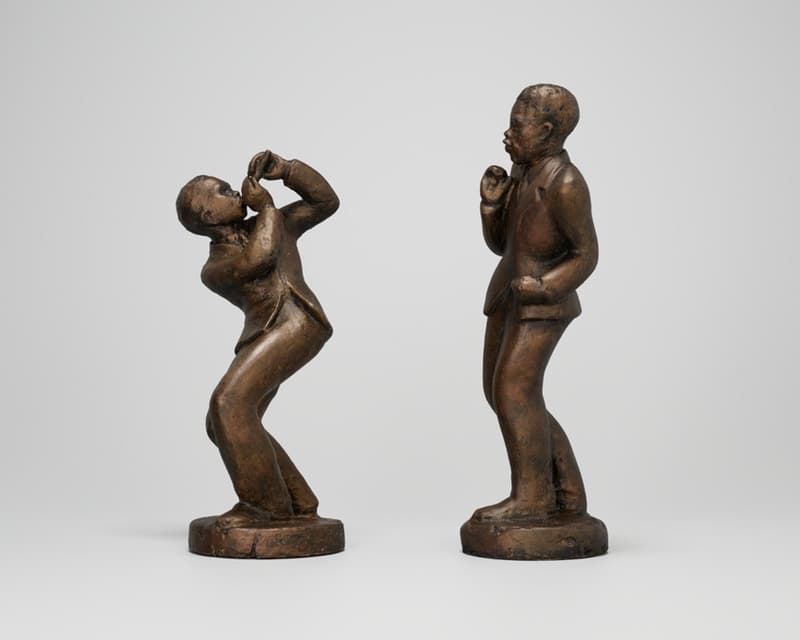
Two small figures in jackets and trousers, each on a round base, painted a bronze brown. One leans far back with his head thrown up and both hands at his mouth; the other stands nearly upright, head turned towards him, one fist raised to the chest. Augusta Savage modelled them in plaster around 1939, and both survive. The Art Institute of Chicago bought them at auction in 2021 and catalogues them together as 2021.29a-b.
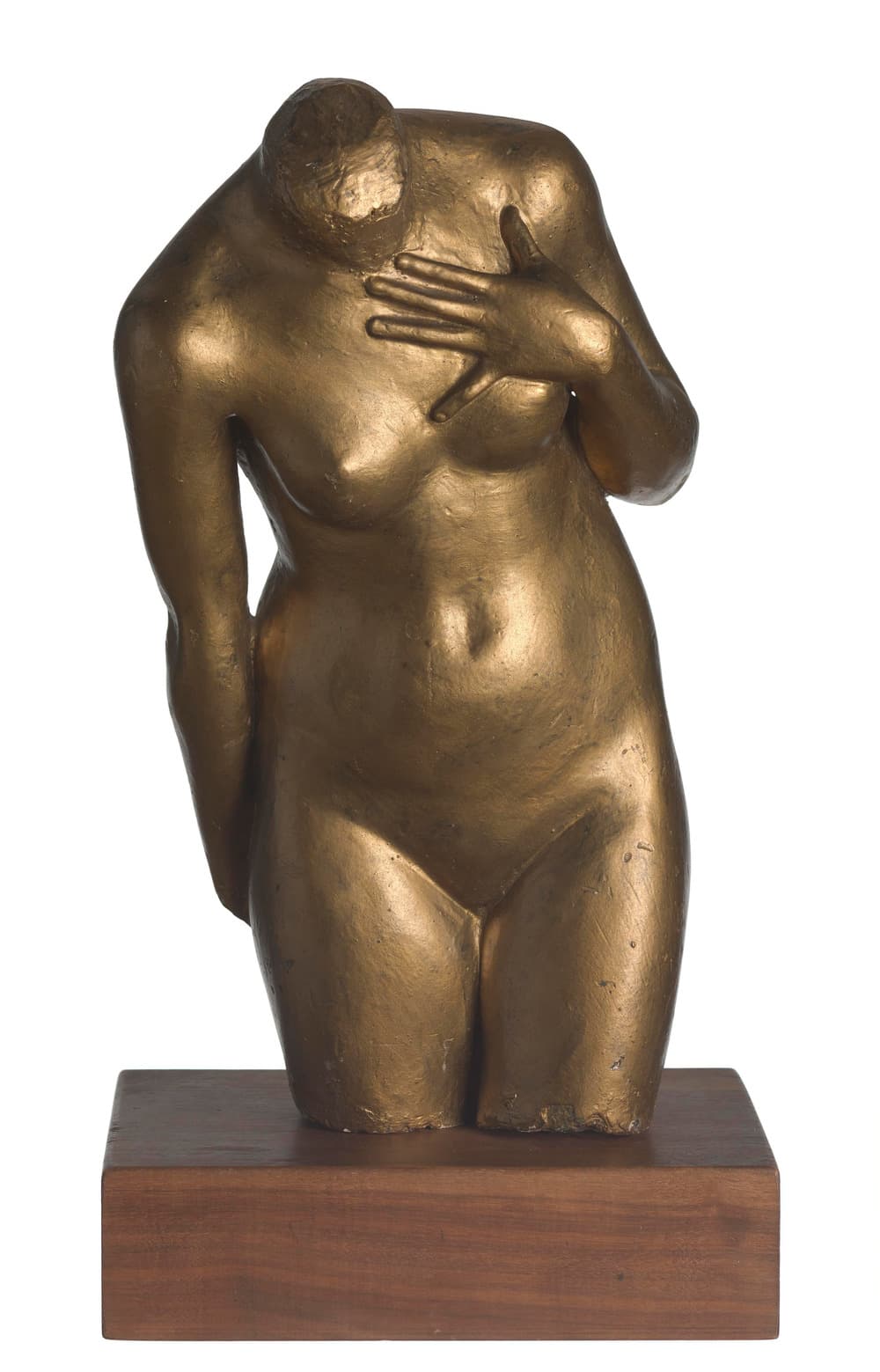
A woman's torso in plaster, painted dark gold, cut at the neck, at both arms and across the thighs. One hand lies flat on the chest with the fingers spread; the other arm falls straight at the side. Augusta Savage modelled it in Harlem after coming back from two years at the Académie de la Grande Chaumière in Paris, taking her former student Edythe Williams Scott as the model. The sculpture survives, at the National Museum of African American History and Culture as 2014.233.2.
c. 1938 · Modelled group, never cast; no institution catalogues the object or records its material
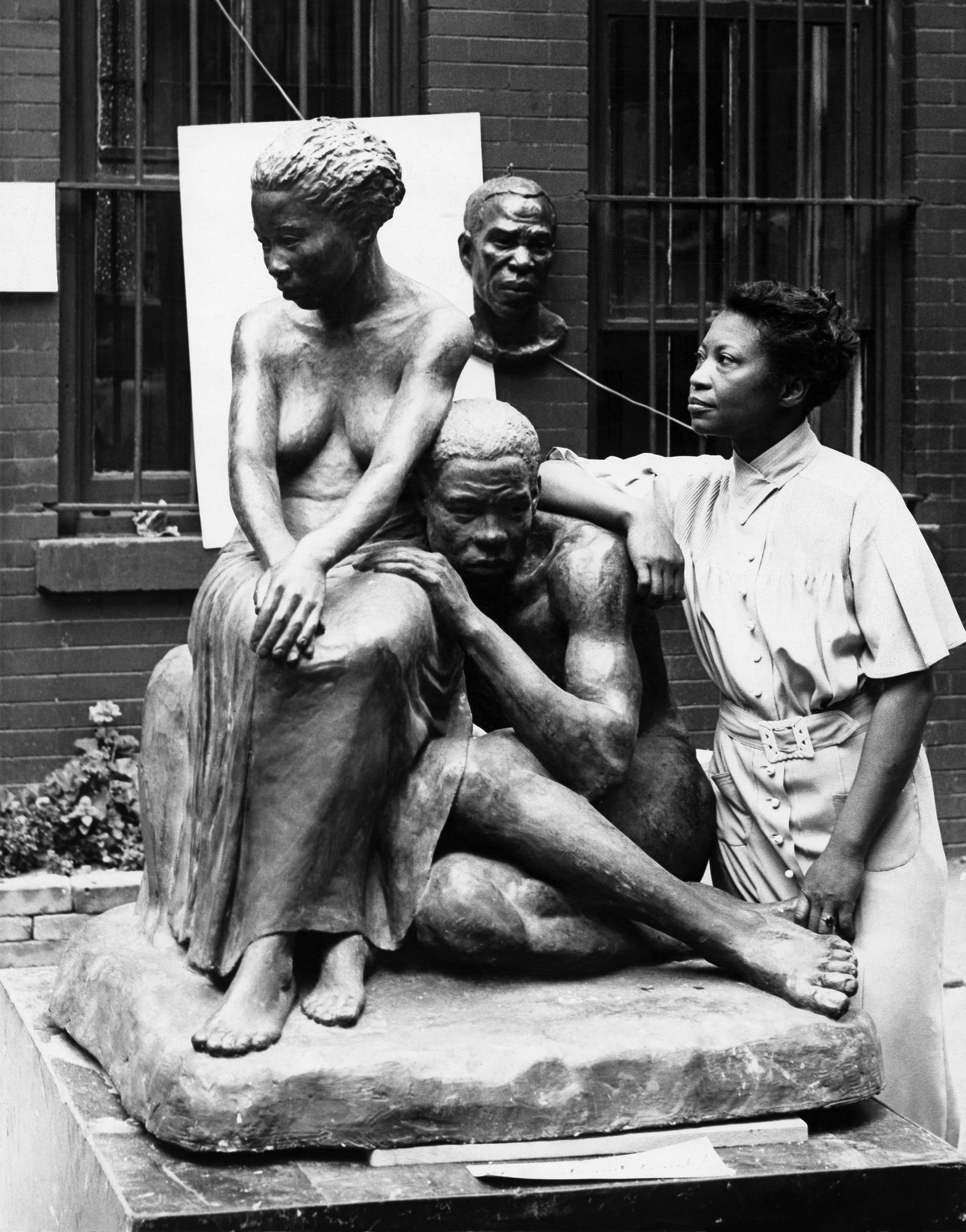
Two figures sit on a rough slab: a woman upright with her hands folded over her knee, and a man below her with his legs stretched out and one arm hooked across her lap. Augusta Savage modelled the group around 1938 under the Works Progress Administration's Federal Art Project. No institution records the object today. What survives is a photograph taken in Harlem by Andrew Herman for the Federal Art Project's Photographic Division, with Augusta Savage standing beside the group.
Augusta Savage, Realization, c. 1938. Image: public domain (US).
People Augusta Savage Knew
Relationships with other people, with sources for each connection.
W. E. B. Du Bois
Author
Editor
Activist
Painted a portrait of · 1920
Savage established her reputation as a portrait sculptor in Harlem during the 1920s. A commissioned bust of W. E. B. Du Bois was among the works that brought her support from Black civic organizations before her Paris fellowship.
Augusta Savage’s connections to people, places, and works, with the sources behind each one.
Painted a portrait of · 1920
W. E. B. Du Bois
Savage established her reputation as a portrait sculptor in Harlem during the 1920s. A commissioned bust of W. E. B. Du Bois was among the works that brought her support from Black civic organizations before her Paris fellowship.
Savage studied sculpture briefly with Félix Benneteau-Desgrois at the Académie de la Grande Chaumière after arriving in Paris on a Rosenwald Fellowship in 1929.
— Augusta Savage — artist biography
References
References
The sources below include biographies, scholarly essays, interviews, and primary materials that informed this page. They reflect both the historical record and ongoing critical conversations about Augusta Savage and their work.
These references anchor the page in the documented record and in the scholarly conversations around Augusta Savage. Every claim on this page traces back to one or more of the works listed here.




 View source