The Paris AtlasCharting the artists, works, and places worth returning to.

In their own words

Edgar Allan Poe quotes

21 quotations, each verified against its source and credited to the work it comes from — the wording as Edgar Allan Poe wrote or said it, not as the internet passes it around.

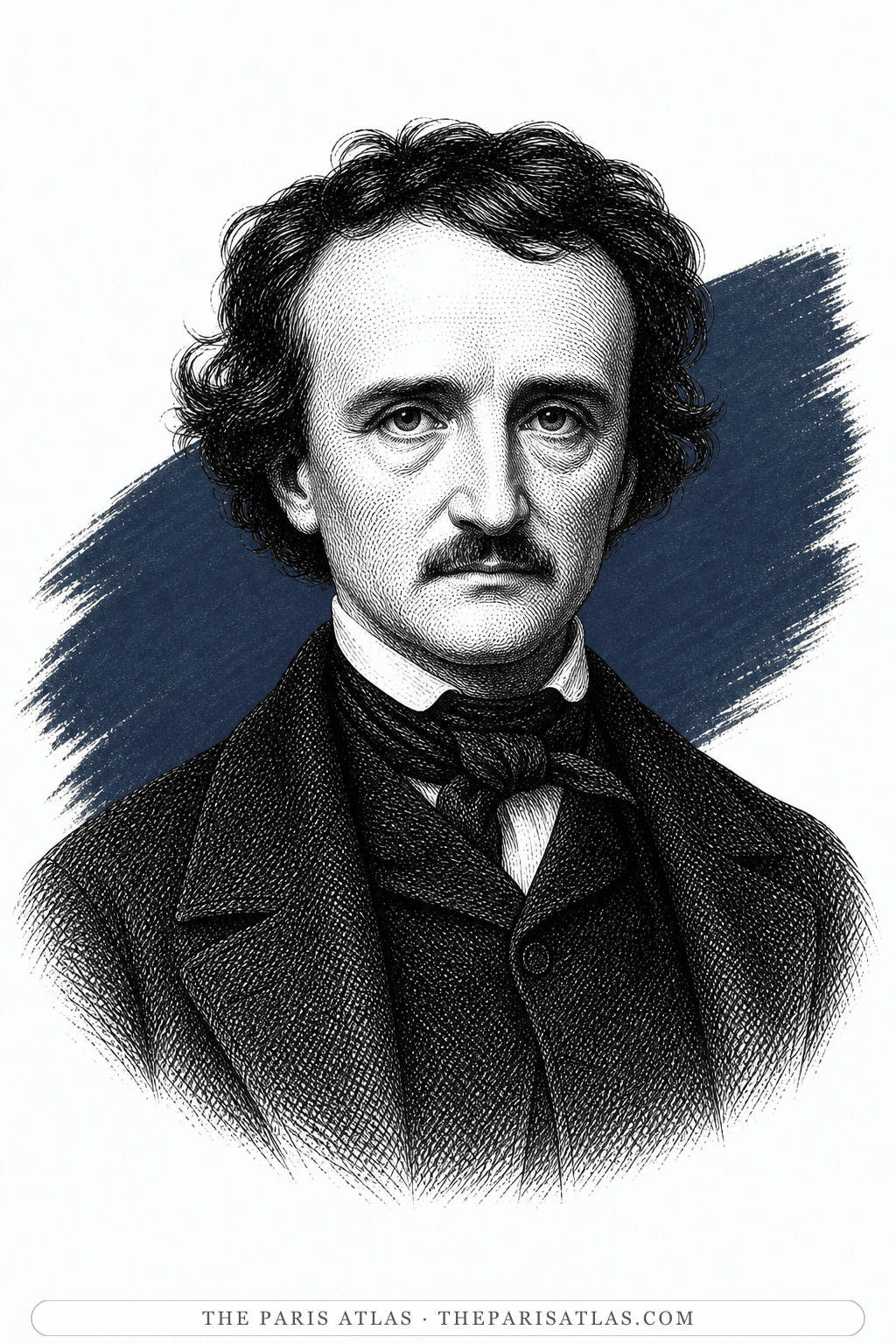
Illustrated portrait of Edgar Allan Poe
Pen-and-ink illustration of a raven feather quill, candle, hourglass, and storm-dark rooftops

How these quotes were checked

How we decide whether a quote is genuine

Edgar Allan Poe's real sentences are grim enough that the invented ones have to work hard to out-do them — and they try. A line enters this collection only when its wording is verified against the printed works: the poems and essays in their standard texts, and the letters in their published editions.

The internet's favorite fake Poe line is documented below, next to what he actually wrote.

One famous Edgar Allan Poe quote, fact-checked

A sentence linked to Edgar Allan Poe may be exact, shortened, remembered by someone else, or unsupported. Each label below explains what the available evidence actually proves.

Unproven

“The scariest monsters are the ones that lurk within our souls.”

A full-text search across Poe's works and published letters finds nothing like this sentence. It circulates over his name without a citation; the sentiment is modern, and so is the phrasing.

  • — HathiTrust full-text search across Edgar Allan Poe's works (2026)

All that we see or seem / Is but a dream within a dream.
— Edgar Allan Poe, “A Dream Within a Dream” (1849)
“Though thy crest be shorn and shaven, thou,” I said, “art sure no craven, / Ghastly grim and ancient Raven wandering from the Nightly shore,— / Tell me what thy lordly name is on the Night's Plutonian shore!” / Quoth the Raven, “Nevermore.”
— Edgar Allan Poe, “The Raven” (1845)
Deep into that darkness peering, long I stood there wondering, fearing, / Doubting, dreaming dreams no mortal ever dared to dream before;
— Edgar Allan Poe, “The Raven” (1845)
I became insane, with long intervals of horrible sanity.
— Edgar Allan Poe, letter to George W. Eveleth, 4 January 1848
The death, then, of a beautiful woman is, unquestionably, the most poetical topic in the world.
— Edgar Allan Poe, “The Philosophy of Composition,” Graham's Magazine, April 1846
These many pieces are yet one book.
— Edgar Allan Poe, Tales of the Grotesque and Arabesque, Preface (1840 title-page date)
We have put her living in the tomb!
— Edgar Allan Poe, The Fall of the House of Usher, in Tales of the Grotesque and Arabesque (1840 title-page date)
I had swooned, and Peters had caught me as I fell.
— Edgar Allan Poe, The Narrative of Arthur Gordon Pym of Nantucket (1838), Chapter XXIV
The more earnestly I struggled not to think, the more intensely vivid became my conceptions, and the more horribly distinct.
— Edgar Allan Poe, The Narrative of Arthur Gordon Pym of Nantucket (1838), Chapter XXIV
If what I have written is to circulate at all, I am naturally anxious that it should circulate as I wrote it.
— Edgar Allan Poe, The Raven and Other Poems (1845), Preface
To seek for treasure in the jewelled skies
— Edgar Allan Poe, Sonnet—To Science, in The Raven and Other Poems (1845)
But to-morrow I die, and to-day I would unburthen my soul.
— The narrator of The Black Cat (narration) · Edgar Allan Poe, "The Black Cat" (1843), in Tales (1845)
Perhaps the mystery is a little too plain.
— C. Auguste Dupin (dialogue) · Edgar Allan Poe, "The Purloined Letter" (1844), in Tales (1845)
It took less than a single day to change these hairs from a jetty black to white, to weaken my limbs, and to unstring my nerves, so that I tremble at the least exertion, and am frightened at a shadow.
— The old fisherman (dialogue) · Edgar Allan Poe, "A Descent into the Maelström" (1841), in Tales (1845)
He refuses to be alone. He is the man of the crowd.
— The narrator of The Man of the Crowd (narration) · Edgar Allan Poe, "The Man of the Crowd" (1840), in Tales (1845)
Books, indeed, were his sole luxuries, and in Paris these are easily obtained.
— The narrator (narration) · Edgar Allan Poe, "The Murders in the Rue Morgue" (1841), in Tales (1845)
Truth is not always in a well.
— C. Auguste Dupin (dialogue) · Edgar Allan Poe, "The Murders in the Rue Morgue" (1841), in Tales (1845)
The depth lies in the valleys where we seek her, and not upon the mountain-tops where she is found.
— C. Auguste Dupin (dialogue) · Edgar Allan Poe, "The Murders in the Rue Morgue" (1841), in Tales (1845)
They have fallen into the gross but common error of confounding the unusual with the abstruse.
— C. Auguste Dupin (dialogue) · Edgar Allan Poe, "The Murders in the Rue Morgue" (1841), in Tales (1845)
In investigations such as we are now pursuing, it should not be so much asked 'what has occurred,' as 'what has occurred that has never occurred before.'
— C. Auguste Dupin (dialogue) · Edgar Allan Poe, "The Murders in the Rue Morgue" (1841), in Tales (1845)
Our friend the Prefect is somewhat too cunning to be profound.
— C. Auguste Dupin (dialogue) · Edgar Allan Poe, "The Murders in the Rue Morgue" (1841), in Tales (1845)

From the books

Every book with a quote collection of its own, each line verified against the text.

Questions about Edgar Allan Poe quotes

Did Edgar Allan Poe say “the scariest monsters are the ones that lurk within our souls”?

No. Nothing like it appears in his works or published letters. It is a modern sentence wearing his name.

What is Edgar Allan Poe's most famous quotation?

Probably the refrain of “A Dream Within a Dream” (1849): “All that we see or seem / Is but a dream within a dream.” — with “The Raven”'s “Quoth the Raven, ‘Nevermore.’” as its only real rival.

Did Poe really write “I became insane, with long intervals of horrible sanity”?

Yes — in a letter to George W. Eveleth of 4 January 1848, describing the years of his wife Virginia's tuberculosis and his drinking through her repeated crises.

Why did Poe call the death of a beautiful woman “the most poetical topic in the world”?

The line is from “The Philosophy of Composition” (1846), the essay in which he reconstructs — with a straight face that readers still argue about — how he engineered “The Raven” choice by choice. In the essay's logic, beauty is the poem's province, death its most melancholy note, and the two meet there.

What are the most famous lines from “The Raven”?

The refrain itself — “Quoth the Raven, ‘Nevermore.’” — and the chamber-door stanza's “Deep into that darkness peering, long I stood there wondering, fearing, / Doubting, dreaming dreams no mortal ever dared to dream before.” The poem was published in 1845 and made Poe famous within weeks.

References

References

The sources below are the editions, archives, and full-text searches used to verify the quotations on this page. Every line was checked against one or more of them before it appeared here.

  1. 1The Works of Edgar Allan Poe (Raven Edition) and The Complete Poetical Works

    Poetry
    Project Gutenberg ebooks #2148, #2151, #10031, #17192, 1903
    Used for

    Primary text included as part of the documented record for Edgar Allan Poe.

    View source
  2. 2HathiTrust full-text search across Edgar Allan Poe's works

    Website
    HathiTrust Digital Library, searched 30 August 2026, 2026
    Used for

    Web source consulted for documented facts and historical context presented on the Edgar Allan Poe page.

    View source
i
Why these sources are here

Verification is the point of this collection: a quotation is listed only when its wording has been checked against the sources above, and the attribution notes record what each check found about the famous lines that failed.

Explore more resources

Newsletter

Join our newsletter

New stories about art, literature and famous places around the world.

Unsubscribe anytime.