The Paris AtlasCharting the artists, works, and places worth returning to.
  • Painter
· Irish-born British · 1909–1992

Francis Bacon

The Irish-born British painter of screaming popes and hinged triptychs — pictures in three panels, after the folding altarpieces of medieval churches. He is not the Elizabethan philosopher of the same name but a collateral descendant, a relative through a side branch of the family. An exhibition of drawings by Pablo Picasso in Paris in 1927 turned him into an artist; he spent the years after it designing chrome-and-glass furniture in London before he painted anything he would keep, and from 1974 he kept a flat near the Place des Vosges.

Details

Lived
1909–1992
Born
1909
Birthplace
Dublin
Died
1992
Place of death
Madrid
Nationality
Irish-born British
Profession
Painter
Major works
Three Studies for Figures at the Base of a Crucifixion (1944), Painting (1946), Triptych May–June 1973
Roles
Painter

About Francis Bacon

Francis Bacon (1909–1992) painted the twentieth century's most disturbing human figures: popes howling inside glass boxes — versions of a seventeenth-century Velázquez portrait of Pope Innocent X that he returned to for years — lovers wrestling on a bed, faces smeared as if seen through moving water. He is not the Elizabethan philosopher and statesman Francis Bacon, who died in 1626 — the two are separated by three centuries, though the family claimed him as an ancestor, and the painter's Estate describes the Bacons as collateral descendants of the philosopher, meaning relatives through a side branch rather than a direct line.

He came to painting late, sideways, and without training. At sixteen he was thrown out of his father's house in Ireland; at seventeen he was in Paris, sitting in a commercial gallery on the rue La Boétie in front of a wall of drawings by Pablo Picasso, the Spanish painter who was then the most famous living artist in Europe. Bacon said for the rest of his life that those drawings were the reason he became a painter. He went back to London and spent the next few years designing furniture instead, and only in 1944 produced the picture — Three Studies for Figures at the Base of a Crucifixion — that he was willing to call his beginning.

Dublin, London, Berlin, Paris

Bacon was born in a Dublin nursing home at 63 Lower Baggot Street on 28 October 1909, the son of a retired British army major who bred and trained racehorses in County Kildare and of Christina Firth, an heiress of a Sheffield steel family. He was asthmatic from early childhood — an affliction that kept him off horses and, as his Estate puts it, 'diminished him in the eyes of his father'. His only sustained schooling was two years at Dean Close School in Cheltenham, from 1924 to 1926. By his own account he was expelled from the household in 1926, after his father caught him trying on his mother's underwear.[1]

He went to London at sixteen with no plan, living on a small allowance from his mother and odd jobs. In the spring of 1927 his father sent him to Berlin in the care of a family acquaintance, hoping the trip would cure what he considered his son's effeminacy; the chaperone, in the Estate's phrase, 'took advantage of his charge'. Berlin was Bacon's first overwhelming encounter with a modern city — its opulence and its squalor, its architecture, painting and cinema. After two months he crossed to France, and Paris did the rest.[2]

The Picasso drawings on the rue La Boétie

In Paris he met Yvonne Bocquentin, a connoisseur of art who took him into her house near Chantilly, north of the city, and taught him French. He stayed about three months. At the Château de Chantilly — the great country house whose museum holds one of France's finest old-master collections — he stood in front of Massacre of the Innocents by the French painter Nicolas Poussin, a seventeenth-century picture of a mother screaming as her child is killed, and decided it held 'probably the best human cry ever painted' — an image he was still working against forty years later.[2]

The decisive room, though, was a commercial gallery. In the summer of 1927 Bacon went to an exhibition of drawings by Pablo Picasso at the Galerie Paul Rosenberg — the dealer's gallery at 21 rue La Boétie in the 8th arrondissement, then the most powerful modern-art shop in Paris and the room where Picasso's new work was shown to collectors. Bacon's Estate is careful about the claim, because Bacon himself was not: he 'repeatedly claimed that seeing a Picasso exhibition at Chez Paul Rosenberg gallery in Paris in 1927 triggered his wish to become a painter', and the Estate's own biography says he 'seems to have considered becoming an artist only after' that exhibition. He began making drawings and watercolours, and moved into Montparnasse, the quarter on the Left Bank where most foreign artists in Paris then lived and drank.[2]

What he took from Picasso was a shape rather than a style. In those years Picasso was painting bathers at the French seaside resorts of Dinard and Cannes as boneless, ballooning creatures — 'organic form that relates to the human body but is a complete distortion of it', in the Estate's description — and that distortion is the ancestor of every stretched neck and swollen torso Bacon painted afterwards. His own account of the debt was typically grudging: 'Let's say perhaps that Picasso helped me to see…'[3]

The furniture designer who became a painter

Back in London by late 1928, Bacon did not paint for a living: he decorated. From a studio at 17 Queensberry Mews West in South Kensington he designed rugs and modernist furniture in chrome-plated steel and glass, following the lead of the modernist designers Marcel Breuer and Le Corbusier, and in August 1930 The Studio magazine published his rooms as an example of 'The 1930 Look in British Decoration'. The Australian painter Roy de Maistre found him most of his commissions and taught him the rudiments of oil paint.[4]

The turn came slowly and badly. Crucifixion (1933), painted at twenty-three and, in the Estate's words, 'clearly indebted to the biomorphs of Picasso' — biomorphs being shapes that look organic and alive without being any identifiable creature — was reproduced in the critic Herbert Read's book Art Now and bought by the collector Sir Michael Sadler. Then a one-man show at London's Transition Gallery in February 1934 flopped, and in 1936 the organisers of London's International Surrealist Exhibition — the show that brought Surrealism, the movement built on dream logic and the unconscious, to Britain — rejected his work as insufficiently surreal. He drifted, gambled, and destroyed most of what he had painted; the ruthless editing of his own output never stopped.[4]

Three Studies for Figures at the Base of a Crucifixion, painted in 1944, was hung in a group show at the Lefevre Gallery on New Bond Street in April 1945: three hunched, stone-coloured creatures on a hot orange ground, their tubular necks ending in mouths. The Estate identifies them with the Furies, the avenging spirits who pursue Orestes — the son who kills his own mother — through the tragedies of the Greek playwright Aeschylus. The triptych 'rivetted the attention of public and critics', was bought by Bacon's friend Eric Hall, and was presented by him to the Tate Gallery, Britain's national collection of modern art, where it still hangs; Tate now holds some fifty works by Bacon.[5][6] He treated the picture as the start of his career and dated himself from it.

The Grand Palais, October 1971

By 1962, when the Tate Gallery gave the fifty-two-year-old a full retrospective — an exhibition surveying a whole career, in this case ninety-odd paintings, with the news of his former lover Peter Lacy's death in Tangier reaching him on the opening day — Bacon was the most conspicuous painter in Britain. Late in 1963 George Dyer entered his life: an East End Londoner with a petty criminal past, twenty-five years younger, and, behind the sharp suits, depressive and insecure. He became Bacon's lover and the most painted face of the decade, usually worked up from photographs taken by John Deakin, the Soho photographer Bacon commissioned to shoot his friends so that he could paint them in their absence, rather than from sittings.[7]

In 1971 Paris gave Bacon the Grand Palais — the vast glass-roofed exhibition hall built on the Champs-Élysées for the 1900 World's Fair — for a retrospective, an honour the Estate of Francis Bacon calls 'exceptional for a living painter'. Two nights before the opening, Dyer was found dead of an overdose of drink and barbiturates in the bathroom of their room at the Hôtel des Saints-Pères, on the Left Bank street of the same name. Bacon attended his own opening; the death was kept quiet until it was over.[8]

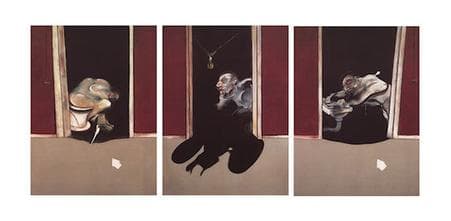
The paintings that followed are the reason the week is not merely biography. In Memory of George Dyer (1971), Triptych August 1972 and Triptych May–June 1973 make up what are usually called the black triptychs — a triptych is a picture in three panels, the form medieval painters used for altarpieces, and Bacon set his figures on flat black grounds, dissolving from one panel to the next. The Estate describes the last of them as 'a work of monumental and grave simplicity in which the circumstances of Dyer's death are re-enacted': the hunched body, the basin, the light of the doorway.[8]

The flat on the rue de Birague

Rather than avoid the city, Bacon moved into it. In 1974 he bought a flat on the rue de Birague — the short street in Le Marais, the old aristocratic quarter on the Right Bank, that runs from the rue Saint-Antoine into the Place des Vosges, Paris's oldest square — and kept it as a second base for the rest of the 1970s, painting there and seeing the French writers and critics who had taken him up. His 1976 portrait of Michel Leiris — the French writer, ethnographer and critic who moved in Surrealist circles and became one of his closest friends in France — belongs to that Paris life.[8]

His talk had by then become as famous as his pictures: the interviews the critic David Sylvester recorded with him between 1962 and 1974 were published as a book in 1975 and expanded twice more, and in the same year the Metropolitan Museum of Art, New York's encyclopedic art museum on Fifth Avenue, mounted a Bacon exhibition. In the mid-1970s he met John Edwards, the East End publican's son who became the great friendship of his last years and his sole heir.[8]

In April 1992, against medical advice, the eighty-two-year-old flew to Madrid to see a friend. Within days he was critically ill and taken to a clinic, where he suffered a heart attack and died on 28 April in the presence of two nuns of the Servants of Mary, a Catholic order whose sisters nurse the sick. He was cremated in Spain with no service, and his ashes were scattered privately in England. In 1998 Edwards gave Bacon's London studio at 7 Reece Mews — its floor a compost of paint tins, slashed photographs and torn books — to the Hugh Lane Gallery, Dublin's municipal gallery of modern art, in the city where he was born; reconstructed there piece by piece, it opened to the public in May 2001.[9]

Life events

  1. 1909

    Born on 28 October in a nursing home at 63 Lower Baggot Street, Dublin, to a racehorse-training former army major and a Sheffield steel heiress.

    — Francis Bacon biography: the 1910s

  2. 1926

    Expelled from the family house in Ireland at sixteen — by his own account after his father caught him in his mother's underwear — and goes to London with no plan.

    — Francis Bacon biography: the 1920s

  3. 1927

    Two months in Berlin, then about three months in France: French lessons near Chantilly, and Poussin's Massacre of the Innocents at the château — 'probably the best human cry ever painted'.

    — Francis Bacon biography: the 1920s

  4. 1927

    Sees an exhibition of drawings by Picasso at the Galerie Paul Rosenberg in Paris in the summer; he claimed ever after that it made him want to be a painter. Begins drawing, living in Montparnasse.

    — Francis Bacon biography: the 1920s; Influence & Inspiration: Pablo Picasso

  5. 1930

    Working in London as an interior decorator and furniture designer at 17 Queensberry Mews West; The Studio publishes his chrome-and-glass rooms in August as 'The 1930 Look in British Decoration'.

    — Francis Bacon biography: the 1930s

  6. 1933–1936

    Crucifixion, 'clearly indebted to the biomorphs of Picasso', is reproduced in Herbert Read's Art Now and bought by Sir Michael Sadler — then a 1934 solo show at the Transition Gallery fails, London's International Surrealist Exhibition rejects him in 1936 as insufficiently surreal, and he destroys most of his early paintings.

    — Francis Bacon biography: the 1930s

  7. 1945

    Three Studies for Figures at the Base of a Crucifixion, painted in 1944, is hung at the Lefevre Gallery in April and makes his name; Eric Hall buys it and gives it to the Tate.

    — Francis Bacon biography: the 1940s; Francis Bacon 1909–1992 — artist record and collection

  8. 1962

    Tate Gallery retrospective in May, some ninety works; news of Peter Lacy's death in Tangier reaches him on the opening day.

    — Francis Bacon biography: the 1960s

  9. 1963

    Meets George Dyer, who becomes his lover and the subject of the decade's portraits.

    — Francis Bacon biography: the 1960s

  10. 1971

    Retrospective at the Grand Palais in Paris — 'an honour exceptional for a living painter'. Two nights before the opening, George Dyer dies of an overdose of drink and barbiturates at the Hôtel des Saints-Pères.

    — Francis Bacon biography: the 1970s

  11. 1973

    Triptych May–June 1973 completes the black triptychs, re-enacting the circumstances of Dyer's death.

    — Francis Bacon biography: the 1970s

  12. 1974

    Buys a flat on the rue de Birague, near the Place des Vosges, and works from Paris through the decade.

    — Francis Bacon biography: the 1970s

  13. 1992

    Travels to Madrid in April against medical advice, falls ill, and dies of a heart attack on 28 April; cremated in Spain, no service, ashes scattered in England.

    — Francis Bacon biography: the 1990s

  14. 2001

    His Reece Mews studio, given to Dublin's Hugh Lane Gallery by his heir John Edwards in 1998, opens there in May, reconstructed contents and all.

    — Francis Bacon biography: the 1990s

Selected works

Cataloged from the holding institutions' records. Reproductions appear only where the rights are verified.

Paintings

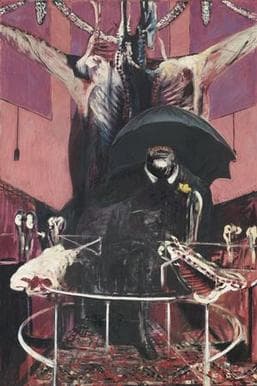
A man in a black coat sits under an open black umbrella whose dome hides everything above his nose, leaving an open mouth with the upper teeth bared. A white collar shows at his throat and a yellow flower sits at his lapel. Behind and above him hangs a carcass split down the spine and opened out, bone-white streaked with pink, its ribs legible and its two halves reaching sideways like outstretched arms. A white tubular rail on thin posts curves around the figure, with a pale joint of meat lying on it at the left and a long ribbed flank at the right. The wall behind is pink-mauve in vertical bands, the floor a red and black patterned carpet

Artwork reproduction

Painting

Painting 1946

1946 · Oil and pastel on linen

A man in a black coat sits under a black umbrella with his mouth open, a flayed carcass spread above him like a pair of wings and a white rail curving around him. Francis Bacon painted it in 1946. The Museum of Modern Art in New York bought it two years later and holds it as 229.1948.

The Museum of Modern Art

Francis Bacon, Painting 1946, 1946. The Museum of Modern Art. Image © the rights holder, shown under fair use.

A seated figure on a near-black ground worked in long vertical brushstrokes that fall from the top edge to the bottom and pass across the figure as well as behind it. The head is pale grey-white and smeared downward, with two dark hollows under the brow and a wide open dark mouth showing pale teeth. Below it a deep violet-indigo band runs down the front of a cape, with purple-mauve shoulders spreading to either side and a broad white and cream robe dragged downward in long strokes. Two pale hands grip the arms of a throne. Thin yellow-ochre lines stand as finials behind the head and sweep in from both sides to form a box in perspective, and dark red spatters fall down the right of the robe

Artwork reproduction

Painting

Study after Velázquez's Portrait of Pope Innocent X

1953 · Oil on canvas

A pope sits on a throne with his mouth open, behind a curtain of vertical brushmarks that falls across the whole canvas. Francis Bacon painted it in 1953 after a portrait of Pope Innocent X by Diego Velázquez that he never saw in the original. The Des Moines Art Center bought it in 1980 and calls it the definitive statement on a theme he returned to for more than twenty years.

Des Moines Art Center

Francis Bacon, Study after Velázquez's Portrait of Pope Innocent X, 1953. Des Moines Art Center. Image © the rights holder, shown under fair use.

Three panels side by side, each a flat orange ground scored with a few ruled darker lines. In the left panel a pale grey hump bows forward over a fold of mauve-pink cloth draped across a stool with thin black legs, a long limb sweeping down to the left. In the centre a smooth grey-white ovoid with one curved crease stands on a thin neck above a dark banded stalk, with a white wrapping at its left opening on a red-lipped mouth and four white drips running down. In the right panel a long neck arches from a pale ribbed body down to a head tipped back with its mouth wide open and teeth showing, above a patch of straw-yellow strokes on the floor

Artwork reproduction

Painting

Three Studies for Figures at the Base of a Crucifixion

1944 · Oil paint on 3 boards

Three orange panels, each holding one pale grey creature with a long neck and a mouth. Francis Bacon painted them in 1944 and afterwards treated the triptych as the beginning of his work, destroying much of what he had made before it. Tate holds all three panels as a single accession, N06171, and shows them at Tate Britain.

Tate

Francis Bacon, Three Studies for Figures at the Base of a Crucifixion, 1944. Tate. Image © the rights holder, shown under fair use.

Three small canvases side by side, each a single head against flat black, the hair a dark crimson mass in all three and the shoulders bare at the bottom edge. In the left panel the head turns three-quarters to the right, the face built from thick white, cream and pink with a band of granular pale green and gold speckle across the brow, one eye a dark red slit and a broad crimson band across the neck. The centre head is almost frontal, a white crescent sweeping from the brow across the nose, one eye a brown-grey socket with a pale iris and the other a black hollow ringed in white, the nose and cheek dissolving into slate blue. In the right panel the features come apart into a knot of white, grey-blue and dark red twisting in on itself above broad cream and crimson shoulders

Artwork reproduction

Painting

Three Studies for Portrait of Henrietta Moraes

1963 · Oil on canvas

Three canvases the size of a sheet of paper, each holding one head on flat black. Francis Bacon painted Henrietta Moraes in 1963 from photographs rather than from sittings, and the three panels move from a face clearly modelled to a face almost undone. William S. Paley bought the triptych the year it was painted, and it was sold at Sotheby's in London in October 2022.

Private collection

Francis Bacon, Three Studies for Portrait of Henrietta Moraes, 1963. Private collection. Image © the rights holder, shown under fair use.

Three tall panels side by side, each with a wall of deep oxblood red filling the upper two thirds, a black rectangular doorway in the middle framed by pale grey-green jambs, and a flat warm grey-brown floor below. In the left panel a naked figure is hunched forward over a white lavatory bowl inside the opening, head down and turned away, with a small white angular shape lying on the floor to the right. In the centre panel a bare bulb hangs on a cord from the top of the opening above a head thrown back with its mouth open and a grey-white cloud of smoky paint around it, the body below a flat black silhouette spilling out onto the floor with one arm reaching down to the left. In the right panel a figure is bent double over a basin at the left of the opening, a dark stem descending below it, with a matching white angular shape on the floor at the right

Artwork reproduction

Painting

Triptych May–June 1973

1973 · Oil on canvas

Three panels, each nearly two metres high, each showing a dark doorway in a deep red wall with a figure in it. Francis Bacon painted them in 1973, eighteen months after George Dyer died in a Paris hotel two days before the opening of his retrospective at the Grand Palais. The Estate of Francis Bacon describes the work as one in which the circumstances of that death are re-enacted.

Private collection

Francis Bacon, Triptych May–June 1973, 1973. Private collection. Image © the rights holder, shown under fair use.

Who Inspired Francis Bacon

People whose work inspired Francis Bacon. They did not necessarily meet or know one another.

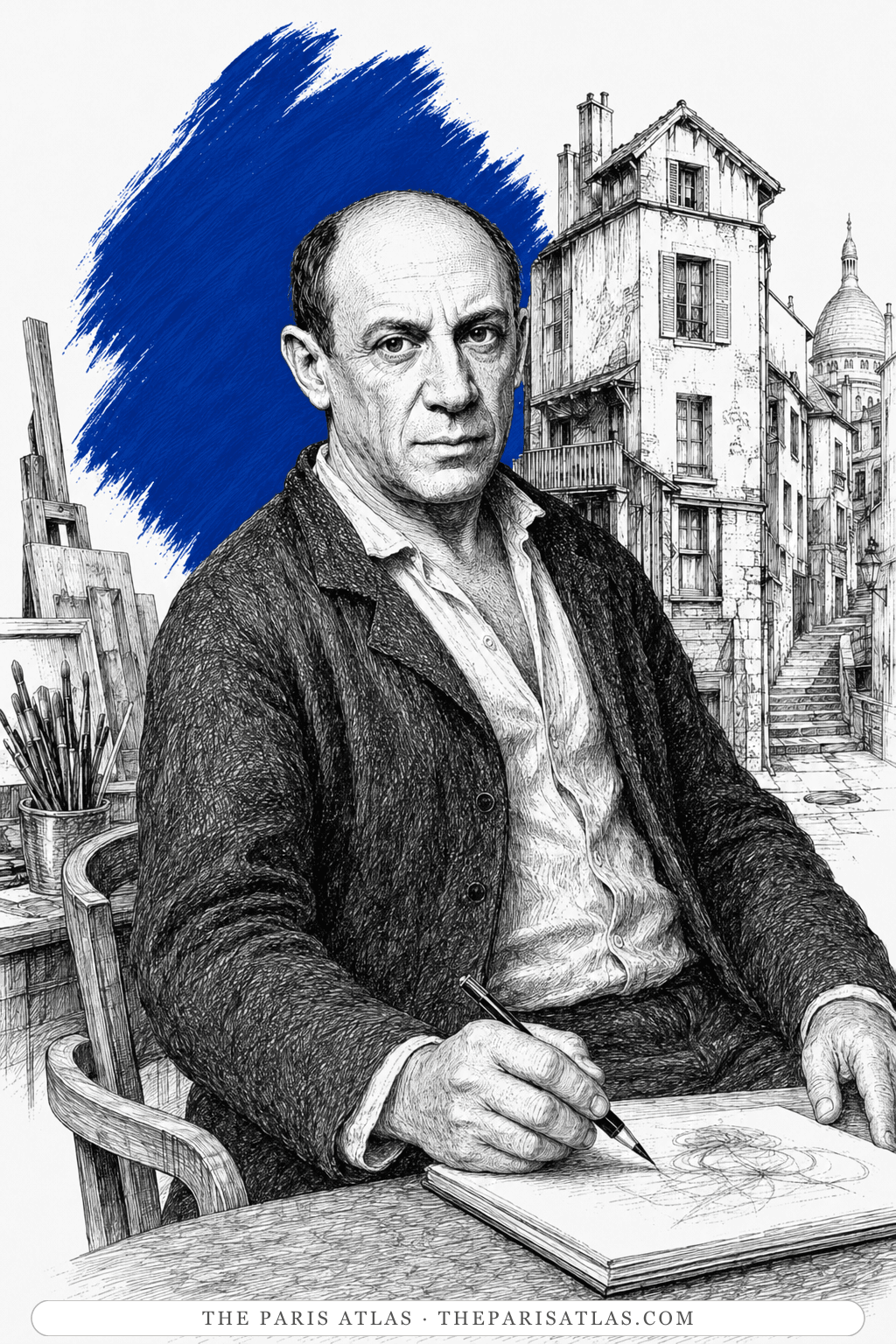
Illustrated portrait of Pablo Picasso

Pablo Picasso

Bacon, then seventeen and with no thought of painting, saw an exhibition of Picasso's drawings at the Galerie Paul Rosenberg in Paris in the summer of 1927 and claimed ever afterwards that it made him want to be a painter. The Estate of Francis Bacon states the claim and its caution — he 'seems to have considered becoming an artist only after' that show — and traces the boneless, distended figures of Picasso's Dinard and Cannes bathers into Bacon's own biomorphs, down to Three Studies for Figures at the Base of a Crucifixion (1944). Bacon's own verdict: 'Let's say perhaps that Picasso helped me to see…'

— Influence & Inspiration: Pablo Picasso; Francis Bacon biography: the 1920s

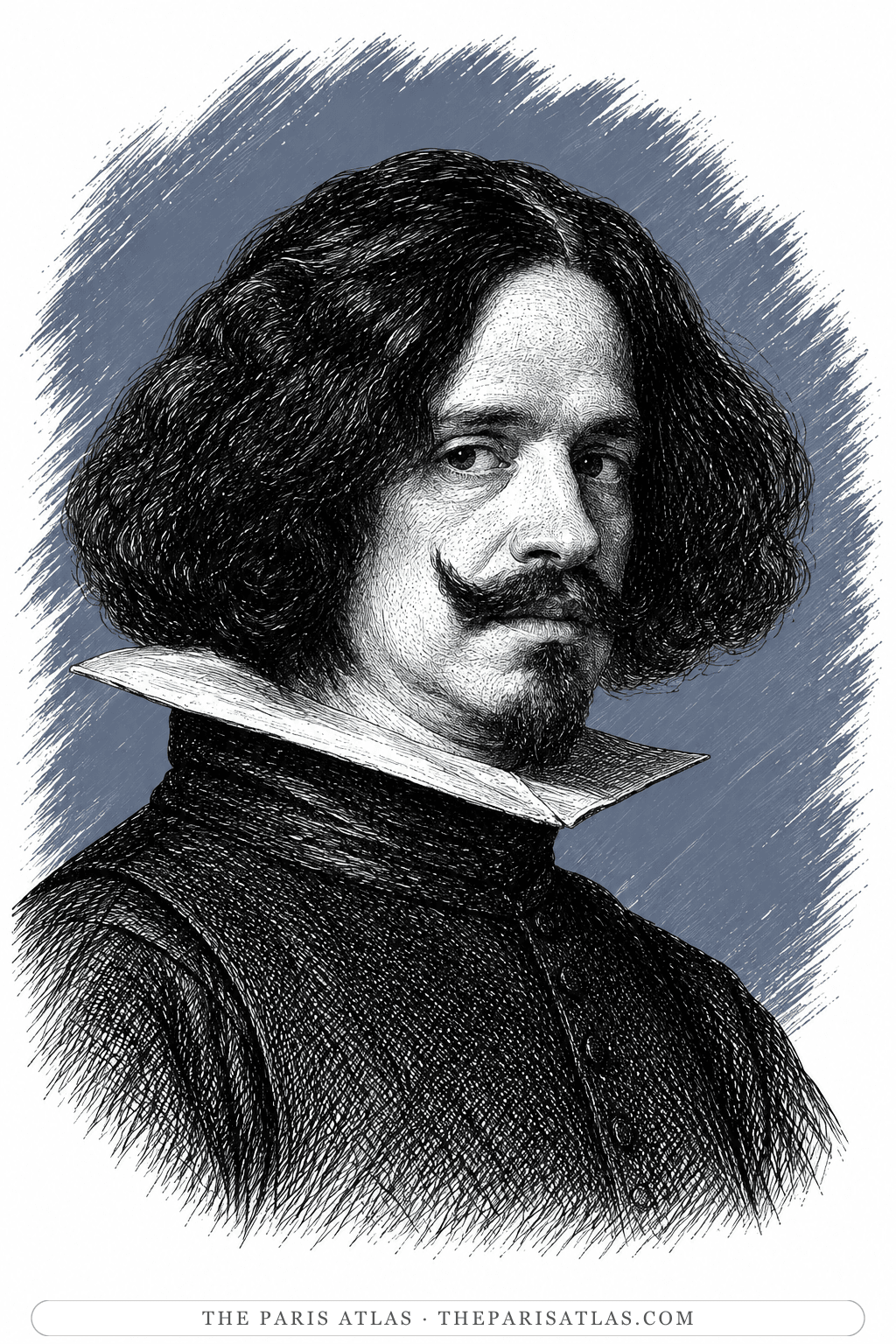
Illustrated portrait of Diego Velázquez

Diego Velázquez

Francis Bacon painted a group of pictures of a pope in 1953 taken from Velázquez's Portrait of Pope Innocent X. One of them is called Study after Velázquez's Portrait of Pope Innocent X, measures 153 by 118 centimeters and hangs at the Des Moines Art Center in Iowa.

— Francis Bacon, Study after Velázquez's Portrait of Pope Innocent X, 1953 — catalogue record; Velázquez, Portrait of Pope Innocent X Pamphilj

Questions about Francis Bacon

Is Francis Bacon the painter the same as Francis Bacon the philosopher?

No. Francis Bacon the philosopher, lawyer and statesman lived from 1561 to 1626 and is remembered for laying out the scientific method and for his Essays. Francis Bacon the painter lived from 1909 to 1992 and painted popes, lovers and triptychs — pictures in three panels. The families are connected: the Estate of Francis Bacon describes the painter's family as collateral descendants of the Elizabethan philosopher, meaning they come down from a side branch of his family rather than directly from him, which is why they share the name.

What made Francis Bacon become a painter?

By his own repeated account, an exhibition of Picasso's drawings at the Galerie Paul Rosenberg in Paris in the summer of 1927, when he was seventeen. He had gone abroad after being thrown out of his family home in Ireland, spent two months in Berlin and about three in France, and was living partly near Chantilly and partly in Montparnasse. His Estate phrases it cautiously — he 'seems to have considered becoming an artist only after' that show — and notes that he still went back to London and spent several years designing furniture first.

What was Francis Bacon's connection to Paris?

Three connections, spread across his life. Paris turned him into a painter in 1927. Paris gave him the retrospective that confirmed him, at the Grand Palais in 1971 — an honour his Estate calls exceptional for a living painter. And from 1974 he kept a flat of his own on the rue de Birague, the street that opens into the Place des Vosges, Paris's oldest square, in the Marais quarter — working there and among French writers for the rest of the decade.

How did George Dyer die?

Of an overdose of alcohol and barbiturates, in the bathroom of the room he shared with Bacon at the Hôtel des Saints-Pères in Paris, two nights before Bacon's Grand Palais retrospective opened in October 1971. Dyer, whom Bacon had met at the end of 1963, was an East Londoner with a petty criminal past and, in the Estate's description, a depressive and insecure nature behind a tough look. Bacon painted the death for years afterwards, most directly in Triptych May–June 1973.

What is Francis Bacon's most famous painting?

Three Studies for Figures at the Base of a Crucifixion (1944) has the strongest claim: three writhing, stone-coloured creatures on an orange ground, which the Estate links to the Furies, the avenging spirits who pursue the matricide Orestes through the Greek tragedies of Aeschylus. It was shown at the Lefevre Gallery in London in April 1945, was given to the Tate by Bacon's friend Eric Hall, and hangs at Tate Britain. Bacon treated it as the beginning of his work and destroyed much of what came before. The other candidates are the screaming popes — his repeated reworkings of Velázquez's portrait of Pope Innocent X — and the black triptychs of 1971–73, the three-panel pictures he made after George Dyer's death.

Where can you see Francis Bacon's work today?

Tate holds around fifty works, including the 1944 triptych on display at Tate Britain. The Hugh Lane Gallery in Dublin holds his London studio at 7 Reece Mews, moved from South Kensington and rebuilt object by object after his heir John Edwards gave it to the city in 1998; it opened to visitors in May 2001. Major paintings are also in the Museum of Modern Art in New York, which acquired Painting (1946) in 1948.

How did Francis Bacon die?

Of a heart attack in Madrid on 28 April 1992, aged eighty-two. He had flown to Spain that month against his doctors' advice to see a friend, fell critically ill within days, and died in a clinic attended by two nuns of the Servants of Mary. He was cremated in Spain without a service, as he had asked, and his ashes were scattered privately in England.

Connections and Sources

Francis Bacon’s connections to people, places, and works, with the sources behind each one.

Influenced by · 1927

Pablo Picasso

Bacon, then seventeen and with no thought of painting, saw an exhibition of Picasso's drawings at the Galerie Paul Rosenberg in Paris in the summer of 1927 and claimed ever afterwards that it made him want to be a painter. The Estate of Francis Bacon states the claim and its caution — he 'seems to have considered becoming an artist only after' that show — and traces the boneless, distended figures of Picasso's Dinard and Cannes bathers into Bacon's own biomorphs, down to Three Studies for Figures at the Base of a Crucifixion (1944). Bacon's own verdict: 'Let's say perhaps that Picasso helped me to see…'

— Influence & Inspiration: Pablo Picasso; Francis Bacon biography: the 1920s

Influenced by · 1953

Diego Velázquez

Francis Bacon painted a group of pictures of a pope in 1953 taken from Velázquez's Portrait of Pope Innocent X. One of them is called Study after Velázquez's Portrait of Pope Innocent X, measures 153 by 118 centimeters and hangs at the Des Moines Art Center in Iowa.

— Francis Bacon, Study after Velázquez's Portrait of Pope Innocent X, 1953 — catalogue record; Velázquez, Portrait of Pope Innocent X Pamphilj

References

References

The sources below include biographies, scholarly essays, interviews, and primary materials that informed this page. They reflect both the historical record and ongoing critical conversations about Francis Bacon and their work.

  1. 1↑Francis Bacon biography: the 1910s

    Website
    The Estate of Francis Bacon
    Used for

    Birth, family, asthma, schooling.

    View source
  2. 2abcFrancis Bacon biography: the 1920s

    Website
    The Estate of Francis Bacon
    Used for

    London, Berlin, Chantilly, and the 1927 Picasso exhibition.

    View source
  3. 3↑Influence & Inspiration: Pablo Picasso

    Website
    The Estate of Francis Bacon
    Used for

    The Estate on what Bacon took from Picasso, in Bacon's own words.

    View source
  4. 4abFrancis Bacon biography: the 1930s

    Website
    The Estate of Francis Bacon
    Used for

    The design career at Queensberry Mews and the first paintings.

    View source
  5. 5↑Francis Bacon biography: the 1940s

    Website
    The Estate of Francis Bacon
    Used for

    Three Studies for Figures at the Base of a Crucifixion and its reception.

    View source
  1. 6↑Francis Bacon 1909–1992 — artist record and collection

    Website
    Tate
    Used for

    Tate's holdings, including the 1944 triptych on display at Tate Britain.

    View source
  2. 7↑Francis Bacon biography: the 1960s

    Website
    The Estate of Francis Bacon
    Used for

    The 1962 Tate retrospective and the meeting with George Dyer.

    View source
  3. 8abcdFrancis Bacon biography: the 1970s

    Website
    The Estate of Francis Bacon
    Used for

    The Grand Palais retrospective, Dyer's death, and the rue de Birague flat.

    View source
  4. 9↑Francis Bacon biography: the 1990s

    Website
    The Estate of Francis Bacon
    Used for

    Madrid, his death, and the gift of the studio to Dublin.

    View source
i
Why these sources are here

These references anchor the page in the documented record and in the scholarly conversations around Francis Bacon. Every claim on this page traces back to one or more of the works listed here.

Explore more resources