Spanish painter who spent thirty-seven years in the household of Philip IV, painting the king, his family and the dwarfs and jesters of the palace, and who ended his career as the official responsible for housing and moving the court.
In images
Details
Lived
1599–1660
Born
baptized 6 June 1599
Birthplace
Seville, Spain
Birth name
Diego Rodríguez de Silva y Velázquez
Died
6 August 1660
Place of death
Madrid, Spain
Nationality
Spanish
Profession
Painter and palace official
Major works
Las Meninas, The Surrender of Breda, Juan de Pareja, Portrait of Pope Innocent X, The Toilet of Venus, The Triumph of Bacchus
Married
Juana Pacheco · 1618–1660
Children
Francisca de Silva Velázquez y Pacheco, Ignacia de Silva Velázquez y Pacheco, Antonio
Roles
Painter
Also known as
Diego Rodríguez de Silva y Velázquez · Diego de Silva Velázquez · Diego Velázquez de Silva
About Diego Velázquez
Spanish painter to Philip IV, and the maker of Las Meninas
Diego Velázquez (1599–1660) was born in Seville, trained there from the age of eleven, and moved to Madrid at twenty-four to work for King Philip IV.[1][2] The royal order taking him into the king's service is dated 6 October 1623.[1] He stayed for the rest of his life, and Philip IV declared that nobody else would paint him.[1]
Most of what he painted was people: the king, the queen, the royal children, the ministers, and the dwarfs and jesters kept at the palace. Two journeys to Italy, in 1629 and again in 1649, loosened his handling until the paint stopped describing things up close and began describing them from across a room.[1] Las Meninas, finished in 1656, is the picture that carried his name into every century after his own.[3]
Painting was never his job title. He climbed the palace hierarchy instead, from usher of the chamber to gentleman of the wardrobe to gentleman-in-waiting, and in 1652 to aposentador mayor, the officer who housed and moved the court.[1] That last post sent him to the French border in 1660 to arrange the wedding of the king's daughter to Louis XIV.[1][4] He came home worn out at the end of June, fell ill on 31 July, and died on 6 August.[1]
Seville, 1599
Diego Velázquez was baptized at the parish church of San Pedro in Seville on Sunday 6 June 1599, and the entry is still in the church register.[1] He was the first child of Juan Rodríguez de Silva and Jerónima Velázquez.[1] Following the Andalusian custom of the time he was known by his mother's family name rather than his father's, and he signed himself Diego de Silva Velázquez.[1][2]
His father's family had come to Seville from Portugal a generation or two earlier and claimed noble Portuguese descent.[1] Sixty years later that claim was taken apart in detail. When Velázquez applied in 1658 to join the Order of Santiago, the Council of Military Orders sent commissioners to Galicia and to Seville to look for proof of it, and did not find enough.[1]
Seville in 1599 was the richest city in Spain and the port through which the trade of the American colonies passed.[1] It had printers, poets, a steady market in religious pictures and a working school of painters. A Spanish painter of that century had two possible patrons, the Church and the crown.[1] Only the crown was in Madrid.
Apprenticed at eleven to Francisco Pacheco
Velázquez's parents intended him for a learned profession and gave him a grounding in languages first. Early accounts, the Prado's own biography among them, put him briefly in the studio of Francisco de Herrera the Elder, a forceful Seville painter with a temper who kept few apprentices for long.[2][1] Nothing survives to show how long the boy stayed with him.
At eleven he entered the workshop of Francisco Pacheco and stayed six years.[2] Pacheco was a mediocre painter and a serious scholar. He wrote poetry and drew the notable men of Seville for a book of portraits.[1] He also wrote Arte de la pintura, a treatise published in Seville in 1649 that is now the main contemporary source for Velázquez's early life.[5] Pacheco described his own workshop as “a gilded prison of art.”[2] He drilled his pupils in drawing and in working from what was actually in front of them.
At the end of the six years Velázquez sat the Seville guild examination and was approved, in the language of the certificate, as a master painter of religious images and in oils.[2] He could now take commissions in his own name and keep apprentices. Alonso Cano trained in the same workshop and Francisco de Zurbarán was among the young painters around it.[1] Both of them gave evidence for Velázquez forty years later, when the Council of Military Orders was investigating whether he had ever worked for money.[1]
Kitchen pictures, and marriage into his master's house
The pictures Velázquez painted in Seville in his late teens are kitchen and tavern scenes, known in Spanish as bodegones. An Old Woman Cooking Eggs is dated 1618 and hangs in the Scottish National Gallery in Edinburgh.[6] An old woman holds a spoon over eggs setting in a bowl. A boy stands beside her with a melon and a flask of wine. The two never look at each other. Around them Velázquez painted a mortar, an earthenware jug, an onion and a chili, each of them lit hard from one side.[6]
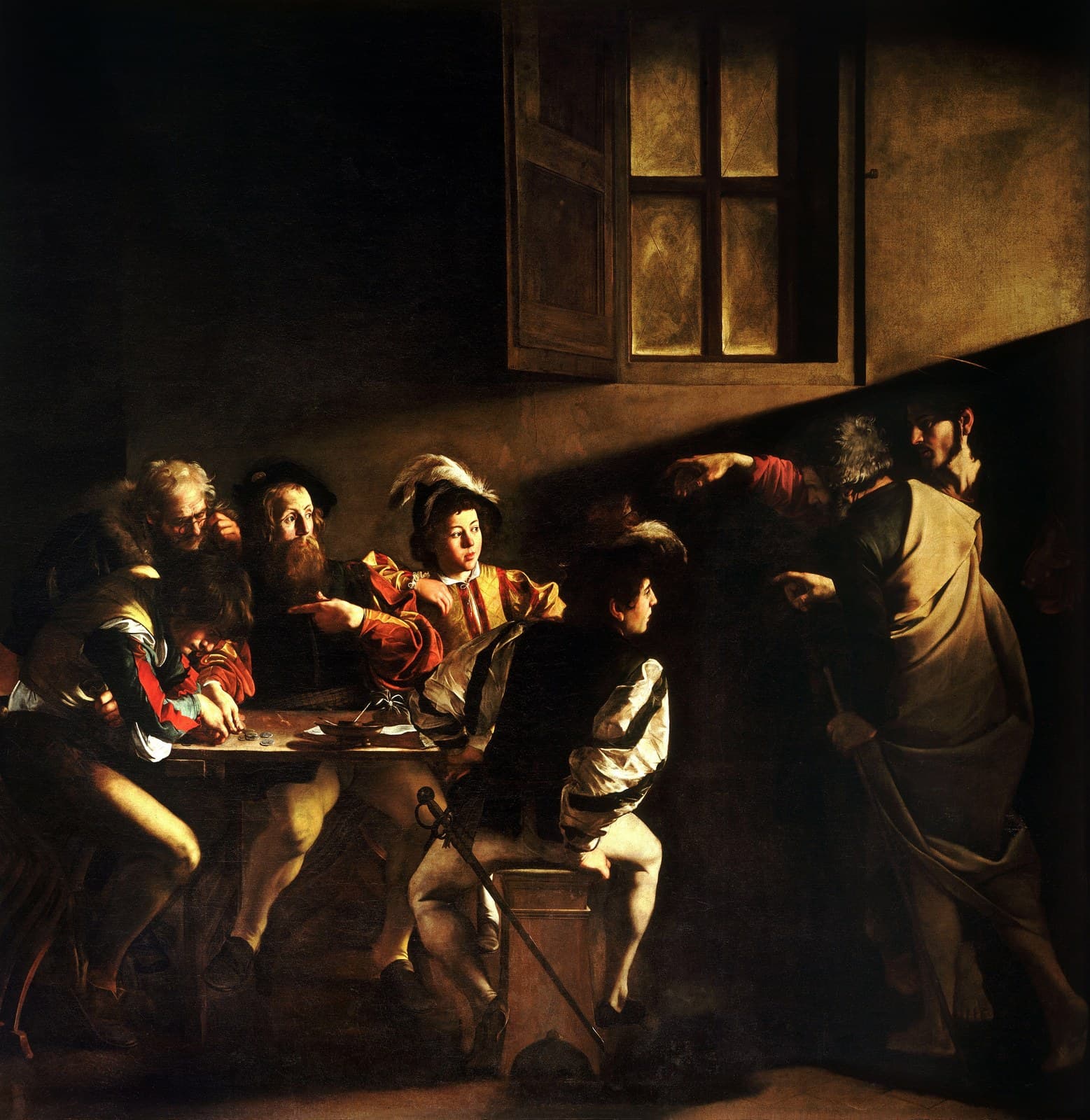
The Waterseller of Seville, painted about 1620 and now at Apsley House in London, is the best known of the group.[7] An old man in a torn smock hands a glass to a boy across the top of an enormous unglazed water jar. This is the naturalism that ran through Baroque art all over seventeenth-century Europe, and Caravaggio had painted something close to it in Rome twenty years earlier. The Prado's biography places Velázquez in a line that came from Caravaggio directly or at second hand.[2] He had never been to Italy when he painted these pictures, and no document records him seeing a Caravaggio, so the link is a reading of the paint rather than a fact anybody wrote down.
He painted religious subjects at the same time. The Adoration of the Magi carries the date 1619 on the front of the canvas. It was made for the Jesuit novitiate of San Luis in Seville, passed to the Escuela de Nobles Artes there after the Jesuits were expelled from Spain in 1767, and reached the Prado in 1819. It stands just over two meters high.[8]
On 23 April 1618 Velázquez married Pacheco's daughter, Juana Pacheco.[1] The poet Francisco de Rioja was one of the witnesses and the record survives in the church of San Miguel in Seville.[1] Pacheco wrote afterwards that he had given the young man his daughter after five years of teaching him, on the strength of his character and his talent.[5][1] Two daughters followed: Francisca, baptized on 18 May 1619, and Ignacia, baptized on 29 January 1621, who died as a child.[1]
Madrid, and the king who would let nobody else paint him
In April 1622 Velázquez went to Madrid for the first time, carrying letters of introduction from Pacheco.[1] The most useful of them was addressed to Juan de Fonseca y Figueroa, a chaplain to the king and a friend of Pacheco's.[1] It was not enough. Velázquez never got in front of Philip IV on that visit. He looked at the royal palaces in Madrid, at the Pardo and Aranjuez and at the monastery of the Escorial, painted a portrait of the poet Luis de Góngora at Pacheco's request, and went home to Seville.[1]
He was called back the following year by the Count-Duke of Olivares, the king's chief minister and, like Velázquez, a man of Seville. Fifty ducats came with the summons to cover the journey.[1] Philip IV, who was eighteen and two years into his reign, sat for him on 30 August 1623.[1]
The royal order taking Velázquez into the king's service is dated 6 October 1623. It set his salary at twenty ducats a month and added lodging, medical attendance, and separate payment for every picture he painted.[1] The king had his existing portraits taken down and said that from then on only Velázquez would paint him.[1] In 1624 he sent three hundred ducats so that the painter could bring his family up from Seville.[1]
Madrid gave Velázquez something Seville could not: the royal collection. The Titians bought by Charles V and Philip II hung in the palaces where he could study them any day he liked, and he did, for the next thirty-seven years.[2][9]
Rubens in Madrid, 1628
Peter Paul Rubens reached Madrid at the end of August 1628 as an ambassador, sent to negotiate peace between Spain and England. He was fifty-one and the most famous painter in Europe, and he stayed about nine months.[1] Philip IV told Velázquez, who was twenty-nine, to show him the royal collections.
Pacheco left the only contemporary account of what passed between them. He wrote that Rubens made friends with few painters in Madrid, praised Velázquez's modesty and his talent, and rode out with him to see the Escorial.[5][1] Pacheco adds in a parenthesis that Velázquez and Rubens had already been writing to each other.[5] No letter between them has ever turned up. Aureliano de Beruete, who went through the Spanish archives in the 1890s, reported the correspondence lost.[1]
What the nine months did to Velázquez's painting is still argued about. Enriqueta Harris, writing the Prado's biography, names Titian and Rubens as the two painters who shaped him most, and reads Rubens behind The Triumph of Bacchus, the first mythological picture Velázquez attempted, painted in 1628 and 1629.[2] Beruete took the opposite view in 1906: Velázquez looked hard at Rubens, saw how far his own aims lay from Rubens's, and changed nothing.[1] Velázquez left almost no writing, so neither side can quote him.
The Triumph of Bacchus is a naked young man crowned with vine leaves, sitting on a wine barrel among beggars with wine-flushed faces.[1] In July 1629 the king signed a decree allotting Velázquez a hundred ducats for it.[1] It hangs in the Prado and is known in Spain as Los Borrachos, the drunks.
Italy, 1629 to 1631
Philip IV let Velázquez go to Italy in 1629 without losing his salary and gave him four hundred ducats. Olivares added two hundred more.[1] He sailed from Barcelona in August with Ambrogio Spinola, the Genoese general who had taken the Dutch town of Breda four years earlier and was on his way to command the Spanish army at Milan.[1] Velázquez painted the surrender of Breda six years later, with Spinola at the center of it.[10]
In Venice he copied Tintoretto and sent the copies home to the king. In Rome he was given rooms at the Villa Medici so that he could draw the antique statues in the gardens, and he moved down into the city when he caught a fever there.[1][2] He painted two small views of those gardens, both now in the Prado.[1] In 1630 he went on to Naples, where he met his countryman Jusepe de Ribera and painted the king's sister, the Infanta María.[1]
He brought two large canvases back. The Forge of Vulcan shows the god Apollo, a young man with light around his head, standing in the doorway of a working blacksmith's shop. He has come to tell the smith god Vulcan that Vulcan's wife has been unfaithful, and the workmen stop and stare. Joseph's Tunic, now at the Escorial, paints the Old Testament scene in which Jacob is handed the bloodied coat of his son Joseph. Both were painted from the same live models, and neither of them looks Italian.[1][2] He was back in Madrid early in 1631.[1]
The Buen Retiro, the lances, and the palace dwarfs
Two royal building projects took up much of the next decade. The Buen Retiro was a new pleasure palace on the eastern edge of Madrid, built for the king by Olivares. The Torre de la Parada was a hunting lodge in the woods outside the city.[2] For the Hall of Realms at the Retiro, finished in 1635, Velázquez painted five equestrian portraits of the royal family and one battle picture.[2]
The battle picture is The Surrender of Breda, 307 centimeters high and 371 across, and Spaniards call it Las Lanzas, the lances.[10] It shows 5 June 1625, the day the Dutch commander Justinus van Nassau handed the keys of the besieged town of Breda to Ambrogio Spinola.[10] Spinola has a hand on the beaten man's shoulder. Behind the Spanish ranks a wall of upright pikes fills the sky, and past both armies the flooded Dutch countryside runs off into smoke.
The Surrender of Breda (Las Lanzas), c. 1635, oil on canvas, 307.3 by 371.5 cm (Museo Nacional del Prado, Madrid). Justinus van Nassau hands the keys of Breda to Ambrogio Spinola on 5 June 1625; painted for the Hall of Realms of the Buen Retiro palace. (Diego Velázquez (Museo Nacional del Prado), via Wikimedia Commons · Public domain)
For the hunting lodge he painted the king, the king's brother and the king's son in hunting dress with their dogs, and two philosophers dressed as beggars, Aesop and Menippus.[2] Over about twenty years he also painted the dwarfs and jesters kept at the palace. They include El Primo with a folio and inkwell too big for him, Sebastián de Morra, the boy known as the child of Vallecas, and the jester Pablo de Valladolid.[2]
Pablo de Valladolid stands alone in an empty brown space. There is no floor line, no horizon, no furniture and no room. The only thing that says where the ground is at all is the shadow at his feet.[11] The Prado began restoring the picture in 2026 and read the layers underneath with scanning X-ray fluorescence and multispectral infrared reflectography before touching the surface.[11]
How he painted
Almost no drawings by Velázquez survive. Beruete went through every sheet then attributed to him and accepted five or six, none of them important.[1] Pacheco says Velázquez drew constantly as a student, so the likely explanation is that he stopped. He set the composition straight onto the canvas and corrected it with the brush instead. Those corrections are visible in most of his paintings as ridges and half-buried outlines under the finished surface.[1]
The technical study of Las Meninas found a beige ground of lead white, ochre and calcite under the paint.[12] The list of pigments above it is short. It runs to lead white, vermilion and a red lake, yellow and brown ochre and umber, azurite, natural ultramarine and smalt for the blues, and charcoal and bone black.[12] Some of it has shifted with age. The skirt of the kneeling maid of honor reads dark green now, and it was once the brighter blue-green of azurite.[12]
The working method was as short as the palette. He used a few long, thin brushes and a strictly limited number of colors. He put the color down at the first touch, rubbed the shadows in thin and loaded the paint only in the highlights.[1]
Stand close to one of the late canvases and the strokes describe nothing at all. Step back a few paces and they resolve into lace, hair, a wet mouth, the sheen along a sleeve. Painters traveled to Madrid all through the nineteenth century to study exactly that.
What the court actually paid him
In the palace paperwork Velázquez appears alongside the barbers, the dwarfs and the buffoons. He drew a daily allowance of twelve reals, the same as a court barber, and ninety ducats a year for clothes. He was paid in kind as well, in lengths of cloth whenever the court went into mourning.[1]
The money was late for most of his career, and the documents that record it are specific.
1634: the palace owed him 11,843 reals in back wages and a further 3,960 reals for clothing, before the price of any picture was counted.[1]
1636: he petitioned for several years of unpaid salary together with the prices of finished paintings.[1]
1640: the king settled the argument by granting him 500 ducats a year for work done and work still to come. Part of the arrears was paid the following year, in monthly installments.[1]
1647: he was appointed inspector of the palace building works, and his own memorial of 17 May says that salary was already years behind.[1]
1648: after every royal order to pay him had failed, the palace ordered a general settlement of its debts. Whether Velázquez was actually paid is not recorded.[1]
He kept climbing anyway. He was sworn usher of the chamber in 1627, granted a saleable court office in 1633, and made an officer of the wardrobe in 1634. He sold the usher's post to his son-in-law, the painter Juan Bautista Martínez del Mazo, who had married his daughter Francisca.[1] In 1643 he became a gentleman-in-waiting and was put under the Marquis of Malpica on the building works at the Alcázar. By 1645 Velázquez and Malpica were at odds over work he had done and had not been paid for, and the king decided in the nobleman's favor.[1]
Italy again, 1649 to 1651: Juan de Pareja and the Pope
By the late 1640s Philip IV wanted an academy of art in Madrid and sculpture for the new rooms at the Alcázar. Velázquez asked to go to Italy and buy it for him. He had no money for the journey, so on 18 May 1648 the king ordered the palace treasury to pay him what it owed. The treasury took until 6 October to do it.[1] He left Madrid in November and sailed from Málaga on 2 January 1649.[1]
He landed at Genoa on 11 February, went by way of Milan and Padua, and reached Venice on 21 April.[1] There he bought Veronese's Venus and Adonis and two Tintorettos, all three of which hang in the Prado today.[1] In Naples he chose marbles and antique bronzes and ordered casts made.[1] Then he went back to Rome for the jubilee year of 1650, which had pulled most of the artists in Italy into the city. Nicolas Poussin, Pietro da Cortona, Salvator Rosa, Alessandro Algardi and Gian Lorenzo Bernini were all there.[1]
Velázquez had not touched a brush since leaving Madrid. To get his hand back before painting the Pope he painted the man traveling with him.[1] Juan de Pareja was born about 1606 in Antequera, was of mixed descent, and was enslaved in Velázquez's household. He could read and write, and he had witnessed legal documents for Velázquez since 1634.[13] The portrait went on public show at the Pantheon in Rome in March 1650 and got Velázquez elected to the Academy of Saint Luke.[2] Antonio Palomino, writing in 1724, reports that the painters who saw it said everything else there looked like painting and this alone looked like truth.[14]
Juan de Pareja, 1650, oil on canvas, 81.3 by 69.9 cm (The Metropolitan Museum of Art, New York, 1971.86). Velázquez painted his enslaved assistant in Rome to get his hand back in before painting Pope Innocent X. He signed the document freeing Pareja on 23 November 1650. (Diego Velázquez (The Metropolitan Museum of Art, Open Access CC0), via Wikimedia Commons · CC0)
On 23 November 1650, six months after the portrait was shown, Velázquez signed the document freeing Juan de Pareja.[13] Pareja stayed in the household afterwards and painted for himself, signing and dating his own pictures, and he died in Madrid in 1670.[13] The Metropolitan Museum of Art in New York bought the portrait in 1971.[15]
The portrait of Pope Innocent X followed in the summer of 1650 and has never left Rome.[16] Giovanni Battista Pamphilj had been elected pope six years earlier, and Velázquez painted him without flattering him. The canvas measures 141 by 119 centimeters and hangs in the Galleria Doria Pamphilj, in a room built for it in the middle of the nineteenth century by Prince Filippo Andrea V Doria Pamphilj.[16] The English painter Joshua Reynolds later called it the finest picture in Rome.[16]
The Toilet of Venus, known since the nineteenth century as the Rokeby Venus, was painted between 1647 and 1651.[17] It is the only female nude by Velázquez that survives. A woman lies on her side on gray silk with her back to the viewer while a winged boy holds up a mirror in which her face appears, out of focus. It was in a Madrid collection by June 1651, stayed in the Alba family for more than a century, and reached England in 1813.[17]
The Toilet of Venus, known as the Rokeby Venus, 1647–51, oil on canvas, 122.5 by 177 cm (The National Gallery, London, NG2057). Velázquez's only surviving female nude; the National Art-Collections Fund bought it in 1905 and gave it to the gallery in 1906. (Diego Velázquez (The National Gallery, London), via Wikimedia Commons · Public domain)
Two other things happened in Rome. Velázquez fathered a son, Antonio, by a widow named Marta.[18] When he left the city his agent Juan de Córdoba took over the child's care, and on 13 November 1650 removed the boy from his mother on the grounds that she was not looking after him.[18] Velázquez never saw the son again.
The second thing is that he would not come home. Philip IV wrote to his ambassador in Rome on 17 February 1650 that, knowing the painter's phlegmatic nature, he should order him not to prolong his stay.[1] On 22 June the king wrote again, telling the ambassador to press Velázquez not to put off his departure for a minute.[1] Velázquez sailed from Genoa and landed at Barcelona in June 1651, a year after he had been told to leave.[1]
He had meant to travel home across France and see Paris, and had gone as far as having his passport stamped for the route.[1] The king's impatience ended the plan. Velázquez never saw the city.
Palace chamberlain, and Las Meninas
In 1652 Philip IV made Velázquez aposentador mayor of the palace, the officer responsible for housing the court.[1] It paid well and left very little time for painting. He had to run the interiors of the royal residences, organize the court's moves from one palace to another, find lodgings for the king's people, furnish the rooms and stage the entertainments. The post came with an apartment in the Casa del Tesoro next to the Alcázar, and he gave up the rented house on the Calle de la Concepción Jerónima where he had been living.[1]
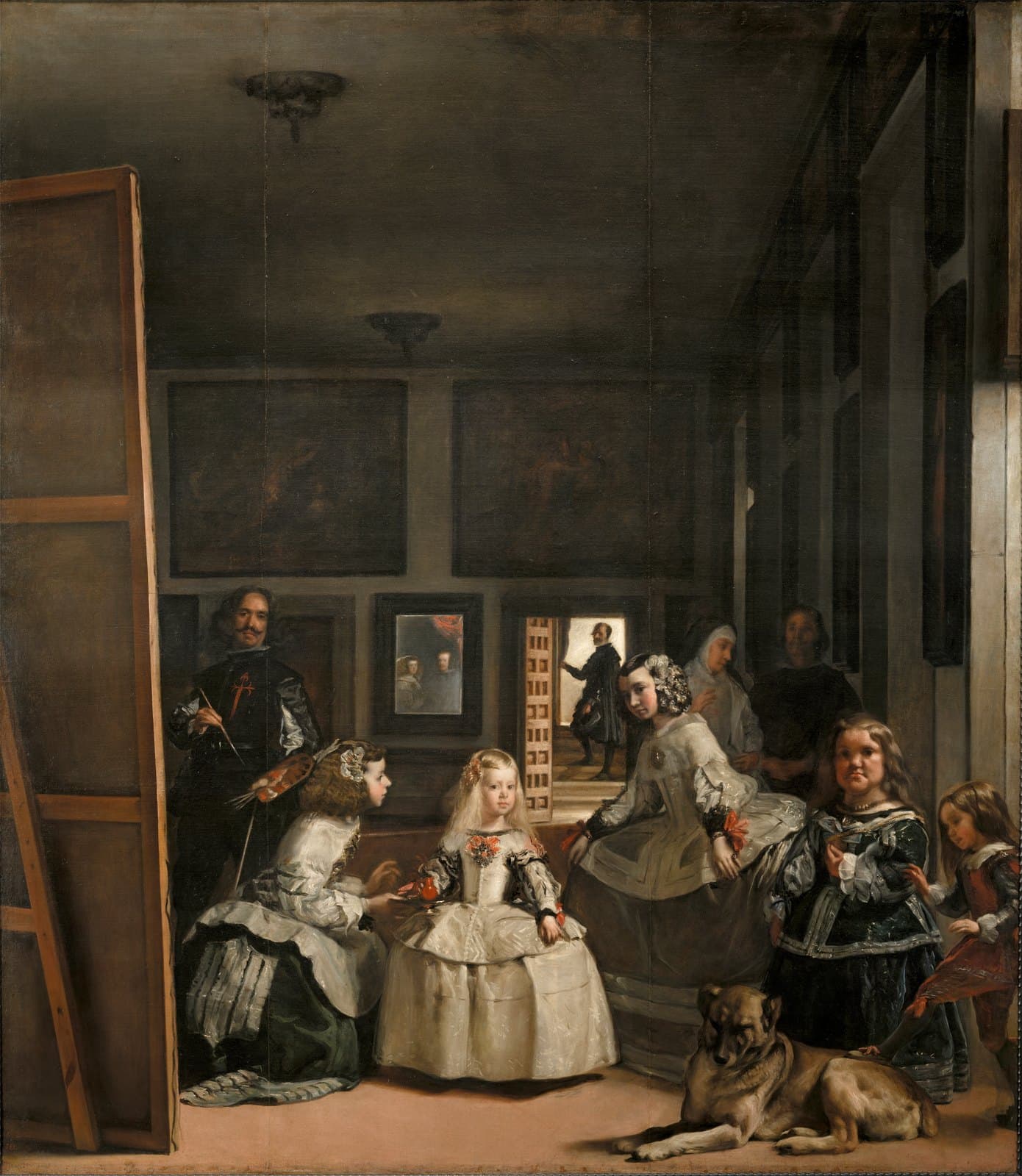
Las Meninas was painted in 1656 and measures 320 centimeters by 279.[3] The setting is a room in the Alcázar. The Infanta Margarita, the five-year-old daughter of Philip IV, stands in the middle in a wide pale dress. Two ladies-in-waiting flank her: María Agustina Sarmiento, kneeling to offer her a small red jug on a tray, and Isabel de Velasco. To the right are the dwarf Maribárbola, the boy Nicolasito Pertusato with his foot on a large dog, and behind them the chaperone Marcela de Ulloa and a man nobody has identified. At the far end, in a lit doorway, stands José Nieto, who ran the queen's tapestry works.[3]
Velázquez himself is at the left, behind a very large canvas turned away from the viewer, brush and palette in hand. On the back wall, between two dim mythological paintings after Rubens and Jacob Jordaens, hangs a small mirror with two faces in it: Philip IV and Queen Mariana of Austria.[3]
Las Meninas, 1656, oil on canvas, 320.3 by 279.1 cm (Museo Nacional del Prado, Madrid, P1174). The Infanta Margarita with her attendants, the painter at his easel, and Philip IV and Queen Mariana of Austria reflected in the mirror on the back wall. (Diego Velázquez (Museo Nacional del Prado), via Wikimedia Commons · Public domain)
The painting has changed its name repeatedly. The palace inventory of 1666 called it a portrait of the empress with her ladies and a dwarf. It hung in the king's private office and came through the Alcázar fire of 1734 undamaged, after which it was known as The Family of Philip IV and then simply as The Family. Only in 1843 did Pedro de Madrazo, working on the Prado catalog, print the title Las Meninas.[3] The Neapolitan painter Luca Giordano is said to have called it the theology of painting.[3]
The Order of Santiago, and the cross on his chest
Philip IV signed the order admitting Velázquez to the Order of Santiago on 12 June 1658.[1] He sent the case to the Council of Military Orders, which had to satisfy itself that the new knight was noble on all four sides of his family. Velázquez wrote out his own genealogy on 15 July.[1] Commissioners went to Seville, where he and his mother's family came from, and to Monterrey and Tuy in Galicia, near the Portuguese border his father's family had crossed.[1] Gaspar de Fuensalida, the king's recorder, put up the three hundred silver ducats the inquiry cost, which suggests Velázquez did not have it.[1]
More than a hundred witnesses were questioned across Galicia, Madrid and Seville. The painters Alonso Cano, Francisco de Zurbarán, Juan Carreño de Miranda and Angelo Nardi all testified in Madrid.[1] What the council wanted to know was whether Velázquez had worked as a tradesman, because a nobleman could not. Cano answered that he had never heard that Velázquez practiced the craft of painting or sold a picture, and that he painted only for his own pleasure and to obey the king.[1] The palace archives at that moment held the receipts for pictures Velázquez had been paid for.
On 26 February 1659 the council accepted his age, his religion and his lineage and rejected his nobility on both his father's and his mother's side.[1] Velázquez produced a document showing that his parents in Seville had been exempt from a meat tax that nobles never paid. On 2 April the council ruled against him anyway.[1] The king then asked Pope Alexander VII for a dispensation, and the papal brief was issued at Albano on 7 October 1659.[1] On 2 November the king signed a decree making Velázquez a nobleman by his own absolute power, and on 27 November the council ordered the habit delivered.[1]
In Las Meninas Velázquez wears the red cross of Santiago on his doublet, on a canvas he had finished three years before the order reached him. The story told ever since is that Philip IV took up a brush and painted the cross himself.[1] Antonio Palomino already knew in 1724 that it was added after Velázquez died, on the king's instruction.[14] Who held the brush has never been established. Velázquez had nine months left to live after the habit was granted, and his son-in-law, the painter Juan Bautista Martínez del Mazo, was also at hand.
Self-portrait, about 1650, oil on canvas, 45 by 38 cm (Museo de Bellas Artes de Valencia, from the collection of the Real Academia de Bellas Artes de San Carlos). Francisco Martínez Blanch gave it to the academy in 1835. (Diego Velázquez (Museo de Bellas Artes de Valencia), via Wikimedia Commons · Public domain)
The last journey, the illness, and the death
Velázquez left Madrid on 8 April 1660 for Irún, on the French border.[1] France and Spain had made peace, and the treaty was to be sealed by the marriage of Philip IV's daughter María Teresa to Louis XIV. As aposentador mayor Velázquez had to lodge the king along the whole road north and fit out the Spanish half of the Isle of Pheasants, a small island in the river Bidasoa where the two courts met. The handover took place on 7 June 1660, and he started for home the next day.[4]
He reached Madrid before dawn on Saturday 26 June.[1][4] Palomino says his household received him with more amazement than joy, because a report of his death had gone round the court while he was away.[4] A week after getting back he wrote to a painter friend in Valladolid, Diego Valentín Díaz.[1] It is one of the few letters of his that survives.
I arrived at Madrid on Saturday, June 26, at daybreak, tired with travelling by night and working by day, but in good health.
Yo Sr. llegue a esta corte sabado a el amanecer 26 de Junio cansado de caminar de noche y trabajar de dia pero con salud[1]
On 31 July, after a day attending the king, Velázquez felt tired and feverish and went back to his rooms through the palace gallery.[1][4] He complained of severe pain in his stomach and chest. Vicencio Moles, the doctor who looked after palace staff, saw him first. The king then sent two of his own physicians, Miguel de Alva and Pedro de Chavarri, who called it an acute tertian syncopal fever and said his unstoppable thirst was a sign of clear danger.[1][4] Tertian fever was the period's name for a fever that returned every third day, and it cannot be turned into a modern diagnosis with any confidence.
The Archbishop of Tyre, Alfonso Pérez de Guzmán, came at the king's order to sit with him.[4][1] Velázquez made his friend Gaspar de Fuensalida the executor of his will, received the sacraments, and died at two in the afternoon on Friday 6 August 1660.[1] He was sixty-one years and two months old.
His body was dressed as a knight of Santiago, in a cloak with the red cross on the breast, with hat, sword, boots and spurs. On the Saturday evening it was carried on a black velvet bier to the parish church of San Juan Bautista, with the musicians of the Royal Chapel and a crowd of court officials following.[1][4] He was buried in Gaspar de Fuensalida's own vault, which Fuensalida gave him. His pupil Juan de Alfaro wrote the Latin inscription for the tomb.[1] Juana Pacheco died seven days after her husband and was buried beside him.[1]
Four days after the death the king had Velázquez's studio in the palace opened and everything in it seized. The audit of the aposentador mayor's accounts had turned up large liabilities, so the palace treasury made claims against his family and impounded property in his house as well. Six years passed before the seizure was lifted and the accounts cleared.[1] On 15 August 1660 the palace works committee proposed that a thousand ducats paid to Velázquez be returned to it. Philip IV made no ruling. He wrote in the margin only that he was most distressed.[1]
The church of San Juan Bautista was pulled down in the first half of the nineteenth century, during the reign of Joseph Bonaparte, when blocks of central Madrid were cleared to open up squares.[19][1] The grave went with the building. The site is the Plaza de Ramales today. Markers set into the paving show where the church walls stood, and a column topped with a cross of Santiago stands over the spot.[19] The remains of Velázquez have never been found.[19]
Where the paintings are, and what Paris holds
The Prado in Madrid lists ninety-four works under his name.[20] They are there because they were royal property from the day they were painted, and passed from the Alcázar, through the fire of 1734 and the later royal palaces, into the museum when it opened to the public in 1819.[8]
The rest is scattered. The National Gallery in London holds nine paintings under his name, the Rokeby Venus among them.[21] The Metropolitan Museum of Art in New York has Juan de Pareja.[15] The portrait of Pope Innocent X is in Rome, An Old Woman Cooking Eggs is in Edinburgh, and The Waterseller of Seville is at Apsley House in London.[16][6][7]
On 10 March 1914 the suffragette Mary Richardson walked into the National Gallery with a meat cleaver under her coat and cut the Rokeby Venus repeatedly across the back of the figure.[22] She said she wanted to draw a parallel between the public's indifference to the slow destruction of Emmeline Pankhurst, then in prison and being force-fed, and the destruction of an object with a price on it.[22][23] She was sentenced to six months.[23] The canvas was repaired, and the cuts are hard to see today.
Paris holds no painting that the Louvre itself calls a Velázquez. It has four pictures from his circle, none of them currently on show in the museum. The Portrait of the Infanta Margarita Teresa, ordered in March 1654 for Anne of Austria's bathing rooms in the Louvre palace and shipped from Madrid that October, is listed as Velázquez and workshop.[24] The full-length Queen Mariana of Austria is listed as workshop of Velázquez.[25] The Infanta María Teresa is Velázquez and workshop.[26] Philip IV as a Huntsman is attributed to him and hangs on long loan at the Musée Goya in Castres.[27]
Portrait of the Infanta Margarita Teresa, oil on canvas, 70 by 58 cm (Musée du Louvre, Paris, INV 941). The Louvre dates it 1654 and gives it to Velázquez and his workshop rather than to Velázquez alone. It was ordered in March 1654 for Anne of Austria's bathing rooms in the Louvre palace and shipped from Madrid that October. (Diego Velázquez and workshop (Musée du Louvre; Web Gallery of Art scan), via Wikimedia Commons · Public domain)
Paris did have a room of Spanish painting once. King Louis-Philippe sent his envoy Baron Taylor to Spain in 1835 to buy Spanish paintings, and the Galerie espagnole opened in the Colonnade rooms of the Louvre on 7 January 1838 with 412 of them.[28][29] The Velázquez end of it was weak, mostly copies and workshop canvases rather than the painter himself.[28] The revolution of 1848 turned the collection back into the deposed king's private property. It went with him to England and was sold in London in 1853.[28]
It was the Prado, not the Louvre, that changed French painting. Édouard Manet reached Madrid and saw the Velázquez rooms on 1 September 1865.[11] He wrote to his friend the painter Henri Fantin-Latour that Velázquez was “the painter of painters,” and singled out the portrait of the jester Pablo de Valladolid: “the background disappears, and it is air that surrounds the man dressed in black.”[11][3]
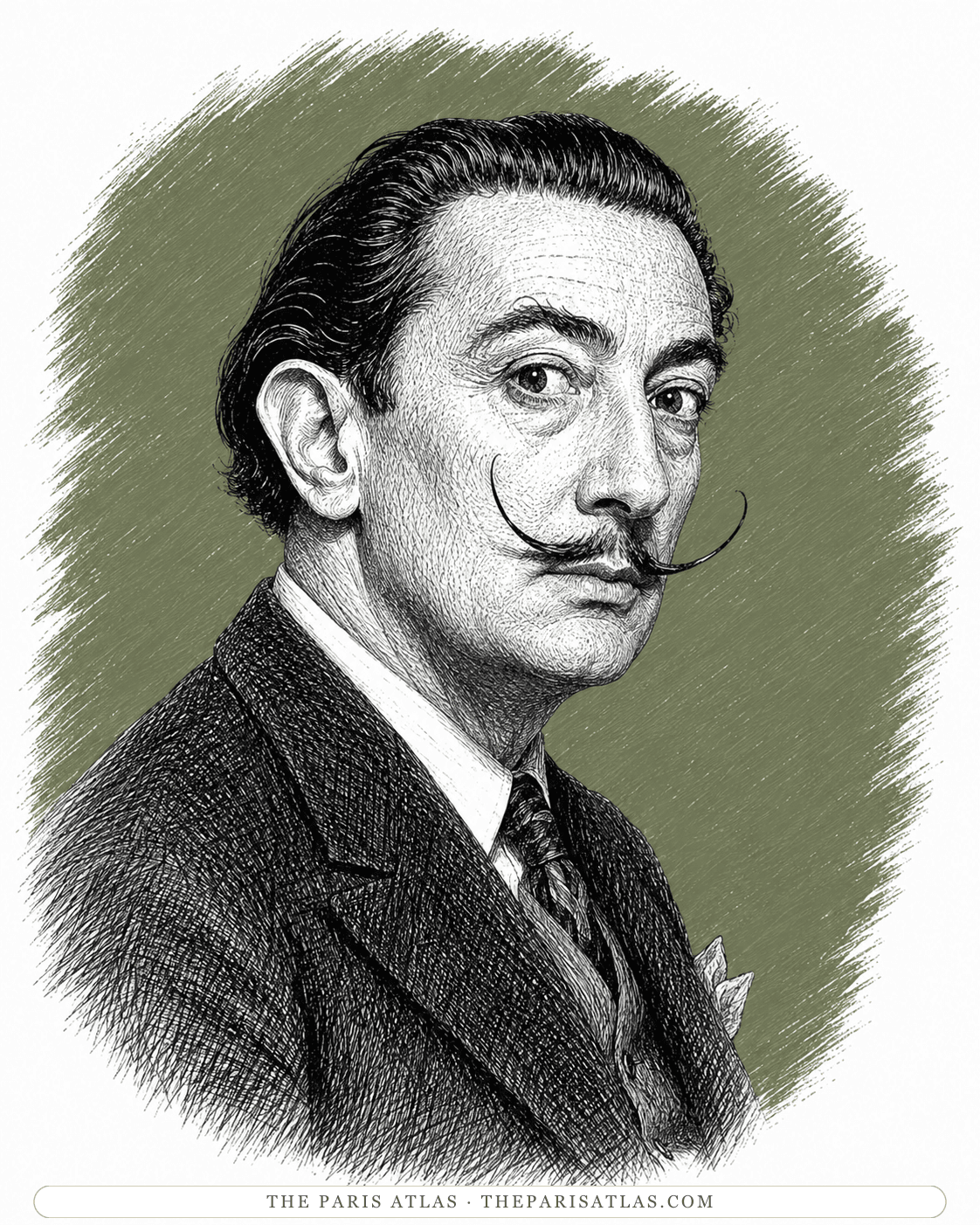
Other painters kept going back to the same rooms. John Singer Sargent traveled to Madrid in 1879 to copy Velázquez at the Prado, and used Las Meninas three years later for The Daughters of Edward Darley Boit.[30]Pablo Picasso spent 16 August to 30 December 1957 in Cannes making fifty-eight works out of Las Meninas, and gave the whole series to the Museu Picasso in Barcelona in 1968.[31]Francis Bacon painted a group of popes in 1953 from the Innocent X.[32]Salvador Dalí worked from Velázquez for more than twenty years, and the Dalí Theatre-Museum in Figueres holds eleven paintings he made from him between 1960 and 1982.[33]
Life events
6 June 1599
Baptized at the parish church of San Pedro in Seville, the first child of Juan Rodríguez de Silva and Jerónima Velázquez.
— Aureliano de Beruete, Velazquez (1906)
c. 1610
Enters the Seville workshop of the painter and writer Francisco Pacheco at the age of eleven, after a short spell with Francisco de Herrera the Elder.
— Enriqueta Harris, Velázquez, Diego Rodríguez de Silva y (Enciclopedia del Museo del Prado)
c. 1617
After six years with Pacheco he passes the Seville guild examination and is approved as a master painter of religious images and in oils.
— Enriqueta Harris, Velázquez, Diego Rodríguez de Silva y (Enciclopedia del Museo del Prado)
1618
Paints An Old Woman Cooking Eggs, now in the Scottish National Gallery in Edinburgh.
— An Old Woman Cooking Eggs, Diego Velázquez, 1618 (National Galleries of Scotland)
23 April 1618
Marries Juana Pacheco, his master's daughter, in Seville. The poet Francisco de Rioja is one of the witnesses.
— Aureliano de Beruete, Velazquez (1906)
1619
Dates The Adoration of the Magi, painted for the Jesuit novitiate of San Luis in Seville and now in the Prado.
— Diego Velázquez, The Adoration of the Magi — collection record
c. 1620
Paints The Waterseller of Seville, the best known of his kitchen pictures, now at Apsley House in London.
— The Waterseller of Seville (English Heritage, The Wellington Collection, Apsley House)
1619–1621
Two daughters are baptized in Seville: Francisca on 18 May 1619 and Ignacia on 29 January 1621. Ignacia dies as a child.
— Aureliano de Beruete, Velazquez (1906)
April 1622
First visit to Madrid, carrying letters from Pacheco. He paints the poet Luis de Góngora and fails to get an introduction to the king.
— Aureliano de Beruete, Velazquez (1906)
30 August 1623
Philip IV sits for him in Madrid. The royal order taking Velázquez into the king's service follows on 6 October, at twenty ducats a month with lodging, medical attendance and payment for each picture. In 1624 the king sends three hundred ducats to move his family up from Seville.
— Aureliano de Beruete, Velazquez (1906)
1627
Sits with Vicente Carducho and Eugenio Cajés on the tribunal examining candidates for a vacant court painter's post, and files a written dissent from their ranking. In the same year he wins the king's competition for a picture of the expulsion of the Moriscos and is sworn usher of the chamber. The painting burns in the Alcázar fire of 1734.
— Diego Velázquez, tribunal de oposición (Archivo General de Simancas, documento destacado 2024) (2024); Aureliano de Beruete, Velazquez (1906)
August 1628
Peter Paul Rubens reaches Madrid on an embassy and stays about nine months. Velázquez shows him the royal collections and rides with him to the Escorial.
— Francisco Pacheco, Arte de la pintura, su antigüedad y grandezas (1649); Aureliano de Beruete, Velazquez (1906)
1629
The king signs a decree in July allotting him a hundred ducats for The Triumph of Bacchus. In August he sails from Barcelona for Italy with Ambrogio Spinola, the general who had taken Breda four years earlier.
— Aureliano de Beruete, Velazquez (1906)
1630–1631
Draws the antique statues at the Villa Medici in Rome and paints The Forge of Vulcan. In Naples he meets Jusepe de Ribera and paints the king's sister, the Infanta María. He is back in Madrid early in 1631.
— Aureliano de Beruete, Velazquez (1906)
1634
The palace owes him 11,843 reals in back wages. His son-in-law Juan Bautista Martínez del Mazo takes over the post of usher, and Velázquez is made an officer of the wardrobe.
— Aureliano de Beruete, Velazquez (1906)
1635
The Hall of Realms at the Buen Retiro is finished, hung with five equestrian portraits by Velázquez and The Surrender of Breda.
The Surrender of Breda (Las Lanzas), c. 1635, oil on canvas, 307.3 by 371.5 cm (Museo Nacional del Prado, Madrid). Justinus van Nassau hands the keys of Breda to Ambrogio Spinola on 5 June 1625; painted for the Hall of Realms of the Buen Retiro palace. (Diego Velázquez (Museo Nacional del Prado), via Wikimedia Commons)
— Diego Velázquez, The Surrender of Breda — collection record; Enriqueta Harris, Velázquez, Diego Rodríguez de Silva y (Enciclopedia del Museo del Prado)
1640
The king grants him five hundred ducats a year for pictures painted and still to be painted, after years of unpaid claims.
— Aureliano de Beruete, Velazquez (1906)
1643
Made a gentleman-in-waiting to the king and attached to the Alcázar building works under the Marquis of Malpica.
— Aureliano de Beruete, Velazquez (1906)
1647
Appointed inspector of the palace building works. His memorial of 17 May says the salary is already years in arrears.
— Aureliano de Beruete, Velazquez (1906)
18 May 1648
The king orders the palace treasury to pay what it owes him so that he can travel to Italy. The treasury pays on 6 October.
— Aureliano de Beruete, Velazquez (1906)
2 January 1649
Sails from Málaga on his second Italian journey.
— Aureliano de Beruete, Velazquez (1906)
21 April 1649
Reaches Venice, where he buys Veronese's Venus and Adonis and two Tintorettos for the king. All three are in the Prado today.
— Aureliano de Beruete, Velazquez (1906)
March 1650
His portrait of Juan de Pareja is shown at the Pantheon in Rome, and he is elected to the Academy of Saint Luke.
Juan de Pareja, 1650, oil on canvas, 81.3 by 69.9 cm (The Metropolitan Museum of Art, New York, 1971.86). Velázquez painted his enslaved assistant in Rome to get his hand back in before painting Pope Innocent X. He signed the document freeing Pareja on 23 November 1650. (Diego Velázquez (The Metropolitan Museum of Art, Open Access CC0), via Wikimedia Commons)
— Aureliano de Beruete, Velazquez (1906); Velázquez, Juan de Pareja (ca. 1608–1670), 1650 — collection record
Summer 1650
Paints Pope Innocent X, which has stayed in Rome and hangs in the Galleria Doria Pamphilj.
— Velázquez, Portrait of Pope Innocent X Pamphilj
13 November 1650
Juan de Córdoba, acting for Velázquez in Rome, takes his infant son Antonio away from the child's mother on the grounds of neglect.
— David García Cueto, Sobre las relaciones de Velázquez y don Juan de Córdoba tras el regreso del segundo viaje a Italia (2011)
23 November 1650
Signs the document freeing Juan de Pareja.
— Carmen Fracchia, The Fall into Oblivion of the Works of the Slave Painter Juan de Pareja (2012)
1647–1651
Paints The Toilet of Venus, the only female nude by him that survives. It is recorded in a Madrid collection by June 1651.
The Toilet of Venus, known as the Rokeby Venus, 1647–51, oil on canvas, 122.5 by 177 cm (The National Gallery, London, NG2057). Velázquez's only surviving female nude; the National Art-Collections Fund bought it in 1905 and gave it to the gallery in 1906. (Diego Velázquez (The National Gallery, London), via Wikimedia Commons)
— Diego Velázquez, The Toilet of Venus ('The Rokeby Venus'), NG2057 — collection record
June 1651
Lands at Barcelona a year after the king first ordered him home, abandoning a plan to travel back through France and see Paris.
— Aureliano de Beruete, Velazquez (1906)
1652
Appointed aposentador mayor of the palace and moves into an apartment in the Casa del Tesoro beside the Alcázar.
— Aureliano de Beruete, Velazquez (1906)
March 1654
A portrait of the Infanta Margarita Teresa is ordered in Madrid for Anne of Austria's bathing rooms in the Louvre palace, and shipped that October.
Portrait of the Infanta Margarita Teresa, oil on canvas, 70 by 58 cm (Musée du Louvre, Paris, INV 941). The Louvre dates it 1654 and gives it to Velázquez and his workshop rather than to Velázquez alone. It was ordered in March 1654 for Anne of Austria's bathing rooms in the Louvre palace and shipped from Madrid that October. (Diego Velázquez and workshop (Musée du Louvre; Web Gallery of Art scan), via Wikimedia Commons)
— Portrait de l'infante Marguerite Thérèse (1651–1673), INV 941 — Louvre collections record
1656
Paints Las Meninas, 320 centimeters by 279, for the king's private office in the Alcázar.
Las Meninas, 1656, oil on canvas, 320.3 by 279.1 cm (Museo Nacional del Prado, Madrid, P1174). The Infanta Margarita with her attendants, the painter at his easel, and Philip IV and Queen Mariana of Austria reflected in the mirror on the back wall. (Diego Velázquez (Museo Nacional del Prado), via Wikimedia Commons)
— Francisco Calvo Serraller, Meninas, Las [Velázquez] (Enciclopedia del Museo del Prado)
12 June 1658
Philip IV signs the order admitting him to the Order of Santiago and sends the case to the Council of Military Orders.
— Aureliano de Beruete, Velazquez (1906)
1659
On 26 February the council accepts his age, religion and lineage and rejects his nobility on both sides of his family, and rules against him outright on 2 April. Pope Alexander VII issues a dispensation from Albano on 7 October, the king makes Velázquez a nobleman on 2 November, and the habit is ordered delivered on 27 November.
— Aureliano de Beruete, Velazquez (1906)
8 April 1660
Leaves Madrid for Irún to lodge the court and fit out the Spanish side of the Isle of Pheasants for the royal wedding.
— Aureliano de Beruete, Velazquez (1906); Palomino, Vida de Velázquez, XII: de la jornada de Irún, enfermedad y muerte (Arte y palabra: fuentes del arte español de los Siglos de Oro)
7 June 1660
The Infanta María Teresa is handed over to Louis XIV on the Isle of Pheasants. Velázquez starts for home the next day.
— Palomino, Vida de Velázquez, XII: de la jornada de Irún, enfermedad y muerte (Arte y palabra: fuentes del arte español de los Siglos de Oro)
31 July 1660
Falls ill after a day attending the king, with fever and pain in the stomach and chest. Three physicians call it an acute tertian syncopal fever.
— Aureliano de Beruete, Velazquez (1906); Palomino, Vida de Velázquez, XII: de la jornada de Irún, enfermedad y muerte (Arte y palabra: fuentes del arte español de los Siglos de Oro)
6 August 1660
Dies at two in the afternoon, aged sixty-one, and is buried the following evening in Gaspar de Fuensalida's vault at the church of San Juan Bautista in Madrid.
Self-portrait, about 1650, oil on canvas, 45 by 38 cm (Museo de Bellas Artes de Valencia, from the collection of the Real Academia de Bellas Artes de San Carlos). Francisco Martínez Blanch gave it to the academy in 1835. (Diego Velázquez (Museo de Bellas Artes de Valencia), via Wikimedia Commons)
— Aureliano de Beruete, Velazquez (1906)
August 1660
Juana Pacheco dies seven days after her husband and is buried beside him. The palace seizes the contents of his studio and property in his house, and the accounts take six years to clear.
— Aureliano de Beruete, Velazquez (1906)
1 September 1865
Édouard Manet sees the Velázquez rooms at the Prado and writes to Henri Fantin-Latour that Velázquez is the painter of painters.
— El Museo del Prado inicia la restauración de Pablo de Valladolid de Velázquez, «el cuadro más asombroso jamás pintado», según definió Manet (2026)
10 March 1914
Mary Richardson slashes The Toilet of Venus at the National Gallery in London with a meat cleaver and is sentenced to six months in prison.
— Deeds Not Words: Slashing the Rokeby Venus; Suffragettes on file: Mary Richardson
Diego Velázquez quotes
Verbatim, as recorded by the witnesses of the era — sources on every quotation.
“
I arrived at Madrid on Saturday, June 26, at daybreak, tired with travelling by night and working by day, but in good health.
Yo Sr. llegue a esta corte sabado a el amanecer 26 de Junio cansado de caminar de noche y trabajar de dia pero con salud
— Diego Velázquez, letter to the painter Diego Valentín Díaz, Madrid, 3 July 1660
Selected works
Cataloged from the holding institutions' records. Reproductions appear only where the rights are verified.
Diego Velázquez finished Las Meninas in 1656 at the court of Philip IV of Spain. It hangs in the Museo del Prado in Madrid. The picture shows the young Infanta Margarita Teresa among her attendants, with the painter standing at a canvas whose face is turned away. Philip IV and Queen Mariana appear only as a reflection in a mirror on the back wall.
Peter Paul Rubens reached Madrid at the end of August 1628 on a diplomatic mission and stayed about nine months. Francisco Pacheco, who taught Velázquez and was his father-in-law, wrote in his Arte de la pintura of 1649 that Rubens made friends with few painters in Madrid, praised Velázquez's modesty and talent, and went with him to see the Escorial. Philip IV told Velázquez to show Rubens the royal collections. Rubens left in the spring of 1629.
— Francisco Pacheco, Arte de la pintura, su antigüedad y grandezas (1649); Aureliano de Beruete, Velazquez (1906); Enriqueta Harris, Velázquez, Diego Rodríguez de Silva y (Enciclopedia del Museo del Prado)
Who Inspired Diego Velázquez
People whose work inspired Diego Velázquez. They did not necessarily meet or know one another.
The kitchen scenes Velázquez painted in Seville between about 1617 and 1623 use hard side light, dark backgrounds and ordinary people as models. The Prado's biography by Enriqueta Harris calls him one of the first painters in Spain to work in the naturalism that came, directly or indirectly, from Caravaggio, and places him on the same path as Jusepe de Ribera. The link is an inference drawn from the pictures. Velázquez had never been to Italy when he painted them, and no document records him seeing a Caravaggio.
— Enriqueta Harris, Velázquez, Diego Rodríguez de Silva y (Enciclopedia del Museo del Prado); The Waterseller of Seville (English Heritage, The Wellington Collection, Apsley House); Diego Velázquez (1599 – 1660) — artist page
Scholars disagree about what the nine months with Peter Paul Rubens in Madrid did to Velázquez's painting. Enriqueta Harris, writing the Prado's biography, names Titian and Rubens as the two painters who shaped him most, and reads Rubens's example behind his first mythological picture, The Triumph of Bacchus of 1628 and 1629. Aureliano de Beruete argued the opposite in 1906: that Velázquez saw how far his own aims were from Rubens's and changed nothing. Neither position rests on anything Velázquez himself said, because he left almost no writing.
— Enriqueta Harris, Velázquez, Diego Rodríguez de Silva y (Enciclopedia del Museo del Prado); Aureliano de Beruete, Velazquez (1906)
Who Diego Velázquez Inspired
People who found inspiration in Diego Velázquez’s work.
Édouard Manet went to the Prado in Madrid on 1 September 1865, saw the Velázquez rooms and called him the painter of painters in a letter to his friend the painter Henri Fantin-Latour. He singled out the full-length portrait of the jester Pablo de Valladolid, writing that the background disappears and air surrounds the man dressed in black. The Prado quoted Manet's words for that picture when it began restoring it in 2026.
— Francisco Calvo Serraller, Meninas, Las [Velázquez] (Enciclopedia del Museo del Prado); El Museo del Prado inicia la restauración de Pablo de Valladolid de Velázquez, «el cuadro más asombroso jamás pintado», según definió Manet (2026)
Francis Bacon painted a group of pictures of a pope in 1953 taken from Velázquez's Portrait of Pope Innocent X. One of them is called Study after Velázquez's Portrait of Pope Innocent X, measures 153 by 118 centimeters and hangs at the Des Moines Art Center in Iowa.
— Francis Bacon, Study after Velázquez's Portrait of Pope Innocent X, 1953 — catalogue record; Velázquez, Portrait of Pope Innocent X Pamphilj
John Singer Sargent traveled to Madrid in 1879 to copy Velázquez at the Prado, and Las Meninas was among the paintings he studied. Three years later he painted The Daughters of Edward Darley Boit, now at the Museum of Fine Arts, Boston, which the museum describes as taking Velázquez's deep shadowed room, his dark restrained color and the way his young princess looks straight out at the viewer.
— The Daughters of Edward Darley Boit (1882), accession 19.124
Between 16 August and 30 December 1957, at his house in Cannes, Pablo Picasso made 58 works that come out of Velázquez's Las Meninas. Forty-five take the 1656 painting apart, figure by figure and group by group; the rest are nine pictures of the pigeons outside his studio, three landscapes and a portrait of his companion Jacqueline Roque. The largest canvas, 194 by 260 centimeters, changes the shape from upright to wide and makes the painter almost as tall as the canvas itself. Picasso gave the whole series to the Museu Picasso in Barcelona in 1968.
— Museu Picasso Barcelona — chronology of the 58-work Las Meninas series; Museu Picasso Barcelona — Las Meninas, 1957
Salvador Dalí reworked Velázquez for more than twenty years. The Dalí Theatre-Museum in Figueres holds eleven paintings he made between 1960 and 1982 from Velázquez pictures, among them Las Meninas, the portraits of the Infanta Margarita, the jester Calabacillas and Sebastián de Morra. The museum also holds his sculpture Bust of Velázquez Turning into Three Figures Conversing and the hologram Holos! Holos! Velázquez! Gabor!, which used Las Meninas.
— Exhibition of Works Inspired by Velázquez (2015)
Movements
The artistic and literary currents this life ran through.
Art movement and historical period · circa 1600–1750
Las Meninas, painted in 1656, puts Velázquez at his canvas and the Infanta Margarita among her attendants, with Philip IV and his queen present only as faces in a mirror on the back wall — an arrangement that makes representation itself the subject.
— Diego Velázquez, Las Meninas — collection record
Questions about Diego Velázquez
Who was Diego Velázquez?
Diego Velázquez (1599–1660) was a Spanish painter who worked for King Philip IV in Madrid from 1623 until his death. He was born and trained in Seville, painted the king, the royal family and the dwarfs and jesters of the palace, and rose through the royal household to become aposentador mayor, the official responsible for housing and moving the court. Las Meninas, painted in 1656, is his best known picture.
What is Velázquez's most famous painting?
Las Meninas, painted in 1656 and now in the Prado in Madrid. It measures 320 centimeters by 279 and shows a room in the royal Alcázar. In it are the five-year-old Infanta Margarita with two ladies-in-waiting, two palace dwarfs, a dog, a chaperone and a man in a lit doorway at the back. Velázquez himself stands at a large canvas turned away from the viewer. A mirror on the back wall reflects Philip IV and Queen Mariana of Austria.
How did Diego Velázquez die?
Velázquez died of a fever in Madrid at two in the afternoon on 6 August 1660, aged sixty-one. He had spent the spring on the French border arranging the wedding of the king's daughter to Louis XIV, and got home exhausted on 26 June. On 31 July he came off a day's duty tired and feverish, with severe pain in the stomach and chest. Three physicians attended him and called it an acute tertian syncopal fever, the period's term for a fever that returned every third day.
Where is Velázquez buried?
Nobody knows. He was buried on the evening of 7 August 1660 in the vault of his friend Gaspar de Fuensalida at the church of San Juan Bautista in Madrid, and his wife Juana Pacheco was buried beside him a week later. The church was demolished in the early nineteenth century, during the reign of Joseph Bonaparte, when blocks of central Madrid were cleared to make squares. The site is now the Plaza de Ramales, where paving markers show the church walls and a column with a cross of Santiago stands over the spot. The remains have never been recovered.
Where can you see Velázquez's paintings?
The Prado in Madrid, which lists ninety-four works under his name, including Las Meninas, The Surrender of Breda and The Triumph of Bacchus. Outside Spain, the National Gallery in London holds nine paintings under his name, among them The Toilet of Venus. The Metropolitan Museum of Art in New York has Juan de Pareja and the Galleria Doria Pamphilj in Rome has Pope Innocent X. An Old Woman Cooking Eggs is in the Scottish National Gallery in Edinburgh, and The Waterseller of Seville is at Apsley House in London.
Is there a Velázquez in the Louvre?
Not one the museum itself calls a Velázquez. The Louvre holds four paintings from his circle, none of them on display at present. The Portrait of the Infanta Margarita Teresa, ordered in March 1654 for Anne of Austria's rooms in the Louvre palace, is listed as Velázquez and workshop. Queen Mariana of Austria is workshop of Velázquez, the Infanta María Teresa is Velázquez and workshop, and Philip IV as a Huntsman is attributed to him and hangs on loan at the Musée Goya in Castres.
Did Philip IV paint the cross of Santiago on Las Meninas?
There is no evidence that he did. Velázquez finished the picture in 1656 and only received the habit of the Order of Santiago at the end of 1659, so the red cross on his doublet was added afterwards. Antonio Palomino, writing in 1724, already knew that it was added after Velázquez died and on the king's instruction. The story that Philip IV took up a brush and painted it himself is a later embellishment, and who actually held the brush has never been established.
Who was Juan de Pareja?
Juan de Pareja was a painter, born about 1606 in Antequera, who was enslaved in Velázquez's household and worked as his assistant. He could read and write and witnessed legal documents for Velázquez from 1634. Velázquez painted his portrait in Rome in 1650 and exhibited it at the Pantheon that March, then signed the document freeing him on 23 November 1650. Pareja went on painting under his own name, signing and dating his pictures, and died in Madrid in 1670. The portrait is at the Metropolitan Museum of Art in New York.
Connections and Sources
Diego Velázquez’s connections to people, places, and works, with the sources behind each one.
Las Meninas, painted in 1656, puts Velázquez at his canvas and the Infanta Margarita among her attendants, with Philip IV and his queen present only as faces in a mirror on the back wall — an arrangement that makes representation itself the subject.
— Diego Velázquez, Las Meninas — collection record
Édouard Manet went to the Prado in Madrid on 1 September 1865, saw the Velázquez rooms and called him the painter of painters in a letter to his friend the painter Henri Fantin-Latour. He singled out the full-length portrait of the jester Pablo de Valladolid, writing that the background disappears and air surrounds the man dressed in black. The Prado quoted Manet's words for that picture when it began restoring it in 2026.
— Francisco Calvo Serraller, Meninas, Las [Velázquez] (Enciclopedia del Museo del Prado); El Museo del Prado inicia la restauración de Pablo de Valladolid de Velázquez, «el cuadro más asombroso jamás pintado», según definió Manet (2026)
Francis Bacon painted a group of pictures of a pope in 1953 taken from Velázquez's Portrait of Pope Innocent X. One of them is called Study after Velázquez's Portrait of Pope Innocent X, measures 153 by 118 centimeters and hangs at the Des Moines Art Center in Iowa.
— Francis Bacon, Study after Velázquez's Portrait of Pope Innocent X, 1953 — catalogue record; Velázquez, Portrait of Pope Innocent X Pamphilj
John Singer Sargent traveled to Madrid in 1879 to copy Velázquez at the Prado, and Las Meninas was among the paintings he studied. Three years later he painted The Daughters of Edward Darley Boit, now at the Museum of Fine Arts, Boston, which the museum describes as taking Velázquez's deep shadowed room, his dark restrained color and the way his young princess looks straight out at the viewer.
— The Daughters of Edward Darley Boit (1882), accession 19.124
Between 16 August and 30 December 1957, at his house in Cannes, Pablo Picasso made 58 works that come out of Velázquez's Las Meninas. Forty-five take the 1656 painting apart, figure by figure and group by group; the rest are nine pictures of the pigeons outside his studio, three landscapes and a portrait of his companion Jacqueline Roque. The largest canvas, 194 by 260 centimeters, changes the shape from upright to wide and makes the painter almost as tall as the canvas itself. Picasso gave the whole series to the Museu Picasso in Barcelona in 1968.
— Museu Picasso Barcelona — chronology of the 58-work Las Meninas series; Museu Picasso Barcelona — Las Meninas, 1957
Salvador Dalí reworked Velázquez for more than twenty years. The Dalí Theatre-Museum in Figueres holds eleven paintings he made between 1960 and 1982 from Velázquez pictures, among them Las Meninas, the portraits of the Infanta Margarita, the jester Calabacillas and Sebastián de Morra. The museum also holds his sculpture Bust of Velázquez Turning into Three Figures Conversing and the hologram Holos! Holos! Velázquez! Gabor!, which used Las Meninas.
— Exhibition of Works Inspired by Velázquez (2015)
Peter Paul Rubens reached Madrid at the end of August 1628 on a diplomatic mission and stayed about nine months. Francisco Pacheco, who taught Velázquez and was his father-in-law, wrote in his Arte de la pintura of 1649 that Rubens made friends with few painters in Madrid, praised Velázquez's modesty and talent, and went with him to see the Escorial. Philip IV told Velázquez to show Rubens the royal collections. Rubens left in the spring of 1629.
— Francisco Pacheco, Arte de la pintura, su antigüedad y grandezas (1649); Aureliano de Beruete, Velazquez (1906); Enriqueta Harris, Velázquez, Diego Rodríguez de Silva y (Enciclopedia del Museo del Prado)
The kitchen scenes Velázquez painted in Seville between about 1617 and 1623 use hard side light, dark backgrounds and ordinary people as models. The Prado's biography by Enriqueta Harris calls him one of the first painters in Spain to work in the naturalism that came, directly or indirectly, from Caravaggio, and places him on the same path as Jusepe de Ribera. The link is an inference drawn from the pictures. Velázquez had never been to Italy when he painted them, and no document records him seeing a Caravaggio.
— Enriqueta Harris, Velázquez, Diego Rodríguez de Silva y (Enciclopedia del Museo del Prado); The Waterseller of Seville (English Heritage, The Wellington Collection, Apsley House); Diego Velázquez (1599 – 1660) — artist page
Scholars disagree about what the nine months with Peter Paul Rubens in Madrid did to Velázquez's painting. Enriqueta Harris, writing the Prado's biography, names Titian and Rubens as the two painters who shaped him most, and reads Rubens's example behind his first mythological picture, The Triumph of Bacchus of 1628 and 1629. Aureliano de Beruete argued the opposite in 1906: that Velázquez saw how far his own aims were from Rubens's and changed nothing. Neither position rests on anything Velázquez himself said, because he left almost no writing.
— Enriqueta Harris, Velázquez, Diego Rodríguez de Silva y (Enciclopedia del Museo del Prado); Aureliano de Beruete, Velazquez (1906)
References
References
The sources below include biographies, scholarly essays, interviews, and primary materials that informed this page. They reflect both the historical record and ongoing critical conversations about Diego Velázquez and their work.
Methuen and Co., London (Getty Research Institute scan, Internet Archive), 1906
Used for
The documentary spine of this biography: the baptism at San Pedro on 6 June 1599, the marriage of 23 April 1618 and the daughters' baptisms, the royal appointment of 6 October 1623 and its salary, the court arrears, the Order of Santiago file, both Italian journeys, the letter of 3 July 1660, the illness and death, and the seizure of his goods afterwards.
2abcdefghijklmnopVelázquez, Diego Rodríguez de Silva y (Enciclopedia del Museo del Prado)
Website
Museo Nacional del Prado
Used for
Enriqueta Harris's biography for the Prado: the training with Herrera and Pacheco from the age of eleven, the guild approval as a master painter of religious images and in oils, the Caravaggio and Rubens questions, and the court career in outline.
3abcdefgMeninas, Las [Velázquez] (Enciclopedia del Museo del Prado)
Website
Museo Nacional del Prado
Used for
Las Meninas: dimensions, inventory number P1174, the names of the figures, the changing titles from the 1666 inventory to Madrazo's Prado catalog of 1843, and Luca Giordano's remark.
4abcdefghPalomino, Vida de Velázquez, XII: de la jornada de Irún, enfermedad y muerte (Arte y palabra: fuentes del arte español de los Siglos de Oro)
Website
Universidad Complutense de Madrid
Used for
The Complutense transcription of Palomino's chapter on the journey to Irún: the departure, the Isle of Pheasants, the physicians Vicencio Moles, Miguel de Alva and Pedro de Chavarri, and the death on 6 August 1660.
Francisco Pacheco's treatise, published in Seville in 1649, is the only contemporary account of the Rubens visit of 1628 and of Velázquez's apprenticeship.
10abcDiego Velázquez, The Surrender of Breda — collection record
Website
Museo Nacional del Prado
Used for
The Surrender of Breda: 307.3 by 371.5 cm, inventory P001172, the surrender of 5 June 1625 by Justinus van Nassau to Ambrogio Spinola, and the Hall of Realms commission.
11abcdEl Museo del Prado inicia la restauración de Pablo de Valladolid de Velázquez, «el cuadro más asombroso jamás pintado», según definió Manet
Website
Museo Nacional del Prado, 2026
Used for
Pablo de Valladolid: the figure standing in undefined space with only its own shadow, the 2026 restoration and its imaging, and Manet's words about the picture after his Prado visit of 1 September 1865.
Pigment analysis of Las Meninas after McKim-Smith, Andersen-Bergdoll and Newman: the beige ground, the pigments identified, and the darkening of the kneeling maid's azurite skirt.
13abcThe Fall into Oblivion of the Works of the Slave Painter Juan de Pareja
Periodical
Art in Translation, vol. 4, no. 2 (University of Glasgow open-access copy), 2012
Used for
Carmen Fracchia on Pareja's birth in Antequera about 1606, his literacy and his appearances as a legal witness from 1634, the manumission of 23 November 1650, and his own signed paintings up to his death in Madrid in 1670.
14abEl museo pictórico y escala óptica, tomo III: El Parnaso español pintoresco laureado (Vida de don Diego Velázquez de Silva)
Biography
Madrid, 1724; 1795 edition on the Internet Archive, 1724
Used for
Antonio Palomino's life of Velázquez, printed in 1724, is the source of the Pantheon anecdote, the funeral description, and the note that the cross of Santiago was added to Las Meninas after the painter's death.
17abDiego Velázquez, The Toilet of Venus ('The Rokeby Venus'), NG2057 — collection record
Website
The National Gallery, London
Used for
The Toilet of Venus: 1647–51, 122.5 by 177 cm, NG2057, first recorded in a Madrid collection by June 1651, in England from 1813, bought by the National Art-Collections Fund in 1905 and given to the gallery in 1906.
18abSobre las relaciones de Velázquez y don Juan de Córdoba tras el regreso del segundo viaje a Italia
Periodical
Archivo Español de Arte, LXXXIV, 334, pp. 177–180, 2011
Used for
New documents on Velázquez's Roman agent Juan de Córdoba, including the son Antonio, the boy's mother Marta, and the removal of the child from her care on 13 November 1650.
19abcTumba de Diego Velázquez (Lugares de la memoria)
Website
Revive Madrid
Used for
The burial at San Juan Bautista, the demolition of the church under Joseph Bonaparte, and the markers and Santiago cross in the Plaza de Ramales today.
The attack of 10 March 1914: the date, the meat cleaver, and Mary Richardson's own explanation of the parallel she meant to draw with Emmeline Pankhurst.
24↑Portrait de l'infante Marguerite Thérèse (1651–1673), INV 941 — Louvre collections record
Website
Musée du Louvre
Used for
INV 941, listed as Velázquez and workshop, 70 by 58 cm, ordered in March 1654 for Anne of Austria's bathing rooms in the Louvre palace and shipped that October.
28abcLa Galerie espagnole de Louis Philippe au Louvre : 1838-1848
Website
Musées Occitanie
Used for
The Galerie espagnole: Baron Taylor's buying mission of 1835, the opening in the Colonnade rooms on 7 January 1838 with 412 Spanish paintings, the weakness of its Velázquez holdings, and the London sale of 1853.
31↑Museu Picasso Barcelona — chronology of the 58-work Las Meninas series
Website
Museu Picasso Barcelona
Used for
The Museu Picasso's chronology of Picasso's Las Meninas series: 16 August to 30 December 1957 at Cannes, the fifty-eight works made there, and the gift of the whole series to the museum in 1968.
34Diego Velázquez, tribunal de oposición (Archivo General de Simancas, documento destacado 2024)
Website
Ministerio de Cultura, Archivo General de Simancas, 2024
Used for
The 1627 tribunal on which Velázquez sat with Vicente Carducho and Eugenio Cajés, his signed dissent from the ranking, and the separate competition for a picture of the expulsion of the Moriscos.
These references anchor the page in the documented record and in the scholarly conversations around Diego Velázquez. Every claim on this page traces back to one or more of the works listed here.


 View source