The Paris AtlasCharting the artists, works, and places worth returning to.
  • Author
  • Poet
  • Painter
· Lebanese-American · 1883–1931

Kahlil Gibran

Lebanese-American poet and painter who wrote The Prophet, one of the best-selling books of the twentieth century, and who spent 1908 to 1911 in Europe — mostly Paris — learning to paint on the money of a Boston schoolmistress. He is two writers at once: a gentle sage in English, and in Arabic a founding modernist who broke classical verse open.

Details

Lived
1883–1931
Born
1883
Birthplace
Bsharri, Lebanon
Died
1931
Nationality
Lebanese-American
Profession
Poet, essayist and painter
Major works
The Prophet (1923), The Madman (1918), The Broken Wings (1912)
Roles
AuthorPoetPainter
Also known as
Gibran Khalil Gibran · Khalil Gibran · Jubran Khalil Jubran

About Kahlil Gibran

Kahlil Gibran was born in 1883 in Bsharri, a village in the mountains of northern Lebanon, was carried to Boston at twelve, and died in 1931 at forty-eight having written, in English, a small book of twenty-six prose sermons called The Prophet. It has never been out of print since 1923 and is counted among the best-selling books of the twentieth century — the volume people give each other at weddings and funerals, quoted by readers who could not name its author.[1]

Between those two lives sits Paris. From 1908 to 1911 Gibran was in Europe, chiefly in Paris, studying and painting on money sent by Mary Haskell, the Boston schoolmistress who had walked into his first exhibition in 1904 and spent the rest of her life underwriting him. He came back with the two enthusiasms that shaped everything after — Friedrich Nietzsche's Thus Spake Zarathustra, and the visionary English poet-engraver William Blake — and with the beginnings of a legend about a meeting with Auguste Rodin that has been retold so often it now obscures what he actually did there.[2]

Bsharri to a Boston tenement

He was born in 1883 in Bsharri, a village on the edge of the cedar forests of northern Lebanon, then a province of the Ottoman empire. The family left under a shadow: his father, a tax collector, was caught up in a scandal over the money he handled, and in 1895 Gibran sailed for America at twelve with his mother, his half-brother and his two sisters. They landed in the immigrant tenements of Boston's South End, and he went to school as the only English-speaking generation in the household.[1]

His drawings were noticed almost at once. In 1896 a settlement-house art teacher, Florence Pierce, passed them on, and within a fortnight the boy had entered the circle of Fred Holland Day — the Boston photographer, publisher and patron who collected unusual talent and put Gibran in front of a camera and in front of books. In 1904 Day's studio gave Gibran his first exhibition of paintings, at twenty-one. It is the moment the rest of his life turns on.[3]

The schoolmistress who paid for everything

Mary Haskell came to that 1904 exhibition. She was a South Carolinian who ran an elite girls' school outside Boston, ten years older than Gibran, and for the next twenty-seven years she was his patron, editor, first reader and closest correspondent. She paid for his training, argued with his English, kept diaries full of him, and after his death in 1931 became a principal heir of his estate.[2]

The arrangement is unusually well documented, because Haskell kept everything. Her papers — the letters Gibran wrote her from 1904 until the end, the diaries, the sketches he sent — sit today in the Minis Family Papers at the University of North Carolina at Chapel Hill, filed under the name of the Savannah businessman, Jacob Florance Minis, whom she married in 1926. It is that archive, not the biographies, that fixes the plain fact of the Paris years: throughout his travels in Europe between 1908 and 1911, Haskell paid.[2]

Paris, 1908–1911: what is documented, and what is legend

Gibran arrived in Paris in 1908, twenty-five years old, an immigrant painter from Boston with an allowance and no French reputation to lose. He stayed roughly three years. What he took away is clear enough from the work that follows: the Italian Renaissance masters, the English Pre-Raphaelites, the French Symbolists — the Paris painters of the 1880s and 1890s who preferred dream, myth and allegory to the visible world — and, above all, William Blake, the English poet who engraved and hand-coloured his own prophetic books and whom Gibran read as a brother. Telfair Museums, which holds the largest public collection of his art in the United States, names exactly those influences on his work. He also read Nietzsche's Thus Spake Zarathustra in Paris, a book of aphoristic sermons delivered by a solitary prophet coming down from a mountain. Fifteen years later he would write one.[1]

What is not clear is the Rodin story. Gibran's biographers place him in the orbit of Auguste Rodin, then the most famous sculptor alive and the presiding figure of artistic Paris, and credit Rodin with putting Blake into his hands. That much is repeated by the Kahlil Gibran Collective, the research archive that maintains his papers online, and by the standard modern life of him. What comes attached to it, everywhere — on paperback jackets, on quotation sites, in a thousand introductions — is a sentence in which Rodin calls Gibran the William Blake of the East, or of the twentieth century. No source has ever been produced for it in Rodin's own words. The museums that hold Gibran's art do not use it. It is best read as publicity that outlived its publicist, and it should not be quoted as something Rodin said.[4]

The honest shape of the Paris years is therefore smaller and more interesting than the legend: three years of training and reading, paid for from Massachusetts, that turned a gifted Boston draughtsman into a painter with a private mythology — nude figures rising out of mist, single souls in a landscape of light — and gave him the voice he would use in English. He returned to America in 1911 and settled into the studios in Boston and then New York where he worked for the rest of his life.[5]

The Prophet, 1923

The Prophet is a slim book with a simple frame. A prophet named Almustafa, who has lived twelve years in the city of Orphalese, is about to sail home; the people gather and ask him to speak, and he answers in twenty-six short prose poems — on love, marriage, children, work, joy and sorrow, death — each a page or two long, each illustrated by Gibran himself. Alfred A. Knopf published it in New York in 1923 in an edition of 1,300 copies, which sold out within a month.[1]

It then did something almost no book does: it kept selling, decade after decade, without ever being fashionable. Critics generally ignored it; readers passed it hand to hand. Telfair Museums, cataloguing his art, describes it plainly as one of the top-selling books of the twentieth century — and its most quoted lines, the ones about children not being your children and about the pillars of the temple standing apart, are now read aloud at ceremonies by people who have never opened the book.[3]

The other Gibran: the Arabic modernist

In English, Gibran is a sage. In Arabic he is something else entirely: a founder. He wrote in Arabic first — the novella The Broken Wings, the essays, the stories — and in New York he helped found Arrabitah, the Pen Bond, a league of Arab émigré writers formed to drag Arabic literature out of a thousand years of fixed classical form. Its members pushed Romanticism into Arabic poetry, loosened the metrical rules, and made the prose poem a genre in a language that had not had one.[4]

That is why the two reputations do not match. An English-language reader meets a gift-book mystic; an Arabic-language reader meets one of the writers who made modern Arabic literature possible, described in his own lifetime as the genius of his age. Both readers are looking at the same man. Neither description is wrong, and each is baffling to the other.

1931, and where the work went

Gibran died in 1931, aged forty-eight, of an illness his biographers describe only vaguely. Mary Haskell, as a principal heir, took charge of the estate and shipped his artwork and possessions back to Bsharri, the mountain village he had left at twelve. They are kept there still, in the old monastery that the village runs as the Gibran Museum.[4]

Haskell kept a great deal of the painting herself, and in 1950, by then Mary Haskell Minis of Savannah, she gave nearly a hundred works — drawings, watercolours and oils spanning his whole career, from The Vision of Adam and Eve shown at Fred Holland Day's studio in 1904 to the pictures of his last years — to Telfair Museums in Georgia. It remains the largest public collection of Gibran's visual art in the United States, which is how the painter half of him survived at all: as a gift from the woman who had paid for the training in Paris.[3]

Life events

  1. 1883

    Born in Bsharri, a village in the mountains of northern Lebanon, then Ottoman territory.

    — Gibran: Man & Poet — the Kahlil Gibran Collective

  2. 1895

    Sails for America at twelve with his mother, half-brother and sisters after his father's tax-collecting scandal; the family settles in Boston's immigrant tenements.

    — Gibran: Man & Poet — the Kahlil Gibran Collective; The Art of Kahlil Gibran — Telfair Museums exhibition, 2010–11

  3. 1896

    His drawings are noticed by the settlement-house teacher Florence Pierce, and within a fortnight he enters the circle of the Boston photographer and patron Fred Holland Day.

    — Gibran: Man & Poet — the Kahlil Gibran Collective

  4. 1904

    First exhibition of his paintings, at Fred Holland Day's Boston studio. Mary Haskell sees it and becomes his patron for the next twenty-seven years.

    — The Art of Kahlil Gibran — Telfair Museums exhibition, 2010–11; Minis Family Papers, 1739–1948 (collection 02725), Southern Historical Collection

  5. 1908

    Leaves for Europe to study art, on money sent by Haskell; Paris is his base.

    — Minis Family Papers, 1739–1948 (collection 02725), Southern Historical Collection; Gibran: Man & Poet — the Kahlil Gibran Collective

  6. 1908–1910

    The Paris years: he reads Nietzsche's Thus Spake Zarathustra, takes up William Blake, and — according to his biographers — meets Auguste Rodin.

    — Gibran: Man & Poet — the Kahlil Gibran Collective

  7. 1911

    Back from Europe; he lives and works in Boston and then New York, still supported by Haskell.

    — Minis Family Papers, 1739–1948 (collection 02725), Southern Historical Collection

  8. 1912

    Gives Haskell his corrected typescript of The Broken Wings, the Arabic novella; it survives in her papers at Chapel Hill.

    — Minis Family Papers, 1739–1948 (collection 02725), Southern Historical Collection

  9. 1923

    The Prophet is published in New York by Alfred A. Knopf in an edition of 1,300 copies, which sells out within a month.

    — Gibran: Man & Poet — the Kahlil Gibran Collective; The Art of Kahlil Gibran — Telfair Museums exhibition, 2010–11

  10. 1931

    Dies at forty-eight. Haskell, a principal heir, ships his artwork and possessions home to Bsharri.

    — Gibran: Man & Poet — the Kahlil Gibran Collective; Minis Family Papers, 1739–1948 (collection 02725), Southern Historical Collection

  11. 1950

    Mary Haskell Minis gives nearly a hundred of his paintings and drawings to Telfair Museums in Savannah — still the largest public collection of Gibran's art in the United States.

    — The Art of Kahlil Gibran — Telfair Museums exhibition, 2010–11; Visions of The Prophet: The Visual Art of Kahlil Gibran — Telfair Museums

Art Depicting Kahlil Gibran

Works with Kahlil as their subject.

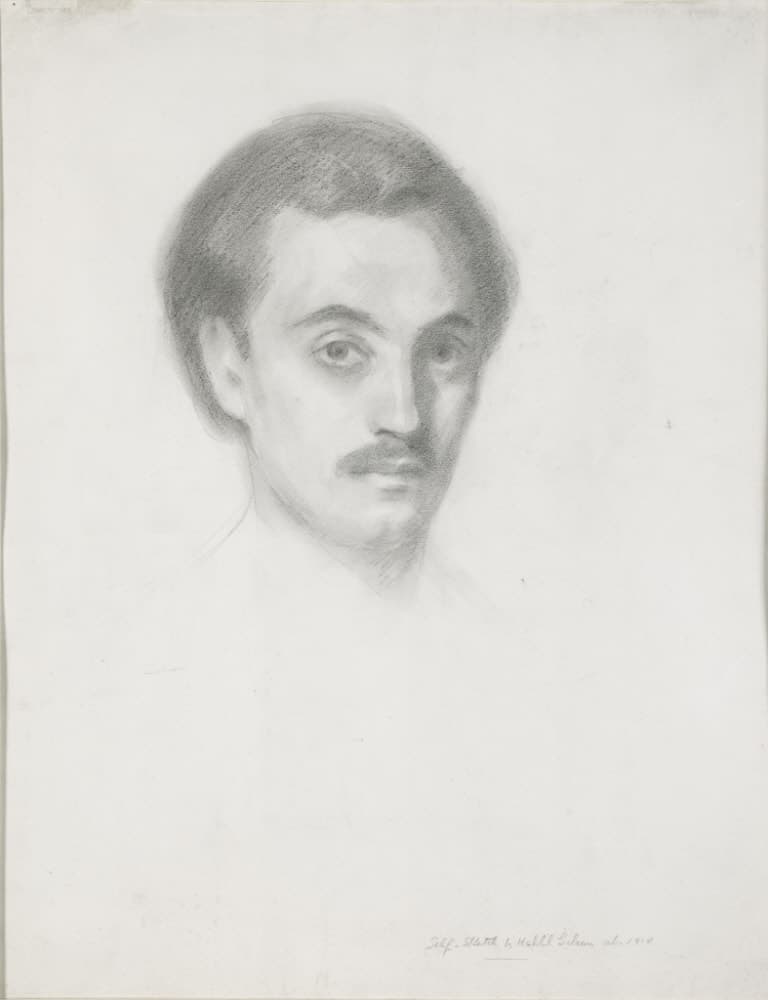
A pencil drawing of a young man's head and neck on a large sheet of pale paper, looking straight out. His hair is a thick mass of parallel diagonal strokes arcing over the temple, his brows are dark and heavy, and a soft moustache covers his upper lip above closed lips. The eye on the viewer's left is fully drawn with iris and lashes; the other sits in shadow. The neck is drawn in outline with no collar, and the lower half of the sheet is bare except for a line of pencil writing at the lower right

Artwork reproduction

Drawing

Self-Portrait

Kahlil Gibran · 1910 · Pencil on wove paper

A pencil head of the artist at twenty-seven, looking out of the sheet, drawn in 1910 — the year Kahlil Gibran left Paris after two years of study paid for by Mary Haskell. The sheet is one half of a pair at Telfair Museums in Savannah: its companion, numbered 1950.8.94.b, is his portrait of Mary Haskell.

Telfair Museums

Kahlil Gibran, Self-Portrait, 1910. Telfair Museums. Image: public domain.

Selected works

Cataloged from the holding institutions' records. Reproductions appear only where the rights are verified.

Paintings

A dark oil painting. A band of pale grey-green water runs across the middle of the canvas, and a severed head lies in it just left of centre, the face turned up and painted pale olive-yellow with the eyes closed as dark hollows. Dark hair spreads around the face and merges with the current. Above, in a near-black sky, three pale forms float with fingers and thumbs visible, one at the upper left and two entering from the upper right. Dark banks close the scene at the right and across the bottom left

Artwork reproduction

Painting

The Head of Orpheus Floating Down the River Hebrus to the Sea

c. 1908–1914 · Oil on canvas

A severed head floats face-up in a pale green channel of water, under a black sky crossed by three pale hands. Telfair Museums dates the canvas to about 1908 to 1914, a bracket that opens with Kahlil Gibran's art training in Paris, and holds it as 1950.8.4 from the 1950 gift of Mary Haskell Minis. The subject is the end of the Orpheus myth: the singer's head thrown into the river Hebrus after he is torn apart.

Telfair Museums

Kahlil Gibran, The Head of Orpheus Floating Down the River Hebrus to the Sea, c. 1908–1914. Telfair Museums. Image: public domain.

Drawings

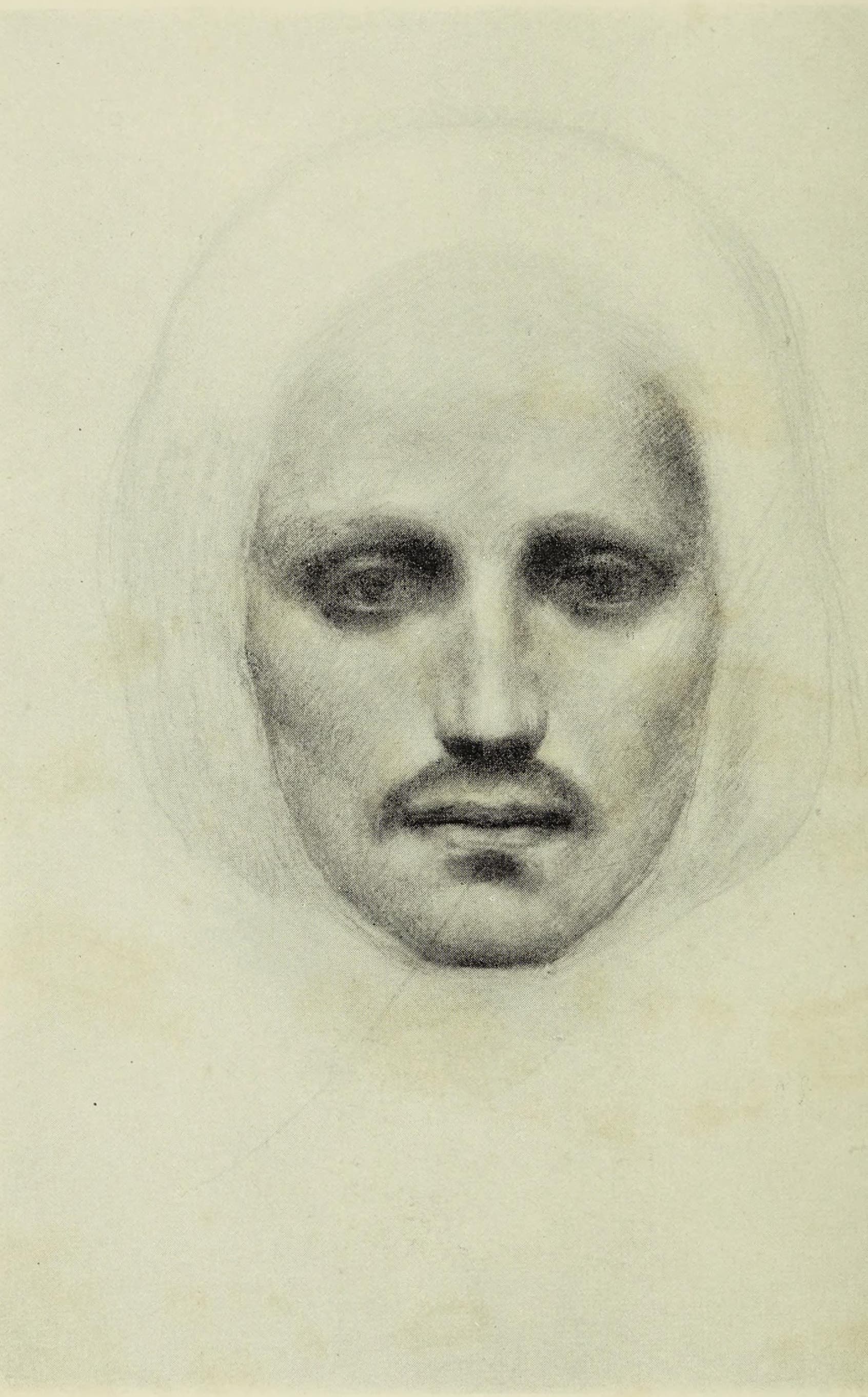
A charcoal drawing of a man's face seen straight on, filling the plate. The eyes sit in deep shadow, with only the eye on the viewer's left showing a drawn iris. The nose is long with a highlight down the ridge, and a dark moustache crosses the closed mouth. Hair falls on both sides as long pale vertical strokes, with the top of the head marked by a single faint arc. Below the chin the drawing stops, leaving bare paper crossed by two faint lines

Artwork reproduction

Drawing

Face of Almustafa

1923 · Charcoal, reproduced as the frontispiece plate of The Prophet (Alfred A. Knopf, New York, 1923)

A man's face, drawn frontally in charcoal and printed as the first thing a reader of The Prophet sees. Kahlil Gibran made the twelve illustrations for the book himself, and Alfred A. Knopf tipped this one in facing the title page in September 1923. The face is usually identified as Almustafa, the prophet whose farewell sermons fill the volume.

Published in The Prophet (Alfred A. Knopf, New York, 1923)

Kahlil Gibran, Face of Almustafa, 1923. Published in The Prophet (Alfred A. Knopf, New York, 1923). Image: public domain (US).

A pencil portrait of a woman's head and shoulders in the upper half of a large pale sheet. Her hair is swept up and back off the forehead in dense diagonal strokes with a bare curving highlight through it. She looks out and slightly to her left; the eye on the viewer's left is fully drawn while the other is a soft smudge of shadow. Fine diagonal shading gathers on the cheek and jaw on the viewer's right, the lips are closed, and below the chin only a shaded neck and two faint lines for a blouse are drawn before the paper goes blank. Two lines of pencil writing sit at the lower right

Artwork reproduction

Drawing

Portrait of Mary Haskell

1910 · Pencil on wove paper

A pencil portrait of the woman who paid for everything: Mary Haskell, the Boston schoolmistress who funded Kahlil Gibran's years of art study in Paris and remained his patron, editor and closest correspondent for twenty-seven years. She kept the sheet, annotated it in her own hand, and gave it to Telfair Museums in Savannah in 1950, where it is numbered 1950.8.94.b.

Telfair Museums

Kahlil Gibran, Portrait of Mary Haskell, 1910. Telfair Museums. Image: public domain.

A pencil drawing of a young man's head and neck on a large sheet of pale paper, looking straight out. His hair is a thick mass of parallel diagonal strokes arcing over the temple, his brows are dark and heavy, and a soft moustache covers his upper lip above closed lips. The eye on the viewer's left is fully drawn with iris and lashes; the other sits in shadow. The neck is drawn in outline with no collar, and the lower half of the sheet is bare except for a line of pencil writing at the lower right

Artwork reproduction

Drawing

Self-Portrait

1910 · Pencil on wove paper

A pencil head of the artist at twenty-seven, looking out of the sheet, drawn in 1910 — the year Kahlil Gibran left Paris after two years of study paid for by Mary Haskell. The sheet is one half of a pair at Telfair Museums in Savannah: its companion, numbered 1950.8.94.b, is his portrait of Mary Haskell.

Telfair Museums

Kahlil Gibran, Self-Portrait, 1910. Telfair Museums. Image: public domain.

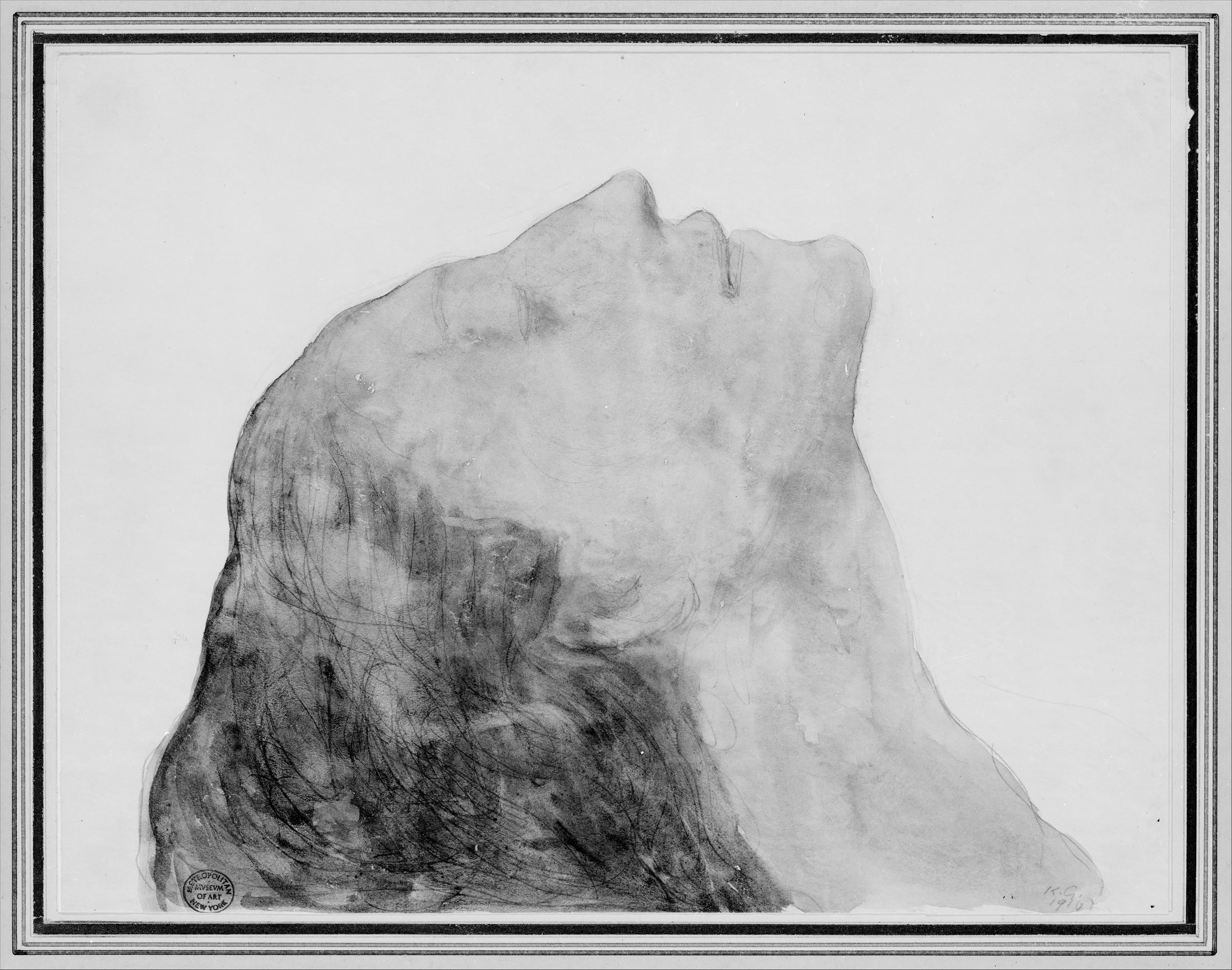
A black-and-white photograph of a watercolour drawing in a mount with a ruled black border. A head is tipped back with the eyes closed, its profile carried by a single contour over the brow, nose and lips, the face left as a pale wash. A heavy mass of dark hair worked in fine curving graphite strokes fills the lower left, and a long pale wash runs from the jaw out to the right for the throat and chest. A pencil signature reading K.G. over 1916 sits at the lower right, and a circular museum stamp is pressed over the hair at the lower left

Artwork reproduction

Drawing

Towards the Infinite

1916 · Watercolor and graphite on paper

A head tipped back with the eyes closed, painted in thin watercolour over pencil, with a mass of dark hair worked in fine graphite strokes. Kahlil Gibran signed and dated it 1916 and made it the frontispiece of Twenty Drawings, the book of his own plates that Alfred A. Knopf published in 1919. The Metropolitan Museum of Art catalogues the sitter as his mother, Kamila Gibran.

The Metropolitan Museum of Art

Kahlil Gibran, Towards the Infinite, 1916. The Metropolitan Museum of Art. Image: CC0.

People Kahlil Gibran Knew

Relationships with other people, with sources for each connection.

Illustrated portrait of Auguste Rodin

Auguste Rodin

  • Sculptor

Met · 1908

Gibran's biographers place a meeting during his Paris study years, 1908 to 1911, and credit Rodin with putting the work of William Blake into his hands — an encounter Blake's mark on everything Gibran wrote afterwards makes plausible. The edge is recorded as probable rather than documented because the Rodin connection is routinely overstated: the sentence in which Rodin supposedly calls Gibran the William Blake of the East, or of the twentieth century, is repeated everywhere in Gibran publicity and has never been traced to anything Rodin wrote or is recorded as saying. Telfair Museums, which holds the largest public collection of Gibran's art in the United States, names Blake and the French Symbolists among his influences without invoking Rodin at all. Cite the meeting; do not quote the endorsement.

— Gibran: Man & Poet — the Kahlil Gibran Collective; Suheil B. Bushrui and Joe Jenkins, Kahlil Gibran: Man and Poet — A New Biography (1999); Visions of The Prophet: The Visual Art of Kahlil Gibran — Telfair Museums

Questions about Kahlil Gibran

Who was Kahlil Gibran?

A Lebanese-American poet, essayist and painter, born in Bsharri in northern Lebanon in 1883, brought to Boston at twelve, and dead in New York at forty-eight in 1931. He wrote The Prophet (1923), twenty-six short prose sermons that became one of the best-selling books of the twentieth century, and he was also a painter — nearly a hundred of his pictures are at Telfair Museums in Savannah, Georgia.

Why is his name spelled Kahlil in some places and Khalil in others?

Because he had an Arabic name and an American one. In Arabic he is Gibran Khalil Gibran — his own first name, his father's, his grandfather's. The books he published in English carry the shorter, respelled form Kahlil Gibran, and that is the name museums and libraries file him under. Khalil Gibran, the straight transliteration, is what most people type into a search box. All three name the same man.

What did Kahlil Gibran do in Paris?

He studied and painted there from 1908 until about 1911, in his mid-twenties, entirely on money sent from Massachusetts by his patron Mary Haskell — a fact recorded in her own papers at the University of North Carolina. He came home with the influences that shaped the rest of his work: the Italian Renaissance, the English Pre-Raphaelites, the French Symbolists, William Blake, and Nietzsche's Thus Spake Zarathustra, whose solitary mountain prophet is the ancestor of Almustafa in The Prophet.

Did Auguste Rodin call Gibran the William Blake of the East?

There is no evidence that he did. The sentence is attached to Gibran everywhere — on book jackets, on quotation sites — but no source has ever been produced for it in Rodin's own words, and the museums that hold Gibran's art do not repeat it. What his biographers do say is that Gibran met Rodin in Paris and that Rodin pointed him toward Blake. Treat the meeting as likely and the famous quotation as publicity.

What is The Prophet about?

A prophet called Almustafa, after twelve years in the city of Orphalese, is about to sail home. Before he goes, the people ask him to speak, and he answers in twenty-six short prose poems — on love, marriage, children, work, giving, joy and sorrow, freedom, death. Gibran illustrated it himself. Alfred A. Knopf published it in 1923 in a first printing of 1,300 copies, which sold out in a month; it has sold steadily ever since without ever needing a revival.

Is Gibran regarded differently in Arabic?

Completely differently. English-language readers meet a gentle aphorist. Arabic-language readers meet a founder of literary modernism: he wrote in Arabic before he wrote in English, and in New York he helped found Arrabitah, the Pen Bond, the league of émigré Arab writers that brought Romanticism into Arabic poetry, loosened its thousand-year-old metrical rules, and established the prose poem as a form. He was called the genius of his age in his own lifetime, and the phrase meant something more strenuous than the English reputation suggests.

Where can you see Kahlil Gibran's paintings?

Telfair Museums in Savannah, Georgia holds the largest public collection in the United States — nearly a hundred drawings, watercolours and paintings given in 1950 by Mary Haskell Minis, the patron who had paid for his training. The artwork and possessions that Mary Haskell shipped back to Lebanon after his death are in Bsharri, the mountain village where he was born, kept in the old monastery there as the Gibran Museum.

Connections and Sources

Kahlil Gibran’s connections to people, places, and works, with the sources behind each one.

Met · 1908

Auguste Rodin

Gibran's biographers place a meeting during his Paris study years, 1908 to 1911, and credit Rodin with putting the work of William Blake into his hands — an encounter Blake's mark on everything Gibran wrote afterwards makes plausible. The edge is recorded as probable rather than documented because the Rodin connection is routinely overstated: the sentence in which Rodin supposedly calls Gibran the William Blake of the East, or of the twentieth century, is repeated everywhere in Gibran publicity and has never been traced to anything Rodin wrote or is recorded as saying. Telfair Museums, which holds the largest public collection of Gibran's art in the United States, names Blake and the French Symbolists among his influences without invoking Rodin at all. Cite the meeting; do not quote the endorsement.

— Gibran: Man & Poet — the Kahlil Gibran Collective; Suheil B. Bushrui and Joe Jenkins, Kahlil Gibran: Man and Poet — A New Biography (1999); Visions of The Prophet: The Visual Art of Kahlil Gibran — Telfair Museums

Depicted in · 1910

Self-Portrait

Telfair Museums catalogues the sheet as Self-Portrait, dated 1910, and the sheet itself is annotated in pencil at the lower right: Self-Sketch by Kahlil Gibran ab. 1910. The note is in the third person, so it is an owner's label rather than a signature, and the abbreviation records the date as an estimate. The date is approximate for the same reason.

— Kahlil Gibran Collection — Telfair Museums online collection, 1950.8.94.a; The Art of Kahlil Gibran — Telfair Museums exhibition, 2010–11

References

References

The sources below include biographies, scholarly essays, interviews, and primary materials that informed this page. They reflect both the historical record and ongoing critical conversations about Kahlil Gibran and their work.

  1. 1abcdGibran: Man & Poet — the Kahlil Gibran Collective

    Website
    The Kahlil Gibran Collective
    Used for

    The Kahlil Gibran Collective's biography, drawn from Bushrui and Jenkins, on Bsharri, Boston, the Paris years, The Prophet's first printing and the Arabic reputation.

    View source
  2. 2abcMinis Family Papers, 1739–1948 (collection 02725), Southern Historical Collection

    Archive
    Wilson Special Collections Library, University of North Carolina at Chapel Hill
    Used for

    The Mary Haskell archive — letters, diaries and sketches — and the finding aid's summary of her support for Gibran's European travels of 1908–1911.

    View source
  3. 3abcThe Art of Kahlil Gibran — Telfair Museums exhibition, 2010–11

    Website
    Telfair Museums, Savannah, Georgia
    Used for

    Telfair Museums on the 1895 emigration, the 1904 Fred Holland Day exhibition, the 1950 Haskell gift, and The Prophet's standing as a top-selling book of the century.

    View source
  1. 4abcKahlil Gibran: Man and Poet — A New Biography

    Biography
    Oneworld, 1999
    Used for

    The standard modern English biography; the source behind the Collective's account, listed here as further reading.

  2. 5↑Visions of The Prophet: The Visual Art of Kahlil Gibran — Telfair Museums

    Website
    Telfair Museums, Savannah, Georgia
    Used for

    Telfair on Gibran as a painter first, and on the influences he acknowledged: the Renaissance, the Pre-Raphaelites, the French Symbolists and William Blake.

    View source
i
Why these sources are here

These references anchor the page in the documented record and in the scholarly conversations around Kahlil Gibran. Every claim on this page traces back to one or more of the works listed here.

Explore more resources
Browse all authors