The Paris AtlasCharting the artists, works, and places worth returning to.
  • Photographer
  • Filmmaker
· Swiss-American · 1924–2019

Robert Frank

Swiss-American photographer and filmmaker who recruited Kerouac to introduce The Americans and collaborated with him on Pull My Daisy.

Details

Lived
1924–2019
Born
9 November 1924
Birthplace
Zurich, Switzerland
Died
9 September 2019 · aged 94
Place of death
Inverness, Nova Scotia, Canada
Nationality
Swiss-American
Profession
Photographer and filmmaker
Major works
The Americans, Pull My Daisy, The Lines of My Hand, Cocksucker Blues
Married
Mary Lockspeiser · married 1950, divorcedJune Leaf · married; together until his death in 2019
Children
Andrea Frank, Pablo Frank
Roles
PhotographerFilmmaker

About Robert Frank

Swiss-American photographer and filmmaker, author of The Americans

Robert Frank was a Swiss-American photographer and filmmaker, born in Zurich on 9 November 1924. His 1958 book The Americans, eighty-three photographs chosen from thousands taken on road trips across the United States, is often called the most influential photography book of the twentieth century. Its grainy, off-kilter, melancholy view of postwar America changed what photography was allowed to look like.

Frank emigrated to New York in 1947, tired of fashion and magazine work, and won a Guggenheim Fellowship in 1955 to photograph the whole country. The book that resulted found no American publisher at first and was mocked when it appeared, until an introduction by Jack Kerouac and the slow verdict of other artists made it canonical. Around 1959 Frank turned largely from still photography to film, directing the Beat short Pull My Daisy and, later, the suppressed Rolling Stones documentary Cocksucker Blues.

He moved in 1971 to a fisherman's shack at Mabou on Cape Breton Island in Nova Scotia, kept a loft in New York, and made increasingly personal, scratched and collaged work marked by the deaths of both his children. He died at Inverness, Nova Scotia, on 9 September 2019, aged 94.

Zurich, the fashion trade, and New York, 1924–1954

Robert Frank was born in Zurich on 9 November 1924 into a Jewish family; his German-born father had been left stateless, and the family watched Nazism from safe but anxious neutral Switzerland. Frank turned to photography to escape a business-minded home, trained under Zurich commercial photographers, and made his first hand-bound book, 40 Fotos, in 1946. In 1947 he emigrated to New York and took a job shooting fashion for Harper's Bazaar.[1]

He chafed at editors' control and travelled, in South America and Europe, before settling back in New York in 1953 as a freelance photojournalist for Vogue, Fortune and other magazines. He married the artist Mary Lockspeiser in 1950, had two children, Andrea and Pablo, and fell in with the loose group Jane Livingston later called the New York School of photographers, among them Diane Arbus and Saul Leiter. Edward Steichen included seven of his pictures in the 1955 blockbuster exhibition The Family of Man.

The Americans, 1955–1959

In 1955, on the recommendation of Walker Evans and others, Frank won a Guggenheim Fellowship to drive across the United States and photograph every layer of its society. Over nine months on the road and more than 27,000 exposures, in Detroit, the Deep South, Nevada, Montana and beyond, he built a bleak, tender, sceptical portrait of the country: jukeboxes, lunch counters, funerals, segregated buses, lonely highways. He met anti-Semitism on the road, jailed overnight in Arkansas and ordered out of another town, and the darkness entered the work.[2]

He chose eighty-three photographs from the thousands. No American publisher would take them, so The Americans appeared first in Paris in 1958, as Les Américains, and only in 1959 in the United States. Early reviewers called it sloppy, blurred and depressing. But Frank had met Jack Kerouac, who wrote the introduction to the American edition. Over the following years the book's grainy, subjective, deliberately imperfect style reversed the verdict, until critics called it the most influential photography book of the century.[1]

Film, the Beats, and the Rolling Stones, 1959–1972

As The Americans reached America, Frank had already turned to film. Pull My Daisy (1959), co-directed with the painter Alfred Leslie, was written and narrated by Kerouac and acted by Allen Ginsberg, Gregory Corso and other Beats. It was praised for years as pure improvisation, until Leslie revealed it had in fact been carefully planned, rehearsed and professionally lit. Frank became a lifelong friend of Ginsberg and one of the chief photographers of the Beat scene.

His best-known film is the one almost no one can see. Cocksucker Blues, his 1972 documentary of the Rolling Stones on tour, showed drug use and backstage squalor so frankly that the band sued to suppress it. A court order limits it to a handful of screenings a year, and only with Frank present. His photograph also made the cover of the Stones' album Exile on Main St.[3]

Mabou, the losses, and death, 1971–2019

Frank separated from Mary in 1969, married the sculptor June Leaf, and in 1971 moved to a former fisherman's shack at Mabou on Cape Breton Island in Nova Scotia, keeping a loft on Bleecker Street in New York. He returned to still images in autobiographical, collaged and scratched forms, published in The Lines of My Hand (1972), none of which matched the impact of The Americans.

Grief shaped the late work. His daughter Andrea was killed in a plane crash in Guatemala in 1974, and his son Pablo, long ill with schizophrenia, died in 1994. Much of Frank's later art is about those losses, and he founded the Andrea Frank Foundation in her memory. Increasingly reclusive, he still took occasional assignments and directed music videos for New Order and Patti Smith. The National Gallery of Art gave him a major retrospective, Moving Out, in 1994. He died at Inverness, Nova Scotia, on 9 September 2019, aged 94.[3]

How Frank worked

The Americans broke nearly every rule of the well-made photograph. Frank shot fast and handheld, tolerating grain, blur, tilted horizons, harsh cropping and deep shadow, and chose moments other photographers would have discarded. The result reads as felt rather than composed, an outsider's melancholy seen from the side of the road, and it gave later photographers permission to be subjective, rough and personal.

After 1959 he distrusted the single perfect image and moved toward sequence and construction: films built from apparent improvisation, and photographs scratched, doubled, captioned and combined into narrative. Critics have noted that this later work, coming after Robert Rauschenberg's silkscreen composites, no longer broke new ground the way The Americans had. Frank's importance rests on that one book and on the freedom it opened.

Reputation

Frank is regarded as one of the most influential photographers of the twentieth century, and The Americans as its most important photobook. It has been compared to Tocqueville for its outsider's clarity about the United States. It has been reissued repeatedly, most notably in an uncropped fiftieth-anniversary edition in 2008, and its style is visible in nearly all serious documentary photography since.

His pictures are held by the National Gallery of Art, the Museum of Modern Art and museums worldwide, and his role as the visual chronicler of the Beats keeps him tied to Kerouac and Ginsberg. The suppressed Rolling Stones film and the album cover for Exile on Main St. gave him a second, rock-and-roll afterlife, but it is The Americans that made him permanent.[2]

Life events

  1. 1924

    Born in Zurich, Switzerland, on 9 November, into a Jewish family.

    — Robert Frank

  2. 1947

    Emigrates to New York and works as a fashion photographer for Harper's Bazaar.

    — Robert Frank

  3. 1955

    Wins a Guggenheim Fellowship to photograph the United States, and shows in The Family of Man at MoMA.

    — Robert Frank

  4. 1958

    The Americans is published first in Paris, as Les Américains.

    — Robert Frank

  5. 1959

    The Americans appears in the US with Jack Kerouac's introduction; Frank co-directs the Beat film Pull My Daisy.

    — Pull My Daisy and The Sin of Jesus

  6. 1971

    Moves to a fisherman's shack at Mabou, Nova Scotia, with the sculptor June Leaf.

    — Robert Frank

  7. 1972

    Films the Rolling Stones documentary Cocksucker Blues, later restricted by court order.

    — Robert Frank

  8. 1974

    His daughter Andrea is killed in a plane crash in Guatemala; grief shapes his later work.

    — Robert Frank

  9. 1994

    The National Gallery of Art gives him the retrospective Moving Out; his son Pablo dies the same year.

    — Robert Frank

  10. 2019

    Dies at Inverness, Nova Scotia, on 9 September, aged 94.

    — Robert Frank

Selected works

Cataloged from the holding institutions' records. Reproductions appear only where the rights are verified.

Photographs

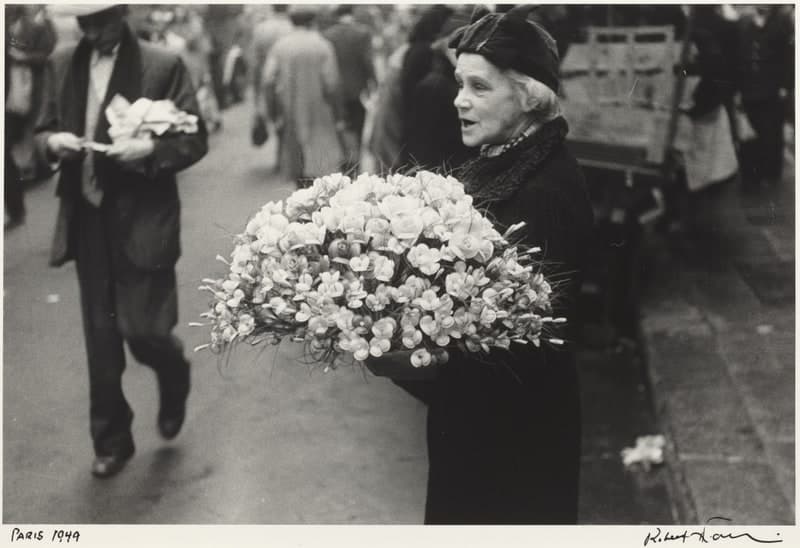
A black-and-white street photograph. An elderly woman in a dark coat, a heavy knitted collar and a dark cloth cap over white hair walks from right to left with her mouth open, carrying a wide armful of small pale flowers on long stems across her front. Behind her a man in a flat cap and dark suit walks toward the camera holding a paper-wrapped bunch, out of focus, with a blurred crowd behind him. A wooden handcart with slatted sides stands at the right, and two or three loose blooms lie on the paving at the lower right. In the white margin below the image the artist has written Paris 1949 at the left and signed at the right

Artwork reproduction

Photograph

Flowers, Paris

1951, printed 2004–05 · Gelatin silver print

An elderly woman walks along a Paris street with an armful of pale flowers held across her front, her mouth open in mid-speech. A man in a flat cap comes toward the camera behind her, carrying a small wrapped bunch. The National Gallery of Art in Washington owns the print as 2010.22.1 and dates the negative to 1951, while Robert Frank signed the sheet Paris 1949.

National Gallery of Art

Robert Frank, Flowers, Paris, 1951, printed 2004–05. National Gallery of Art. Image © the rights holder, shown under fair use.

A horizontal black-and-white photograph of a dark brick wall with pale mortar, holding two windows with projecting sills. At the left window a heavy-set woman in a short-sleeved dress with a small repeating print leans forward on the sill, one bare forearm on the ledge, her face behind the glass of the raised sash and under a white roller blind, blurred and shadowed. At the right window a person in a light buttoned coat with a rounded collar stands with one hand raised near chin height and the other at the waist, the head completely hidden by a large American flag that hangs across the upper right of the wall, its canton at the upper left and its stripes billowing off the right edge of the frame

Artwork reproduction

Photograph

Parade—Hoboken, New Jersey

1955, printed 1977 · Gelatin silver print

Two people watch from separate windows in a brick wall while an American flag hangs across the wall between and above them. The flag covers the second person's head completely. Robert Frank made the photograph in Hoboken, New Jersey, in 1955 and printed this sheet in September 1977; the National Gallery of Art holds it as 1991.82.5.

National Gallery of Art

Robert Frank, Parade—Hoboken, New Jersey, 1955, printed 1977. National Gallery of Art. Image © the rights holder, shown under fair use.

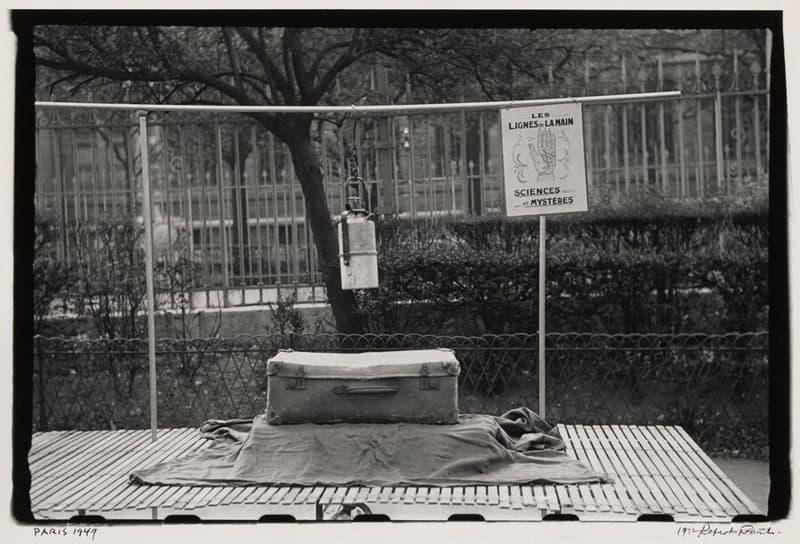
A black-and-white photograph with a printed black border. A flat handcart of narrow wooden slats fills the lower third of the frame, a folded canvas sheet spread over it and rucked up at the right, with a pale battered suitcase standing in the middle, its corners capped in metal. Two thin poles rise from the cart carrying a horizontal bar; a pale metal canister with a side handle hangs from a hook at its centre, and at the right a hand-lettered placard hangs from the same bar reading LES LIGNES DE LA MAIN above a drawing of an open palm and SCIENCES ET MYSTÈRES below. Behind stand a low looped wire fence, a clipped hedge, tall park railings and bare trees. In the margin below, PARIS 1949 is written at the left and the print is signed 1972 Robert Frank at the right

Artwork reproduction

Photograph

Paris

1949, printed 1972 · Gelatin silver print

A battered suitcase sits on a folded tarpaulin spread over a slatted wooden handcart, beside park railings in Paris. A hand-lettered sign hanging above it reads LES LIGNES DE LA MAIN and, below a drawing of an open palm, SCIENCES ET MYSTÈRES. Robert Frank made the negative in 1949 and Sid Kaplan printed this sheet in 1972 for the National Gallery of Art's 1994.57.1.

National Gallery of Art

Robert Frank, Paris, 1949, printed 1972. National Gallery of Art. Image © the rights holder, shown under fair use.

A warm-toned black-and-white photograph in upright format. A rough-barked tree trunk fills the left of the frame and runs off the top edge. Beside it, slightly right of centre, stands an empty folding chair with a plain wooden backboard and five wooden seat slats on a thin bent-steel frame with cross-braces and feet that curl to points. Both stand on dry, pale, gritty ground scattered with small stones and a few twigs, which runs flat to the top of the frame with no horizon and no sky

Artwork reproduction

Photograph

Tree and Chair/Paris

1949 · Gelatin silver print

An empty folding park chair stands on bare sandy ground beside a tree trunk. Robert Frank made the photograph in Paris in 1949 and bound a print of it into Black White and Things, the book he assembled by hand in Zurich in 1952. The National Gallery of Art in Washington holds that volume complete, and this sheet is number 29 in its third section.

National Gallery of Art

Robert Frank, Tree and Chair/Paris, 1949. National Gallery of Art. Image © the rights holder, shown under fair use.

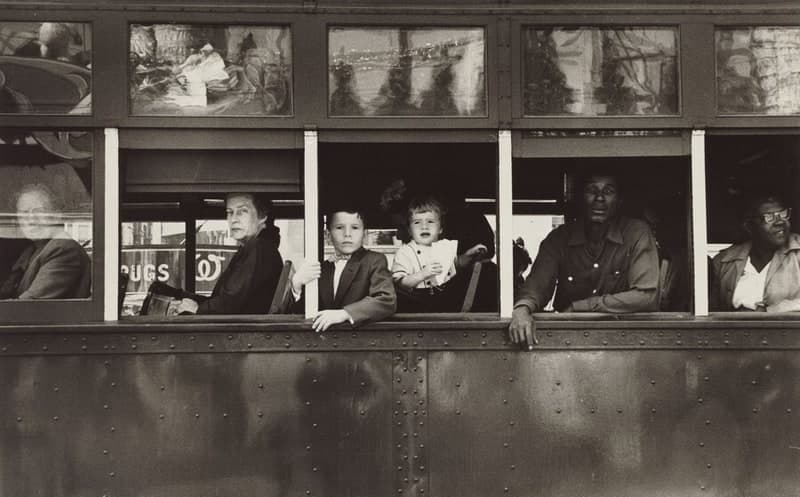
A horizontal black-and-white photograph of the side of a streetcar, cut off at both ends. A riveted metal flank fills the lower third. Above it, five windows hold six passengers in a row: a man behind closed glass at the left, an older white woman in a dark coat looking straight out under arched eyebrows, a white boy in a jacket gripping a white window post, a small child with an open mouth holding a folded white paper, a Black man in a long-sleeved button-down shirt leaning on the ledge on both forearms, and at the right edge a Black woman in glasses looking back over her shoulder. A row of smaller panes above them reflects the street behind the camera, and a shop sign reading DRUGS shows through the first window

Artwork reproduction

Photograph

Trolley—New Orleans

1955 · Gelatin silver print

Six passengers look out of the windows along one side of a New Orleans streetcar. The National Gallery of Art describes the seating order plainly: the four people at the front are white, the two at the back are Black. Robert Frank made the photograph in 1955, and it went into the book Robert Delpire published in Paris in 1958 as Les Américains.

National Gallery of Art

Robert Frank, Trolley—New Orleans, 1955. National Gallery of Art. Image © the rights holder, shown under fair use.

People Robert Frank Knew

Relationships with other people, with sources for each connection.

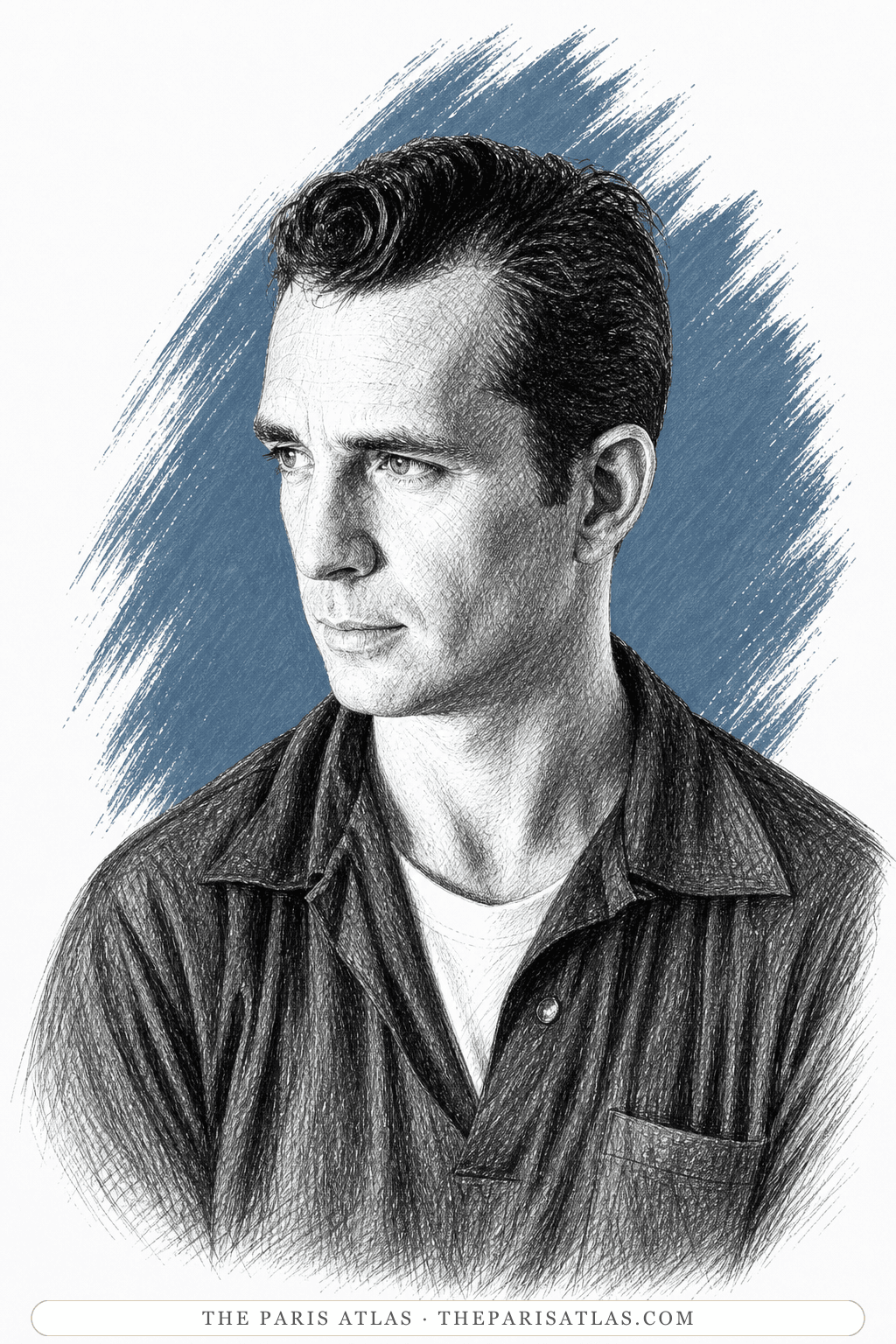
Illustrated portrait of Jack Kerouac

Jack Kerouac

  • Author
  • Poet

Collaborated with · 1958

Kerouac wrote the introduction to Frank's The Americans and supplied the spontaneous narration for Frank and Alfred Leslie's Pull My Daisy.

— Pull My Daisy (1959); Pull My Daisy and The Sin of Jesus

Questions about Robert Frank

Who was Robert Frank?

Robert Frank (1924–2019) was a Swiss-American photographer and filmmaker, best known for his 1958 book The Americans, widely regarded as the most influential photography book of the twentieth century. Its grainy, melancholy, outsider's view of postwar America changed documentary photography. Frank later turned to filmmaking, directing the Beat short Pull My Daisy and the suppressed Rolling Stones documentary Cocksucker Blues, and spent his last decades in Nova Scotia.

What is The Americans?

A book of eighty-three black-and-white photographs Frank chose from some 28,000 taken on road trips across the United States, funded by a 1955 Guggenheim Fellowship. Its images of jukeboxes, lunch counters, funerals, segregated buses and empty highways offered a bleak, tender outsider's portrait of the country. First published in Paris in 1958 and in the US in 1959 with an introduction by Jack Kerouac, it was mocked at first, then became one of the most influential works in the history of photography.

What was Robert Frank's connection to the Beats?

Close and lasting. Frank met Jack Kerouac shortly after his road trips, and Kerouac wrote the introduction to the American edition of The Americans, which helped the difficult book find an audience. Frank then co-directed the 1959 short film Pull My Daisy, written and narrated by Kerouac and acted by Allen Ginsberg, Gregory Corso and others. He became a lifelong friend of Ginsberg and one of the chief visual chroniclers of the Beat Generation.

Why is Cocksucker Blues banned?

Frank's 1972 documentary followed the Rolling Stones on their American tour and showed heavy drug use and backstage debauchery so candidly that the band sued to stop its release. A court settlement restricted the film to no more than a handful of screenings a year, and only when Frank himself is present, so it has almost never been shown publicly. It remains his most notorious film, quite apart from his fame in photography.

How did Robert Frank die?

He died on 9 September 2019 at his home in Inverness, on Cape Breton Island in Nova Scotia, Canada, at the age of 94. He had lived since 1971 in the fishing community of Mabou nearby, dividing his time with a loft in New York. His final decades were shadowed by the deaths of both his children, his daughter Andrea in a 1974 plane crash and his son Pablo in 1994, losses that ran through his late work.

What made Frank's photography style so influential?

Frank broke the conventions of the polished photograph. He shot fast and handheld, accepted grain, blur, tilted horizons and heavy shadow, and picked moments other photographers would have thrown away, so his pictures feel seen and felt rather than staged. Contemporary critics called The Americans sloppy, but the raw, subjective approach gave later photographers permission to be personal and imperfect, and it underlies most serious documentary photography made since.

Connections and Sources

Robert Frank’s connections to people, places, and works, with the sources behind each one.

Collaborated with · 1958

Jack Kerouac

Kerouac wrote the introduction to Frank's The Americans and supplied the spontaneous narration for Frank and Alfred Leslie's Pull My Daisy.

— Pull My Daisy (1959); Pull My Daisy and The Sin of Jesus

References

References

The sources below include biographies, scholarly essays, interviews, and primary materials that informed this page. They reflect both the historical record and ongoing critical conversations about Robert Frank and their work.

  1. 1abRobert Frank

    Website
    The Museum of Modern Art
    Used for

    The Museum of Modern Art's artist record.

    View source
  2. 2abRobert Frank

    Website
    National Gallery of Art
    Used for

    The National Gallery of Art's artist record, which held the 1994 Moving Out retrospective.

    View source
  3. 3abRobert Frank, Pivotal Figure in Documentary Photography, Is Dead at 94

    Periodical
    The New York Times, 2019
    Used for

    The New York Times obituary of September 2019, used for the death and the career assessment.

    View source
  4. 4Robert Frank

    Website
    Wikipedia
    Used for

    Reference article cross-checked for the emigration, the Guggenheim road trips, The Americans, the films, and the death.

    View source
  5. 5National Gallery of Art to Premiere Looking In: Robert Frank's "The Americans", press release, 14 February 2008

    Official record
    National Gallery of Art, Washington, 2008
    Used for

    The National Gallery of Art's announcement of Looking In, giving the 1955–1956 road trips, the 767 rolls and more than 27,000 exposures, publication in France in 1958 and the United States in 1959, and Frank's gifts of archival material to the Gallery in 1990, 1994 and 1996.

    View source
  1. 6Robert Frank, Fellow 1955 and 1956, Photography

    Official record
    John Simon Guggenheim Memorial Foundation
    Used for

    The Guggenheim Foundation's own fellow record, which lists Frank in photography for 1955 and 1956.

    View source
  2. 7Robert Frank's Groundbreaking Photographs Featured in Major Exhibition Marking 50th Anniversary of His Book The Americans, press release

    Official record
    The Metropolitan Museum of Art, 2009
    Used for

    The Metropolitan Museum of Art's release for the New York showing of Looking In, confirming the eighty-three photographs of the original book and the hostile American reception in 1959.

    View source
  3. 8The Robert Frank Collection: Access and Rights

    Archive
    National Gallery of Art, Washington
    Used for

    The National Gallery of Art's guide to the Robert Frank Collection, the archive of prints, negatives and contact sheets Frank gave the Gallery.

    View source
  4. 9Pull My Daisy and The Sin of Jesus

    Official record
    The Museum of Modern Art
    Used for

    Official record used to verify names, dates, institutional details, or other factual information on this page.

    View source
i
Why these sources are here

These references anchor the page in the documented record and in the scholarly conversations around Robert Frank. Every claim on this page traces back to one or more of the works listed here.

Explore more resources