Alphaville
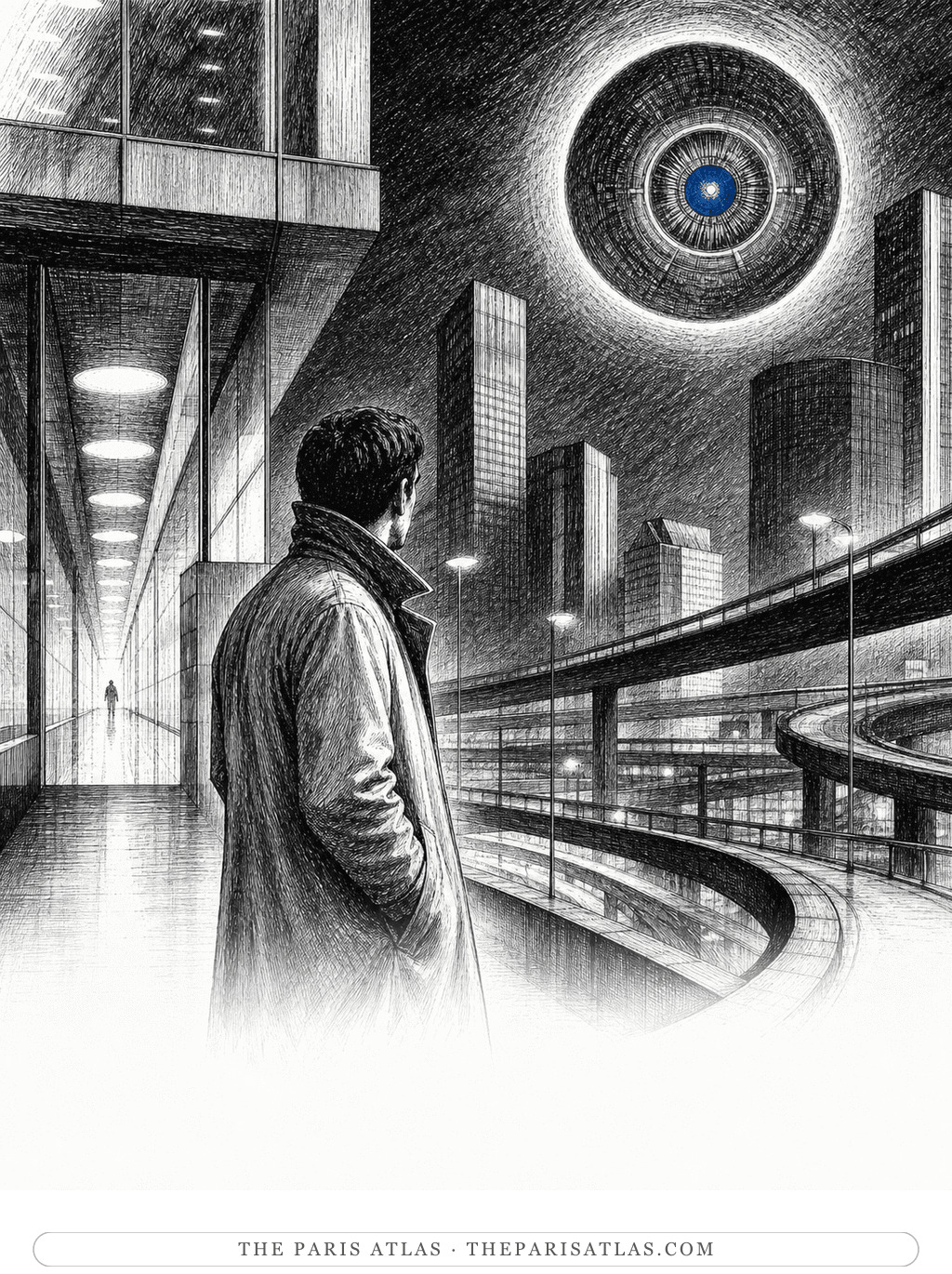
A science-fiction film with no sets, no effects and no future. Godard sent a trench-coated American detective into a city ruled by a computer, and shot the whole thing in the actual streets and buildings of Paris in 1965 — office blocks, corridors, a swimming pool, a hotel. The bet is that the modern city already looks like a dystopia if you photograph it at night and refuse to explain anything. It won the Golden Bear at Berlin.
- 1965
- Feature film, black and white
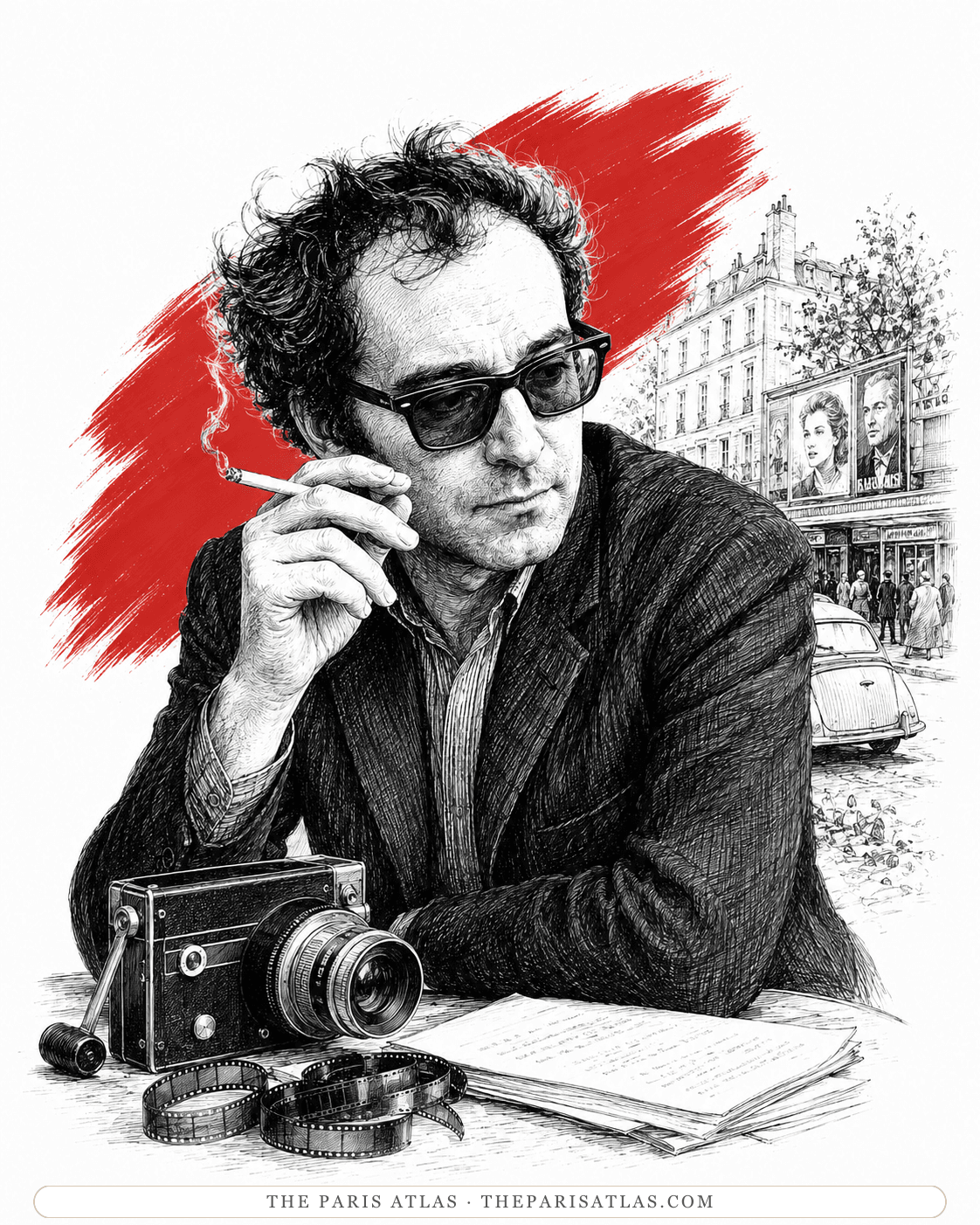
About Jean-Luc Godard
What happens in it
Lemmy Caution, a secret agent posing as a journalist, drives into Alphaville — a city in another galaxy, reached by car — to find a missing agent and to deal with Professor von Braun, the scientist who built the place. Alphaville is run by Alpha 60, a computer that has outlawed emotion. Words for feelings are being deleted from the dictionary each year. People who weep at a spouse's death are executed.
Caution meets von Braun's daughter Natacha, played by Anna Karina, who has been raised inside the system and has no word for what she starts to feel. The film ends with him driving her out, and with her managing to say a sentence she has no vocabulary for.
That is genuinely the whole plot, and it is deliberately a pulp plot. Eddie Constantine was already famous for playing Lemmy Caution in a long series of straight French detective thrillers. Godard hired the actor and the character intact and dropped them into science fiction without changing the trench coat.
The reason this page exists
Alphaville is Paris, filmed as it was
There is no production design in this film in the ordinary sense. Godard and his cinematographer Raoul Coutard shot the city of Paris in 1965 and called it the future. The computer centre is a real electricity board building. The hotel Caution stays in is a real hotel. The swimming pool where executions are carried out is a real municipal pool on the edge of the city.
The BFI's account of how the effect was achieved is almost comically low-tech: no trick shots, no special effects, and a deliberate refusal to add lighting — the menace comes from reflection and shadow, and from shooting at night in buildings that were already there.
What makes it work is that mid-1960s Paris was in the middle of an argument with itself. Modernist office towers and glass corridors were going up against nineteenth-century stone, and Godard simply pointed the camera at the new stuff. The film is a documentary of a real city undergoing real change, wearing a science-fiction costume.
It is worth watching for that reason alone. Alphaville preserves the texture of a Paris that was being built at exactly that moment, and it preserves it from the point of view of someone who found it sinister.
The voice of the computer
Alpha 60 speaks in a rasping, mechanical growl that is genuinely unpleasant to listen to. The voice was supplied by an actor who had had a laryngectomy and spoke through a mechanical device — a real damaged human voice used to play a machine, rather than a machine effect used to play a machine.
What it says is not technical. Alpha 60 delivers aphorisms about time, memory, logic and death that sound like a philosophy seminar conducted by something with no interest in the answer. The film's real argument is there: not that computers will kill us, but that a society organised entirely around logic will quietly stop having words for the things that make life bearable.
How to watch it
Do not go in expecting science fiction to behave. There is no explanation of how a car drives between galaxies, and asking is the wrong question — the film is a fable using genre furniture, closer to a fairy tale than to Star Wars.
Go in for the city, the faces and the language. And go in knowing that the emotional weight lands at the very end, in one sentence spoken by Karina, which the whole film has been withholding the vocabulary for.
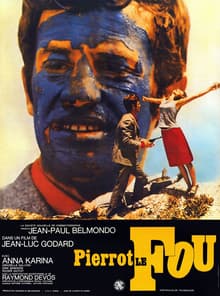
If you are working through Godard, this sits after Breathless and Vivre sa vie and just before Pierrot le Fou, which he made in the same year. Alphaville and Pierrot le Fou are the two halves of 1965: one shot in grey Paris at night, one in colour on the Mediterranean.
Timeline
1965
Godard shoots the film on location in Paris with Raoul Coutard, using existing buildings instead of sets.
1965
Alphaville wins the Golden Bear at the Berlin International Film Festival.
1965
Godard releases Pierrot le Fou in the same year — in colour, and on the Mediterranean.
Frequently asked questions
What is Alphaville (1965) about?
A secret agent, Lemmy Caution, travels to Alphaville — a city controlled by a computer called Alpha 60 that has banned emotion and is deleting words for feelings from the dictionary. He is sent to find a missing agent and confront the scientist who built the system, and he leaves with the scientist's daughter Natacha, played by Anna Karina.
Where was Alphaville filmed?
In Paris, on location, in 1965. Godard used no sets and no special effects: real office buildings, corridors, hotels and a municipal swimming pool on the city's outskirts stand in for the future city. The film is effectively a documentary of Paris's new modernist architecture, shot at night to make it look menacing.
Did Alphaville win any awards?
Yes — the Golden Bear, the top prize at the Berlin International Film Festival, in 1965.
Who stars in Alphaville?
Eddie Constantine as Lemmy Caution, a character he had already played in a series of straight French detective thrillers, and Anna Karina as Natacha von Braun. Akim Tamiroff plays the missing agent Henri Dickson. Raoul Coutard shot it and Paul Misraki wrote the score.
Is Alphaville a science-fiction film?
In its furniture, yes; in its method, no. There are no effects, no future technology on screen and no explanation of how interstellar travel works by car. Godard borrowed the genre's shapes — the dystopian city, the controlling computer, the agent sent in — and used them to make a fable about a real city and a real fear.
What is Alpha 60?
The computer that governs Alphaville. It speaks in a harsh mechanical rasp — voiced by an actor who spoke through a device after a laryngectomy — and delivers aphorisms about logic, time and death. Its rule is that emotion is illegal, and the words for emotions are progressively removed from circulation.
Where does Alphaville fit in Godard's films?
It is his 1965 black-and-white film, made the same year as the colour Pierrot le Fou. Watch it after Breathless (1960) and Vivre sa vie (1962). Alphaville and Pierrot le Fou make a useful pair: the same year, the same star in Anna Karina, and completely opposite worlds.
More by Jean-Luc Godard


If you like Jean-Luc Godard
Explore directors from the same movements and circles.
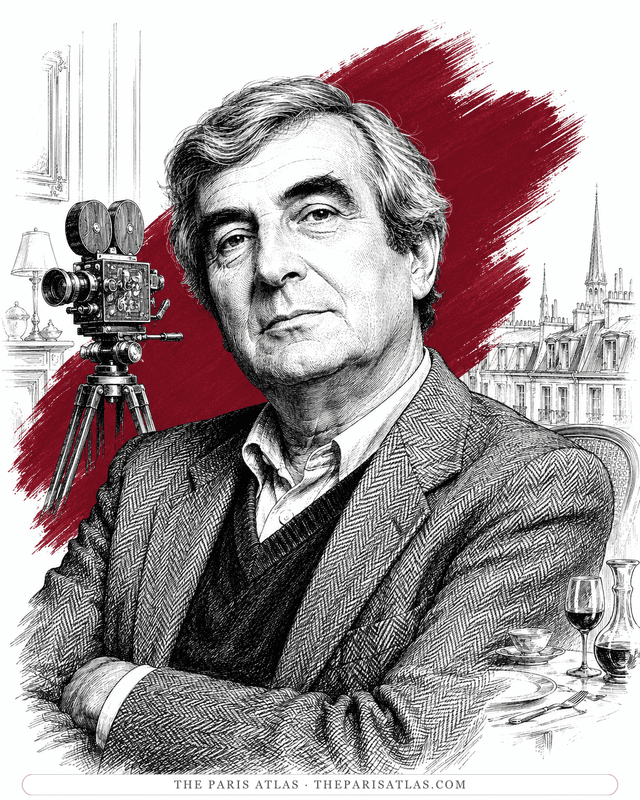
Claude Chabrol
The Cahiers du cinéma critic who reached the screen first: his 1958 debut Le Beau Serge was the first feature from the group that made the New Wave. Over fifty years he became the 'French Hitchcock,' anatomist of the provincial bourgeoisie.
View artist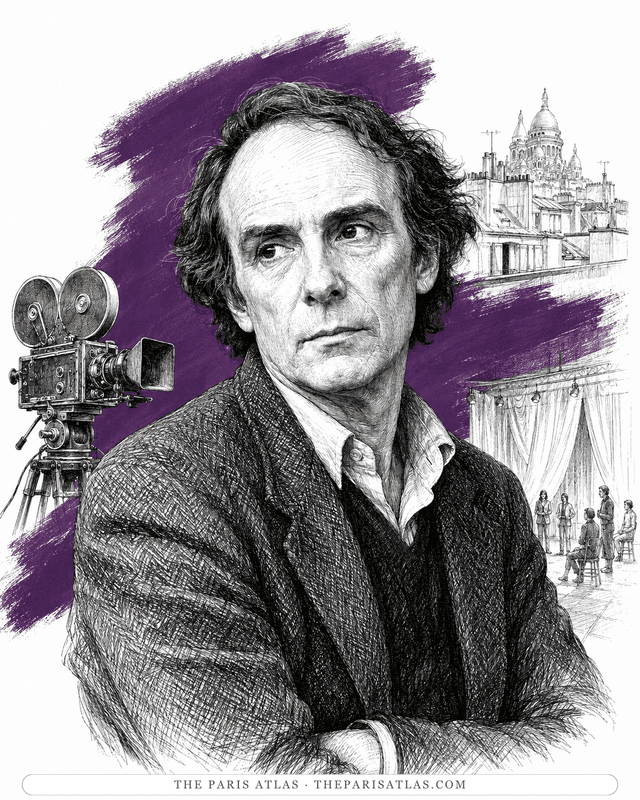
Jacques Rivette
The most experimental of the Cahiers du cinéma directors. Rivette made films built on theatre, improvisation, and unusual length — from Paris Belongs to Us to the thirteen-hour Out 1 and Celine and Julie Go Boating.
View artist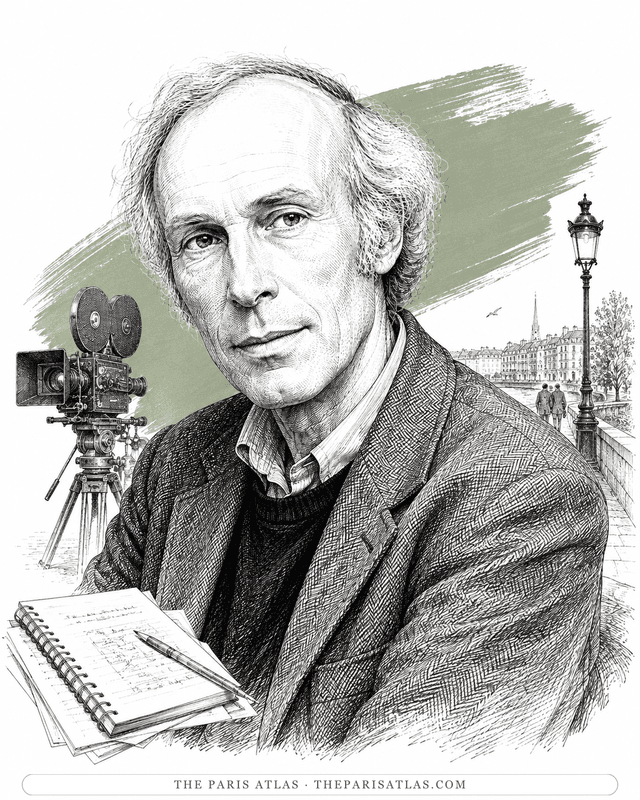
Éric Rohmer
Critic and editor of Cahiers du cinéma who became the New Wave's most literary director. His Six Moral Tales — My Night at Maud's, Claire's Knee — built a body of talkative, closely observed films about desire and hesitation.
View artist
References
The sources below include collection records, catalogues, scholarly research, and primary materials that informed this page. They document Alphaville, its making, and its place in cultural history.


1Godard's best film? Alphaville turns 60
PeriodicalSight and Sound, British Film InstituteUsed forThe BFI on the full title, the cast, Coutard's photography, Misraki's score, the real Paris locations, and how the future was achieved without effects or added lighting.

2The Berlinale Mourns the Loss of Jean-Luc Godard
WebsiteInternationale Filmfestspiele Berlin, 2022Used forThe Berlin festival's own confirmation that the 1965 jury gave Godard the Golden Bear for Alphaville.
3Alphaville (1965)
WebsiteThe Criterion CollectionUsed forWeb source consulted for documented facts and historical context presented on the Alphaville page.
4Alphaville (1965)
WebsiteBFI PlayerUsed forWeb source consulted for documented facts and historical context presented on the Alphaville page.
These references provide the documented foundation for this work's history and interpretation. Claim-level citations remain attached to the specific claims they support.
 Explore more resources