A square canvas, 59.5 centimetres each way, divided by black lines into rectangles of red, yellow, blue, black and several different whites. Piet Mondrian sold it in Paris within the year he finished it. The first thing to notice in front of it is that several of the black lines stop before they reach the edge. The painting is at the Kunstmuseum Den Haag.
A red plane takes up the upper left and most of the middle, about a fifth of the whole square. Yellow appears three times: a narrow band along the top right, a larger block directly below it, and a third block in the bottom left corner. Blue appears once, low on the right. Red appears a second time, as a small block wedged into the bottom right corner.
Black is used two ways, and the difference matters. Black paint draws the lines, and it also fills two planes in its own right — a large rectangle below the red plane, and a band running right from the foot of that rectangle. Every other rectangle is pale.
The pale rectangles are not one colour. The field to the left of the red plane is a warm cream. The field above it, across the black line, is a blue-grey. The two below the red plane, in the middle of the canvas, are the darkest and coolest in the picture. The strips along all four edges are paler blue-grey again, and are the canvas edges turning over the stretcher.
The lines stop short of the edge
The Kunstmuseum Den Haag asks readers to look at the boundaries of the planes and points out that the lines do not run all the way to the edge everywhere. Where the lines stop, the colours appear to pass from one plane into the next and mix. The museum's reading is that the stopping keeps the composition compact, and stops it suggesting a fragment of something that carries on past the canvas.
The lines stop short repeatedly. The long horizontal across the top stops short at both ends. The two verticals that box in the yellow blocks at the top right both begin below the top edge rather than at it. The short horizontal at the left stops before the canvas edge, so the cream field above it and the field below join behind it. Above the yellow block at the bottom left, another horizontal stops short, and the yellow block runs on past the line's end.
One black vertical does not stop at another line at all. Near the top, a stub about a fifth of the way across rises from the long horizontal and ends in mid-air, with nothing above it. The stub's tip is blunt and slightly ragged, and a thin grey film covers the last few millimetres where the white paint of the field was carried back down across the black line.
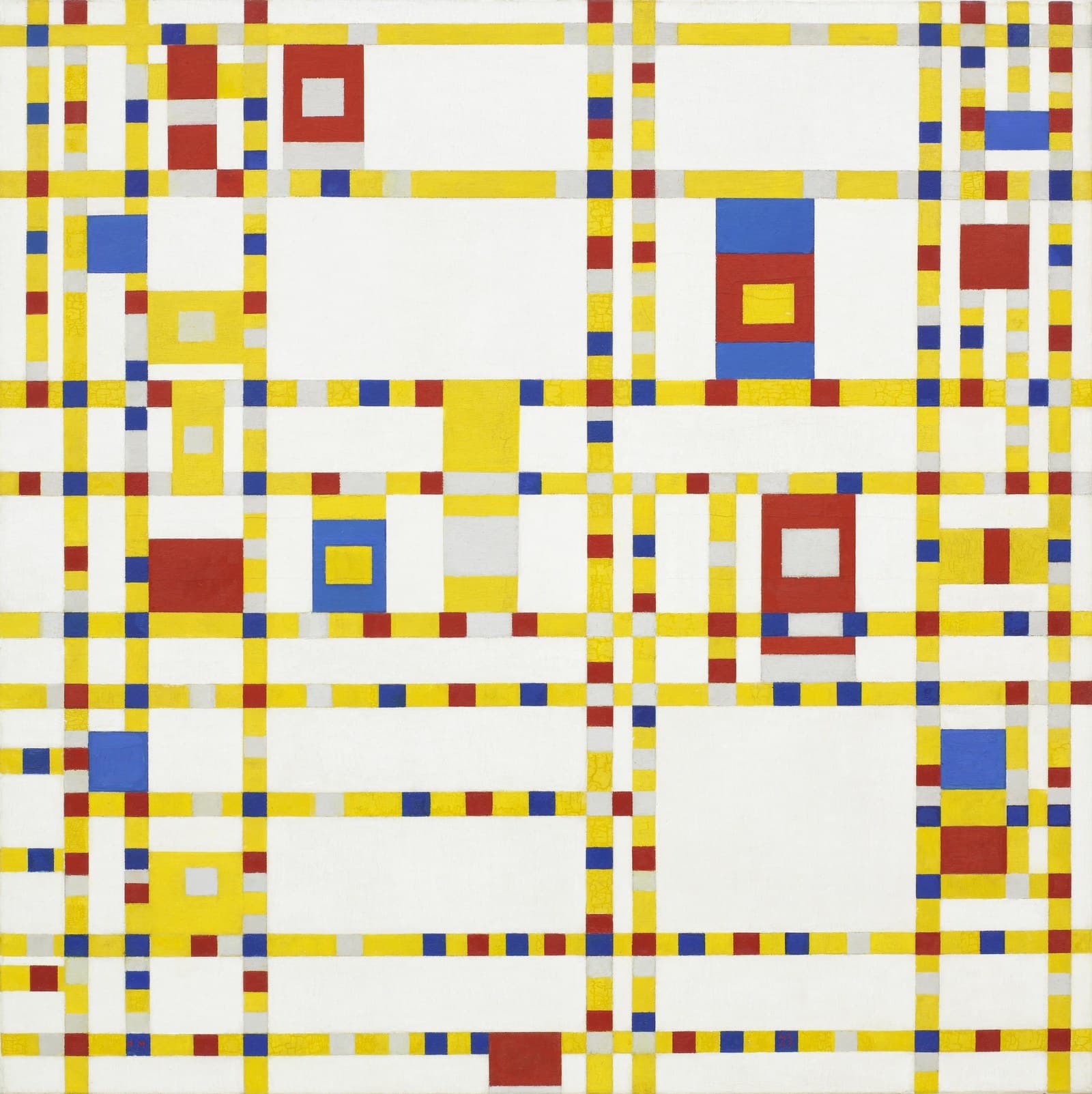
The museum treats this as a dated habit rather than a quirk. Writing about Tableau I (Painting I), also painted in 1921, the museum says that canvas opens outward on every side because its black lines run off the edge. The museum contrasts Tableau I with earlier works in which the lines stop before reaching the edge, and names this painting as the example.
Not really primary, and not really white
By 1921 Mondrian was already known for red, yellow and blue. The Kunstmuseum Den Haag's flat contradiction of that reputation is worth quoting in full: the colours are not really primary and the white is not really white. He went on mixing his colours throughout his career, the museum says, to tune them to one another.
The painting bears this out under magnification. The red plane is a warm scarlet with orange in it, not a pure red. The yellow blocks are a warm ochre-yellow, the same in all three places the colour appears. The blue block is a deep, slightly green ultramarine. The black planes are a very dark olive-black, greener than the black of the lines beside them.
The whites are the clearest case. The cream field to the left of the red plane and the grey field below it are far apart, the cream lighter and warmer by a wide margin. Two pale rectangles that sit side by side on the right, separated only by a thin vertical, are also not the same: one is slightly warmer and darker than the other.
Painted by hand, and it shows
None of the lines is taped or ruled. The lines vary in width along their length, their edges waver, and the horizontals are visibly wider than the vertical that separates the two pale rectangles on the right. Where a horizontal meets a vertical, one usually stops against the other rather than crossing it.
The weave of the canvas shows through everywhere, including through the red, blue and black planes, so the paint layer is thin. A fine network of cracks runs across the pale fields and the yellow blocks. Inside the large black rectangle the brush passes did not merge: a vertical seam and a horizontal seam are visible where separate blocks of black meet.
The signature is at the bottom centre, in small black capitals, and reads P M '21. The signature sits in the pale strip below the black band, and the letters are drawn with a fine brush, slightly uneven in height.
Sold in a week, and it paid for a better studio
In the autumn of 1921 Jo Steijling, an acquaintance from Laren in the Netherlands, came over to Paris and stayed a week. She bought this painting. According to the Kunstmuseum Den Haag, the sale gave Mondrian enough confidence to rent a more expensive studio in his old street, the rue du Départ.
The museum quotes him on what he was after by then. Writing in 1919, he said: "Ten slotte is den kunstenaar een bepaald natuurgegeven niet meer nodig om tot een schoonheidsbeeld te komen." In English: the artist finally no longer needs a given fact of nature to arrive at an image of beauty. Red, yellow and blue start appearing in the work from that point on.
Close reading
Reading the work, detail by detail
The square canvas of 1921 rewards magnification more than it looks as though it will. None of the black lines is ruled or taped: they change width along their length, their edges waver, and several stop short of the canvas edge. The Kunstmuseum Den Haag warns that the colours are not really primary and the white is not really white, and both statements hold up under a lens.
1.A black line that ends in mid-air
A short black vertical rises from the long horizontal near the top and simply stops. No other line meets it. The stub's tip is blunt and slightly ragged, and a thin grey film lies over the last few millimetres where the white paint was carried back down across the black line. The pale field to its left is blue-grey; the pale field to its right is cream.
2.Signed P M '21 at the bottom centre
The signature sits in a pale band below the black band, drawn with a fine brush in small capitals: P M, then an apostrophe and 21. The letters are uneven in height. Above them the black band shows horizontal brush drag and a lower edge that wanders by a millimetre or two.
3.The black plane was painted in blocks
Inside the large black rectangle the paint is thin enough for the weave to count through it everywhere. The rectangle is not one field: a faint vertical seam and a faint horizontal seam show where separate passes of black met and did not merge. The colour is a very dark olive-black, not a neutral one.
4.The line stops before the edge
A black horizontal runs in from the right and stops a few millimetres before the pale blue-grey strip at the canvas edge. The pale field passes behind the line's blunt end and joins the field above. The Kunstmuseum Den Haag reads this as the device that keeps the picture from looking like a fragment of something larger.
5.The red is a warm scarlet, and thin
The red plane is an even warm scarlet with orange in it, not a pure red. The paint is thin enough that the weave reads through the whole field, and a fine crack network runs across it. No thick paint stands up anywhere in the plane, and the tone does not change from one side to the other.
6.The blue carries the brush direction
The blue plane is a deep ultramarine with a little green in it. Lighter streaks run diagonally across the field where the brush was dragged, so the direction of the brush is easy to read. The black line below it is markedly thinner than the one to its left.
7.Yellow, then a line, then the canvas edge
At the upper right a black horizontal runs into a black vertical and stops against it without crossing. Beyond the vertical, a pale blue-grey strip runs to the edge, and that strip is the canvas turning over the stretcher. The yellow field is a warm ochre-yellow, and it carries fine cracks from age that the flat colour hides at normal viewing distance.
8.Two whites that are not the same white
Two pale rectangles sit side by side, divided by a thin black vertical. The two are not the same colour: the left one is slightly warmer and a shade darker than the right. The vertical between them is also the thinnest line in the picture, noticeably narrower than the horizontals above and below it.
9.The yellow runs past the end of the line
The black horizontal above the yellow block at the bottom left stops short of the canvas edge. Because the line stops, a tab of yellow carries on above its blunt end and runs to the edge strip. The tab is the clearest instance in the painting of a colour crossing a boundary the lines were meant to hold.
10.A second red in the corner
A small block of red is wedged into the bottom right corner, separated from the blue block by a single black vertical. The small block is very slightly duller and pinker than the large red plane across the canvas. Red therefore appears twice in the picture, at opposite corners of the composition.
11.Lines meet by stopping, not crossing
Where the long horizontal reaches the vertical that boxes in the red plane, it stops against it instead of crossing. The junction is a T. The vertical is the wider of the two, and its left edge is straighter than its right, which wavers along its whole length.
12.Where the red plane ends
The red plane ends against a horizontal that reads brown-black where it crosses the black plane below. Two black paints are in contact here and they are not the same: the line is warmer, the plane greener. Below and to the right the pale field is the darkest and coolest grey in the picture.
Timeline
1919
Writes that an artist no longer needs a given fact of nature to arrive at an image of beauty. Red, yellow and blue begin to appear in the work.
1921
Paints the canvas and signs it at the bottom centre, P M '21.
Autumn 1921
Jo Steijling, an acquaintance from Laren, visits Paris for a week and buys the painting. The sale gives Mondrian the confidence to rent a more expensive studio in his old street, the rue du Départ.
1921
Paints Tableau I (Painting I), in which the black lines run off the edge instead of stopping short.
Where to see it
Kunstmuseum Den Haag
The Hague, Netherlands
A public viewing address has not yet been confirmed for this holding.
Gallery displays change, and the museum rotates its Mondrian holdings. Check the museum's own object record before making a special visit.
Frequently asked questions
Where is Composition with large red plane, yellow, black, gray and blue?
At the Kunstmuseum Den Haag in The Hague, object number 0333329. The museum credits it simply to Kunstmuseum Den Haag. Displays change, so check the museum's own record before travelling to see it.
Why do the black lines stop before the edge?
To keep the composition closed. The Kunstmuseum Den Haag explains that where the lines stop, the colours seem to pass from one plane into the next and mix. The effect keeps the picture compact and stops it reading as a fragment of something continuing beyond the canvas. The museum notes that the habit disappears in later works.
Are the colours really primary?
No. The Kunstmuseum Den Haag states plainly that the colours are not really primary and the white is not really white, and that Mondrian went on mixing his colours all his career to tune them to one another. The red plane is a warm scarlet, the yellow blocks a warm ochre-yellow, and the pale rectangles range from a warm cream to a cool grey.
How big is it?
59.5 by 59.5 centimetres — a square a little under two feet on each side. Oil on canvas, dated 1921 by the Kunstmuseum Den Haag.
Who bought it first?
Jo Steijling, an acquaintance of Mondrian's from Laren in the Netherlands. She came to Paris in the autumn of 1921, stayed a week, and bought the painting. The Kunstmuseum Den Haag records that the sale gave Mondrian the confidence to take a more expensive studio in the rue du Départ.
How is it different from Tableau I of the same year?
By what happens at the edge. The Kunstmuseum Den Haag describes Tableau I (Painting I) as opening outwards on every side because its black lines run off the canvas edge, and names this painting as the earlier kind, where the lines stop before they get there. Tableau I is 103 by 100 centimetres; this one is a 59.5-centimetre square.
Is the title Composition with large red plane or Composition with Large Red Plane?
The Kunstmuseum Den Haag prints both. The museum's English collection page gives Composition with large red plane, yellow, black, gray and blue, while the caption inside its own photograph of the painting uses title case: Composition with Large Red Plane, Yellow, Black, Gray and Blue. The Dutch title is Compositie met groot rood vlak, geel, zwart, grijs en blauw.
In the atlas
What the graph records about this work — every claim carries its citation.
Piet Mondrian painted the 59.5-centimetre square in 1921 and sold it in Paris that autumn. The Kunstmuseum Den Haag notes that the lines do not everywhere run to the edge, and that the colours are not really primary.
— Composition with large red plane, yellow, black, gray and blue — collection page
Explore painters from the same movements and circles.
Marcel Duchamp
The century's quietest revolutionary — readymades, the abandonment of painting, chess on a Paris rooftop in Entr'acte, and one anemic film of spinning puns signed Rrose Sélavy.
Brazilian painter who spent the 1920s moving between São Paulo and Paris, studied Cubism under André Lhote, Albert Gleizes and Fernand Léger, and used what she learned to paint Brazilian towns, railways, plants and bodies. Her 1928 painting Abaporu prompted the manifesto that gave the Anthropophagic movement its name.
The sources below include collection records, catalogues, scholarly research, and primary materials that informed this page. They document Composition with large red plane, yellow, black, gray and blue, its making, and its place in cultural history.
1Composition with large red plane, yellow, black, gray and blue — collection page
Website
Kunstmuseum Den Haag
Used for
The holding museum's record: the 1921 date, the 59.5 cm square canvas, Jo Steijling's purchase, the rue du Départ studio, the lines that stop short of the edge, and the statement that the colours are not really primary.
These references provide the documented foundation for this work's history and interpretation. Claim-level citations remain attached to the specific claims they support.





 View source