
Black Spring
The 1936 collection where the essay first appeared and still finds its natural context.
Read our take
by Henry Miller
A blocked writing day becomes a horse, a bridge, a volcano, a gondola, and finally the sad angel hovering above them all.
Miller’s comic account of making one watercolor, first published inside Black Spring and then issued as an illustrated book in 1944. He begins with a horse and keeps converting mistakes into subject matter until the page contains a bridge, burning houses, a volcano, a gondola, cemetery gates, and the melancholy angel of the title. The 1962 Abrams volume Watercolors, Drawings, and His Essay ‘The Angel Is My Watermark!’ placed that text inside a detachable portfolio of Miller’s art. (An essay about process — nothing to spoil.)
The essay begins with artistic paralysis. Miller expects to write, finds himself flooded by memories and notes instead, tries food, wine, a bicycle, and a magazine about art and madness, and finally decides that what he wants is to paint. The rest is a minute-by-minute comedy of improvisation.
A remembered Etruscan horse becomes an elongated, five-legged problem. The extra limb changes into a man’s arm; a copied landscape supplies a bridge and roofs; mistakes in the mountain become the signs of a volcano. When strong color sets the houses ablaze, the horse turns into a dragon and then disappears under paint. The method is conversion rather than correction: he would rather turn a failed horse into a piano than erase it.
The title figure arrives almost as leftover space. Miller draws a sad angel with a sagging stomach and umbrella-rib wings, then recognizes in it the waiting-room posture of people stranded alone with themselves. What survives is not a theory of technique but a theory of permission: the painting’s meaning lies in the story of its accidents.
After a day of creative blockage, the narrator abandons the typewriter for watercolor. He starts with a horse, cannot make its anatomy work, and gradually folds every failure into a new image: a man leaning over a parapet, houses, trees, a bridge, a volcano, a gondola, and cemetery gates.
Color overturns the drawing. The houses catch fire in crimson, the horse becomes a dragon and is painted out, and the small angel in the corner becomes the picture’s governing emblem. The essay records the making because the finished sheet alone cannot show the chain of decisions that produced it.
The sink episode makes damage part of composition rather than its opposite. Miller subjects the apparently ruined watercolor to soaking and scrubbing, then reverses the gesture by flattening the altered sheet with conspicuous care. Rough intervention and delicate attention belong to the same process. His subsequent claim of a masterpiece is comic, but the accompanying reflection does not pretend that confidence eliminates hesitation or error. It gathers both into the work's making. The episode therefore offers more than permission to be careless: continuing requires the painter to recognize and attend to a result he did not fully control.
The station comparison gives the angel an exhausted human body instead of supernatural power. Waiting travelers supply its sagging posture, while the time they must spend alone with themselves becomes a kind of confinement. By locating these figures in recognizable stations, Miller brings the apparently fantastic image back into ordinary public life. The metaphor does not rescue the travelers from their isolation; it asks the observer to see that isolation differently. What looks like an eccentric invention in the watercolor becomes a way of noticing vulnerability in people who are merely waiting.
Every mistake gets narrated, justified, and converted into the next image; confidence and self-mockery arrive in the same sentence.
The essay explains Miller’s writing as well as his watercolor: begin anywhere, resist erasure, and let accidents redirect the form.
A Black Spring chapter, a 1944 illustrated book, and a 1962 detachable art portfolio — the publication history is part of its meaning.
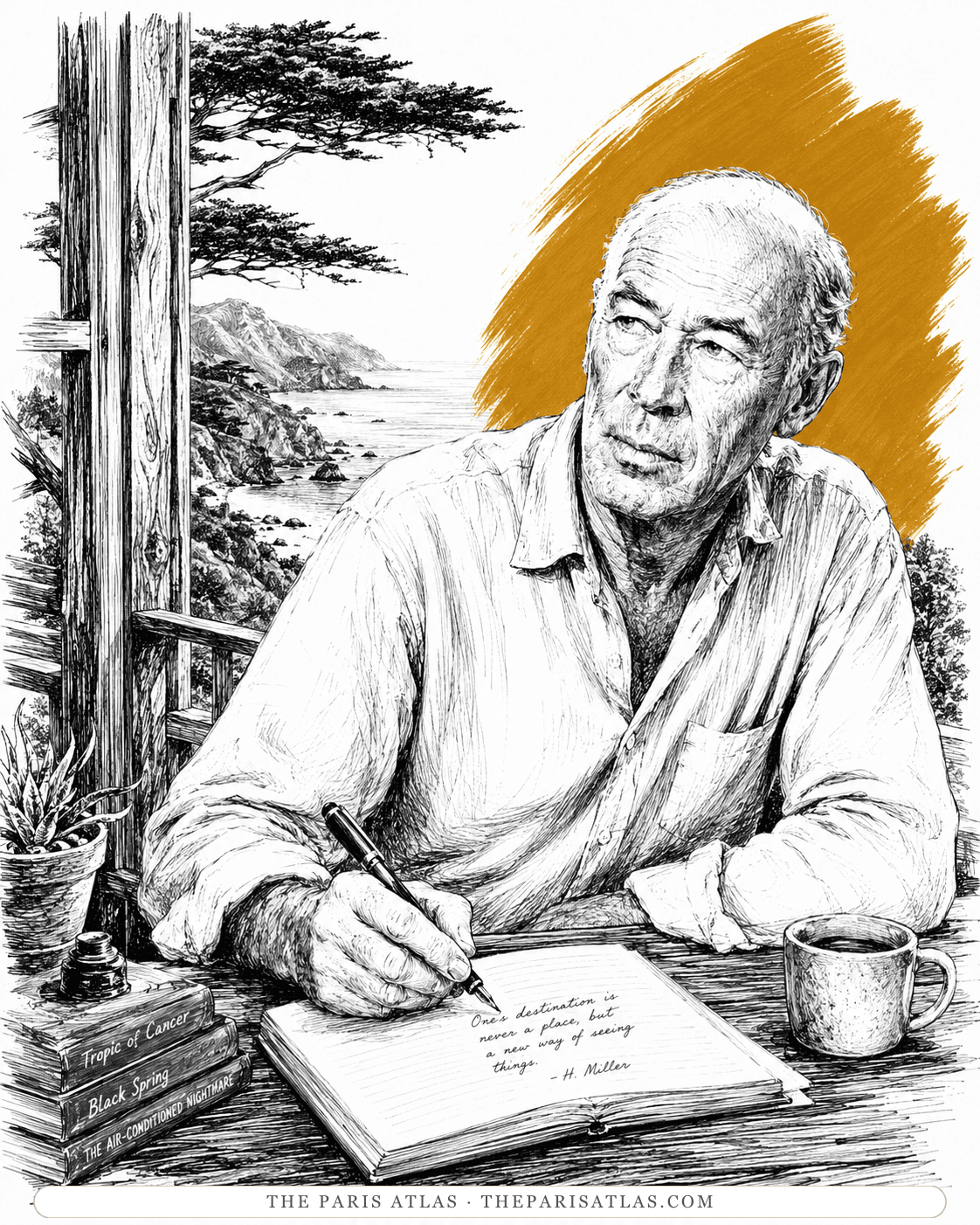
Miller as his own comic studio subject: blocked at the typewriter, liberated by the refusal to erase a bad horse.
1936
The essay first appears as one of the ten pieces in Black Spring.
1944
Holve-Barrows publishes an illustrated book edition with seven Miller watercolors.
1962
Harry N. Abrams publishes Watercolors, Drawings, and His Essay ‘The Angel Is My Watermark!’ as a detachable art portfolio.
The 1936 collection where the essay first appeared and still finds its natural context.
Read our take
The late book in which painting again becomes a second language for autobiography.
Read our take
It is Henry Miller’s comic account of making a watercolor, turning a failed horse and a series of mistakes into a finished image crowned by a sad angel.
No. The essay first appeared in Black Spring in 1936, then received an illustrated book edition in 1944.
It is Harry N. Abrams’s 1962 art-book edition, pairing the essay with Miller’s art in a 39-page portfolio whose plates could be removed and placed in two supplied frames.
A melancholy figure Miller adds to the upper corner of the watercolor, with a sagging body and umbrella-like wings; he associates it with people waiting alone in railway stations.
Yes. The illustrated editions pair the essay with Miller’s visual art; their selection and presentation differ by edition.
Explore authors with a similar voice, perspective, and influence.

Miller's acknowledged master at making literature out of the gutter. Journey gave him permission; Cancer is what he did with it.
View author
Pound read Cancer and sent Miller a famously backhanded postcard. Both believed literature's job was to wake the reader by any means necessary.
View author
French writer and philosopher whose novels, memoirs, and social analysis examined freedom, gender, responsibility, aging, and the material conditions that shape a life.
View authorThe sources below include the primary text, editions, scholarship, archival materials, and other records that informed this page. They document The Angel Is My Watermark, its publication, and its place in literary history.


Primary text included as part of the documented record for The Angel Is My Watermark.

Official record used to verify names, dates, institutional details, or other factual information on this page.
Archival evidence used to document the historical record connected to The Angel Is My Watermark.

Published analysis and historical context used in preparing the The Angel Is My Watermark page.
The new readings use Miller's selected passages reproduced in Barbara Beisinghoff's 2009 artist's book, whose colophon cites Grove Press, 1963. They do not attribute her commentary or artwork to Miller or claim a complete collation of the earlier illustrated editions.
The primary text is the baseline reference for every book page. Additional references document publication history, interpretation, and historical context where that evidence is available.
 Explore more resources