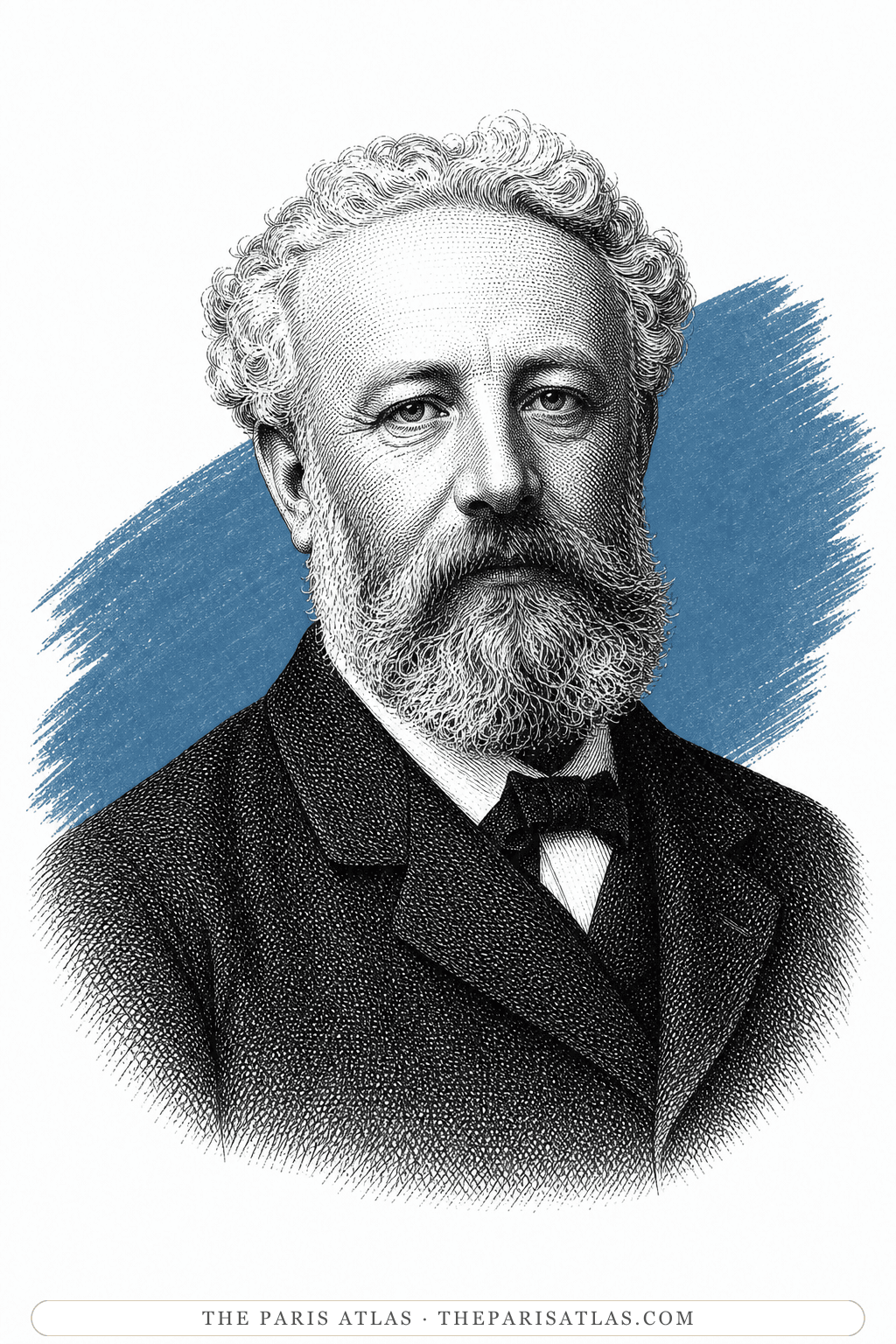


The Mysterious Island
by Jules Verne
Five Northerners escape the American Civil War in a stolen balloon, fall onto an unknown island, and rebuild an industrial country there from nothing.
- 1875
- Exuberant
- Atmospheric
- plot-driven
- episodic
- political
About Jules Verne
The story, briefly
Spoiler-freeIn March 1865, near the end of the American Civil War, five Northerners escape from Richmond, the besieged Southern capital, in a balloon. A storm carries them for five days across the Pacific and drops them on an island no map shows. Cyrus Smith is an engineer, Gideon Spilett a newspaper reporter, Pencroft a sailor, Herbert a fifteen-year-old boy and Neb, Smith's servant. They name the island after Abraham Lincoln. Starting with one match and no tools, they make fire, pottery, iron, glass, explosives and a telegraph. All the while someone they cannot see keeps saving their lives. Jules Verne published the novel in Paris with Pierre-Jules Hetzel in 1874 and 1875.[1][2]
The story, in more detail
The novel appeared in instalments in Hetzel's Magasin d'éducation et de récréation from 1 January 1874 to 15 December 1875. Hetzel issued it as a book in three parts: Dropped from the Clouds, The Abandoned and The Secret of the Island. The illustrated edition of 1875 carries 154 drawings by Jules Férat. According to the national library, part of it came from an earlier manuscript, L'Oncle Robinson, which Hetzel had turned down in 1870.[2][3][4]
The book belongs to a kind of story French calls a robinsonnade, after Daniel Defoe's Robinson Crusoe and Johann David Wyss's The Swiss Family Robinson. Verne said the Robinsons were the books of his childhood. The national library says he wanted to bring the newest science to the form and to write what he called a chemical novel. Cyrus Smith is that science in one man, and much of the book describes him working out how to make each thing the colonists need.[2]
Verne wrote it in Amiens, where he had moved from Paris in 1871. The Paris link is his publisher. The novel is also a sequel. The mysterious helper turns out to be Captain Nemo from Twenty Thousand Leagues Under the Seas. Ayrton, the man the colonists find on a nearby island, comes from Verne's In Search of the Castaways.[5][2]
The full plot
After five days in the air the balloon comes down into the sea off a rocky coast. Cyrus Smith is lost in the surf, and his dog Top with him. The others search for days before Neb finds him lying in the dunes, alive, with no idea how he got there. The colonists have one match between them. Smith later makes a burning glass from the glasses of two watches filled with water, and lights a fire from the sun. From the top of the volcano they see that they are on an island, and they call it Lincoln Island.[1]
Under Smith's direction they build a brick kiln, smelt iron, make nitroglycerine to blast a new outlet for a lake, and move into a dry cave high in a granite cliff that they call Granite House. They fit it with windows, a lift, and later a telegraph wire. Strange things keep happening. Pencroft breaks a tooth on a lead pellet inside a young peccary they are eating, though none of them owns a gun. A crate of tools and weapons washes ashore. A bottle holds a message about a castaway on Tabor Island, a small island nearby.[1]
Pencroft builds a small boat, and on Tabor Island they find Ayrton, a man who has lived alone for twelve years and has become almost an animal. They bring him back. In time he confesses his past as a mutineer and becomes one of them. Then a pirate ship anchors off the island and opens fire. The ship blows up before the pirates can storm Granite House, and the colonists find the remains of a torpedo in the wreck. When Herbert is shot by the surviving pirates and falls ill with fever, a box of quinine appears on the table in Granite House.[1]
How it ends — spoilers ahead
In the fourth year a telegraph message calls the colonists to a cave on the coast. Inside, lit by electricity, lies the Nautilus, and on a couch in its salon lies Captain Nemo, old and dying. He tells them his name is Prince Dakkar, the son of a rajah of Bundelkund in India. He led the rising against British rule in 1857. His parents, wife and children paid for it in his place, and after the defeat he left the world with twenty loyal men. His crew are all dead. He has been watching over the colonists since they arrived.
Nemo dies aboard the Nautilus, and the colonists sink it in the cave as his tomb, as he asked. He has warned them that the island's volcano will soon destroy it. The eruption blows the island apart, and the six men are left on a bare rock. Lord Glenarvan's yacht, the Duncan, picks them up. The yacht came because Nemo had left a notice on Tabor Island giving the island's position. Back in the United States, the colonists buy land in Iowa and found a new colony, which they call Lincoln.
Themes and analysis
Castaways who call themselves colonists
Early on, Pencroft makes a proposal the others accept at once. They should stop thinking of themselves as castaways and call themselves colonists. He promises Smith that they will turn the island into a little America, with towns, railways and telegraphs, and one day hand it to the United States. The national library points out that the name Lincoln Island belongs to the same plan.
The book follows through. Each step of the colony's growth is shown as a problem Cyrus Smith has to solve with what the island provides: clay, iron ore, seals, sulphur, wild wheat. The national library points out that Verne gave the island, on its map, the outline of a shark with open jaws. The library reads the shape as a warning about how dangerous the island could be to the men stranded on it.
The ending tests Pencroff's early confidence almost literally. In chapter XI, the narrator says that even a barren rock would not discourage him if Smith were there. In chapter LXII, a rock is all they have left, and the narrator explicitly declares their knowledge and skill powerless. The rescue depends instead on the notice Nemo left for another crew. This reversal does not make the colony's work worthless; it exposes the difference between ingenuity and guaranteed independence. Their survival requires help beyond the abilities of the group.
Captain Nemo's name, and the English editions that hid it
Five years after Twenty Thousand Leagues Under the Seas left Nemo's origins a secret, Verne gave them here. Nemo is Prince Dakkar, a nephew of Tipu Sultan, the ruler of Mysore who died fighting the British at Seringapatam. He was educated in Europe and led the Indian rising of 1857. His father, mother, wife and children paid for it in his place. Cyrus Smith tells the dying man that his mistake was to believe he could bring back the past and fight against progress. He adds that history will not judge him harshly.
English readers long got a different Nemo. The Encyclopedia of Science Fiction says the Sampson Low translation of 1875 was the work of Agnes Kinloch Kingston, published under the name of W. H. G. Kingston. The same entry says the editing of both Nemo novels removed any suggestion that Nemo had good reason to take revenge on the British who had invaded his country. Stephen W. White's American translation of 1876 keeps the Indian chapters and is the one quoted here.
I die from having believed that man could live alone
Nemo's last speech turns the two Nemo novels around. In Twenty Thousand Leagues Under the Seas he tells Aronnax that his books are his only tie to the land. Here he tells the colonists that solitude and isolation are more than a man can bear, and that he is dying of having believed a man could live alone. The national library sees the same change in Ayrton, who returns to other people after twelve years alone on Tabor Island.
Nemo's final scene changes what repayment can mean. Smith and Spilett cannot prolong his life, yet the colonists can make him comfortable, listen and carry out his wishes. The small act of arranging cushions comes just before the account of priceless objects: the submarine's owner now needs an ordinary human service amid his treasures. When he asks for a promise rather than a rescue, care becomes something other than technical success. The scene gives practical form to his rejection of isolation without suggesting that friendship can undo his losses.
Quotes from The Mysterious Island
If you choose, Mr. Smith, we will make a little America here. We will build cities, lay railroads, establish telegraphs, and some day, when the island is transformed and civilized, offer her to the United States.nous ferons de cette île une petite Amérique! Nous y bâtirons des villes, nous y établirons des chemins de fer, nous y installerons des télégraphes, et un beau jour, quand elle sera bien transformée, bien aménagée, bien civilisée, nous irons l'offrir au gouvernement de l'Union!
“Had you a burning-glass, sir?” asked Herbert of Cyrus Smith. “No, my boy,” said he, “but I made one.”
Captain, your mistake has been in believing that you could bring back the old order of things, and you have struggled against necessary progress.Capitaine, votre tort est d'avoir cru qu'on pouvait ressusciter le passé, et vous avez lutté contre le progrès nécessaire.
Solitude, isolation are sorrowful things, beyond human endurance. I die from having believed that man could live alone!je meurs d'avoir cru que l'on pouvait vivre seul!
Why we recommend it
How to rebuild civilisation from one match
Fire from two watch glasses, then bricks, iron, glass, explosives and a telegraph, each worked out on the page.
Captain Nemo's secret, finally told
The man with no name from the earlier book gets a name, a country and a history in the last part.
A mystery that runs the whole length
Someone keeps saving the colonists: a bullet in a pig, a crate on the beach, quinine on a table. The answer comes late.
What this book explores
The people in its pages

Cyrus Smith
An engineer from Massachusetts and a Union officer, whose knowledge turns a desert island into a working colony.

Gideon Spilett
A war correspondent for the New York Herald, taken prisoner with Smith, who keeps a record of everything.

Pencroft
A sailor who has been everywhere, the colony's boatbuilder, and the one who insists they are colonists, not castaways.

Herbert Brown
A fifteen-year-old orphan in Pencroft's care, the colony's naturalist, whose illness brings the hidden helper into the open.

Neb
Cyrus Smith's servant, born to enslaved parents Smith had freed, who slipped into besieged Richmond to find his master.

Ayrton
A former mutineer left alone on Tabor Island for twelve years, whom the colonists bring back to himself.
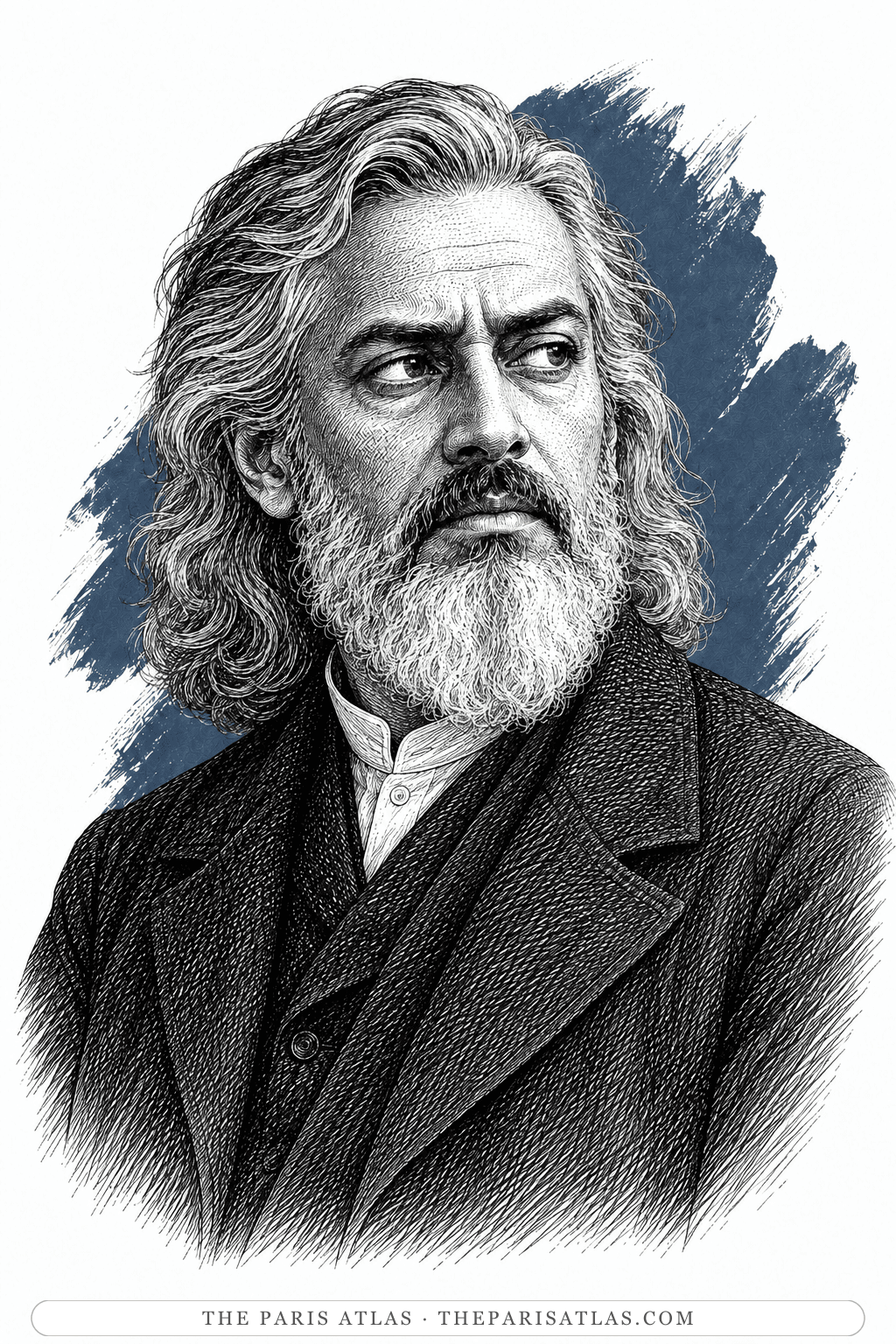
Captain Nemo
The unseen protector of the island, who in the last part reveals himself as the Indian prince Dakkar.
Bring it to book club
- Pencroft wants the colonists to stop calling themselves castaways. What changes when they do?
- Cyrus Smith knows how to make almost everything. Does the book ever let him fail?
- Ayrton lives alone for twelve years and nearly stops being human. What does his story say about Nemo's?
- Smith tells Nemo he fought against progress. Is that fair to a man who fought an empire?
- The island is destroyed at the end. Why might Verne have chosen not to let the colony last?
Timeline
1870
Pierre-Jules Hetzel turns down Verne's manuscript L'Oncle Robinson, parts of which go into this novel.
1 January 1874
The first instalment appears in Hetzel's Magasin d'éducation et de récréation.
1874–1875
Hetzel publishes the novel in three parts: Dropped from the Clouds, The Abandoned and The Secret of the Island.
1875
Sampson Low publishes the Kingston translation in London, with Nemo's Indian past cut.
15 December 1875
The last instalment appears in the magazine.
1876
Stephen W. White's translation is printed in the Philadelphia Evening Telegraph, keeping Nemo's history.
2002
The Modern Library publishes Jordan Stump's complete translation.
Book editions
Hardcover
- Hardcover
- J. Hetzel
- 1875
Hardcover
- Hardcover
- Sampson Low, Marston, Low and Searle
- 1875
- Agnes Kinloch Kingston (published as W. H. G. Kingston)
Hardcover
- Hardcover
- Evening Telegraph, Philadelphia
- 1876
- Stephen W. White

- Paperback
- Modern Library
- 2002
- 9780812966428
- Jordan Stump

- Paperback
- Signet Classics
- 2004
- 9780451529411
Reader reviews
Readers may also like

The Toilers of the Sea
Victor Hugo's 1866 novel of one man working alone with ropes and a forge to beat the sea, published by the same Paris house.
Read our take
Journey to the Center of the Earth
Another Verne party of explorers who meet the forces inside a volcano.
Read our take
The Narrative of Arthur Gordon Pym of Nantucket
Edgar Allan Poe's novel of castaways in the southern seas, which Verne later continued in Le Sphinx des glaces (1897).
Read our takeThe Mysterious Island: frequently asked questions
Is The Mysterious Island a sequel to Twenty Thousand Leagues Under the Seas?
Yes. The hidden helper is Captain Nemo, who tells his story and dies aboard the Nautilus in the last part. The national library describes it as following on from In Search of the Castaways as well, because Ayrton and the yacht Duncan come from that book.
Who is Captain Nemo in this book?
Prince Dakkar, the son of a rajah of Bundelkund in India and a nephew of Tipu Sultan. He led the rising of 1857 against British rule, lost his family, and left the world in the Nautilus.
How do the castaways get to the island?
By balloon. In March 1865 they steal a balloon to escape from Richmond, the besieged Southern capital, and a storm carries them for five days before dropping them into the sea off the island.
Why is it called Lincoln Island?
The colonists are Northerners and name it after President Abraham Lincoln. The national library notes that the name matches Pencroft's plan to build a little America there.
Which English translation should I read?
A complete modern one such as Jordan Stump's for the Modern Library. Of the free older texts, Stephen W. White's 1876 translation keeps Nemo's Indian history. The Kingston translation, the usual British text, cuts it.
What happens to the island?
Its volcano erupts and blows it apart, as Nemo warned. The colonists survive on a rock and are rescued by the yacht Duncan, which found them through a note Nemo had left on Tabor Island.
If you like Jules Verne
Explore authors with a similar voice, perspective, and influence.

Louis-Ferdinand Céline
The doctor of the Paris slums who wrote the century's blackest, funniest novel — and changed the sound of French prose.
View author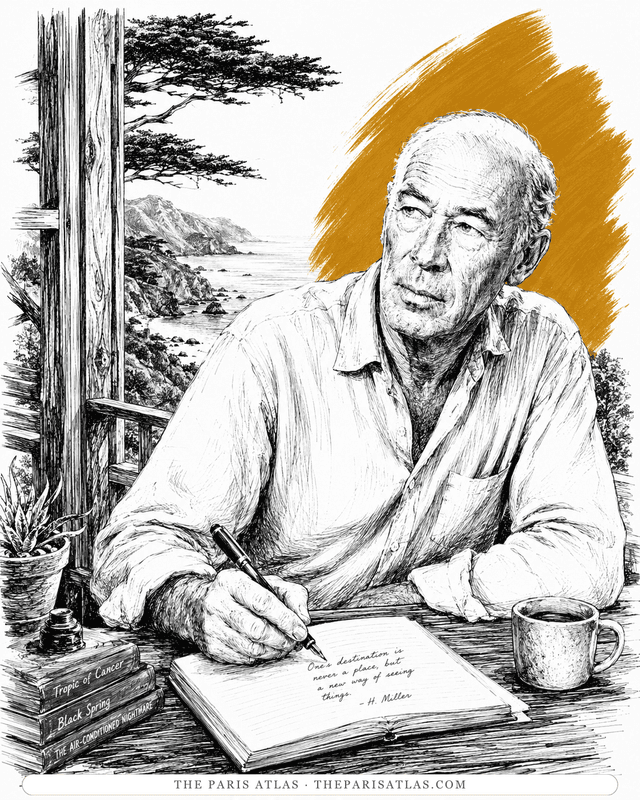
Henry Miller
The Brooklyn dropout who arrived in Paris broke at thirty-eight and wrote the exuberant, banned books that ended American censorship.
View author
Simone de Beauvoir
French writer and philosopher whose novels, memoirs, and social analysis examined freedom, gender, responsibility, aging, and the material conditions that shape a life.
View author
References
References
The sources below include the primary text, editions, scholarship, archival materials, and other records that informed this page. They document The Mysterious Island, its publication, and its place in literary history.


3↑L'Île mystérieuse, illustré de 154 dessins par Férat (J. Hetzel, 1875) — catalogue record
Official recordBibliothèque nationale de France, 1875Used forCatalogue record of the 1875 illustrated Hetzel edition with 154 drawings by Férat.

4↑Verne, Jules
WebsiteThe Encyclopedia of Science Fiction (Clute, Langford, Sleight, eds.)Used forThe three volumes, the Kingston and White translations, and the cutting of Nemo's case against British rule.
5↑Jules Verne, une vie
WebsiteCentre International Jules Verne, AmiensUsed forVerne's move from Paris to Amiens in 1871.
6L'Île mystérieuse (French text)
NovelProject Gutenberg, eBook no. 14287Used forVerne's French text, used for the originals of the quotations.
7The Mysterious Island (translation by Agnes Kinloch Kingston, published as W. H. G. Kingston's)
NovelProject Gutenberg, eBook no. 1268Used forThe Kingston translation, the older British text.
8The Mysterious Island, translated by W. H. G. Kingston (Sampson Low, 1875) — catalogue record
Official recordBibliothèque nationale de France, 1875Used forCatalogue record of the 1875 Sampson Low translation credited to W. H. G. Kingston.
9The Mysterious Island, translated by Jordan Stump, introduction by Caleb Carr (Modern Library, 2002), publisher page
WebsitePenguin Random HouseUsed forPublisher page for Jordan Stump's Modern Library translation.
10The Mysterious Island, afterword by Isaac Asimov, introduction by Bruce Sterling (Signet Classics, 2004), edition record
WebsiteOpen LibraryUsed forOpen Library record of the Signet Classics edition.
11The Mysterious Island
NovelJules Verne, 1875Used forThe primary text represented by this page, used for descriptions of the work’s contents and for any quoted passages shown here.
i
Why these sources are here
The primary text is the baseline reference for every book page. Additional references document publication history, interpretation, and historical context where that evidence is available.
 Explore more resources