
The Stranger
A clerk in Algiers kills a man, then faces a court more interested in his behavior at his mother’s funeral.
Read our take
by Ernesto Sabato
A painter explains a murder from inside the obsession and suspicion that led him to it.
Ernesto Sabato’s 1948 novel places the reader inside the isolated, obsessive mind of painter Juan Pablo Castel as he recounts a relationship and a murder.
The small seascape carries a meaning Castel believes the larger painting’s admirers have missed. When María looks at it, he takes her attention as evidence of an exceptional understanding. Yet the scene gives him an observable action, not access to her thoughts. The leap between those two things is crucial. What might begin a conversation instead becomes, in his imagination, proof of a connection already complete. Her silence leaves room for the certainty he wants to find.
Penguin’s reading guide usefully separates the reliability of Castel’s reported facts from the reliability of his interpretations. Applied to the gallery, that distinction changes the reader’s task. We need not deny that María noticed the window to question the claims he builds on her interest. Sabato places the wish to be understood beside the danger of treating another person as the answer to that wish, rather than as someone whose meanings may differ.
At the office building, Castel lists several explanations for María’s absence and finds that each justifies waiting. As time passes, he becomes increasingly attached to the possibility that she works there, although waiting has supplied no confirmation. The café gives him a vantage point, but not knowledge. This is the unsettling comedy of the episode: elaborate reasoning produces a practical plan while leaving its central assumption untested. Watching the doorway can prolong the search without bringing him closer to understanding the person he seeks.
Because the murder is announced at the outset, the reader cannot encounter this pursuit as an innocent courtship whose outcome remains open. Suspense shifts toward the workings of Castel’s explanations: how will he turn limited observations into a case for his own actions? The short chapters keep exposing successive turns of that reasoning. Following his account closely does not require accepting its conclusions, or confusing the intensity of his desire with a right to control María.
Sabato makes the reader follow a murderer’s obsessive reasoning without offering a simple instruction to condemn or excuse him.
The disclosed murder directs attention to Castel’s reasoning rather than to identifying a culprit.
Castel’s identity as a painter makes recognition and interpretation part of his obsessive relationship.
1948
El túnel is first published in Spanish, attracting praise from Albert Camus.
2011
Penguin Modern Classics issues The Tunnel in Britain.
2012
Penguin Classics publishes the American edition in June.
A clerk in Algiers kills a man, then faces a court more interested in his behavior at his mother’s funeral.
Read our takeJuan Pablo Castel, a painter, narrates the novel. Readers encounter the relationship and murder through his isolated, obsessive perspective.
The interest lies less in discovering a culprit than in following the narrator’s explanations and distortions. His account turns the reader’s attention toward motive and self-justification.
His obsession shapes the way he interprets other people. Readers should separate what he reports from the conclusions he insists those events must support.
Painting connects Castel’s desire to be understood with his interpretation of another person’s attention. The wish for recognition becomes entangled with his possessiveness.
Ernesto Sabato’s novel was published in 1948. Its concentrated first-person narration belongs to a work of fiction, not a criminal case report.
Explore authors with a similar voice, perspective, and influence.

French Algerian novelist, essayist, journalist and playwright who used the absurd and revolt to ask how people should live without false consolation.
View author
American novelist and composer whose expatriate fiction explores dislocation, unstable intimacy, fatalism, and North Africa.
View author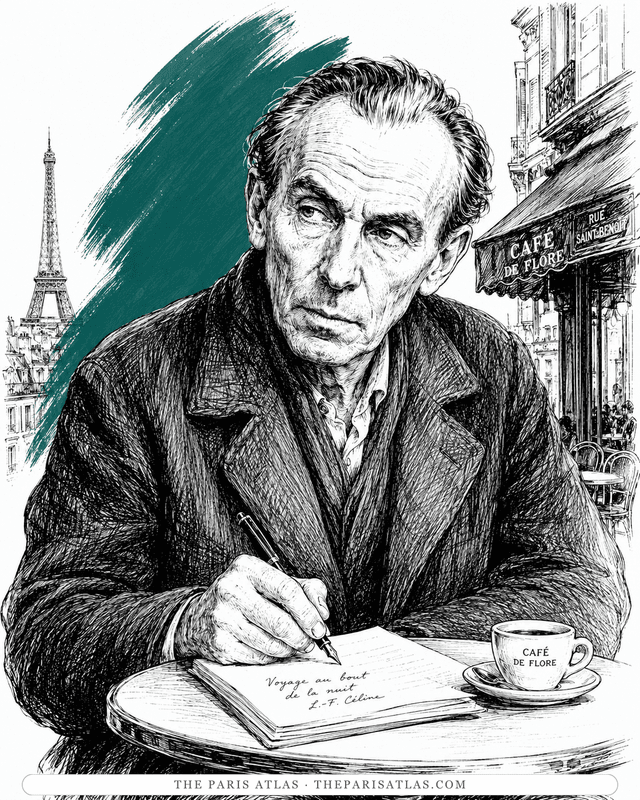
The doctor of the Paris slums who wrote the century's blackest, funniest novel — and changed the sound of French prose.
View authorThe sources below include the primary text, editions, scholarship, archival materials, and other records that informed this page. They document The Tunnel, its publication, and its place in literary history.


Open Library ISBN catalogue used to verify the title, ISBN, and publication metadata.
Google Books catalogue record used to cross-check the title and edition metadata.
Internet Archive ISBN catalogue used to cross-check the edition and its availability in library holdings.
Library of Congress books catalogue used to cross-check the bibliographic record by ISBN.

Web source consulted for documented facts and historical context presented on the The Tunnel page.
Web source consulted for documented facts and historical context presented on the The Tunnel page.
Web source consulted for documented facts and historical context presented on the The Tunnel page.
Primary text included as part of the documented record for The Tunnel.
Primary text included as part of the documented record for The Tunnel.
The primary text is the baseline reference for every book page. Additional references document publication history, interpretation, and historical context where that evidence is available.
 Explore more resources