American novelist and composer whose expatriate fiction explores dislocation, unstable intimacy, fatalism, and North Africa.
13 books on our shelves
In images
Details
Lived
1910–1999
Born
30 December 1910
Birthplace
New York City
Died
18 November 1999 · aged 88
Place of death
Tangier, Morocco
Nationality
American
Married
Jane Auer · 1938–1973
Roles
AuthorComposerTranslatorCritic
About Paul Bowles
Paul Bowles (30 December 1910–18 November 1999), born Paul Frederic Bowles, was an American composer, novelist, short-story writer, translator, and music critic. His life connected the artistic circles of New York and Paris with the literary and musical cultures of Morocco. He established a professional reputation as a composer well before publishing fiction, writing incidental music for New York theatrical productions through the 1930s and 1940s. After settling in Tangier in 1947, he made the city his principal home for fifty-two years, until his death in 1999. His first novel, The Sheltering Sky (1949), became an immediate bestseller and established him as a major literary figure in his late thirties. [1][2]
In The Sheltering Sky, an American couple, Port and Kit Moresby, travel deeper into North Africa in the hope that geographical distance will repair a marriage neither can adequately discuss. Their journey introduces an enduring concern of Paul Bowles’s fiction: the failure of people to understand either the unfamiliar societies around them or the motives governing their own behavior. His subsequent novels and stories developed this concern through encounters marked by desire, misunderstanding, dependence, and sometimes violence. The precision of his prose made these disturbances more unsettling, allowing apparently comprehensible situations to become strange without an accompanying change into extravagant or sensational language. [3][4]
Morocco was not simply a setting for his fiction. Paul Bowles first visited the country in 1931, aged twenty, after Gertrude Stein recommended that he spend the summer there. In 1959, with Library of Congress sponsorship and Rockefeller Foundation funding, he recorded approximately sixty hours of Moroccan music. He subsequently devoted much of his working life to translating Moroccan authors and oral storytellers into English. These activities created a body of work extending far beyond the familiar image of an American novelist living abroad. [5][6]
Childhood and Education in New York
Paul Frederic Bowles was born in New York City on 30 December 1910, the only child of Claude Dietz Bowles, a dentist, and Rena Winnewisser Bowles. He attended the Model School and Jamaica High School in Queens, studying piano, music theory, and ear training from an early age. His education therefore developed along two tracks: the conventional schooling expected of a middle-class child and an increasingly absorbing private engagement with sound and language. Music was not a secondary interest discovered after literary success; it was one of the foundations of his intellectual life. [1]
His later accounts of childhood emphasized an early desire to escape his surroundings. Literature offered one route into other worlds, and his mother introduced him to writers including Edgar Allan Poe and Nathaniel Hawthorne. The combination of domestic restriction and imaginative freedom helps explain why departure became such a persistent subject in his recollections, although it should not be treated as a complete psychological explanation of his fiction. In his adult writing, leaving home often creates new dangers rather than solving the difficulties that made departure attractive. [2][7]
Paul Bowles enrolled at the University of Virginia but did not complete a degree, leaving twice within two years. His eventual artistic education depended more on individual teachers, friendships, travel, and professional experience than on a sustained university course. The pattern was established early: he pursued opportunities with unusual decisiveness, but he also abandoned settings that appeared likely to restrict his movement. His first Atlantic crossing followed one such departure from university. [1][2]
Published in Paris Before He Had Been There
Paul Bowles was seventeen when his poem “Spire Song” appeared in the March 1928 issue of transition, the Paris-based literary magazine edited by Eugene Jolas. A second poem, “Entity,” followed that summer. The magazine was an important forum for modernist experimentation and published writers including James Joyce, Djuna Barnes, and Gertrude Stein. Paul Bowles was still a schoolboy in Queens and had never crossed the Atlantic, yet his writing had already entered a literary community centered thousands of miles from home. [1][2]
In April 1929, aged eighteen, he finally traveled to Paris after abandoning his studies at the University of Virginia without telling his parents that he was leaving the country. The venture did not provide the lasting independence he had hoped for. He returned to the United States and resumed his university education, only to leave again after a single semester. Nevertheless, the journey established Paris as a practical destination rather than merely a place encountered through magazines and books. [2]
Musical Apprenticeship and the Nadia Boulanger Question
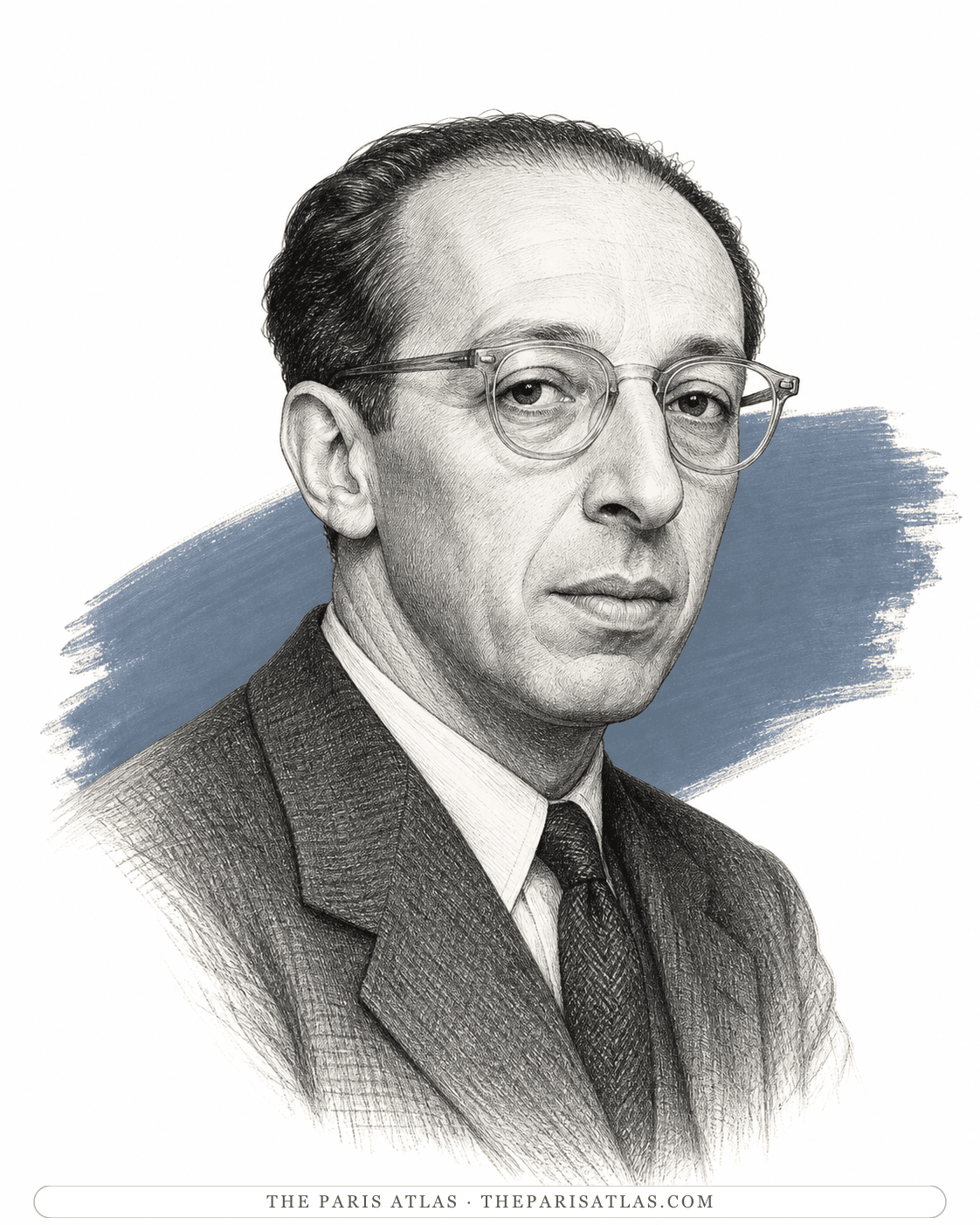
Paul Bowles’s most important early musical relationships were with the American composers Aaron Copland and Virgil Thomson. He studied composition with Aaron Copland in New York, beginning a relationship that also involved travel and introductions to other artists. Virgil Thomson became another mentor, and later a professional colleague in music criticism. Their example offered an alternative to academic credentials: a composer could develop through close attention to contemporary work, direct discussion, and the practical demands of earning a living. [1][7][8]
His connection with Nadia Boulanger, the French teacher whose pupils included many American composers of his generation, requires qualification. In a 1992 interview with Bruce Duffie, when Paul Bowles was eighty-one, he denied having studied with her. He said that he enrolled in her counterpoint class at the École Normale de Musique de Paris but left to visit Spain. Enrollment should therefore not be confused with sustained instruction. [9][10]
Gertrude Stein, Alice B. Toklas, and the Road to Morocco
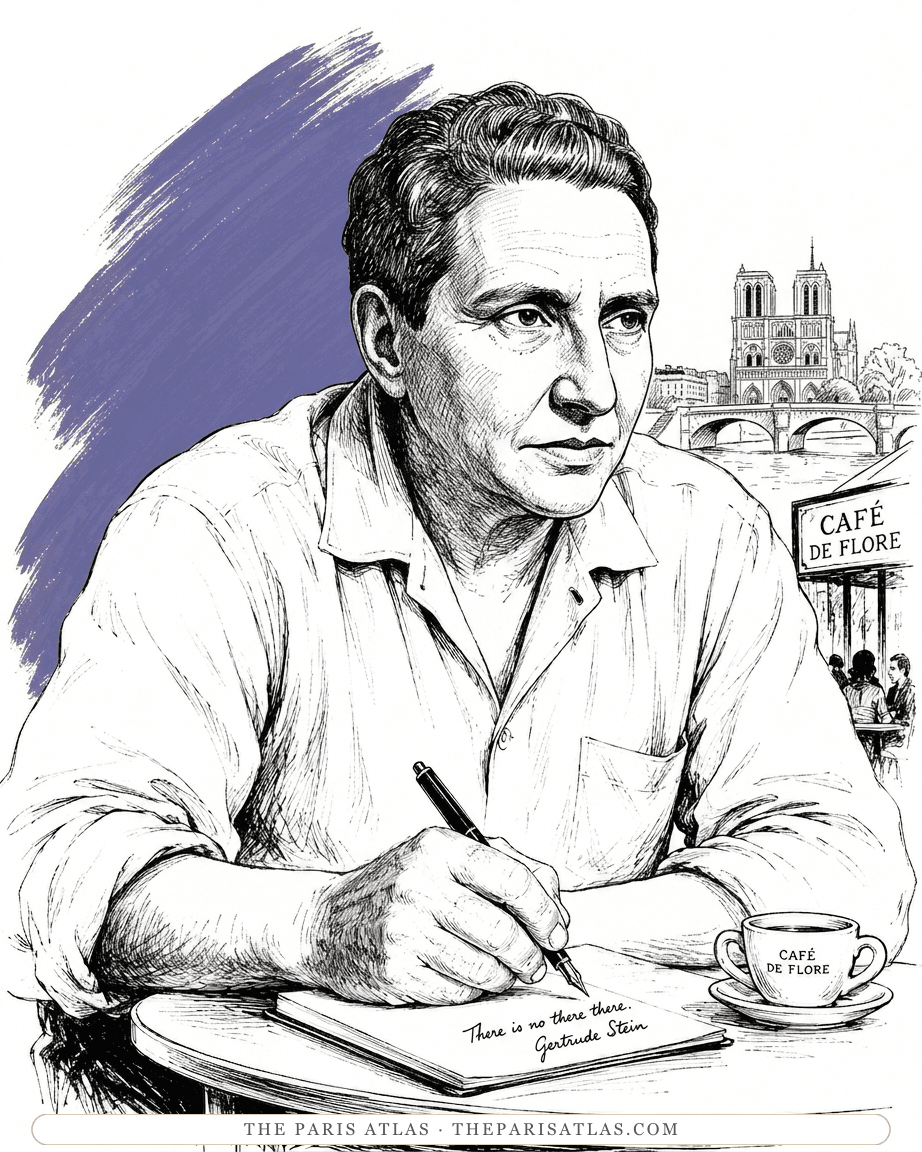
Paul Bowles returned to Paris in 1931 with Aaron Copland. During this visit, he met the American writer Gertrude Stein, whose apartment at 27 rue de Fleurus had become a celebrated gathering place for American and European artists and writers. Her response to his poetry was unfavorable, and she did not conceal her opinion. Nevertheless, the relationship proved consequential in a way that literary encouragement might not have been: Gertrude Stein helped determine where Paul Bowles would spend much of the rest of his life. [2]
Invited to stay for a fortnight at Bilignin, the country house Gertrude Stein and Alice B. Toklas used in southeastern France, Paul Bowles discussed his summer plans with them. Gertrude Stein recommended Tangier rather than the French Riviera, explaining that she and Alice B. Toklas had spent their own summers in Tangier. Her advice redirected an ordinary seasonal journey into the beginning of a relationship with a country that would later become central to his fiction, translations, and musical fieldwork. [2]
Gertrude Stein’s severe judgment of the young man survives in Paul Bowles’s own autobiography. He recalled her considering him the most spoiled, insensitive, and self-indulgent young man she had ever seen, and finding his complacent rejection of every value appalling.[11]
If you were typical, it would be the end of our civilization. You’re a manufactured savage.[11]
The remark should be understood as Paul Bowles’s remembered account of their encounter, rather than as a neutral description of his personality. Its preservation also suggests that he recognized the literary force of an unflattering story about himself. [11]
David Seidner’s 1982 portrait for BOMB records a lighter story. Gertrude Stein reportedly found “Paul” too romantic a name and called him “Freddie,” after his middle name. At the country house, she encouraged him to run while her poodle, Basket, chased him through the garden, jumping against his bare legs. The anecdote offers an informal glimpse of a household famous for formidable literary conversations. [12]
Paul Bowles took the travel advice. He and Aaron Copland sailed for Morocco in the summer of 1931 and rented a house on the mountain above Tangier bay. Paul Bowles was twenty years old, and permanent expatriation was not yet a settled plan. Sixteen years separated this first visit from his decision to make Tangier his principal home and begin work on The Sheltering Sky in 1947. The distinction matters: his attachment to Morocco developed over time rather than through a single irreversible act of escape. [2]
A Career in Theater Music
Through the 1930s and 1940s, Paul Bowles worked principally as a composer, and music provided his first professional livelihood. He wrote incidental scores for productions associated with Orson Welles, William Saroyan, and John Houseman, among others. Such work required music to support dramatic pacing, atmosphere, entrances, transitions, and spoken dialogue. It placed him inside a collaborative theatrical culture in which an effective score had to serve a production rather than exist solely as an independent concert work. [1][13]
His association with Tennessee Williams was particularly important. Paul Bowles composed music for The Glass Menagerie, Summer and Smoke, and Sweet Bird of Youth. These commissions also show why his career cannot be divided too neatly into an early musical period and a later literary one: the collaboration extended beyond his move to Tangier. Music continued to connect him with the American stage even after fiction had become his principal public identity. [1][9]
Among his more ambitious musical works was The Wind Remains, a zarzuela, the Spanish theatrical form combining music with spoken dialogue. Its text came from Federico García Lorca, and it was first performed at the Museum of Modern Art in New York in 1943, conducted by Leonard Bernstein. Merce Cunningham contributed choreography. The combination of poetry, theater, music, and movement illustrates the breadth of Paul Bowles’s artistic connections before he became internationally famous as a novelist. [1][13]
In his 1981 interview with The Paris Review, Paul Bowles described his change of direction in practical rather than ceremonious terms: “I gave up composing professionally simply because I wanted to leave New York.” He added, “I wanted to get out of the States.” This statement concerned the organization of his working life, not an absolute prohibition on further composition. He continued to write music, sometimes preparing scores in Morocco and returning to New York for rehearsals. [7][9]
Musical Style and Work as a Critic
Paul Bowles valued musical clarity and rhythmic discipline, naming Wolfgang Amadeus Mozart as his greatest influence in a 1992 interview. He preferred instrumental performers to respect strict tempos rather than introduce conspicuous expressive alterations. Singers could take greater freedom when communicating a text. His preference was for controlled expression, not the exclusion of emotion. [9]
Between 1942 and 1946, Paul Bowles served as a music critic for the New York Herald Tribune, writing more than four hundred reviews. His experience as a working composer informed his criticism, but his interests were not restricted to concert music. Recalling those years in a January 1998 interview with Ken Smith and Frank J. Oteri, he described a musical world encompassing European performers, contemporary composition, jazz, and popular entertainment. He remembered the producer John Hammond introducing him to Harlem’s musical life and to musicians including Billie Holiday and Teddy Wilson. [1][8]
One recollection from the same interview concerned a visit to the harpsichordist Wanda Landowska. Her preparations, instruments, and explanations of her interpretive decisions remained vivid in his memory decades later. Such encounters show Paul Bowles as an attentive participant in musical life, rather than a novelist who happened to have an earlier profession. His criticism also benefited from Virgil Thomson’s insistence that a reviewer should report what occurred in a performance, not merely announce personal approval or disapproval. [8]
Jane Auer and an Unconventional Literary Marriage
Paul Bowles met Jane Auer in 1937, when she was twenty. They married on 21 February 1938 at a Dutch Reformed church in Manhattan, the day before her twenty-first birthday, and honeymooned in Central America. Their marriage lasted thirty-five years, but it did not follow conventional expectations of sexual exclusivity or continuous domestic life. Both had lovers of their own sex, they often lived separately, and they nevertheless remained closely attached. [1]
Writing as Jane Bowles, she published her only novel, Two Serious Ladies, in 1943, as well as short stories and a play. Her work mattered to Paul Bowles as more than the achievement of someone close to him. He acknowledged that her example encouraged his own return to fiction, making her an important influence at the point when his identity as a composer began to expand into that of a prose writer. Their literary relationship therefore complicates any account in which Jane Bowles appears only as a supporting figure in her husband’s career. [1][7]
Their collaboration also reached the stage. Jane Bowles’s play In the Summer House opened at the Playhouse Theatre on Broadway on 29 December 1953, with incidental music by Paul Bowles. The production record preserves a concrete instance of their artistic work meeting within a single project. Their respective achievements remained distinct, but music and dramatic writing provided a practical area of cooperation. [14]
Jane Bowles suffered a stroke in 1957, aged forty, which damaged her sight and her ability to write. Her health deteriorated over the following years, and she died in Málaga, southern Spain, in 1973. Paul Bowles continued living in Tangier after her death. The long period of her illness and his subsequent twenty-six years without her form an important part of his later biography, rather than a brief interruption between more public literary events. [1]
Settling in Tangier in 1947
In 1947, Paul Bowles received a contract from Doubleday for a novel and used the advance to move to Tangier. Jane Bowles followed him in 1948. At the time, Tangier was an International Zone with an administration involving several foreign powers. Its unusual status made relocation comparatively affordable and straightforward for foreigners, helping attract writers and artists. Their experience should not, however, be confused with that of the city’s Moroccan inhabitants. [2]
The move brought together several strands of Paul Bowles’s earlier life: his dissatisfaction with remaining in New York, his long interest in travel, his experience of Morocco since 1931, and his renewed commitment to prose. Tangier became a place from which he could write about people who had left their familiar surroundings while maintaining a degree of distance from American literary institutions. It remained his principal residence for the rest of his life, even though he continued to travel and work elsewhere. [2][7]
The Sheltering Sky: Travel and the Failure of Escape
The Sheltering Sky appeared in 1949 and became an immediate bestseller. Its central characters, Port and Kit Moresby, travel with a friend from the North African coast toward the Sahara. Their marriage has become difficult to sustain, but neither can fully articulate what is wrong. Movement promises renewal without requiring the direct emotional confrontation they have avoided. The farther they travel, however, the less securely they can rely on the habits, resources, and assumptions that previously structured their lives. [2][3]
Paul Bowles in 1952, photographed in front of stacked steamer trunks three years after The Sheltering Sky made him famous and five years after he moved to Tangier. The attribution to the Magnum photographer Dennis Stock comes from the file record and could not be confirmed independently. (Attributed to Dennis Stock, 1952 · Fair use)
Port’s distinction between a traveler and a tourist is central to the novel’s examination of self-deception. A tourist expects to go home; a traveler, in his account, does not necessarily regard return as the purpose of departure. Yet illness, a stolen passport, and the ordinary machinery of borders expose the inadequacy of this distinction. An identity chosen in conversation cannot remove the body’s vulnerability or make institutional power disappear. The novel turns the wish for unlimited freedom into an examination of the conditions that make freedom possible. [3]
The desert is consequently more than picturesque scenery. Its scale intensifies the characters’ isolation and makes their private difficulties appear both urgent and insignificant. The novel can be read as an examination of estrangement within marriage as much as of estrangement abroad: Port and Kit’s inability to understand one another precedes their difficulties understanding the world around them. Paul Bowles’s treatment of travel is unsettling precisely because arrival does not guarantee revelation, recovery, or a more authentic self. [3]
The Later Novels
Paul Bowles followed The Sheltering Sky with Let It Come Down in 1952. Its protagonist, Nelson Dyar, leaves an unfulfilling life in New York for Tangier, hoping that a different environment will allow him to become a different person. The novel shifts attention from the desert journey to the city’s entanglements of money, influence, and opportunity. Its title suggests surrender as much as release: removing familiar restraints does not necessarily produce independence. [3]
The Spider’s House, published in 1955, places cultural misunderstanding within a more explicitly political setting. Set in Fez during the nationalist unrest of 1954, it examines encounters between Americans and Moroccans near the end of French colonial rule. The city is not simply a background for expatriate dissatisfaction; political change gives its inhabitants purposes and pressures that outsiders cannot easily grasp. The novel was a finalist for the 1956 National Book Award for Fiction. Its first-publication date should therefore be distinguished from the year of its award recognition. [15]
His fourth novel, Up Above the World, appeared in 1966. Set in Latin America, it follows an American couple drawn into a situation whose danger becomes apparent too late. It revisits the instability of trust that runs through his earlier fiction, but in a compressed and increasingly claustrophobic form. Together, the four novels show that Paul Bowles’s recurring interest was not simply one country or landscape, but what happens when people misread their circumstances and lose control over the terms of their own experience. [4]
Short Stories and Literary Style
The collection The Delicate Prey and Other Stories appeared in 1950, shortly after The Sheltering Sky. Stories including “A Distant Episode,” “Pages from Cold Point,” and “The Delicate Prey” became central to Paul Bowles’s reputation. In the short form, he could bring a character’s assumptions into crisis with particular speed and concentration. An apparently limited encounter could reveal a much larger failure of understanding, while the narrative’s composure made its implications difficult to dismiss as mere melodrama. [4][16]
These books broadened the range of his fiction beyond the image of a Western traveler overwhelmed by an unfamiliar country. Moroccan characters, social relationships, disputed motives, and everyday arrangements could also occupy the center of his narratives. His work includes dark comedy and close observation of manners as well as the terror for which it is often remembered. [4]
Paul Bowles’s prose is frequently controlled at the level of the sentence while withholding certainty at the level of motive. A narrator may describe a room, a journey, or a conversation precisely without guaranteeing that either the characters or the reader understand what is happening. This separation between exact observation and incomplete knowledge is a useful way to understand the distinctive unease of his fiction. The effect depends less on ornamental language than on the accumulating difference between what someone believes and what events permit that person to believe. [3][16]
His influences should not be reduced to a single school. His early reading included American writers of psychological disturbance and the uncanny; his first poems entered the experimental world of transition; Gertrude Stein challenged his literary ambitions; and Jane Bowles helped renew his interest in fiction. These connections illuminate different stages of his development without making his mature prose an imitation of any one predecessor. His musical career offers a further context for his attention to pacing and structure, although a direct equivalence between his compositions and his fiction would oversimplify both. [2][7]
The Writers Around Paul Bowles in Tangier
Paul Bowles’s residence in Tangier and the growing reputation of his fiction helped draw American and European writers to the city during the 1950s. Truman Capote, Tennessee Williams, and Gore Vidal visited, while the painter and writer Brion Gysin settled there. These connections made Tangier part of an international literary network, but the presence of several famous writers should not be mistaken for a unified artistic movement. Their reasons for visiting, methods of working, and relationships with Morocco differed considerably. [2][17]
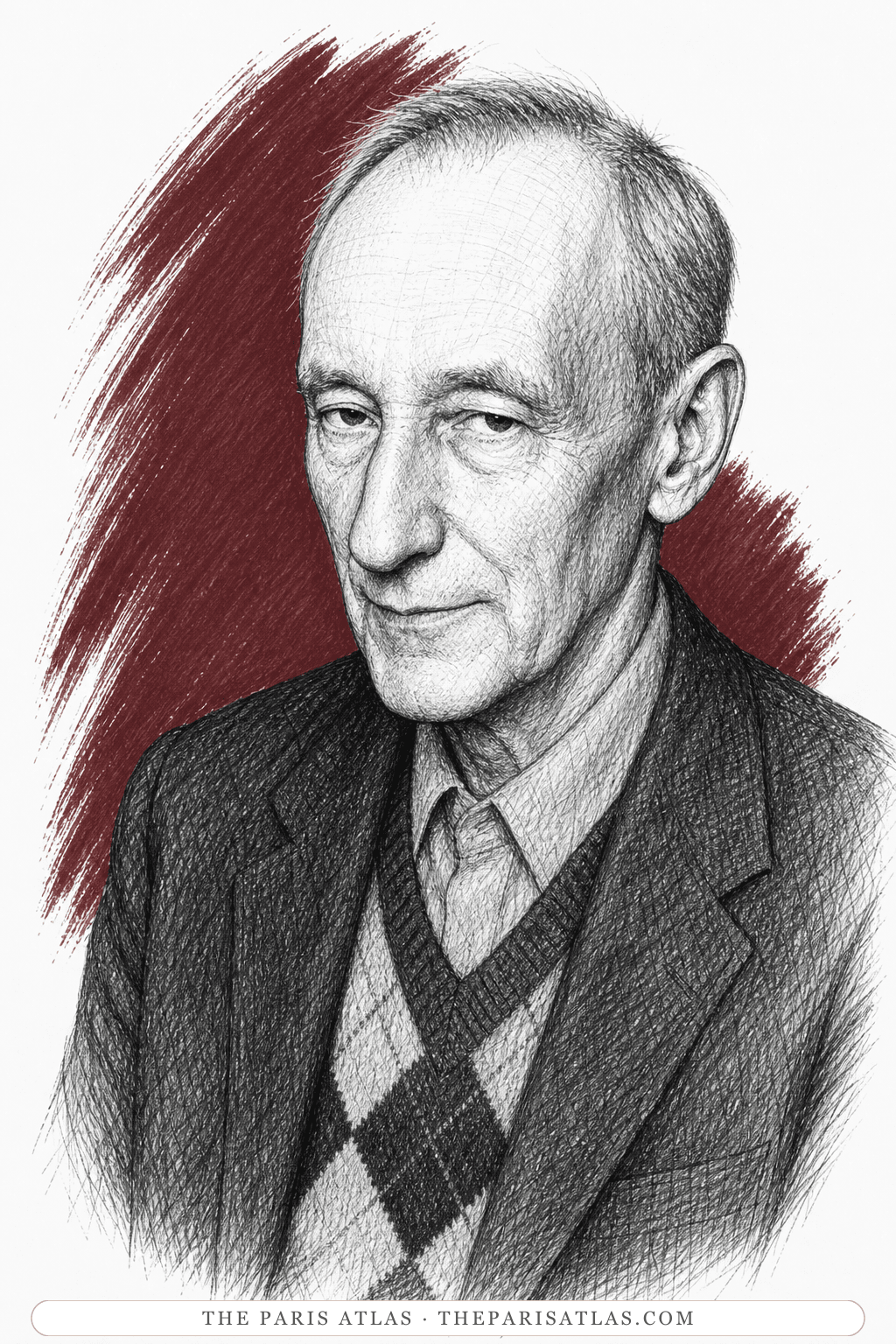
William S. Burroughs moved to Tangier in 1954 and spent several years assembling material that became Naked Lunch. In his essay “Burroughs in Tangier,” Paul Bowles remembered first seeing him in 1953, walking along a back street in the rain. Their friendship developed in the winter of 1955–56, after which they saw one another regularly for approximately two years. This distinction between an initial sighting and the beginning of a friendship preserves the more precise chronology of Paul Bowles’s own recollection. [17]
The same essay offers a memorable picture of William S. Burroughs at work. Manuscript pages were scattered around his room, and he would pick up portions and read them aloud, often with laughter. The scene complicates the intimidating reputation of Naked Lunch: its composition also involved performance, comic timing, and the pleasure of testing material on someone willing to listen. In 1957, Jack Kerouac and Allen Ginsberg arrived and helped type and organize the manuscript. [17][2]
Travel Beyond Morocco and the Island of Taprobane
Making Tangier his home did not end Paul Bowles’s travels. In a 1982 interview, he recalled first visiting Ceylon, now Sri Lanka, in 1949, and later buying the small island of Taprobane. Photographs belonging to David Herbert had first attracted him to it. According to his account, he learned in Madrid that the island was available and arranged its purchase by cable: an unusually decisive response to the attraction of another distant home. [12]
Recording the Music of Morocco
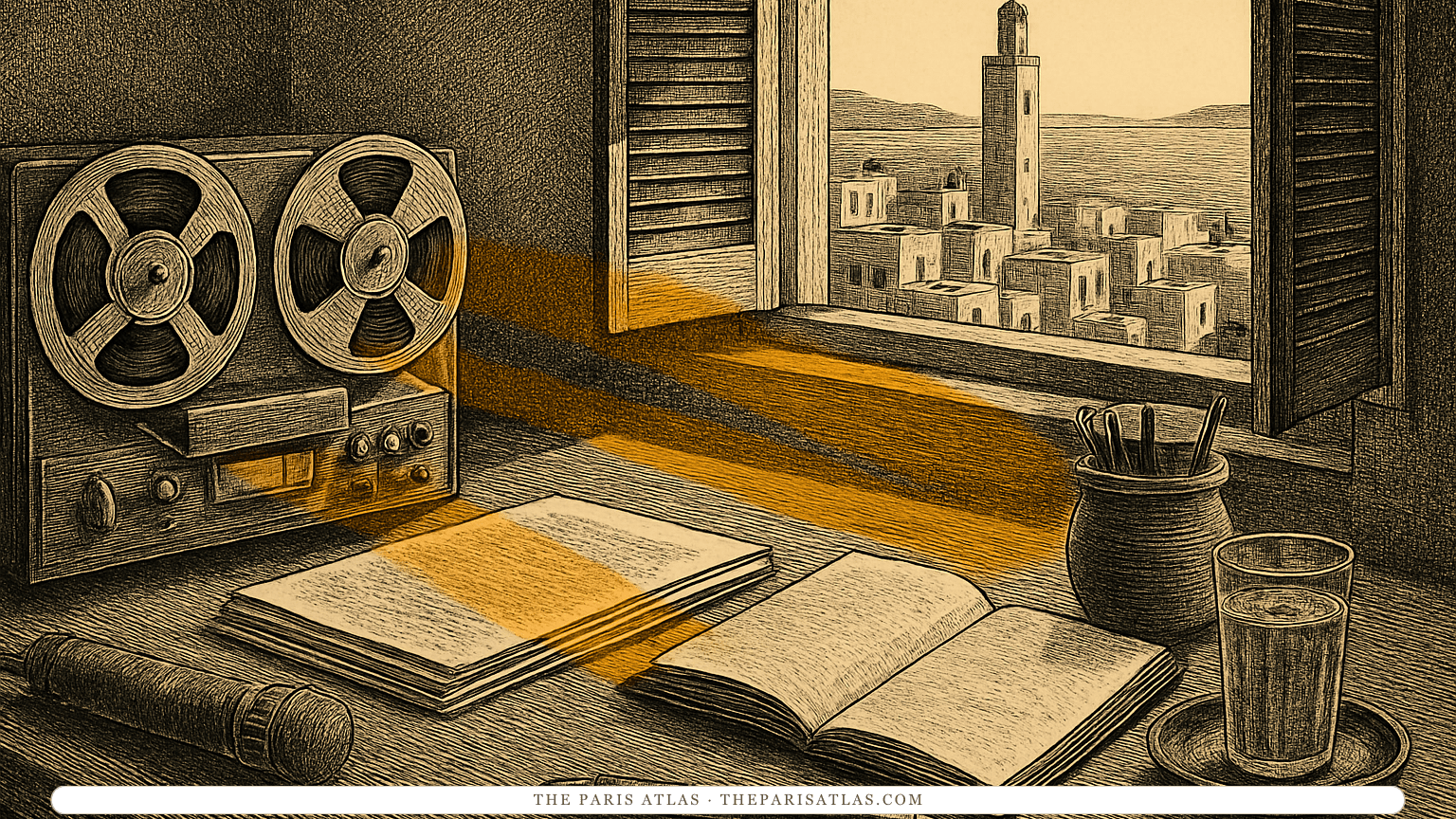
In 1959, the Library of Congress sponsored Paul Bowles to undertake a systematic recording project in Morocco, supported by a grant from the Rockefeller Foundation. Traveling with an Ampex reel-to-reel tape recorder and an assistant, he recorded approximately sixty hours of folk, art, and popular music in twenty-three villages, towns, and cities. The undertaking brought his experience as a composer and listener into direct contact with performances that could not be represented adequately by literary description alone. [5]
The route covered the Mediterranean and Atlantic coasts, from Goulimine at the edge of the Sahara to Segangan in the Rif. It also extended inland through the Middle and Grand Atlas ranges toward Zagora, described in the collection guide as part of the Anti-Atlas itinerary. Political conditions in the newly independent country prevented him from recording in the southeast. The resulting archive was extensive, but it was not a complete or geographically unrestricted survey of Moroccan musical life. [5]
The recordings predominantly document Berber, or Amazigh, and Arab musical traditions. They also include Sephardic liturgical music and folk songs associated with the historic Jewish communities of Essaouira and Meknes. This variety is important: the project did not preserve a single uniform national sound. It brought together traditions shaped by different languages, communities, performance settings, and religious practices. The accompanying documentation also records aspects of the circumstances in which music was performed. [5]
The material is held by the American Folklife Center at the Library of Congress as the Paul Bowles Moroccan Music Collection, AFC 1960/001. In 1963, the Library acquired five additional recordings made by Paul Bowles and Christopher Wanklyn between 1960 and 1962. A two-record selection with a descriptive booklet appeared in 1972. The archive’s importance rests on the preserved performances and their documentation, not simply on the fame of the person who operated the recorder. [5]
Translating the Storytellers of Tangier
From the 1960s, Paul Bowles devoted a substantial part of his working time to translating Moroccan storytellers and writers into English. His collaborators included Mohammed Mrabet, Larbi Layachi, Ahmed Yacoubi, and Abdeslam Boulaich. Much of this work began as oral narration rather than a written manuscript: storytellers spoke in Moroccan Arabic onto tape, and Paul Bowles prepared English versions from the recordings. The process connected the spoken tale, sound recording, literary translation, and international publishing. [1][6]
Mohamed Choukri was an important exception to this predominantly oral method because he wrote his own books. Paul Bowles translated his autobiography For Bread Alone, an account of childhood poverty in the Rif and Tangier. The English edition appeared in 1973, before publication of the Arabic original. The distinction between Mohamed Choukri’s written authorship and the recorded narratives of other collaborators should be retained rather than grouping all these writers together as anonymous suppliers of stories. [6][18]
Paul Bowles explained in his introduction that he did not know the literary Arabic in which For Bread Alone was written. In his account, Mohamed Choukri rendered the text into Moroccan Arabic, and they used Spanish and French to clarify shades of meaning. The translation therefore emerged from direct negotiation between the two men, not from Paul Bowles independently reading a manuscript in its original literary language. This description reveals both the resourcefulness of their collaboration and the linguistic limits within which it operated. [6]
The translations also require critical consideration. In a later comparative reading of For Bread Alone, Hanna Alwine, drawing on scholarship by Nirvana Tanoukhi, argues that changes in the English version can alter the political significance of Mohamed Choukri’s story. Such criticism does not erase the translation’s role in reaching English-language readers, but it challenges the assumption that a celebrated intermediary is necessarily an invisible or neutral one. Paul Bowles’s literary legacy includes both the circulation he helped make possible and questions about how Moroccan voices were presented through his English prose. [18]
Later Writing, Letters, and Literary Recognition
Paul Bowles remained in Tangier after Jane Bowles’s death in 1973, continuing to write, translate, and receive visitors for another twenty-six years. He continued living in the same small apartment, which became a destination for people interested in his work and in the literary worlds he had known. This late-life visibility could coexist uneasily with his preference for quiet. His daily circumstances were modest compared with the glamorous image sometimes attached to expatriate literary life. [2][9]
His autobiography, Without Stopping, appeared in 1972, preserving his own account of his upbringing, travels, and artistic relationships. In 1994, Jeffrey Miller edited a selection of his correspondence as In Touch: The Letters of Paul Bowles. The edition drew on approximately seven thousand pages addressed to 140 correspondents, offering another view of the network that connected his Tangier apartment with writers, artists, publishers, and friends elsewhere. Autobiography and letters should be read as personal testimony rather than as records free of selection or self-presentation. [11][19]
In 1991, Paul Bowles received the Rea Award for the Short Story, a recognition of his contribution to the form rather than a prize for one particular book. The jury included Joel Conarroe, Francine du Plessix Gray, and Joyce Carol Oates. The award acknowledged the importance of the stories alongside the novel that had brought him his widest readership. His reputation among fellow writers had always depended on more than The Sheltering Sky. [16]
The Sheltering Sky on Film
Bernardo Bertolucci adapted The Sheltering Sky for the cinema in 1990, with John Malkovich as Port and Debra Winger as Kit. Paul Bowles himself appeared in the film, placing the elderly author within an adaptation of the book that had made him famous more than four decades earlier. The British Film Institute’s record credits Paul Bowles among the cast and identifies Bernardo Bertolucci and Mark Peploe as the screenwriters. The adaptation gave the novel a separate visual existence and introduced its story to an audience beyond its readers. [20]
Final Years and His Continuing Interest in Music
Paul Bowles’s later reputation as a novelist sometimes obscured how important music remained to him. The pianist and researcher Irene Herrmann met him in 1992 while investigating his compositions. On that first visit, she played music recovered from manuscripts that he had not heard for decades. She continued visiting him in Tangier, and in 1996 he designated her as the inheritor of his musical estate. The relationship helped bring neglected parts of his earlier work back into his daily life. [13]
As his health declined, listening could replace the exertion of extended conversation. Irene Herrmann later recalled their shared attention to music and his pleasure in discussing it. His interview with Ken Smith and Frank J. Oteri in January 1998, twenty-two months before his death, likewise returned to composition, criticism, and the performers he had known. These encounters complicate any image of his last years as merely a prolonged farewell to the author of The Sheltering Sky: the composer remained present to the end. [8][13]
Death in Tangier and Burial in New York
Paul Bowles died at the Italian Hospital in Tangier on 18 November 1999, aged eighty-eight. He had been in poor health for some time, including respiratory difficulties. An Associated Press report quoted the hospital as saying that he died of a heart attack.[21][22]
His death ended fifty-two years of residence based in Tangier and thirty-five years of marriage followed by twenty-six years as Jane Bowles’s widower. Although Morocco had become the principal setting of his adult life, his remains returned to the United States. His ashes were buried at Lakemont in New York State, beside the graves of his parents and grandparents. [23]
Connection to Paris
Paris played a formative role in Paul Bowles’s life even though Tangier became his lasting home. His poems reached readers through the Paris magazine transition before he first arrived in the city in April 1929. On his return in 1931, his association with Aaron Copland and his encounters with Gertrude Stein and Alice B. Toklas connected him with an international artistic community. 27 rue de Fleurus became a particularly important address in his biography: the relationship established there led to the stay at Bilignin and the advice to visit Tangier. His uncompleted enrollment with Nadia Boulanger belongs to the same period of exploration. Paris was therefore not merely a stop on his travels; it was a place where literary publication, musical ambition, personal encounters, and the route toward Morocco converged. [2][9][10]
Legacy
Paul Bowles’s achievement crosses several forms that are too often discussed separately. His theatrical music connects him with major figures of the American stage. His novels and short stories examine the fragility of understanding and the hazards of self-invention. His translations brought Moroccan writers and storytellers to English-language readers. His recordings preserved performances that remain valuable independently of his literary reputation. No single description—expatriate, novelist, composer, or traveler—fully encompasses this range. [1][5][24]
His legacy also depends on reading him with distinctions intact. The experiences of his fictional travelers are not comprehensive descriptions of Morocco. The writers he translated had identities and artistic intentions of their own. His recollections of famous acquaintances are personal accounts, and his shift away from earning his living in New York did not erase his continuing work in music. Preserving these differences makes his career more interesting rather than less coherent: it reveals an artist whose life repeatedly crossed between media, languages, and social worlds without making their boundaries disappear. [7][9][6][18]
Life events
1910
Born in New York City on 30 December, the only child of Claude Dietz Bowles, a dentist, and Rena Winnewisser Bowles.
— Paul Bowles — Contemporary Authors biographical entry
1928
His poem "Spire Song" is published in transition, the Paris modernist magazine edited by Eugene Jolas, in the issue of March. He is seventeen. A second poem, "Entity", follows that summer.
1929
Leaves the University of Virginia in April without telling his parents and sails for Paris on a one-way ticket. The trip is unsuccessful and he returns to the United States.
— Paul Bowles — biographical page, English 88 (the 1950s)
1930
Resumes study at the University of Virginia at his parents' insistence, then leaves again after a single semester.
— Paul Bowles — biographical page, English 88 (the 1950s)
1931
Returns to Paris with Aaron Copland, the American composer with whom he had been studying in New York, and studies briefly with the French teacher Nadia Boulanger.
— Paul Bowles — biographical page, English 88 (the 1950s)
1931
Meets Gertrude Stein at 27 rue de Fleurus. She tells him his poetry is not poetry, and invites him to stay a fortnight at Bilignin, her house in south-eastern France.
1931
On Stein's advice, spends the summer in Tangier rather than on the French Riviera, sailing with Copland. They take a house on the mountain above the bay. He is twenty.
1937
Is introduced to the writer Jane Auer.
1938
Marries Jane Auer on 21 February at a Dutch Reformed church in Manhattan, the day before her twenty-first birthday. They honeymoon in Central America.
— Paul Bowles — Contemporary Authors biographical entry
1942
Becomes a music critic for the New York Herald Tribune, a post he holds until 1946 and in which he writes more than four hundred reviews.
— Paul Bowles — Contemporary Authors biographical entry
1943
His zarzuela The Wind Remains, set to a text by Federico García Lorca, is first performed at the Museum of Modern Art in New York, conducted by Leonard Bernstein.
1943
Jane Bowles publishes her novel Two Serious Ladies.
1945
Writes the incidental music for Tennessee Williams's The Glass Menagerie.
— Paul Bowles — biographical page, English 88 (the 1950s)
1947
Receives a novel contract from Doubleday and uses the advance to move to Tangier, then an International Zone administered by several European powers.
— Paul Bowles — biographical page, English 88 (the 1950s)
1948
Jane Bowles joins him in Tangier.
1949
The Sheltering Sky is published and becomes an immediate bestseller. He is thirty-eight.
Paul Bowles in 1952, photographed in front of stacked steamer trunks three years after The Sheltering Sky made him famous and five years after he moved to Tangier. The attribution to the Magnum photographer Dennis Stock comes from the file record and could not be confirmed independently. (Attributed to Dennis Stock, 1952)
1950
Publishes the story collection The Delicate Prey and Other Stories.
1952
Publishes his second novel, Let It Come Down, set in Tangier.
1954
William S. Burroughs moves to Tangier, where he will assemble the manuscript that becomes Naked Lunch.
1955
Publishes The Spider's House, set in Fez during the events leading to Moroccan independence.
1956
Morocco becomes independent and the International Zone of Tangier is reintegrated into the country.
1957
Jane Bowles suffers a stroke at forty, which damages her sight and her capacity to write.
— Paul Bowles — Contemporary Authors biographical entry
1957
Jack Kerouac and Allen Ginsberg arrive in Tangier to help Burroughs type and order the Naked Lunch material.
1963
Random House publishes Their Heads Are Green and Their Hands Are Blue, his collected travel writing, which includes "The Rif, to Music" — his own account of recording in northern Morocco.
— Paul Bowles: Collected Stories & Later Writings
1959
Records Moroccan music across the country for the Library of Congress, funded by a Rockefeller Foundation grant — roughly sixty hours in twenty-three villages, towns and cities, from Goulimine at the edge of the Sahara to Segangan in the Rif.
— Michelle Forner, Paul Bowles Moroccan Music Collection (AFC 1960/001) — Guides to the Collections in the Archive of Folk Culture (1994)
1962
Completes a further series of Moroccan recordings made with Christopher Wanklyn since 1960.
— Michelle Forner, Paul Bowles Moroccan Music Collection (AFC 1960/001) — Guides to the Collections in the Archive of Folk Culture (1994)
1963
The Library of Congress acquires five additional recordings of Moroccan music made by Bowles between 1960 and 1962.
— Michelle Forner, Paul Bowles Moroccan Music Collection (AFC 1960/001) — Guides to the Collections in the Archive of Folk Culture (1994)
1966
Publishes Up Above the World, his fourth and final novel.
1972
Publishes his autobiography, Without Stopping.
1972
The Library of Congress issues a two-record set of selections from his Moroccan recordings, with a descriptive booklet.
— Michelle Forner, Paul Bowles Moroccan Music Collection (AFC 1960/001) — Guides to the Collections in the Archive of Folk Culture (1994)
1973
His translation of Mohamed Choukri's For Bread Alone is published in English, ahead of the book's publication in the original Arabic.
1973
Jane Bowles dies in Málaga, Spain, after years of declining health.
— Paul Bowles — Contemporary Authors biographical entry
1981
Is interviewed in Tangier by Jeffrey Bailey for The Paris Review's Art of Fiction series.
— Jeffrey Bailey, Paul Bowles, The Art of Fiction No. 67 (1981)
1990
Bernardo Bertolucci's film of The Sheltering Sky is released, with Bowles appearing in it himself.
1994
In Touch, a selection of his letters edited by Jeffrey Miller, is published.
1999
Dies of heart failure at the Italian Hospital in Tangier on 18 November, aged eighty-eight. His ashes are buried at Lakemont, New York, beside his parents and grandparents.
Paul Bowles quotes
Verbatim, as recorded by the witnesses of the era — sources on every quotation.
“
I don't see myself as a consummate anything.
— Paul Bowles, interviewed by Jeffrey Bailey, The Paris Review, issue 81, Fall 1981
“
I didn't find the United States particularly interesting and once I found places that were more interesting I chose to live in them, which I think makes sense.
— Paul Bowles, interviewed by Jeffrey Bailey, The Paris Review, issue 81, Fall 1981
“
There was nothing I wanted there, and once I'd moved away I saw that all I needed from the States was money. I went back there for that.
— Paul Bowles, interviewed by Jeffrey Bailey, The Paris Review, issue 81, Fall 1981
Paul Bowles wrote incidental music for productions of The Glass Menagerie, Summer and Smoke and Sweet Bird of Youth. The Glass Menagerie reached Broadway in 1945, and their collaboration continued after Bowles moved to Tangier in 1947.
— Paul Bowles — biographical page, English 88 (the 1950s); Paul Bowles — Contemporary Authors biographical entry
Paul Bowles spent a fortnight with Alice B. Toklas and Gertrude Stein at Bilignin in southeastern France in 1931. Their experience of Morocco helped shape the recommendation that he visit Tangier that summer.
— Paul Bowles — biographical page, English 88 (the 1950s)
Paul Bowles met Gertrude Stein at 27 rue de Fleurus during his second Paris visit in 1931. She criticized his poetry but advised him to spend the summer in Tangier instead of the French Riviera, leading to his first visit to Morocco.
— Paul Bowles — biographical page, English 88 (the 1950s); Paul Bowles — Contemporary Authors biographical entry
Paul Bowles recalled first seeing William S. Burroughs in a Tangier back street in the rain in 1953. Their friendship developed in the winter of 1955–56, and they met regularly for roughly two years while Burroughs was assembling material for Naked Lunch. Bowles’s own essay distinguishes the first sighting from the closer relationship.
Paul Bowles studied composition with Aaron Copland in New York from 1930. They traveled to Paris together in 1931 and continued to Morocco that summer, extending their relationship beyond musical instruction.
— Paul Bowles — biographical page, English 88 (the 1950s); Paul Bowles — Contemporary Authors biographical entry
Paul Bowles was an American composer, novelist, short-story writer, translator, and music critic, born in New York on 30 December 1910. He first established himself by writing music for the New York theater, then became internationally known for The Sheltering Sky, published in 1949. Tangier, Morocco, was his principal home from 1947 until his death in 1999, and his work there included both literary translation and the recording of Moroccan music. [1][5]
What is The Sheltering Sky about?
The Sheltering Sky follows Port and Kit Moresby, an American couple traveling with a friend from the North African coast toward the Sahara. They hope that changing their surroundings will repair a marriage whose difficulties remain largely unspoken. Port distinguishes travelers from tourists on the grounds that tourists expect to return home, but illness, a stolen passport, and the practical demands of crossing borders expose the limits of his confidence. The novel examines estrangement, dependence, and the failure of travel to provide an automatic escape from the self. [3]
Why did Paul Bowles move to Morocco?
Paul Bowles first visited Morocco in the summer of 1931, aged twenty, after Gertrude Stein recommended Tangier instead of the French Riviera. During a fortnight at Bilignin with Gertrude Stein and Alice B. Toklas, he heard about their own visits, then traveled to Morocco with Aaron Copland. His permanent move came much later, in 1947, when he used the advance from a Doubleday novel contract to establish himself in Tangier. The initial visit and the decision to settle were separated by sixteen years. [2]
Was Paul Bowles a composer or a writer?
He was both, although his professional reputation as a composer came first. Paul Bowles studied with Aaron Copland and Virgil Thomson, wrote music for plays by Tennessee Williams and other dramatists, and served as a critic for the New York Herald Tribune from 1942 to 1946. Moving to Tangier in 1947 changed the emphasis of his career, but he continued composing and returned to New York for theatrical work. It is more accurate to describe overlapping careers than a complete abandonment of music for fiction. [1][7][9]
Who was Jane Bowles?
Jane Bowles, born Jane Auer in 1917, was an American writer who married Paul Bowles on 21 February 1938. She published Two Serious Ladies in 1943, as well as short stories and the play In the Summer House, for which her husband wrote music. Their marriage was unconventional but enduring, and her writing influenced his return to fiction. She suffered a stroke in 1957 that damaged her sight and ability to write, and died in Málaga, Spain, in 1973. [1][7][14]
What did Paul Bowles record in Morocco?
In 1959, Paul Bowles recorded approximately sixty hours of Moroccan folk, art, and popular music for a Library of Congress project funded by the Rockefeller Foundation. He worked in twenty-three villages, towns, and cities, traveling from Goulimine at the edge of the Sahara to Segangan in the Rif and inland toward Zagora, described in the collection guide’s Anti-Atlas itinerary. The recordings include Amazigh and Arab traditions and Sephardic music from Jewish communities. They are preserved by the American Folklife Center as the Paul Bowles Moroccan Music Collection, AFC 1960/001. [5]
How did Paul Bowles die?
Paul Bowles died at the Italian Hospital in Tangier on 18 November 1999, aged eighty-eight. An Associated Press report quoted the hospital as saying that he died of a heart attack; he had been in poor health with respiratory problems. His ashes were buried at Lakemont, New York, beside his parents and grandparents.[21][22][23]
Connections and Sources
Paul Bowles’s connections to people, places, and works, with the sources behind each one.
Paul Bowles wrote incidental music for productions of The Glass Menagerie, Summer and Smoke and Sweet Bird of Youth. The Glass Menagerie reached Broadway in 1945, and their collaboration continued after Bowles moved to Tangier in 1947.
— Paul Bowles — biographical page, English 88 (the 1950s); Paul Bowles — Contemporary Authors biographical entry
Paul Bowles spent a fortnight with Alice B. Toklas and Gertrude Stein at Bilignin in southeastern France in 1931. Their experience of Morocco helped shape the recommendation that he visit Tangier that summer.
— Paul Bowles — biographical page, English 88 (the 1950s)
Paul Bowles met Gertrude Stein at 27 rue de Fleurus during his second Paris visit in 1931. She criticized his poetry but advised him to spend the summer in Tangier instead of the French Riviera, leading to his first visit to Morocco.
— Paul Bowles — biographical page, English 88 (the 1950s); Paul Bowles — Contemporary Authors biographical entry
Paul Bowles recalled first seeing William S. Burroughs in a Tangier back street in the rain in 1953. Their friendship developed in the winter of 1955–56, and they met regularly for roughly two years while Burroughs was assembling material for Naked Lunch. Bowles’s own essay distinguishes the first sighting from the closer relationship.
Paul Bowles studied composition with Aaron Copland in New York from 1930. They traveled to Paris together in 1931 and continued to Morocco that summer, extending their relationship beyond musical instruction.
— Paul Bowles — biographical page, English 88 (the 1950s); Paul Bowles — Contemporary Authors biographical entry
References
References
The sources below include biographies, scholarly essays, interviews, and primary materials that informed this page. They reflect both the historical record and ongoing critical conversations about Paul Bowles and their work.
Gale’s Contemporary Authors material on family, education, theatrical music and marriage. Some bibliography dates refer to reprints rather than first editions.
2abcdefghijklmnopqPaul Bowles — biographical page, English 88 (the 1950s)
Website
University of Pennsylvania
Used for
A University of Pennsylvania-hosted republication of a Guardian obituary, used for the Paris journeys, Stein’s recommendation and the 1947 move. Its Boulanger claim is qualified by Bowles’s own interview.
5abcdefghPaul Bowles Moroccan Music Collection (AFC 1960/001) — Guides to the Collections in the Archive of Folk Culture
Archive
American Folklife Center, Library of Congress, 1994
Used for
The American Folklife Center collection guide documents the 1959 recording project, funding, itinerary, musical traditions and later acquisitions. The full archive is distinct from the roughly sixty-hour 1959 project.
Geoff Wisner’s essay reproduces Bowles’s translator’s introduction to For Bread Alone, describing Choukri’s written manuscript and their use of Moroccan Arabic, Spanish and French.
Jeffrey Bailey’s 1981 interview on Bowles’s upbringing, fiction, Jane Bowles and his decision to leave New York; the source of the quotations attributed to this interview.
8abcdPaul Bowles meets with Ken Smith and Frank J. Oteri
Periodical
NewMusicBox, New Music USA, 1999
Used for
Ken Smith and Frank J. Oteri’s interview, recorded in Tangier in January 1998 and published in 1999, covers composition, criticism and memories of performers.
9abcdefghComposer/Author Paul Bowles: A Conversation with Bruce Duffie
Periodical
WNIB Classical 97, Chicago, 1992
Used for
Bowles’s interview recorded on 14 May 1992, when he was eighty-one, documents enrollment without sustained study with Nadia Boulanger, his continuing composition and performance preferences.
David Seidner’s 1982 BOMB interview supplies the Freddie and Basket anecdote and Bowles’s recollections of Ceylon and Taprobane. The Boulanger account is qualified by his later Duffie interview.
13abcdNew book on author Paul Bowles is co-edited by UCSC lecturer who inherited famed writer’s musical estate
Website
University of California, Santa Cruz, 9 September 2003, 2003
Used for
Scott Rappaport’s UCSC report quotes Irene Herrmann on meeting Bowles in 1992, recovering his music and being designated heir to his musical estate in 1996.
Bowles’s firsthand essay distinguishes his 1953 sighting of Burroughs from their friendship in winter 1955–56 and recalls Burroughs reading manuscript pages aloud.
British Film Institute record for the 1990 film: director Bernardo Bertolucci, screenwriters Mark Peploe and Bertolucci, and cast including Bowles, John Malkovich and Debra Winger.
25Paul Bowles papers supplement — novels, circa 1952–1966
Archive
University of Delaware Library Special Collections
Used for
University of Delaware finding aid for novel manuscripts, approximately 1952–1966; an archival research resource rather than an examination of the manuscripts themselves.
These references anchor the page in the documented record and in the scholarly conversations around Paul Bowles. Every claim on this page traces back to one or more of the works listed here.





 View source