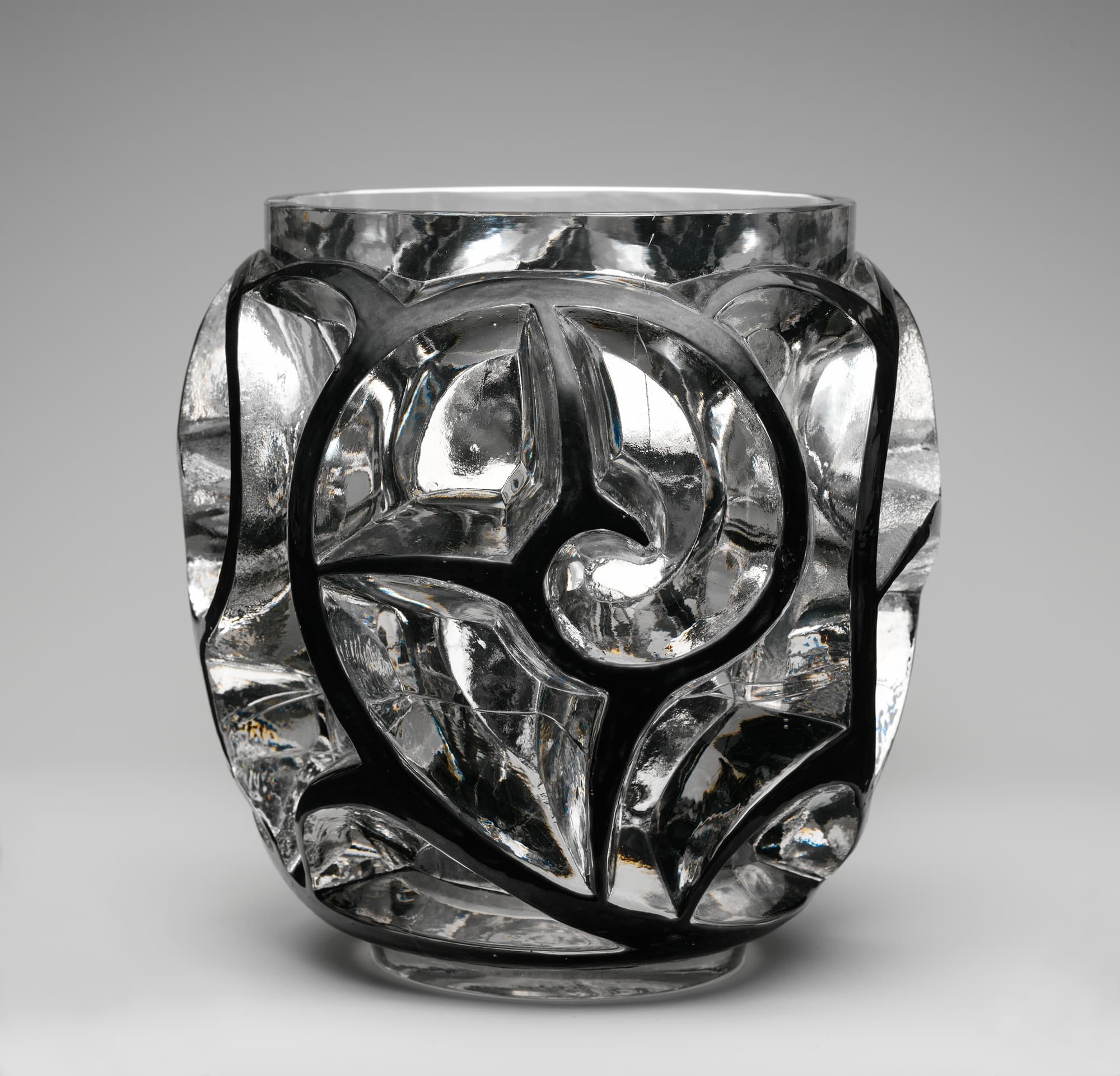
The Tourbillons vase, introduced by the Lalique firm in 1926, is a rounded glass vessel whose surface is worked into thick curling forms that sweep around the body. The Metropolitan Museum of Art's example is clear glass about 20 centimetres high, with black enamel run along the edges of the curls. Who designed it is unsettled: the Met credits René Lalique, while Lalique's own centenary account credits his daughter, Suzanne Lalique-Haviland.
The Tourbillons Vase, whose French title is translated by the Metropolitan Museum as Whirlwinds, turns a compact glass vessel into an image of swirling movement. Its deeply modeled surface makes light, shadow, and transparency part of the decoration. Although the design was produced in multiple examples and colors, its sculptural complexity gives it an appearance far removed from an anonymous standardized container.[1]
A Design Attribution Being Reconsidered
The vase's authorship requires a distinction between longstanding museum cataloging and a more recent account from the manufacturer. The Metropolitan Museum continues to list René-Jules Lalique as its designer. Lalique's 2026 centenary presentation, however, states that his daughter, Suzanne Lalique-Haviland, conceived the design in 1926, drawing inspiration from an unfurling fern. These two institutional accounts should be acknowledged rather than silently treated as identical.[1][2]
Suzanne's involvement is consistent with the broader history of the family enterprise. The Musée Lalique explains that she contributed designs for decorative objects, textiles, and glass, and that work in which she participated was often manufactured under her father's signature. Her contributions during the 1920s helped the firm develop its Art Deco vocabulary. Her later career extended into porcelain decoration and theatrical design, including work for the Comédie-Française. The familiar Lalique name consequently represents a more collaborative history than a single-designer attribution might suggest.[3]
Form, Movement, and Light
The vase has a rounded body and an open circular mouth. Raised, curling forms sweep around its surface, alternately projecting outward and folding back into the body. In the Metropolitan Museum's example, black detailing emphasizes the edges of these forms against the clear glass, making the design resemble a three-dimensional drawing. The dark lines remain visually forceful while the transparent areas gather reflections and reveal overlapping layers.[1]
Its movement is therefore suggested rather than represented literally. There is no identifiable scene of a storm, and the vessel is not shaped like an ordinary fern. Instead, the design takes the principle of curling, expanding growth and converts it into a repeated sculptural rhythm. The forms encourage the eye to travel around the object, making its decoration inseparable from its volume.[1]
Artistry and Repeated Production
René Lalique's transition from Art Nouveau jewelry to glassmaking placed him at an important intersection of artistic design and industrial production. By the mid-1920s, his glass designs exploited contrasts between clear and frosted surfaces, sometimes enhanced with enamel, staining, or other finishes. These methods allowed a relatively limited range of materials to produce strikingly different effects.[4]
The firm's use of molds also enabled designs to be produced repeatedly. René established the Wingen-sur-Moder manufacture in Alsace in 1921, and glass became the basis for a wide range of objects, including tableware, lighting, vases, clocks, and automobile ornaments. Tourbillons belongs to this wider effort to make artist-designed glass available through manufacture rather than through the production of unique objects alone.[5]
Original Glass and Later Crystal Versions
An early Tourbillons vase should not automatically be described as crystal simply because contemporary Lalique is closely associated with that material. The Metropolitan Museum catalogs its 1926 example as glass. The Musée Lalique identifies the period after René's death in 1945, under his son Marc, as the transition toward crystal production. Later versions therefore belong to the design's continuing history, but their materials and manufacture should not be projected backward onto every interwar example.[1][5]
Collection and Significance
The Metropolitan Museum's vase measures approximately 20 centimeters high and 20.3 centimeters across and entered the collection in 2004. It demonstrates how Art Deco could combine a nature-derived motif with forceful abstraction. The history of its attribution also reveals the importance of collaborators whose contributions were absorbed into the reputation of a famous design house.[1]
Close reading
Reading the work, detail by detail
The vase is heavy clear glass cut into thick curling forms, with black enamel run into the channels between them. The details show how the pattern is built, where the glass is left plain, and how the far wall of the vessel shows through the near one.
1.The spiral at the centre
One form curls inward to a blunt end at the middle of the design. It is the tightest curve on the vase, and the surrounding shapes open outward from it.
2.Black enamel in the cut channels
The black is in the recesses, not on the surface. It separates one raised form from the next, so the pattern reads as firm outlines against clear glass rather than as colour applied over it.
3.The plain collar at the rim
The decoration stops short of the top. A smooth band of clear glass runs around the neck to the lip, which is where the eye finds the actual thickness of the wall.
4.The lobes around the shoulder
Toward the widest part of the vessel the forms project furthest and then fold back into the body. The relief is deep enough that the profile of the vase is interrupted rather than smooth.
5.The far wall seen through the near one
Because the glass is clear, the pattern on the opposite wall shows through the pattern in front of it. The overlapping layers are why a photograph of one side cannot record the whole design.
6.The foot
The body narrows to a plain thick ring. Like the collar at the top, it is left undecorated, so the carved area is contained between two smooth bands.
Where to see it
The Metropolitan Museum of Art
1000 Fifth Avenue, New York, NY 10028, United States
Gallery displays change, so check the museum's own object record before making a special visit.
That is unsettled. The Metropolitan Museum of Art credits René-Jules Lalique. Lalique's own centenary account credits his daughter, Suzanne Lalique-Haviland, with conceiving the design in 1926 after an unfurling fern. Work she contributed to was often manufactured under her father's signature.
What does Tourbillons mean?
Whirlwinds. That is the Metropolitan Museum's translation of the French title. The vase does not depict a storm: it takes the idea of curling, expanding growth and repeats it as a sculptural rhythm around the body.
Is the Tourbillons vase glass or crystal?
An interwar example is glass. The Metropolitan Museum catalogues its 1926 vase as glass. Lalique moved toward crystal after René Lalique's death in 1945, under his son Marc, so do not apply the later material to early examples.
How big is the Tourbillons vase?
The Metropolitan Museum's example is about 20 centimetres high and 20.3 centimetres across.
Where can I see the Tourbillons vase?
The Metropolitan Museum of Art in New York holds one, acquired in 2004. The design was moulded and produced in quantity in several colours, so examples are held in other collections too.
In the atlas
What the graph records about this work — every claim carries its citation.
The vase is Art Deco glass made in quantity rather than as a unique object: moulded at the Wingen-sur-Moder factory René Lalique founded in 1921, with curling forms picked out in black enamel. Who designed it is unsettled between the Metropolitan Museum of Art, which credits René Lalique, and the firm, which credits his daughter Suzanne Lalique-Haviland.
— René Lalique, Tourbillons vase — collection record; Art Deco: René Jules Lalique; Tourbillons: A Century of Light in Motion
If you like René Lalique
Explore designers from the same movements and circles.
A. M. Cassandre
French poster designer whose advertisements for railways, liners and aperitifs — Nord Express, Dubonnet, Normandie — reduced their subjects to a few commanding shapes.
British ceramic designer who began factory work at thirteen and whose brightly painted Bizarre range, launched in 1927, put Art Deco on ordinary tables.
Irish designer and architect, a pioneer of modern furniture and architecture whose Riviera house E-1027 is a landmark of the movement; her furniture stayed obscure until a 1970s rediscovery.
The sources below include collection records, catalogues, scholarly research, and primary materials that informed this page. They document “Tourbillons” (Whirlwinds) Vase, its making, and its place in cultural history.
1abcdefRené Lalique, Tourbillons vase — collection record
Website
The Metropolitan Museum of Art
Used for
The holding museum's record: the 1926 date, the clear glass with black enamel, the 20 by 20.3 by 20.3 cm dimensions, the 2004 acquisition, and the attribution to René-Jules Lalique.
Suzanne Lalique-Haviland's contributions to glass, decorative objects, textiles, porcelain and theatrical design, and the practice of manufacturing her work under her father's signature.
These references provide the documented foundation for this work's history and interpretation. Claim-level citations remain attached to the specific claims they support.



 View source