Posters, Illustration, and Advertising
Art Deco spread partly through images that circulated much more widely than expensive original objects. Fashion magazines, advertisements, illustrated programs, and commercial publications carried its visual language to international audiences. Erté, born Romain de Tirtoff, worked across fashion illustration, theatrical costume, and stage design, while George Barbier likewise moved between related decorative and illustrative fields. Such careers demonstrate how readily artistic practice crossed the boundary between fine art and commercial design.[25]
Modern Life as a Subject
The style's imagery frequently drew upon contemporary cities, travel, entertainment, and movement. Artists could transform the experience of urban life into simplified shapes and rhythmic patterns. Posters were especially effective vehicles for this approach because they had to communicate quickly and remain legible at a distance. A viewer passing through a street or station might have only seconds to register an image, so Art Deco's visual clarity had practical value as well as decorative appeal.
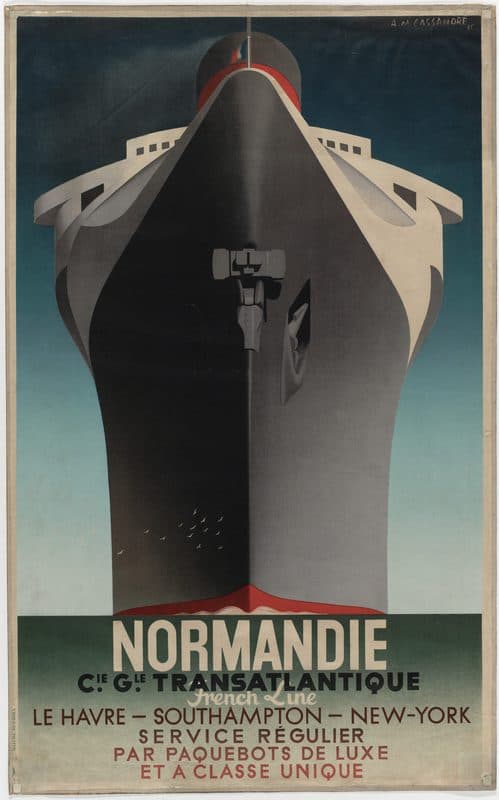
A. M. Cassandre's 1935 poster for the ocean liner Normandie is a particularly clear example of Art Deco graphic design. Seen almost directly from the front, the ship becomes an immense, simplified form rising above the viewer. Small birds emphasize its scale, while the lettering participates in the composition rather than functioning as an unrelated caption.[26]
The poster offers more than a likeness of a vessel. Its exaggerated viewpoint makes the liner appear monumental and technologically commanding. Read as an advertisement, it turns a journey into an encounter with power, modernity, and prestige. Its impact depends on selection and simplification: relatively few forms carry the image's principal message.
Art Deco and Paris
Paris was Art Deco's principal early center and its most influential international showcase. The city brought together the people and institutions that helped the style flourish: decorative artists, fashion houses, skilled workshops, wealthy collectors, and exhibitions capable of attracting worldwide attention. Although Art Deco absorbed influences from many countries, Paris played a decisive role in transforming those influences into a recognizable expression of modern sophistication. Its importance extended beyond producing individual masterpieces to presenting a coordinated vision of how modern life could look.[32]
Why Art Deco Flourished in Paris
Art Deco developed in Paris through the interaction of artistic experimentation and established luxury trades. French designers wanted to renew the country's reputation for exceptional craftsmanship while responding to new ideas about color, geometry, and modern life. Developments associated with Cubism and other avant-garde movements supplied possibilities that decorators could adapt to furniture, fabrics, jewelry, and interiors. The resulting designs could appear contemporary without abandoning the prestige of beautifully worked materials.[3]
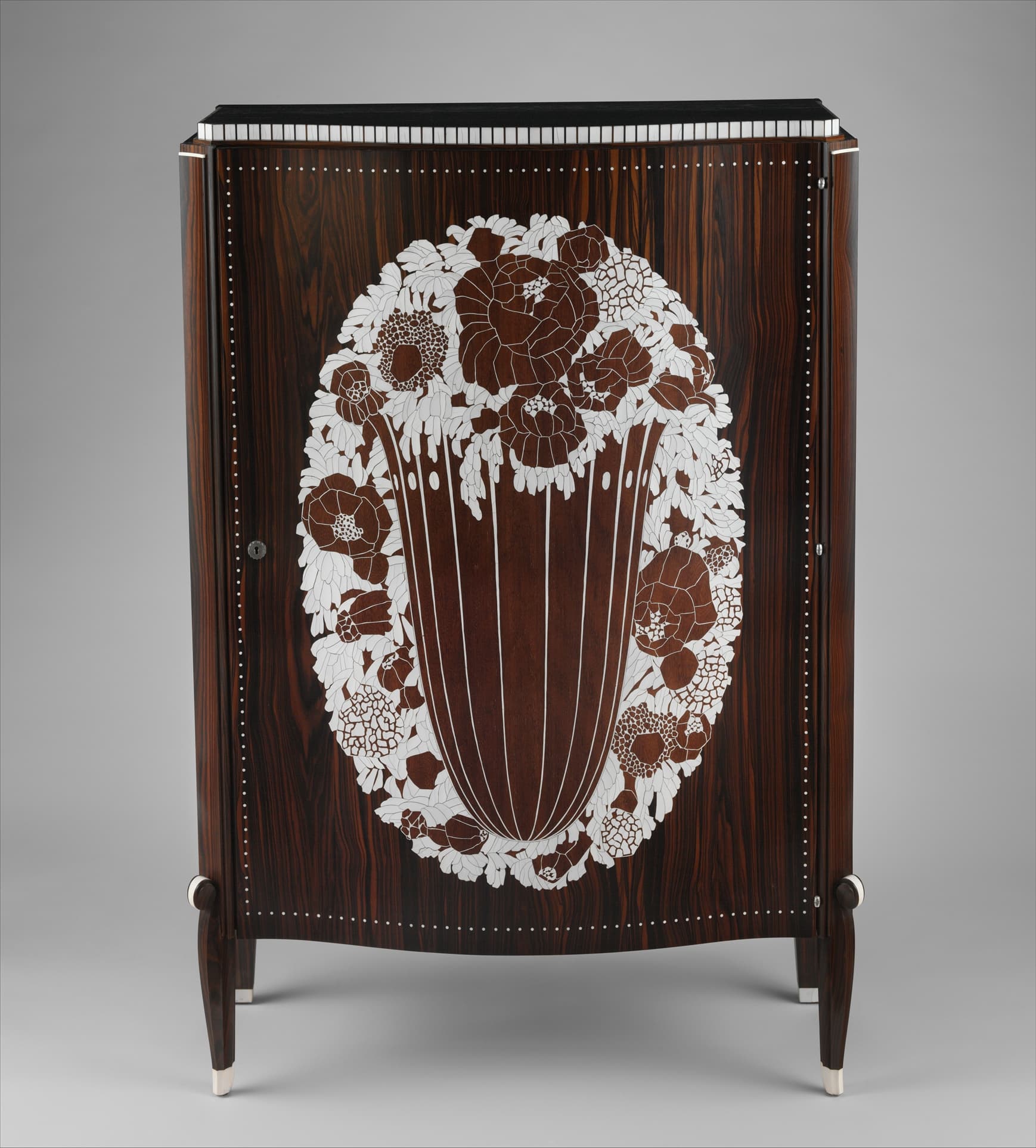
The career of Émile-Jacques Ruhlmann illustrates this connection between inherited craft and modern enterprise. Born in Paris, he took over his family's decorating business in 1907 and expanded it into furniture and interior design. By the 1920s, his operation employed more than one hundred skilled workers and assistants. His elegant cabinets and desks were therefore the products of an extensive working organization, not simply the inventions of an individual designer. Paris provided both the expertise needed to manufacture such demanding objects and the clients prepared to commission them.[9]
Fashion strengthened these relationships. In 1911, Paul Poiret established a perfume and cosmetics business named after his daughter Rosine and a decorative-arts enterprise named after his daughter Martine. Both were located at 107 rue du Faubourg-Saint-Honoré. Clothing, scent, textiles, and furnishings could now be presented as related expressions of a designer's taste. Poiret helped establish a model in which a Parisian fashion house offered an entire style of living, extending its influence from the dressed body into the furnished home.[22]
The 1925 Exhibition: A Temporary Design District Along the Seine
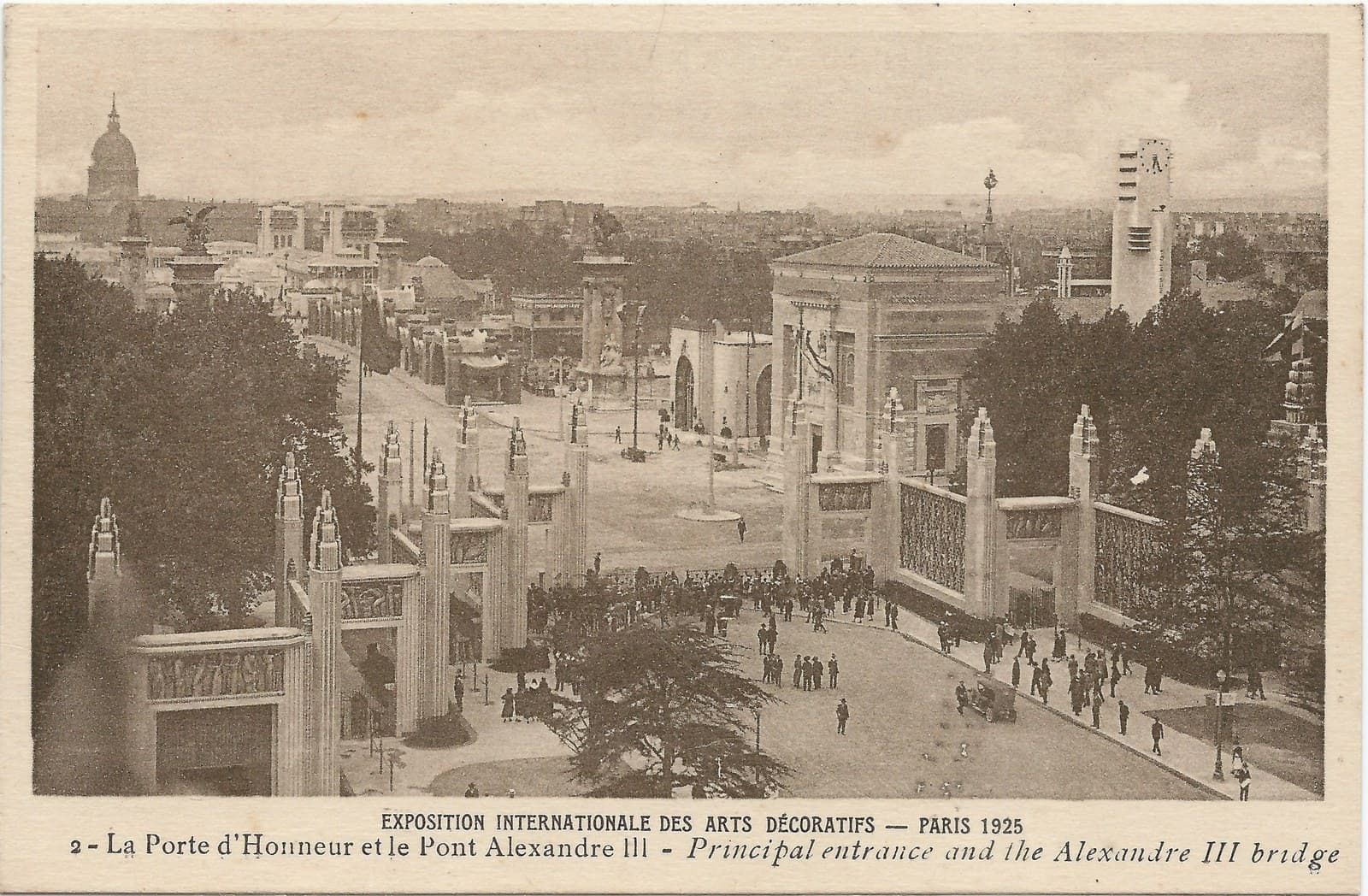
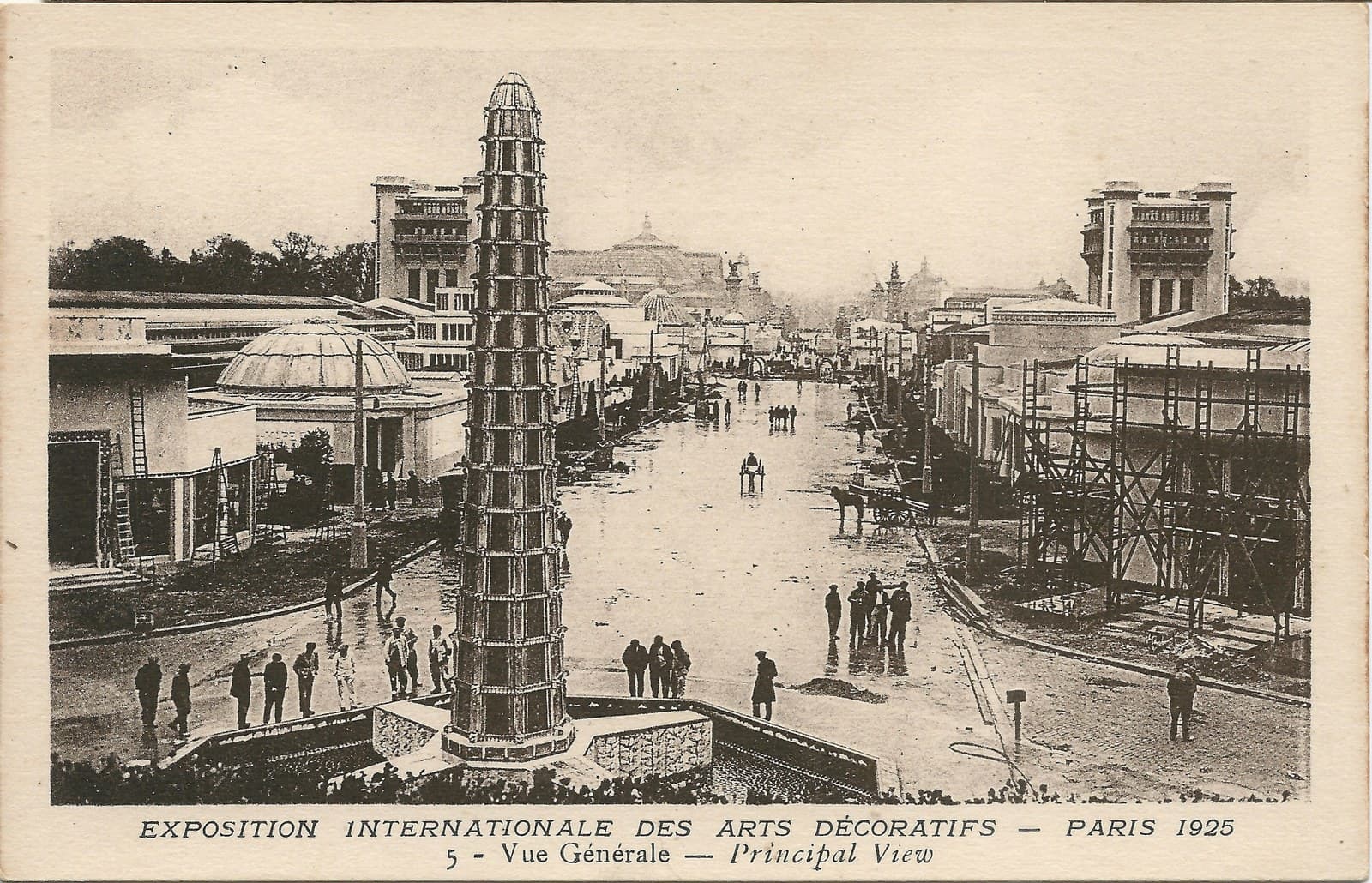
The Exposition internationale des arts décoratifs et industriels modernes of 1925 made Paris the center of an extraordinary international presentation of decorative design. Its grounds extended around the Grand Palais, across the Seine, and toward the Esplanade des Invalides. The Pont Alexandre III became part of the exhibition itself, lined with temporary shops. Visitors moved through a transformed section of the city in which pavilions, displays, gardens, and commercial spaces presented competing visions of contemporary taste. The exhibition supplied the name from which the later term Art Deco developed.[3]
Ruhlmann's Hôtel du Collectionneur was among its defining attractions. Conceived as the home of an imaginary wealthy collector, it demonstrated how furniture, carpets, lighting, and decorative objects could be organized into a complete environment. Its importance lay in this coordination: the rooms presented a convincing image of cultivated modern living rather than a miscellaneous collection of expensive possessions. Parisian craftsmanship was being displayed as a comprehensive approach to interior design, capable of shaping every aspect of a room.[9]
The exhibition also made the relationship between fashion and decoration visible. Armand-Albert Rateau's work appeared in the Pavillon de l'Élégance, which housed displays associated with Jeanne Lanvin, Worth, Callot Soeurs, Jenny, and Cartier. A bronze dressing-table design that Rateau included there drew on ancient sources, particularly Pompeian furniture, while serving a distinctly modern luxury setting. Such displays explain why Parisian Art Deco could embrace historical references without simply reproducing historical rooms: older forms were being rearranged for contemporary clients and commercial purposes.[33]
The International Workshops Behind Parisian Elegance
The designation “French Art Deco” can obscure how international its production often was. Eileen Gray, an Irish artist who settled in Paris in 1902, developed her practice through collaboration with craftspeople from different backgrounds. In 1910, she opened a workshop with the Japanese lacquer specialist Seizo Sugawara at 11 rue Guénégaud. With Evelyn Wyld, she also established a rug-making workshop on rue Visconti. Lacquer, weaving, painting, and furniture design became connected activities through which she explored increasingly complex relationships between objects and space.[34]
On May 17, 1922, Gray opened her gallery, Jean Désert, at 217 rue du Faubourg-Saint-Honoré. It connected her work with a network of Parisian and American clients. Her career demonstrates both the cosmopolitan character of Parisian design and the limitations of rigid stylistic categories: the same artist who produced elaborate lacquer furniture also became an important architectural modernist. Paris supported these overlapping practices rather than a single, universally accepted definition of what modern design should be.[34]
Theaters, Brasseries, and the Parisian Night
Parisian Art Deco was experienced in public as well as private settings. An important early example is the Théâtre des Champs-Élysées, completed in 1913 on avenue Montaigne. Its creation involved Henry van de Velde, the Perret brothers, Antoine Bourdelle, and Maurice Denis, bringing architecture and decoration into a coordinated project. Reinforced concrete made the building structurally modern, while sculpture and painting gave it an artistic identity. Its opening year also brought the disruptive premiere of Stravinsky's The Rite of Spring, with choreography by Vaslav Nijinsky. The audience's notorious reaction concerned the performance rather than the building, but the association makes the theater a revealing meeting point between architectural innovation and Paris's experimental cultural life.[5]
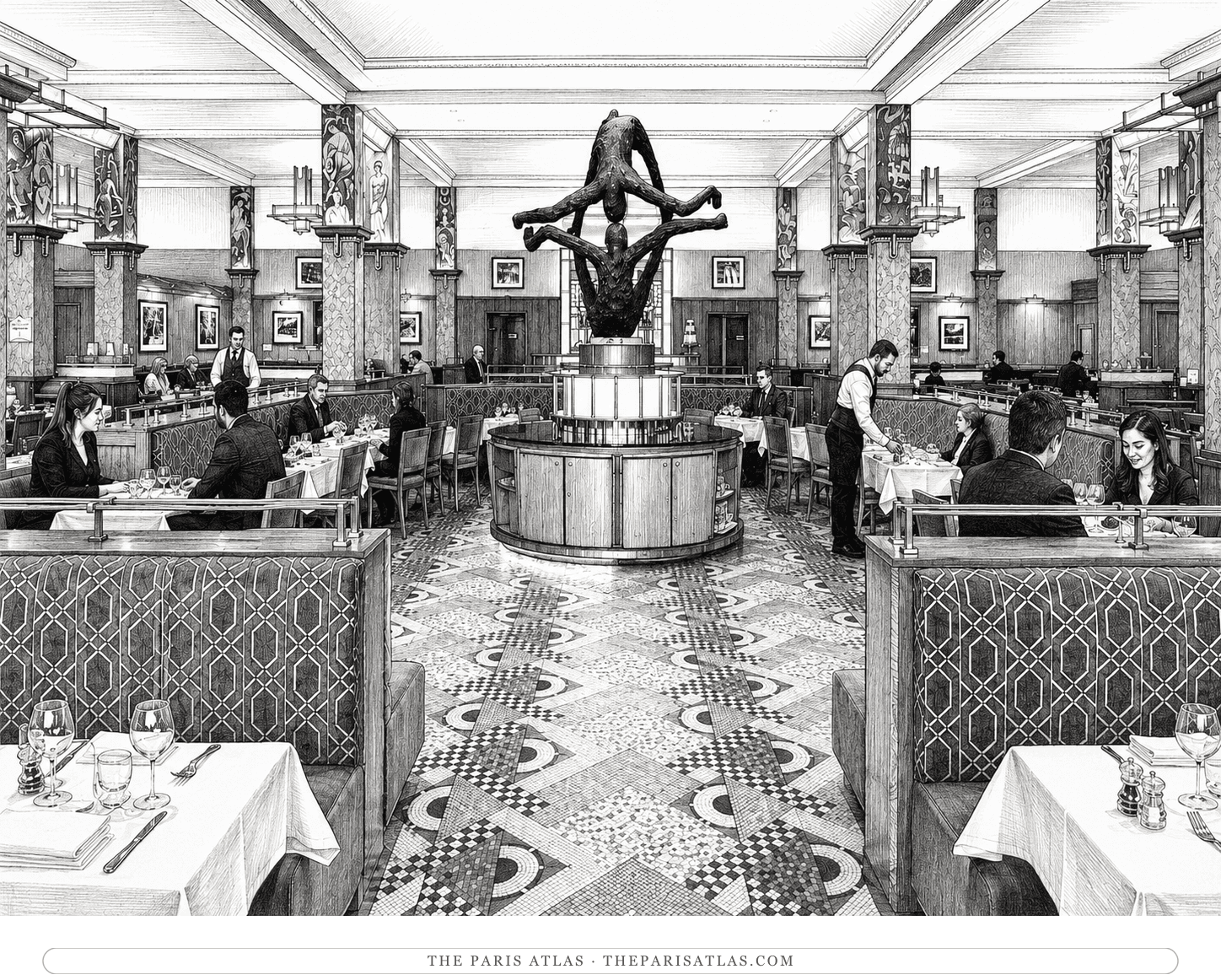
In Montparnasse, La Coupole, opened on December 20, 1927, brought Art Deco into the social world of artists and writers. Its interior incorporated painted pillars and pilasters decorated by artists associated with the neighborhood, including Marie Vassilieff, Othon Friesz, and Jeanne Rij-Rousseau. The paintings made the brasserie a collective artistic undertaking as well as a commercial establishment. Its significance is therefore greater than the familiar claim that famous people ate there: members of Montparnasse's artistic community helped shape the environment in which that community gathered.
The Grand Rex, which opened on December 8, 1932, offered a different kind of experience. Behind its imposing Art Deco façade, spectators encountered an auditorium designed to suggest an outdoor setting beneath a star-filled sky. Architectural scenery evoked Mediterranean places through balconies, colonnades, and other picturesque features. The cinema's founder, Jacques Haïk, conceived an attraction in which the surroundings were part of the entertainment. The contrast between the modern exterior and the imaginative interior also reveals Art Deco's flexibility: geometric architecture could coexist with theatrical historical references when both contributed to a carefully planned experience.[35]
Together, these places show why Art Deco became so closely associated with Parisian leisure. A concert, a dinner, or a film could take place within an environment that was itself a major part of the occasion. Design helped distinguish a venue, attract its public, and give an ordinary commercial activity the character of a cultural event.
Department Stores, Swimming Pools, and Modern Leisure
The city's department stores provide a particularly useful way to distinguish Art Deco from its predecessor, Art Nouveau. At La Samaritaine, Frantz Jourdain's earlier work incorporated the colorful ornament and floral imagery associated with Art Nouveau. The extension toward the Seine, developed with Henri Sauvage between 1926 and 1928, introduced an Art Deco architectural character. The complex demonstrates that these styles did not always replace one another completely. They could occupy different parts of the same expanding business, recording changing tastes within a single Parisian site.
Swimming pools offered another setting for modern design. Molitor, designed by Lucien Pollet and inaugurated in 1929, combined swimming facilities with an architectural atmosphere often compared to an ocean liner. Its two pools and surrounding galleries made it a place for recreation, sociability, and display. The association with maritime travel was particularly appropriate to a period in which the ocean liner had become an important model for sophisticated interiors and modern leisure. At Molitor, that atmosphere could be experienced without leaving Paris.[36]
One of the site's most famous episodes occurred after Art Deco's interwar heyday. On July 5, 1946, designer Louis Réard presented the swimsuit he called the bikini at Molitor, modeled by Micheline Bernardini, a performer from the Casino de Paris. Réard had struggled to find a conventional fashion model willing to wear his revealing design. The event belongs to the history of postwar fashion rather than the origins of Art Deco, but it illustrates how a building created for the leisure culture of the 1920s could continue to provide a setting for new forms of publicity and changing social conventions.[37]
Monumental Art Deco: Paris in 1931 and 1937
Art Deco also became a language for large public buildings. The Palais de la Porte Dorée, constructed between 1929 and 1931 under architect Albert Laprade, is an especially concentrated example. Architecture, sculpture, frescoes, mosaics, metalwork, and furniture were conceived as parts of a unified undertaking. Its historic reception rooms preserve the work of two important decorators: Ruhlmann designed the Africa Salon, while Eugène Printz designed the Asia Salon. Their responsibilities extended beyond supplying furniture to coordinating materials, floor patterns, and the surrounding decoration. The building demonstrates Art Deco's ambition to integrate multiple crafts within a single architectural setting.[38]
Its political purpose is inseparable from that artistic achievement. Built for the 1931 Colonial Exhibition, the Palais was intended to celebrate the French colonial empire. Its decoration must therefore be understood as an official representation of colonial power, not simply as an attractive collection of international motifs. The building now houses the Musée national de l'histoire de l'immigration, alongside its aquarium and historic spaces. Its present interpretation examines and questions the ideas that its original decorative program was designed to promote.[39][40]
The 1937 International Exhibition added further monumental buildings to Paris, notably the Palais de Chaillot and Palais de Tokyo, which extended the period's interest in symmetry, large volumes, and integrated sculpture. These projects show that the Parisian history of Art Deco continued beyond the decorative extravagance associated with 1925. Its architectural language could become more restrained and monumental while retaining a strong relationship between structure and the arts.
One of the exhibition's most remarkable artistic commissions was Raoul Dufy's La Fée Électricité—The Electricity Fairy. Created for the electricity pavilion designed by Robert Mallet-Stevens on the Champ-de-Mars, the approximately 600-square-meter painting presents the history and applications of electricity through landscapes, machinery, mythological figures, and portraits of 110 scientists and inventors. Dufy completed the undertaking in about ten months from conception, using extensive preparatory work and projection to transfer compositions onto its panels. Installed at the Musée d'Art Moderne de Paris in 1964, it preserves the ambition of a period in which modern technology could become the subject of an immense decorative artwork.[41]
The Parisian Legacy: Objects, Interiors, and a Way of Living
Paris preserves this history through both buildings and museum collections. The Musée des Arts Décoratifs holds furniture and decorative objects alongside reconstructed interiors, including rooms from Jeanne Lanvin's Parisian home, decorated by Armand-Albert Rateau. Such ensembles are particularly valuable because Art Deco often depends on relationships between objects: a chair, a textile, or a lamp may be impressive alone, but a coordinated room reveals how color, material, proportion, and placement were intended to work together.
Paris's distinctive contribution to Art Deco was the close connection it established between artistic invention, skilled manufacture, commerce, and daily experience. Its designers gave modern form to clothing and furniture, while its exhibitions and public interiors showed how those forms could operate within a larger environment. Seen across these settings, Parisian Art Deco was more than a decorative vocabulary. It was an influential attempt to make modern life feel coherent, sophisticated, and desirable—an ambition expressed as clearly in a neighborhood brasserie or a cinema as in a wealthy collector's drawing room.







 View source