The Paris AtlasCharting the artists, works, and places worth returning to.

Museum · Notre-Dame quarter, at the head of the town of Versailles

Château de Versailles

The buildingStill standing
Getting inHours or admission
What's there nowStill the same

A state-owned national estate, open to visitors as a museum. The palace admits ticket-holders from 9.00 am to 6.30 pm and closes on Mondays; the gardens and park open earlier and stay open later.

The palace of the French kings, in the town of Versailles west of Paris. Louis XIV moved the court and the government here on 6 May 1682; since 1837 the building has been a museum, and since 2008 the estate has commissioned a living artist a year to work in it.

Address
Place d'Armes, 78000 Versailles
Years
Seat of the French court 1682–1789; a museum since 1837
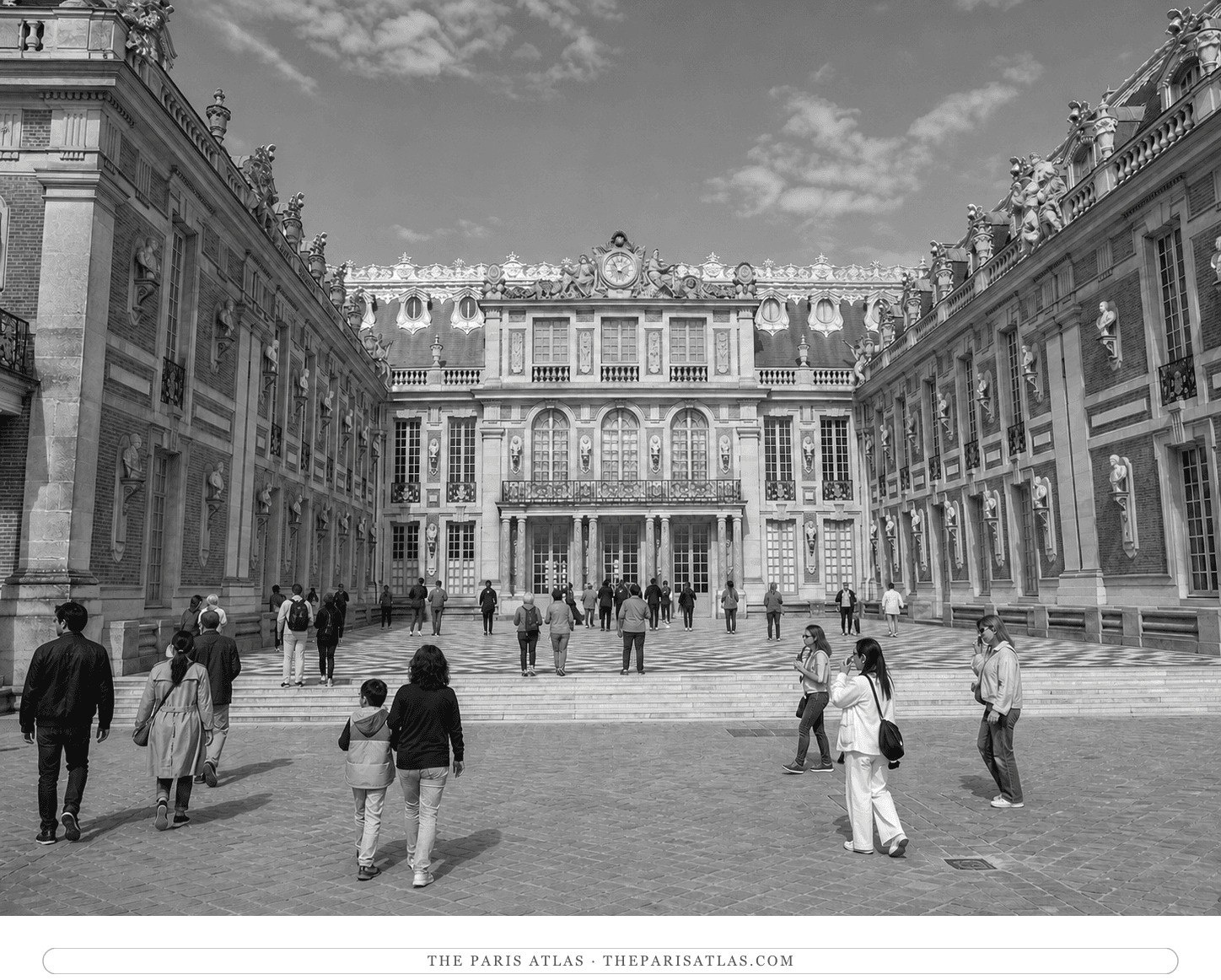
IllustrationPresent-day color view of the gilded Marble Courtyard at Versailles beneath a blue sky

The palace's red brick, pale stone, slate roofs and gilded cresting in bright contemporary daylight.

Editorial illustration

The place, briefly

Versailles began as somewhere to sleep after a day's hunting. The future Louis XIII came out for his first hunt on 24 August 1607, liked the woods and the game, and in late 1623 ordered a small lodge built where he could stay the night; he first used it in June 1624. He had it rebuilt from 1631, work that ran to 1634 and laid the base of the building that stands now. His son Louis XIV was three when he first came, in October 1641, and forty when he settled the government here. From 1661 the king built without stopping: the forecourt in 1662, Louis Le Vau's enveloping façades in 1668–1670, the Pavilions of the Secretaries of State in 1670–1671, the South Wing in 1679–1681, the Grand Commun in 1681–1684, the North Wing in 1685–1689 and the Royal Chapel in 1699–1710.[1]

The move itself has a date. On 6 May 1682 Versailles became the headquarters of the government, and although Paris never stopped being the official capital, the kingdom was run from here until 1789. Jean-Baptiste Colbert, the king's controller-general, had wanted the court kept in Paris and was overruled. Louis XIV disliked the capital, which he had been forced to leave in haste in 1649 during the Fronde, the civil wars of 1648 to 1653, and at Versailles he had room to build. Between 1678 and 1682 he built more than in his previous twenty years on the throne.[2]

The Hall of Mirrors is the room everything else in the palace leads to. Jules Hardouin-Mansart began it in 1678 in place of an open terrace that had proved impractical, and finished it in 1684. It runs 73 metres. Seventeen mirrored arcades face seventeen windows, carrying 357 mirrors at a time when a mirror was a luxury and the Venetians held the trade; Charles Le Brun painted thirty compositions across the vault, covering the first eighteen years of the reign up to the peace treaties of Nijmegen. Courtiers crossed it every day, and on rare occasions it was cleared for ceremony: the Doge of Genoa was received here in 1685, the ambassadors of Siam in 1686, of Persia in 1715 and of the Ottoman Empire in 1742. Two later ceremonies were not French ideas. Otto von Bismarck had the German Empire proclaimed in this room on 18 January 1871, after France's defeat by Prussia, and on 28 June 1919 the Allies made the German delegation sign the peace treaty in the same room, at a Louis XV desk placed beneath a painting of Louis XIV titled The King governs by himself. That session lasted fifty minutes and was attended by twenty-seven delegations representing thirty-two powers.[3]

The royal family left for the Tuileries Palace in Paris on 6 October 1789 and did not come back. The building was not sacked. What emptied it was legislation: a law of 10 June 1793 ordered the contents of the former crown palaces sold, and between 25 August 1793 and 11 August 1794 no fewer than 17,182 lots went under the hammer, most of them bought by Paris dealers. The paintings and sculptures had already gone the other way, to the new Central Museum for the Arts at the Louvre, which opened in August 1793. Every fleur-de-lis, crown and royal monogram was chiselled off. The Convention declared the palace a public establishment on 8 July 1793, and a museum opened inside it in 1796. Charles Dickens came out to see it in January 1847, on a fortnight of sightseeing with his biographer John Forster that took in the Louvre, the Morgue and the prisons as well.[4]

What Dickens saw was Louis-Philippe's idea. The king of the French decided on 1 September 1833 to turn the palace into a history museum dedicated to "all the glories of France", spent four years and twenty million from his own civil list on it, and inaugurated it on 10 June 1837 in the Gallery of Great Battles, with Victor Hugo, Alexandre Dumas and Eugène Delacroix among the guests. The building has been a museum ever since, and the decision saved it: a palace with a public purpose was no longer a royal residence waiting for an occupant.[5]

Versailles today is state property, classed as a historic monument by an order of 31 October 1906 and inscribed on the World Heritage list, run as a public establishment under the ministry of culture. A storm on 26 December 1999 took 10,000 trees out of the park and caused damage estimated at 250 million francs, and the replanting was used to restore André Le Nôtre's original layout. Restoration of the buildings has run since 2003 under a programme called Le Grand Versailles, and the Dufour Pavilion, rebuilt by the architect Dominique Perrault, opened in February 2016 as the main entrance. The estate also commissions living artists. Since 2008 it has given one of them the palace and gardens for a few months at a time: Jeff Koons in 2008, Xavier Veilhan in 2009, Takashi Murakami in 2010, Bernar Venet in 2011, Joana Vasconcelos in 2012, Giuseppe Penone in 2013, Lee Ufan in 2014, Anish Kapoor in 2015, Olafur Eliasson in 2016, a group show in 2017 and Hiroshi Sugimoto in 2018, with Eva Jospin in the Orangery in 2024. The 2015 invitation is the one that turned into a court case. Kapoor put six works in the gardens from 9 June, the largest of them a sixty-metre steel horn called Dirty Corner; it was defaced three times over the summer, he refused to have the slogans cleaned off, a tribunal in Versailles ordered them removed, and he covered them in gold leaf instead. One earlier commission stayed for good: the Water Theatre Grove, replanted in 2015 to a design by the landscape architect Louis Benech and the artist Jean-Michel Othoniel.[6]

Key facts

Address
Place d'Armes, 78000 Versailles — west of Paris, at the head of the town
The court moves in
6 May 1682, when Versailles became the headquarters of the French government
Hall of Mirrors
Built 1678–1684 by Jules Hardouin-Mansart: 73 metres long, 357 mirrors, a vault painted by Charles Le Brun
Emptied
17,182 lots of furnishings sold between 25 August 1793 and 11 August 1794, after the royal family left on 6 October 1789
Museum since
10 June 1837, when Louis-Philippe opened his museum "dedicated to all the glories of France"
Treaty of Versailles
Signed in the Hall of Mirrors on 28 June 1919, in the room where the German Empire had been proclaimed in 1871
Protection
State property, classed as a historic monument on 31 October 1906 and inscribed on the World Heritage list
Contemporary art
One living artist invited to work across the estate most years since 2008

Documentary photographs

Archival and present-day photographs, reproduced with rights verified.

Bust of Louis XIV, marble, carved in Paris in 1665 and shown to the king on 5 October that year. It was moved to Versailles in 1684 and stands in the Salon de Diane.1665 · Photograph by Coyau, via Wikimedia Commons · CC BY-SA 3.0
The layered Royal and Marble Courtyards today, with the Louis XIII château still visible at the centre.Editorial illustration
The palace's red brick, pale stone, slate roofs and gilded cresting in bright contemporary daylight.Editorial illustration
Historically informed editorial reconstruction of the working Royal Courtyard around 1785, before the court left Versailles.Artistic reconstruction
An ordinary late-Ancien Régime palace morning in natural color; the precise people, carriage and deliveries are interpretive.Artistic reconstruction
The 73-metre Hall of Mirrors during public hours, with its windows, mirror arches, Le Brun ceiling and single central chandelier row.Editorial illustration
The Royal Chapel during a public opening, with its lower arcade, upper colonnade, painted vault and organ.Editorial illustration
The restored King's Private Bedchamber, presented in its October 1789 state with reconstructed carving and Lyon silk.Editorial illustration

Timeline

  1. 1607

    The future Louis XIII hunts at Versailles for the first time on 24 August, and later builds a lodge there, first used in June 1624.

  2. 1631–1634

    Louis XIII rebuilds the lodge. That building is the core of the palace that stands today.

  3. 1661

    Louis XIV begins the building campaigns that run to the end of his life, from the forecourt of 1662 to the Royal Chapel of 1699–1710.

  4. 1678–1684

    Jules Hardouin-Mansart builds the Hall of Mirrors in place of an open terrace, and Charles Le Brun paints its vault.

  5. 1682

    On 6 May the government moves to Versailles. Paris remains the official capital; the kingdom is run from here until 1789.

  6. 1789

    The royal family leaves for the Tuileries on 6 October and never returns.

  7. 1793–1794

    The Convention declares the palace a public establishment on 8 July 1793; 17,182 lots of its contents are sold between 25 August 1793 and 11 August 1794, and its paintings go to the Louvre.

  8. 1796

    A museum opens inside the emptied palace.

  9. 1837

    Louis-Philippe inaugurates his museum "dedicated to all the glories of France" on 10 June, in the Gallery of Great Battles.

  10. 1847

    Charles Dickens visits Versailles in January, during a fortnight of sightseeing around Paris with John Forster.

  11. 1871

    Bismarck has the German Empire proclaimed in the Hall of Mirrors on 18 January.

  12. 1906

    The estate is classed as a historic monument by an order of 31 October.

  13. 1919

    The German delegation signs the peace treaty in the Hall of Mirrors on 28 June, in a session of fifty minutes attended by twenty-seven delegations.

  14. 1999

    The storm of 26 December destroys 10,000 trees in the park; the replanting restores Le Nôtre's layout.

  15. 2008

    Jeff Koons opens the estate's run of contemporary-art invitations, one artist at a time. Anish Kapoor's turn comes in 2015.

  16. 2016

    The Dufour Pavilion, rebuilt by Dominique Perrault, opens in February as the palace's main entrance.

On the map

Questions before you go

What is the Château de Versailles?

The palace the kings of France lived and governed in between 1682 and 1789, in the town of Versailles west of Paris. It began as a hunting lodge built for Louis XIII in the 1620s, was enlarged by Louis XIV for the rest of his life, and has been a museum since 1837. The estate is state property and includes the gardens, the park and the two Trianon palaces.

When did Louis XIV move the court to Versailles?

On 6 May 1682, when Versailles became the headquarters of the government. Paris stayed the official capital, but the kingdom was run from Versailles until 1789. Colbert, his controller-general, had argued for keeping the king in Paris and lost the argument; Louis XIV had disliked the city since being forced out of it in 1649 during the civil wars known as the Fronde.

What is the Hall of Mirrors?

A gallery 73 metres long, built between 1678 and 1684 by Jules Hardouin-Mansart where an open terrace had been. Seventeen mirrored arcades of 357 mirrors face seventeen windows, and Charles Le Brun painted thirty compositions on the vault showing the first eighteen years of Louis XIV's reign. The court crossed it daily, and ambassadors were received in it. The German Empire was proclaimed there in 1871 and the Treaty of Versailles signed there in 1919.

What happened to Versailles during the French Revolution?

It was emptied rather than destroyed. The royal family left on 6 October 1789, the Convention declared the palace a public establishment on 8 July 1793, and a law of 10 June 1793 ordered the contents of the crown palaces sold: 17,182 lots went at auction between 25 August 1793 and 11 August 1794. The paintings and sculptures were sent to the new museum at the Louvre, and the emblems of the monarchy were cut off the building. A museum opened in the empty rooms in 1796.

Why is there a museum inside a royal palace?

Because Louis-Philippe put one there. On 1 September 1833 he decided to turn the palace into a museum "dedicated to all the glories of France", covering French history from the Middle Ages to his own reign, and inaugurated it on 10 June 1837 with Victor Hugo, Alexandre Dumas and Eugène Delacroix present. Four years of work went into it, paid for out of his civil list. It also settled what the building was for, which is part of why it survived.

Was the Treaty of Versailles signed at the palace?

Yes, in the Hall of Mirrors on 28 June 1919. The room was chosen deliberately: it was where Bismarck had proclaimed the German Empire on 18 January 1871, after France lost the Franco-Prussian War. The signing took fifty minutes, with twenty-seven delegations representing thirty-two powers in the room; Germany was represented by its foreign minister and a jurist.

Why is there contemporary art in the gardens?

Because the estate invites it. Since 2008 Versailles has given a living artist the palace and gardens for a few months at a time, starting with Jeff Koons and continuing with Xavier Veilhan, Takashi Murakami, Bernar Venet, Joana Vasconcelos, Giuseppe Penone, Lee Ufan, Anish Kapoor in 2015, Olafur Eliasson, Hiroshi Sugimoto and Eva Jospin. Kapoor's year was the contentious one: his sixty-metre steel work Dirty Corner was defaced three times, he refused to clean it, and a tribunal in Versailles ordered the slogans removed. One commission was kept: the Water Theatre Grove, replanted in 2015 by the landscape architect Louis Benech with the artist Jean-Michel Othoniel.

Can you visit the Château de Versailles?

Yes, with a ticket. The palace opens from 9.00 am to 6.30 pm and closes on Mondays, 25 December, 1 January and 1 May; the Trianon estate opens at midday, and the gardens and park open from 7.00 am to 8.30 pm. The address is Place d'Armes, 78000 Versailles.

Writers who knew this place

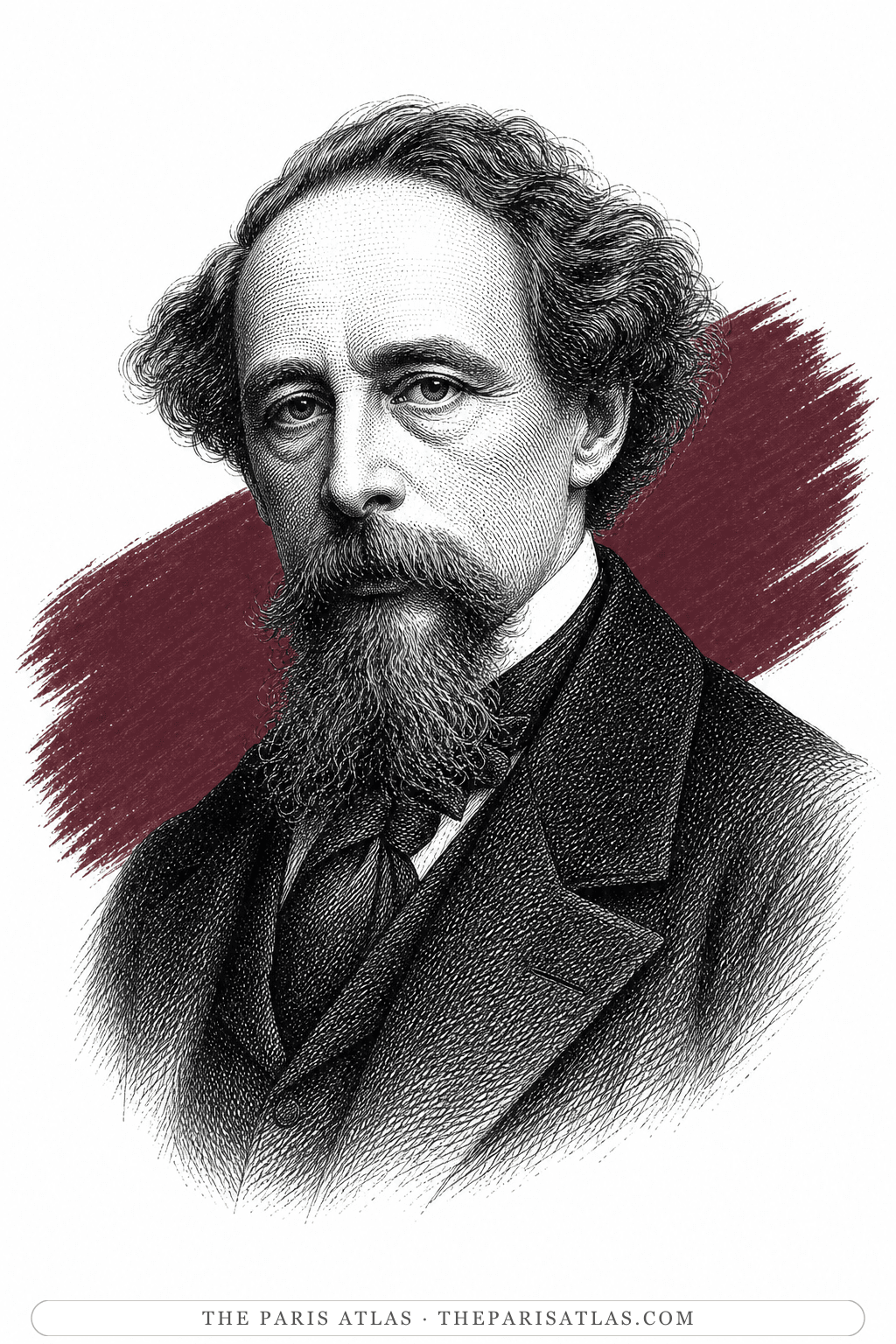
Illustrated portrait of Charles Dickens

Charles Dickens

English · The most popular English novelist of the nineteenth century, who was never a Paris resident in the ordinary sense but kept coming back for twenty-five years: one winter in a rented mansion on the rue de Courcelles, a second winter on the Champs-Élysées writing Little Dorrit, repeated compulsive visits to the Paris Morgue — the riverside building where the city displayed its unidentified dead to the public — and a novel of the French Revolution, A Tale of Two Cities, that has shaped how English readers picture Paris ever since.

Visited by · 1847

John Forster lists Versailles among the places he and Charles Dickens went to see during a fortnight of sightseeing from Paris in January 1847, alongside the Louvre, Saint-Cloud, the Morgue and the prisons. He does not describe what they saw at the palace; by then the building held Louis-Philippe's history museum, open since 1837.

— John Forster, The Life of Charles Dickens, Vols. I–III, Complete (1874), Book V, Paris 1846–47; Inauguration of the historic galleries, 1837

People who knew this place

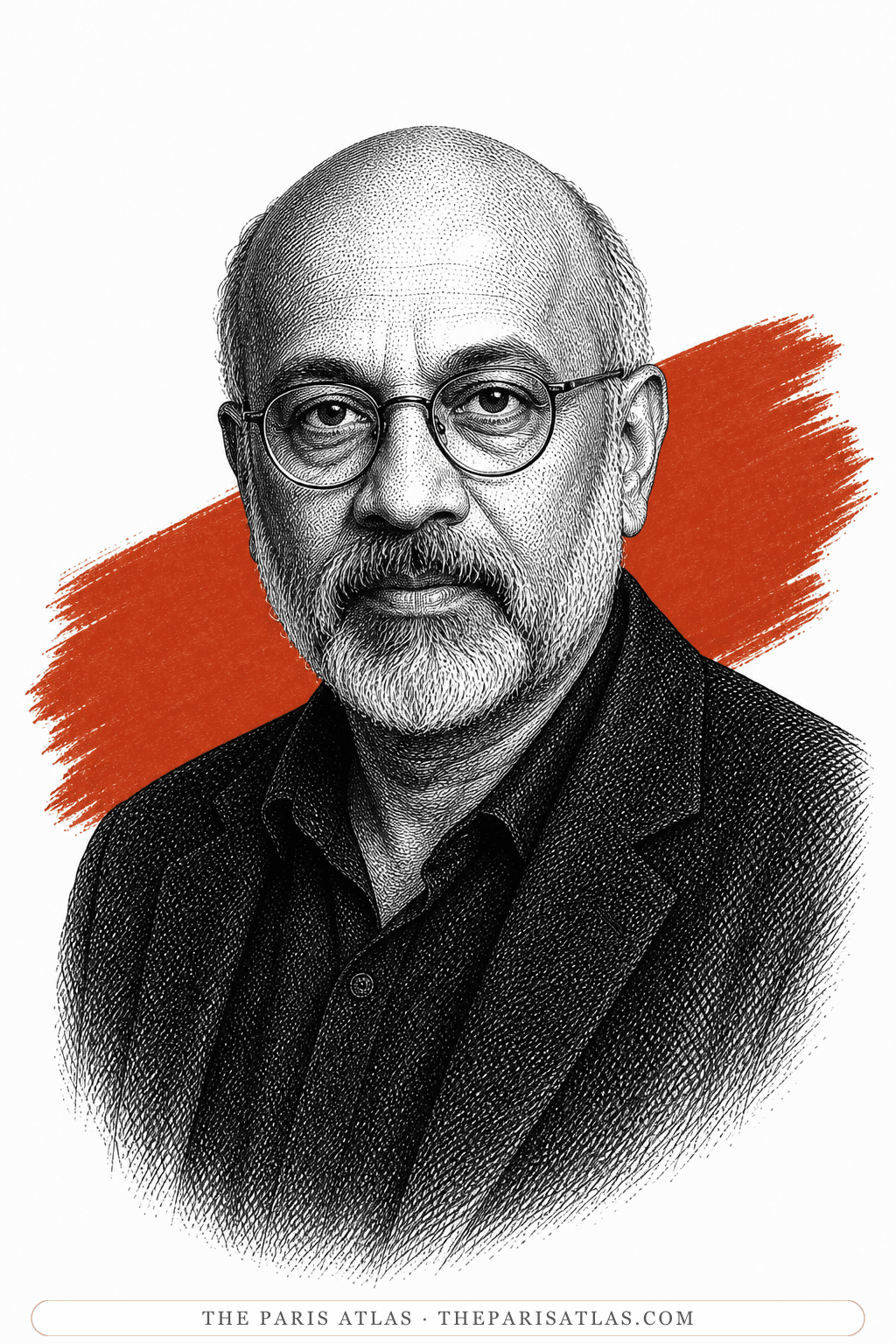
Illustrated portrait of Anish Kapoor

Anish Kapoor

British · Sculptor

Anish Kapoor was the artist the estate invited for 2015, the eighth in the run of contemporary-art commissions it has made since 2008. Six works of his opened to the public in the gardens on 9 June 2015, four of them along the Grande Perspective, the central axis of the gardens; none were placed inside the palace. The largest, Dirty Corner, was a horn of Cor-Ten steel about sixty metres long, first built in Milan in 2011 and installed here in a heap of earth and rock. It was attacked with paint in June, sprayed with hostile slogans in September and defaced a third time days later; Kapoor said he would not have the words removed, a tribunal in Versailles ordered that they be, and he answered by covering the damaged areas in gold leaf. The exhibition closed on 1 November 2015.

Illustrated portrait of Gian Lorenzo Bernini

Gian Lorenzo Bernini

Italian · Sculptor, Architect

Bernini spent the day at Versailles on 13 September 1665, seventeen years before Louis XIV moved the court there. It was still Louis XIII's small brick and stone house, and André Le Nôtre met the party and took Bernini into the gardens first. Chantelou noticed that his praise of the château was carefully worded: it was elegant, everything with proportion is beautiful, and that palace was in proportion. Bernini's own marble bust of Louis XIV, carved in Paris that summer, was moved to Versailles in 1684 and stands in the Salon de Diane.

Art movement and historical period · circa 1600–1750

Baroque Art was seen here first

The seventeenth-century style of dramatic light, twisting movement and direct address to the viewer — Caravaggio and Bernini in Rome, Rembrandt and Vermeer in the Dutch Republic, Velázquez in Madrid, Poussin in Paris and Rome.

Enter the movement
References

References

The sources below include histories, archival materials, scholarly research, and official records that informed this page. They document Château de Versailles, the people connected to it, and its place in Versailles.

  1. 1↑The history of the Palace of Versailles

    Website
    Château de Versailles
    Used for

    The estate's own history of itself: Louis XIII's lodge, the building campaigns of Louis XIV, the Revolution and the sales, Louis-Philippe's museum, the storm of 1999 and the Grand Versailles restoration programme.

    View source
  2. 2↑Versailles, "capital" of the kingdom, 1682

    Website
    Château de Versailles
    Used for

    The date of the move — 6 May 1682 — with Colbert's opposition, the Fronde, and the building work of 1678 to 1682.

    View source
  3. 3↑The Hall of Mirrors

    Website
    Château de Versailles
    Used for

    The Hall of Mirrors: built 1678–1684 by Jules Hardouin-Mansart, 73 metres, 357 mirrors on seventeen arcades, Le Brun's thirty ceiling compositions, the ambassadorial receptions, and the 1919 signature.

    View source
  4. 4↑Versailles after the French Revolution

    Website
    Château de Versailles
    Used for

    The departure of 6 October 1789, the declaration of 8 July 1793, the removal of royal emblems, and the revolutionary sales.

    View source
  5. 5↑Inauguration of the historic galleries, 1837

    Website
    Château de Versailles
    Used for

    Louis-Philippe's decision of 1 September 1833, the four years and twenty million francs, and the inauguration of 10 June 1837 with Hugo, Dumas and Delacroix in the room.

    View source
  6. 6↑Domaine national de Versailles — notice Mérimée PA00087673

    Official record
    Ministère de la Culture, Plateforme ouverte du patrimoine
    Used for

    The French heritage register for the Domaine national de Versailles: classed as a historic monument by the order of 31 October 1906, state property under the ministry of culture, and on the World Heritage list.

    View source
  7. 7The Treaty of Versailles, 1919

    Website
    Château de Versailles
    Used for

    The signature of 28 June 1919: the fifty-minute session, the twenty-seven delegations, the Louis XV desk, and the choice of the room where the German Empire was proclaimed in 1871.

    View source
  1. 8Sugimoto Versailles — exhibition page, with the estate's contemporary art programme year by year

    Website
    Château de Versailles, 2018
    Used for

    The estate's list of its contemporary-art invitations year by year, from Jeff Koons in 2008 through Anish Kapoor in 2015 to Hiroshi Sugimoto in 2018.

    View source
  2. 9Anish Kapoor à Versailles : qu'y voit-on vraiment ?

    Periodical
    Les Inrockuptibles, 2015
    Used for

    The opening of Anish Kapoor's commission on 9 June 2015: six works in the gardens, four of them on the Grande Perspective.

    View source
  3. 10Anish Kapoor vandalised statue to be covered in gold

    Periodical
    BBC News, 2015
    Used for

    The vandalism of Dirty Corner, the Versailles tribunal's order to remove the slogans, and the gold leaf Kapoor used instead.

    View source
  4. 11Practical information — opening times and address

    Website
    Château de Versailles
    Used for

    Opening times and the postal address at the Place d'Armes.

    View source
  5. 12The Life of Charles Dickens, Vols. I–III, Complete

    Biography
    Chapman and Hall, 1874
    Used for

    Forster names Versailles among the places he and Charles Dickens saw in January 1847.

    View source
  6. 13OpenStreetMap

    Map data
    Used for

    Map data used to verify addresses, geographic coordinates, and the placement associated with Château de Versailles.

    View source
i
Why these sources are here

These references provide the documented foundation for this page's history and context. Claim-level citations remain attached to the specific claims they support.

Explore more resources

Newsletter

Paris, one address at a time.

The cafés, studios, and walk-up flats where the work was made — one story from the map in every letter.

Unsubscribe anytime.