Italian sculptor and architect. He carved the David of 1623–24 and the Ecstasy of Saint Teresa, designed the colonnade around Saint Peter's Square, and spent five months in Paris in 1665 drawing a new Louvre that was never built.
In images
Details
Lived
1598–1680
Born
7 December 1598
Birthplace
Naples, Kingdom of Naples
Died
28 November 1680 · aged 81
Place of death
Rome, Papal States
Nationality
Italian
Profession
Sculptor, architect, painter and designer for the stage
Major works
Apollo and Daphne, David, the Baldacchino of Saint Peter's, the Fountain of the Four Rivers, the Ecstasy of Saint Teresa, the colonnade of Saint Peter's Square, the bust of Louis XIV
Married
Caterina Tezio · 1639–1673
Children
Pier Filippo Bernini, Paolo Valentino Bernini, Domenico Bernini
Roles
SculptorArchitect
Also known as
Gianlorenzo Bernini · Giovanni Lorenzo Bernini · Il Cavalier Bernino · Le Cavalier Bernin
About Gian Lorenzo Bernini
Italian sculptor and architect, the maker of Baroque Rome
Gian Lorenzo Bernini (1598–1680) was the sculptor and architect who gave seventeenth-century Rome its public face. He carved four large marble groups for Cardinal Scipione Borghese before he was thirty. He built the bronze canopy over the tomb of Saint Peter, made the Fountain of the Four Rivers in Piazza Navona, and ringed Saint Peter's Square with a colonnade of free-standing columns. He also wrote and staged comedies, built the machinery for them, drew caricatures, and painted.
He worked under a line of popes running from Paul V, who noticed him as a boy, to Innocent XI, who was reigning when he died, and he was the dominant artist in Rome for more than fifty years. The one long interruption came in 1665, when Louis XIV sent for him. Bernini left Rome on 29 April, reached Paris on 2 June, and stayed until 20 October.[1][2] He drew three schemes for the east front of the Louvre and carved a marble bust of the king. Louis XIV laid the foundation stone of Bernini's Louvre and then had a French design built instead.[2][3] The bust survived, and stands at Versailles.[4]
His private life is documented in unusual detail because of a criminal case. In 1638 he found that his younger brother Luigi Bernini was involved with Costanza Bonarelli, the wife of one of his assistants. Bernini had carved her portrait and was involved with her himself. He attacked his brother, sent a servant to slash Costanza Bonarelli's face, was fined and then pardoned by Pope Urban VIII, and was married off the following year to Caterina Tezio, who bore him eleven children.[5] A stroke paralyzed his carving arm in his last fortnight.[6] He died in Rome on 28 November 1680, nine days short of eighty-two, and was buried in the family tomb he had prepared in Santa Maria Maggiore.[7][6]
Naples, Rome, and his father's workshop
Gian Lorenzo Bernini was born in Naples on 7 December 1598.[5] His father, Pietro Bernini, was a sculptor from Florence who had gone south to work on the Certosa di San Martino.[6] His mother, Angelica Galante, was Neapolitan.[5] The family moved to Rome in 1605 or 1606, when the boy was six or seven, and Rome was where he stayed.[5] Apart from five months in Paris in 1665 and the journeys either side of them, he lived and worked in the same city for the rest of his life.
His father taught him to cut stone, and nobody else did. There was no school and no other master, and he went on living in his father's house until a few years after Pietro Bernini died in 1629.[5] The rest of a sculptor's education he took for nothing from the collections of Rome: the Greek and Roman marbles in the Vatican and at the Villa Borghese, and Raphael's frescoes in the Vatican Stanze. For two years, in his early teens, he drew from them almost every day.[5] His two early biographers, Filippo Baldinucci and his own son Domenico Bernini, both say he was carving marble at eight.[5] A memorial bust of Antonio Coppola, made in 1612 for the church of San Giovanni dei Fiorentini in Rome, is among the first works securely his.[5]
Self-portrait as a Young Man, about 1623, oil on canvas laid on panel, 39 by 31 centimeters. Bernini was about twenty-five when he painted it. Galleria Borghese, Rome, inv. 554. (Gian Lorenzo Bernini (Galleria Borghese, Rome), via Wikimedia Commons · Public domain)
In Paris in 1665, forty years on, he described that education himself, to Paul Fréart de Chantelou, the French official who kept a day-by-day diary of Bernini's months in France. When he was very young he drew constantly from ancient sculpture, and while carving his first figure he would go and consult the Antinous in the Vatican whenever he was unsure of something, treating the statue as an oracle.[2] He noticed, he said, that beauties kept appearing in it from one day to the next that he had not seen before and would never have seen if he had not been holding a chisel at the same time. From that he drew a rule for students: do not only draw and model, but start cutting or painting early, so that making and copying go together.[2]
Chantelou also wrote down the family story Bernini told about himself. Cardinal Maffeo Barberini, who became Pope Urban VIII in 1623, called at Pietro Bernini's house while Gian Lorenzo, then eight years old, was finishing a piece of carving.[2] That puts it around 1607. The cardinal looked at it and said, laughing, that Pietro should watch out, because this child would surpass him and would certainly end up more skillful than his master. Pietro Bernini answered flatly that he did not mind at all, because in that game the loser wins: a father beaten by his own son has lost nothing.[2] The story comes from Bernini himself, in his sixties, repeating a compliment paid to him as a child.
The Borghese marbles, 1618 to 1625
Bernini's first great patron was Cardinal Scipione Borghese, the nephew of Pope Paul V, who was filling a villa on the edge of Rome with sculpture. Between about 1618 and 1625 Bernini carved four large marble groups for him. All four are in that villa today, which is now the Galleria Borghese.
Aeneas, Anchises and Ascanius, 1619, marble, 220 centimeters high. A surviving payment receipt of 1619 ended a long argument, going back to the seventeenth century, over whether his father had a hand in it. The money was paid to the son.[8]
The Rape of Proserpine, 1621–22, marble, 255 centimeters high without its base. Scipione Borghese paid 300 scudi toward it in June 1621 and then gave the finished group away, to Cardinal Ludovico Ludovisi, in October 1622. The Italian state bought it back in 1908.[9]
Apollo and Daphne, 1622–25, Carrara marble, 243 centimeters high. The block was bought on 2 August 1622 and the last payment made on 24 November 1625. Bernini was paid 1,000 scudi in all.[10]
David, 1623–24, white marble, 170 centimeters high. Cardinal Alessandro Montalto had ordered a David from him in March 1623 and died in June. Scipione Borghese took over the commission, and Bernini put Apollo and Daphne aside and finished the David in seven months.[11]
Apollo and Daphne, 1622–25, Carrara marble, 243 centimeters high, carved for Cardinal Scipione Borghese. Galleria Borghese, Rome. (Photograph by Architas, via Wikimedia Commons · CC BY-SA 4.0)
Apollo and Daphne, carved between 1622 and 1625, takes one moment out of Ovid's Metamorphoses, the Roman poem of transformations. The god has caught up with the nymph, and she is turning into a laurel tree to escape him. Bernini carved the change while it is happening: bark closing over her right leg, roots under her foot, her fingers already ending in leaves, her hair spreading into branches. Both figures are up on one foot, still running. The finish changes from surface to surface, so that cloth does not read like skin and bark does not read like either. While the work was going on he wrapped the thinnest parts in plaster cushions to keep the vibration of the carving from snapping them, which is what analysis during the 1997 restoration found.[10]
Who cut the leaves of the Apollo and Daphne is disputed. The Metropolitan Museum's account of Bernini's studio says he hired the sculptor Giuliano Finelli to carve each leaf wafer-thin and set each at a slightly different angle so that the light scatters.[12] The Galleria Borghese, which owns the group, says that close examination has led most modern scholars to exclude any other hand.[10] The seventeenth-century source for Finelli's part is the biographer Giovanni Battista Passeri.[12]
The David of 1623–24 sets a different problem, and Bernini solved it a different way. Earlier sculptors had shown David before his fight with the giant Goliath, or after it. Bernini shows him in the middle of it, twisted round with the sling drawn, biting his lower lip, staring hard at a Goliath who is not there. The giant has to be somewhere in the room, which puts the viewer inside the fight. Filippo Baldinucci, who published the first life of Bernini in 1682, reported that Cardinal Maffeo Barberini amused himself by holding the mirror, so that the face Bernini carved onto David was his own.[11]
David, 1623–24, marble, 170 centimeters high, carved for Cardinal Scipione Borghese. Galleria Borghese, Rome. (Photograph by Burkhard Mücke, via Wikimedia Commons · CC BY-SA 4.0)
Urban VIII, the Baldacchino, and Saint Peter's
Maffeo Barberini was elected pope on 6 August 1623 and took the name Urban VIII.[6][7] He had known Bernini since the sculptor was a boy. Both early biographers report that the new pope sent for Bernini at once. It was a great piece of luck for Bernini, he said, to see Cardinal Maffeo Barberini made pope, but a far greater one for the pope himself to have the Cavalier Bernini alive in his pontificate.[6][7] Filippo Baldinucci and Domenico Bernini were both writing to build his reputation, so the remark is best taken as their version of it. The favors that followed are in the records. Within weeks Bernini held three paid offices: commissioner of the fountain conduits in Piazza Navona from 24 August, overseer of the foundry at Castel Sant'Angelo from 1 October, and superintendent of the Acqua Felice conduits from 7 October.[5]
The largest of the Barberini commissions was the Baldacchino, the bronze canopy over the tomb of Saint Peter, built between 1624 and 1633.[5] It stands under Michelangelo's dome on four twisted bronze columns. Bernini was in his mid-twenties when he was given it and thirty-four when it was done, and he was paid 10,000 scudi for it.[5] Francesco Borromini, then one of the architects on the basilica works and later his competitor for every large Roman commission, worked on it with him.[5]
The twenty-one years of Urban VIII's pontificate kept him at work across the city. Bernini rebuilt the church of Santa Bibiana between 1624 and 1626 and began Urban VIII's own tomb in 1628.[5] He carved the colossal Saint Longinus for one of the piers of Saint Peter's between 1635 and 1638.[5] He also made two fountains Romans still meet at: the Barcaccia at the foot of the Spanish Steps and the Triton in Piazza Barberini. He was made architect of Saint Peter's at the beginning of 1629, after Carlo Maderno died, and finished the Palazzo Barberini between 1629 and 1633.[5]
Portrait busts ran alongside the architecture. In 1632 he carved Cardinal Scipione Borghese and found, when the work was finished, a crack in the marble running across the forehead. He carved the whole bust again.[13] Filippo Baldinucci, who published a life of him in 1682, says he showed the cardinal the damaged one first and then produced the replacement as a surprise. His son Domenico Bernini, whose life of him came out in 1713, says the cardinal spotted the difference himself and made him hand over the first version too. The Galleria Borghese has both busts.[13] In about 1638 he carved the English gentleman Thomas Baker, now in London, for a reported 6,000 scudi, more than the 4,000 he had received for a bust of Charles I.[14] Working for a private gentleman when he was the pope's sculptor was a slight, and Urban VIII sent his nephew Cardinal Francesco Barberini to order Bernini to stop.[14] The English sculptor Nicholas Stone reported that Bernini defaced the terracotta model in response.[14]
How he cut marble
Bernini's marble does things marble is not supposed to do. Daphne's fingers end in leaves cut to a paper edge, Saint Teresa's habit falls in folds too deep for stone to hold, and David's lower lip is pulled in under his teeth. He explained parts of how it was done himself.
Work began in clay. He modeled small rough studies with his fingers and a few tools, called bozzetti, to settle the pose before anyone touched stone, and then had larger, more finished clay models made to show a patron or to guide an assistant.[12] He made the small ones himself and almost always delegated the large ones. More than sixty of these terracottas survive to be examined, and fifty-two were gathered for the Metropolitan Museum's exhibition of 2012.[12] The clay still carries his fingerprints and the marks of his tools. One of those fingerprints is on the clay model for the Río de la Plata, one of the four river gods of the Piazza Navona fountain. It settled a long argument over whether Bernini had modeled that figure himself.[12]
Then came the block, cut down with chisels and drills.[15] The drill did most of the work that looks impossible. For a head of curls Bernini would run a line of closely spaced holes and then cut away the marble between them.[12] Sometimes he left the holes as they were, because the light breaking on them made carved hair look more like hair. Delicate parts were held by marble struts left standing until the last stage of work.[12] He also left surfaces unfinished where he had judged that nobody would be able to see them from where the sculpture was going to stand.
For portraits he refused to work from a sitter holding still.[15] In Paris in 1665 he drew Louis XIV during meetings of the royal council, with the king free to move about the room and talk as usual.[2] When Louis XIV caught him at it, Bernini would say "Sto rubando", I am stealing, meaning that he was taking the king's likeness without asking for it. The king once answered, in Italian, that he was stealing in order to give back. Bernini said he would be giving back less than he had taken.[2] He told the court on 12 August 1665 that he had brought the marble to the state they saw from memory, and from the image of the king he had formed and printed in his imagination. Had the king held a pose or sat down, he said, he could not have made him so alive. Once he had the image he stopped looking at the drawings altogether, so that the bust would be an original rather than a copy of his own work. The drawings had only ever been there, in his words, to soak and steep himself in the king's face.[2]
He also told Chantelou, his guide in Paris, what he thought the real difficulty of a marble portrait was. Color, he said, carries most of a likeness. If a man whitened his hair, beard, eyebrows, lips and even the pupils of his eyes, the people who saw him every day would struggle to know him.[2] The pallor of someone fainting is enough on its own to make a face unrecognizable. A marble head is all one color, so the sculptor has to compensate. To get the bruised shadow some people have under the eyes, Bernini said, you cut the marble deeper there, putting into the stone something that is not in the face, because sculpture cannot use color. Nature and imitation, he added, are not the same thing.[2]
The other half of his method is what happens around the sculpture. Baldinucci wrote that Bernini was reckoned the first to have tried to join architecture with sculpture and painting so that all of them together made one beautiful whole, a bel composto.[7] The Cornaro Chapel in Rome, with the Ecstasy of Saint Teresa on its altar, is the clearest case. A window is hidden above the group, so that daylight falls on the figures from a source the visitor cannot see.[5] He used the same idea on a larger scale in the Cathedra Petri, where the light comes through an alabaster window set above the throne.
The sculpture was not separate from the theater he made on the side. Bernini wrote comedies and staged them at his own house in Rome, built the machinery, and sometimes spent a month playing every part himself to teach the cast.[7][2] His effects were famous: a flood in which water appeared to break its banks and come at the audience, a fire that seemed to have started by accident, and a sunrise that Louis XIII asked for the model of.[7][2] John Evelyn, who saw one in Rome in November 1644, wrote that Bernini painted the scenes, cut the statues, invented the engines, composed the music, wrote the comedy and built the theater. He also drew caricatures, including cardinals and a pope, and told Chantelou that one whole production had cost him three baiocchi, which is to say a few pennies.[2]
Costanza Bonarelli, the marriage, and eleven children
Costanza Piccolomini Bonarelli was born about 1614 and married Matteo Bonarelli, a sculptor from Lucca who worked in Bernini's studio, in Rome in February 1632. Bernini began an affair with her in the mid-1630s.[5] Around 1636 or 1637 he carved her portrait in marble, with her hair loose and her shift open at the neck. He made it for himself and not for a patron, which is the first thing the Bargello, the Florence museum that owns it now, says about it.[16] He kept it in his studio, and in 1645 it went to Cardinal Giovan Carlo de' Medici, most likely as a gift from Bernini himself. From there it went to the Uffizi and then, in 1873, to the Museo Nazionale del Bargello in Florence, where it is on display.[16]
In the summer of 1638 Bernini learned that his younger brother Luigi Bernini was also involved with Costanza Bonarelli. He is said to have set out for the country, doubled back to the district near Saint Peter's where she lived, and seen his brother leave at dawn. He went after Luigi Bernini and beat him with an iron bar, breaking two of his ribs.[17] Accounts differ over whether that happened at Saint Peter's or at the end of a chase into the basilica of Santa Maria Maggiore. He then sent a servant to Costanza Bonarelli's house carrying a present from him as a pretext, and the servant cut her face with a razor.[17]
The servant was exiled and Luigi Bernini left Rome. Costanza Bonarelli was shut in the Casa Pia, a house of correction, and was not handed back to her husband until 7 April 1639, after she petitioned the Governor of Rome.[17] Bernini was fined 3,000 scudi. His mother, Angelica Galante, wrote to Cardinal Francesco Barberini asking for help in controlling her son, and Urban VIII pardoned him.[17]
Costanza Bonarelli did not disappear afterwards. Sarah McPhee's work in the Roman archives established that she ran her husband's business after he died in January 1654, chiefly as a dealer in art, and did well at it. She made a will in February 1659, added a codicil three days before her death, and died on 3 December 1662. She was buried not beside her husband in their parish crypt but in the basilica of Santa Maria Maggiore, the church where Bernini's own family tomb is.
In May 1639, at forty, Bernini married Caterina Tezio, a young Roman woman and the daughter of a lawyer too poor to give her a dowry. The marriage was arranged, and Urban VIII ordered it.[5] Caterina Tezio died in 1673.[5] They had eleven children, of whom nine reached adulthood.[5] Three of the children have a place in his story. Pier Filippo Bernini, the eldest son, became a prelate and a canon of Santa Maria Maggiore and wrote a short life of him. Paolo Valentino Bernini became a sculptor and went with him to Paris in 1665, at eighteen. Domenico Bernini, the youngest, born in 1657, published the fullest early biography of his father in 1713.[6]
The bell tower, and the years out of favor
In 1637 Bernini began building a bell tower at the south end of the façade of Saint Peter's, the first of a pair Urban VIII wanted.[5] The ground under the façade could not carry it. Cracks appeared, the alarm was raised, and in 1646 the tower was pulled down.[5] It is the one outright failure of his career, and the timing was the worst it could have been. Urban VIII had died in 1644, and under the new pope, Innocent X, the Barberini family lost their standing and their offices.[5] Bernini had been their artist, and his own standing went with theirs. For the first and only time it looked as though his career might be over.
He answered his critics with a statue. In 1646 he began a group called Truth Unveiled by Time.[5] He carved the figure of Truth and never carved the Time who was to uncover her. He kept the figure in his own house for the rest of his life and left it there under a condition of his will that it could not be sold out of the family.[7] Baldinucci calls it the one piece of his own chisel-work that stayed in his children's hands.[7]
The Four Rivers, the Ecstasy of Saint Teresa, and Saint Peter's Square
What brought him back into favor was a fountain, and he got the commission by a trick. Innocent X, who had frozen him out since the bell tower came down, asked the leading architects of Rome for designs for a fountain in Piazza Navona and did not ask Bernini. Francesco Borromini submitted one. Prince Niccolò Ludovisi, who was married to the pope's niece, made Bernini produce a model anyway. He had it set out in the Piazza Navona palace of the pope's sister-in-law, in a room Innocent X would walk through on his way from dinner. Innocent X stopped in front of it for half an hour.[7] Baldinucci reports what he then said in front of the whole room. This was a trick of Prince Ludovisi, and they would have to employ Bernini in spite of those who did not want it. Whoever does not want to use his work, the pope added, must take care not to see it.[7]
Bernini built the Fountain of the Four Rivers between 1648 and 1651: an Egyptian obelisk on a pierced rock, with four colossal river gods around the base. Baldinucci names them as the Nile for Africa, the Danube for Europe, the Ganges for Asia and the Río de la Plata for America.[7] The rock is hollow underneath, so the obelisk appears to stand on nothing. Domenico Bernini reports that his father came to hate the fountain, which is not a thing an admiring son would invent. He would pull the carriage curtains shut when he passed through Piazza Navona rather than look at it, saying how ashamed he was to have worked so badly.[6]
While the fountain was going up, Bernini was also at work on a side chapel of the small Roman church of Santa Maria della Vittoria. Cardinal Federico Cornaro paid for it, and between about 1645 and 1652 Bernini designed every part of it, from the colored marble on the walls to the sculpture on the altar and the light that falls on it.[5] Teresa of Ávila was a Spanish Carmelite nun who died in 1582 and was made a saint in 1622. She wrote that an angel came to her holding a long golden spear with a point of fire, and thrust it into her heart. The pain made her moan, she said, and was so sweet that she could not wish to be rid of it.[18] Bernini carved that scene, and the group is called the Ecstasy of Saint Teresa. The angel holds the spear. The nun has fallen back on a marble cloud with her eyes shut, her mouth open and one bare foot hanging down. Gilded rays stand behind them, and a window hidden above the chapel throws real daylight down the rays.[5] Members of the Cornaro family are carved in boxes on the side walls, watching, as though at a theater. Only one of them, the cardinal who paid, was alive when it was made.[5]
The Ecstasy of Saint Teresa, 1647–52, marble and gilded bronze, in the Cornaro Chapel of Santa Maria della Vittoria, Rome. A window hidden above the group lights it from the front. (Photograph by Alvesgaspar, via Wikimedia Commons · CC BY-SA 4.0)
Under Pope Alexander VII, elected in 1655, Bernini rebuilt the approach to Saint Peter's in Rome. The Cathedra Petri, made between 1657 and 1666, is the great bronze throne at the far end of the basilica, apparently held up by four bronze figures of Doctors of the Church.[5] Above it he set a window of thin alabaster, so that the daylight coming through the stone looks like light coming off the throne. Outside, from 1657, he laid out the piazza: two curved arms of free-standing columns four deep, reaching out from the church front and closing most of the way round an oval.[5] He also rebuilt the Scala Regia, the state staircase in the Vatican, between 1663 and 1666.[5] The stairwell narrows as it climbs, so he narrowed and shortened the columns along it at the same rate, and the stair looks straight-sided all the way up.
Sant'Andrea al Quirinale is the oval church he built for the Jesuit novitiate between 1658 and 1670, at the expense of Cardinal Camillo Pamphilj.[5] It is small, and it turns the oval so that the short axis is the main one. Domenico Bernini describes going into it one day and finding his father sitting alone in a corner, looking at every part of it. Domenico asked him what he was doing there so quietly. Bernini said that of this one work of architecture he felt some particular satisfaction at the bottom of his heart, and that he often came there for relief from his labors, to console himself with his own work.[6] His son notes that this was unusual: Bernini normally could not bear to look at anything he had finished.[6]
How Louis XIV got him to Paris
In January 1664 Jean-Baptiste Colbert became superintendent of the king's buildings, and the unfinished east front of the Louvre was the first thing on his desk.[2] The French architect Louis Le Vau had produced a design. Other architects were invited to criticize it and to submit their own, and Claude Perrault put in a scheme close to the one eventually built. Colbert liked none of it well enough. He sent copies of Le Vau's drawings to Rome and asked the best Italian architects for opinions and for new designs.[2]
The job of showing the Louvre drawings round Rome in 1664 nearly went to the French painter Nicolas Poussin, who had lived there for forty years. He was too ill, and it went instead to Colbert's agent, the abbé Elpidio Benedetti.[2] Pietro da Cortona, Carlo Rainaldi and an amateur named Landiani all produced schemes. Francesco Borromini is said to have asked to be paid in advance, or at least to have a letter from the king. Benedetti then put Louis Le Vau's Louvre plan in front of Bernini.[2]
Bernini wrote to thank Colbert on 4 May 1664 and sent his own designs on 24 June.[2] Paris did not like them, and the criticisms reached Rome before the acknowledgement of receipt did. Bernini complained to the duc de Créqui, the French ambassador to the pope, that more objections had been raised and more faults found than there were stones needed to build the Louvre.[2] Asked for another set, he refused at first, saying that the architects of France would never fail to condemn anything he did and had an interest in not letting an Italian's design be built. He was talked round, and a second set went to Paris in January 1665. Those pleased more, but arguing by post was hopeless, and someone at court proposed fetching Bernini himself.[2]
Louis XIV wrote to him on 11 April 1665.[19] The letter says the king holds his merit in such particular esteem that he greatly wishes to see and know so illustrious a person, provided it can be reconciled with the service Bernini owes the pope.[19] Alexander VII gave permission, which made the journey close to a diplomatic errand. On the day he arrived, Bernini told Paul Fréart de Chantelou, the official who met him in France, that the pope had in fact ordered him to go.[2]
He left Rome on 29 April 1665, aged sixty-six, traveling with his son Paolo Valentino Bernini, his assistants Mattia de' Rossi and Giulio Cartari, his steward Cosimo Scarlati and three servants. The road to Paris ran through Viterbo, Siena, Florence, Bologna, Milan, Turin and Chambéry, over the Alps to Pont-de-Beauvoisin and on through Lyon.[1] Louis XIV had ordered that he be received like a prince of the blood, and in every town the officers came out to compliment him and present the town's gifts.[1][19] Paul Fréart de Chantelou, an art collector chosen because he spoke good Italian and because Bernini spoke no French, met the party outside Juvisy on 2 June and stayed with him every day until he left.[2]
The Louvre he designed, and the Louvre that got built
A perspective view recording one of Bernini's designs for the east front of the Louvre, made about 1700. Accademia delle Scienze di Torino, Fondo Millon. (After Gian Lorenzo Bernini, Accademia delle Scienze di Torino (Fondo Millon), via Wikimedia Commons · Public domain)
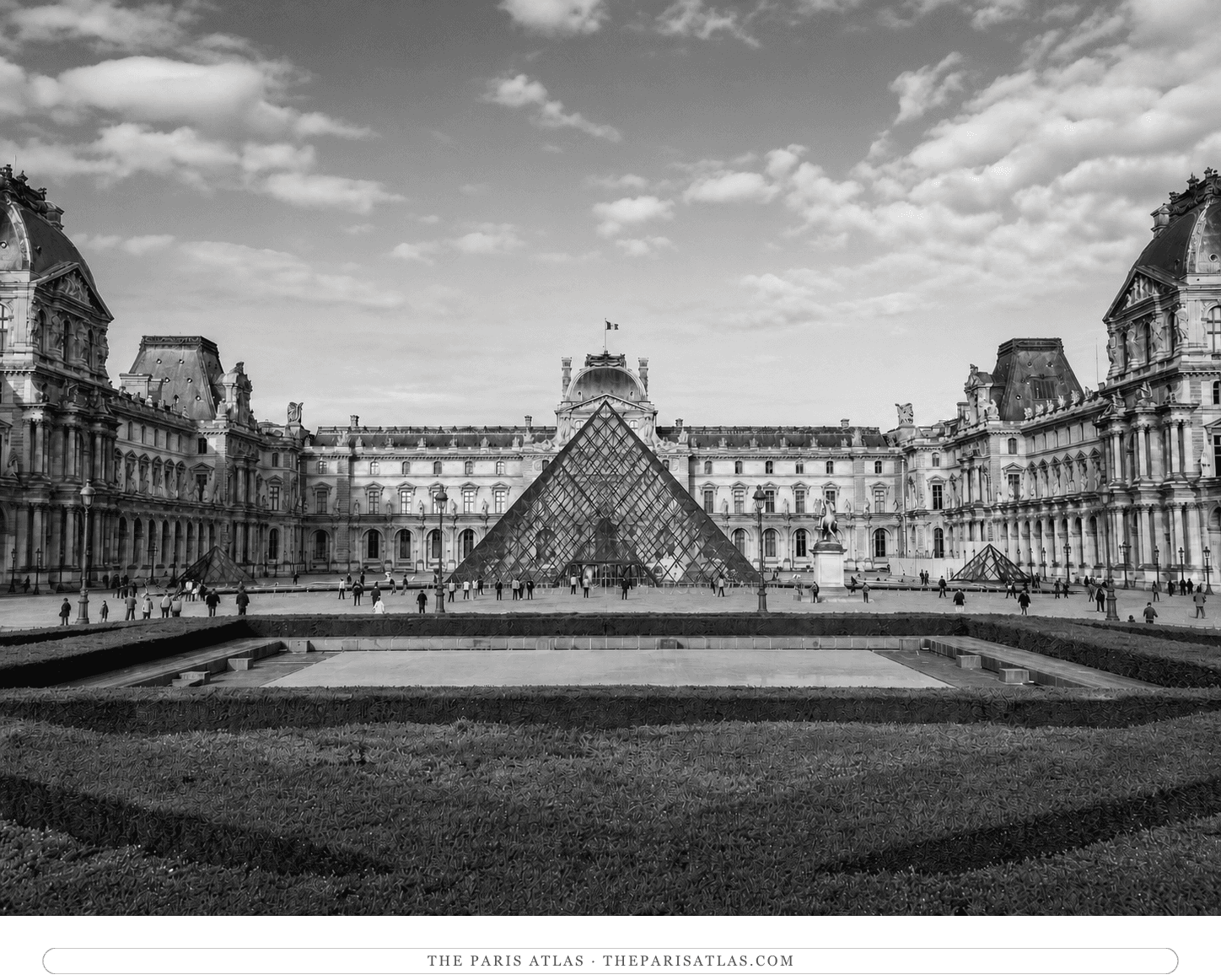
Bernini made three designs for the east front of the Louvre. The first, sent from Rome in June 1664, put an oval pavilion in the center and ran a colonnade out from it that curved forward and then back, so that the whole front moved.[20] The second went from Rome in January 1665.[2] The third he made in Paris, and it dropped the curves for a huge flat-roofed block wrapped in giant columns and pilasters, with statues along the balustrade. Colbert's verdict on it was that it gave admirable room for ballrooms, staircases and grand approaches, and left the king no better housed than before.
Building began that summer. The council chamber of the Louvre was given to Bernini as a studio, and marble for the king's portrait was carried up to it on the last day of June.[2] Houses were surveyed for demolition and men were put on the foundations. On 17 October 1665 Louis XIV came to lay the first stone. Chantelou watched it. A medal by Jean Varin worth 500 écus and two copper plaques of inscriptions were set into a square of marble. Colbert handed the king the medal, Bernini handed him a silver trowel with mortar taken from a silver basin, and the king laid it.[2]
Nothing was ever built on the Louvre foundations. Mattia de' Rossi, left in Paris to run the site, went back to Rome at the end of May 1667.[1] On 15 July 1667 Colbert wrote to Bernini that the king much regretted being unable to carry out the fine design. A project of that size, he said, was hard to begin with a war pressing on land and sea.[1] That was the end of it. In the same year Colbert handed the east front to a committee of three Frenchmen: Charles Le Brun, Louis Le Vau and Claude Perrault.[3] The colonnade they produced is what stands there today, a long straight row of paired columns on a high base.[3]
Charles Perrault, Colbert's clerk and the brother of Claude Perrault, later claimed the credit for killing Bernini's design. In his memoirs he says he put a memorandum of objections on Colbert's desk the night before the decision to drop it was taken.[19] Perrault is not a neutral witness. Ludovic Lalanne, who edited Chantelou's diary, and Léon Mirot, who worked through the building accounts, both warn that his memoirs flatter his brother and himself and get details wrong.[2][1]
The bust of Louis XIV
On 20 June 1665 Louis XIV told Bernini himself that he wanted his portrait in marble, and work began the next day. Bernini asked for sittings and was granted thirteen as a particular favor, which was a great many for a king. His assistant Giulio Cartari roughed the block out for him.[4] Bernini drew the king in council and in movement, then carved from the image he had fixed in his memory. He stopped consulting his own drawings so that the bust would not turn into a copy of them.[2]
Through the summer of 1665, forty courtiers and more crowded into the studio at the Palais Mazarin to watch the king's bust being cut, and then argued about the eyes, the nose and the lace collar.[4] Bernini worked on it from June to October, moving with it from the Louvre to the Palais Mazarin in August.[4]
Bust of Louis XIV, marble, carved in Paris in 1665 and shown to the king on 5 October that year. It was moved to Versailles in 1684 and stands in the Salon de Diane. (Photograph by Coyau, via Wikimedia Commons · CC BY-SA 3.0)
On 5 October 1665, after more than three months, the finished bust was set out at the Louvre on a table covered with gold cloth and shown to the king.[4] Lalanne, introducing Chantelou's diary, says Bernini was so overcome as he presented it that sobbing stopped him speaking.[2] The marble shows Louis XIV at twenty-seven in a great wig, head turned, the drapery flung up behind him as if in wind. It was moved to Versailles in 1684 and stands in the Salon de Diane.[4]
Five months at the French court
Bernini was sixty-six in the summer of 1665, and the two men who described him in Paris both fixed on how he talked. Chantelou liked him, and describes a man of middling height, thinner than fat, with an eagle's face and very long eyebrow hairs. He was bald, the hair he had left was white and curling, and he walked as briskly as a man of thirty or forty. He talked better, Chantelou thought, than anyone he had ever met.[2] Charles Perrault, who did not like him, called him a fine talker, full of maxims, parables, anecdotes and witticisms, with a great talent for showing himself off.[19][2]
Two days after landing, in June 1665, Bernini told the room around the king that nobody was to speak to him of anything small.[2] Asked what he thought of the Tuileries palace, he answered that it seemed to him a great little thing, and added that it was like a great squadron of small children.[2] He said of the dome of the Val-de-Grâce that a very small skullcap had been put on a big head.[2] He told Chantelou that French painters had a manner that was small, sad and thin, and that the cure was to study the antique, above all the Belvedere Torso.[2] At a Carmelite convent, finding a silver tabernacle blocking two thirds of a painting by Guido Reni, he said the nuns were making people think the French were extremely ignorant.[2] His own explanation, given on 1 September 1665, was that if the pope had wanted a French building he would have called a French architect, and that the king had wanted a Roman palace.[2] Charles Perrault, who watched the visit from Colbert's office, wrote that the Cavaliere had not made himself liked.[19]
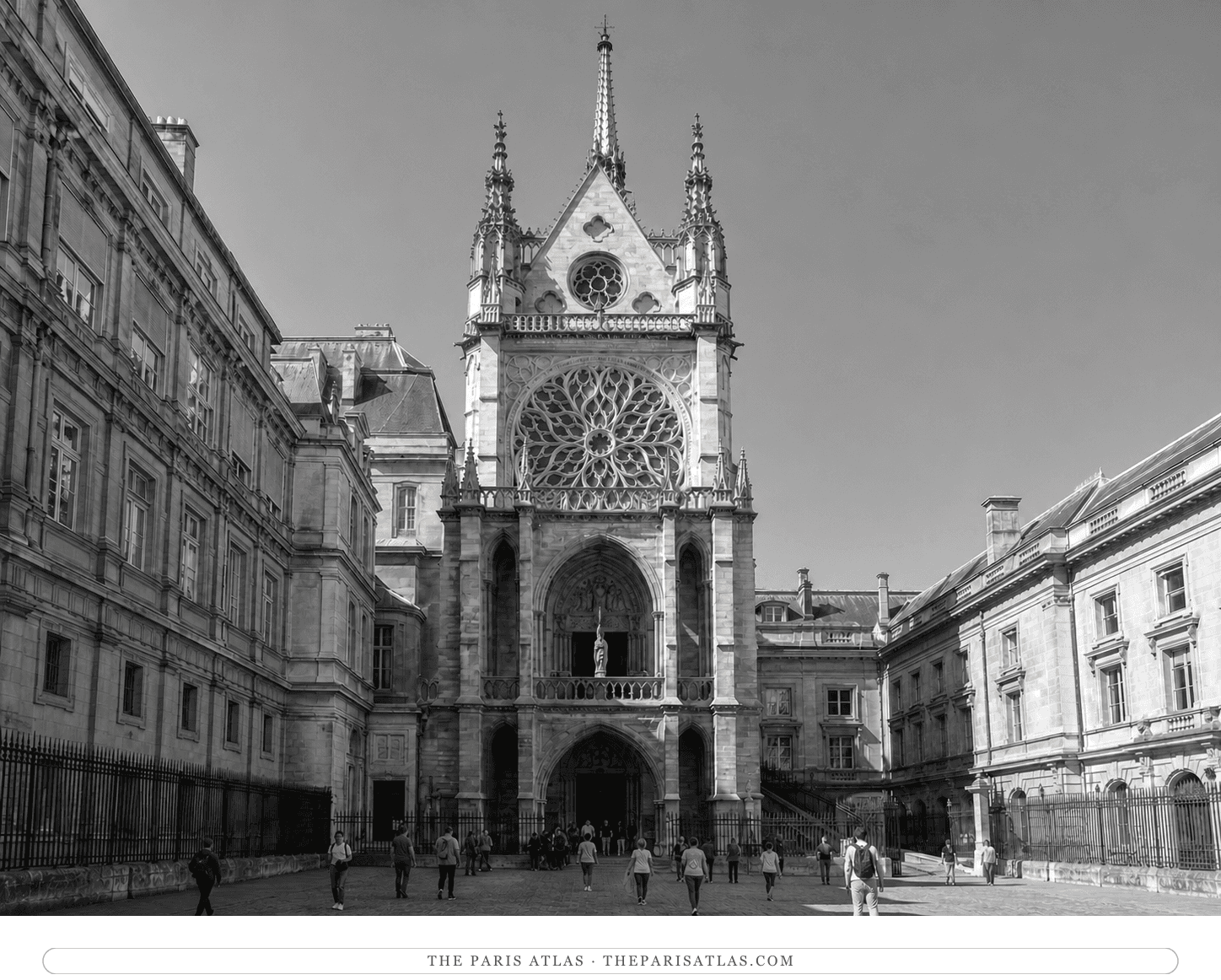
Paris did not only take offense. On 16 June 1665 the Royal Academy of Painting and Sculpture came in a body to visit him, and in September he went to the Academy and talked to the students about how to learn.[2] Draw large, he told them, and hold the paper as far from the eye as you can. Finish everything. Study the antique before nature, because nature on its own is usually thin and mean and a beginner cannot correct it. And work beside a master rather than only watching him.[2] He said that in twenty or thirty words he could hand on the experience of more than forty years of continuous work.[2] He visited Notre-Dame on 15 August 1665, and Colbert had taken him round the Sainte-Chapelle on 5 June, his fourth day in the city.[2]
On 13 September 1665 he was driven out to Versailles, which was then still Louis XIII's small brick and stone house with new gardens going in around it.[2] André Le Nôtre, who was laying out the gardens, met the party and took Bernini round them before he saw the house. Chantelou noticed that Bernini praised the château in carefully chosen words: it was elegant, and everything that has proportion is beautiful, and that palace was in proportion.[2]
He left Paris on 20 October 1665, with Chantelou riding out as far as Villejuif to say goodbye.[2] The Gazette de France printed the accounts.[2] He had already been paid 10,000 écus before he left Rome. On top of that the king gave him 11,000 écus in three thousand gold louis, and a pension warrant for 2,000 écus. His son Paolo got 2,000 écus and a 400-écu pension. Mattia de' Rossi, the assistant who was to stay behind and build the design, got 2,000 écus, and the same sum again was shared among the servants.[2] Charles Perrault carried the money to him in his own arms the night before.[19] Bernini's whole reply, Perrault says, was that such good days would be very agreeable if they came often, and that he expected the pension to be paid for a year or two and no longer.[19]
The equestrian statue, and what François Girardon did to it
Bernini had proposed a second commission for Louis XIV while he was in Paris. On 13 August 1665 he described to Chantelou an idea for two columns on the model of Trajan's Column in Rome, with the king on horseback between them.[21] Nothing came of it at the time. In December 1667, five months after Colbert dropped the Louvre design, Colbert wrote to Rome asking him to make the statue after all.[21] The marble reached his studio in the summer of 1669, he modeled it in terracotta around 1669 and 1670, carving began in 1671, and the statue was finished in 1677 or 1678. It was still in Rome when he died in 1680.[21]
The finished marble came by sea from Civitavecchia in 1684, reached Le Havre early in 1685, and was brought up the Seine to Paris on 10 March 1685, where crowds came to look at it.[1] It was not unloaded there. It went back down the river to the bridge at Sèvres and on to Versailles, where it was set on a pedestal in the Orangery.[1] On 14 November 1685 Louis XIV walked through that part of the palace, decided the statue was badly made, and ordered it broken up.[1] He then settled for having it moved in front of the Neptune basin, and later it was put away behind the Pièce d'Eau des Suisses.[1]
Louis XIV had the French sculptor François Girardon replace the head.[1] According to Léon Mirot, who worked through the naval and building archives, Girardon did less than that. He put a helmet on the rider, covered the mount of glory that Bernini's king had been riding up with marble flames, and recut a few details.[1] The rider stopped being Louis XIV and became Marcus Curtius, the Roman who rode into a chasm to save his city.[1] The statue is back in the Orangery at Versailles.[21]
Illness, death, and where he is buried
Bernini worked until nearly the end. The last large religious figure he carved was the Blessed Ludovica Albertoni, a marble woman lying in her death agony above the altar of the Altieri Chapel in San Francesco a Ripa in Rome, finished in 1674.[5] Giovanni Battista Gaulli painted the altarpiece behind it the following year.[5] The terracotta model for the figure is in London.[15] His wife Caterina Tezio died in 1673.[5] Baldinucci says he worked at the marble for up to seven hours at a stretch into extreme old age, at a rate the young men in the studio could not keep up with.[7] When anyone tried to make him stop he answered: let me stay here, I am in love.[7] In his last years a young assistant had to stand on the scaffolding beside him, because he became so absorbed that he was in danger of walking off it.[7]
The illness that killed him began with a job. In 1680 the old Palazzo della Cancelleria in Rome started to threaten collapse, the pope put Bernini in charge of repairing it, and the work meant climbing up and down the scaffolding again and again at over eighty.[7] He lost his sleep and then his strength. A slow fever came, and in the middle of it a stroke that paralyzed his right arm, the arm he carved with.[6] Both his biographers record what he said when he found he could not move it: it was only right that this arm should rest a little before his death, having worked so hard in life.[7][6] His confessor asked whether his mind was at rest and whether anything troubled him. Baldinucci reports the answer: he had an account to give to a Lord who, out of his goodness alone, does not reckon it in half-pennies.[7]
Bernini's last illness lasted fifteen days.[7][6] His speech went, and he made himself understood by signs. His pupils Mattia de' Rossi and Giovanni Battista Contini stayed at the bed. He joked with them, pointing at a machine for lifting great weights, that they could not come up with an invention for drawing the catarrh out of his throat.[7] Queen Christina of Sweden sent to the house at least twice a day, and so did cardinals and ambassadors.[7] Pope Innocent XI sent his blessing. Bernini died about midnight at the start of 28 November 1680, in his own house in Rome, at the age Baldinucci gives as eighty-two years less nine days.[7]
Bernini left a large estate, reported in Rome at about 400,000 scudi.[7] Christina of Sweden, the abdicated queen who had lived in Rome since 1655, was told the figure and said she would be ashamed if he had served her and left so little.[7] His will gave a painting of Christ to Innocent XI, and the marble Salvator Mundi, the last work of his hands, to Christina.[7] Cardinal Altieri got a marble portrait bust of Pope Clement X, Cardinal Azzolino one of Pope Innocent X, and Cardinal Rospigliosi a painting.[7] His body was carried to Santa Maria Maggiore and lay in state there, with candles distributed and alms given out, and the crowd was so large that the burial had to be put off to the next day.[7] He had prepared the family tomb in that basilica himself. He was laid in it with a lead plate giving his name and the day of his death.[6]
After his death in 1680 his reputation fell for a century and a half and then came back. Eighteenth- and nineteenth-century critics used his name as shorthand for the twisting, theatrical manner that a classical taste disliked, and Léon Mirot was still writing in 1904 about Bernini's bad manner.[1] Since the middle of the twentieth century he has been treated as the central figure of Baroque art. His fountain in Piazza Navona and his Saint Teresa in Santa Maria della Vittoria are among the most visited things in Rome.
Rome, free to enter: the Baldacchino and the Cathedra Petri inside Saint Peter's, and the colonnade around the square outside it.
Rome, also free: the Fountain of the Four Rivers in Piazza Navona, the Ecstasy of Saint Teresa in Santa Maria della Vittoria, the Blessed Ludovica Albertoni in San Francesco a Ripa, and the church of Sant'Andrea al Quirinale.
Rome, ticketed: the four Borghese marbles, the Truth, and the painted self-portraits at the Galleria Borghese, which sells timed tickets and sells out.
Florence: the bust of Costanza Bonarelli at the Museo Nazionale del Bargello.[16]
Versailles: the marble bust of Louis XIV in the Salon de Diane, and the recut equestrian statue in the Orangery.[4][21]
Paris: the Louvre keeps the drawings for the Louvre projects in its prints and drawings department, seen by appointment rather than on the walls, and its sculpture galleries hold his bust of Cardinal Richelieu.
London: the Victoria and Albert Museum holds the Neptune and Triton group of 1622–23, the marble bust of Thomas Baker, and the terracotta model for the Blessed Ludovica Albertoni.[15][14]
Life events
7 December 1598
Born in Naples, son of the Florentine sculptor Pietro Bernini and Angelica Galante.
— Howard Hibbard, Bernini, Gian Lorenzo (1967)
1605 or 1606
The family moves to Rome, where his father has papal work.
— Howard Hibbard, Bernini, Gian Lorenzo (1967)
1619
Aeneas, Anchises and Ascanius, the first of the large groups for Cardinal Scipione Borghese.
— Gian Lorenzo Bernini, Aeneas, Anchises and Ascanius — collection record
1621–1622
Carves the Rape of Proserpine; Scipione Borghese gives it away to Cardinal Ludovico Ludovisi in October 1622.
— Gian Lorenzo Bernini, Rape of Proserpine — collection record
1622–1625
Apollo and Daphne, carved for Scipione Borghese for 1,000 scudi.
Apollo and Daphne, 1622–25, Carrara marble, 243 centimeters high, carved for Cardinal Scipione Borghese. Galleria Borghese, Rome. (Photograph by Architas, via Wikimedia Commons)
— Gian Lorenzo Bernini, Apollo and Daphne — collection record
6 August 1623
Maffeo Barberini is elected pope and takes the name Urban VIII.
— Domenico Bernini, Vita del cavalier Gio. Lorenzo Bernino, descritta da Domenico Bernino suo figlio (1713)
1623–1624
Takes over a David commissioned by the late Cardinal Montalto and carves it in seven months.
David, 1623–24, marble, 170 centimeters high, carved for Cardinal Scipione Borghese. Galleria Borghese, Rome. (Photograph by Burkhard Mücke, via Wikimedia Commons)
— Gian Lorenzo Bernini, David — collection record
c. 1623
Paints the Self-portrait as a Young Man now in the Galleria Borghese.
Self-portrait as a Young Man, about 1623, oil on canvas laid on panel, 39 by 31 centimeters. Bernini was about twenty-five when he painted it. Galleria Borghese, Rome, inv. 554. (Gian Lorenzo Bernini (Galleria Borghese, Rome), via Wikimedia Commons)
— Gian Lorenzo Bernini, Self-portrait as a Young Man — collection record
1624–1633
Builds the Baldacchino over the tomb of Saint Peter, and is paid 10,000 scudi for it.
— Howard Hibbard, Bernini, Gian Lorenzo (1967)
1629
Appointed architect of Saint Peter's after Carlo Maderno's death, and begins finishing the Palazzo Barberini.
— Howard Hibbard, Bernini, Gian Lorenzo (1967)
1632
Carves the bust of Cardinal Scipione Borghese twice, after a flaw appears in the marble of the first.
— Gian Lorenzo Bernini, Bust of Scipione Borghese — collection record
c. 1636–1637
Carves the bust of Costanza Bonarelli, for himself rather than for a patron.
— Il nuovo medagliere e la sala della scultura barocca — the bust of Costanza Bonarelli (2023)
1637
Begins the south bell tower on the façade of Saint Peter's for Urban VIII.
— Howard Hibbard, Bernini, Gian Lorenzo (1967)
1638
Attacks his brother Luigi Bernini and has a servant slash Costanza Bonarelli's face. He is fined 3,000 scudi and pardoned by Urban VIII.
— Howard Hibbard, Bernini, Gian Lorenzo (1967)
7 April 1639
Costanza Bonarelli is released from the Casa Pia and returned to her husband.
— Il nuovo medagliere e la sala della scultura barocca — the bust of Costanza Bonarelli (2023)
May 1639
Marries Caterina Tezio, in a match ordered by Urban VIII. They have eleven children.
— Howard Hibbard, Bernini, Gian Lorenzo (1967)
1644
Urban VIII dies, the Barberini fall, and Innocent X is elected.
— Howard Hibbard, Bernini, Gian Lorenzo (1967)
1646
The bell tower is demolished after cracks appear. Bernini begins the Truth for himself and keeps it at home.
— Howard Hibbard, Bernini, Gian Lorenzo (1967)
1647–1652
Builds the Cornaro Chapel in Santa Maria della Vittoria and carves the Ecstasy of Saint Teresa.
The Ecstasy of Saint Teresa, 1647–52, marble and gilded bronze, in the Cornaro Chapel of Santa Maria della Vittoria, Rome. A window hidden above the group lights it from the front. (Photograph by Alvesgaspar, via Wikimedia Commons)
— Howard Hibbard, Bernini, Gian Lorenzo (1967)
1648–1651
Builds the Fountain of the Four Rivers in Piazza Navona after Prince Niccolò Ludovisi smuggles his model in front of Innocent X.
— Filippo Baldinucci, Vita del cavaliere Gio. Lorenzo Bernino, scultore, architetto e pittore (1682), in the 1812 Milan reprint (1682)
1657–1666
Makes the Cathedra Petri at the far end of Saint Peter's.
— Howard Hibbard, Bernini, Gian Lorenzo (1967)
From 1657
Lays out the colonnade around Saint Peter's Square for Alexander VII.
— Howard Hibbard, Bernini, Gian Lorenzo (1967)
1658–1670
Builds the oval church of Sant'Andrea al Quirinale, the work he told his son he was most content with.
— Domenico Bernini, Vita del cavalier Gio. Lorenzo Bernino, descritta da Domenico Bernino suo figlio (1713)
24 June 1664
Sends his first design for the east front of the Louvre from Rome to Paris. A second set follows in January 1665.
— Paul Fréart de Chantelou, Journal du voyage du Cavalier Bernin en France, edited by Ludovic Lalanne (1885)
11 April 1665
Louis XIV writes to invite him to France.
— Charles Perrault, Mémoires de ma vie, edited by Paul Bonnefon (1909)
29 April 1665
Leaves Rome with his son Paolo, two assistants and four servants, traveling by Siena, Florence, Bologna, Turin and Lyon.
— Léon Mirot, Le Bernin en France: les travaux du Louvre et les statues de Louis XIV (1904)
2 June 1665
Reaches Paris. Paul Fréart de Chantelou meets him outside Juvisy and begins his diary of the visit.
— Paul Fréart de Chantelou, Journal du voyage du Cavalier Bernin en France, edited by Ludovic Lalanne (1885)
4 June 1665
First audience with Louis XIV at Saint-Germain, where he says that nobody is to speak to him of anything small.
— Paul Fréart de Chantelou, Journal du voyage du Cavalier Bernin en France, edited by Ludovic Lalanne (1885)
20 June 1665
The king commissions his portrait in marble; work starts the next day.
— Genius and Majesty: Louis XIV and Bernini — press release
13 September 1665
Visits Versailles, where André Le Nôtre shows him the gardens.
— Paul Fréart de Chantelou, Journal du voyage du Cavalier Bernin en France, edited by Ludovic Lalanne (1885)
5 October 1665
The finished bust of Louis XIV is shown to the king at the Louvre.
Bust of Louis XIV, marble, carved in Paris in 1665 and shown to the king on 5 October that year. It was moved to Versailles in 1684 and stands in the Salon de Diane. (Photograph by Coyau, via Wikimedia Commons)
— Genius and Majesty: Louis XIV and Bernini — press release
17 October 1665
Louis XIV lays the foundation stone of Bernini's Louvre; Bernini hands him the silver trowel.
A perspective view recording one of Bernini's designs for the east front of the Louvre, made about 1700. Accademia delle Scienze di Torino, Fondo Millon. (After Gian Lorenzo Bernini, Accademia delle Scienze di Torino (Fondo Millon), via Wikimedia Commons)
— Paul Fréart de Chantelou, Journal du voyage du Cavalier Bernin en France, edited by Ludovic Lalanne (1885)
20 October 1665
Leaves Paris with three thousand gold louis and a pension warrant. Chantelou parts from him at Villejuif.
— Paul Fréart de Chantelou, Journal du voyage du Cavalier Bernin en France, edited by Ludovic Lalanne (1885)
15 July 1667
Colbert writes that the king will not build the design, blaming the cost and the war.
— Léon Mirot, Le Bernin en France: les travaux du Louvre et les statues de Louis XIV (1904)
December 1667
Colbert commissions the equestrian statue of Louis XIV.
— Gian Lorenzo Bernini, Model for the Equestrian Statue of King Louis XIV — collection record
1673
His wife Caterina Tezio dies.
— Howard Hibbard, Bernini, Gian Lorenzo (1967)
1674
Finishes the Blessed Ludovica Albertoni for the Altieri Chapel in San Francesco a Ripa.
— Howard Hibbard, Bernini, Gian Lorenzo (1967)
28 November 1680
Dies in Rome about midnight, after fifteen days of illness and a stroke that paralyzed his right arm. He is buried in the family tomb in Santa Maria Maggiore.
— Filippo Baldinucci, Vita del cavaliere Gio. Lorenzo Bernino, scultore, architetto e pittore (1682), in the 1812 Milan reprint (1682)
1684
The marble bust of Louis XIV is installed at Versailles.
— Genius and Majesty: Louis XIV and Bernini — press release
1685
The equestrian statue reaches France. Louis XIV rejects it in November and François Girardon recuts it as Marcus Curtius.
— Léon Mirot, Le Bernin en France: les travaux du Louvre et les statues de Louis XIV (1904)
Gian Lorenzo Bernini quotes
Verbatim, as recorded by the witnesses of the era — sources on every quotation.
“
Let no one speak to me of anything small.
Qu'on ne me parle de rien qui soit petit.
— Gian Lorenzo Bernini at his first audience with Louis XIV, recorded by Paul Fréart de Chantelou
“
I have seen, Sire, the palaces of the emperors and the popes, and those of the sovereign princes along the road from Rome to Paris. But for a king of France, a king of today, greater and more magnificent things must be made than any of them.
J'ai vu, Sire, … les palais des empereurs et des papes, ceux des princes souverains qui se sont trouvés sur la route de Rome à Paris, mais il faut faire pour un roi de France, un roi d'aujourd'hui, de plus grandes et magnifiques choses que tout cela.
— Gian Lorenzo Bernini to Louis XIV, recorded by Paul Fréart de Chantelou
“
I am stealing.
Sto rubando.
— Gian Lorenzo Bernini to Louis XIV, recorded by Paul Fréart de Chantelou
Gian Lorenzo Bernini carved The Ecstasy of Saint Teresa between 1647 and 1652 for the Cornaro Chapel in the church of Santa Maria della Vittoria in Rome, where it stands above the altar. The marble group shows the Spanish mystic Teresa of Ávila at the moment an angel pierces her heart with a golden spear.
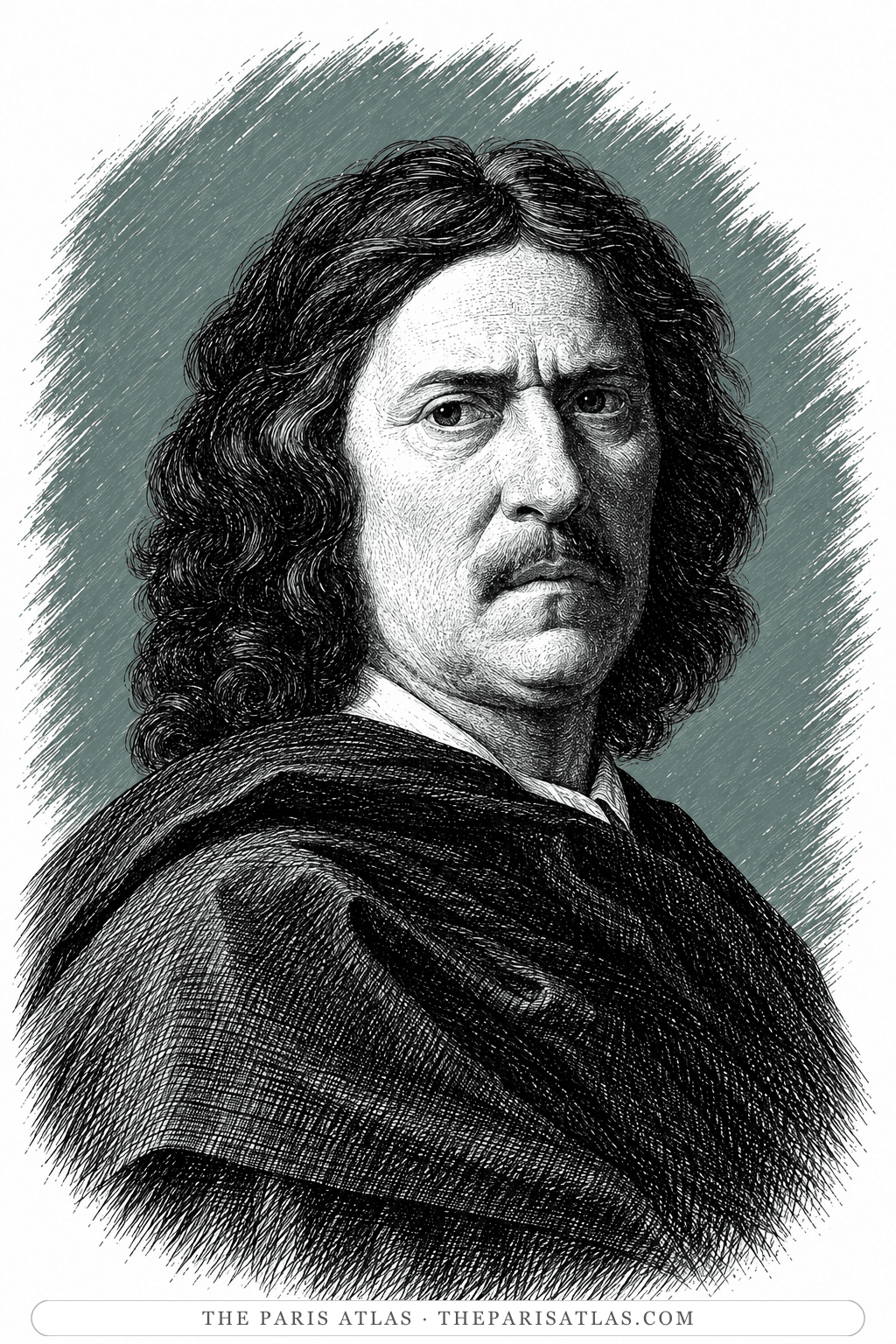
Bernini and Nicolas Poussin both worked in Rome for four decades, and Bernini told Chantelou in Paris in 1665 that it was he who had obtained for Poussin the commission for the altarpiece of the Martyrdom of Saint Erasmus in Saint Peter's, and that other painters had resented him for it. No source records a particular meeting between them, which is why this edge is marked probable rather than documented. Bernini talked about Poussin's pictures constantly in Paris, calling him the greatest and most learned painter there was, and saying in front of a Poussin landscape that he was a painter who works from up there, while pointing to his own forehead. Poussin was too ill to act as Colbert's agent in Rome over the Louvre designs, and died in Rome on 19 November 1665, a month after Bernini left France.
— Paul Fréart de Chantelou, Journal du voyage du Cavalier Bernin en France, edited by Ludovic Lalanne (1885), pp. 67, 90, 146, 190
Who Inspired Gian Lorenzo Bernini
People whose work inspired Gian Lorenzo Bernini. They did not necessarily meet or know one another.
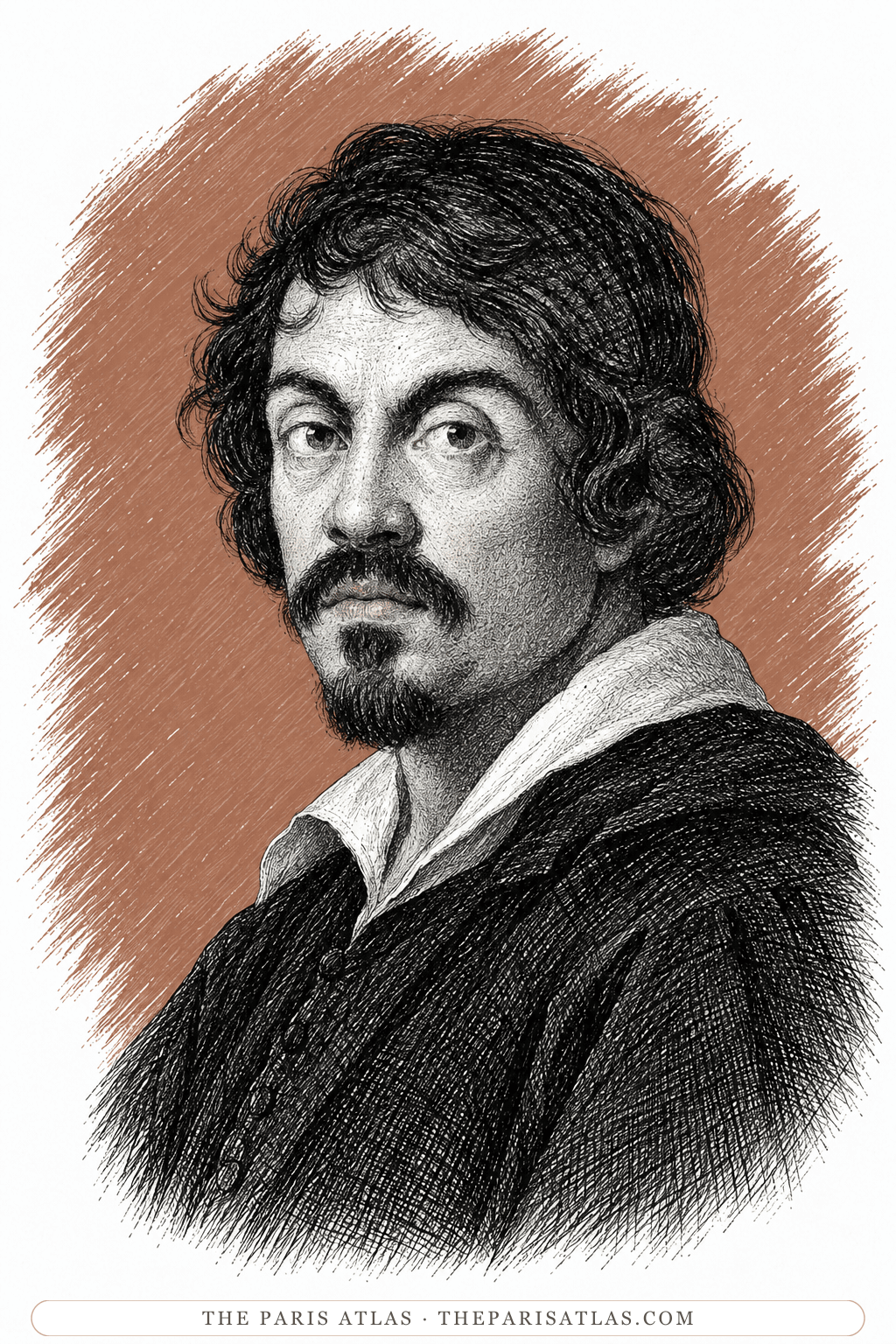
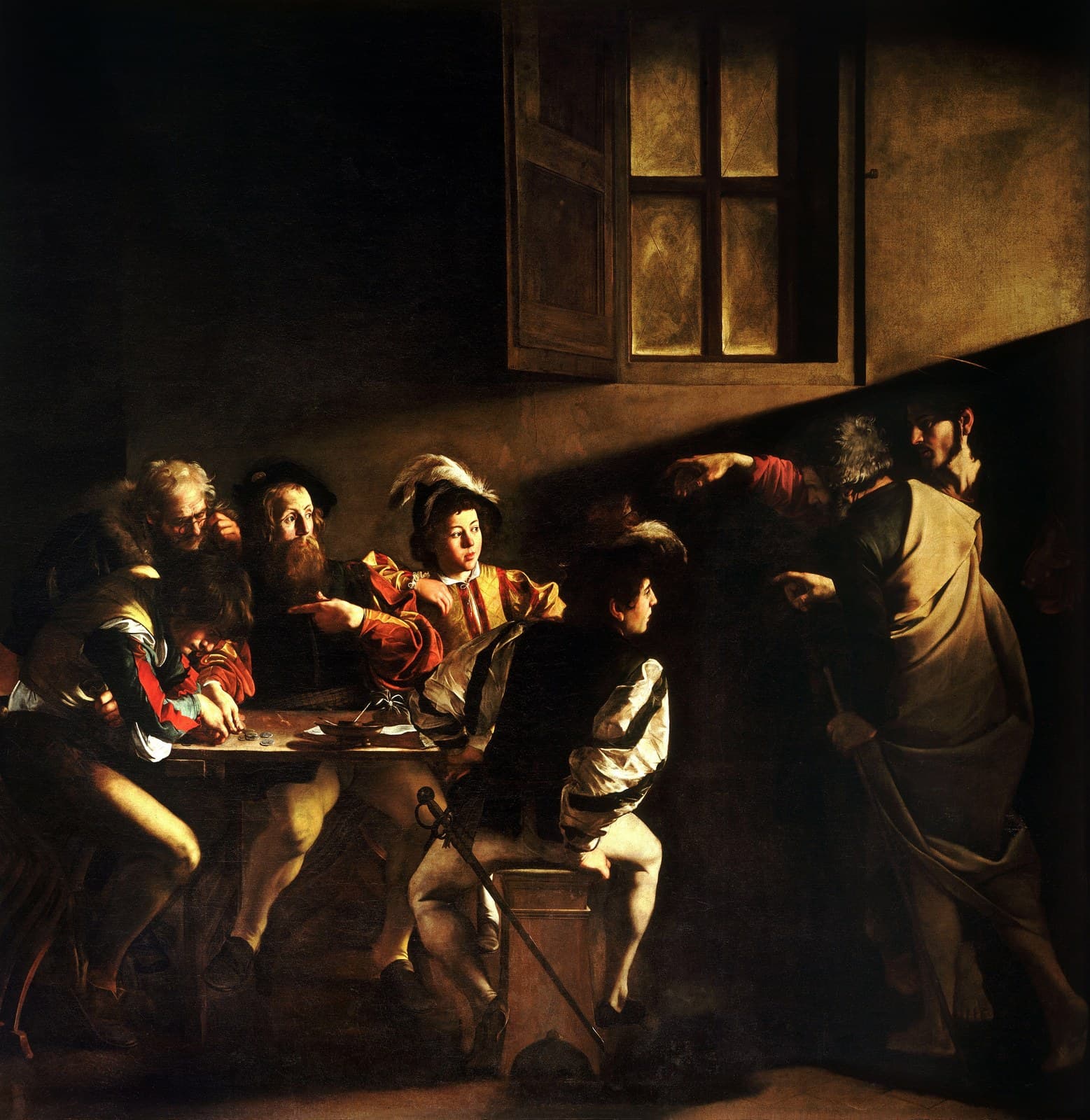
Gian Lorenzo Bernini was twelve when Caravaggio died in 1610, and he made his career in Rome as a sculptor. He also painted, mostly head studies and portraits, and the National Gallery in London says Caravaggio's work influenced that side of his practice. The claim is about Bernini's painting, not his marble.
— Gian Lorenzo Bernini (1598 – 1680) — artist page
Movements
The artistic and literary currents this life ran through.
Art movement and historical period · circa 1600–1750
Bernini's David of 1623–24 aims at a Goliath outside the sculpture, and Apollo and Daphne of 1622–25 catches the moment bark closes over flesh — fragile parts were held with plaster supports while he carved. The Cornaro Chapel's Ecstasy of Saint Teresa, 1647–52, works only as a whole room: marble, gilded rays, hidden light and sculpted witnesses.
— Gian Lorenzo Bernini, David — collection record; Gian Lorenzo Bernini, Apollo and Daphne — collection record; Bernini and the Baroque; Gian Lorenzo Bernini (1598–1680)
Gian Lorenzo Bernini’s Places
The cataloged places connected to Gian Lorenzo Bernini — through the books, and through the documented record.
Places you can enter today appear first, followed by addresses to see from outside and sites that have vanished.
Gian Lorenzo Bernini (1598–1680) was an Italian sculptor and architect, and the dominant artist in Rome for more than fifty years. He carved the David and the Apollo and Daphne now in the Galleria Borghese. He built the bronze canopy over the tomb of Saint Peter, made the Fountain of the Four Rivers in Piazza Navona, and designed the colonnade that encloses Saint Peter's Square.
What are Bernini's most famous sculptures, and where can you see them?
Four of them stand in one sequence of rooms at the Galleria Borghese in Rome, on a timed ticket: Aeneas, Anchises and Ascanius, the Rape of Proserpine, Apollo and Daphne, and the David. The Ecstasy of Saint Teresa is in the Cornaro Chapel of Santa Maria della Vittoria and the Fountain of the Four Rivers is in Piazza Navona. Both are free. The Baldacchino, the Cathedra Petri and the colonnade are at Saint Peter's, also free. The bust of Costanza Bonarelli is at the Bargello in Florence, and the bust of Louis XIV is at Versailles.
Who were Bernini's parents, and what did his father do?
His father, Pietro Bernini, was a sculptor from Florence who had moved to Naples to work on the Certosa di San Martino. His mother was Angelica Galante, a Neapolitan. Pietro Bernini trained his son himself. There was no other master and no academy. The family moved to Rome in 1605 or 1606, when Gian Lorenzo was six or seven.
Which popes did Bernini work for?
The popes he worked under run from Paul V, who noticed him as a boy, to Innocent XI, who was reigning when he died. Three mattered most. Urban VIII, elected in 1623, had known him since he was a child. Innocent X cut him out after the bell tower of Saint Peter's failed, then employed him again from 1648. Alexander VII gave him Saint Peter's Square. He died in 1680 under Innocent XI.
Did Bernini design the Louvre?
He designed it three times, and none of it was built. Louis XIV brought him to Paris in 1665 to solve the unfinished east front. The king laid the foundation stone of Bernini's design on 17 October 1665 and then let the project lapse. On 15 July 1667 Colbert wrote that it would not go ahead. The colonnade that stands there was designed by a French committee of Charles Le Brun, Louis Le Vau and Claude Perrault. The Louvre keeps Bernini's project drawings in its prints and drawings department.
Where is Bernini's bust of Louis XIV?
In the Salon de Diane at the Château de Versailles, where it has stood since 1684. Bernini carved it in Paris between June and October 1665, from thirteen sittings and from drawings he made of the king moving and talking during council meetings, and presented it on 5 October 1665.
What happened between Bernini and Costanza Bonarelli?
Bernini had an affair with Costanza Bonarelli, the wife of his assistant Matteo Bonarelli, and carved her portrait in marble around 1636. In the summer of 1638 he found that his younger brother Luigi Bernini was involved with her too. He beat his brother with an iron bar and broke two of his ribs, and sent a servant to cut her face with a razor. The servant was exiled and Luigi Bernini left Rome. Costanza Bonarelli was held in a house of correction until 7 April 1639. Bernini was fined 3,000 scudi and then pardoned by Urban VIII, who married him to Caterina Tezio the following month.
How did Bernini die, and where is he buried?
He died in Rome about midnight at the start of 28 November 1680, nine days short of his eighty-second birthday. Repairing the Palazzo della Cancelleria had worn him out, and he took a slow fever. During that fever a stroke paralyzed his right side, including the arm he carved with. The illness lasted fifteen days. He is buried in the family tomb he had prepared in the basilica of Santa Maria Maggiore, with a lead plate giving his name and the day of his death.
Connections and Sources
Gian Lorenzo Bernini’s connections to people, places, and works, with the sources behind each one.
Bernini's David of 1623–24 aims at a Goliath outside the sculpture, and Apollo and Daphne of 1622–25 catches the moment bark closes over flesh — fragile parts were held with plaster supports while he carved. The Cornaro Chapel's Ecstasy of Saint Teresa, 1647–52, works only as a whole room: marble, gilded rays, hidden light and sculpted witnesses.
— Gian Lorenzo Bernini, David — collection record; Gian Lorenzo Bernini, Apollo and Daphne — collection record; Bernini and the Baroque; Gian Lorenzo Bernini (1598–1680)
Bernini and Nicolas Poussin both worked in Rome for four decades, and Bernini told Chantelou in Paris in 1665 that it was he who had obtained for Poussin the commission for the altarpiece of the Martyrdom of Saint Erasmus in Saint Peter's, and that other painters had resented him for it. No source records a particular meeting between them, which is why this edge is marked probable rather than documented. Bernini talked about Poussin's pictures constantly in Paris, calling him the greatest and most learned painter there was, and saying in front of a Poussin landscape that he was a painter who works from up there, while pointing to his own forehead. Poussin was too ill to act as Colbert's agent in Rome over the Louvre designs, and died in Rome on 19 November 1665, a month after Bernini left France.
— Paul Fréart de Chantelou, Journal du voyage du Cavalier Bernin en France, edited by Ludovic Lalanne (1885), pp. 67, 90, 146, 190
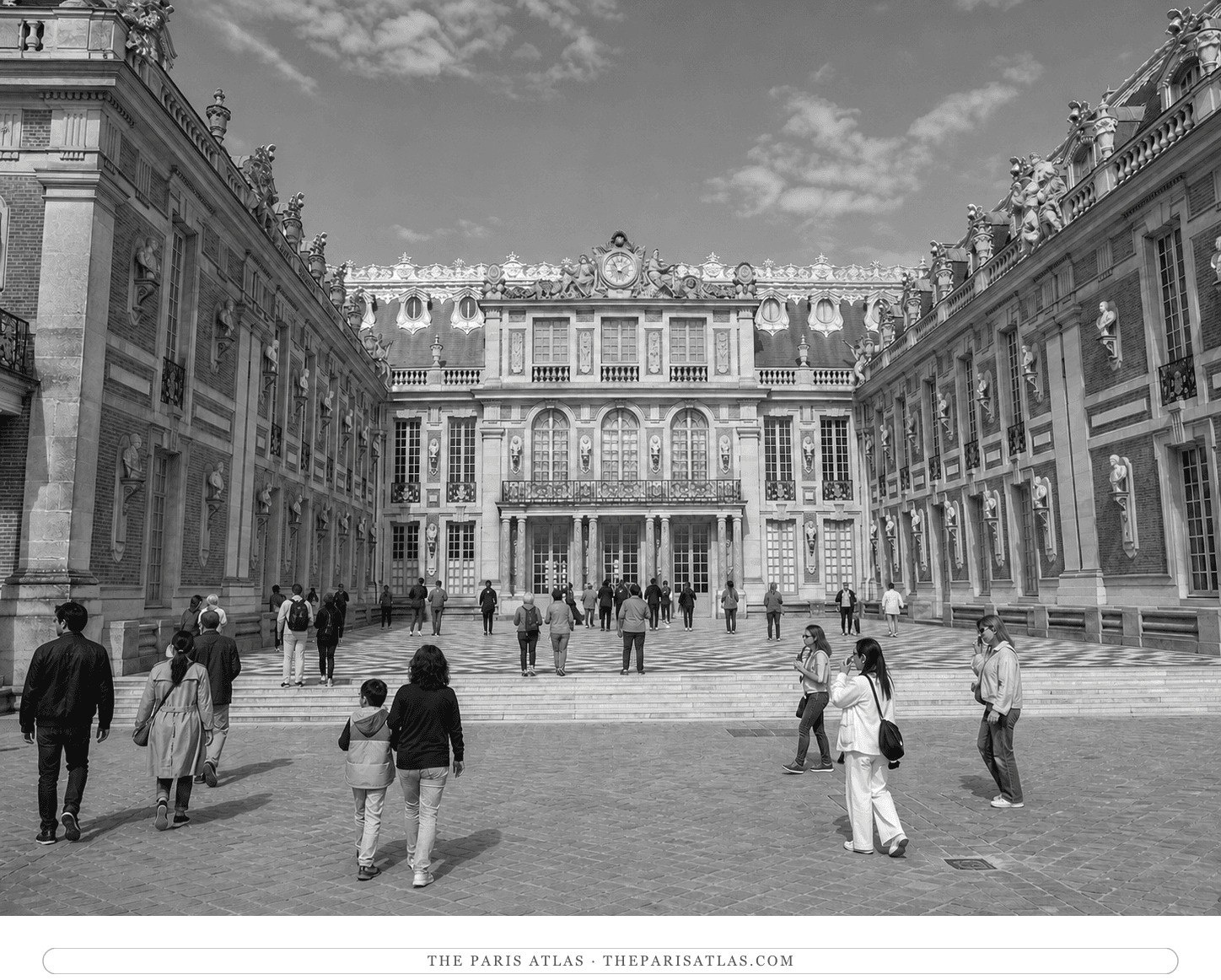
Bernini spent the day at Versailles on 13 September 1665, seventeen years before Louis XIV moved the court there. It was still Louis XIII's small brick and stone house, and André Le Nôtre met the party and took Bernini into the gardens first. Chantelou noticed that his praise of the château was carefully worded: it was elegant, everything with proportion is beautiful, and that palace was in proportion. Bernini's own marble bust of Louis XIV, carved in Paris that summer, was moved to Versailles in 1684 and stands in the Salon de Diane.
— Paul Fréart de Chantelou, Journal du voyage du Cavalier Bernin en France, edited by Ludovic Lalanne (1885), pp. 155–57, entry for 13 September 1665; Genius and Majesty: Louis XIV and Bernini — press release
Bernini went to Notre-Dame on 15 August 1665, the feast of the Assumption, after making his devotions with the fathers of the Oratory. He was in Paris for five months that year to design a new east front for the Louvre and to carve Louis XIV's portrait, and Chantelou's diary follows him to church almost every day of it.
— Paul Fréart de Chantelou, Journal du voyage du Cavalier Bernin en France, edited by Ludovic Lalanne (1885), pp. 98–99, entry for 15 August 1665
On 5 June 1665, his fourth day in Paris, Jean-Baptiste Colbert spent the morning showing Bernini the city. They began inside the courtyard of the Louvre, went on to the Tuileries and along the quay, then took a carriage to the Île de la Cité to see the Sainte-Chapelle and the halls of the Palais. Chantelou, who was with them, records the itinerary but not what Bernini said about the building.
— Paul Fréart de Chantelou, Journal du voyage du Cavalier Bernin en France, edited by Ludovic Lalanne (1885), p. 14, entry for 5 June 1665
Louis XIV brought Bernini from Rome in 1665 to design the unfinished east front of the Louvre, and gave him the palace's council chamber as a studio; marble for the king's portrait was carried up to it on 30 June 1665. The king laid the foundation stone of Bernini's design on 17 October 1665, with Bernini handing him the silver trowel. Nothing was built on those foundations: on 15 July 1667 Colbert wrote that the design would not go ahead, and the east front was given to a French committee of Charles Le Brun, Louis Le Vau and Claude Perrault, whose colonnade stands there now.
— Paul Fréart de Chantelou, Journal du voyage du Cavalier Bernin en France, edited by Ludovic Lalanne (1885), pp. 40, 250–51; Projet pour le Louvre: élévation pour la façade orientale (premier projet), 1664 — collection record; Charles Le Brun, Projet pour la façade orientale du Louvre, INV 27641 — collection record
Gian Lorenzo Bernini was twelve when Caravaggio died in 1610, and he made his career in Rome as a sculptor. He also painted, mostly head studies and portraits, and the National Gallery in London says Caravaggio's work influenced that side of his practice. The claim is about Bernini's painting, not his marble.
— Gian Lorenzo Bernini (1598 – 1680) — artist page
References
References
The sources below include biographies, scholarly essays, interviews, and primary materials that informed this page. They reflect both the historical record and ongoing critical conversations about Gian Lorenzo Bernini and their work.
1abcdefghijklmnLe Bernin en France: les travaux du Louvre et les statues de Louis XIV
Nonfiction
Paris; digitized by the Internet Archive, 1904
Used for
Léon Mirot's archival study of the French episode: the departure from Rome on 29 April 1665, the route, Colbert's letter of 15 July 1667, and the shipping and recutting of the equestrian statue in 1685.
Gazette des Beaux-Arts, Paris; digitized by the Internet Archive, 1885
Used for
The primary source for the Paris visit: Chantelou's day-by-day diary in Ludovic Lalanne's 1885 edition, used here for the invitation, the journey, the studio arrangements, the sittings for the bust, the foundation ceremony of 17 October 1665, the visits to the Sainte-Chapelle, Notre-Dame and Versailles, the departure, and six of the seven quotations on this page.
4abcdefgGenius and Majesty: Louis XIV and Bernini — press release
Website
Château de Versailles
Used for
The Château de Versailles on the bust of Louis XIV: the commission of 20 June 1665, the thirteen sittings, Giulio Cartari's rough-hewing of the block, the presentation on 5 October 1665, and the installation in the Salon de Diane in 1684.
Dizionario Biografico degli Italiani, vol. 9, Treccani, 1967
Used for
Howard Hibbard's entry in the Dizionario Biografico degli Italiani, vol. 9 (1967): the birth and parents, the move to Rome, the offices of 1623, the Barberini commissions, the bell tower begun in 1637 and demolished in 1646, the Roman works of the 1650s and 1660s, the marriage and children, and the death on 28 November 1680.
6abcdefghijklmVita del cavalier Gio. Lorenzo Bernino, descritta da Domenico Bernino suo figlio
Biography
Rocco Bernabò, Rome; digitized by the Internet Archive, 1713
Used for
The life written by his youngest son: the family's move from Florence to Naples and on to Rome, Urban VIII's remark on the day of his election, Bernini's disgust at the Four Rivers fountain, his answer in Sant'Andrea al Quirinale, and the fifteen days of his last illness.
7abcdefghijklmnopqrstuvwxyzVita del cavaliere Gio. Lorenzo Bernino, scultore, architetto e pittore (1682), in the 1812 Milan reprint
Biography
Digitized by the Internet Archive, 1682
Used for
The first life of Bernini, published two years after his death, quoted here from the 1812 Milan reprint: the bel composto, the stage effects, the Four Rivers commission, the working habits, and the whole account of his last illness, will and funeral.
10abcGian Lorenzo Bernini, Apollo and Daphne — collection record
Website
Galleria Borghese
Used for
Dates, Carrara marble, height, the 1,000 scudi, the plaster cushions found during the 1997 restoration, and the view that no other hand worked on the group.
The Metropolitan Museum's 2012 catalog on the terracotta models: how Bernini used them, the fingerprint and tool-mark evidence, the drilling of hair, and Giuliano Finelli's part in Apollo and Daphne.
The 1638 attack on Luigi Bernini, the disfigurement of Costanza Bonarelli, her confinement and release, the fine, and the pardon by Urban VIII, at pages 99 to 106.
18↑The Life of St. Teresa of Jesus, translated by David Lewis
Memoir
Christian Classics Ethereal Library
Used for
Teresa of Ávila's own account of the angel with the golden spear, chapter 29 of her Life in David Lewis's translation, which is what the Cornaro Chapel group represents.
19abcdefghMémoires de ma vie, edited by Paul Bonnefon
Memoir
Librairie Renouard, Paris; digitized by the Internet Archive, 1909
Used for
Charles Perrault's memoirs in Paul Bonnefon's 1909 edition: prints Louis XIV's letter of 11 April 1665, describes the honors paid along the road, and records the parting gifts and Bernini's reply. A hostile witness on the Louvre decision, used here with that said.
These references anchor the page in the documented record and in the scholarly conversations around Gian Lorenzo Bernini. Every claim on this page traces back to one or more of the works listed here.








 View source