Major Baroque Painters and Their Works
Caravaggio: Sacred History in an Ordinary Room
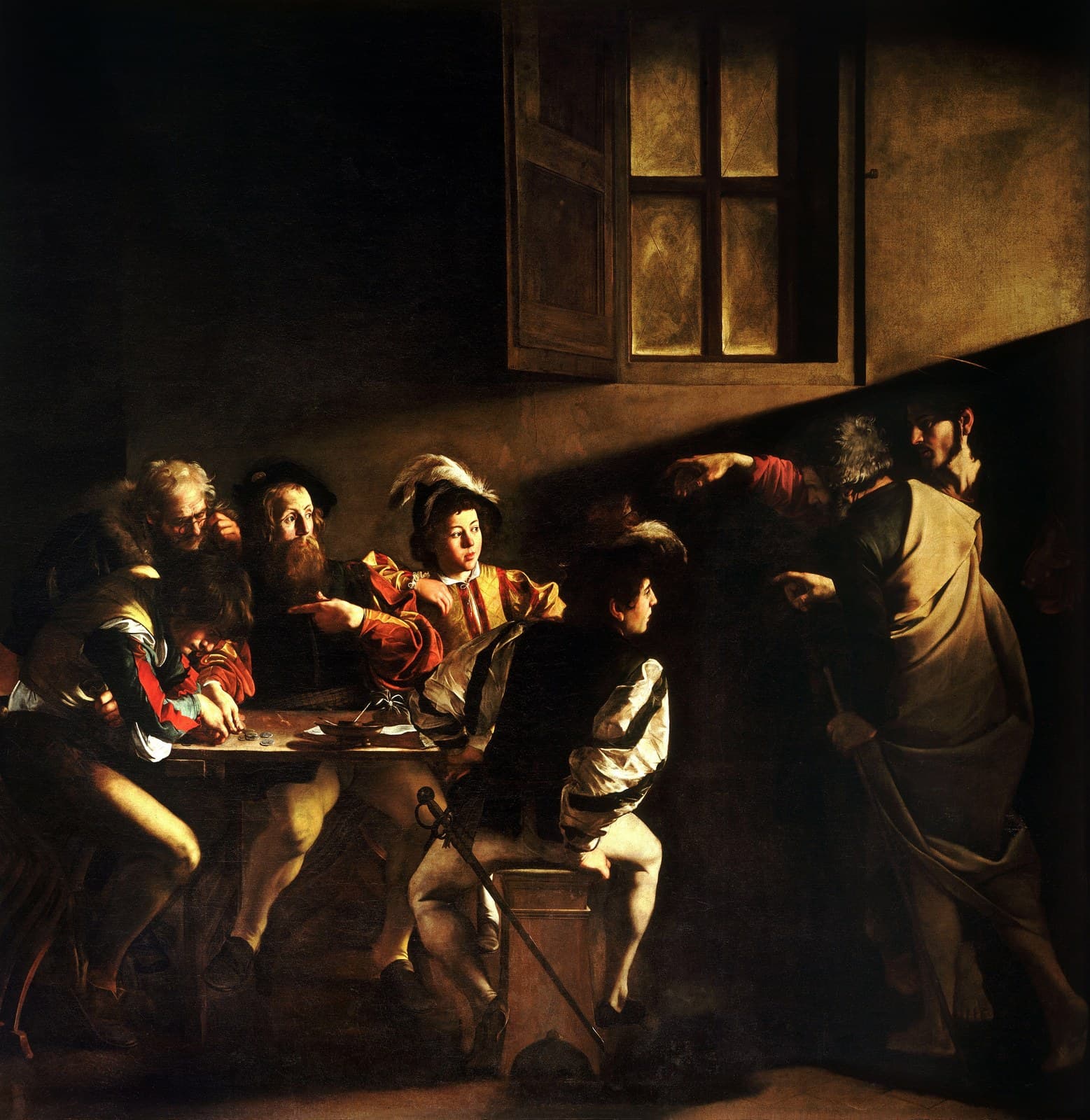
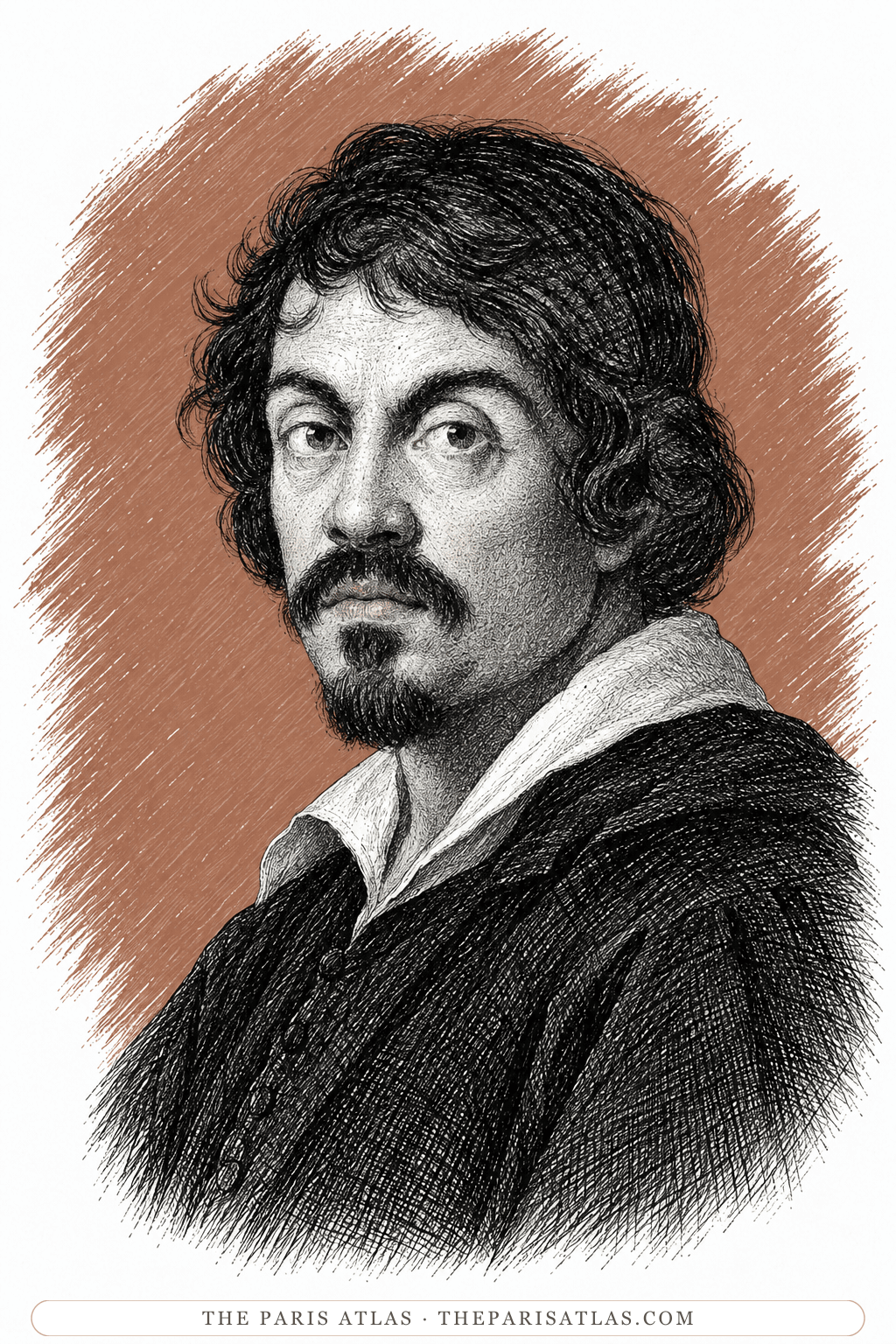
Michelangelo Merisi da Caravaggio transformed religious painting through concentrated action, dramatic lighting, and figures whose physical presence could appear startlingly immediate. In The Calling of Saint Matthew of 1599–1600, painted for the Contarelli Chapel in Rome's San Luigi dei Francesi, Christ enters a setting occupied by men gathered around a table. The directional light and Christ's gesture connect spiritual revelation with an otherwise ordinary-looking encounter. The scene's power comes from making an extraordinary event seem to interrupt everyday life.[13]
His naturalism could also create difficulties with patrons. The Death of the Virgin, completed around 1605–1606, was rejected by the clergy of the Roman church for which it had been commissioned. Rather than presenting Mary's death as an obviously triumphant heavenly event, the painting emphasizes the weight of her body and the grief of those around her. Its subsequent history is revealing: the rejected altarpiece entered the Gonzaga collection in Mantua, later belonged to Charles I of England, and eventually entered Louis XIV's collection. A work considered unsuitable for one religious setting became a possession sought by major collectors and monarchs.[14]
Artemisia Gentileschi: History Painting and Professional Independence
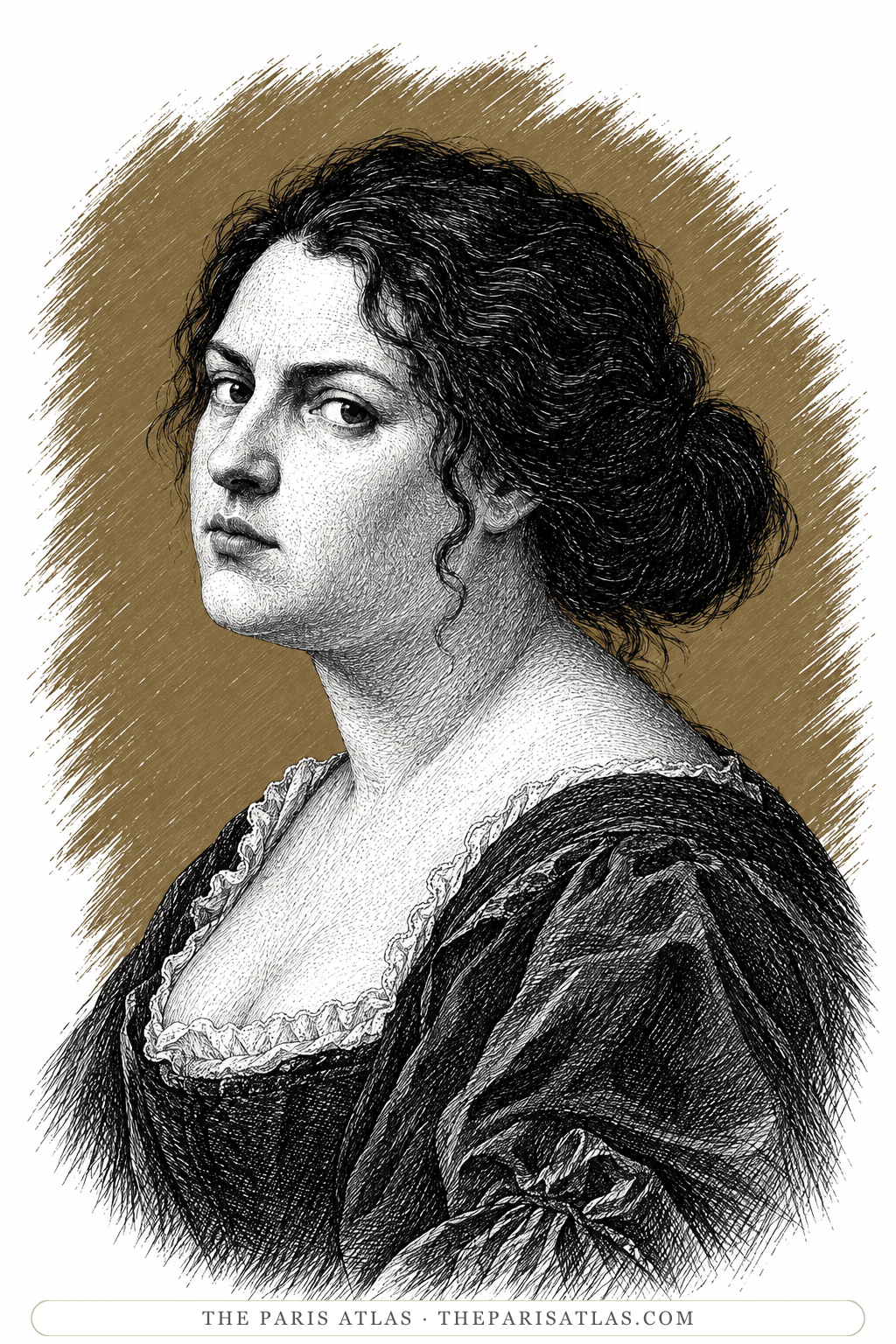
Artemisia Gentileschi became an accomplished painter of biblical and historical subjects in a profession that placed substantial obstacles before women. Trained by her father, Orazio Gentileschi, she developed a career across several major artistic centers and was admitted to Florence's Accademia delle Arti del Disegno in 1616. Her surviving works demonstrate an ability to organize complex actions, differentiate materials, and convey physical effort with exceptional conviction.[15]
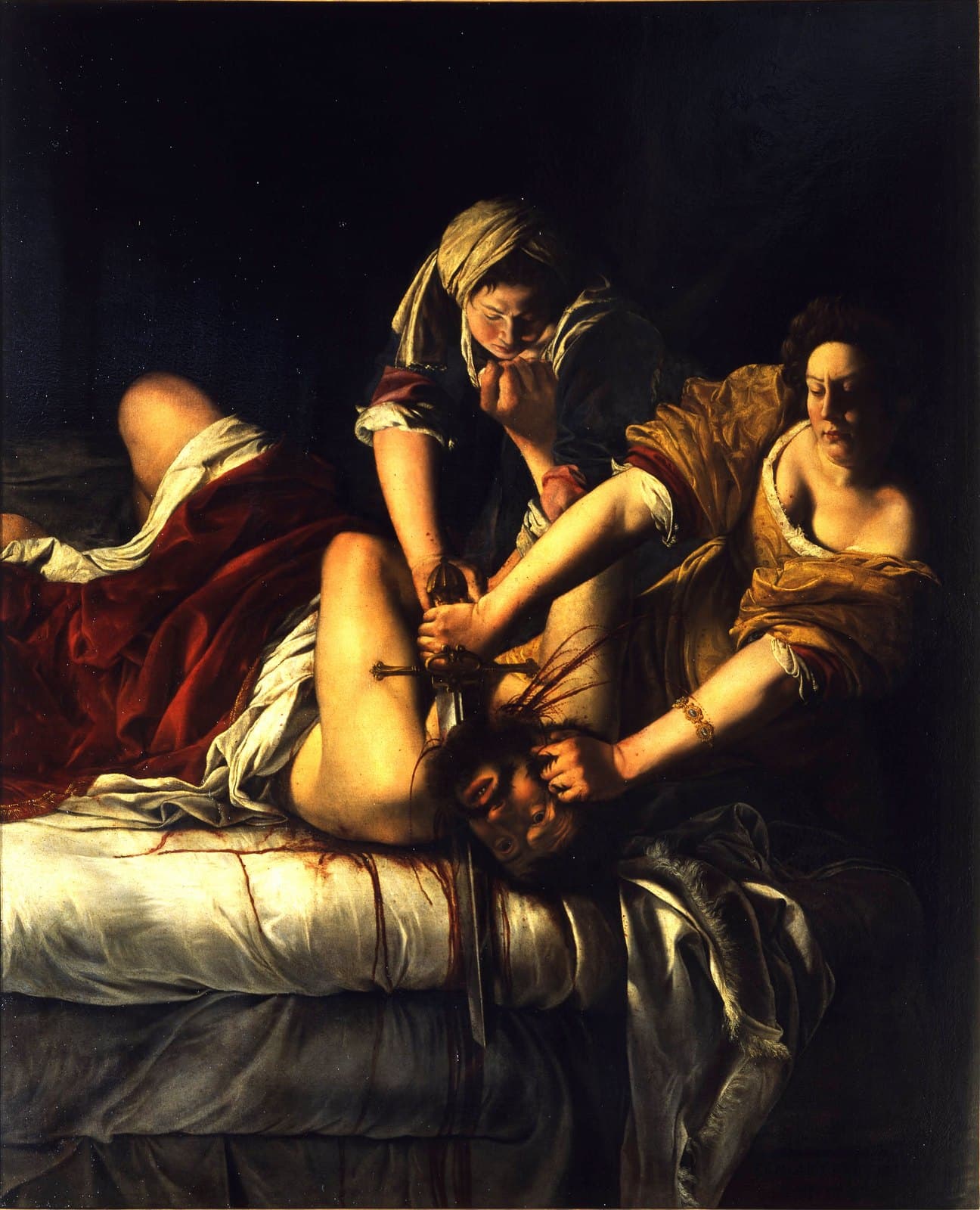
In the Uffizi version of Judith Beheading Holofernes, painted around 1620, Judith and her attendant work together to overpower the Assyrian general. Their bodies register the difficulty of the action: this is not an elegant symbolic gesture but a forceful physical struggle. The biblical subject offered a story of courage and deliverance, while the composition made female agency central to the image.[16]
Gentileschi's rape by Agostino Tassi and the subsequent trial are important documented events in her life, but interpreting every forceful woman she painted as personal revenge obscures her artistic intelligence and professional ambitions. Another episode reveals the practical difficulties of her career: the Uffizi records that she struggled to secure payment for the Judith and obtained it belatedly with Galileo Galilei's assistance. Her history belongs as much to the worlds of patronage, negotiation, and intellectual friendship as to the trauma that has often dominated accounts of her work.[16]
Peter Paul Rubens: Movement, Mythology, and Diplomacy
Peter Paul Rubens, based in Antwerp in the southern Netherlands, developed an expansive style characterized by animated bodies, rich color, and complex, flowing compositions. His career extended across altarpieces, portraits, landscapes, mythological subjects, and large decorative commissions. He also operated within international courtly networks and undertook diplomatic work, bringing artistic production into close contact with European politics.[17]
One of his most ambitious commissions was the Marie de' Medici cycle, created in 1622–1625 for the queen mother's Luxembourg Palace in Paris.[18]
Rembrandt: Collective Action and Human Attention
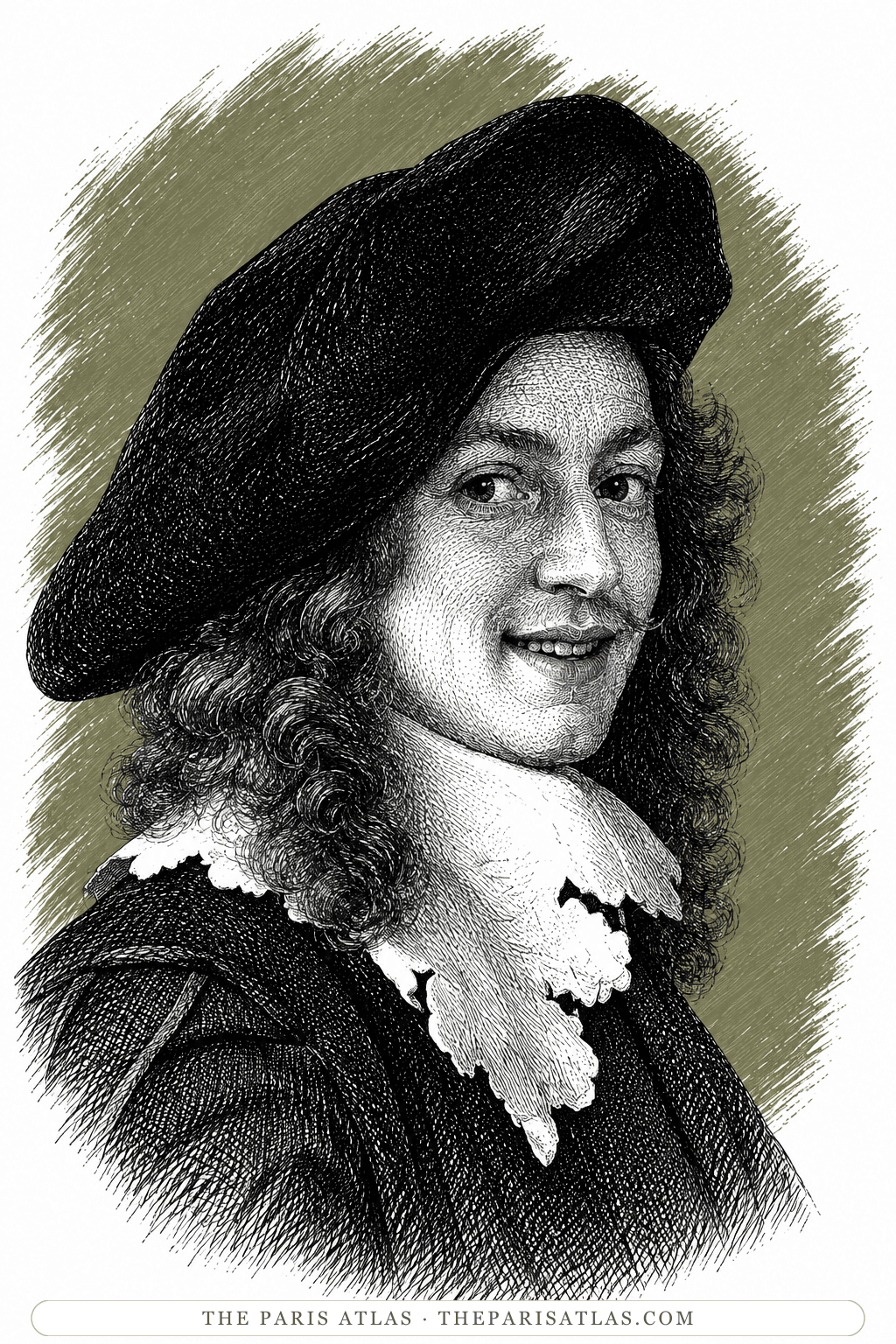
Rembrandt van Rijn brought dramatic illumination and an unusually searching treatment of human behavior to Dutch painting. In The Night Watch, completed in 1642, he transformed a civic militia portrait into a scene of collective activity. Figures move, gesture, handle weapons, and emerge unevenly into the light. Instead of giving every sitter equal prominence in an orderly row, he organized the group around a developing action.[19]
The familiar title is misleading: the scene is not a nighttime patrol. An even more surprising episode occurred in 1715, when the painting was moved to Amsterdam's Town Hall. To fit it between two doors, strips were cut from all four sides, with the largest section removed from the left. These pieces have not been recovered. The surviving composition therefore differs from the one Rembrandt completed, a striking example of how even celebrated works could be subordinated to the practical demands of an interior.[19]
Diego Velázquez: Painting, Power, and the Act of Looking
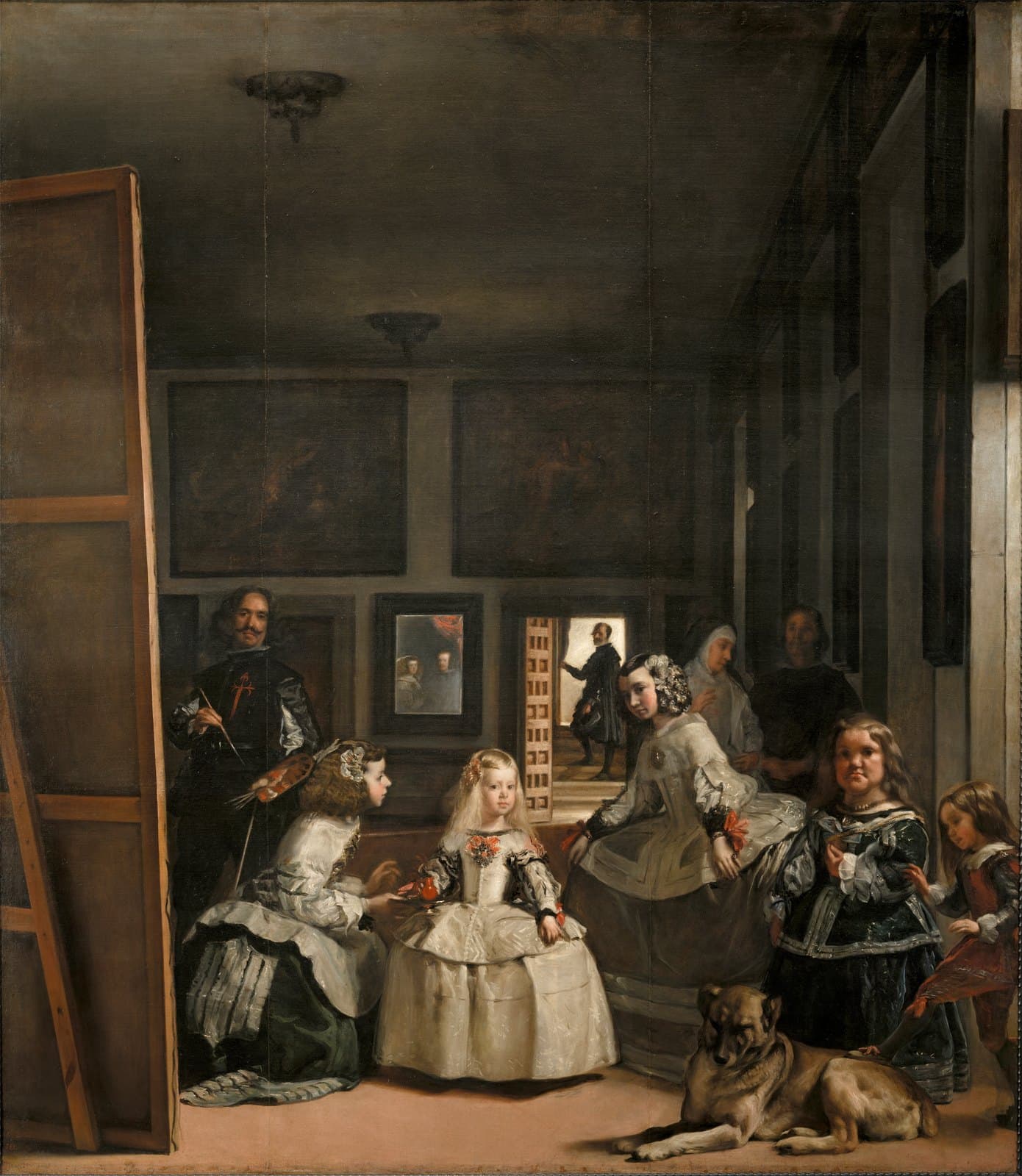
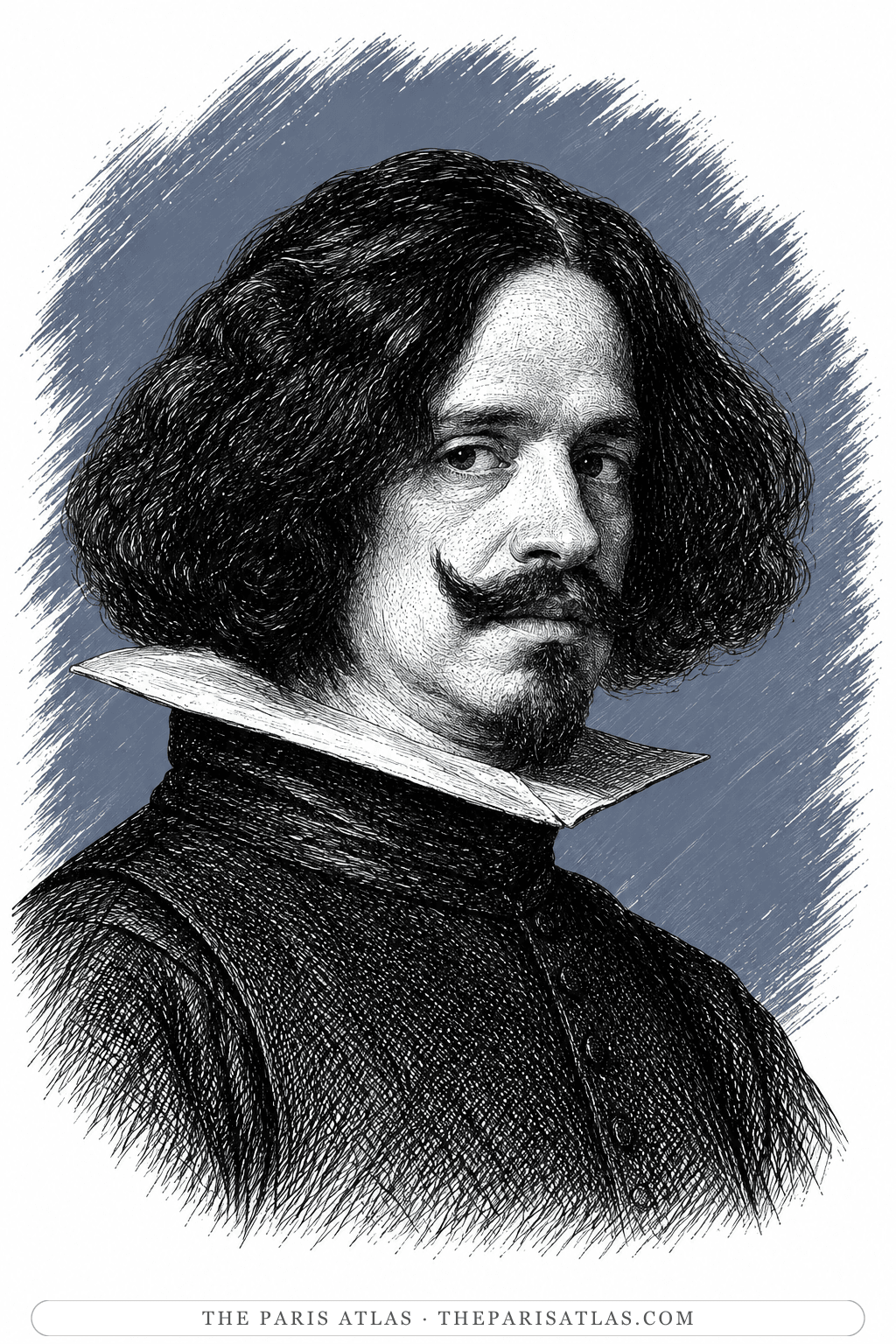
Diego Velázquez, painter at the court of Philip IV of Spain, explored a less overtly theatrical but equally sophisticated relationship between art and spectatorship. His Las Meninas, painted in 1656, shows the Infanta Margarita surrounded by attendants, with the painter himself standing at a large canvas. On the rear wall, a mirror contains the faces of the king and queen.[20]
The arrangement complicates the viewer's position. The royal couple appear within the image only as reflections, yet their implied presence helps organize the scene. Velázquez looks outward, connecting the act of painting with the space occupied by the spectator. Rather than resolving everything into a straightforward narrative, Las Meninas makes representation itself part of its subject: who is observing, who is being represented, and how an image establishes the presence of people beyond its visible boundaries.[20]
Johannes Vermeer: The Intensity of Quiet Observation
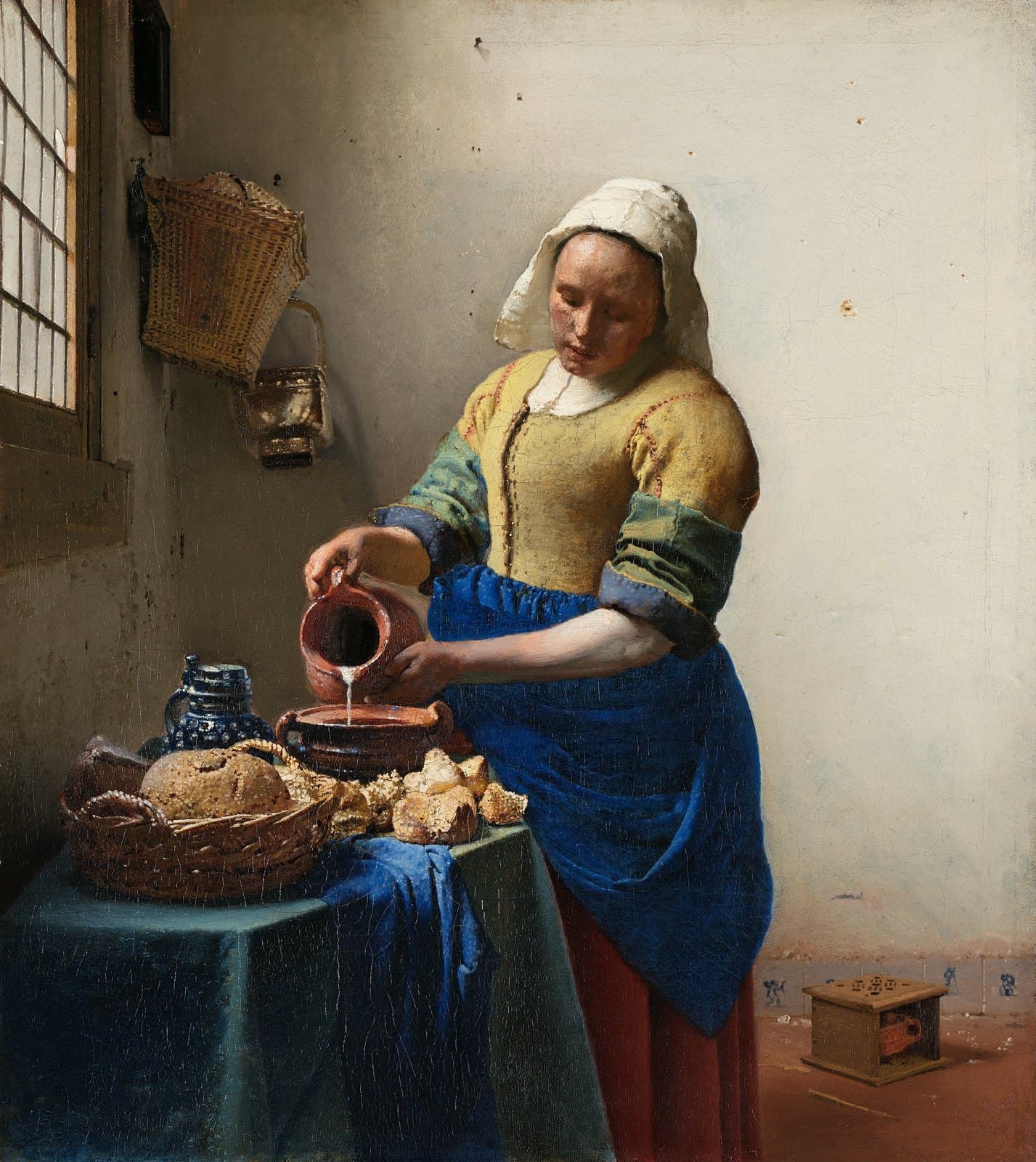
Johannes Vermeer demonstrates why the Baroque period cannot be defined solely by spectacle. In The Milkmaid, dated by the Rijksmuseum to about 1660, a woman pours milk in a modest interior. Almost everything is still, and the narrow stream of liquid becomes the focus of sustained attention. Light gives ordinary objects and surfaces exceptional clarity, while the woman's firmly constructed figure lends dignity to an everyday task.[21]
Vermeer's work shares the period's interest in making a represented world convincingly present, but achieves this through concentration rather than agitation. His interiors offer a useful corrective to the assumption that Baroque art must contain violent gestures, heavy ornament, or an explicit religious message. The distinction is between a historical category and a checklist of visual effects, not between a supposedly “real” Baroque and an irrelevant exception.
Baroque Art in France and Paris
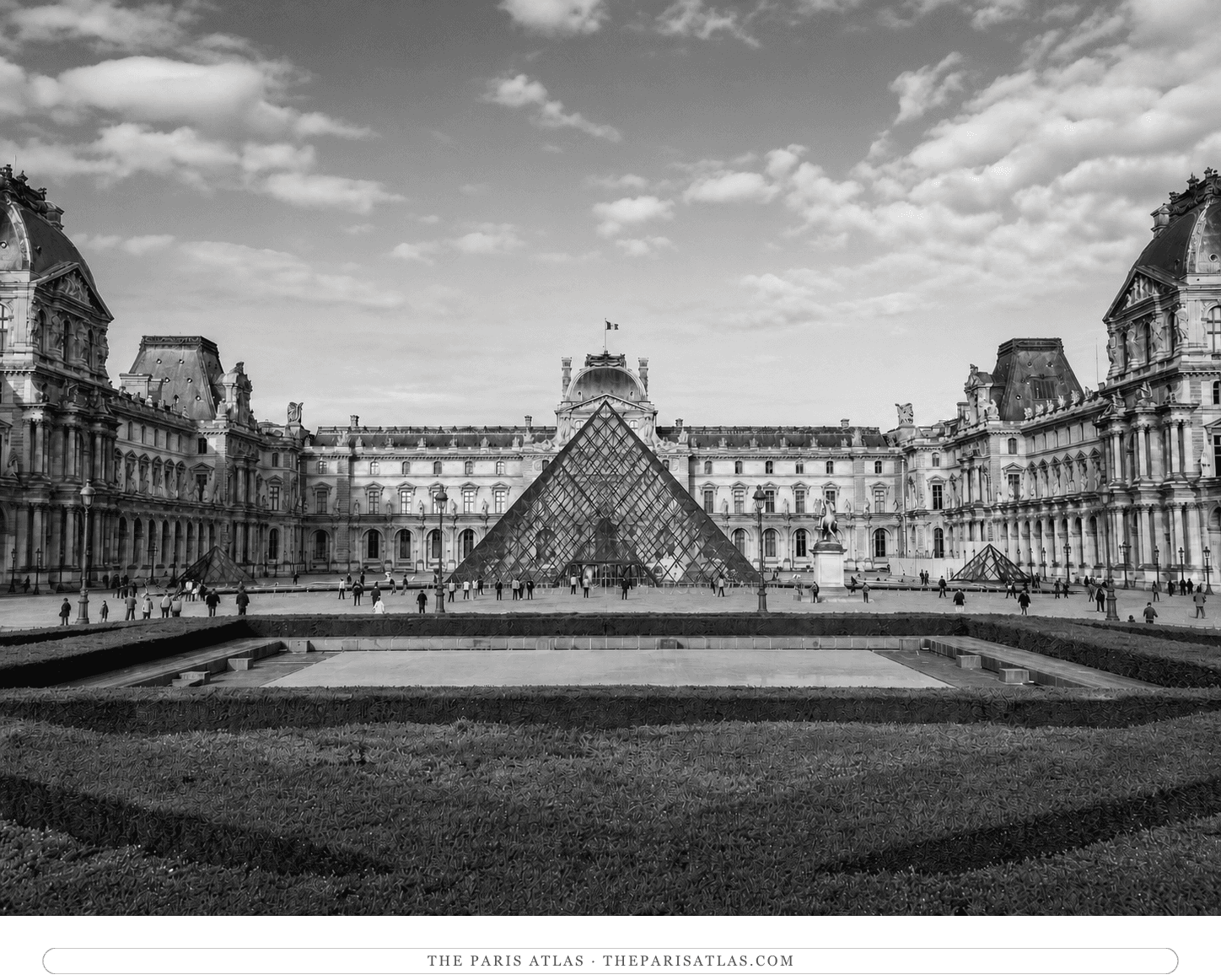
Baroque art in France developed through a continuing exchange between Italian artistic traditions and French ideas about religion, political authority, and classical order. Paris became a major center of this exchange, bringing together royal patrons, powerful ministers, religious communities, collectors, and artists. Its churches and palaces provided settings in which painting, sculpture, architecture, and decoration could be coordinated into ambitious statements of faith or prestige. Although Versailles eventually became the most celebrated expression of this culture, Paris itself preserves important examples, from the church of Val-de-Grâce to the painted galleries of the Louvre and the former palace of Cardinal Mazarin.
French Baroque and French Classicism
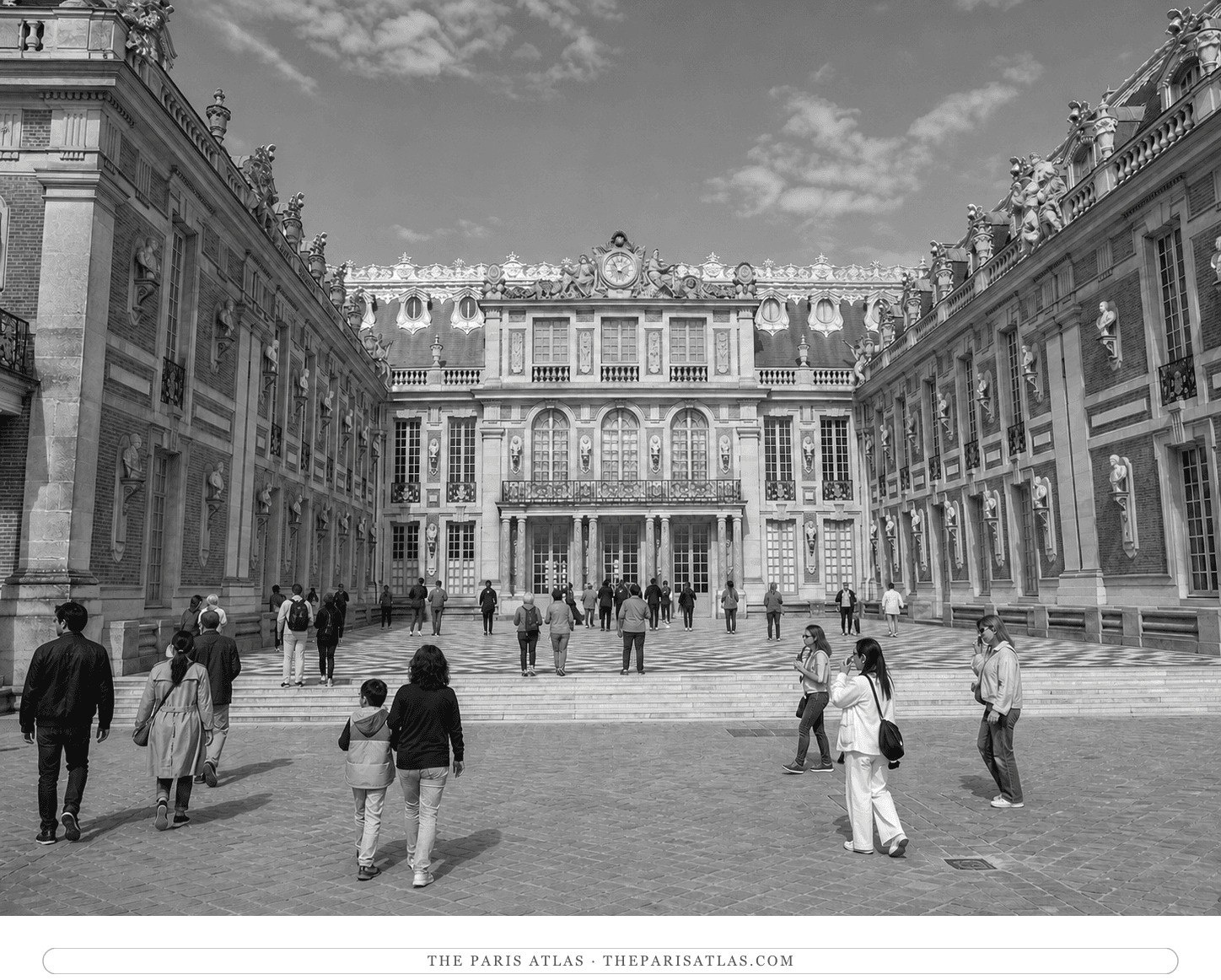
The relationship between Baroque and classicism is essential to understanding French seventeenth-century art. French artists frequently pursued the emotional force, visual richness, and coordinated effects associated with the Baroque while maintaining symmetry, clearly organized compositions, and architectural forms derived from antiquity. A building could have a disciplined exterior and an extraordinarily elaborate interior without representing two incompatible artistic ambitions. The palace of Versailles is a particularly important example of this combination.
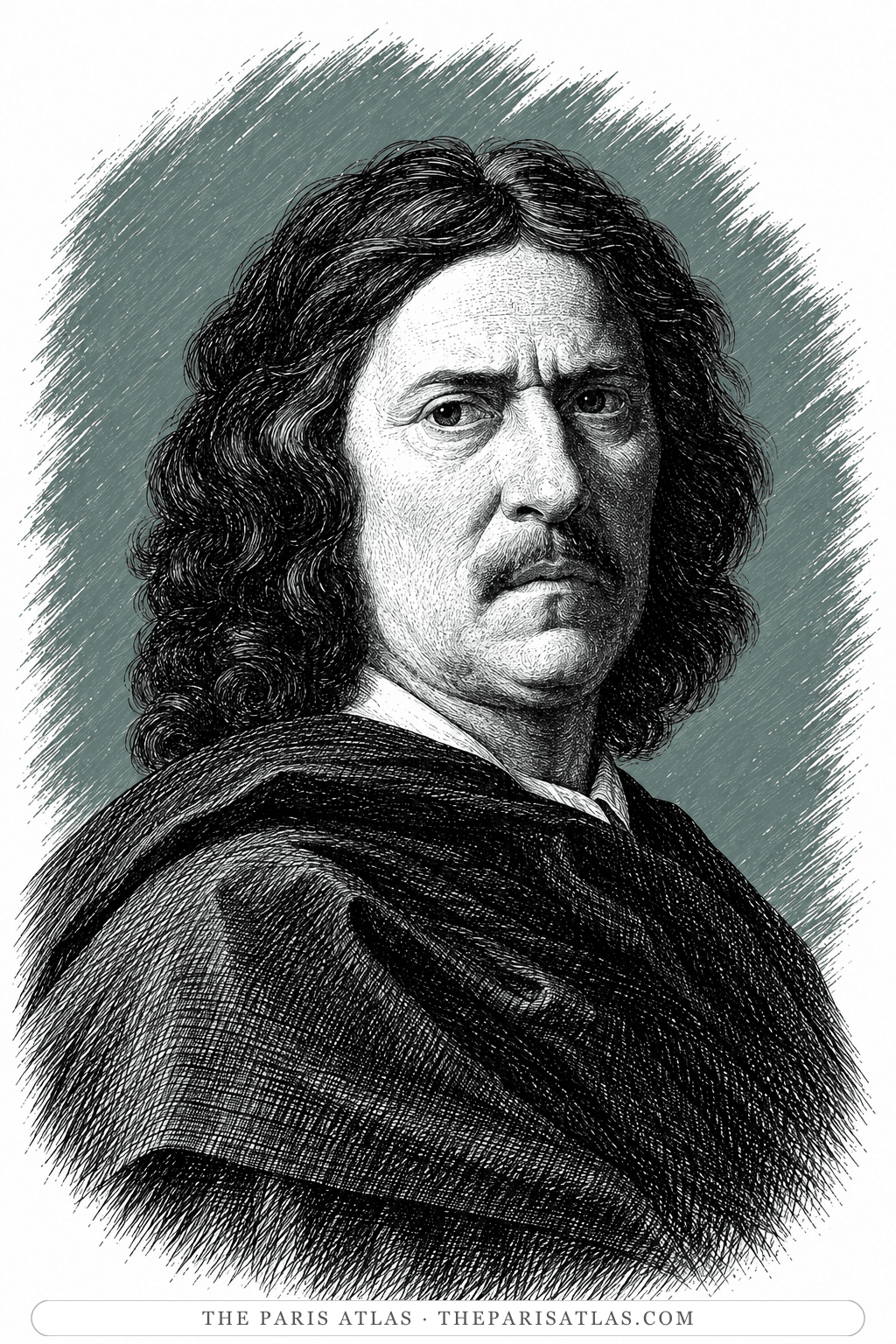
Nevertheless, not every French work made during the Baroque period is best described as stylistically Baroque. Nicolas Poussin, for example, deliberately developed an approach distinct from the prevailing exuberance of Roman painting. His carefully ordered compositions encouraged sustained interpretation rather than immediate visual astonishment. French seventeenth-century art therefore encompasses several approaches, including theatrical religious painting, classical history painting, monumental royal decoration, and quieter forms of devotion. Its variety should not be reduced to the idea that France merely produced a restrained version of Italian Baroque art.[31]
Rome and Paris: Vouet, Poussin, and Claude
Simon Vouet was an important intermediary between Italy and France. After working in Rome, where his early painting reflected Caravaggio's influence, he developed a broader approach informed by Venetian color and other Italian traditions. His return to Paris in 1627 brought this experience into the service of the French court and patrons including Cardinal Richelieu. Through his substantial workshop, Vouet helped establish a generation of painters capable of undertaking ambitious religious and decorative commissions. His pupils included Charles Le Brun, Eustache Le Sueur, and Pierre Mignard, all significant figures in the subsequent development of French painting.[32]
Poussin followed a different path. Although French by birth and closely connected to French collectors, he spent most of his mature career in Rome. His return to Paris in 1640–1642, when he undertook royal commissions, proved less successful than his work for private patrons. Back in Rome, he continued developing paintings in which gesture, setting, and the arrangement of figures carried complex historical or moral meanings. Contemporary accounts describe his use of small stages and wax figures; he probably employed these models to test the relationships among bodies, drapery, and light before completing a composition. The apparent inevitability of his arrangements was therefore supported by a practical process of experimentation.[33][31]
The Lorraine-born painter Claude Gellée, generally known as Claude Lorrain or simply Claude, also established his career in Rome. He combined outdoor observation with carefully constructed studio landscapes, producing scenes whose balance and luminous atmosphere offered a different kind of visual grandeur. Claude recorded many compositions in his Liber Veritatis, or Book of Truth, perhaps partly to guard against imitations being sold as his work. Together, Vouet, Poussin, and Claude demonstrate that the formation of French painting depended on travel, correspondence, collecting, and artistic exchange rather than on activity within France alone.[34]
Marie de' Medici and the Luxembourg Palace
One of the most ambitious Baroque commissions associated with Paris was Peter Paul Rubens's Marie de' Medici cycle, painted in 1622–1625 for the queen mother's Luxembourg Palace. Comprising twenty-one narrative paintings and three portraits, it presented her life through a mixture of recognizable historical events, ancient gods, and personifications. The paintings are now in the Louvre, but their original setting was a palace gallery designed to establish Marie's dignity and political importance.[18]
The commission required considerable diplomatic judgment. Marie's relationship with her son, Louis XIII, had involved conflict, exile, and reconciliation. Rubens needed to celebrate his patron without making an unnecessarily provocative statement against the reigning king. Mythology and allegory helped transform disputed events into an apparently providential history, allowing political instability to assume the appearance of divine order. The grandeur of the finished paintings concealed a more ordinary problem: Rubens had difficulty securing payment and eventually accepted a reduction in the agreed sum. The cycle belongs to the history of artistic invention, but also to the less glamorous history of artists negotiating with powerful clients.[18]
Parisian Churches: Faith, Royal Patronage, and Spectacle
Saint-Paul–Saint-Louis, in the Marais, is an important example of the connection between religious renewal and royal support. Originally the Jesuit church of Saint-Louis, it was begun with the laying of a foundation stone by Louis XIII in 1627. Cardinal Richelieu celebrated its first Mass in 1641 in the king's presence. The building's prominence and elaborate architectural presentation expressed the ambitions of a religious order closely associated with the Catholic renewal of the period. Its royal associations continued after the deaths of Louis XIII and Louis XIV, whose hearts were deposited there.[35]
On the Left Bank, Val-de-Grâce connected religious gratitude with the survival of the royal dynasty. Anne of Austria commissioned the church in thanksgiving for the birth of the future Louis XIV in 1638, after more than two decades of marriage without a surviving heir. Construction began in 1645, and the project involved several architects, including François Mansart and Jacques Lemercier. The church was therefore both a devotional offering and a monumental expression of the monarchy's future.[36]
Inside Val-de-Grâce, Pierre Mignard's painted dome, executed in 1663, transforms the overhead space into a crowded heavenly vision. Among its figures, Anne of Austria presents a model of the church to the Virgin. The painting places the queen's earthly act of patronage within a sacred narrative, while the architecture and canopy over the altar give that narrative a physical setting. The church's later incorporation into a military hospital complex helped preserve it, although elements of its furnishings were lost or replaced. Its surviving appearance consequently combines seventeenth-century invention with subsequent restoration.[36]
Cardinal Mazarin's Palace and Its Painted Gallery
The Galerie Mazarin, also called the Galerie Mazarine, at the Bibliothèque nationale de France's Richelieu site preserves an important part of Cardinal Mazarin's former palace. In 1644, Mazarin commissioned François Mansart to construct two superimposed galleries, including an upper gallery for exceptional paintings, sculpture, and luxury furnishings. The Italian painter Giovanni Francesco Romanelli and his workshop decorated its ceiling in 1646–1647, combining mythological narratives with gilded stucco.[37]
A revealing detail concerns the relationship between architecture and painting. Mansart initially planned a ceiling composed of three domes, but Romanelli had the design altered to create a continuous barrel vault better suited to his decorative program. Painting was not simply added after the architecture had been settled; it helped determine the form of the room. The gallery's history also includes damage and censorship. After Mazarin's death, an heir ordered the mutilation of nude antique statues, and the BnF considers it likely that painted nudity in the gallery was covered during the same period. The room's survival records changes in taste and religious attitudes as well as the cardinal's original ambitions.[37]
The Louvre's Galerie d'Apollon
The Galerie d'Apollon demonstrates how royal imagery could be developed through the coordinated work of architects, painters, and sculptors. Its creation followed a disaster: a fire in February 1661 destroyed the Louvre's Petite Galerie. Louis Le Vau and Charles Le Brun were subsequently commissioned to rebuild and decorate the space. Apollo, associated with the sun and cosmic order, supplied an appropriate mythological counterpart to Louis XIV's developing royal image.[38]
Le Brun's program combined painted allegories with an elaborate sculptural framework, creating an important precedent for the Hall of Mirrors at Versailles. Yet the gallery should not be mistaken for an interior completed entirely during Louis XIV's reign. Its decoration remained unfinished and was developed in later periods. The great central painting, Eugène Delacroix's Apollo Slaying the Serpent Python, is a nineteenth-century contribution. The room is therefore both a major survival of French Baroque design and an example of how later artists continued working within an inherited decorative scheme.[38]
Bernini in Paris: A Celebrated Visit and a Rejected Louvre
In 1665, Louis XIV invited Gian Lorenzo Bernini to France. The visit brought the most celebrated sculptor of the Italian Baroque into direct contact with French royal patronage, but its outcome was mixed. Bernini's proposals for rebuilding the Louvre were not executed, while his portrait bust of the king became a major success. The distinction is important: the rejection of an architectural project did not amount to the rejection of everything Bernini represented.[39]
The bust presents Louis XIV through an animated arrangement of armor, fabric, and hair, giving the monarch a presence that extends beyond the conventions of a simple likeness. Its production was not effortless: Bernini encountered difficulties with the marble and criticism during the process. Nevertheless, the completed sculpture became an enduring image of royal majesty. The visit illustrates the selective nature of artistic exchange between France and Italy. French patrons could admire Bernini's ability to animate stone while preferring different solutions for a major royal building. His prestige did not eliminate competing tastes, institutional interests, or the authority of local architects.[40]
Vaux-le-Vicomte and the Collaboration Behind Versailles
Outside Paris, Vaux-le-Vicomte brought together three figures whose collaboration became fundamental to French royal art: Louis Le Vau, responsible for architecture; Charles Le Brun, responsible for decoration; and André Le Nôtre, responsible for the gardens. Their patron, the superintendent of finances Nicolas Fouquet, sought a residence in which building, interior, and landscape formed a coordinated whole. Views through the château, the organization of rooms, and the garden's calculated perspectives connected experiences that might otherwise have remained separate.[41]
Fouquet's arrest in 1661 abruptly transformed the history of the estate. His possessions were confiscated and dispersed, and he was ultimately imprisoned for life. His wife, Marie-Madeleine de Castille, eventually recovered the property after prolonged efforts. The contrast between Fouquet's ambitions and his downfall has made Vaux an unusually dramatic chapter in the history of patronage. Its artistic importance, however, extends beyond the fate of its owner: the collaboration associated with Vaux helped establish the integrated approach subsequently developed on a much greater scale in royal projects.[42]
Versailles: Art and the Representation of Louis XIV
Although Versailles lies outside Paris, it is inseparable from the history of the capital's artists and workshops. There, architecture, painting, sculpture, and furnishing were organized into a sustained representation of monarchy. Charles Le Brun played a central role, producing designs that coordinated imagery across different media rather than limiting himself to individual paintings. His work helped establish connections among the palace's decorated rooms, royal history, and the mythological language through which power was presented.[43]
The Hall of Mirrors, constructed under Jules Hardouin-Mansart between 1678 and 1684, combined architectural order with exceptional decorative richness. Its origins were partly practical: it replaced an exposed terrace that had stood between the king's and queen's apartments and proved inconvenient in bad weather. The new gallery extended for approximately 73 meters, with 357 mirrors arranged in seventeen arches opposite the windows. These mirrors did more than multiply light and garden views; they demonstrated the capacity of French manufacture to compete with Venice in an expensive and prestigious field.[44]
Le Brun's ceiling presented the king's achievements through historical events and allegorical figures. Despite its ceremonial appearance, the gallery was ordinarily a place of passage, waiting, and conversation rather than a permanent ballroom. On exceptional occasions, its length and arrangement became instruments of diplomatic display, turning the approach to the monarch into an extended public event.[44]
The reception of the Siamese embassy in 1686 provides a concrete example. Representatives of King Narai arrived at a court prepared to impress them with silver furnishings, formal ceremony, and the assembled royal household. The splendor supported political and commercial objectives: France hoped to strengthen its position in Asia and counter Dutch influence. Versailles's magnificence was therefore not detached from international affairs. It was one of the means through which those affairs were conducted.[45]
Gardens, Academies, and Royal Workshops
The gardens of Versailles extended artistic planning beyond the palace walls. Beginning in 1661, Le Nôtre developed an immense landscape of perspectives, planted compartments, fountains, sculpture, and canals. Its apparent order required substantial physical intervention: earth was moved, wet ground reshaped, trees transported from different parts of France, and thousands of workers employed, sometimes including entire military regiments. The relationship between the visible result and the labor necessary to create it is an important part of the site's history. The landscape's carefully controlled views can be read as an expression of royal command, but they were also achievements of construction, maintenance, and collaboration.[46]
Artistic production was supported by institutions as well as individual commissions. Le Brun was a founding member of the Royal Academy of Painting and Sculpture in 1648 and became manager of the Gobelins manufactory in 1663. His responsibilities brought paintings, tapestries, furnishings, and decorative designs into close relationship. These organizations helped give royal patronage continuity and scale: an image or composition could be developed across several media by many skilled hands. French Baroque grandeur consequently depended on extensive workshops and administrative structures, not only on the achievements of a few celebrated artists.[43]
The Invalides and the Baroque Transformation of Paris
The Invalides demonstrates the connection between architecture, religious practice, military service, and monarchy. Jules Hardouin-Mansart's church design provided related but distinct spaces for soldiers and the sovereign. The arrangement allowed them to participate in the same Mass while entering through different approaches, making social hierarchy part of the building's organization. The soldiers' church opened in 1679, while the royal domed church was inaugurated in 1706.[47]
The gilded dome is now strongly associated with Napoleon, but the church was not originally built as his tomb. It belonged to Louis XIV's architectural program. Napoleon's remains were brought to the Invalides in 1840, and their installation in the present tomb followed in 1861. Understanding that sequence changes the interpretation of the monument: a royal religious setting was adapted to a different political and commemorative purpose more than a century after its construction.[48]
Another major addition to the Parisian skyline was the Collège des Quatre-Nations, now occupied by the Institut de France. Founded through Mazarin's will, it provided education for students from four territories recently acquired by France. Le Vau's design placed a domed chapel at the center of a curved composition facing the Seine. The dome itself contains a subtle architectural adjustment: it is round externally but oval within. Construction began in 1663, and the college opened in 1688, turning the cardinal's testamentary ambitions into a prominent urban monument.[49]
Royal architectural planning also extended into public squares. Hardouin-Mansart's work at Place des Victoires and Place Vendôme helped establish coherent architectural settings within the city. His activity beyond Paris, including projects in Arles and Dijon, demonstrates that the development of French monumental architecture was not confined to the royal residences.[50]
Philippe de Champaigne and a Quieter Religious Art
French religious painting did not always seek overwhelming spectacle. Philippe de Champaigne's Ex-Voto of 1662 offers a markedly different encounter with faith. The painting commemorates the recovery of his daughter Catherine, a nun at Port-Royal, from a disabling illness. Her family and religious community understood the recovery as miraculous, and Champaigne created the work as an offering of gratitude.[51]
The picture presents Catherine with Mother Agnès Arnauld in a plain interior. Restrained gestures, white habits marked by red crosses, and carefully differentiated expressions replace the crowded heavens and expansive movement found in more theatrical religious decoration. Its emotional intensity comes from concentration rather than abundance. Champaigne's connections with Port-Royal also place the work within the religious controversies of seventeenth-century France. The painting is a reminder that French Catholic culture contained competing spiritual attitudes and that personal devotion could produce an artistic language very different from the public magnificence of a royal chapel.[51]
Pierre Puget and Baroque Sculpture Beyond the Court
The Marseille-born sculptor Pierre Puget provides another important alternative to the dominant courtly image of French art. Initially trained in woodcarving in a maritime environment, he later directed sculptural work for the royal navy at Toulon. There, he noticed unused blocks of Carrara marble and obtained permission to turn them into major sculptures. One result was Milo of Croton, completed in 1682 and subsequently displayed at Versailles.[52]
Puget represented the legendary athlete with his hand trapped in a tree as a lion attacks him. The twisting body, strained muscles, and agonized expression emphasize the collapse of physical power. This was an unusual subject for a setting so frequently devoted to royal triumph: instead of an invincible hero, the viewer encounters strength rendered useless. Puget's forceful treatment of movement and vulnerability demonstrates that French sculpture could approach the emotional intensity associated with Bernini while retaining a distinct character. His work also connects Parisian collections and royal commissions to the artistic life of southern France.[52]
Eighteenth-Century Paris and the Transition Toward Rococo
Baroque religious art in Paris did not simply end with the seventeenth century. Churches remained important patrons and public settings for contemporary painting throughout much of the eighteenth. Artists continued producing large altarpieces, painted ceilings, and effects that appeared to extend real architecture into imagined space. At Saint-Roch, Jean-Baptiste Pierre's painted dome in the 1750s continued the tradition of presenting a heavenly vision overhead. Theatrical approaches also informed decorative settings at Saint-Merri and Sainte-Marguerite.[53]
At the same time, the development of Rococo, especially in French decorative arts during the 1720s and 1730s, introduced a more asymmetrical vocabulary of curves, shells, and ornamental invention. Rococo retained the Baroque interest in theatricality and coordinated visual effects, but its designs often operated differently from the monumental symmetry associated with Louis XIV's major projects. The transition was gradual, and the categories overlap; an elaborate eighteenth-century Parisian interior should not automatically be assigned to the same stylistic phase as the Hall of Mirrors.[54]
The survival of this heritage is equally complex. During the Revolution, paintings were removed from churches, dispersed, destroyed, or transferred to museums. Works returned to religious use in the nineteenth century were not always placed in their original locations. Parisian Baroque art must therefore be understood through both its original commissions and its later movements: the place where a painting is encountered today may tell only the latest chapter of its history.[53]
Understanding the French Contribution
The French contribution to Baroque art lies partly in its ability to combine different priorities. Classical organization could support extraordinary decorative richness; a royal interior could function as both an everyday working environment and a setting for international ceremony; religious painting could seek either public astonishment or private concentration. Paris and the surrounding royal estates brought these possibilities into close proximity without eliminating their differences. The Hall of Mirrors and Champaigne's Ex-Voto belong to the same century, but their contrasting purposes are fundamental to understanding its art.







 View source