Orientalism
Orientalist painters depicted North Africa, the Middle East and the Ottoman world through travel studies, studio inventions and imagined scenes. Delacroix, Ingres, Gérôme and their contemporaries worked within a history of exploration, collecting and empire that continues to shape debate about their paintings.
Overview
Orientalism brought Cairo’s streets, Morocco’s courts, Egypt’s ruins, and imagined harem interiors into European painting. It flourished during the nineteenth century, encompassing close observation and elaborate invention. Eugène Delacroix’s travel sketches, Jean-Auguste-Dominique Ingres’s idealized nudes, Jean-Léon Gérôme’s detailed interiors, and John Frederick Lewis’s studies of Egyptian daily life belong to this broad tradition. Its artists found new possibilities in light, color, architecture, and the human figure. Their pictures also reveal how travel, literature, collecting, and empire shaped European views of other societies.[1][2]
What is Orientalism in art?
In art history, Orientalism usually describes European images of North Africa, the Middle East, and the Ottoman world. It is especially associated with the nineteenth century, when French and British painters were prominent. Subjects included monuments and street life, biblical episodes, literary fantasies, military campaigns, and imagined private interiors. Artists from other countries also contributed to the tradition.[1]
Orientalism was not a unified school with a single technique or manifesto. Ingres’s carefully drawn nudes, Delacroix’s expressive brushwork, and Gérôme’s polished interiors belong to different artistic traditions. Their shared subject matter crosses the boundaries between Neoclassicism, Romanticism, academic painting, and later modern art.[3][4][5][2]
The word also has a wider intellectual history. It once described the study of Asian and Middle Eastern languages, literatures, religions, and societies. Edward Said’s Orientalism, published in 1978, made it influential in a different sense: as a term for the ways institutions and cultural works represent an “East” in relation to a supposedly contrasting “West.” The art-historical category and Said’s argument are connected, but they are not interchangeable. A painting can be classified as Orientalist without that label, by itself, explaining its quality, purpose, or political meaning.[6][7]
Where was “the Orient”?
The boundaries were never consistent. For nineteenth-century European artists, the term could include Egypt, Algeria, Morocco, Ottoman Turkey, the Levant, and Greece; broader usages reached into Persia and India. It was not the name of a single culture or a geographically precise region. North Africa lay south of Europe, while places grouped together under the label differed in language, religion, government, and history.[1]
Nor is Orientalist art another name for Islamic art. The former describes a tradition of representation, usually associated with European artists; the latter concerns artistic production within societies shaped by Islam. They intersect through buildings, textiles, ceramics, manuscripts, and objects depicted or collected by painters, but they remain distinct subjects. Moreover, Orientalist pictures frequently portray Jewish and Christian communities as well as Muslim ones. Delacroix’s studies of the Ben-Chimol family and Théodore Chassériau’s scenes of Jewish life in Algeria are important reminders of that diversity.[8][9][10]
Historical origins: travel, scholarship, and conquest
Before the nineteenth century
European artists had represented Ottoman dress and eastern settings long before Orientalism became a recognizable nineteenth-century category. Renaissance and Baroque painting supplied precedents, while eighteenth-century taste made fashionable an imagined world of luxurious interiors and Turkish costume. The nineteenth century did not invent these interests; it changed their scale, their political circumstances, and the means by which artists and audiences encountered the places represented.[1]
Women travelers also contributed accounts that did not always resemble male fantasies. Lady Mary Wortley Montagu, who accompanied her husband to Constantinople during his embassy in 1717–1718, wrote about spaces inaccessible to most European men. Her Turkish Embassy Letters, published after her death in 1763, became part of the literature through which Europeans imagined Ottoman domestic life. Their importance lies partly in the difference between describing a social world one has entered and inventing a scene around its supposed secrecy.[11]
Napoleon’s Egyptian expedition
Napoleon Bonaparte’s invasion of Egypt in 1798 was a major turning point. Alongside the army traveled a Commission of Sciences and Arts; more than 160 scholars and specialists participated in the expedition, including engineers, architects, naturalists, artists, and antiquarians. They recorded monuments, plants, animals, landscapes, and aspects of contemporary Egyptian life. Their work combined genuine scholarly ambition with the opportunities and purposes of a military occupation.[12]
A decree of February 6, 1802, ordered the expedition’s research and illustrations to be published at government expense. The first volumes of the monumental Description de l’Égypte appeared in 1809, with publication continuing through the 1820s. The enterprise required hundreds of engravers and exceptionally large sheets of paper. Its plates made Egyptian architecture and ornament available to people who would never visit Egypt, furnishing a visual reference library for artists, architects, designers, and collectors.[12][13]
The campaign also generated images designed to shape Napoleon’s reputation. Antoine-Jean Gros’s Bonaparte Visiting the Plague Victims of Jaffa (1804), now in the Louvre, depicts him entering a hospital and touching the swelling of a sick French soldier. Around this carefully staged gesture, fear and disease occupy an enormous architectural setting. The picture transforms a politically useful episode into a demonstration of personal courage and exceptional authority. Gros had not traveled to the region: the impression of eyewitness immediacy was an artistic construction.[14][1]
Greece, Algeria, and the Romantic imagination
For Romantic painters, eastern subjects offered settings for events of extraordinary emotional intensity. Delacroix’s Massacre at Chios (1824) responded to the Greek struggle against Ottoman rule. His Death of Sardanapalus, painted in 1827 and exhibited during the Salon of 1827–1828, moved into the world of ancient legend and literature. A ruler watches the destruction of the people and possessions around him from a vast bed, while diagonals of bodies, fabric, and movement disrupt any sense of stable order. Delacroix painted these works before his own journey to North Africa.[1][15]
French forces took Algiers in July 1830, beginning a prolonged and violent expansion of French control. France formally annexed Algeria in 1834. Occupation remained largely coastal through 1837, before campaigns to conquer the interior intensified from 1840.[16]
The French king Louis-Philippe commissioned Horace Vernet to paint military victories during the conquest of Algeria for Versailles. Vernet’s attention to uniforms, horses, terrain, and local dress made the pictures visually informative, but their official function was to celebrate conquest. The same material could interest a painter, inform an audience, and support a government’s account of its actions.[16]
Algeria subsequently became a major destination for French artists. Théophile Gautier compared the painter’s journey to Algiers with the established pilgrimage to Italy. The comparison reveals a changing geography of artistic education: the Mediterranean’s southern shore was becoming a place where artists expected to find subjects, light, and visual experiences unavailable at home.[17]
What Orientalist painting looks like
Color, light, and atmosphere
There is no universal Orientalist palette. A shaded room in Cairo, a Moroccan courtyard, and an Algerian desert landscape require different solutions. Nevertheless, many painters were drawn to the contrast between strong outdoor illumination and dark interiors, or between sunlit architecture and deep, cool shadows. These contrasts could give a scene dramatic clarity, establish an atmosphere of stillness, or make a small area of saturated color dominate the composition.[2][18]
The distinction between painters matters. Delacroix’s surfaces often remain visibly active: adjacent colors and shifting accents suggest the movement of light over fabric and skin. Ingres creates a more continuous, polished figure whose long contours govern the picture. Gérôme’s textures seem separately identifiable, encouraging the viewer to distinguish velvet from silk or worn stone from glazed tile. Rather than a progression from one method to another, these are competing ideas about what painting should accomplish.[4][3][19]
Architecture, textiles, and material detail
Buildings and objects were rarely neutral backgrounds. Arcades organize processions and prayer; lattice screens divide public and private space; patterned tiles and carpets establish rhythm across a picture. A turban, a sword, or a richly worked garment can supply a figure’s apparent identity even when the sitter is anonymous. In Gérôme’s Bashi-Bazouk, the extraordinary clothing is central to the effect, although the model posed in Paris wearing items the painter had acquired abroad.[20][21][22][23]
Such detail helps explain both the paintings’ attraction and the difficulty of reading them as evidence. An accurately painted object does not guarantee an accurate scene. A painter might borrow a wall from one city, a costume from another, and a gesture from a studio model. The resulting image can be convincing as a composition while representing no single place or event that actually existed.[19][24]
Everyday life and spectacle
The best-known images of harems, slave markets, and violent rulers represent only part of the field. Orientalist artists also painted schools, families, musicians, workshops, markets, worshipers, and travelers. The contrast is significant: a scene of ordinary religious practice invites a different kind of attention from a theatrical execution, even when both are painted with comparable finish. Subjects should therefore be considered individually rather than treated as illustrations of one unchanging attitude.[18][10][19]
Portrait-like figures complicate the category further. A painting titled after a military or social “type” may present its sitter with dignity and individuality, while still withholding the person’s name. Looking closely involves attending to both things: what the artist made visible in a human face, and what the title or accompanying story encourages the viewer to assume.[20][21][22][23]
Eugène Delacroix: the journey that changed his painting
Morocco in 1832
In January 1832, Delacroix joined the diplomatic mission of the Comte de Mornay to Morocco. France’s recent conquest of Algiers had unsettled relations with the Moroccan sultan, and the journey took place within that political setting. Delacroix traveled through Tangier and Meknes, recording people, buildings, clothing, horses, and ceremonies in notebooks. These rapidly gathered observations became an enduring resource rather than simply the preparation for one exhibition.[25][26][9]
Before this journey, his experience abroad had been limited to a visit to England in 1825. Morocco seemed to offer him a living counterpart to the ancient world he knew through art and literature. That response was artistically productive but also selective: he was looking at a contemporary society while recognizing in it forms that reminded him of antiquity. The sketches, watercolors, and objects he brought back continued to nourish his work for decades.[25][26]
The encounter depended on local intermediaries. Abraham Ben-Chimol, the Jewish interpreter attached to the mission, introduced Delacroix to his family in Tangier. The watercolor Saada, the Wife of Abraham Ben-Chimol, and Préciada, One of Their Daughters (1832) preserves their names as well as their appearance. Delacroix also described a Jewish wedding he attended on February 21. These were not encounters with an undifferentiated “East,” but relationships with particular people whose hospitality helped determine what he could see and paint.[9]
Women of Algiers in Their Apartment
On his return journey, Delacroix stopped in Algiers. A longstanding account connects Women of Algiers in Their Apartment with a visit to a private household there, commonly described as the harem of a former Turkish corsair. The reported visit gave the subject a basis in travel, but the canvas was developed in Paris from studies and memory. The finished room should therefore be understood as a composition, not a direct transcription of a private interior.[4]
Exhibited at the Salon of 1834 and purchased by the French state, the painting shows three seated women and a standing Black attendant. Instead of the violence of Sardanapalus, Delacroix builds the composition around pauses, glances, and the visual richness of an enclosed space. Light touches the women’s clothing, patterned cushions, jewelry, and tiled surfaces without illuminating everything equally. The room feels inhabited but not fully explained. Its attraction depends as much on the relationships between colors and textures as on the invitation to look into a supposedly private world.[27][4]
Its restraint distinguishes it from the nude odalisques often associated with the genre. The women are clothed, and the composition does not deliver a clear narrative climax. Yet the subject still offered a Paris audience privileged access to an interior it could not ordinarily enter. Both features belong to the painting: the seriousness of Delacroix’s pictorial invention and the expectations carried by its setting.[4]
Memory transformed in the studio
Delacroix’s later Sultan of Morocco and His Entourage demonstrates how travel material could be reworked in response to subsequent events. A graphite drawing of 1845, now at the Metropolitan Museum of Art, measures 59.7 centimeters high. Squaring in white chalk helped Delacroix transfer and enlarge the composition. The final conception excludes the French delegation, shifting the emphasis from a diplomatic encounter toward the authority of the sultan himself. The Met connects this renewed interest to the Franco-Moroccan war of 1844.[28]
This is more revealing than a simple distinction between a traveler and an armchair painter. Delacroix had witnessed the setting, but he reconsidered it years later. Experience supplied material; memory, current events, and the requirements of a major Salon painting determined its new form.[28]
Ingres: an imagined East and the art of the nude
Grande Odalisque
Jean-Auguste-Dominique Ingres never traveled to the Middle East. He painted the [Grande Odalisque](https://parisatlas.com/works/grande-odalisque) in Rome in 1814 for Caroline Murat, Queen of Naples. Its eastern identity emerges through accessories and setting rather than the observation of an actual household. The reclining woman turns toward the viewer across an elongated back, while a turban, fan, fabrics, and smoking equipment establish the associations through which the figure was understood.[1][3]
The painting’s bodily proportions are not a straightforward anatomical study. Ingres stretches and joins forms to create an extended, continuous movement across the canvas. The result combines the authority of meticulous drawing with a body shaped by pictorial preference. Its importance therefore extends beyond Orientalist subject matter: the tension between apparently exact description and deliberate deformation is central to Ingres’s art. The work appeared at the Salon of 1819 and entered the Louvre in 1899.[3]
The Turkish Bath
The Turkish Bath gathers this long-standing interest into a crowded circular composition. Ingres developed it as a rectangular picture in 1859 and transformed it into a tondo, or round painting, by 1862, when he was eighty-two. The women’s overlapping bodies, bent limbs, and repeated curves fill the interior with a continuous movement of forms. The circular format intensifies the sense that the viewer is looking into a self-contained world.[29]
The Turkish Bath belonged briefly to Prince Napoléon, who acquired it in 1859 and returned it to Ingres the following year in an exchange involving a self-portrait. It subsequently entered the collection of Khalil Bey, an Ottoman diplomat and art collector living in Paris. The Turkish Bath appeared in the sale of Khalil Bey’s collection at the [Hôtel Drouot](https://parisatlas.com/locations/hotel-drouot) on January 16–18, 1868. An Ottoman patron had bought a French fantasy of Turkish women, complicating any account that places European makers and eastern subjects in entirely separate worlds.[29]
Harem, bath, and fantasy
A harem was not simply a room full of sexually available women. In the accounts studied by historians of women’s travel, it appears as a domestic and social environment with its own relationships, visits, rules, and restrictions. A bath is another kind of space again. European images often blurred such distinctions, using an eastern setting to give the nude a narrative identity and to suggest an intimacy beyond ordinary public life.[11][30]
Jean-Léon Gérôme: precision, theatricality, and the studio
Gérôme became one of the most internationally successful practitioners of Orientalist painting. His travels supplied sketches, garments, photographs, and objects, while his studio provided a controlled environment in which to combine them. He was also a determined defender of academic painting, opposed to the Impressionist movement developing around him. His extraordinary finish was not an incidental preference but part of a larger conviction about artistic skill and intelligibility.[5]
The Met’s catalogue dates Gérôme’s 1868 travels in Egypt and Asia Minor from January 1 to April 13. His companions included the writer Edmond About, journalist Frédéric Masson, painter Léon Bonnat, and amateur photographer Albert Goupil, his brother-in-law. Sketches, photographs, and purchased clothing supplied material for later paintings.[31][32]
Back in Paris, Gérôme dressed a model in garments acquired abroad for Bashi-Bazouk (1868–1869). Its title identifies an irregular Ottoman soldier, but the man’s sumptuous silk clothing and composed bearing suggest little of life on a battlefield. The painting combines a study of an individual face with a costume that gives its unnamed sitter a military identity.[20]
Prayer in the Mosque
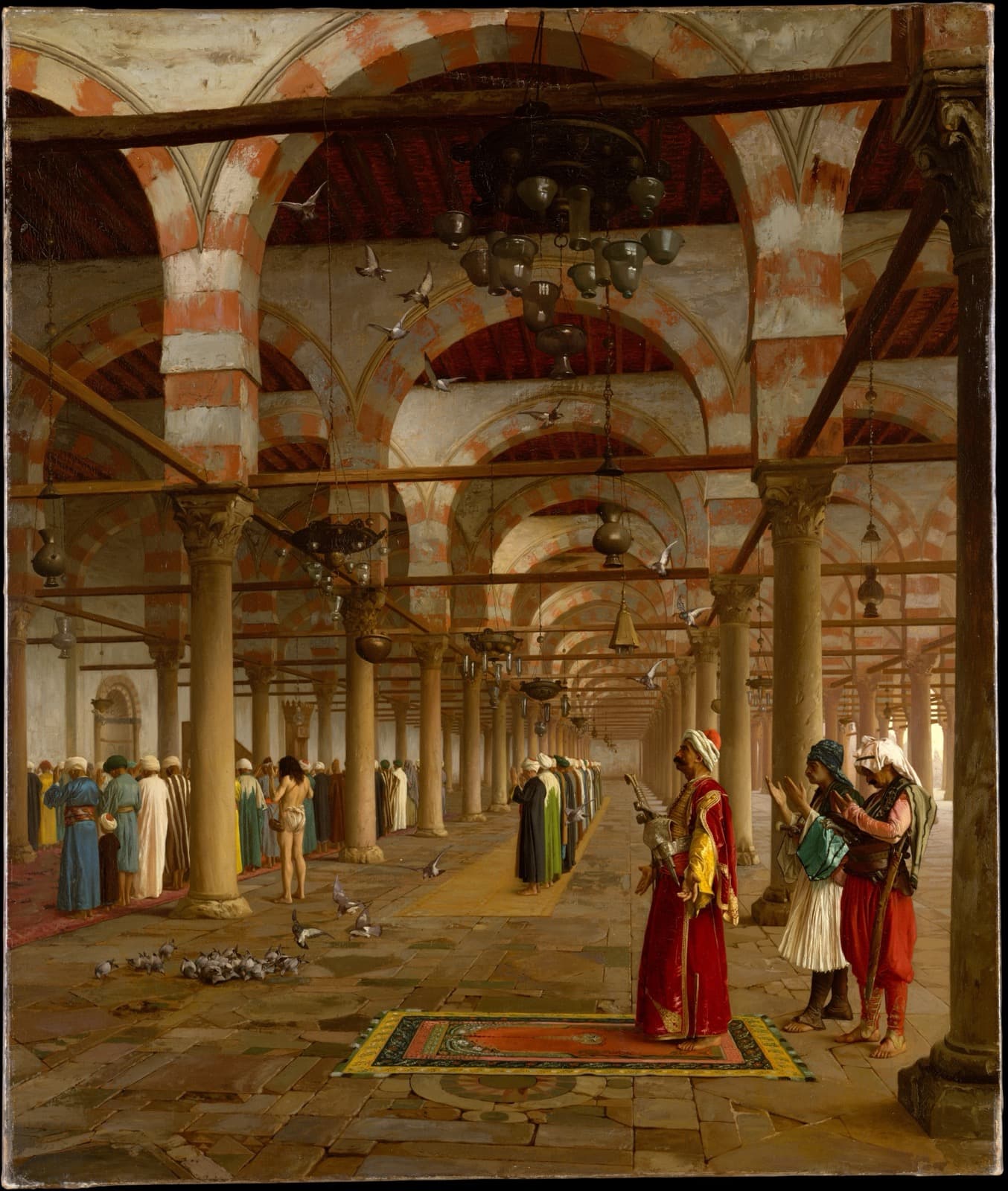
Painted by 1874, Prayer in the Mosque presents worshipers in an interior based on Cairo’s Mosque of ʿAmr ibn al-ʿAs, originally built around 642. Rows of columns, worn stone, and carefully differentiated clothing make the scene appear observed. Gérôme even painted scuffs in the red velvet garment of the foreground worshipper.[19]
In Prayer in the Mosque, the Met notes, Gérôme combined details that do not accurately describe one place, time, or custom. Its catalogue also records that Cairo’s Mosque of ʿAmr had fallen out of use by 1868. Gérôme was therefore unlikely to have witnessed the service he painted. Sketches and photographs probably helped him assemble the scene. The architectural and material detail makes the painting convincing, but does not establish that its gathering of worshipers took place.[19][33]
The Snake Charmer
In The Snake Charmer, painted around 1879, the blue-tiled wall appears to anchor the scene in a specific interior. There is a concrete source behind that impression: the Getty Research Institute identifies an Abdullah frères photograph of tiles in the sultan’s harem at Topkapı Palace as a source for Gérôme’s backdrop. The Ottoman photographers’ work thus contributed to a French painter’s representation of the region.[24]
The Clark Art Institute describes The Snake Charmer as a European fantasy assembled from several cultures. Its floor resembles one in Cairo’s Mosque of ʿAmr, while the spectators’ costumes and weapons come from different regions. In the Clark’s interpretation, the men appear entranced by a spectacle that exposes the boy’s naked body to them and to the painting’s viewer. The museum argues that such images both reflected and shaped European prejudices about the Islamic world. These details explain why the painting’s apparent accuracy has become central to debate about its meaning.[34][35][36]
Other artists and different kinds of encounter
Decamps, Chassériau, Fromentin, and Dehodencq
Alexandre-Gabriel Decamps visited Smyrna, now İzmir, in 1828. A Turkish patrol became the subject of a painting shown at the Salon of 1831; he returned to the composition in the version of about 1855–1856 now at the Met. The repetition shows how a memorable scene from a journey could become a lasting artistic subject, worked over long after the traveler returned home.[37]
Théodore Chassériau’s Scene in the Jewish Quarter of Constantine (1851) grew from drawings made during his Algerian journey of 1846. Two women attend to an infant in a domestic interior, a quiet subject far removed from military spectacle. Trained by Ingres and subsequently drawn toward Delacroix’s color, Chassériau brought together two traditions often treated as artistic opposites.[10]
Eugène Fromentin made Algerian landscapes and figures central to his career, combining an interest in light and atmosphere with scenes of movement, rest, and social life. His Women of the Ouled Nayls appeared at the Salon of 1867 and later passed through French and American collections.[38]
Alfred Dehodencq likewise treated North African public life as a major subject. His Dance Scene in a Street in Tangier, exhibited at the Salon of 1874, fills a public street with crowds and musicians. It offers a different emphasis from the secluded rooms that dominate popular perceptions of Orientalist art.[39]
John Frederick Lewis and British Orientalism
John Frederick Lewis lived in Cairo from 1841 to 1851, producing a large body of drawings and watercolors that continued to support his work after his return to Britain. This was a sustained residence rather than a brief collecting expedition. His pictures often depend on the intricate relationship between figures and their surroundings: fabrics, screens, patterned surfaces, and sharply filtered light become part of the scene’s structure.[40][18]
John Frederick Lewis’s Arab School, made during his Cairo residence of 1841–1851, depicts pupils learning the Qur’an, with a boy reciting before a teacher. He developed these studies into Interior of a School, Cairo, a watercolor of 1865 now at the Victoria and Albert Museum. The interval shows how observations made abroad could serve an artist long after his return home.[18]
British Orientalism also included artists such as David Roberts, William Holman Hunt, and Thomas Seddon. Their interests were not identical: monuments, topographical views, and biblical associations could be as important as contemporary social life. Hunt’s Palestinian subjects, including The Scapegoat, placed the observed landscape in the service of Christian interpretation. The same journey could therefore be understood as artistic travel, religious investigation, and a search for convincing historical detail.[41][42][1]
Henriette Browne and access to women’s lives
Henriette Browne, the professional name of Sophie de Saux, visited Constantinople in 1860 and exhibited two harem interiors at the Paris Salon the following year. Her A Visit represents women receiving other women, with a child present and the rituals of greeting taking precedence over erotic display. The room is a setting for social behavior rather than an excuse for a collection of reclining nudes.[11]
Women’s accounts also changed the balance of authorship. Scholars have recovered travel writing and memoirs by Ottoman women, including Halide Edib and Demetra Vaka Brown, whose descriptions challenged the assumption that the harem could only be explained by an outside visitor. Their work adds another perspective to the contrast between Browne’s social interiors and Ingres’s imagined baths.[30]
How the pictures were made
Sketchbooks, costumes, and studio models
Travel notebooks were working archives. A quickly drawn pose, a written color note, an architectural study, or a purchased garment could remain useful for years. Delacroix’s squared drawing of the Moroccan sultan and Gérôme’s Parisian model in Ottoman clothing reveal two stages of this process: transforming an earlier observation into a composition, and creating a new scene from transported materials.[28][20]
An artist could also alter an observed scene to meet a buyer’s expectations. In a letter of June 8, 1903, Gérôme recalled being asked to turn a figure toward the spectator in a mosque painting because figures seen only from behind or in profile would make it harder to sell. He complied. The episode, recorded in a Sotheby’s catalogue citing the surviving letter, makes the commercial decisions behind apparently spontaneous scenes unusually visible.[43]
Photography and the new archive of appearances
Photography entered this history almost immediately after its public announcement in 1839. Late that year, Horace Vernet made a daguerreotype of the exterior of Mohammed Ali’s harem in Alexandria. The original photographic plates from that early expedition are not known to survive, but engravings after the images helped circulate the views. Photography was becoming both a record of travel and a source for later visual production.[24]
Maxime Du Camp traveled with [Gustave Flaubert](https://parisatlas.com/people/gustave-flaubert) through Egypt, Nubia, Palestine, and Syria between 1849 and 1851. He produced more than 200 paper negatives, publishing 125 images in 1852. Yet the photographic career behind this substantial achievement was brief: in Beirut in October 1850, he abandoned the practice and sold his equipment. He later allowed Fromentin to use his photographic proofs freely.[44]
Albert Goupil’s photographs provide a less polished view of the traveling artists themselves. An album acquired by the BnF in 1996 contains seventy-nine photographs from the 1868 expedition. Some are streaked, awkwardly framed, or poorly exposed. They were private working records rather than images made for exhibition. Gérôme later used Goupil’s photograph of Madinet el-Fayoum for Fellah Women Drawing Water (1870), retaining its setting while adding figures: the transformation from travel document to genre painting can be followed unusually closely.[32]
Steamships, railways, and shorter journeys
For much of the nineteenth century, travel to Constantinople required money, time, and often diplomatic support. A common route passed through Vienna, Budapest, Belgrade, and Bucharest before a Black Sea crossing. Steamships gradually expanded the alternatives: the Messageries Maritimes operated from Marseille from 1851, alongside competing companies that offered cheaper passages.[45]
In 1889, the Orient Express began offering a direct Paris–Constantinople journey of less than sixty-eight hours. The BnF’s history of the route contrasts this with journeys of about three months in the generation of the writer Gérard de Nerval. The journey could now take days rather than months.[45]
This did not mean that travelers encountered an unmediated reality. Guides, established itineraries, photographers, collectors, and hosts shaped what they saw. The experience of travel and the expectation of what was worth painting developed together: artists sought subjects already made desirable by books and pictures, even as new observations occasionally disrupted those expectations.[45][44]
Paris as a center of Orientalist art
The Salon, dealers, and international collectors
Paris was not merely the place to which travelers returned. It was where subjects became public reputations, where large canvases were completed, and where critics and buyers judged them. The Salon offered an especially visible stage: Gros’s Jaffa, Delacroix’s Women of Algiers, and Browne’s harem interiors reached audiences through this exhibition culture.[14][27][11]
Gérôme began a lasting commercial relationship with the dealer and art publisher Adolphe Goupil in 1859. Private buyers reduced his dependence on state commissions and Salon sales, although he continued exhibiting. Goupil distributed his paintings internationally, especially to the United States, while reproductions brought the compositions to a wider audience. Gérôme’s success in this market helps explain the presence of so many of his works in American collections.[5][31]
Goupil bought Prayer in the Mosque from Gérôme on September 23, 1874, for 20,000 francs. On November 5, Goupil entered a profit-sharing arrangement with the New York dealer Knoedler. Knoedler sold the painting to Catharine Lorillard Wolfe on November 13 for 40,000 francs, recorded as $10,670. The price had doubled in less than two months. Wolfe’s bequest brought the painting to the Met in 1887.[33][19][46]
Fromentin’s Women of the Ouled Nayls also crossed the Atlantic through private sales and auctions. It fetched 9,400 francs at the Marmontel sale at the Hôtel Drouot on May 11–12, 1868. Twenty years later, it sold for $6,400 at the Albert Spencer sale at New York’s Fifth Avenue Galleries on February 28, 1888. It subsequently entered Henry Field’s Chicago collection and reached the Art Institute of Chicago in 1894.[38][47]
Success was not automatic. Delacroix’s monumental Death of Sardanapalus remained with him after the Salon and was not sold until 1846, when Daniel David Wilson bought it for 6,000 francs. The contrast between that long wait and Gérôme’s rapid international sales cautions against imagining a uniformly enthusiastic market for every kind of Orientalist painting.[15]
The Rue du Caire at the 1889 Exposition Universelle
At the Paris Exposition Universelle of 1889, visitors could enter a constructed rue du Caire roughly 150 meters long, with twenty-five different facades. Shops with wooden fronts stood alongside a sabil-kuttab, a combined public fountain and Qur’anic school. A replica of the minaret of Sultan Qaytbay’s funerary complex was one story shorter than its model. Antique screens, doors, and tiles appeared alongside new construction, and casts were taken from Egyptian monuments.[48]
The Rue du Caire’s promoter, Baron Alphonse Delort de Gléon, brought approximately fifty donkey drivers and their animals from Cairo. Visitors could drink Turkish coffee and watch belly dancing in the evening; painters came in the mornings to find subjects. People, architectural fragments, and performances had been brought to Paris to create an experience of Cairo for exhibition visitors.[48]
The result was neither an entirely invented set nor a transplanted city. Its historical interest lies in the mixture of authentic fragments, architectural reconstruction, entertainment, and commercial expectation. It belongs to the same culture of assembling an apparently convincing whole from selected parts that can be seen in Orientalist studio painting.[48]
A society and a residence for artists
Léonce Bénédite, curator of the Musée du Luxembourg, founded the Société des Peintres Orientalistes Français in 1893. He regarded the Luxembourg’s collection of contemporary art as a source from which future Louvre holdings would be chosen. The society gave Orientalist painters a collective exhibition platform, despite their different styles.[49]
The Société des Peintres Orientalistes Français exhibited at the Galerie Durand-Ruel from February 26 to March 16, 1895. Its 1897 exhibition, held from February 16 to March 13, included a retrospective of Théodore Chassériau. By 1905, its annual show was taking place at the Grand Palais, where exhibitions continued before the First World War.[50][51][52]
In 1907, the Villa Abd-el-Tif in Algiers became a residence for artists from metropolitan France. The project developed through Bénédite and Governor-General Charles Jonnart after the critic Arsène Alexandre proposed an Algerian counterpart to Rome’s Villa Medici. A competition prize, administered by the society, supported stays of one to two years. Paul Jouve and Léon Cauvy were its first residents.[53]
At the Villa Abd-el-Tif, artists could work among terraces, a courtyard, and ceramic decoration above Algiers’s Jardin d’Essai. The Algerian heritage record counts eighty-seven recipients of its residency prize. The program gave artists accommodation and time to paint, funded through a system of patronage tied to colonial rule.[53]
Ottoman artists, collectors, and longer commitments
Osman Hamdi Bey
Osman Hamdi Bey complicates any account in which Europeans are the only makers and people from the Ottoman world merely appear before their easels. French-trained and active within Ottoman cultural life, he used the techniques of academic painting to represent subjects from his own society. His work belongs to the history of exchange around Orientalism, but it cannot be understood simply as a European outsider’s fantasy.[21][22][23][54]
His famous The Tortoise Trainer was exhibited at the Grand Palais in Paris in 1906 under the title L’homme aux tortues. The Salon catalogue identified its painter as “Hamdy Bey.” This is an important Paris connection: a work now central to the history of Turkish painting entered the same exhibition system through which French Orientalists had built their careers.[54]
Ottoman collectors were also active participants. Khalil Bey owned The Turkish Bath, while the painter Şeker Ahmed Pasha helped acquire works for Sultan Abdülaziz through Goupil. Gérôme visited Istanbul, maintained relationships with Ottoman artists, and corresponded with Hamdi. Orientalist pictures could therefore function as European fantasies, international commodities, and objects of interest within Ottoman collections at the same time.[29][5]
Étienne Dinet and Algeria
Étienne Dinet’s attachment to Algeria began almost accidentally. In 1884, he accompanied Lucien Simon on a journey connected with Simon’s brother’s search for a rare beetle. What might have remained an incidental expedition became the basis of his artistic life. By 1895 he had abandoned subjects outside Algeria, and in 1904 he settled permanently in Bou-Saâda.[55]
Dinet’s interests included photography, painting outdoors, and the everyday activities of the people around him. His Algerian work was not limited to the desert as spectacle: water, vegetation, children, and social encounters could take precedence over panoramic emptiness. His sustained residence allowed familiar places and recurring human encounters to replace the succession of novelties offered by a short tour.[55]
Orientalism, empire, and the debate after Edward Said
What Said changed
Edward Said’s Orientalism appeared in 1978. He wrote much of it in 1975–1976 during a fellowship at Stanford’s Center for Advanced Study in the Behavioral Sciences. Its primary field was literature, scholarship, and political-cultural representation rather than the history of painting alone. Said examined how descriptions of the East could acquire authority through repetition and institutional prestige, presenting historically changing societies as fundamentally different from the West.[7]
Applied to art, this encourages questions beyond whether a costume is correct. Who is represented as active or passive? Which aspects of contemporary life are omitted? Why are certain subjects repeatedly associated with secrecy, violence, luxury, or timelessness? The issue is not that every detail is false, but that the selection and arrangement of details can shape a larger account of a people or place.[7][34]
Linda Nochlin’s essay The Imaginary Orient (1983) became an influential application of this critical approach to nineteenth-century painting. It helped redirect attention from the supposed truthfulness of an image toward the assumptions that made the image convincing. The paintings’ polished surfaces and apparent completeness became part of the problem to be analyzed rather than sufficient proof of their historical authority.[56]
Disagreement and the limits of a single explanation
Bernard Lewis challenged Edward Said’s account of Oriental scholarship in The Question of Orientalism, published in the New York Review of Books on June 24, 1982. An exchange between Said and Lewis followed on August 12. Lewis disputed the breadth of Said’s claims about scholarly traditions and their relationship to political power.[6][7]
Sadik Jalal al-ʿAzm warned in 1981 that criticism of Orientalism could repeat its division of East and West into unchanging, essentially different societies. He called the adoption of such fixed identities by Arab and Muslim thinkers “Orientalism in reverse.” Talal Asad, writing in 1980, particularly valued Said’s analysis of how scholars establish authority.[57][7]
James Clifford questioned a tension in Edward Said’s methods. Said valued individuals’ ability to understand other people beyond cultural stereotypes. Yet his use of Michel Foucault’s ideas emphasized systems of knowledge that constrained what writers could think and say. Clifford asked how these positions could fit together. His critique first appeared in 1980 and was reprinted in The Predicament of Culture (1988).[7][58]
Aijaz Ahmad offered a Marxist critique of Said in In Theory (1992). An earlier essay, published in 1991, identified one central objection: Said gave ideas and representations too much weight compared with military conquest and economic forces in explaining colonialism. Ahmad’s political agreements with Said and solidarity with him as a Palestinian intellectual did not resolve their theoretical differences. In the 1992 book, he described their approaches to theory and history as fundamentally incompatible.[7][59]
Museums and changing interpretations
Tate’s 2008 exhibition The Lure of the East: British Orientalist Painting brought together more than 120 paintings, prints, and drawings covering the period 1780–1930. It examined British representations of the region alongside debates about their historical and cultural meanings. The Getty’s 2010 retrospective, The Spectacular Art of Jean-Léon Gérôme, reconsidered a painter whose academic technique and hostility to Impressionism had damaged his later reputation.[41][42][60]
At the Getty on August 12, 2010, Linda Nochlin joined art historian Mary Roberts and artist Lalla Essaydi for a discussion called Rethinking Orientalism. Nochlin maintained her objections to Gérôme’s depictions of sexuality and colonial power, including the seemingly timeless world of The Snake Charmer. Yet she also acknowledged the attraction of his dazzling surfaces and cinematic storytelling. Discussing a slave-market image, she wondered whether its fantasy of possession was deliberately exaggerated: “Gérôme didn’t really think this was real, did he?”[61][62]
At the Getty’s Rethinking Orientalism discussion on August 12, 2010, Mary Roberts pointed to Ottoman painters such as Osman Hamdi Bey and to sultans who collected Orientalist art. Their participation complicated an account concerned only with Europeans looking at the East. Lalla Essaydi described her own conflicting responses to the paintings: admiration for their beauty and distress at their treatment of women. The discussion preserved the criticism while making room for different accounts of the pictures’ appeal.[61][62]
Tate’s glossary offers a smaller example of changing interpretation. As of September 2026, its entry for “Orientalist” carries a notice that the previous definition has been removed for review because it misrepresented important perspectives. The notice concerns the wording of a particular entry, rather than the disappearance of the art-historical category.[63]
The Metropolitan Museum’s Orientalism: Between Fact and Fantasy runs from June 12, 2026, to February 28, 2027. It brings European and American works into conversation with art and objects from the Middle East. Organized jointly across European Paintings and Islamic Art, the exhibition examines the encounters, materials, and exchanges behind the pictures. Osman Hamdi Bey forms an important part of that account. A catalogue by curators Deniz Beyazit, Maryam Ekhtiar, and Asher Miller accompanies the exhibition.[21][22][23]
From Orientalism to modern art
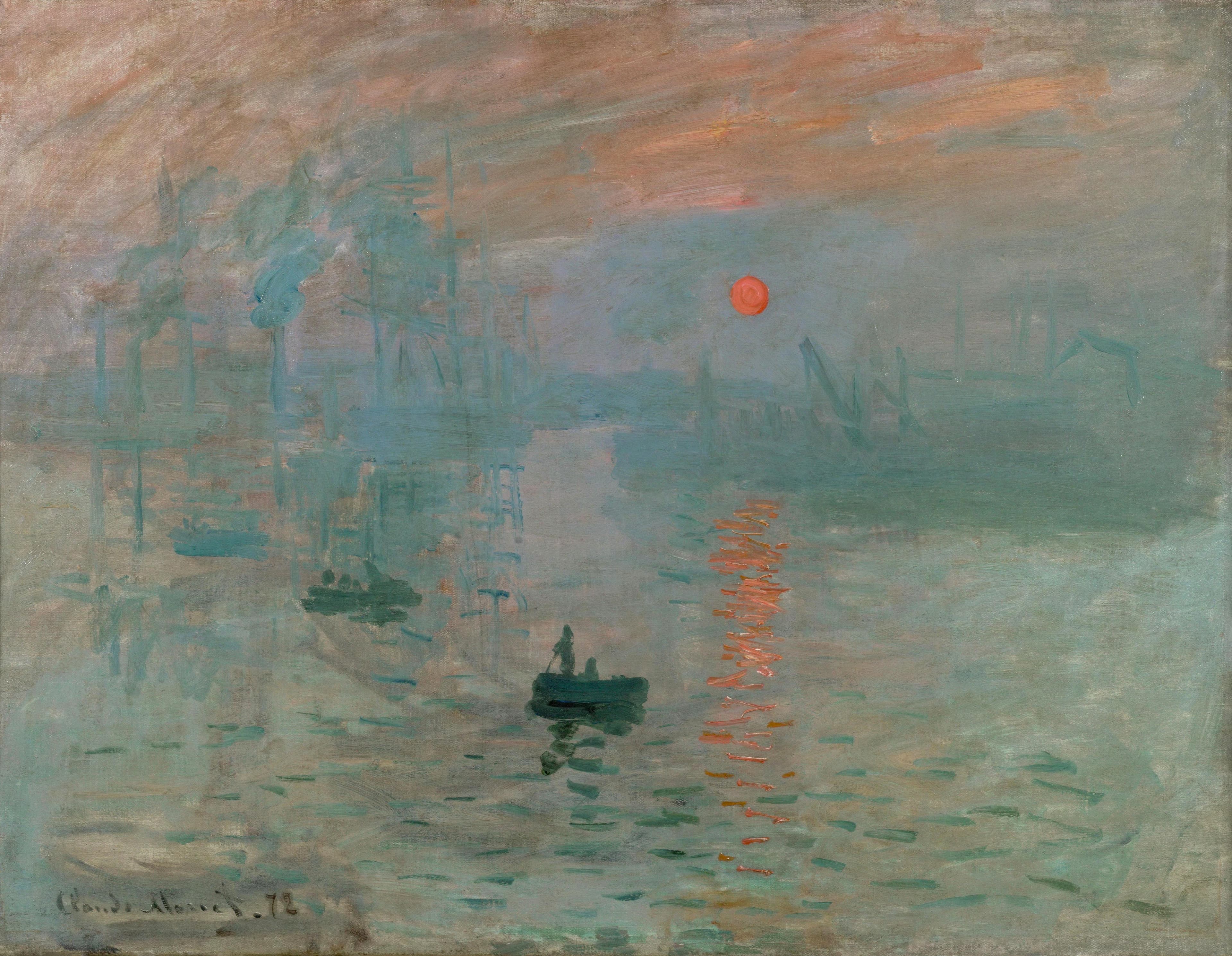
Orientalist academic painting did not end on a single date, and travel to North Africa did not cease to matter when modernism challenged the Salon tradition. The interest in intense light, patterned interiors, and the relationship between the body and ornament survived changes in technique. What shifted was often the kind of pictorial problem for which these subjects were used.[2]
Henri Matisse’s Moroccan journeys of 1912 and 1912–1913 produced paintings and drawings in which landscape, architecture, and figures became fields of color and simplified form. His Periwinkles / Moroccan Garden (1912) exemplifies the importance of a specific place within an art increasingly concerned with the organization of the painted surface. The trip did not merely supply exotic accessories to an established formula; it became part of his continuing investigation of how a picture could be structured.[64][65]
In 1914, Paul Klee traveled to Tunisia with August Macke and Louis Moilliet. His watercolors and drawings intensified his engagement with color and abstraction, translating buildings and landscapes into interlocking, sometimes grid-like forms. The trip belongs to the longer history of artists visiting the region, but its importance for Klee lies in the transformation of observation into a new pictorial language rather than in elaborate ethnographic description.[66]
Delacroix’s Women of Algiers also acquired an afterlife through direct reinterpretation. Between December 1954 and February 1955, Pablo Picasso developed fifteen painted variations on the subject. These paintings bring Delacroix into a twentieth-century conversation about the female figure, inherited masterpieces, and the possibilities of pictorial reconstruction. Their first collective exhibition at the Musée des Arts Décoratifs in Paris in 1955 placed that dialogue before a new audience.[67]
Contemporary artists have approached the tradition by confronting the positions it assigned to its subjects. Moroccan-born artist Lalla Essaydi’s photographs use staged interiors, fabric, and bodies inscribed with henna calligraphy. Her work recalls Orientalist compositions while introducing women’s speech, memory, and agency into the image. Rather than simply discarding the older paintings, it treats their continuing visual power as something to examine and transform.[68][69]
Where to see Orientalist art in Paris
The Louvre
The Louvre offers the most concentrated encounter with several of the tradition’s defining French paintings. Gros’s Bonaparte Visiting the Plague Victims of Jaffa, Delacroix’s Death of Sardanapalus and Women of Algiers in Their Apartment, and Ingres’s Grande Odalisque and The Turkish Bath allow sharply different approaches to be compared within one museum. Together they encompass imperial history painting, Romantic catastrophe, a domestic interior, and the idealized nude.[14][15][27][3][29]
The Louvre’s Islamic Art collection offers a complementary perspective through ceramics, textiles, architectural elements, and metalwork. These objects have histories of their own, separate from the roles comparable materials play in European pictures. Gallery access should be checked before a visit: in September 2026, the Louvre’s collection page specifically notes a closure on level −2 of the Cour Visconti.[8]
Musée national Eugène-Delacroix
The Musée national Eugène-Delacroix occupies the apartment and studio on the rue de Furstemberg where the painter settled in December 1857. The daily journey from his previous studio near Notre-Dame-de-Lorette to Saint-Sulpice, where he was decorating a chapel, had become tiring. His friend, the dealer Étienne Haro, found the new address. Delacroix designed a studio in its garden, creating a secluded working environment within walking distance of the church. The apartment, studio, and garden offer an intimate counterpart to the monumental pictures in the Louvre.[70]
Musée d’Orsay and temporary exhibitions
The Musée d’Orsay extends the story into the later nineteenth century. Its holdings include Dehodencq’s large dance scene in Tangier and Osman Hamdi Bey’s Dervish at the Children’s Tombs (1903), also known under titles describing an old man before children’s tombs. Hamdi’s presence is particularly valuable because it prevents the subject from being encountered exclusively through French representations of other societies.[39][71]
Paris institutions have also revisited the subject through temporary exhibitions. The [Musée Marmottan Monet](https://parisatlas.com/locations/musee-marmottan-monet) presented L’Orient des peintres, du rêve à la lumière in 2019, while the Institut du monde arabe showed Étienne Dinet, passions algériennes in 2024. These were past exhibitions, not permanent displays. Individual works may also be lent, moved, or temporarily unavailable, so collection ownership should not be confused with a guarantee that a painting is on view on a particular day.[2][55]
Major works at a glance
This selection includes paintings and a study on paper. Dimensions exclude frames; height precedes width.
| Work | Artist | Date | Medium and dimensions | Collection | Significance |
|---|---|---|---|---|---|
| Bonaparte Visiting the Plague Victims of Jaffa | Antoine-Jean Gros | 1804 | Oil on canvas; 523 × 715 cm | Musée du Louvre, Paris | Imperial image-making on the scale of monumental history painting.[14] |
| Grande Odalisque | Jean-Auguste-Dominique Ingres | 1814 | Oil on canvas; 91 × 162 cm | Musée du Louvre, Paris | An imagined eastern setting organized around idealized, elongated bodily form.[3] |
| The Death of Sardanapalus | Eugène Delacroix | 1827 | Oil on canvas; 392 × 496 cm | Musée du Louvre, Paris | Romantic violence and literary invention before the artist’s North African journey.[15] |
| Women of Algiers in Their Apartment | Eugène Delacroix | 1834 | Oil on canvas; 180 × 229 cm | Musée du Louvre, Paris | A richly colored domestic interior associated with the 1832 journey.[27] |
| Arab School | John Frederick Lewis | 1841–1851 | Watercolor and gouache over black chalk on brownish paper; 29.7 × 48.6 cm | Metropolitan Museum of Art, New York | Qur’anic instruction observed during a decade in Cairo; a study for later work.[18] |
| The Turkish Bath | Jean-Auguste-Dominique Ingres | 1859–1862 | Oil on canvas mounted on wood; approximately 108 × 110 cm, circular format | Musée du Louvre, Paris | The late transformation of the odalisque into an enclosed, interlocking composition.[29] |
| A Visit: A Harem Interior (smaller version) | Henriette Browne | Undated version of a composition exhibited in 1861 | Oil on canvas; 29.5 × 41 cm | Private ownership; offered at Sotheby’s in 2020 | Women’s social visits depicted by a woman who had entered Ottoman domestic interiors.[11] |
| Bashi-Bazouk | Jean-Léon Gérôme | 1868–1869 | Oil on canvas; 80.6 × 66 cm | Metropolitan Museum of Art, New York | A Paris studio model transformed through costume into an Ottoman military “type.”[20] |
| Prayer in the Mosque | Jean-Léon Gérôme | By 1874 | Oil on canvas; 88.9 × 74.9 cm | Metropolitan Museum of Art, New York | Detailed architecture and clothing assembled into an invented gathering of worshipers.[19][33] |
| The Snake Charmer | Jean-Léon Gérôme | About 1879 | Oil on canvas; 82.2 × 121 cm | Clark Art Institute, Williamstown | A tiled backdrop, costumes from several regions, and a staged performance central to later criticism.[35][36] |
| Dervish at the Children’s Tombs | Osman Hamdi Bey | 1903 | Oil on canvas; 202 × 150.7 cm | Musée d’Orsay, Paris | An Ottoman artist applies academic painting techniques to a religious setting in his own society.[71] |
Orientalism connections

Timeline
1798
Napoleon’s expedition reaches Egypt, accompanied by scholars, engineers, and artists whose work will contribute to the Description de l’Égypte.[12]
1802
A decree of February 6 authorizes government-funded publication of the expedition’s research.[13]
1804
Gros exhibits Bonaparte Visiting the Plague Victims of Jaffa.[14]
1809
The first volumes of the Description de l’Égypte appear; publication continues through the following decades.[13]
1814
Ingres paints Grande Odalisque in Rome for Caroline Murat.[3]
1824
Delacroix exhibits The Massacre at Chios.[1]
1827–1828
Delacroix paints and exhibits The Death of Sardanapalus, before traveling to North Africa.[15]
1830
French forces take Algiers in July.[16]
1832
Delacroix accompanies the Comte de Mornay’s mission to Morocco and visits Algiers on the return journey.[25][4]
1834
Women of Algiers in Their Apartment appears at the Salon and is purchased by the state.[27]
1839
Horace Vernet makes a daguerreotype in Alexandria shortly after the photographic process is publicly announced.[24]
1841–1851
John Frederick Lewis lives and works in Cairo.[40]
1849–1851
Maxime Du Camp travels with Flaubert; his photographic album follows in 1852.[44]
1861
Henriette Browne exhibits harem interiors in Paris after visiting Constantinople.[11]
1862
Ingres completes the circular version of The Turkish Bath, aged eighty-two.[29]
1868–1869
Gérôme paints Bashi-Bazouk after returning from his 1868 journey.[20]
1874
Goupil buys Prayer in the Mosque for 20,000 francs; Knoedler sells it to Catharine Lorillard Wolfe for 40,000 francs less than two months later.[33]
1889
The Rue du Caire forms part of the Paris Exposition Universelle.[48]
1893
Léonce Bénédite founds the Société des Peintres Orientalistes Français.[49]
1895–1905
The Société des Peintres Orientalistes Français exhibits at Durand-Ruel in 1895 and 1897, then at the Grand Palais by 1905.[50][51][52]
1904
Étienne Dinet settles permanently in Bou-Saâda.[55]
1906
Osman Hamdi Bey’s The Tortoise Trainer is exhibited at the Grand Palais in Paris.[54]
1907
The Villa Abd-el-Tif artist-residency program begins in Algiers.[53]
1912–1913
Matisse makes two visits to Morocco.[64]
1914
Klee travels to Tunisia with Macke and Moilliet.[66]
1954–1955
Picasso paints fifteen variations on Delacroix’s Women of Algiers.[67]
1978
Edward Said publishes Orientalism.[7]
1983
Linda Nochlin publishes The Imaginary Orient.[56]
2008
Tate Britain presents The Lure of the East from June 4 to August 31.[41][42]
2010
A Getty retrospective and an August 12 discussion reconsider Gérôme’s art with Linda Nochlin, Mary Roberts, and Lalla Essaydi.[60][61][62]
2026–2027
The Met’s Orientalism: Between Fact and Fantasy opens on June 12, 2026 and runs through February 28, 2027.[21][22][23]
Orientalism: frequently asked questions
What is Orientalism in art?
Orientalism is an art-historical category for images of North Africa, the Middle East, and the Ottoman world, especially those made by nineteenth-century European artists. French and British painters were prominent. Subjects include streets, schools, worship, monuments, military campaigns, and imagined harems. The category embraces many styles, from Ingres’s carefully drawn nudes to Delacroix’s expressive color and Gérôme’s polished detail.[1][2]
Why is the word Orientalism controversial?
The word names both an artistic tradition and a disputed way of representing other societies. Edward Said’s Orientalism (1978) examined how Western scholarship and culture helped establish authority over an East presented as fundamentally different. Linda Nochlin applied related questions to painting in The Imaginary Orient (1983). Critics ask whether apparently accurate images repeat assumptions about violence, sexuality, passivity, or timelessness. The label alone cannot settle a particular painting’s meaning.[7][56]
Who were the main Orientalist painters?
Leading French painters included Eugène Delacroix, Jean-Auguste-Dominique Ingres, Jean-Léon Gérôme, Alexandre-Gabriel Decamps, Théodore Chassériau, Eugène Fromentin, Alfred Dehodencq, and Horace Vernet. British artists included John Frederick Lewis, David Roberts, William Holman Hunt, and Thomas Seddon. Henriette Browne brought a woman traveler’s experience to domestic interiors. Osman Hamdi Bey, an Ottoman painter trained in France, represented subjects from his own society.[1][41][42][11][54]
Did the painters actually go there?
Some Orientalist painters traveled to the places they depicted; others invented their settings from books, objects, and images. Delacroix visited Morocco and Algeria in 1832; Lewis lived in Cairo from 1841 to 1851; Gérôme made several journeys. Ingres and Antoine-Jean Gros never visited the region. Travel did not make every finished canvas an eyewitness record. Artists commonly worked later in European studios with sketches, photographs, costumes, and models.[1][25][40][20]
Where can I see Orientalist paintings in Paris?
The Louvre holds major examples by Gros, Delacroix, and Ingres, including Bonaparte Visiting the Plague Victims of Jaffa, Women of Algiers in Their Apartment, Grande Odalisque, and The Turkish Bath. The Musée d’Orsay’s collection includes works by Alfred Dehodencq and Osman Hamdi Bey. At the Musée national Eugène-Delacroix, the artist’s apartment, garden, and studio provide a closer view of his working life. Check the museums’ current displays before visiting, since collection ownership does not guarantee that every work is on view.[14][27][3][29][39][71][70]
Were Orientalist paintings accurate?
Some Orientalist paintings preserve closely observed buildings, clothing, objects, and activities; others combine observation with invention. Gérôme’s Prayer in the Mosque uses a recognizable Cairo setting but assembles a gathering that the Met considers unlikely to have occurred as shown. His Snake Charmer combines architectural details from different cities. A correct costume or wall cannot establish that the entire scene is documentary. Accuracy must be assessed detail by detail, using evidence about the artist’s sources and working methods.[19][33][35][36]
Is Orientalism a movement or a style?
Orientalism is a broad subject category rather than a single style with common techniques or a founding manifesto. Its painters worked within Neoclassicism, Romanticism, academic art, and later modern movements. Ingres, Delacroix, and Gérôme painted related subjects with different approaches to drawing, color, and finish. Their shared interest in the region did not require a shared theory of painting.[1][2][3][4][5]
Were all Orientalist paintings propaganda?
No. Orientalist paintings served different purposes. Some state commissions had explicit political purposes: Gros’s Bonaparte Visiting the Plague Victims of Jaffa helped promote Napoleon’s reputation, while Vernet’s Versailles paintings celebrated French military victories. Other works addressed domestic life, religious practice, travel, or private collectors’ tastes. Such paintings could still repeat political or cultural assumptions, but their purpose has to be established from the particular work and its history.[14][16][11][18][5]
Why does Orientalism matter to the history of modern art?
Travel in North Africa and interest in its architecture, light, and ornament helped artists reconsider color and composition. Henri Matisse’s Moroccan paintings and Paul Klee’s Tunisian studies are major examples. Pablo Picasso later reworked Delacroix’s Women of Algiers in fifteen paintings. Contemporary artist Lalla Essaydi has returned to Orientalist imagery through photographs that reconsider women’s representation and authorship.[64][66][67][68][69]
What is the best way to begin looking at these paintings?
Begin with one work’s composition, title, date, artist, and circumstances of production. Establish which details came from travel, photographs, studio models, or imagination. Then ask who commissioned or bought the painting, what its first audience saw in it, and how later interpretations changed. Comparing a domestic visit by Henriette Browne with a bath imagined by Ingres reveals differences that the broad label Orientalism can conceal.[11][29][19][61][62]
References
The sources below include histories, manifestos, scholarly research, and primary materials that informed this page. They document Orientalism, its development, and the artists and works associated with it.


17↑L'orientalisme
WebsiteHistoire par l'image, Rmn-Grand Palais / Ministere de la CultureUsed forOrientalism and the changing geography of artistic travel
37↑Decamps — The Turkish Patrol
WebsiteThe Metropolitan Museum of ArtUsed forDecamps — The Turkish Patrol
43↑Gérôme’s account of altering a painting for a buyer
WebsiteSotheby’s; Fondation Custodia, Frits Lugt CollectionUsed forGérôme’s account of altering a painting for a buyer
46↑The transatlantic provenance of Prayer in the Mosque
WebsitePubHist; Metropolitan Museum collection catalogueUsed forThe transatlantic provenance of Prayer in the Mosque
47↑Women of the Ouled Nayls — French and American sales
WebsiteArt Institute of ChicagoUsed forWomen of the Ouled Nayls — French and American sales
57↑Sadik Jalal al-ʿAzm — Orientalism in Reverse
WebsiteKhamsin / Matzpen archiveUsed forSadik Jalal al-ʿAzm — Orientalism in Reverse
59↑Aijaz Ahmad on culture, conquest, and political economy
WebsiteAijaz AhmadUsed forAijaz Ahmad on culture, conquest, and political economy
65↑Matisse — Periwinkles / Moroccan Garden
WebsiteThe Museum of Modern ArtUsed forMatisse — Periwinkles / Moroccan Garden
72Delacroix au Maroc et en Andalousie: nouveaux carnets de voyage
WebsiteMusee national Eugene-DelacroixUsed forWeb source consulted for documented facts and historical context presented on the Orientalism page.
73Femmes d'Alger dans leur appartement, collection entry
WebsiteMusee national Eugene-DelacroixUsed forWeb source consulted for documented facts and historical context presented on the Orientalism page.
74Edward W. Said, author page
WebsiteColumbia University PressUsed forWeb source consulted for documented facts and historical context presented on the Orientalism page.
75Rethinking Orientalism, Again
WebsiteGetty (The Iris)Used forWeb source consulted for documented facts and historical context presented on the Orientalism page.
76Orientalism in Nineteenth-Century Art
WebsiteThe Metropolitan Museum of Art, Heilbrunn Timeline of Art HistoryUsed forWeb source consulted for documented facts and historical context presented on the Orientalism page.
77Orientalist (art term), former definition, archived 28 January 2021
WebsiteTate, via the Internet ArchiveUsed forWeb source consulted for documented facts and historical context presented on the Orientalism page.
78From Studio to Museum
WebsiteMusée national Eugène-Delacroix, 2026Used forWeb source consulted for documented facts and historical context presented on the Orientalism page.
These references provide the documented foundation for this movement's history and interpretation. Claim-level citations remain attached to the specific claims they support.
 Explore more resources