The Paris AtlasCharting the artists, works, and places worth returning to.

Art & literary movement · Paris · circa 1860–1910

Symbolism

Symbolist artists and writers used images, sounds and stories to suggest dreams, beliefs and inner experience. Their work connected poetry with painting, theater and music, from Gustave Moreau’s myths to Stéphane Mallarmé’s verse and Claude Debussy’s compositions.

A nude young man stands on a rocky ledge holding a long red-shafted spear upright. A sphinx with a young woman's head and bare torso, a tawny lion's body and large blue-grey wings has sprung against his chest, its front paws hooked into him, staring up into his face while he looks steadily down at her. On the ledge below lie a pale human foot, scattered fingers, a red cloth and a gold crown; a narrow rocky gorge and grey sky fill the background, with an ornamented urn on a column at the right.
Artwork reproductionGustave Moreau, Oedipus and the Sphinx, 1864, the painting he showed at the Paris Salon that year. Metropolitan Museum of Art, New York, bequest of William H. Herriman, 1920; public domain.

Overview

Symbolism was an international movement in literature and the arts that sought to give visible or audible form to dreams, emotions, spiritual convictions, and states of mind. Taking shape in France during the later nineteenth century, it brought together poets who distrusted straightforward description, painters who turned myths into psychological dramas, and composers who explored what music could suggest without putting an experience into words. By the end of the nineteenth century its reach extended across Europe and into North America. Its history connects Charles Baudelaire’s poetry, Gustave Moreau’s elaborate mythological paintings, Odilon Redon’s floating eyes and dreamlike heads, Paul Gauguin’s invented colors, and Claude Debussy’s musical response to Stéphane Mallarmé.[1][2][3][4]

Paris was one of its principal meeting places. Ideas traveled between apartments, publishing houses, studios, exhibition rooms, and theaters: a poem could become an illustrated book, an orchestral work, or the subject of a painting; a painting could become the centerpiece of a novel. Symbolism was never a single organization, and its artists did not share one recognizable technique. What connected them was the conviction that the world as it appeared to the eye was not the whole of human experience.[2][5][6][7]

What is Symbolism?

An art of suggestion

Symbolism is best understood as an approach to meaning rather than a uniform style. A Symbolist work does not necessarily explain a story or identify a feeling. Instead, it establishes relationships between images, colors, sounds, or words that allow meaning to emerge without being completely settled. A sleeping figure may suggest peace, withdrawal, erotic dreaming, or death; an empty landscape may become an image of loneliness without containing a visibly lonely person. Ambiguity is often part of the work’s construction: several meanings can remain in play even when its subject has been identified.[1][8][9]

The French poet Stéphane Mallarmé expressed the principle memorably: “To name an object is to suppress three-quarters of the enjoyment to be found in the poem.” The pleasure lay in discovering it gradually, through suggestion and the reader’s participation. Painters associated with Symbolism approached the viewer in a comparable way, using recognizable forms while preventing those forms from resolving into a single, exhaustive account.[2][8][10]

Interpretation remains grounded in the picture itself. Biblical stories, classical mythology, religious imagery, and contemporary literature provide essential clues. Yet recognizing Salome, Orpheus, or a sphinx is usually the beginning of an interpretation rather than its conclusion. The treatment of the subject—its stillness, atmosphere, arrangement, or strange departures from the familiar story—often carries as much significance as the narrative itself.[2][11][12][13]

A movement, not the invention of symbols

Artists had used symbols for centuries before Symbolism acquired its name. A medieval painting could identify a saint through an attribute; a Renaissance allegory could personify Justice or Fortune. Late nineteenth-century Symbolism did not invent this practice. Its distinctive contribution was to make suggestion, subjective experience, and the uncertain relationship between appearances and ideas central artistic concerns.[1][3][9]

The distinction between a symbol and an allegory is useful, although not absolute. An allegory commonly invites a relatively stable translation: a figure represents a virtue, a season, or an institution. A Symbolist image is more likely to retain an unresolved remainder. The viewer may recognize that a closed eye concerns inner experience without being able to reduce it to one statement. Nevertheless, Symbolist artists also made conventional allegories, particularly for public buildings, so allegory and open-ended suggestion often coexist in their work.[2][14][15]

Why did Symbolism emerge?

Symbolism developed in a culture increasingly shaped by industrial production, scientific explanation, urban expansion, and the prestige of observable facts. Its writers and artists did not all reject science, religion, or modern life in the same way. They did, however, question whether material description could account for desire, memory, imagination, spiritual longing, or fear. In giving imagination and personal feeling this authority, the Symbolists also renewed a central ambition of earlier Romantic art. Some sought religious certainty; others cultivated doubt. Some looked toward ancient myths, while others found the same mysteries in an ordinary room or a modern crowd.[2][3][9]

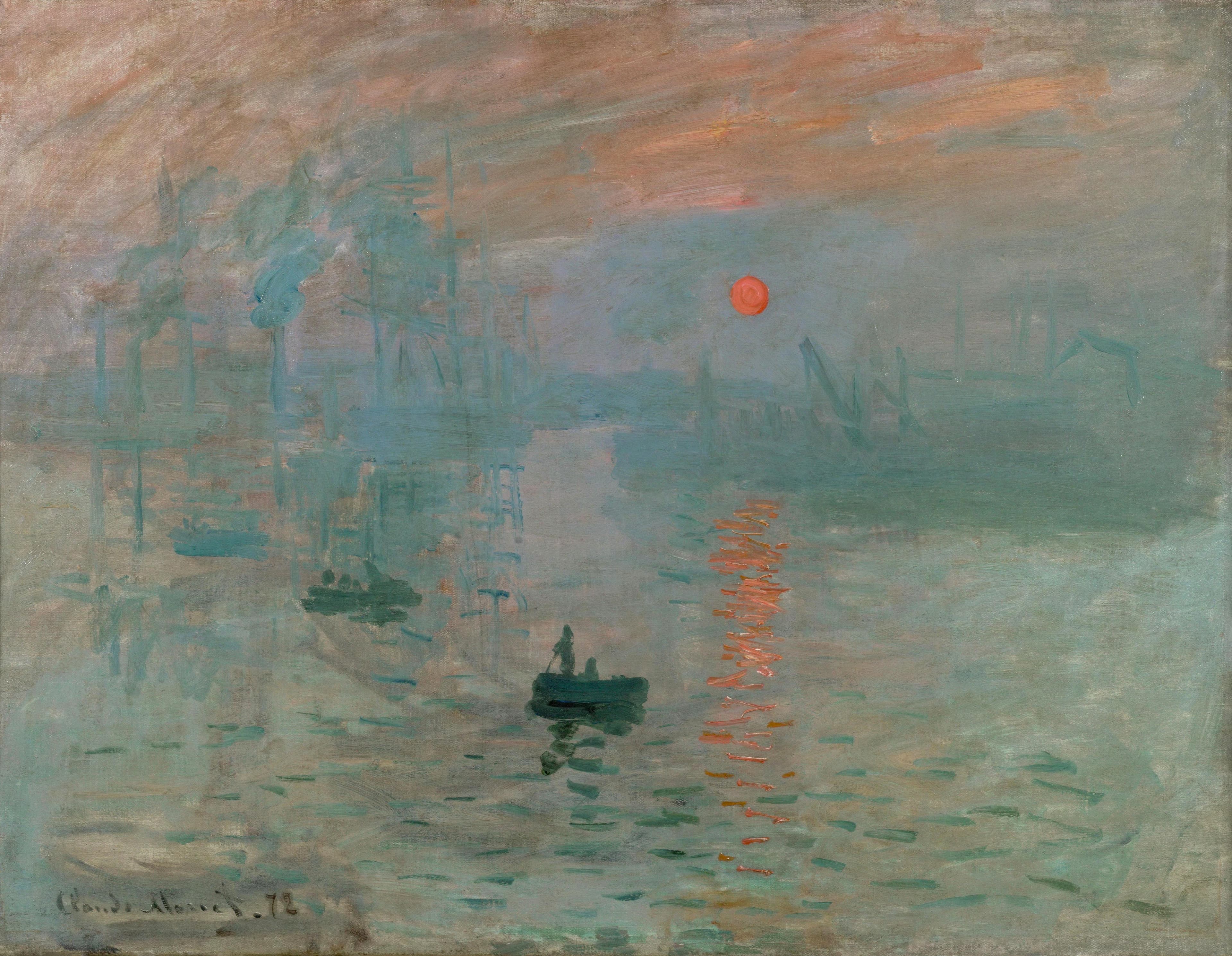
Symbolism developed in close contact with Realism and Impressionism as well as in opposition to their priorities. Symbolist critics frequently opposed the idea that art should concentrate on the visible world, but Impressionist painters were not simply neutral recording devices. They selected, arranged, and transformed what they saw. Nor were the artistic camps socially separate: Mallarmé was a close friend of the painter Édouard Manet, and several artists moved between Impressionist, Post-Impressionist, decorative, and Symbolist concerns. The disagreement was principally about artistic purpose, not a clean division between people who observed and people who imagined.[2][16][17][18]

Where the name came from

The Greek-born poet Jean Moréas gave the movement a public name in “Le Symbolisme,” published in the Paris newspaper Le Figaro on 18 September 1886. The manifesto concerned literature, not painting. It defended a poetry in which tangible things served the expression of ideas rather than being described for their own sake, and it placed the emerging movement in a lineage associated with Charles Baudelaire, Paul Verlaine, and Stéphane Mallarmé.[3][19]

Moréas did not create all the practices he named. Baudelaire had been dead for nearly twenty years, and several of the painters later regarded as Symbolist pioneers had established their careers long before 1886. The manifesto supplied a rallying point and a vocabulary for tendencies that already existed. Even the writers admired by the younger generation did not necessarily welcome the status of leaders of a school.[20][10][21][11]

The term subsequently entered criticism of painting. In March 1891, the French critic Gabriel-Albert Aurier published “Le Symbolisme en peinture: Paul Gauguin” in the Mercure de France. Aurier argued that a painting should be ideational, symbolic, synthetic, subjective, and decorative: it should embody an idea, organize its means around that idea, and acknowledge the artist’s personal interpretation. His article championed Gauguin as a leading Symbolist painter and gave a critical framework to work developing across several independent circles. Aurier was twenty-five when the essay appeared and died in 1892, the following year.[22][9][23][24]

The principal characteristics of Symbolist art

Color and line as carriers of feeling

There is no single Symbolist palette. Moreau could build a scene from jewel-like color and minute ornament, while Redon produced startling visions in charcoal. Pierre Puvis de Chavannes preferred pale, restrained harmonies; Gauguin used large areas of color that openly departed from natural appearances. What matters is not whether a picture is bright or dark, but how its visual decisions create an experience.[11][25][26][27]

A red field in Gauguin’s Vision of the Sermon is not primarily information about agricultural soil. It separates a visionary event from ordinary observation. The soft edges in Eugène Carrière’s family scenes make figures appear to emerge from darkness, whereas the strongly bounded shapes of the Pont-Aven painters can make a scene resemble stained glass. These different techniques share an interest in turning form into an expressive instrument.[28][27][29]

Dreams, myths, religion, and the inner life

Symbolist subjects include love, sexual awakening, unrequited desire, fear, anguish, illness, death, and spiritual aspiration. Myths were useful because their figures already carried histories of longing and conflict, but artists frequently altered them. Moreau’s image of a young woman contemplating the severed head of Orpheus, for example, moves attention away from the violence of the musician’s death and toward an imagined aftermath.[2][12]

Dreamlike imagery did not always mean an illustration of an actual dream. A picture could feel dreamlike because its scale was impossible, its setting unlocatable, its figures strangely motionless, or its narrative incomplete. Redon’s enormous head above a stretch of water and a few small boats is recognizable in its separate elements, but their combination belongs to another order of experience.[25]

Women appear repeatedly as idealized dreamers, saints, muses, threatening seductresses, or embodiments of death. Salome and the sphinx became especially prominent because they allowed artists to connect beauty with danger. These are revealing constructions of the period’s fantasies and anxieties, not descriptions of women as a group. Nor do they describe all women’s roles in the movement, which included participation as performers, patrons, writers, and artists.[2][13][30][31]

The poets who shaped Symbolism

Charles Baudelaire: correspondences and modern experience

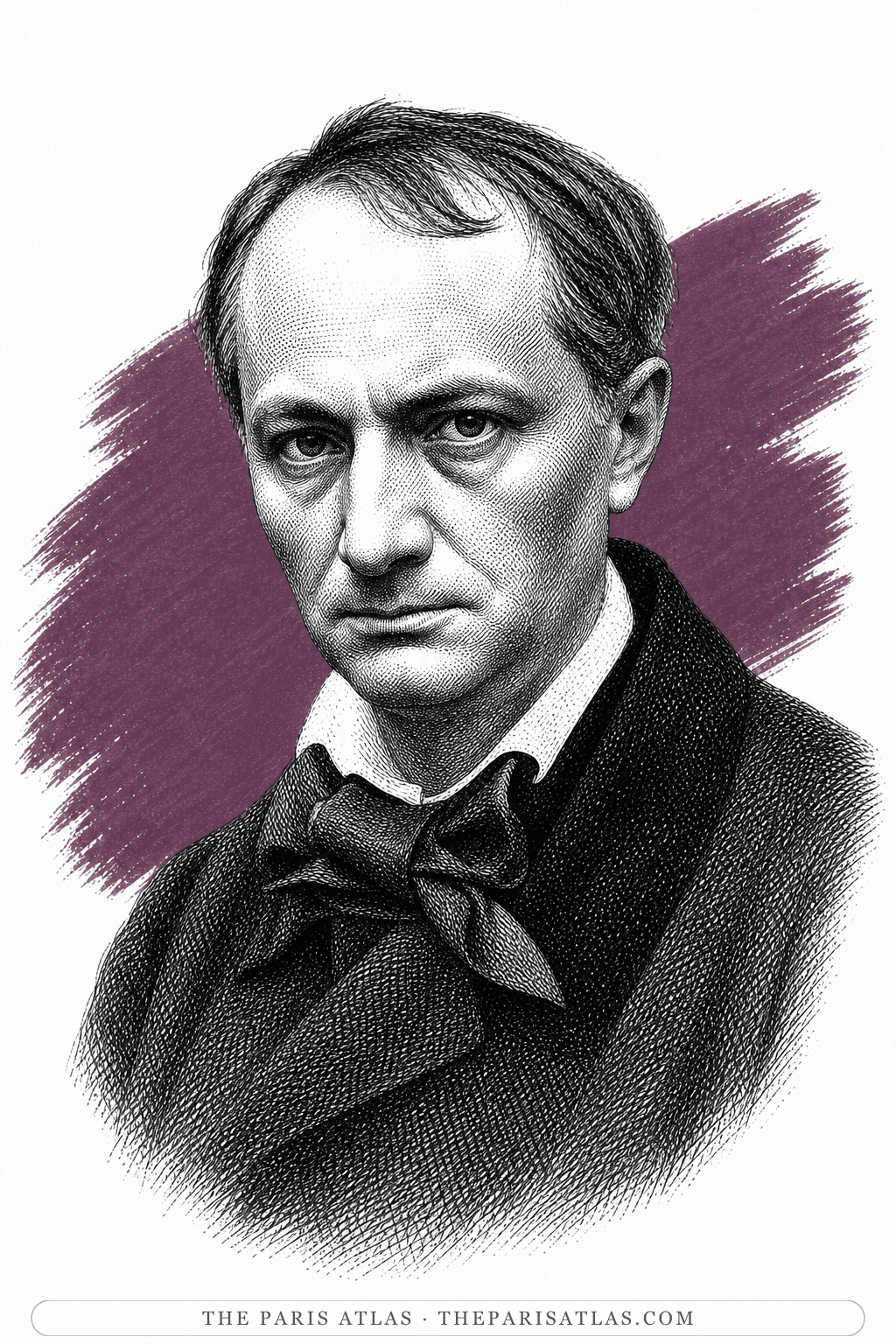
Charles Baudelaire (1821–1867), a French poet and art critic, was a crucial predecessor rather than a member of the movement named in 1886. Mallarmé, Verlaine, and Arthur Rimbaud recognized in his writing a way to connect modern experience with spiritual unease, sensual intensity, and the imaginative possibilities of language. His importance rests not only on the poems collected in Les Fleurs du mal, but also on his criticism and experiments in prose poetry.[20]

Les Fleurs du mal appeared in Paris in 1857 through the publishers Auguste Poulet-Malassis and Eugène de Broise. Its first edition contained one hundred numbered poems, preceded by “Au lecteur.” The book was prosecuted that summer on charges concerning religion and public morality. On 20 August, the court convicted Baudelaire and his publishers of offending public morals and ordered the suppression of six poems; the religious charge did not result in a conviction. The ban on those poems was not overturned in France until 1949. A second edition, published in February 1861, contained 126 numbered poems.[20][32]

“Correspondances” became particularly important to later Symbolist thinking. It proposes a world in which sensations and meanings answer one another: scents, colors, and sounds do not remain isolated but enter into relationships. The poem makes perception itself seem interpretive, as though the visible world contains intimations of something that cannot be directly stated.[3][32]

The Bibliothèque nationale de France preserves an intimate record of this process in Baudelaire’s corrected printing proofs. In the first proof of “Correspondances,” he capitalized the word symboles; in the third, he removed the capital. The revision does not reveal a complete artistic theory, but it shows the poet attending closely to the weight carried by a word that later became central to the movement’s name.[32]

Stéphane Mallarmé: the poem as an act of suggestion

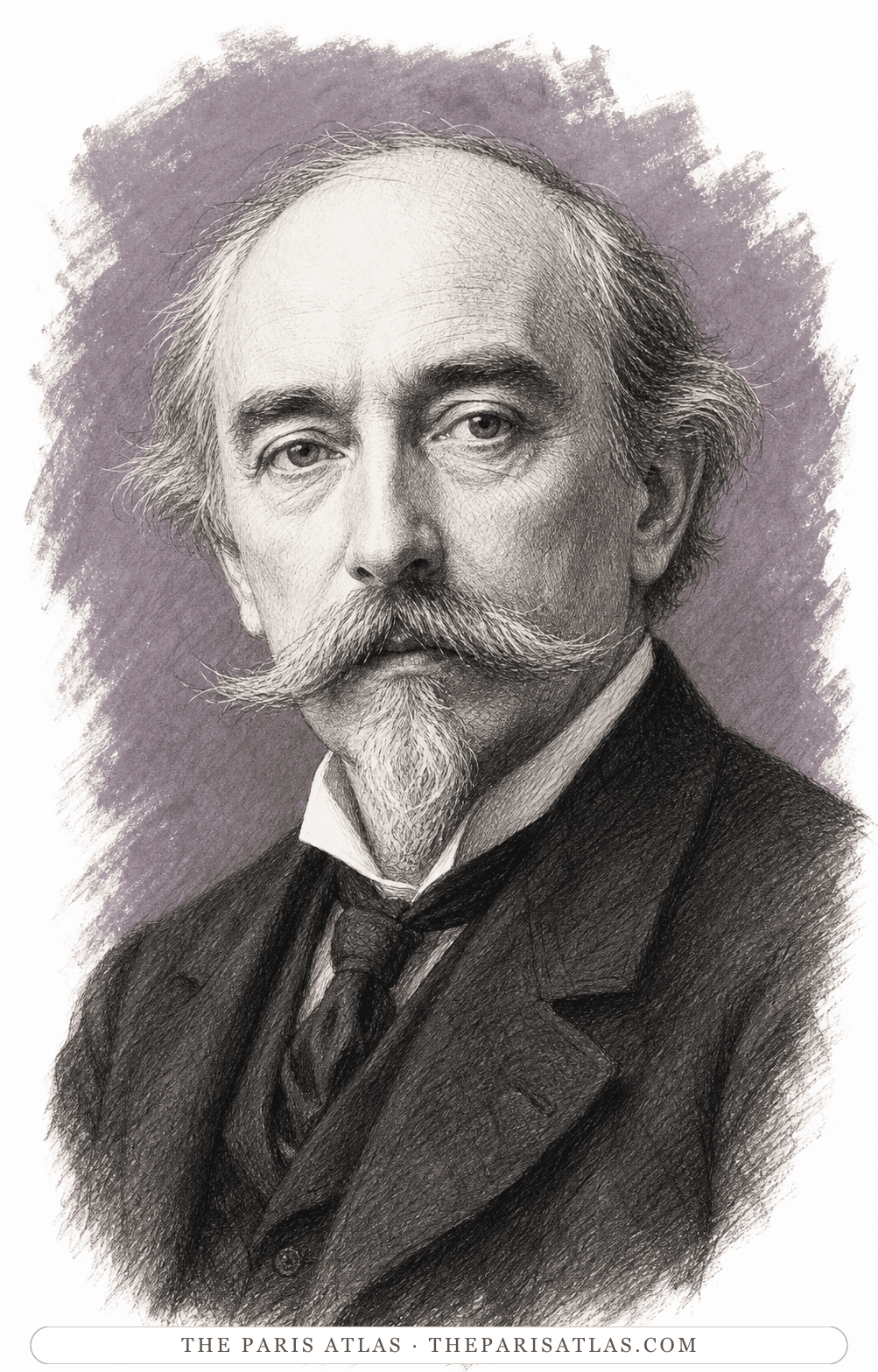
Stéphane Mallarmé (1842–1898), born in Paris on 18 March 1842, worked as an English teacher while developing one of the most demanding and influential bodies of poetry of the century. Younger writers gathered around him, and in 1896 he was elected “Prince of Poets,” an informal literary distinction. He nevertheless resisted being treated as the commander of a school.[10][33]

Mallarmé’s poetry makes meaning through sound, syntax, association, and omission. A poem is not simply an idea transferred into attractive language; its words create relationships that did not exist before the poem. An often-repeated anecdote captures this distinction. The painter Edgar Degas complained that he had plenty of ideas but could not make a satisfactory sonnet. Mallarmé answered that poems were made with words, not ideas. The exchange survives as a recollected anecdote.[10]

His L’Après-midi d’un faune began in an earlier form in 1865 and appeared as an independent illustrated publication in April 1876 after difficulties finding acceptance. The faun, a creature from classical mythology, tries to distinguish sensual experience from imagination: were the nymphs he remembers real, dreamed, or transformed by desire? The uncertainty is not incidental to the poem. It is its organizing condition.[16][34]

Édouard Manet supplied four wood-engraved illustrations or ornaments for the 1876 edition. Princeton University Library’s account describes them as printed in black and tinted pink by Manet himself, a practical response to the expense of color printing. The volume, published by Alphonse Derenne, made the encounter between poetry and visual art a physical object: text, image, paper, and color belonged to the same experience.[16]

Paul Verlaine: music, nuance, and the “cursed poets”

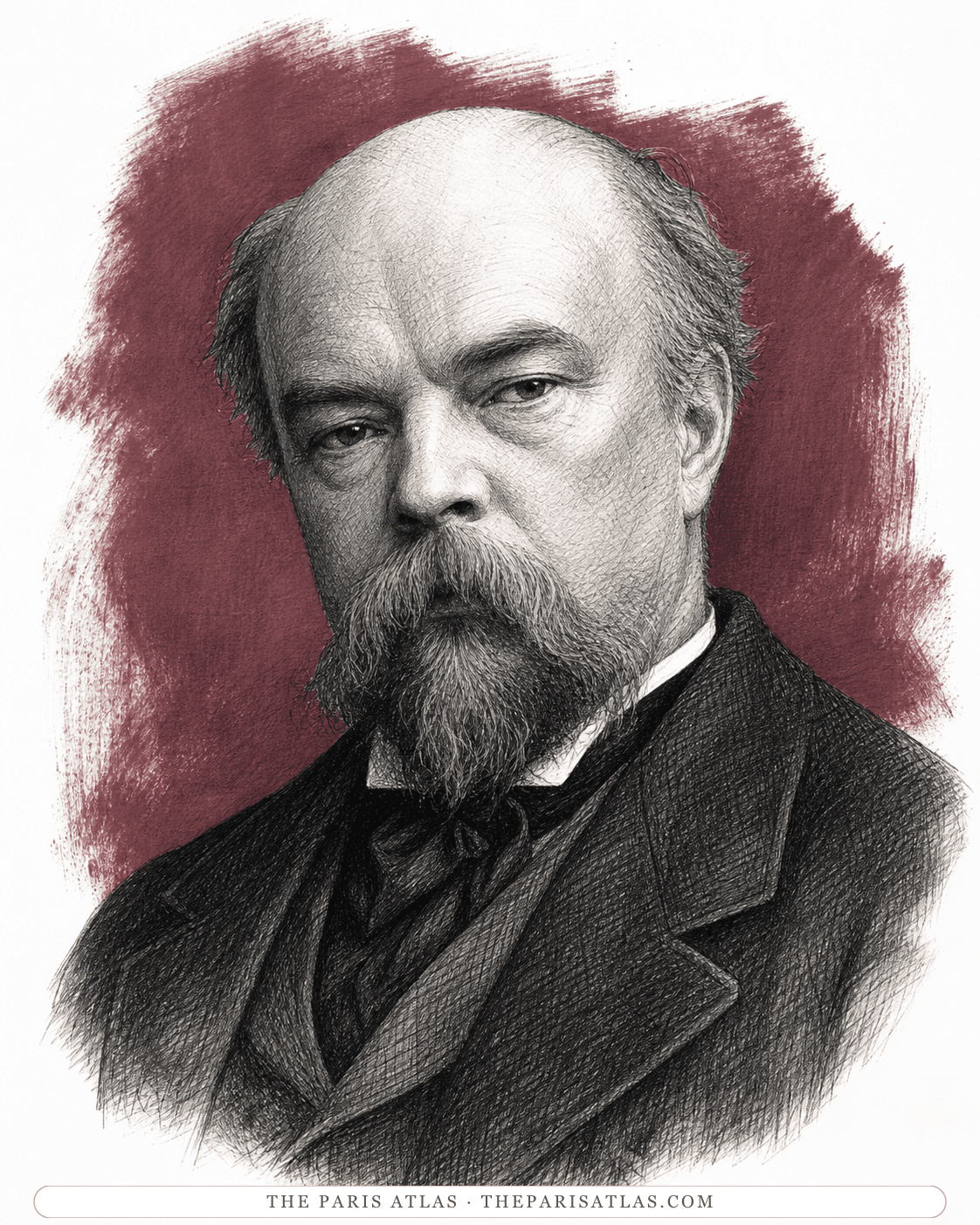
Paul Verlaine (1844–1896), born in Metz on 30 March 1844, began in the orbit of Parnassian poetry, which valued formal discipline and finish. His own reputation came increasingly to rest on a different quality: the ability to make uncertain feelings audible through rhythm, half-tones, and apparently simple words. Young Symbolist and Decadent writers revered him, although he too resisted the role of an official leader. He died in Paris on 8 January 1896.[21][35]

In “Art poétique,” generally dated to 1874 and included in Jadis et naguère in 1884, Verlaine put musicality before rhetorical display. His preference for odd-numbered syllabic lines and for nuance rather than heavy assertion offered younger poets a model of suggestive writing. The poem is often treated as a Symbolist statement, although it preceded Moréas’s manifesto.[21][35]

Verlaine also helped establish the modern idea of the poète maudit, the “cursed poet” whose originality brought estrangement rather than recognition. His essays began appearing in 1883 and were collected as Les Poètes maudits in 1884. That first collection discussed Tristan Corbière, a French poet of bitter wit and irregular rhythms; Arthur Rimbaud; and Mallarmé. The expanded edition of 1888 added the poet Marceline Desbordes-Valmore, the writer Auguste de Villiers de l’Isle-Adam, and Verlaine himself under the anagram “Pauvre Lelian.”[36]

Paul Verlaine’s relationship with Arthur Rimbaud had ended catastrophically. On 10 July 1873, in Brussels, Verlaine shot and wounded the younger poet and was sentenced to two years in prison. Their violent separation and Verlaine’s imprisonment became part of the biographical history through which later readers encountered their poetry.[21][35]

Arthur Rimbaud: visionary language and the abandonment of poetry

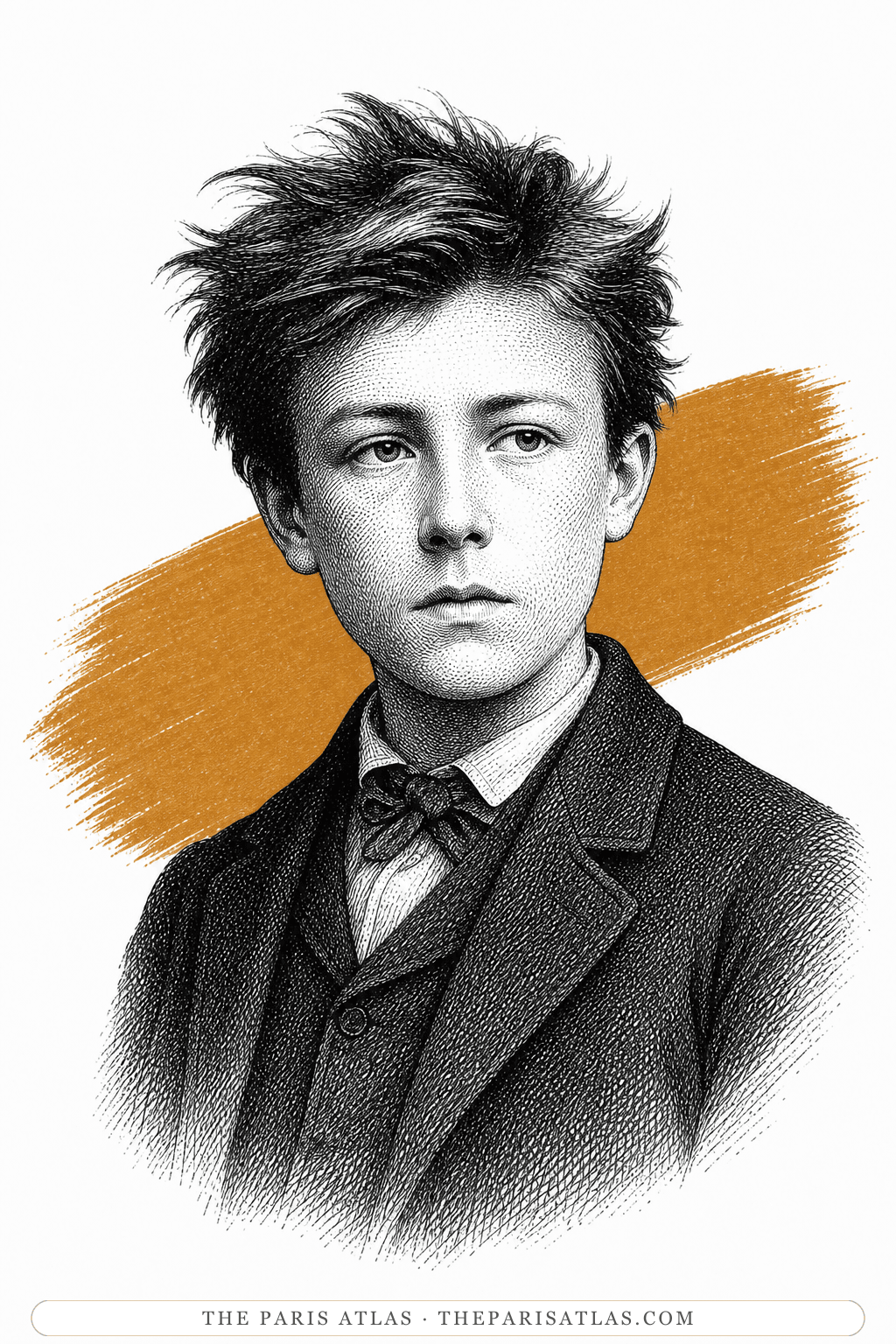
Arthur Rimbaud (1854–1891) was born in Charleville on 20 October 1854. He met Verlaine in September 1871, when he was sixteen, and produced almost all his poetry between approximately 1870 and 1875. His work was therefore largely complete before Symbolism became a named movement. Later writers found in it a radical example of language breaking with ordinary description and with the stable, self-possessed voice expected of a poet.[37][38]

Rimbaud dated Une saison en enfer from April to August 1873. Printed in Brussels, it initially attracted little attention; most copies remained uncollected with the printer. Its early circulation was very limited. The work returned to view through the French literary review La Vogue in 1886.[39]

The composition of Illuminations is harder to date precisely, although much of it is generally placed in the years around 1873–1875. Rimbaud passed manuscripts to Verlaine at their last meeting in February 1875. Publication followed in 1886, with the involvement of Félix Fénéon, the French critic and editor who also championed new painting. Younger Symbolists encountered these extraordinary texts after their author had largely abandoned literary life.[40]

Rimbaud stopped writing poetry around the age of twenty. He subsequently traveled, briefly served as a soldier, reached Java, and worked as a merchant in the Horn of Africa, including involvement in the arms trade. His later correspondence concerns business and practical affairs rather than a continuing poetic career. A tumor in his leg brought him back to Marseille, where the leg was amputated. He died there on 10 November 1891, aged thirty-seven. His short literary career and subsequent silence became part of the fascination surrounding his work.[37][38]

Mallarmé’s Tuesday evenings at 89 rue de Rome

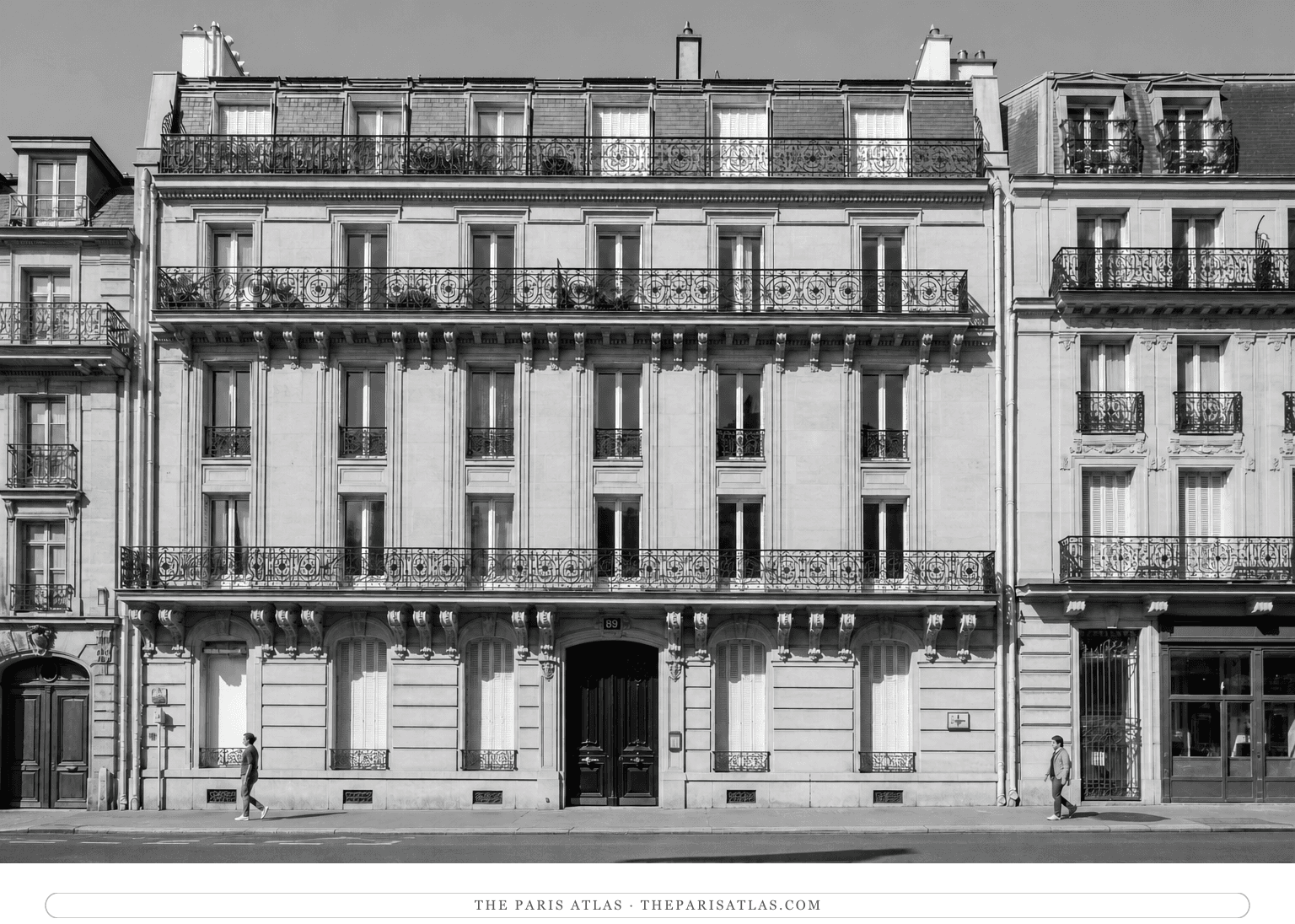
Mallarmé moved to 89 rue de Rome, in the Batignolles district of Paris’s 17th arrondissement, in 1875. The Tuesday gatherings associated with the address became especially important during the 1880s and continued until his death in 1898. Those who attended were known as the Mardistes, from mardi, the French word for Tuesday.[41][5][33]

These were not large public lectures. Their importance came from the concentration of people and conversation in a modest domestic setting. Writers, painters, and musicians could hear the same questions discussed from different perspectives: what language could suggest, how an image might escape literal explanation, or whether music offered a model for the other arts. The gatherings helped make Symbolism a social network as well as a set of ideas.[5][42]

Over the years, Mallarmé’s circle included the French composer Claude Debussy and the American-born painter James Abbott McNeill Whistler. Writers included the poet and playwright Paul Claudel, novelist André Gide, Irish dramatist Oscar Wilde, playwright Alfred Jarry, and poet and essayist Paul Valéry.[5]

A material witness to the gatherings survives. The Musée départemental Stéphane Mallarmé, at Vulaines-sur-Seine outside Paris, preserves the dining table around which these conversations took place. The rue de Rome apartment itself is not a public museum, but the table brings its celebrated literary sociability back to the scale of an ordinary room.[5]

Gustave Moreau: mythology, spectacle, and the imagination

A painter established before the manifesto

Gustave Moreau (1826–1898) was one of the principal painters later claimed as a Symbolist predecessor. Trained at the École des Beaux-Arts in Paris, he drew on the work of Eugène Delacroix, the leading Romantic painter, and Théodore Chassériau, a younger painter who became his friend. His Italian journey of 1857–1859 deepened his interest in Renaissance painting and in older religious and decorative traditions, including Byzantine art.[43][44]

Moreau’s paintings are often filled with jewels, plants, elaborate architecture, and references to different historical cultures. Their richness can look like the opposite of modern simplification. Yet their settings are rarely intended as straightforward archaeological reconstructions. They create an imagined world in which an encounter between two figures acquires the density and remoteness of a dream.[11][13]

His breakthrough came with Oedipus and the Sphinx, exhibited at the Paris Salon in 1864 and now in the Metropolitan Museum of Art in New York. The sphinx—a creature combining a woman’s head with an animal body and wings—clings to Oedipus as the two stare at one another. The remains of earlier victims appear below them. Moreau makes the confrontation physically intimate rather than treating it as a distant episode in a heroic narrative.[11]

The traditional riddle asks what moves on four legs in the morning, two at noon, and three in the evening. The answer is a human being, crawling in infancy, walking upright in adulthood, and using a stick in old age. Knowing the answer explains the myth, but the painting’s tension remains in the locked gazes and the dangerous contact between the figures. It can be read as an encounter between knowledge and mystery without being reduced to that interpretation.[11]

Orpheus after the violence

Moreau painted Orphée in 1865; the French state purchased it in 1866, and it now belongs to the Musée d’Orsay. In Greek mythology, Orpheus is a poet and musician whose art can move living creatures and even the powers of the underworld. Accounts of his death describe his destruction by the Maenads, the female followers of the god Dionysus, with his rejection of women among the explanations given for their violence.[12]

Moreau chose not to paint the attack. Instead, he imagined a young woman in richly ornamented Eastern dress contemplating the musician’s severed head, which rests upon his lyre. Her face and the dead poet’s echo one another, and their lowered or closed eyes produce a strange stillness. The subject becomes an encounter with what survives of song, beauty, or inspiration after physical destruction.[12]

Smaller details connect the scene to the history of music. The turtles in the foreground recall the traditional invention of the lyre from a tortoise shell, while tiny musicians occupy the rocks above. They make the setting more densely associative, inviting the eye to move between the human drama and the objects around it.[12]

Salome and The Apparition

Moreau’s images of Salome became central to the literary culture of the 1880s and 1890s. In the biblical story, the daughter of Herodias dances before the ruler Herod Antipas and, at her mother’s prompting, demands the head of John the Baptist. Later art and literature increasingly transformed Salome herself into the embodiment of destructive desire. Moreau’s paintings were important in that transformation.[13]

John the Baptist’s severed head, encircled by a halo and dripping with blood, appears before a horrified Salome in Gustave Moreau’s The Apparition. Moreau added this supernatural confrontation to the biblical account of the dance and execution. The invented vision makes Salome face the head she demanded. Moreau developed the subject in different media: a celebrated watercolor was shown at the Salon of 1876, while an oil version belongs to the Musée Gustave Moreau.[13]

The novelist Joris-Karl Huysmans subsequently made Moreau’s Salome pictures objects of intense contemplation in À rebours. That book enlarged the painter’s literary following, but Moreau had already been publicly successful for two decades. His admirers included Odilon Redon and Oscar Wilde, whose own work helped carry the subject into new forms.[11][13][45]

Moreau the teacher

Moreau’s career included periods of hostile criticism and withdrawal from the Salon, followed by official recognition. He was elected to the Académie des Beaux-Arts in 1888 and became a professor at the École des Beaux-Arts in 1892. His students included Henri Matisse, Georges Rouault, Albert Marquet, and Henri Manguin, all painters whose mature work differed considerably from his own.[43][44]

Gustave Moreau encouraged his students to develop their own styles rather than reproduce his manner. His studio became an important connection between nineteenth-century Symbolism and Fauvism, whose intense color caused a sensation at the Salon d’Automne in Paris in 1905. Moreau’s students carried his defense of artistic independence into work that often left his mythological subjects behind.[43][44][46]

The house that became a museum

The Moreau family acquired the house at 14 rue de La Rochefoucauld in 1852. It remained central to the painter’s adult life. After the deaths of his mother and his long-standing companion Alexandrine Dureux, Moreau increasingly organized his work and surroundings for preservation. In 1895 he had the house transformed, creating large studio galleries above the domestic rooms.[43]

The house was to preserve not only finished paintings but the process of invention: studies, drawings, unfinished compositions, and repeated variations. Moreau’s arrangements included display panels that could be turned to reveal drawings. In a will made in 1897, he left the property and its contents to the French state. Moreau died on April 18, 1898.[47][43][48]

The museum opened to the public on 14 January 1903, with his former student Georges Rouault as its first curator. The accumulated paintings and thousands of works on paper make the building an unusually direct record of an artist’s imagined world. It is not simply a room devoted to Moreau within a larger museum: the house itself forms part of what he left.[47][48]

Odilon Redon: from the noirs to color

Making the impossible seem visible

Odilon Redon (1840–1916), a French painter, draftsman, and printmaker, pursued a different form of imaginative art. For many years his most distinctive work was in black: charcoal drawings and lithographs that he called his noirs. Floating eyes, heads detached from bodies, and creatures resembling spiders with human faces occupy spaces that feel both empty and strangely alive.[25][49][50]

These works do not abandon observation entirely. Their power often comes from making an impossible being appear as though it possessed a coherent physical existence. A head has weight, an eye has moisture, and a creature seems to inhabit the darkness around it, even when the scene could not occur in the visible world. Redon’s transformations helped establish a language in which recognition and uncertainty could coexist.[50]

Guardian Spirit of the Waters, made in 1878 and held by the Art Institute of Chicago, places an immense, melancholy head above water crossed by tiny boats. The discrepancy of scale makes the human element seem at once protective, mournful, and disturbing. Its title proposes a spirit, but does not explain the apparition’s identity or purpose.[25]

The drawing’s effects were carefully constructed. The museum records different charcoals, touches of black chalk, rubbed passages, erasure, incised marks, work with a sponge to remove material, and traces of white chalk on cream paper toned toward gold. Redon made light partly by taking dark material away. The atmosphere emerges from the changing density of the surface rather than a simple black silhouette on a pale sheet.[25]

Literature and the strange image

Redon’s printmaking had close connections with literature. Edgar Allan Poe, the American writer, offered a precedent for an imagination in which perception could become unsettling and unreliable. The French novelist Gustave Flaubert’s The Temptation of Saint Anthony supplied another rich source: Redon produced three lithographic series associated with the work, in 1888, 1889, and 1896.[50]

The relationship was not limited to illustrating a passage. Literature gave Redon occasions to invent images whose meanings remained partly independent of the text. His work consequently belongs to the same culture as Mallarmé’s poetry without needing to translate Mallarmé’s ideas into a fixed pictorial vocabulary.[49][50]

Closed Eyes and the transition toward color

During the 1890s Redon increasingly worked in color and revisited imagery associated with the noirs. The development was gradual rather than a sudden replacement of one identity by another. Pastel and paint allowed him to construct luminous atmospheres in which flowers, heads, and mythological figures could appear without being tied to an ordinary setting.[49][50]

Les Yeux clos (Closed Eyes), painted in 1890 and now in the Musée d’Orsay, is an important work at this transition. The head is generally identified with Redon’s wife, Camille Falte, although the image exceeds the conventions of a straightforward likeness. Its thinly applied color allows the material support to remain perceptible, contributing to the sense of a figure suspended between presence and disappearance.[14]

Closed eyes recur throughout Redon’s work. They may suggest sleep, inward attention, death, or an experience that does not depend on looking at the external world. These possibilities need not exclude one another. The French state acquired the painting directly from Redon in 1904 for the Musée du Luxembourg, through the initiative of its curator Léonce Bénédite.[14]

Redon’s reflections on his work were later collected in À soi-même, published in 1922, six years after his death. The book is valuable evidence of an artist who thought carefully about the relationship between observation, imagination, and the distinctive possibilities of his medium.[14][49]

Pierre Puvis de Chavannes: Symbolism on public walls

A quieter visual language

Pierre Puvis de Chavannes (1824–1898), born in Lyon on 14 December 1824, developed a form of decorative painting very different from Moreau’s intricate visions. His figures are simplified, his spaces broad, and his colors often pale and restrained. Their stillness can make an episode appear to belong outside ordinary time. He died in Paris on 24 October 1898.[51][52]

Much of his most important work was designed for walls rather than for the independent easel picture. A mural must be read in relation to architecture, distance, and the movements of people through a building. Puvis’s simplification offered younger painters, including Gauguin and later Pablo Picasso, an example of how form could carry an idea without imitating every visible detail.[2][52][15]

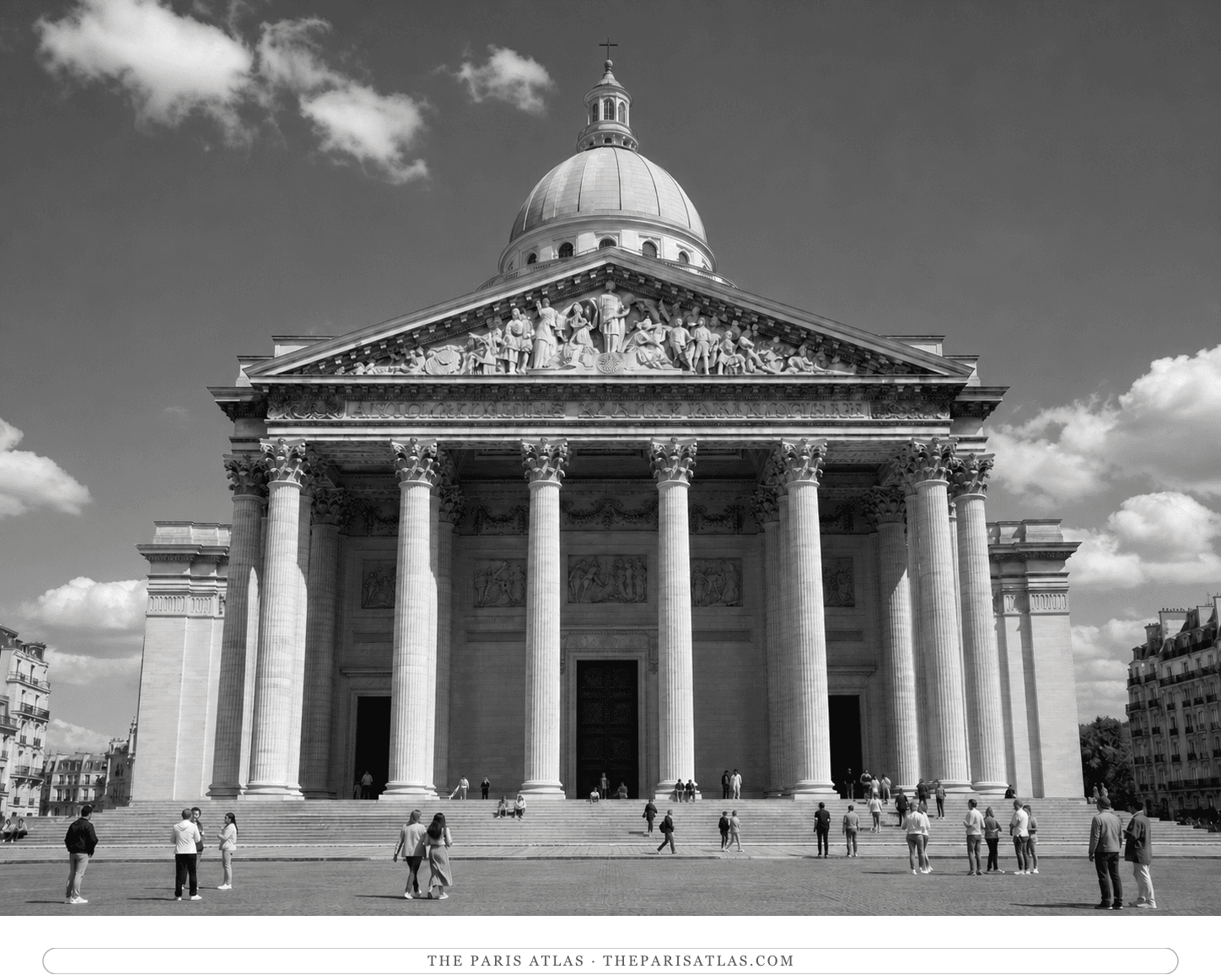
Saint Geneviève in the Panthéon

Puvis painted the life of Saint Geneviève, the patron saint of Paris, in two campaigns for the Panthéon. The first was commissioned in 1874 and completed in 1877. It concerns her childhood and early recognition, including her encounter with Saint Germain of Auxerre, the bishop associated with identifying her religious vocation.[51][26]

The second campaign, commissioned in 1893 and completed in 1898, turns toward her protection of the city. It includes Geneviève helping to provision a besieged Paris and watching over the sleeping capital. Religious narrative becomes a meditation on vigilance, care, and the relationship between an individual and a community. These are historical and devotional subjects, but their simplified treatment also explains their place in accounts of Symbolism.[51][53]

Not everything planned for the building was completed by Puvis. A frieze commissioned in 1893 remained unfinished at his death. The version installed in 1922 was executed by the painter Victor Koos, who worked from Puvis’s design and supplied its color. The Musée d’Orsay preserves Puvis’s unfinished frieze in charcoal and sepia on canvas, allowing the original conception to be distinguished from its later completion.[54]

The Sorbonne, the Hôtel de Ville, and Boston

Puvis completed the great decorative painting for the new Sorbonne’s amphitheater in 1889. The City of Paris also commissioned him, on 29 January of that year, to decorate a room in the Hôtel de Ville. The panels Summer and Winter were shown at the Salons of 1891 and 1892 respectively. His work occupied important civic and educational interiors as well as a building associated with national commemoration.[52][55]

His final major undertaking carried this language to the Boston Public Library. Installed in 1895 and 1896, its murals occupy the grand staircase and the entrance to Bates Hall. They constitute his only mural cycle in the United States. Already in his seventies, Puvis did not travel to Boston to paint them: he worked on canvases in France using measurements supplied by the American architect Charles Follen McKim.[15]

McKim also sent him a sample of the building’s yellow Siena marble. The detail is revealing because Puvis’s pale colors were not chosen in isolation. They were adjusted to the materials and light of an architectural setting he knew through plans, dimensions, and a small piece of stone.[15]

Oil painting made to resemble fresco

The dry, chalky appearance of Puvis’s murals was a technical achievement, not simply the result of faded color. Conservation research on the Boston paintings describes coarse, plain-weave linen sized with animal glue and covered by a very thin, absorbent chalk ground. Puvis reduced the oil content of his paints, including by draining them on blotting paper, used turpentine, added substantial lead white, and left the surface unvarnished.[56]

The finished canvases were attached to the walls by marouflage, a method of adhering a painted canvas to a permanent support. In Boston, a paste containing lead white and linseed oil was applied to the relevant surfaces and the canvas pressed into position with rollers. The result could suggest fresco to a viewer below, although the image had been painted in oil on cloth rather than directly into wet plaster.[15][56]

Eugène Carrière: figures emerging from shadow

Eugène Carrière (1849–1906), born at Gournay-sur-Marne on 17 January 1849, brought Symbolist atmosphere to subjects drawn from intimate human relationships. He studied under the academic painter Alexandre Cabanel and began exhibiting at the Salon in the 1870s. His early maternal subjects, associated with recognition at the end of that decade, established concerns that would continue throughout his career.[28][57]

Carrière’s paintings frequently seem to form out of darkness rather than occupy a clearly defined room. Faces, hands, and bodies are connected by softened transitions, while much of their setting remains indistinct. His The First Communion, painted around 1896 and held by the Metropolitan Museum of Art, demonstrates how an ordinary religious occasion could become an image of inwardness rather than a detailed record of clothing and ceremony.[28]

Descriptions of his palette sometimes emphasize brown and umber, sometimes gray. These are not necessarily contradictory accounts of the same picture. The more consistent feature is the narrow tonal range and the softening of boundaries. A contemporary comparison with his friend Auguste Rodin, the French sculptor, captured the effect by suggesting that Rodin painted in marble while Carrière sculpted with shadow.[28][57][58]

Carrière also belonged to the institutional and teaching history of modern French art. He helped establish the revived Société Nationale des Beaux-Arts, and younger painters including Henri Matisse and André Derain spent time in his studio. His work complicates the notion that Symbolism necessarily meant exotic mythology: tenderness, family relationships, and the emergence of a face from obscurity could serve the same interest in experiences that were not fully visible.[28][57]

À rebours: the novel that turned paintings into a way of life

Joris-Karl Huysmans (1848–1907), a French novelist who had previously worked within the orbit of literary Naturalism, published À rebours in 1884. Its title is often translated as Against Nature or Against the Grain. The novel follows the wealthy aristocrat Jean Floressas des Esseintes as he withdraws from society and attempts to construct an existence governed by private taste. Books, perfumes, colors, works of art, and carefully chosen sensations replace ordinary social life.[59][45]

Joris-Karl Huysmans’s À rebours became a defining work of Decadent literature. Decadence often emphasized artifice, exhaustion, heightened sensation, and the rejection of conventional taste. Symbolism placed greater emphasis on expressing ideas indirectly. The tendencies overlapped in the novel: its fictional protagonist, des Esseintes, shaped his surroundings to satisfy his private tastes and imagination.[59][3]

Two of Moreau’s Salome pictures occupy a central position in des Esseintes’s private world. His contemplation of them becomes an elaborate verbal performance, in which the paintings accumulate meanings through language. Huysmans was not simply recommending an artist. He showed how a painting could become the focus of an entire mental life. This helped establish Moreau’s importance for the literary generation of the 1880s without erasing the painter’s earlier Salon reputation.[13][45]

The novel’s famous tortoise episode reveals the darker comedy of this project. Dissatisfied with the effect of an ordinary tortoise against a richly colored carpet, des Esseintes has its shell gilded and decorated with jewels. The living animal is turned into an ornament and eventually dies beneath the burden. The incident is an extreme example of aesthetic preference attempting to subordinate nature, with an outcome that exposes the cruelty and absurdity of the exercise.[45]

Elsewhere, des Esseintes constructs what he calls a “mouth organ,” associating different liqueurs with different musical instruments so that drinking can resemble a private concert. He also sets out for London but finds an imagined England in Parisian establishments and returns home without completing the journey. These episodes sharpen a question that runs through the wider movement: how far can an experience be created through artifice, memory, and suggestion, and what is lost when actual life is replaced by its carefully composed equivalent?[45]

Paul Gauguin, Pont-Aven, and the transformation of color

Brittany as a place of experiment

The French painter Paul Gauguin (1848–1903) had taken part in Impressionist exhibitions before developing a different approach to color and form. His paintings gave color an expressive force that went beyond realistic description. This made him central to Symbolism, whether he painted a mythological subject or a Breton landscape.[60][17]

He first visited Pont-Aven in Brittany in the summer of 1886. Artists had been drawn to the area since the middle of the nineteenth century, including American painters who helped establish its reputation as a colony. The attraction was partly visual—the coastal light, the harbour and mills, the Bois d’Amour, and the nearby Trémalo chapel—and partly practical. Rooms, studio space, and models were comparatively accessible, and the town was accustomed to welcoming painters.[61][62]

Gauguin encountered Émile Bernard, a young French painter, in Brittany in 1886; their exchange became particularly important in 1888. The expression “Pont-Aven School” was applied retrospectively. It describes an informal circle whose members exchanged ideas outside a formal academy. The artists shared discoveries, argued over them, and later disputed who had originated particular innovations.[61][62][63]

Vision of the Sermon

In Vision of the Sermon (Jacob Wrestling with the Angel), painted in 1888 and now in the National Galleries of Scotland, Breton women in white bonnets occupy the foreground while a biblical struggle takes place beyond them. The ground is an extraordinary flat red. A diagonal tree separates parts of the composition without providing the familiar recession of a naturalistic landscape.[27]

The painting refers to the episode in Genesis in which Jacob wrestles through the night with a mysterious divine being, conventionally represented in art as an angel. Gauguin’s subject is not simply that ancient event. It is the event as imagined by people who have heard it described. In a letter to the Dutch painter Vincent van Gogh, written around 26 September 1888, Gauguin explained that the landscape and the struggle existed in the imagination of the praying women.[27][64]

This distinction makes the picture an especially clear example of Symbolist painting. It places physical figures and an inward vision in the same visual field without pretending that the two belong to an ordinary observed scene. The National Galleries of Scotland acquired the painting in 1925; Aurier had already used it as a central example in his 1891 account of Symbolism in painting.[9][27]

Paul Gauguin attempted to give Vision of the Sermon to a church, but the offer was refused. His contemporary letter names the church at Pont-Aven. Émile Bernard’s later account, written in 1904, differs over the location: it names the priest at nearby Névez. According to Bernard, the priest objected that the women’s enormous bonnets and backs dominated the canvas, while the sacred event appeared at a distance. He considered the picture insufficiently religious.[64]

Cloisonnism, Synthetism, and the argument over invention

Two terms associated with the Pont-Aven painters describe related but different things. Cloisonnism concerns the appearance of a picture: areas of relatively flat color separated by strong outlines, resembling the partitions in cloisonné enamel. The name was coined by the French writer and critic Édouard Dujardin in 1888 in relation to work by Louis Anquetin, a painter closely associated with Bernard.[29][65][63]

Synthetism is a broader conception. It involves bringing together the appearance of a subject, the artist’s feelings about it, and the formal arrangement of color and line. Working from memory could assist this process because it encouraged selection and transformation rather than continuous adjustment to the object immediately before the painter.[29][66]

The distribution of credit remains an important part of the history. Bernard’s Breton Women in a Meadow, also associated with the title Le Pardon, preceded Vision of the Sermon by a short interval, and he later argued that Gauguin had taken credit for ideas they had developed together. Bernard and Anquetin’s experiments were central to the new language of flat color and strong outlines, while Gauguin gave it a distinctive imaginative force. The dispute grew out of an unusually productive exchange.[65][67][17][63]

Tahiti and an imagined alternative to Europe

Gauguin’s search for an alternative to European urban society eventually took him to Tahiti. His desire to find a supposedly less industrialized world influenced how he represented the island, but the place he encountered was already shaped by French colonial rule, missionary activity, trade, and changing local customs. His pictures are consequently imaginative constructions rather than transparent records of an untouched society.[60][17][68]

Gauguin combined local observation with remembered European art, invented religious imagery, and sources from different cultures. The result could be powerful and imaginative while remaining distinct from a documentary account of Polynesian life. His conflicts with colonial officials and his own position as a European artist belong to that history together.[17][68]

Where Do We Come From? What Are We? Where Are We Going?

Gauguin’s great painting of 1897–1898, now in the Museum of Fine Arts, Boston, is nearly four meters wide and was painted on coarse burlap. It was made during a period of financial difficulty, physical illness, emotional distress, and conflict with the colonial authorities. Its title gives the work the form of three questions rather than an explanation.[68]

Gauguin described the composition as moving from right to left, beginning with a sleeping infant and ending with an old woman close to death. Between them, figures of different ages occupy a setting whose gestures and objects do not resolve into a single familiar story. The painting can be read as a meditation on the course of life, but the artist resisted having it reduced to a catalog of known symbols.[68]

Its physical presentation was part of the conception. Gauguin painted yellow corners so that the image could resemble a mural deteriorating at the edges against a golden wall, and he asked for a plain white frame. When it was exhibited in Paris at Ambroise Vollard’s gallery in 1898, Thadée Natanson, a critic and editor of La Revue blanche, found it obscure but connected that obscurity to its invitation to consider human destiny. For Gauguin, a complete verbal explanation risked destroying the painting’s character as a poem.[68]

Paul Sérusier, Le Talisman, and the Nabis

A small painting with an exceptional reputation

Paul Sérusier (1864–1927), a French painter with a background in philosophical study, spent time at Pont-Aven in 1888. In October, under Gauguin’s guidance, he painted a small landscape at the Bois d’Amour. According to the later recollection of the painter Maurice Denis, Gauguin encouraged Sérusier to put down the colors he perceived forcefully: yellow for the trees, pure ultramarine for a blue shadow, vermilion for red leaves. The lesson was to trust and organize a color sensation rather than correct it toward conventional naturalism.[18][69]

The resulting panel, Le Talisman, Paysage au Bois d’Amour, measures 27 by 21.5 centimeters. The wood, path, beech trees, and mill of the landscape are compressed into patches of color. An inscription on the reverse records its making in October 1888 under Gauguin’s direction at Pont-Aven. When Sérusier returned to Paris and showed it to fellow students at the Académie Julian, the picture became a demonstration that painting need not be an exercise in copying.[69]

A famous story says that Paul Sérusier painted Le Talisman on the lid of a cigar box. That account was long repeated, including in museum literature, but the Musée d’Orsay’s later material investigation identified the support as a small wooden panel, probably poplar, and questioned the cigar-box explanation. The familiar cigar-box story thus belongs to the painting’s founding legend, while the surviving support points toward an ordinary painter’s panel.[18][70]

The title Le Talisman reflects the almost initiatory status it acquired among the young painters. Denis remembered the work as a liberation from the belief that a painting had to reproduce appearances. The Musée d’Orsay acquired it in 1985 with assistance from the collector Philippe Meyer. The recognizable landscape became a starting point for a much wider freedom in the use of color.[69]

Who were the Nabis?

The circle that developed around these ideas became known as the Nabis, a name derived from the Hebrew word for prophets. The group took shape around 1888–1889 and remained active through the 1890s. The Metropolitan Museum of Art dates its beginnings to 1888, while the Art Institute of Chicago and Cleveland Museum of Art emphasize 1889, and the Bibliothèque nationale de France describes its public activity through the decade 1890–1900. The dates mark different stages in the circle’s formation and public activity.[18][71][72][73][74]

The poet and physician Henri Cazalis has been credited with suggesting the name, notably in Tate’s account, although the attribution is not uniform across histories of the group. The prophetic comparison expressed the young painters’ sense of bringing a new conception of painting into being. They had become frustrated with strictly representational teaching at the Académie Julian, and Sérusier’s panel gave their dissatisfaction a tangible form.[71][69]

The Nabis were not all mystics, nor did they share identical subjects. Some pursued religious and esoteric imagery; others concentrated on domestic interiors, urban life, and decorative design. Their connection with Symbolism lies in their rejection of simple imitation and their interest in the expressive organization of a surface.[18][72][75]

Maurice Denis and the ordered surface

Maurice Denis (1870–1943), a French painter and the group’s most persistent theorist, published “Définition du néo-traditionnisme” in the journal Art et critique in August 1890 under the pseudonym Pierre Louis. He was nineteen. The essay was later reprinted in Théories, which can cause confusion about its original date.[76][77][70]

Maurice Denis’s 1890 essay “Définition du néo-traditionnisme” opens with a proposition that became one of modern art’s most frequently cited statements. Before representing a horse, a nude, or a story, a painting is a flat surface on which colors have been arranged. The sentence does not mean that Denis considered subject matter worthless. He remained deeply interested in religious painting. For Denis, the arrangement of color and form shaped the meaning of a picture’s subject.[76][77]

Sérusier likewise continued to think about painting as a structured discipline. He made comparatively few prints and eventually published his own treatise, ABC de la peinture, in 1921. The group’s interest in color and the surface was therefore accompanied by sustained reflection, not merely an enthusiasm for vivid effects.[74]

The artists and their different practices

Pierre Bonnard (1867–1947), a French painter and printmaker, became known as the “Japanese Nabi” because of his interest in Japanese prints. Their cropping, asymmetry, and treatment of patterned surfaces offered alternatives to conventional European pictorial space. His France-Champagne poster, published in 1891, was his first print and first color lithograph. It helped show how a medium strongly associated with advertising could become an arena for ambitious modern design; color lithography itself, however, had a longer history.[72][74]

Édouard Vuillard (1868–1940), another French painter, developed an especially close relationship between decorative surfaces and domestic subjects. He increasingly worked in distemper, a medium in which pigment is mixed with a water-based glue binder. Its matte appearance suited his treatment of figures, furniture, and patterned interiors. Alongside these intimate rooms, he produced extensive work for theaters and decorative commissions.[72][75]

Félix Vallotton (1865–1925), a Swiss-born artist who arrived in Paris at sixteen, developed a sharply different graphic language. His black-and-white woodcuts used strong contrasts to expose tensions in public and private life, and some of his work reflected anarchist sympathies. Aristide Maillol (1861–1944), later best known as a sculptor, also worked in painting, textiles, and prints. Vallotton and Maillol were the Nabis most closely associated with woodcut, while color lithography dominated much of the group’s printed output.[74][78]

Paul Ranson (1864–1909), a French painter and designer, worked on wallpaper and theatrical material as well as paintings. Henri-Gabriel Ibels (1867–1936), a painter, printmaker, and illustrator, made programs for the 1892–1893 season of André Antoine’s Théâtre Libre and developed a distinctive involvement with cabaret posters and illustrated song sheets. Ker-Xavier Roussel (1867–1944), a French painter, married Vuillard’s sister Marie in 1893 and increasingly painted mythological pastorals after 1900. Their different interests make the group more varied than a list of shared principles suggests.[72][73][74]

Art beyond the easel

The Nabis worked across sets, costumes, theater programs, stained-glass designs, ceramics, wallpaper, posters, book illustration, and decorative panels for private interiors. These were not simply commercial sidelines to their paintings. They offered ways to place expressive color and design within the spaces and objects of everyday life.[18][74][75]

Denis became the first of the group to provide the illustrations for an entire book when he worked on André Gide’s Le Voyage d’Urien in 1893. Theater offered another form of collaboration. When Ubu Roi was staged with marionettes in 1898, Bonnard made the puppets and Vuillard the sets. A literary work could become a coordinated experiment in bodies, images, scale, and performance.[74][79]

The group exhibited together through 1899, but its members gradually followed increasingly individual paths. Denis’s Hommage à Cézanne, painted in 1900, shows artists gathered around a work by the painter Paul Cézanne in Vollard’s gallery and has often been treated as a retrospective image of their shared decade. There was no single, clearly documented event that explains every aspect of the group’s dispersal. Bonnard and Vuillard continued the intimate domestic painting for which they are now particularly well known.[18][74]

The galleries and magazines that sustained the movement

Le Barc de Boutteville and the exhibition circuit

The Symbolists and Nabis needed places to exhibit that did not require complete conformity with the established Salon. One important figure was the dealer Louis Léon Lebarc, known professionally as Le Barc de Boutteville. His Paris gallery became a meeting point for artists working across several new tendencies.[80][81]

Between 1891 and 1897 he organized a succession of exhibitions, often described as approximately twice yearly. The first carried the deliberately inclusive title “Exhibition of Impressionist and Symbolist Painters,” and Bonnard was among the participants. Denis and Bernard supplied prints for exhibition catalogs. The mixture of labels is a useful reminder that the boundaries drawn in later histories were not always the boundaries through which artists actually sold and displayed their work.[74][80]

Ambroise Vollard: pictures, prints, and books

Ambroise Vollard (1866–1939), a dealer born on Réunion, opened a small shop at 37 rue Laffitte in September 1893. His importance extended across the avant-garde rather than being confined to Symbolism. In November 1895 he organized Paul Cézanne’s first solo exhibition; he also supported artists whose work approached the imaginative and decorative questions central to the Symbolists.[82][83]

Denis began corresponding with Vollard in 1893 and helped introduce him to the Nabis. Vollard gave the group substantial exhibitions in 1897 and 1898 and commissioned color lithographic albums. Between 1894 and 1909 he purchased more than a hundred works by Redon, and in 1900 he became Gauguin’s principal dealer. His business helped connect experiments made in private studios with collectors who could sustain them.[82][83]

In 1900 Vollard published his first artist’s book, Verlaine’s Parallèlement, illustrated by Bonnard. The volume brings together several strands of the movement’s history: a poet associated with Symbolism, a Nabi painter working through lithography, and a dealer willing to make a book into an ambitious artistic production.[82]

La Revue blanche, La Plume, and the printed image

Little magazines were another form of infrastructure. La Revue blanche and La Plume did more than discuss new art: they published original graphic work, commissioned illustrations, and helped organize exhibitions. For a young artist, a drawing printed in a review could circulate beyond the audience for a single gallery display.[7]

La Revue blanche acquired much of its visual character from artists including Vallotton, Bonnard, Vuillard, and Ranson, together with Henri de Toulouse-Lautrec, the French painter and poster designer. Its pages contained portraits, tailpieces, and advertisements as well as criticism. Later contributors included Kees van Dongen, the Dutch-born painter associated with Fauvism. In 1892 its publishing activity brought commissions for Vuillard’s frontispiece to the writer Maurice Beaubourg’s Les Nouvelles passionnées and Denis’s contribution to Édouard Dujardin’s La Réponse de la bergère au berger.[7]

La Plume, founded by the writer and editor Léon Deschamps, developed the Salon des Cent on the Left Bank. Bonnard, Denis, and Ibels exhibited there between 1894 and 1896. Magazine pages, posters, catalogs, and book covers therefore belonged to the movement’s public life as substantially as more prestigious forms of painting.[74][7]

Joséphin Péladan and the Salon de la Rose+Croix

An exhibition with an esoteric program

Joséphin Péladan (1858–1918), a French novelist, critic, and occultist, organized the most theatrical institutional expression of mystical Symbolism. In the late 1880s he became involved in a Rosicrucian order, then broke with it around 1890 and established a rival organization with a more explicitly Catholic artistic program. His activities were one current within Symbolism, not the doctrine of the movement as a whole.[84][85][86]

Péladan cultivated an extraordinary public identity. After publishing Istar, he adopted the title “Sâr” and the name “Mérodack,” presenting himself through a claimed connection with ancient Babylonian royalty and wearing conspicuous robes. The royal ancestry was part of the persona he constructed. The costume, titles, and ceremonial language helped turn his aesthetic convictions into a public spectacle.[84]

The first Salon de la Rose+Croix took place at the Galerie Durand-Ruel in Paris from 10 March to 10 April 1892. Paul Durand-Ruel, whose gallery supplied the venue, was better known for his association with Impressionist painters. Approximately sixty French and foreign artists participated, and accounts of the event put attendance at about twenty-two thousand. Music associated with Richard Wagner, the German composer, including the prelude to Parsifal, helped establish the ceremonial atmosphere.[84][85][87]

There were six salons, one each year from 1892 through 1897. They did not remain in one building: the second was held at the Palais du Champ de Mars and the last at the Galerie Georges Petit, the gallery of another important Paris dealer. The changing venues and international participation made the exhibitions a meeting point for artists whose work had developed in different national settings.[85][88]

The artists and the rules

Participants in the Salons de la Rose+Croix included the Belgian Symbolist painters Fernand Khnopff and Jean Delville and the Swiss painter Ferdinand Hodler. The Dutch artist Jan Toorop, who was born in Java, also exhibited. Other exhibitors included the French sculptor Antoine Bourdelle, the Pont-Aven painter Charles Filiger, Félix Vallotton, and Georges Rouault. The wider network extended to artists from Finland, Italy, Spain, and other European countries. Participation did not mean that every artist accepted every aspect of Péladan’s program.[85][86]

Péladan’s rules favored Catholic ideals, mysticism, legend, myth, allegory, dreams, interpretations of major poetry, and lyricism. He particularly admired work with a mural-like character. His exclusions were equally revealing. History painting, patriotic and military subjects, scenes of contemporary public or private life, and portraits identifiable by fashionable costume were rejected in principle.[30]

Péladan’s rules for the Salons de la Rose+Croix also prohibited rustic scenes, seascapes and sailors, humorous subjects, sport, domestic animals, and merely picturesque Orientalism. Landscape was acceptable only when composed in the manner of Nicolas Poussin, the seventeenth-century French painter associated with carefully ordered classical scenes. Flowers, fruit, and ordinary still life were dismissed as exercises rather than serious exhibition subjects. These rules expressed Péladan’s particular spiritual hierarchy within the much broader range of Symbolist practice.[30]

A separate rule excluded works by women from the visual-art exhibitions, although women could participate in accompanying musical and theatrical performances. The distinction exposes a contradiction in a culture that repeatedly idealized women as muses or spiritual figures while restricting their authority as makers. The Guggenheim’s research on the salons also notes that the works actually exhibited did not always obey the rules.[30]

Péladan ended the series after its sixth exhibition in 1897. He represented the decision as a victory, declaring in effect that the artistic formula for which he had fought was now accepted. The claim was part of his public rhetoric, but the exhibitions had genuinely helped bring an international, mystical strand of Symbolism before a substantial audience.[84][85]

Symbolism in the theater

From the Théâtre d’Art to the Théâtre de l’Œuvre

Symbolist theater sought alternatives to a stage that reproduced an ordinary room and explained its characters through familiar social causes. A setting could be simplified, a gesture slowed, and speech treated for its sound and atmosphere as much as for information. Silence, anticipation, and uncertain motive could become central dramatic materials.[6][89]

In Paris, the poet Paul Fort established the Théâtre d’Art in 1890, providing an early platform for Symbolist experiment. In 1893 the actor and director Aurélien Lugné, professionally known as Lugné-Poe, founded the Théâtre de l’Œuvre with the critic Camille Mauclair and Édouard Vuillard. Lugné-Poe’s adopted name expressed his admiration for Edgar Allan Poe.[6][89]

The presence of Vuillard among the founders made the connection with painting especially direct. The company drew on artists for scenery, posters, and programs, so that its productions generated a parallel history in the visual arts. Much of the surviving evidence can consequently be found in museum print collections as well as theatrical archives.[74][6]

The Belgian playwright Maurice Maeterlinck (1862–1949), who wrote in French, was central to this culture. In plays such as Pelléas et Mélisande, the most consequential forces are not always those the characters can name or understand. Atmosphere is not simply decoration around a plot; it helps establish the world in which the plot becomes possible.[6][90][91]

The scandal of Ubu Roi

The Théâtre de l’Œuvre’s most notorious production was Alfred Jarry’s Ubu Roi, performed at the Nouveau-Théâtre on 10 December 1896. Jarry (1873–1907), a French writer and dramatist, replaced dignified tragedy with grotesque appetite, stupidity, and violence. The play opens with “Merdre,” a deliberately distorted obscenity, and proceeds through a parody of political ambition that recalls the English playwright William Shakespeare’s Macbeth while repeatedly undermining theatrical seriousness.[92]

The first production of Alfred Jarry’s Ubu Roi at the Nouveau-Théâtre in December 1896 had only one public performance, alongside a preceding dress rehearsal. Its aggression and puppet-like action contrasted with the more solemn mystical drama associated with Symbolist theater.[79][92]

Jarry designed a lithographed program printed on orange-pink paper, a copy of which is held by the Van Gogh Museum in Amsterdam. The object links the scandal to the printed culture of the avant-garde. The later marionette production of 1898, with Bonnard’s puppets and Vuillard’s scenery, continued the work’s movement between literature, performance, and visual invention.[79][92]

Symbolism in music

Why music mattered

Music offered Symbolist writers an example of an art that could organize feeling without explaining an object or telling a complete story. Composers, in turn, responded to literature concerned with suggestion, ambiguity, and states of consciousness. The relationship was reciprocal rather than a one-way borrowing of poems as subjects.[4][93]

Claude Debussy is the composer most closely associated with Symbolism. The French composers Gabriel Fauré and Paul Dukas also drew on Symbolist drama, as did Arnold Schoenberg in Austria and Béla Bartók in Hungary. Their different approaches show that these literary connections extended across musical schools.[4]

Maeterlinck’s Pelléas et Mélisande supplied the subject for Fauré’s incidental music and Schoenberg’s symphonic poem. Dukas made an opera from Maeterlinck’s Ariane et Barbe-Bleue. Bartók’s Bluebeard’s Castle sets a libretto by Béla Balázs, who had attended Dukas’s opera in Paris. The prologue to Bluebeard’s Castle asks whether the story unfolds in the outside world or within the mind.[94][95][96]

Debussy and Prélude à l’après-midi d’un faune

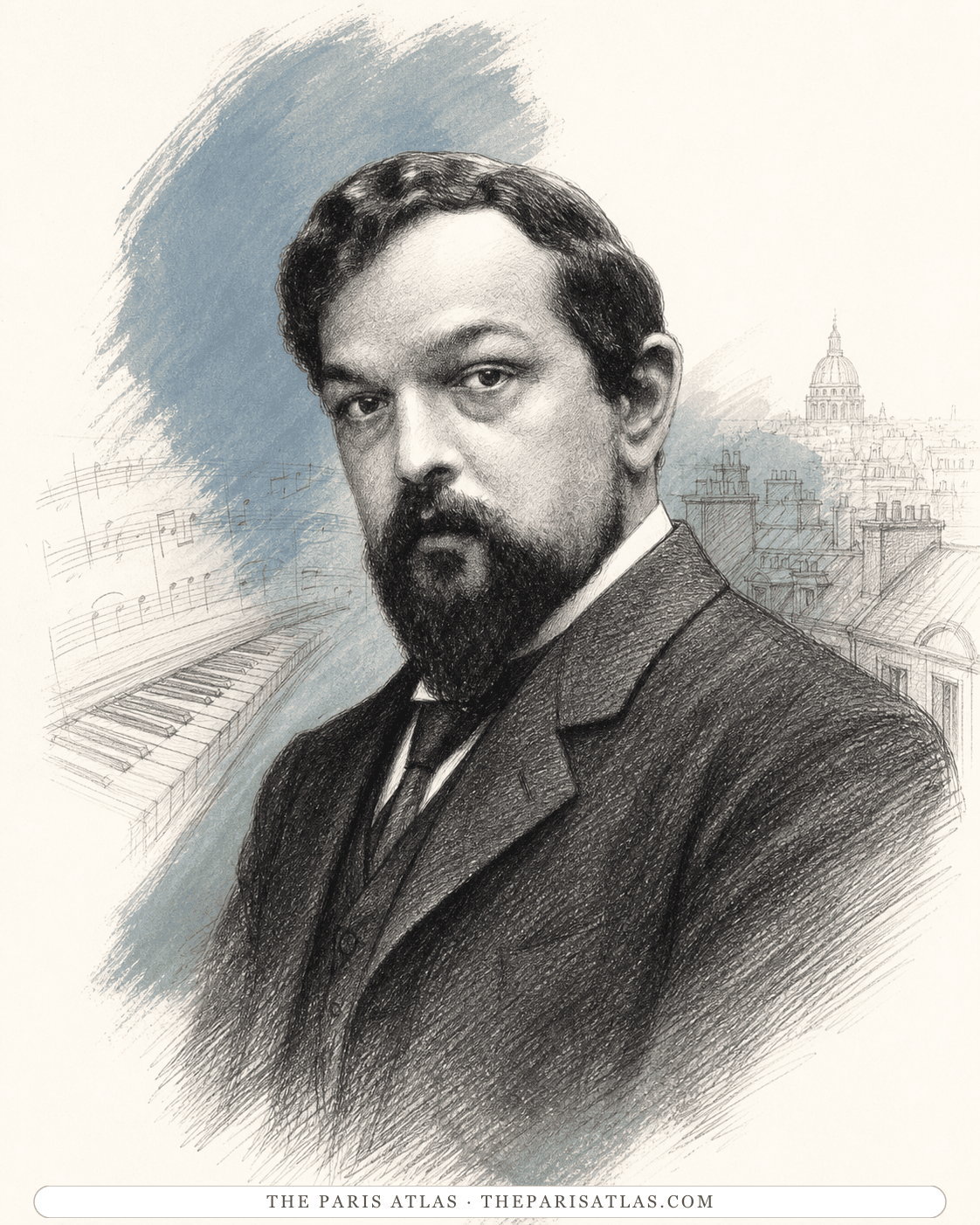
Claude Debussy (1862–1918) became part of Mallarmé’s literary circle, and his music developed in close dialogue with the poet’s work. Mallarmé asked him to write music for a proposed staging of L’Après-midi d’un faune. The theatrical project was abandoned, but Debussy continued to work on music inspired by the poem. His orchestral Prélude à l’après-midi d’un faune, composed between 1892 and 1894 and completed in the autumn of 1894, emerged as an independent work.[5][34][97][98][99]

The opening flute line immediately establishes a music that seems to hover rather than announce a stable destination. Shifting harmonies, instrumental color, and recurring but transformed phrases create a world comparable to the faun’s uncertain recollection. Debussy described the relationship as a free illustration, not a literal translation in which each phrase corresponded to a line of verse.[34]

The first performance took place in Paris on 22 December 1894 at a concert of the Société Nationale de Musique, conducted by the Swiss musician Gustave Doret. The audience requested an encore, although critical responses were not unanimously enthusiastic. One dismissive response characterized the work as more enjoyable to compose than to hear.[97][100][98]

Stéphane Mallarmé praised Debussy’s Prélude à l’après-midi d’un faune in a letter to the composer and in a quatrain inscribed in a copy of his poem L’Après-midi d’un faune. He praised the music for carrying the poem toward a light and imaginative world beyond what he had expected. The inscription evokes the light breathed into the faun’s flute. Together, the letter and the inscribed verse record the poet’s lasting appreciation.[97][100][98]

Pelléas et Mélisande and the angry playwright

Debussy’s only completed opera was based on Maeterlinck’s Pelléas et Mélisande. He secured the playwright’s permission at the end of the summer of 1893 and completed a substantial version of the score in August 1895, although orchestration and revision continued before the first production. The work finally reached the Opéra-Comique in Paris on 30 April 1902. André Messager, a French composer and conductor, directed the performance; the baritone Jean Périer sang Pelléas, and the Scottish-born soprano Mary Garden sang Mélisande.[90][91]

The opera’s expressive force depends less on conventional declarations than on the relationship between restrained speech, orchestral implication, and what remains unsaid. The characters’ words can seem simple while the musical setting makes them emotionally unstable. The work is one of the clearest continuations of Symbolist literary drama into another medium.[4][91][93]

The production also generated a very concrete dispute. Maeterlinck wanted his partner, the singer Georgette Leblanc, to perform Mélisande. When Garden received the role, he publicly dissociated himself from the opera and expressed the wish that it fail. His hostile article appeared before the opening, turning a casting dispute into an argument about the ownership and identity of a work.[90]

The general rehearsal on 28 April encountered laughter and disruption. Garden later recalled the mismatch between the poetic drama the performers believed they were presenting and an audience behaving as though it were at the Folies-Bergère. Maeterlinck himself did not become reconciled to Debussy’s achievement until 1920, two years after the composer’s death.[90]

Erik Satie and the Rose+Croix

Erik Satie (1866–1925), a French composer who worked as a pianist at the Chat Noir cabaret, became Debussy’s friend and also participated for a time in Péladan’s circle. He composed music associated with the Rose+Croix, including Première Pensée Rose+Croix in 1891.[101][102]

Péladan’s dramatic text Le Fils des étoiles prompted three preludes, first performed in the context of the Rose+Croix salon on 19 March 1892. The program described them as “admirably oriental,” language that reveals the exotic associations through which this music was presented. Their role was to establish an atmosphere around a spoken text rather than accompany a conventional operatic drama.[102]

Satie soon broke with Péladan. His Vexations, generally dated to 1893, belongs to the period after that association. The Guggenheim’s account raises questions about whether he expected it to be performed and whether a joke at the expense of mystical pretension lay behind it. No secure evidence permits those intentions to be settled neatly. Satie’s relationship with ceremonial seriousness was capable of turning toward skepticism and absurdity.[86]

Symbolist or Impressionist music?

Both labels have been applied to Debussy, but they describe different aspects of a work. “Symbolist” can identify a literary source or a commitment to indirect expression; “Impressionist” has often been used for qualities of sonority, color, and atmosphere. The Palazzetto Bru Zane, a center devoted to French Romantic music, usefully describes the Prélude as Symbolist in inspiration while already Impressionist in its realization.[4]

The vocabulary traveled between arts with different histories. In Debussy’s case, the link with Symbolism takes concrete form in his friendships with writers and in works based on Mallarmé’s poetry and Maeterlinck’s theater.[34][4][90]

Symbolism beyond France

Belgium: Khnopff, Delville, Ensor, and Les XX

Belgium was a major center, not simply a place that received a finished French movement. The Brussels society Les XX, or “the Twenty,” was founded in 1883 and operated until 1893. Its secretary, Octave Maus (1856–1919), was a lawyer and art critic who subsequently helped organize La Libre Esthétique. Together, the two organizations supported an international exhibition culture extending into 1914.[103]

The Brussels group Les XX fostered substantial exchanges with French artists. Georges Seurat, the French painter associated with Neo-Impressionism, showed A Sunday on La Grande Jatte at the Les XX exhibition of 1887. Artists working through different formal methods could encounter one another within the same network. Despite hostile criticism, the international exhibition activity organized by Les XX continued through its successor, La Libre Esthétique.[103]

Fernand Khnopff (1858–1921), born at Grembergen and active in Brussels, developed images of isolation, idealized figures, and uncertain encounters. His Des caresses (Caresses), painted in 1896 and held by the Royal Museums of Fine Arts of Belgium, brings a human figure into contact with a leopard-bodied sphinx. The long, narrow painting—just over one and a half meters wide—makes the contact appear both tender and unsettling. The viewer is not told whether to understand the caress as affection, seduction, domination, or danger.[31]

The Belgian painter Jean Delville (1867–1953) pursued art shaped by spiritual ideals and esoteric beliefs. He took part in the Rose+Croix exhibitions. His overtly spiritual subjects differed from Khnopff’s more ambiguous encounters, showing the range of work associated with Symbolism.[1][85]

James Ensor (1860–1949), based in Ostend, approached modern life through masks, crowds, caricature, and grotesque religious imagery. His enormous Christ’s Entry into Brussels in 1889 was painted in 1888; the later year belongs to its title. Now in the J. Paul Getty Museum, it depicts a modern carnival procession in which the haloed Christ is almost overwhelmed by the surrounding faces. The haloed Christ is partly a self-portrait, placing Ensor within the crowd as an isolated, misunderstood figure.[104][105]

The canvas is more than four meters wide. According to the familiar account of its early history, Les XX, the very society Ensor helped found, rejected it. It was not publicly exhibited until 1929. The episode makes a useful counterpoint to the image of a uniformly supportive avant-garde: an artist could find his most aggressive work difficult to show even among those committed to new art.[104]

Norway: Edvard Munch and modern anxiety

Edvard Munch (1863–1944), the Norwegian painter and printmaker, spent time in Paris before becoming closely involved with the German art world in the early 1890s. His work shared Symbolism’s interest in subjective experience, but did not require classical mythology or an exotic setting. Illness, jealousy, loneliness, desire, and fear could be expressed through modern people and places. The term “Symbolic Naturalism” has sometimes been used to describe this connection between recognizable modern life and its emotional transformation.[2]

Edvard Munch developed the works associated with his Frieze of Life through the 1890s and beyond. The project gathered selected paintings into changing arrangements, linking works made at different moments in his career. Its images return to relationships between love, suffering, anxiety, and death, with individual paintings acquiring new significance when placed together. A major arrangement was exhibited in Berlin in 1902.[2][106]

Edvard Munch’s The Scream of 1893 is the best-known example of his use of landscape to convey anxiety. The landscape does not merely surround the distressed figure: its colors and curves participate in the disturbance. The celebrated painted 1893 version belongs to Norway’s National Museum in Oslo. MUNCH, the separate museum devoted to the artist, holds other versions and related works. Each version has its own medium, history, and holding collection.[107][106]

Britain: the Pre-Raphaelite inheritance and Beardsley

British Symbolism drew on work made before Moréas’s manifesto. The poet and painter Dante Gabriel Rossetti (1828–1882), associated with the Pre-Raphaelite Brotherhood, offered one important precedent. Another was George Frederic Watts (1817–1904), a painter of allegorical subjects. Their pictures connected beauty, desire, and memory with moral or spiritual reflection.[1]

Edward Burne-Jones (1833–1898) was a British painter and designer associated with the later Pre-Raphaelite movement. His King Cophetua and the Beggar Maid of 1884, now in Tate’s collection, places a king and an idealized young woman within an ornate, carefully arranged setting. When shown at the Paris international exhibition of 1889, the painting brought his work to a wider European audience. It influenced artists including Khnopff and the young Picasso.[108][109]

Aubrey Beardsley (1872–1898), a British illustrator, developed a much sharper black-and-white language. His images for Oscar Wilde’s Salomé joined elegance with erotic suggestion, grotesquerie, and visual wit. The Victoria and Albert Museum dates the first version of The Toilette of Salome to 1893.[110][111]

Wilde wrote Salomé in French; its publication in French in 1893 preceded the illustrated English edition of 1894. The play developed in a cross-Channel setting rather than belonging solely to English literary culture. Beardsley’s illustrations sit at the intersection of Symbolism, Decadence, and Art Nouveau, showing how closely literary subjects and graphic design could interact.[110][111][112]

Switzerland: Arnold Böcklin and Ferdinand Hodler

Arnold Böcklin (1827–1901), a Swiss painter, was another important predecessor. His mythological landscapes made recognizable natural settings seem inhabited by forces outside ordinary experience. Island of the Dead, first painted in 1880, became one of the most influential images of the period.[2][113]

Böcklin produced several versions. In the version now at the Metropolitan Museum of Art, a boat bearing a coffin and a white-clad figure approaches an island of cypresses and rock. The widowed patron Marie Berna commissioned it after seeing a related, unfinished composition in his Florence studio. The combination of a specific memorial circumstance and an unexplained destination helped the subject reach far beyond its original context. The Russian composer Sergei Rachmaninoff later responded to it in his 1909 orchestral work The Isle of the Dead.[113]

Ferdinand Hodler (1853–1918), also Swiss, used simplified bodies and repeated arrangements to give human experience a monumental character. His The Night, painted in 1889–1890, joins sleeping figures with the frightening presence of a dark, shrouded form. Rejected from a Geneva exhibition in 1891 on grounds of propriety, it became an important early statement of his treatment of death, vulnerability, and the rhythms of the human body.[114]

The Netherlands: Jan Toorop

Jan Toorop (1858–1928), a Dutch artist born in Java, brought together Symbolist subject matter and a highly distinctive use of line. His The Three Brides, dated 1892–1893 and held by the Kröller-Müller Museum, is a large work on paper in chalk, pencil, and charcoal, not an oil painting.[115]

Its figures are bound into an intricate linear environment rather than placed in a conventionally measurable space. The three brides suggest different conditions or possibilities of human existence, while the surrounding forms prevent the scene from becoming an ordinary wedding narrative. The work demonstrates how naturally Symbolist imagery could converge with the flowing lines associated with Art Nouveau.[115]

Vienna: Gustav Klimt and the Secession

Gustav Klimt (1862–1918), an Austrian painter and a leading figure in the Vienna Secession, developed another intersection of symbolic meaning and decorative surface. Pattern, bodily gesture, and ornamental richness could turn a human figure into an image of longing, danger, or fulfillment. The Vienna Secession, founded in 1897, provided an institutional setting for such experiments.[2][116]

Klimt’s Beethoven Frieze, made for the Secession’s 1902 exhibition honoring the composer Ludwig van Beethoven, connects painting, architecture, sculpture, and music within a single exhibition project. Its sequence includes human aspiration, threatening forces, and the possibility of fulfillment through the arts. Rather than merely decorating an interior, it gives visible form to an account of desire and struggle.[116]

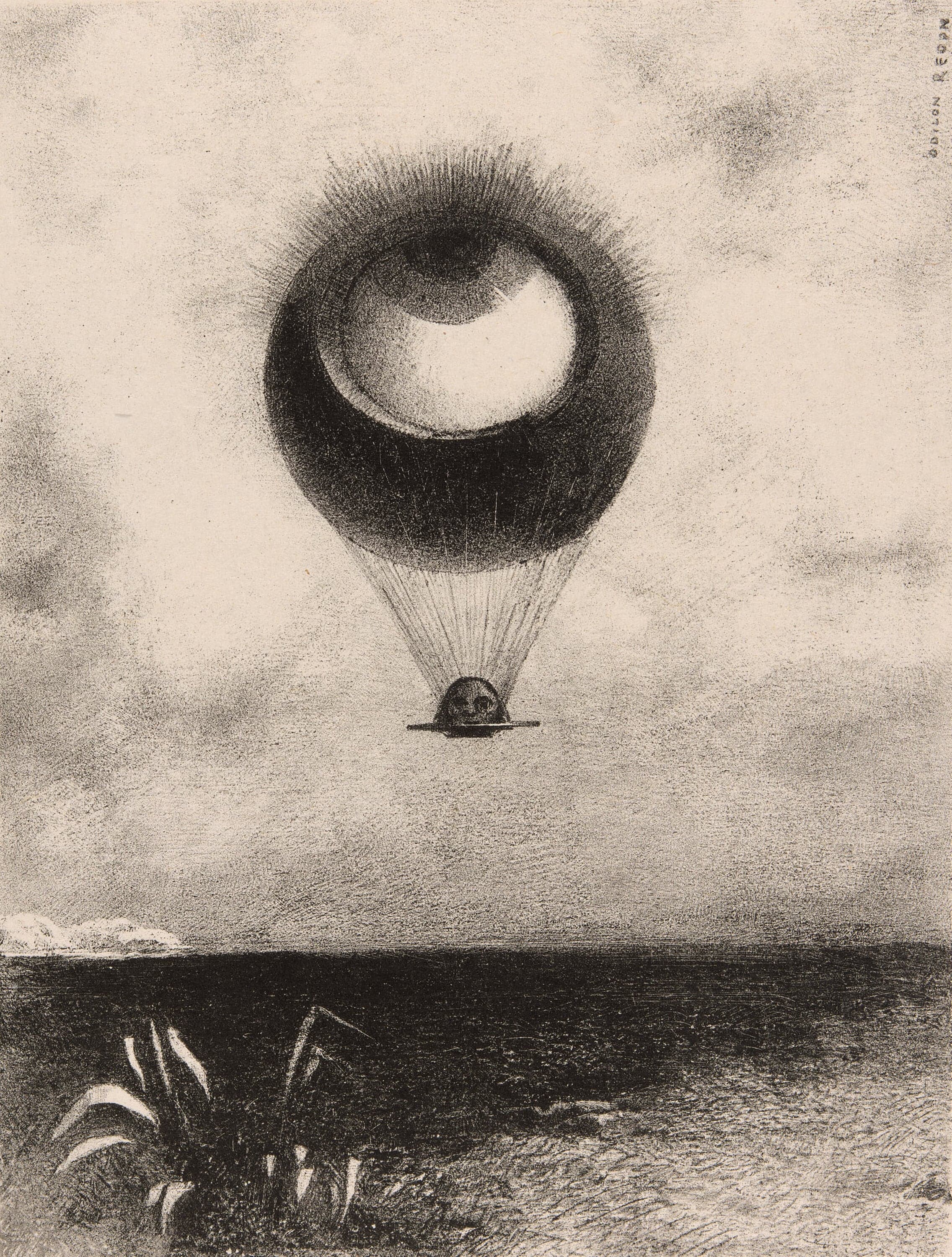
Symbolism, Decadence, Post-Impressionism, and Art Nouveau

These terms overlap because they identify different dimensions of artistic life. Symbolism concerns the expression of ideas and inner experience through suggestion. Decadence often concerns artificiality, refinement, exhaustion, and a challenge to conventional moral or aesthetic expectations. Post-Impressionism is a broader historical designation for varied developments beyond Impressionism, while Art Nouveau describes an international movement in design and the decorative arts as well as aspects of painting and illustration. One artist or object can belong to more than one of these histories.[1][2][59][117]

The Nabis are an especially clear meeting point. Their flat surfaces and expressive color connect them with Post-Impressionist painting; their resistance to literal description connects them with Symbolism; and their designs for interiors, wallpaper, posters, and other objects connect them with Art Nouveau. Calling a work decorative does not, in this context, mean that it lacks ideas. Decoration could be the means through which an idea entered an everyday environment.[18][75][117]

Siegfried Bing (1838–1905), a German-born art dealer active in Paris, opened his gallery L’Art Nouveau in December 1895. The gallery helped popularize both the style and the name, presenting contemporary decoration as a coordinated artistic enterprise. The phrase had already appeared in the Belgian journal L’Art Moderne in the 1880s, before Bing made it the name of his gallery.[117]

Magazines helped carry the new visual language across borders. The Studio, The Yellow Book, and The Savoy in Britain, La Plume in France, and Jugend and Dekorative Kunst in Germany circulated images, designs, and discussions to readers who might never visit the relevant studios or galleries. The Studio featured Beardsley’s bold, Symbolist-inspired drawings, giving this connection between literary imagination and decorative line an international audience.[117]

Salome’s changing forms illustrate the exchange. Moreau repeatedly painted her; Huysmans made those pictures central to a novel; Wilde wrote a French-language play about her; Beardsley developed a graphic world around that play. The subject did not travel unchanged. Each medium introduced a different arrangement of sensuality, cruelty, beauty, and ambiguity, while the chain connected Parisian painting with literature and some of the most distinctive illustration of the 1890s.[13][110][111][117][112]

What Symbolism contributed to modern art

Picasso, Fauvism, and Expressionism

The Spanish painter Pablo Picasso (1881–1973) encountered Gauguin’s work during his early visits to Paris, including his stay in 1901. During his formative years in Barcelona, Picasso developed Symbolist concerns that also appear in his Blue Period paintings. The Blind Man’s Meal, painted in 1903 and held by the Metropolitan Museum of Art, connects simplified form with an atmosphere of deprivation and inwardness. It belongs to a history larger than the familiar later account of Picasso as a founder of Cubism.[2]

Moreau’s teaching provided another route into modern painting. Matisse and other former students carried a belief in the artist’s personal means of expression into experiments with color that became associated with Fauvism. Munch’s use of distorted form and emotionally charged settings was important to the development of Expressionism. Neither development required the younger artists to continue painting the exact subjects of their predecessors.[43][44][107][106]

Symbolism also helped make a central question of modern painting imaginable: if color, line, and rhythm can express something beyond the depicted object, must a painting always depict an identifiable object at all? That possibility became one of the several paths through which abstraction emerged.[2][76]

The later attraction of the dream image

Symbolism’s interest in dreams and strange conjunctions also made it important to later artists concerned with the imagination. André Breton (1896–1966), the French poet and a founder of Surrealism, was deeply attached to the Musée Gustave Moreau. Breton visited the Musée Gustave Moreau with Nadja, a young woman he met in Paris in 1926. Their encounters became the subject of his book Nadja, linking the museum to Surrealist writing as well as his personal experience. Recalling his first visit at sixteen in a text of 1952, Breton credited the museum with permanently shaping his understanding of beauty and love.[48][118]

Symbolism and Surrealism were nevertheless distinct movements. The Symbolists often worked through inherited myths, religious imagery, literary references, and carefully constructed atmospheres. Later Surrealists developed their own theories and practices concerning dreams and the unconscious. A family resemblance does not erase their historical differences.[2][118]

The movement’s value is not limited to what came after it. Its paintings, poems, books, and musical works offer their own accounts of how people experience desire, fear, memory, mortality, and the limits of explanation. Symbolism’s enduring achievement was to make uncertainty artistically productive without requiring every work to supply a solution.[1][3][9]

Symbolism and Paris: places, collections, and surviving settings

Musée d’Orsay

The Musée d’Orsay holds a major concentration of French Symbolist and Nabi work. Important examples include Moreau’s Orphée, Redon’s Les Yeux clos, Sérusier’s Le Talisman, and works by Puvis de Chavannes and the Nabis. The collection makes it possible to compare approaches that otherwise appear almost incompatible: Moreau’s elaborate mythology, Redon’s restrained inwardness, and Sérusier’s compact patches of color.[12][14][54][69]

Moreau’s Galatée also belongs to the museum, extending its representation of his mythological painting. Puvis’s unfinished Panthéon frieze provides a different kind of evidence, showing a decorative project before its later realization by another artist. These are collections that reward comparison between finished pictures, preparatory work, and objects made for architectural settings.[54][119]

Displays change as paintings travel on loan and works on paper rotate for conservation. When planning a visit around a particular work, check its current collection record for display information.[12][14][54][69][119]

Musée Gustave Moreau

The Musée Gustave Moreau preserves the artist’s former home and studio galleries in the 9th arrondissement, at the historical address 14 rue de La Rochefoucauld. Museum publications describe more than fourteen thousand works by Moreau within a larger collection that also preserves objects and artworks he owned. The domestic rooms and tall, crowded studios together explain how the house was conceived as a setting for the preservation of an entire artistic life.[47][48][120]

The hinged display arrangements for drawings are particularly valuable. They reveal that the museum was not intended only as a display of a few masterpieces; it was also a place where compositions, studies, repetitions, and unrealized possibilities could remain available. The experience connects the finished image to the patient accumulation of decisions behind it.[47][48]

The Panthéon and Puvis’s Paris

The Panthéon, in the 5th arrondissement, preserves Puvis’s murals of Saint Geneviève in their architectural setting. They are especially useful for understanding why the decorative surface mattered to nineteenth-century painters: the work is not framed off from its surroundings in the same way as an easel painting. Its scale, rhythm, and pale color belong to the building.[51][26][53]

The Sorbonne and the Hôtel de Ville extend this history into education and civic representation. Their interiors do not operate as freely accessible art museums, so access should be confirmed through the institutions’ own arrangements. Taken together, these sites show that Symbolist-associated painting did not belong only to private collectors or eccentric salons; it also occupied prestigious public walls.[52]

Rue de Rome and the Mallarmé museum

Mallarmé’s former apartment at 89 rue de Rome remains an address associated with a private building, not a museum offering a reconstruction of the Tuesday gatherings. The more substantial destination for material connected with his life is the Musée départemental Stéphane Mallarmé at Vulaines-sur-Seine, where the table from those evenings survives.[5]

Some aspects of Symbolism remain embedded in Paris’s monuments, some have moved into museum collections, and others survive through books, programs, letters, and objects that were once ordinary parts of a room. The movement’s geography cannot be reduced to one neighborhood or one gallery.[51][5][74]

Selected works: a guide to the movement’s range

These works show Symbolism’s range of subjects, materials, and approaches. Locations identify holding collections or architectural settings; current displays may vary.

WorkArtistDateCollection or settingWhat it demonstrates
Oedipus and the SphinxGustave Moreau1864Metropolitan Museum of Art, New YorkMyth transformed into an intense encounter between knowledge and danger.[11]
OrphéeGustave Moreau1865Musée d’Orsay, ParisAn invented, contemplative aftermath of a violent myth.[12]
Guardian Spirit of the WatersOdilon Redon1878Art Institute of ChicagoCharcoal, impossible scale, and an apparition without a complete explanation.[25]
Island of the DeadArnold Böcklin1880, Metropolitan Museum versionMetropolitan Museum of Art, New YorkA landscape functioning as an image of mourning and an unknown destination.[113]
Vision of the SermonPaul Gauguin1888National Galleries of Scotland, EdinburghA shared inward vision expressed through deliberately unreal color.[27]
Le TalismanPaul Sérusier1888Musée d’Orsay, ParisA landscape reorganized as a small, influential arrangement of color.[69]
Christ’s Entry into Brussels in 1889James Ensor1888J. Paul Getty Museum, Los AngelesModern society recast through carnival, caricature, and religious imagery.[104]
Les Yeux closOdilon Redon1890Musée d’Orsay, ParisThe closed eye as an image of inward experience.[14]
The ScreamEdvard Munch1893, painted National Museum versionNational Museum, OsloEmotional experience expressed through figure and landscape together.[107]
Des caressesFernand Khnopff1896Royal Museums of Fine Arts of Belgium, BrusselsA sphinx’s caress suspended between tenderness and threat.[31]
Where Do We Come From? What Are We? Where Are We Going?Paul Gauguin1897–1898Museum of Fine Arts, BostonA large-scale meditation on human life framed as unanswered questions.[68]
Beethoven FriezeGustav Klimt1902Secession, ViennaA Symbolist conception realized through an architectural and musical exhibition project.[116]

Major Works of Symbolism

Paintings and objects from the movement, each with the collection that holds it today. Pictures appear where the rights allow.

A black-and-white lithograph of an enormous eyeball floating as a balloon in a pale sky, lashes radiating from its rim and rigging lines running down to a small platform carrying a dark head, above a black plain with pale spiky plants at the lower left

Artwork reproduction

Print · The noirs

The Eye Like a Strange Balloon Mounts Toward Infinity

Odilon Redon · 1882 · Lithograph in black on ivory China paper, laid down on white wove paper

Collection: Art Institute of Chicago · Chicago, United States

Works on paper are light-sensitive and are shown in rotation, so the print is not on permanent view.

An eyeball the size of a balloon floats above a dark plain, rigged with lines that run down to a small platform carrying a head. Odilon Redon drew it on stone in 1882 as the first of six lithographs he dedicated to Edgar Allan Poe. The Art Institute of Chicago and the Los Angeles County Museum of Art both hold impressions.

Odilon Redon, The Eye Like a Strange Balloon Mounts Toward Infinity, 1882. Art Institute of Chicago. Image: public domain.

Pen-and-ink illustration of a pianist at a grand piano before a moonlit Paris window, with a muted blue brush stroke.

Editorial illustration

Music composition · Musical Impressionism and Symbolism

Clair de lune

Claude Debussy · c. 1890; revised and published 1905 · Solo piano · third movement of Suite bergamasque

Debussy’s most famous piano piece turns moonlight into an experience of suspended rhythm, changing register, resonance and return rather than a literal musical picture.

Claude Debussy, Clair de lune, c. 1890; revised and published 1905.

Pen-and-ink illustration of masked dancers and musicians in a moonlit garden, with dusty-rose and moon-blue brush strokes.

Editorial illustration

Music composition · Musical Impressionism and Symbolism

Suite bergamasque

Claude Debussy · c. 1890; revised and published 1905 · Four-movement suite for solo piano

A four-movement piano suite in which Debussy looks back to dances and courtly elegance while quietly remaking harmony, rhythm and atmosphere for the twentieth century.

Claude Debussy, Suite bergamasque, c. 1890; revised and published 1905.

Pen-and-ink illustration of a draped mythic faun playing a flute beneath a tree, backed by muted olive and ochre brushwork.

Editorial illustration

Music composition · Symbolism and musical modernism

Prélude à l’après-midi d’un faune

Claude Debussy · 1892–1894; premiered 22 December 1894 · Orchestral prelude

Debussy’s languorous orchestral prelude begins with a flute phrase that weakens ordinary tonal certainty and turns Mallarmé’s suggestive poem into a landmark of musical modernism.

Claude Debussy, Prélude à l’après-midi d’un faune, 1892–1894; premiered 22 December 1894.

Pen-and-ink Symbolist illustration of a woman at a forest well with two distant men near a castle arch, accented in moss green and teal

Editorial illustration

Music composition · Symbolism and musical modernism

Pelléas et Mélisande

Claude Debussy · 1893–1902; premiered 30 April 1902 · Drame lyrique in five acts

Debussy’s only completed opera turns Maurice Maeterlinck’s Symbolist drama into an inward musical world where speech, silence and orchestral color reveal what the characters cannot explain directly.

Claude Debussy, Pelléas et Mélisande, 1893–1902; premiered 30 April 1902.

Pen-and-ink nocturnal seascape uniting clouds, a procession of lights and a women's chorus on the shore beneath a deep violet-blue sky

Editorial illustration

Music composition · Symbolism and musical Impressionism

Nocturnes

Claude Debussy · 1897–1899; premiered 1900–1901 · Three nocturnes for orchestra; women’s chorus in Sirènes

Three orchestral studies in changing perception: clouds crossing an unmoving sky, the pulse and procession of a festival, and moonlit sea heard through a wordless women’s chorus.

Claude Debussy, Nocturnes, 1897–1899; premiered 1900–1901.

Pen-and-ink illustration of a conductor and orchestral instruments swept into engraved ocean waves with a deep-blue brush stroke.

Editorial illustration

Music composition · Modernism, Musical Impressionism and Symbolism

La Mer

Claude Debussy · 1903–1905; premiered 15 October 1905 · Three symphonic sketches for orchestra

Debussy’s three symphonic sketches turn the sea into an orchestral study of emergence, motion, light, force and instability rather than a literal sequence of painted waves.

Claude Debussy, La Mer, 1903–1905; premiered 15 October 1905.

A dark-hulled sailing boat with a tall pale sail carries two white-robed figures, with a dark sketched figure at the stern, across blue water, under a sky worked in patches of orange, yellow, pale blue and white, with a deep blue mass in the upper left corner

Artwork reproduction

Drawing · Redon's late color

Flower Clouds

Odilon Redon · c. 1903 · Pastel, with touches of stumping, incising, and brushwork, on blue-gray wove paper with multi-colored fibers altered to tan, perimeter mounted to cardboard

Collection: Art Institute of Chicago · Chicago, United States

A small boat with a tall pale sail carries two seated figures in white, and a darker third shape at the stern, across colored water under a sky broken into patches of orange, blue and white. Odilon Redon drew it in pastel around 1903 and sold it to Charles Waltner in Paris in February 1904. It is at the Art Institute of Chicago, which bought it in 1990.

Odilon Redon, Flower Clouds, c. 1903. Art Institute of Chicago. Image: public domain.

A large soft brown shape, readable as a head and shoulder in shadow, rises from the bottom of a warm tan sheet beneath a crowd of white clustered blossoms, deep blue blooms, an orange leaf spray and dark green fronds, with patches of sky blue at the top

Artwork reproduction

Drawing · Redon's late color

Ophelia

Odilon Redon · 1906 · Pastel on blue-gray wove paper

Collection: Art Institute of Chicago · Chicago, United States

A soft brown shape fills the lower half of the sheet, and flowers crowd the rest of it. Odilon Redon drew the pastel in 1906 and called it Ophelia, after the young woman in William Shakespeare's Hamlet who drowns. It was given to the Art Institute of Chicago in 1973.

Odilon Redon, Ophelia, 1906. Art Institute of Chicago. Image: public domain.

A young woman with auburn hair in strict profile at the right of the sheet, in a pale blue-green dress with a high white lace collar, while the left two thirds carry rounded purple and blue flowers, white umbels, a pink daisy and small yellow flowers on bare gray paper, with more flowers along the top and down the right edge behind her

Artwork reproduction

Drawing · Redon's late color

Violette Heymann

Odilon Redon · 1910 · Pastel on gray wove paper

Collection: Cleveland Museum of Art · Cleveland, United States

A young woman in profile sits at the right of a large sheet while two thirds of it is given over to flowers. Odilon Redon drew her in pastel in 1910; she was Violette Heymann, niece of the Paris collector Marcel Kapferer, who owned the work until 1926. The Cleveland Museum of Art bought it that year and still holds it.

Odilon Redon, Violette Heymann, 1910. Cleveland Museum of Art. Image: CC0.

A bald pale-gold head with one huge dark eye rises over a purple mountain ridge; below it a naked woman lies asleep across a slope of violet, green and crimson flowers, her arm folded above her head

Artwork reproduction

Painting · Redon's late color

The Cyclops

Odilon Redon · c. 1914 · Oil on cardboard mounted on panel

Collection: Kröller-Müller Museum, Otterlo

A one-eyed giant rises over a purple ridge and looks down at a woman asleep in a bank of flowers. Odilon Redon painted it in oil around 1914, at the end of a working life that had begun in charcoal and black ink. It hangs at the Kröller-Müller Museum in Otterlo, in the Netherlands.

Odilon Redon, The Cyclops, c. 1914. Kröller-Müller Museum, Otterlo. Image: public domain.

Symbolism connections

Timeline

  1. 1857

    Charles Baudelaire publishes Les Fleurs du mal. On 20 August, he and his publishers are convicted of offending public morals; six poems are ordered suppressed.[20][32]

  2. 1864

    Gustave Moreau exhibits Oedipus and the Sphinx at the Paris Salon, establishing his public reputation.[11]

  3. 1865–1866

    Moreau paints Orphée in 1865; the French state acquires it in 1866. Mallarmé develops an early version of L’Après-midi d’un faune in 1865.[12][16]

  4. 1874–1877

    Puvis de Chavannes receives the first commission for his Saint Geneviève cycle at the Panthéon in 1874 and completes that campaign in 1877.[26]

  5. 1875

    Mallarmé moves to 89 rue de Rome. The address later becomes the setting for his celebrated Tuesday gatherings.[41][5]

  6. 1876

    L’Après-midi d’un faune appears in April with four illustrations or ornaments by Édouard Manet. Moreau shows a watercolor of The Apparition at the Salon.[16][13]

  7. 1878

    Redon makes Guardian Spirit of the Waters, an important example of his charcoal noirs.[25]

  8. 1880

    Arnold Böcklin begins the series of paintings known as Island of the Dead.[113]

  9. 1883–1884

    Les XX forms in Brussels in 1883. Huysmans publishes À rebours in 1884, and Verlaine’s first collection of Les Poètes maudits appears the same year.[103][36][45]

  10. 1886

    Jean Moréas publishes “Le Symbolisme” in Le Figaro on 18 September. Gauguin makes his first visit to Pont-Aven. Rimbaud’s Illuminations reaches a new public through publication.[19][40][60]

  11. 1888

    Gauguin paints Vision of the Sermon and unsuccessfully offers it to a church. In October, Sérusier paints the small panel later called Le Talisman. The circle that becomes the Nabis begins to take shape.[27][64][18][69]

  12. 1889

    Burne-Jones’s King Cophetua and the Beggar Maid attracts international attention at the Paris exhibition. Puvis completes his Sorbonne decoration.[109][52]

  13. 1890

    Maurice Denis publishes “Définition du néo-traditionnisme” at nineteen under the name Pierre Louis. Redon paints Les Yeux clos. Paul Fort launches the Théâtre d’Art.[76][77][14][70][89]

  14. 1891

    Gabriel-Albert Aurier publishes his essay on Symbolism in Gauguin’s painting in March. Le Barc de Boutteville begins the exhibition series associated with Impressionist and Symbolist painters.[22][80][23]

  15. 1892

    The first Salon de la Rose+Croix runs from 10 March to 10 April. Satie’s preludes for Le Fils des étoiles are performed on 19 March. Moreau becomes a professor at the École des Beaux-Arts.[85][87][102][43]

  16. 1893

    Lugné-Poe, Camille Mauclair, and Vuillard establish the Théâtre de l’Œuvre. Vollard opens his rue Laffitte shop. Munch produces the celebrated painted version of The Scream now in Norway’s National Museum.[6][82][107]

  17. 1894

    Debussy’s Prélude à l’après-midi d’un faune receives its first performance in Paris on 22 December, conducted by Gustave Doret.[97][100][98]

  18. 1895–1896

    Puvis’s Boston Public Library murals are installed. In December 1895, Siegfried Bing opens the Paris gallery L’Art Nouveau.[15][117]

  19. 1896

    The Théâtre de l’Œuvre presents Jarry’s Ubu Roi at the Nouveau-Théâtre on 10 December. Khnopff paints Des caresses.[92][31]

  20. 1897

    Péladan closes the Rose+Croix series after its sixth salon. Moreau makes the will bequeathing his house and collection to the French state. The Vienna Secession is founded.[84][47][116]

  21. 1897–1898

    Gauguin paints Where Do We Come From? What Are We? Where Are We Going? in Tahiti. It is shown in Paris in 1898.[68]

  22. 1898

    Moreau, Puvis de Chavannes, and Mallarmé die. A marionette production of Ubu Roi uses puppets by Bonnard and sets by Vuillard.[43][52][33][79]

  23. 1900

    Vollard publishes Verlaine’s Parallèlement with Bonnard’s illustrations. Denis paints Hommage à Cézanne.[82][74]

  24. 1902

    Debussy’s Pelléas et Mélisande opens at the Opéra-Comique on 30 April. Klimt creates the Beethoven Frieze, and Munch presents a major arrangement of his Frieze of Life in Berlin.[90][116][106]

  25. 1903

    The Musée Gustave Moreau opens to the public on 14 January, with Georges Rouault as its first curator.[47][48]

  26. 1922

    Redon’s À soi-même is published posthumously. Victor Koos’s completion of Puvis’s Panthéon frieze is installed.[14][54]

Symbolism: frequently asked questions

What is Symbolism in art?

Symbolism is a late nineteenth-century movement in which artists used color, line, imagery, and atmosphere to suggest ideas, emotions, dreams, or spiritual experiences. A work might draw on a myth, a biblical episode, or ordinary life, but its meaning reaches beyond a description of what is visible. Moreau’s sphinxes, Redon’s floating heads, and Gauguin’s red-ground Vision of the Sermon achieve this through very different techniques. The movement is united by an interest in suggestion and subjective experience rather than a single style.[1][2][9][27]

Who started Symbolism?

The Greek-born poet Jean Moréas gave the literary movement its public name in a manifesto published in Le Figaro on 18 September 1886. Its foundations were older: Baudelaire, Mallarmé, Verlaine, and Rimbaud shaped its poetic background, while Moreau, Puvis de Chavannes, Redon, Carrière, Böcklin, and Burne-Jones had developed related approaches in painting. In 1891 the critic Gabriel-Albert Aurier championed Gauguin as a leading Symbolist painter. Symbolism grew from these overlapping practices and circles, with no single founder responsible for the whole movement.[2][19][22]

What is the difference between Symbolism and Impressionism?

Impressionism placed particular emphasis on perception, changing light, and modern experience. Symbolism gave greater priority to ideas and inner states, often using imagined settings or deliberately unreal color. Gauguin’s Vision of the Sermon, for example, represents a biblical struggle taking place in the imagination of Breton women. The distinction concerns artistic priorities: Impressionists also selected and transformed what they saw, and Symbolists could draw on close observation. Their social and artistic worlds overlapped, as Mallarmé’s friendship with Manet demonstrates.[2][16][17][27]

Who were the main Symbolist painters?

In France, central figures include Gustave Moreau, Odilon Redon, Pierre Puvis de Chavannes, Eugène Carrière, and Paul Gauguin. The Nabis, including Paul Sérusier and Maurice Denis, connected Symbolist ideas with decorative painting. Belgium’s leading figures include Fernand Khnopff, Jean Delville, and James Ensor. Edvard Munch worked in Norway, Jan Toorop in the Netherlands, Arnold Böcklin and Ferdinand Hodler in Switzerland, and Gustav Klimt in Austria. Edward Burne-Jones and Aubrey Beardsley are major British examples. Beardsley’s main contribution was illustration, showing how closely painting and the graphic arts were connected. Their work ranges from elaborate mythology to modern anxiety, religious imagery, and intimate domestic scenes.[1][2][18][85][104][111][114][115][116]

Where can I see Symbolist art in Paris?

The Musée d’Orsay holds Moreau’s Orphée and Galatée, Redon’s Les Yeux clos, Sérusier’s Le Talisman, and work by Puvis de Chavannes and the Nabis. The Musée Gustave Moreau, at 14 rue de La Rochefoucauld in the 9th arrondissement, preserves the painter’s home and studio galleries. At the Panthéon, Puvis’s Saint Geneviève murals remain in their architectural setting. Check current display information when visiting for a particular museum work. For Mallarmé’s material legacy, the museum at Vulaines-sur-Seine outside Paris holds the dining table from his Tuesday gatherings; his former rue de Rome apartment is a private building.[5][12][14][47][51][69][119]

What is the difference between Symbolism and Art Nouveau?

Symbolism concerns the expression of ideas and subjective experience through suggestion. Art Nouveau developed a broad language of design, often using flowing lines, organic forms, and coordinated decoration across buildings, interiors, furniture, and graphic art. The same work can belong to both: Beardsley’s illustrations combine Symbolist subjects with a distinctive decorative line, while the Nabis carried expressive color into posters, wallpaper, and private interiors. Siegfried Bing’s Paris gallery L’Art Nouveau, opened in December 1895, helped popularize the design movement and its name.[18][111][117]

Was Symbolism only painting?

No. Poetry was central to Symbolism’s formation, and its history also includes novels, theater, printmaking, illustration, decorative art, and music. Huysmans’s À rebours made Moreau’s Salome paintings part of a fictional character’s private world. The Théâtre de l’Œuvre, founded in Paris in 1893, worked with artists on scenery and programs. Debussy drew on Mallarmé’s poem for his Prélude à l’après-midi d’un faune, first performed in 1894, and on Maeterlinck’s play for the opera Pelléas et Mélisande, first staged in 1902. Satie composed music for Péladan’s Rose+Croix circle.[3][6][45][90][97][102]

What was the Salon de la Rose+Croix?

The Salons de la Rose+Croix were six annual Paris exhibitions organized by the writer and occultist Joséphin Péladan from 1892 to 1897. The first ran at the Galerie Durand-Ruel from 10 March to 10 April 1892, with approximately sixty artists and a reported twenty-two thousand visitors. Péladan favored mystical, religious, legendary, and dream subjects. His rules rejected contemporary scenes, military subjects, humor, most landscapes, domestic animals, flowers, and still life, although the exhibited works did not always comply. Women were barred from exhibiting visual art but could take part in accompanying performances. The salons brought together an international mystical current within the wider movement.[30][84][85][87]

Why is Symbolism important?

Symbolism made suggestion and subjective experience central to the relationship between a work and its audience. Its expressive color, simplified forms, and dream imagery helped open paths toward Fauvism, Expressionism, abstraction, and Surrealism. Moreau’s teaching connects it with Matisse, while Munch’s emotionally charged figures and Picasso’s Blue Period show different forms of its influence. Its importance also lies in the works themselves: paintings, poems, and music that explore desire, fear, memory, mortality, and experiences that resist a complete explanation.[1][2][44][106][118][46]

When did Symbolism begin and end?

The named literary movement dates from Moréas’s manifesto of 1886, but important antecedents reach back to Baudelaire’s poetry and paintings made in the 1860s and 1870s. Its most concentrated international development occurred in the 1880s and 1890s, while major works and continuing practices extended into the early twentieth century. Klimt’s Beethoven Frieze of 1902 belongs to this later history. Symbolism had no single closing date: individual artists continued its subjects and approaches as other movements emerged.[2][3][11][19][116]

How can a Symbolist painting be recognized?

Look at the relationship between what is represented and how it is made to feel. Suggestive or unresolved narrative, visionary subjects, expressive color, unusual scale, simplified space, and figures absorbed in inward experience are common features. In Redon’s Guardian Spirit of the Waters, an immense head above tiny boats makes familiar elements feel impossible; in Closed Eyes, a nearly motionless face turns attention inward. Symbolism has no compulsory checklist of motifs, and a traditional symbol alone does not determine a work’s place in the movement.[1][2][9][14][25]

Were all Symbolists occultists?

No. Péladan’s Rose+Croix salons represented an important mystical current, but their rules applied to his exhibitions rather than to Symbolism as a whole. Artists pursued religious commitment, esoteric belief, skepticism, psychological inquiry, and the imaginative treatment of ordinary experience. Carrière’s shadowy family scenes and Munch’s images of modern anxiety show how Symbolist concerns could emerge without an occult program.[2][28][30][85][106]

References

References

The sources below include histories, manifestos, scholarly research, and primary materials that informed this page. They document Symbolism, its development, and the artists and works associated with it.

  1. 1abcdefghijkSymbolism

    Website
    Tate
    Used for

    Symbolism

    View source
  2. 2abcdefghijklmnopqrstuvwxyzSymbolism

    Website
    The Metropolitan Museum of Art
    Used for

    Symbolism

    View source
  3. 3abcdefghiLe symbolisme en litterature

    Website
    Bibliotheque nationale de France (BnF Essentiels)
    Used for

    Le symbolisme en litterature

    View source
  4. 4abcdefSymbolism and Impressionism

    Website
    Palazzetto Bru Zane (Bru Zane Mediabase)
    Used for

    Symbolism and Impressionism

    View source
  5. 5abcdefghijLa table des mardis

    Website
    Musee departemental Stephane Mallarme
    Used for

    La table des mardis

    View source
  6. 6abcdefgThe Theatre de l'Oeuvre (1893-1900): The Birth of Modern Theatre

    Website
    Musee d'Orsay
    Used for

    The Theatre de l'Oeuvre (1893-1900): The Birth of Modern Theatre

    View source
  7. 7abcdLes Nabis et les revues

    Website
    Bibliotheque nationale de France (BnF Essentiels)
    Used for

    Les Nabis et les revues

    View source
  8. 8abLa poesie symboliste

    Website
    Bibliotheque nationale de France (BnF Essentiels)
    Used for

    La poesie symboliste

    View source
  9. 9abcdefghSymbolism (glossary)

    Website
    National Galleries of Scotland
    Used for

    Symbolism (glossary)

    View source
  10. 10abcdStephane Mallarme, prince des poetes

    Website
    Bibliotheque nationale de France (BnF Essentiels)
    Used for

    Stephane Mallarme, prince des poetes

    View source
  11. 11abcdefghijGustave Moreau, Oedipus and the Sphinx

    Website
    The Metropolitan Museum of Art
    Used for

    Gustave Moreau, Oedipus and the Sphinx

    View source
  12. 12abcdefghijOrphee

    Website
    Musee d'Orsay
    Used for

    Orphee

    View source
  13. 13abcdefghiGustave Moreau, The Apparition

    Website
    Musee national Gustave Moreau
    Used for

    Gustave Moreau, The Apparition

    View source
  14. 14abcdefghijkLes Yeux clos

    Website
    Musee d'Orsay
    Used for

    Les Yeux clos

    View source
  15. 15abcdefChavannes Gallery Murals: The Muses of Inspiration

    Website
    Boston Public Library
    Used for

    Chavannes Gallery Murals: The Muses of Inspiration

    View source
  16. 16abcdefStephane Mallarme and Edouard Manet, L'apres-midi d'un faune

    Website
    Princeton University Library (Graphic Arts)
    Used for

    Stephane Mallarme and Edouard Manet, L'apres-midi d'un faune

    View source
  17. 17abcdefPaul Gauguin (1848–1903)

    Website
    The Metropolitan Museum of Art
    Used for

    Paul Gauguin (1848–1903)

    View source
  18. 18abcdefghijkThe Nabis and Decorative Painting

    Website
    The Metropolitan Museum of Art
    Used for

    The Nabis and Decorative Painting

    View source
  19. 19abcdLe Manifeste du symbolisme

    Website
    Bibliotheque nationale de France (BnF Essentiels)
    Used for

    Le Manifeste du symbolisme

    View source
  20. 20abcdCharles Baudelaire

    Website
    Academy of American Poets
    Used for

    Charles Baudelaire

    View source
  21. 21abcdVerlaine, la malediction de la poesie

    Website
    Bibliotheque nationale de France (BnF Essentiels)
    Used for

    Verlaine, la malediction de la poesie

    View source
  22. 22abcGauguin Paintings, Sculpture, and Graphic Works at the Art Institute of Chicago

    Website
    Art Institute of Chicago
    Used for

    Gauguin Paintings, Sculpture, and Graphic Works at the Art Institute of Chicago

    View source
  23. 23abGabriel-Albert Aurier: biographical chronology

    Website
    Wikipedia — Albert Aurier
    Used for

    Gabriel-Albert Aurier: biographical chronology

    View source
  24. 24↑Albert Aurier, critique d’art et poète (1865–1892)

    Website
    Pierre Remérand; proceedings of the fourth meeting of the academies of the Centre region, 2012; hosted by the Association des amis des musées de Châteauroux
    Used for

    Albert Aurier, critique d’art et poète (1865–1892)

    View source
  25. 25abcdefghOdilon Redon, Guardian Spirit of the Waters, 1878

    Website
    Art Institute of Chicago
    Used for

    Odilon Redon, Guardian Spirit of the Waters, 1878

    View source
  26. 26abcdLa Foi, l'Esperance, la Charite veillant sur sainte Genevieve au berceau

    Website
    Musee d'Orsay
    Used for

    La Foi, l'Esperance, la Charite veillant sur sainte Genevieve au berceau

    View source
  27. 27abcdefghiPaul Gauguin, Vision of the Sermon (Jacob Wrestling with the Angel), 1888

    Website
    National Galleries of Scotland
    Used for

    Paul Gauguin, Vision of the Sermon (Jacob Wrestling with the Angel), 1888

    View source
  28. 28abcdefEugene Carriere, The First Communion

    Website
    The Metropolitan Museum of Art
    Used for

    Eugene Carriere, The First Communion

    View source
  29. 29abcSynthetism

    Website
    Encyclopaedia Britannica
    Used for

    Synthetism

    View source
  30. 30abcdefAbout Rules of the Salon de la Rose+Croix by Josephin Peladan

    Website
    Solomon R. Guggenheim Foundation
    Used for

    About Rules of the Salon de la Rose+Croix by Josephin Peladan

    View source
  31. 31abcdFernand Khnopff, Des caresses, 1896

    Website
    Musees royaux des Beaux-Arts de Belgique
    Used for

    Fernand Khnopff, Des caresses, 1896

    View source
  32. 32abcdLes fleurs du mal

    Website
    Bibliotheque nationale de France (expositions)
    Used for

    Les fleurs du mal

    View source
  33. 33abcStephane Mallarme

    Website
    Academy of American Poets
    Used for

    Stephane Mallarme

    View source
  34. 34abcdPrelude to the Afternoon of a Faun

    Website
    Los Angeles Philharmonic
    Used for

    Prelude to the Afternoon of a Faun

    View source
  35. 35abcPaul Verlaine

    Website
    Academy of American Poets
    Used for

    Paul Verlaine

    View source
  36. 36abLes Poetes maudits

    Website
    Bibliotheque nationale de France (BnF Essentiels)
    Used for

    Les Poetes maudits

    View source
  37. 37abRimbaud, le poete aux semelles de vent

    Website
    Bibliotheque nationale de France (BnF Essentiels)
    Used for

    Rimbaud, le poete aux semelles de vent

    View source
  38. 38abArthur Rimbaud

    Website
    Academy of American Poets
    Used for

    Arthur Rimbaud

    View source
  39. 39↑Une saison en enfer

    Website
    Bibliotheque nationale de France (BnF Essentiels)
    Used for

    Une saison en enfer

    View source
  40. 40abLes Illuminations

    Website
    Bibliotheque nationale de France (BnF Essentiels)
    Used for

    Les Illuminations

    View source
  41. 41abMallarme en 30 dates

    Website
    Bibliotheque nationale de France (BnF Essentiels)
    Used for

    Mallarme en 30 dates

    View source
  42. 42↑Chez Mallarme : le cenacle de la rue de Rome

    Website
    Bibliotheque nationale de France (BnF Essentiels)
    Used for

    Chez Mallarme : le cenacle de la rue de Rome

    View source
  43. 43abcdefghBiography of Gustave Moreau — Musée Gustave Moreau

    Website
    Musée Gustave Moreau, Paris
    Used for

    Biography of Gustave Moreau — Musée Gustave Moreau

    View source
  44. 44abcdeGustave Moreau, 1826-1898

    Website
    The National Gallery, London
    Used for

    Gustave Moreau, 1826-1898

    View source
  45. 45abcdefgÀ rebours / Against the Grain — Joris-Karl Huysmans

    Website
    Project Gutenberg — full text of the novel in English translation
    Used for

    À rebours / Against the Grain — Joris-Karl Huysmans

    View source
  46. 46abFauvism

    Website
    The Metropolitan Museum of Art
    Used for

    Fauvism

    View source
  47. 47abcdefgMusée Gustave Moreau — official site

    Website
    Musée Gustave Moreau, Paris
    Used for

    Musée Gustave Moreau — official site

    View source
  48. 48abcdefGustave Moreau: Mythes et chimères and the museum’s centenary

    Website
    Musée de la Vie romantique; document hosted by the Musée Gustave Moreau
    Used for

    Gustave Moreau: Mythes et chimères and the museum’s centenary

    View source
  49. 49abcdOdilon Redon

    Website
    Encyclopaedia Britannica
    Used for

    Odilon Redon

    View source
  50. 50abcdeBeyond the Visible: The Art of Odilon Redon — MoMA exhibition press release

    Website
    The Museum of Modern Art, New York, 2005
    Used for

    Beyond the Visible: The Art of Odilon Redon — MoMA exhibition press release

    View source
  51. 51abcdefLe Pantheon: fiche de visite

    Website
    Centre des monuments nationaux
    Used for

    Le Pantheon: fiche de visite

    View source
  52. 52abcdefPierre Puvis de Chavannes

    Website
    Encyclopaedia Britannica
    Used for

    Pierre Puvis de Chavannes

    View source
  53. 53abSainte Genevieve ravitaillant Paris

    Website
    Musee d'Orsay
    Used for

    Sainte Genevieve ravitaillant Paris

    View source
  54. 54abcdeFrise destinee a la decoration du Pantheon

    Website
    Musee d'Orsay
    Used for

    Frise destinee a la decoration du Pantheon

    View source
  55. 55↑L’Hiver, esquisse pour l’Hôtel de Ville de Paris

    Website
    Paris Musées — Petit Palais
    Used for

    L’Hiver, esquisse pour l’Hôtel de Ville de Paris

    View source
  56. 56abPuvis de Chavannes's Philosophy Mural, in Conserving Canvas

    Website
    Getty Conservation Institute
    Used for

    Puvis de Chavannes's Philosophy Mural, in Conserving Canvas

    View source
  57. 57abcEugene Carriere

    Website
    Encyclopaedia Britannica
    Used for

    Eugene Carriere

    View source
  58. 58↑Eugene Carriere, Self-Portrait

    Website
    The Metropolitan Museum of Art
    Used for

    Eugene Carriere, Self-Portrait

    View source
  59. 59abcDecadence

    Website
    Tate
    Used for

    Decadence

    View source
  60. 60abcPaul Gauguin

    Website
    Encyclopaedia Britannica
    Used for

    Paul Gauguin

    View source
  61. 61abPont-Aven, Land of Inspiration

    Website
    Musee de Pont-Aven
    Used for

    Pont-Aven, Land of Inspiration

    View source
  62. 62abPont-Aven school

    Website
    Encyclopaedia Britannica
    Used for

    Pont-Aven school

    View source
  63. 63abcGauguin and Bernard in Brittany

    Website
    Saint Louis Art Museum — Abigail Yoder
    Used for

    Gauguin and Bernard in Brittany

    View source
  1. 64abcLetter 688: Paul Gauguin to Vincent van Gogh, Pont-Aven, on or about 26 September 1888

    Website
    Van Gogh Museum / Huygens ING, Vincent van Gogh: The Letters
    Used for

    Letter 688: Paul Gauguin to Vincent van Gogh, Pont-Aven, on or about 26 September 1888

    View source
  2. 65abEmile Bernard

    Website
    Encyclopaedia Britannica
    Used for

    Emile Bernard

    View source
  3. 66↑Synthetism

    Website
    Tate
    Used for

    Synthetism

    View source
  4. 67↑Vision of the Sermon

    Website
    Encyclopaedia Britannica
    Used for

    Vision of the Sermon

    View source
  5. 68abcdefgPaul Gauguin, Where Do We Come From? What Are We? Where Are We Going?, 1897-98

    Website
    Museum of Fine Arts, Boston
    Used for

    Paul Gauguin, Where Do We Come From? What Are We? Where Are We Going?, 1897-98

    View source
  6. 69abcdefghiLe Talisman, Paysage au Bois d'Amour

    Website
    Musee d'Orsay
    Used for

    Le Talisman, Paysage au Bois d'Amour

    View source
  7. 70abcThe Talisman — Paul Sérusier

    Website
    Musée d’Orsay — “Le « Talisman » de Sérusier, une prophétie de la couleur”
    Used for

    Le Talisman: the painting lesson and the material evidence

    View source
  8. 71abNabis (art term)

    Website
    Tate
    Used for

    Nabis (art term)

    View source
  9. 72abcdeBeyond the Easel: The Nabis and the Parisian Avant-Garde, 1890-95 - Artists

    Website
    Art Institute of Chicago
    Used for

    Beyond the Easel: The Nabis and the Parisian Avant-Garde, 1890-95 - Artists

    View source
  10. 73abPrivate Lives

    Website
    Cleveland Museum of Art
    Used for

    Private Lives

    View source
  11. 74abcdefghijklmImpressions nabies, dossier de presse

    Website
    Bibliotheque nationale de France
    Used for

    Impressions nabies, dossier de presse

    View source
  12. 75abcdNabi (glossary)

    Website
    The National Gallery, London
    Used for

    Nabi (glossary)

    View source
  13. 76abcdMaurice Denis, le Nabi aux belles icones

    Website
    Bibliotheque nationale de France (BnF Essentiels)
    Used for

    Maurice Denis, le Nabi aux belles icones

    View source
  14. 77abcDenis, Maurice

    Website
    Museo Nacional Thyssen-Bornemisza
    Used for

    Denis, Maurice

    View source
  15. 78↑Felix Vallotton: Painter of Disquiet

    Website
    The Metropolitan Museum of Art
    Used for

    Felix Vallotton: Painter of Disquiet

    View source
  16. 79abcdAffiches de theatres et de cafes-concerts

    Website
    Bibliotheque nationale de France (BnF Essentiels)
    Used for

    Affiches de theatres et de cafes-concerts

    View source
  17. 80abcPierre Bonnard, Femmes au jardin : femme a la pelerine

    Website
    Musee d'Orsay
    Used for

    Pierre Bonnard, Femmes au jardin : femme a la pelerine

    View source
  18. 81↑Galerie Le Barc de Boutteville

    Website
    Bibliothèque nationale de France — Catalogue général
    Used for

    Galerie Le Barc de Boutteville

    View source
  19. 82abcdeCezanne to Picasso: Ambroise Vollard, Patron of the Avant Garde

    Website
    Art Institute of Chicago
    Used for

    Cezanne to Picasso: Ambroise Vollard, Patron of the Avant Garde

    View source
  20. 83abAmbroise Vollard, Modern Art Index Project

    Website
    The Metropolitan Museum of Art, Leonard A. Lauder Research Center
    Used for

    Ambroise Vollard, Modern Art Index Project

    View source
  21. 84abcdefLe Salon de la Rose-Croix

    Website
    L'Histoire par l'image, Rmn-Grand Palais
    Used for

    Le Salon de la Rose-Croix

    View source
  22. 85abcdefghijMystical Symbolism: The Salon de la Rose+Croix in Paris, 1892-1897

    Website
    Peggy Guggenheim Collection
    Used for

    Mystical Symbolism: The Salon de la Rose+Croix in Paris, 1892-1897

    View source
  23. 86abcGuggenheim Presents Mystical Symbolism: The Salon de la Rose+Croix in Paris, 1892-1897

    Website
    Solomon R. Guggenheim Museum
    Used for

    Guggenheim Presents Mystical Symbolism: The Salon de la Rose+Croix in Paris, 1892-1897

    View source
  24. 87abcCatalogue du Salon de la Rose + Croix: Geste esthetique, 1892

    Website
    Bibliotheque nationale de France (Gallica)
    Used for

    Catalogue du Salon de la Rose + Croix: Geste esthetique, 1892

    View source
  25. 88↑Repertoire des catalogues de Salons

    Website
    Musee d'Orsay
    Used for

    Repertoire des catalogues de Salons

    View source
  26. 89abcPaul Fort and the Théâtre d’Art

    Website
    ARTCENA — Dictionnaire des théâtres du monde
    Used for

    Paul Fort and the Théâtre d’Art

    View source
  27. 90abcdefgPelleas et Melisande: A lire avant le spectacle

    Website
    Opera-Comique
    Used for

    Pelleas et Melisande: A lire avant le spectacle

    View source
  28. 91abcPelleas et Melisande

    Website
    Palazzetto Bru Zane (Bru Zane Mediabase)
    Used for

    Pelleas et Melisande

    View source
  29. 92abcdTheatre programme for Ubu roi by Alfred Jarry (Theatre de l'Oeuvre, 10 December 1896)

    Website
    Van Gogh Museum, Amsterdam
    Used for

    Theatre programme for Ubu roi by Alfred Jarry (Theatre de l'Oeuvre, 10 December 1896)

    View source
  30. 93abSymbolism — Debussy in Context

    Essays
    Cambridge University Press, 2024
    Used for

    Symbolism — Debussy in Context

    View source
  31. 94↑Pelléas et Mélisande — Gabriel Fauré

    Website
    Palazzetto Bru Zane (Bru Zane Mediabase)
    Used for

    Pelléas et Mélisande — Gabriel Fauré

    View source
  32. 95↑Le Château de Barbe-Bleue — concert program

    Website
    Philharmonie de Paris
    Used for

    Le Château de Barbe-Bleue — concert program

    View source
  33. 96↑Pelléas et Mélisande, op. 5 — Arnold Schoenberg

    Website
    Philharmonie à la demande
    Used for

    Pelléas et Mélisande, op. 5 — Arnold Schoenberg

    View source
  34. 97abcdePrelude to The Afternoon of a Faun

    Website
    Boston Symphony Orchestra
    Used for

    Prelude to The Afternoon of a Faun

    View source
  35. 98abcdPrelude a l'apres-midi d'un faune

    Website
    Palazzetto Bru Zane (Bru Zane Mediabase)
    Used for

    Prelude a l'apres-midi d'un faune

    View source
  36. 99↑Debussy and the proposed staging of L’Après-midi d’un faune

    Website
    Philharmonie de Paris / Orchestre de Paris
    Used for

    Debussy and the proposed staging of L’Après-midi d’un faune

    View source
  37. 100abcPrelude a l'apres-midi d'un faune de Claude Debussy

    Website
    Philharmonie de Paris (Edutheque)
    Used for

    Prelude a l'apres-midi d'un faune de Claude Debussy

    View source
  38. 101↑Erik Satie

    Website
    Palazzetto Bru Zane (Bru Zane Mediabase)
    Used for

    Erik Satie

    View source
  39. 102abcdJournee Erik Satie, programme booklet

    Website
    Cite de la musique / Philharmonie de Paris
    Used for

    Journee Erik Satie, program booklet

    View source
  40. 103abcLes XX & La Libre Esthetique (1884-1914), research project

    Website
    Musees royaux des Beaux-Arts de Belgique
    Used for

    Les XX & La Libre Esthetique (1884-1914), research project

    View source
  41. 104abcdJames Ensor, Christ's Entry into Brussels in 1889, 1888

    Website
    J. Paul Getty Museum
    Used for

    James Ensor, Christ's Entry into Brussels in 1889, 1888

    View source
  42. 105↑Christ’s Entry into Brussels in 1889 — object authority record

    Website
    Getty, Cultural Objects Name Authority
    Used for

    Christ’s Entry into Brussels in 1889 — object authority record

    View source
  43. 106abcdefEdvard Munch: A Poem of Life, Love and Death

    Website
    Musée d’Orsay
    Used for

    Edvard Munch: A Poem of Life, Love and Death

    View source
  44. 107abcdEdvard Munch, The Scream (1893), NG.M.00939 — Nasjonalmuseet collection record

    Website
    Nasjonalmuseet, Oslo
    Used for

    The Scream — Edvard Munch, 1893

    View source
  45. 108↑Edward Burne-Jones, King Cophetua and the Beggar Maid, 1884

    Website
    Tate
    Used for

    Edward Burne-Jones, King Cophetua and the Beggar Maid, 1884

    View source
  46. 109abEdward Burne-Jones: Exhibition Guide

    Website
    Tate Britain
    Used for

    Edward Burne-Jones: Exhibition Guide

    View source
  47. 110abcThe Toilette of Salome I, print by Aubrey Beardsley

    Website
    Victoria and Albert Museum
    Used for

    The Toilette of Salome I, print by Aubrey Beardsley

    View source
  48. 111abcdeAubrey Beardsley, 1872-1898

    Website
    Tate
    Used for

    Aubrey Beardsley, 1872-1898

    View source
  49. 112abOscar Wilde’s Salome: the French original and the illustrated English edition

    Website
    University of Reading Library — Fiona Barnard
    Used for

    Oscar Wilde’s Salome: the French original and the illustrated English edition

    View source
  50. 113abcdIsland of the Dead — Arnold Böcklin

    Website
    The Metropolitan Museum of Art
    Used for

    Island of the Dead — Arnold Böcklin

    View source
  51. 114abFerdinand Hodler and Symbolism

    Website
    Musée d’Orsay
    Used for

    Ferdinand Hodler and Symbolism

    View source
  52. 115abcThe Three Brides — Jan Toorop

    Website
    Kröller-Müller Museum
    Used for

    The Three Brides — Jan Toorop

    View source
  53. 116abcdefgBeethoven Frieze — Gustav Klimt

    Website
    Vienna Secession
    Used for

    Beethoven Frieze — Gustav Klimt

    View source
  54. 117abcdefgArt Nouveau

    Website
    The Metropolitan Museum of Art
    Used for

    Art Nouveau

    View source
  55. 118abcWith Nadja at Moreau

    Website
    Musée Gustave Moreau
    Used for

    With Nadja at Moreau

    View source
  56. 119abcGalatee

    Website
    Musee d'Orsay
    Used for

    Galatee

    View source
  57. 120↑Gustave Moreau: L’homme aux figures de cire — exhibition dossier, 2010

    Website
    Musée Gustave Moreau
    Used for

    Gustave Moreau: L’homme aux figures de cire — exhibition dossier, 2010

    View source
  58. 121Gustave Moreau — biographical record

    Official record
    The British Museum
    Used for

    Official record used to verify names, dates, institutional details, or other factual information on this page.

    View source
  59. 122Gustave Moreau

    Biography
    Flammarion, 1994
    Used for

    Biographical evidence used to verify chronology, relationships, and historical context connected to Symbolism.

  60. 123À rebours

    Novel
    Charpentier, 1884
    Used for

    Primary text included as part of the documented record for Symbolism.

  61. 124Odilon Redon: Prince of Dreams, 1840–1916 — exhibition catalogue

    Exhibition catalogue
    The Art Institute of Chicago / Harry N. Abrams, 1994
    Used for

    Catalogue scholarship used to verify attribution, provenance, chronology, and interpretive context for Symbolism.

  62. 125Odilon Redon — artist record

    Official record
    Musée d’Orsay
    Used for

    Official record used to verify names, dates, institutional details, or other factual information on this page.

    View source
  63. 126Stephane Mallarme and Edouard Manet, L'apres-midi d'un faune

    Website
    Princeton University Library (Graphic Arts)
    Used for

    Web source consulted for documented facts and historical context presented on the Symbolism page.

    View source
i
Why these sources are here

These references provide the documented foundation for this movement's history and interpretation. Claim-level citations remain attached to the specific claims they support.

Explore more resources