The Paris AtlasCharting the artists, works, and places worth returning to.

Painting technique and movement · Paris · 1886–circa 1906

Pointillism

Painting rebuilt from dots of pure color — Seurat's scientific answer to Impressionism.

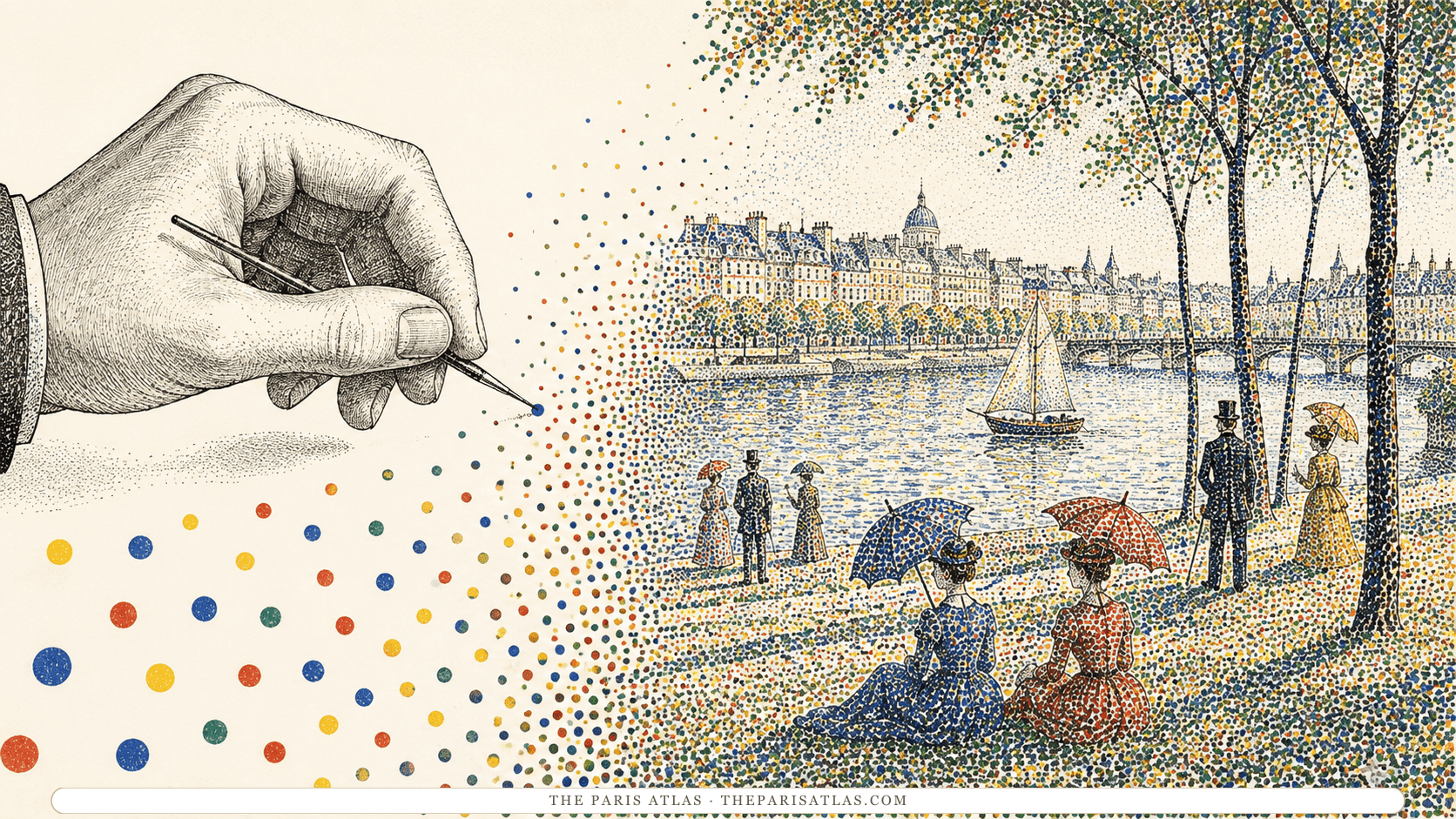
Engraved painter's hand placing a colored dot as separated blue, red, yellow, and green marks resolve into a Seine-side scene with trees, parasols, and a sailboat
Editorial illustrationThe method made visible: separate points of pure color gather into trees, water, figures and light only as the eye pulls away.

What is Pointillism?

Pointillism is painting in small, separate touches of pure color, placed side by side so that the mixing happens in the viewer's eye rather than on the palette. Georges Seurat worked the method out in Paris in the mid-1880s from the color science of his day, wanting to give Impressionism's shimmer a rational, repeatable foundation.[1]

The names were argued over from the start. Critics coined pointillism for the dots themselves, half mockingly; Seurat and his circle preferred Divisionism, for the principle of divided color, and the critic Félix Fénéon named the wider movement Neo-Impressionism in 1886. In everyday use, the dots won: pointillism is the word that stuck.[2]

1886: La Grande Jatte at the last Impressionist exhibition

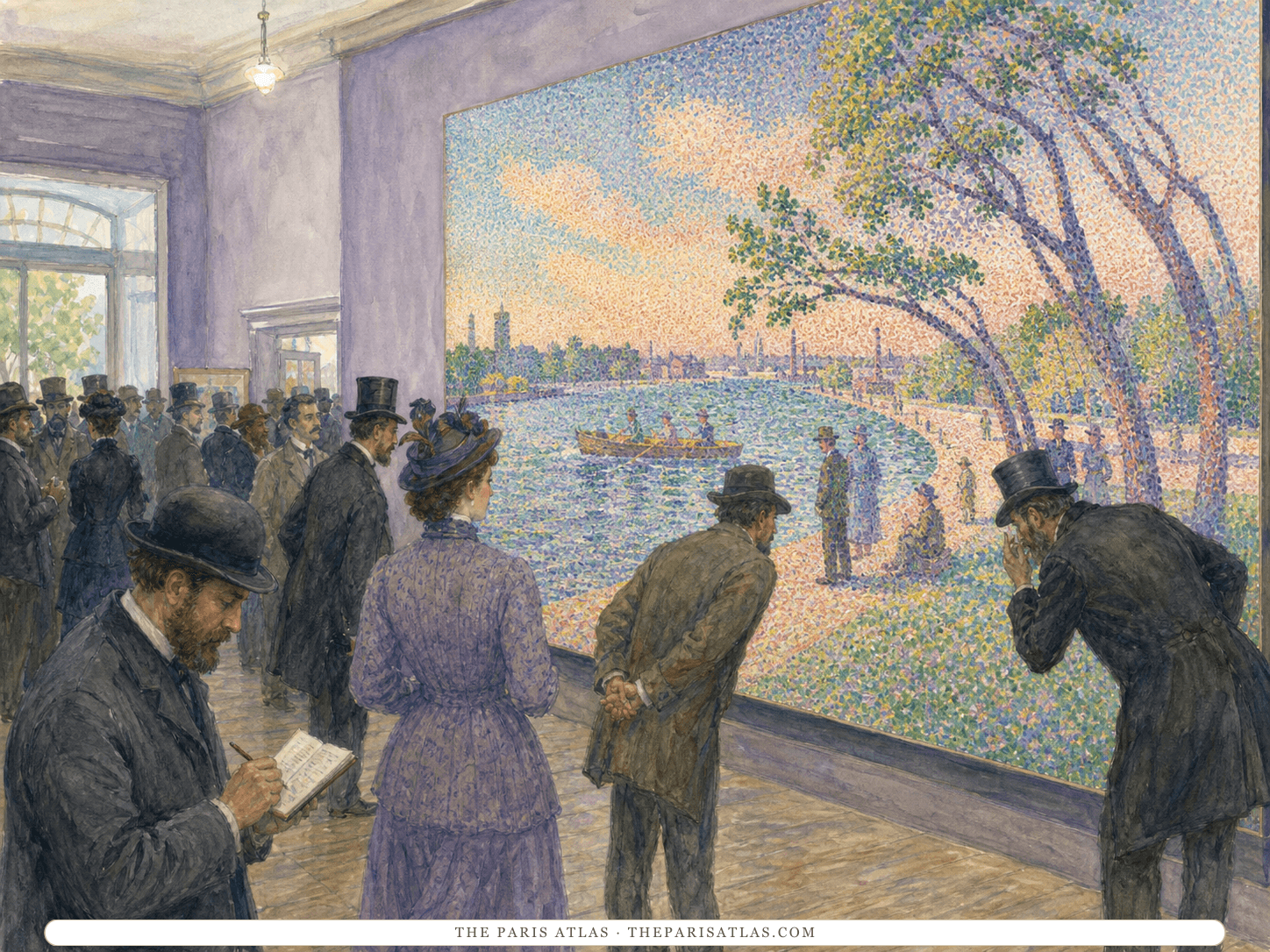
Visitors at an 1886 Paris exhibition step close to and away from a monumental dotted riverside painting while a critic writes in a notebook
Editorial illustrationThe divided surface made distance part of the encounter: marks separated at arm's length began to cohere as visitors stepped back.

The manifesto picture was A Sunday on La Grande Jatte — Seurat's two-by-three-meter canvas of Parisians at leisure on an island in the Seine, built from millions of dots over two years. Camille Pissarro, a convert to the method, pushed Seurat and Paul Signac into the eighth and final Impressionist exhibition in May 1886, where the painting hung in its own room and split the critics.[3]

The old Impressionists saw a mechanical heresy; younger painters saw a system they could learn. Signac became the movement's organizer and propagandist, and for a decade the dot spread through the Paris independents' salons.[1]

A short movement with a long afterlife

Seurat died suddenly in 1891, at thirty-one, and strict pointillism faded within a decade; even Signac loosened the dot into broader mosaic strokes. But the idea that color could be built from separated units of pure pigment ran forward: Henri Matisse painted a pointillist summer beside Signac at Saint-Tropez in 1904, Vincent van Gogh had already absorbed the broken stroke in his Paris years, and the Fauves' liberated color of 1905 starts from the dot.[4]

The famous canvases live mostly outside France: La Grande Jatte at the Art Institute of Chicago, Bathers at Asnières at the National Gallery in London. The Musée d'Orsay in Paris holds Seurat's The Circus and a strong Signac group.[5]

Seurat built modern painting on careful structure

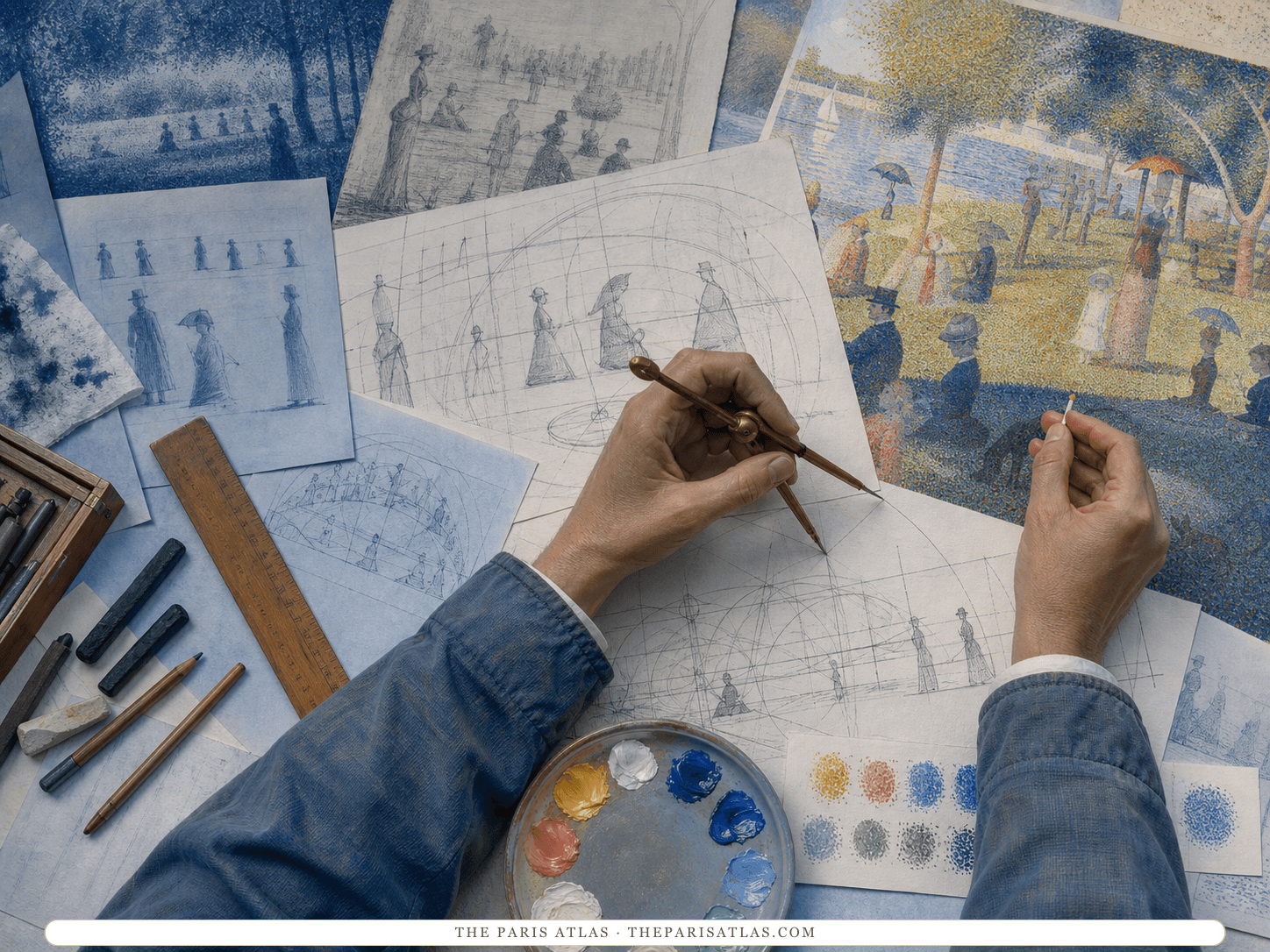
Hands use a compass and place a painted mark above layered blue figure studies, measured arcs, charcoal sticks, a ruler, palette, and color trials
Editorial illustrationBefore the dot came drawing, proportion, tonal study, and patient revision — modern color laid over a carefully planned structure.

Seurat's approach combined modern subjects with a traditional artistic education. He studied under Henri Lehmann at the École des Beaux-Arts and examined older paintings in the Louvre. His drawings, often made with Conté crayon, explored how light could emerge from carefully modulated darkness. These interests matter because his paintings were not simply demonstrations of a color formula. Their measured arrangements, simplified figures, and relationships between light and dark grew from sustained work in drawing and composition.[6]

The color theories of Michel-Eugène Chevreul, Ogden Rood, and other writers supplied additional tools. Discussions of complementary colors, contrast, and perception suggested ways to make neighboring colors affect one another. Seurat also encountered ideas through the art writer Charles Blanc and, later, Charles Henry. He developed his practice gradually rather than deriving a complete painting method from one scientific discovery.[7]

Does the color really mix in the eye?

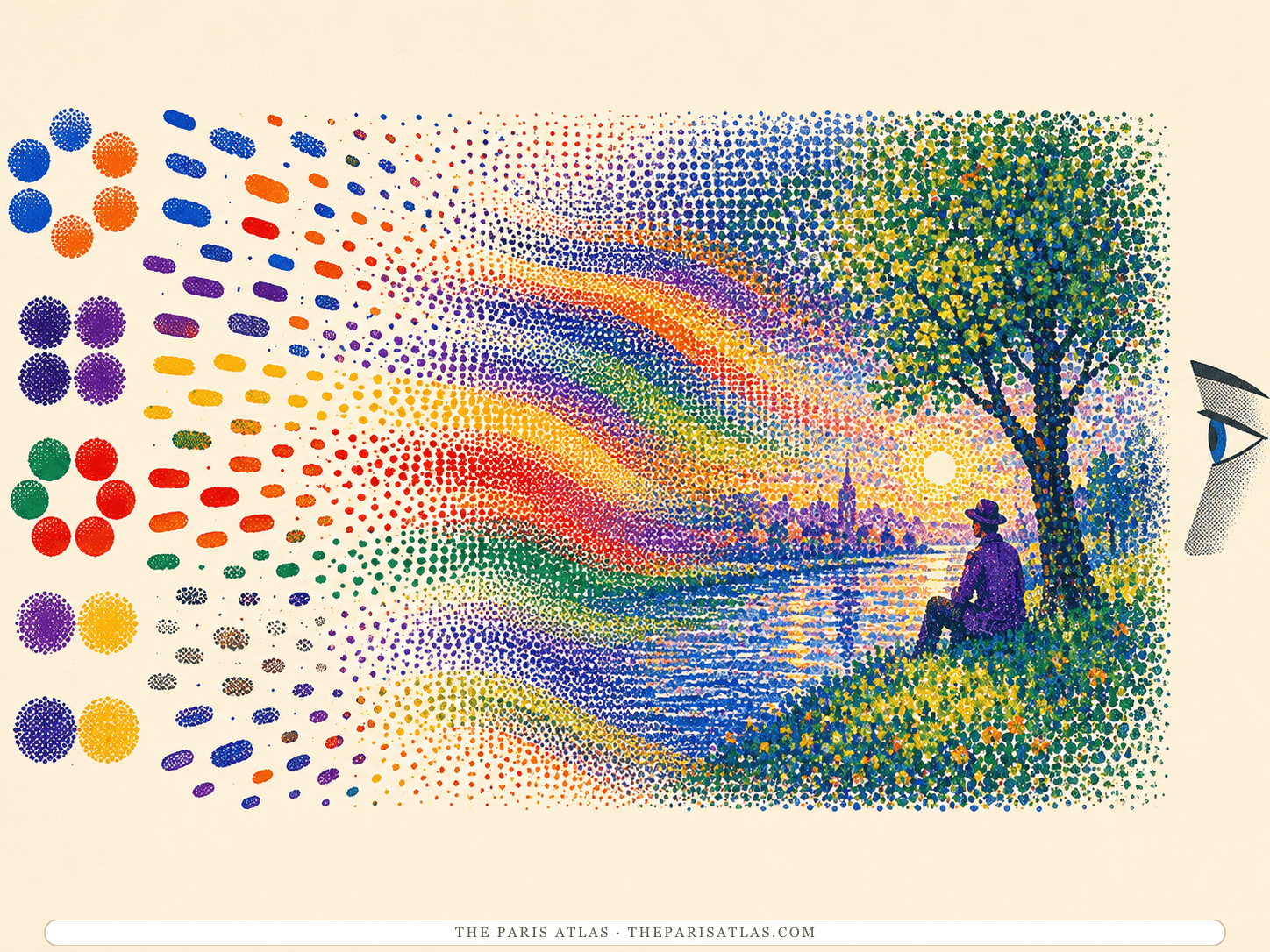
Separate colored dots and dashes flow from enlarged pairs into a luminous riverside scene while a simple eye profile looks across the marks
Editorial illustrationSeparate marks can contribute to a larger color impression without disappearing: contrast, density, scale, and viewing distance all change what the eye perceives.

'Color mixed in the eye' is a useful introduction, but it is not a complete explanation. The pigment remains on the canvas. What changes is the viewer's perception of the separate marks and the larger areas they form. From farther away, small touches may contribute to a more unified color impression; at closer range, their differences become easier to distinguish. The marks do not always disappear into one seamless color. A blended overall impression can coexist with an awareness of individual touches and the painted surface.[7]

Contrast is different from blending

Placing contrasting colors beside one another can make their differences more noticeable. That is not the same process as combining them into a single average color. Signac distinguished the effect of adjacent contrasting areas from that of thoroughly interspersed complementary dots, which could produce a much more neutral result. A successful composition therefore required more than selecting bright pigments: the artist had to consider how much of each color was present, where it appeared, and how it related to its neighbors.[7]

'Pure color' does not mean no mixing whatsoever

The familiar description of Pointillism as painting exclusively with unmixed pigment is too absolute. Even Signac's theoretical account permitted mixing with white and combining neighboring colors. The aim was to avoid indiscriminate mixing that weakened the desired color relationships, not to prohibit every mixture on the palette.[8]

Technical research into Seurat's paintings also reveals combinations of pigments, different preparatory surfaces, and changes in brushwork. The historical paintings are material objects made through varied decisions, not identical demonstrations of a single recipe. Their appearance depends on the preparation and application of paint as well as on the colors selected.[8]

1884: Bathers at Asnières and the beginning of a new approach

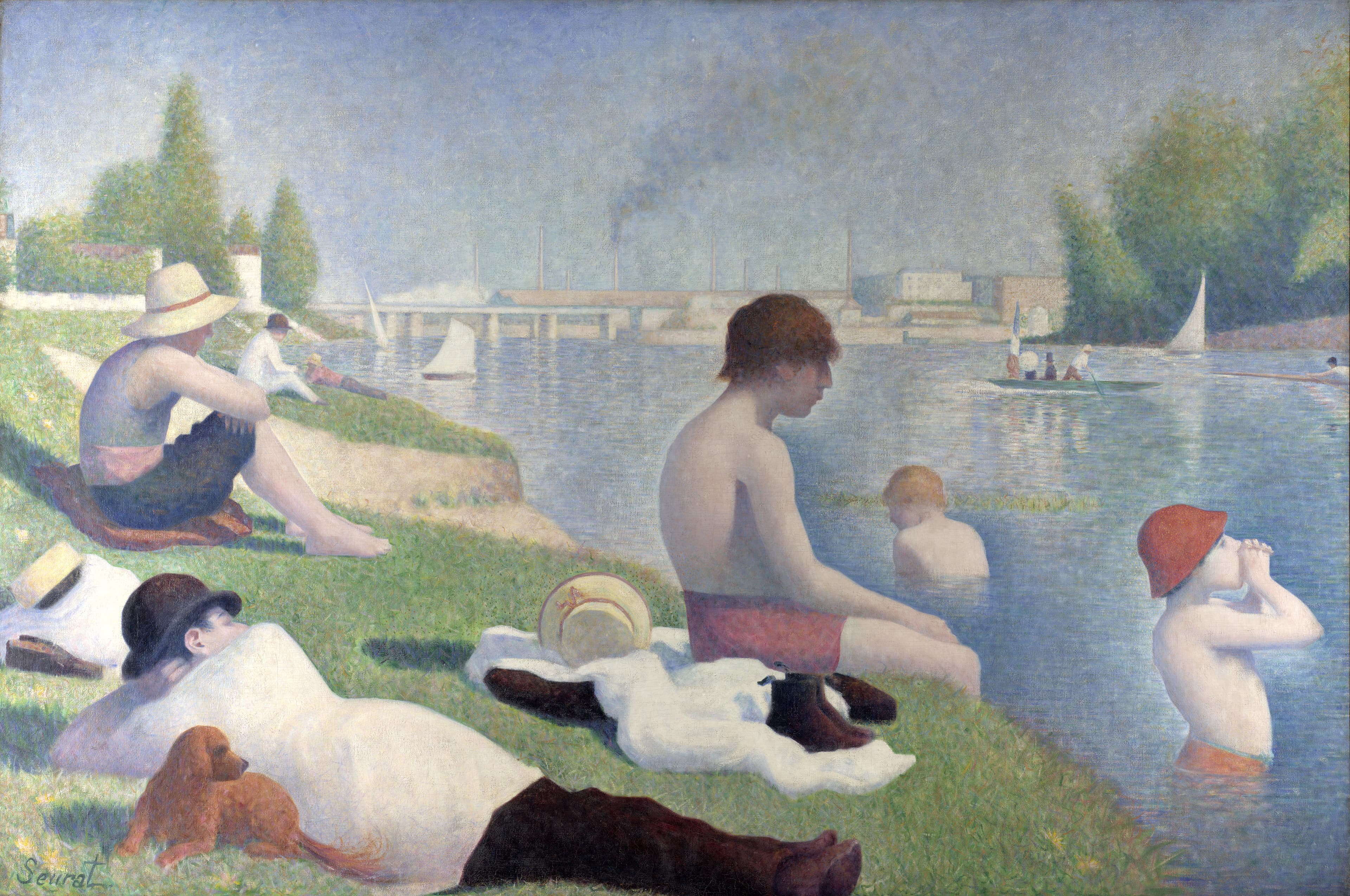
Seurat's Bathers at Asnières presents men and boys beside the Seine, with bridges and industrial buildings in the distance. Although the setting belongs to contemporary suburban life, its large scale and carefully arranged figures give the scene a monumental stillness. Seurat prepared it through numerous studies rather than treating the canvas as a rapid record of one afternoon. Rejected by the official Salon in 1884, it was subsequently shown independently.[9]

The painting is an important precursor, not a fully developed pointillist work from the outset. Its original handling includes broader strokes, and Seurat later revisited selected passages. The yellow and blue touches added to the orange hat of the boy in the water are a particularly clear example of that later experimentation.[9]

Seurat and Signac met in connection with the independent exhibition of 1884. Signac's later account describes an exchange between two painters with different strengths: his own brighter Impressionist palette and Seurat's more systematic separation of pictorial elements. Their collaboration helped turn individual experiments into a shared investigation.[10]

How a pointillist painting was constructed

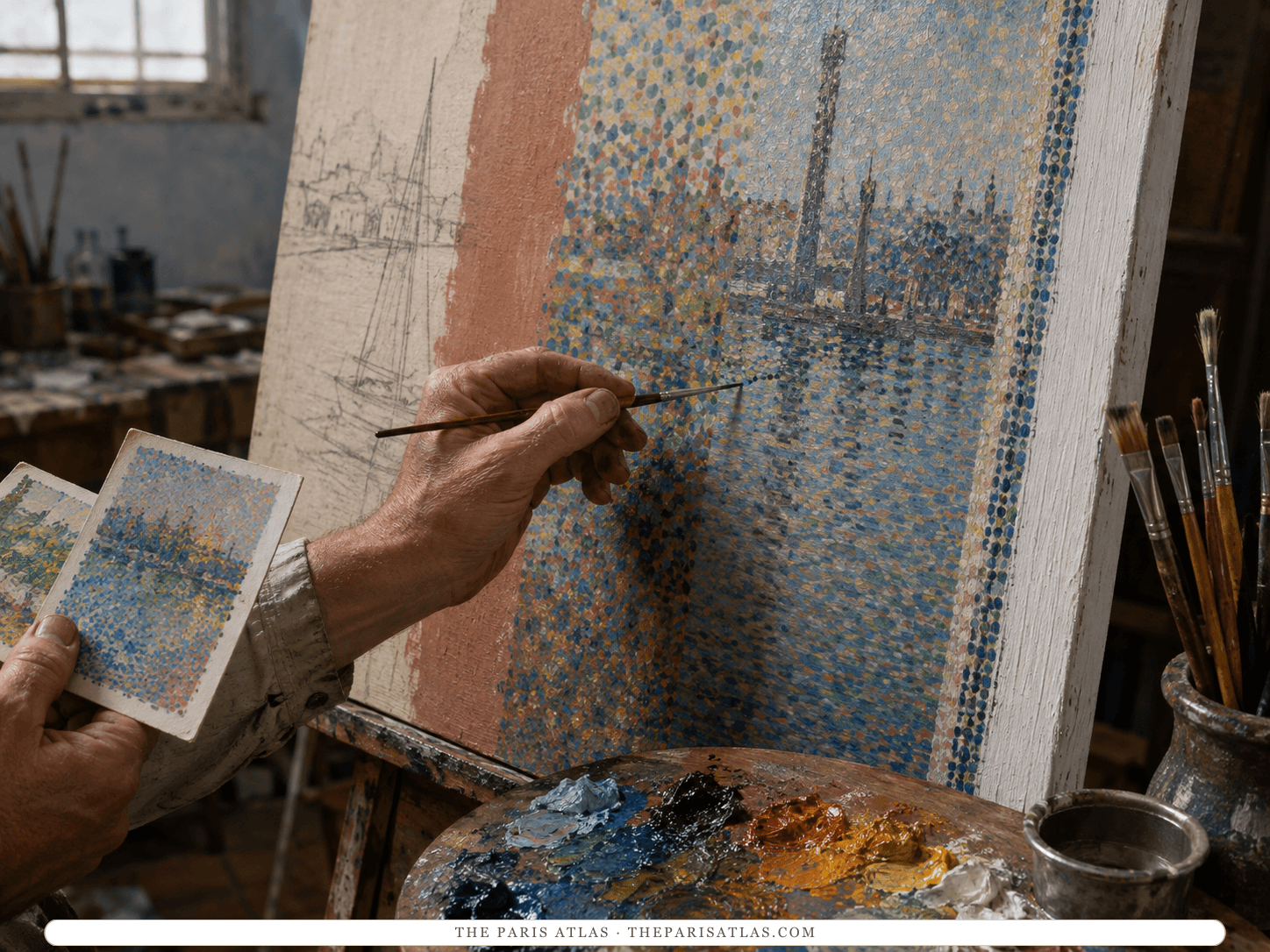
A painter adds small colored marks to a harbor canvas whose unfinished edge reveals underdrawing, a broad first layer, superimposed touches, and a dotted border
Editorial illustrationA pointillist surface was built in stages: drawing, underpaint, drying time, superimposed touches, corrections, and sometimes a border calibrated to the picture.

A finished pointillist surface could conceal a considerable amount of preparation. Technical examination of paintings by Camille and Lucien Pissarro has documented underdrawing, preliminary color, superimposed marks, and revisions. In some passages, artists allowed paint to dry before adding distinct touches over it. These practices helped preserve separation rather than producing an accidental mixture of wet colors. Even within one family, approaches to preparation and handling differed.[5]

In 1889, Seurat added a dotted border to La Grande Jatte, extending its color relationships toward a specially designed white frame. The boundary between the picture and its surroundings became part of the composition.[5]

In his theoretical writing, Signac rejected the idea of covering a canvas mechanically from one corner to the other. He described a process organized around contrasts, adjusting adjoining color relationships as the picture developed. This helps explain why counting the dots tells us very little about the artistic achievement: their placement and interaction matter more than their number.[11]

What did the Neo-Impressionists paint?

Modern leisure, performance, and artificial light

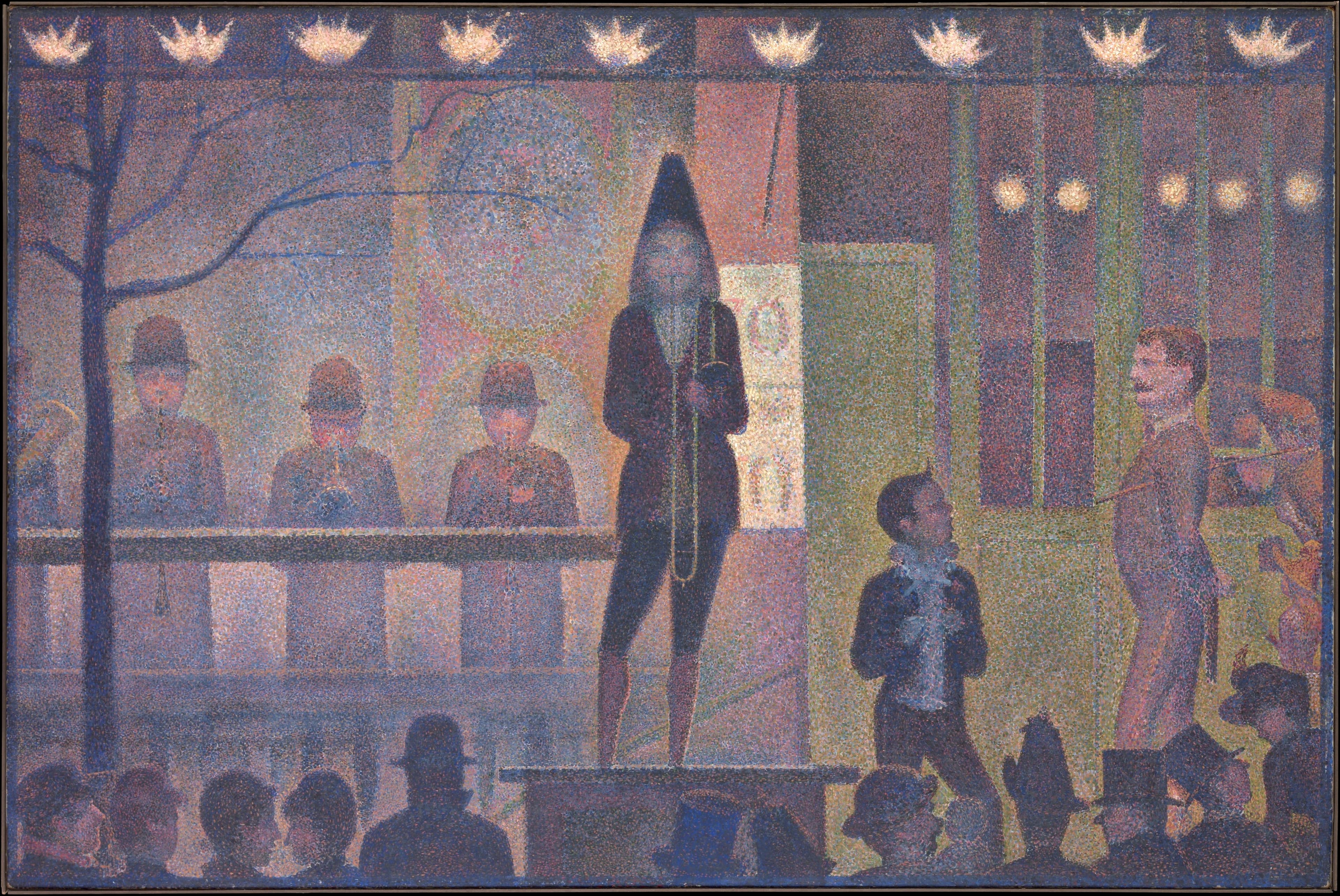
Pointillism was not restricted to sunny landscapes. Seurat's Circus Sideshow, painted in 1887–1888, represents an outdoor performance intended to attract paying customers to a circus. Its subject came from the Corvi circus at a fair in the place de la Nation in Paris. The artificial illumination and nighttime setting offered a different problem from painting daylight on water. When Seurat exhibited it in 1888, he also showed Models, a studio interior, demonstrating the range of subjects to which he applied his method.[12]

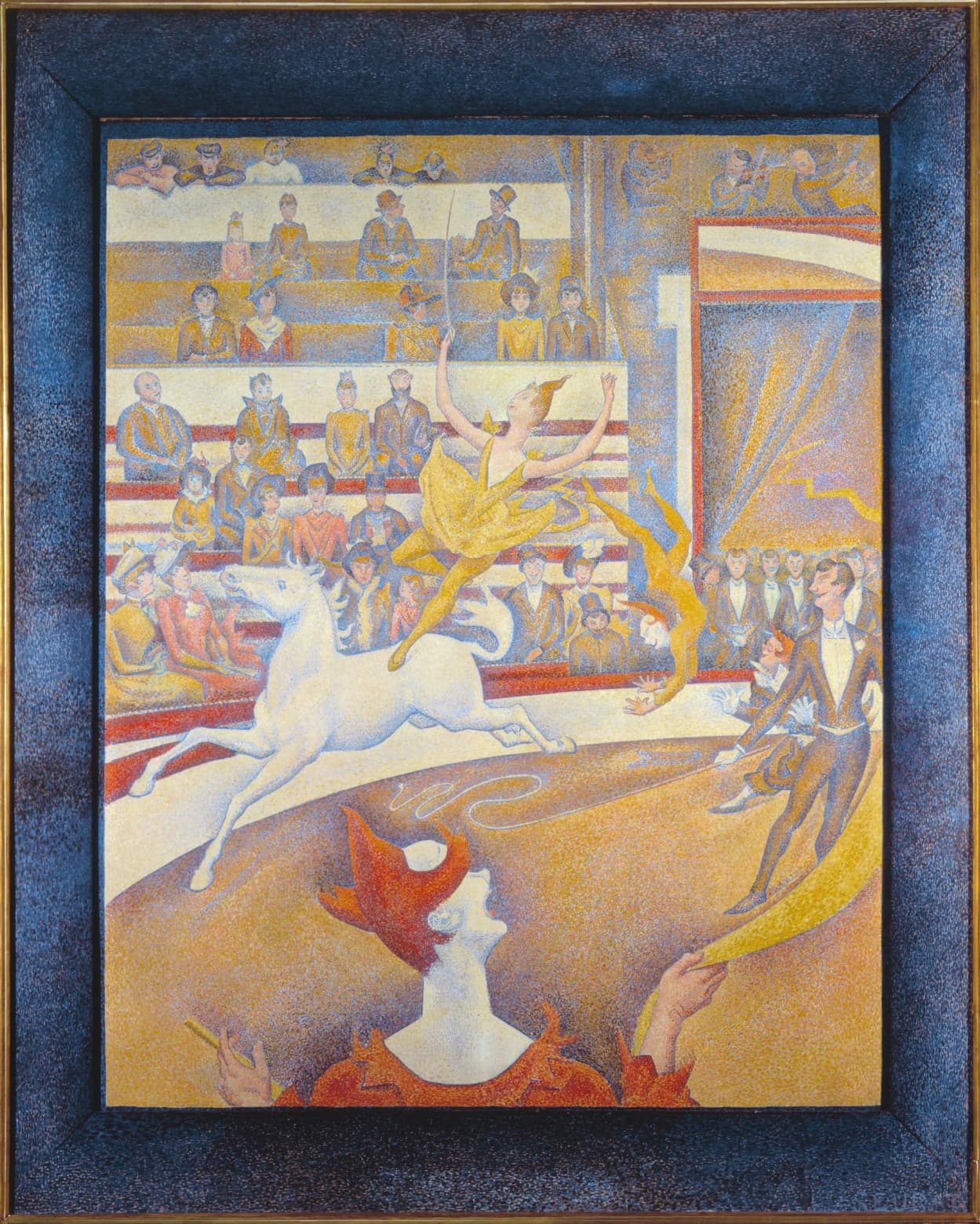
The Circus, exhibited in 1891, continued his interest in popular entertainment. Surviving studies of a clown and a horsewoman show how drawing supported the final composition. The contrast between Seurat's quiet riverside groups and his performance subjects is important: systematic color could accompany different kinds of movement and visual rhythm, not only the immobility associated with La Grande Jatte.[13]

Portraiture and decorative invention

Signac's Portrait of Félix Fénéon of 1890 places the critic in profile against an elaborate, swirling background. Fénéon was an editor and anarchist activist as well as an advocate for the painters. Signac combines an identifiable sitter with a setting organized around decorative color and rhythm rather than a plausible room. Here divided color helps create an imaginative portrait, not a neutral record of appearances.[14]

The circle also remained interested in the changing city. Maximilien Luce's Le Quai Saint-Michel et Notre-Dame, dated 1901, makes central Paris itself the subject. It offers a useful counterpart to the harbors and coastal landscapes associated with Signac and Cross.[15]

Camille Pissarro experiments with the method

Pissarro's involvement makes the relationship between Impressionism and Neo-Impressionism particularly clear. In Late Afternoon in Our Meadow of 1887, he builds a rural scene from numerous touches, varying their direction and density across grass and foliage. The method gave him another way to investigate light, but it also demanded time and sustained control. After several years, he moved away from its stricter application. His dissatisfaction concerned its limitations for his own practice; it did not prevent other painters from continuing to develop it.[16]

Signac and Cross change the method after Seurat

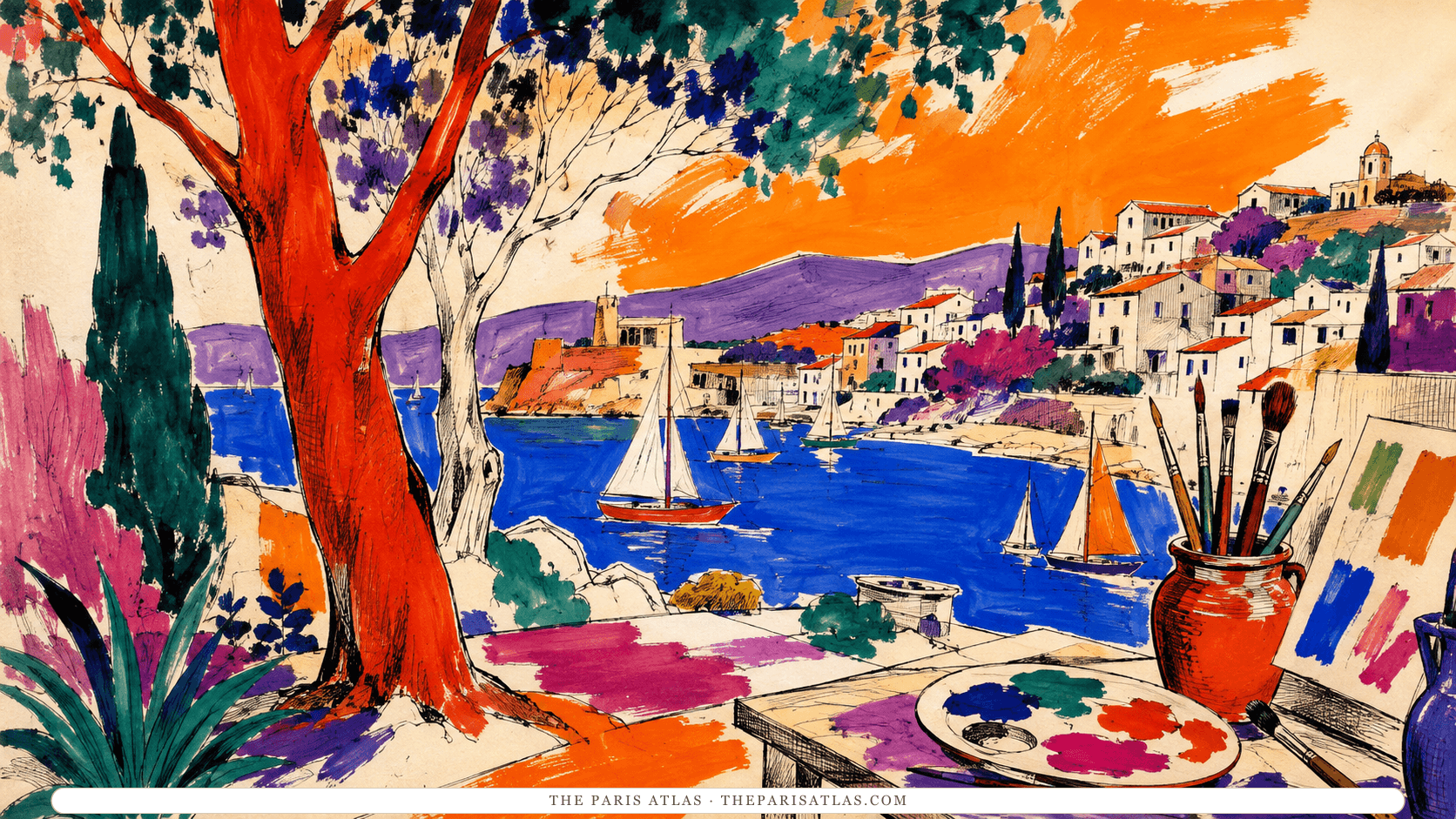
Two painters overlook a Mediterranean harbor where dense blue dots open into broad paper-like squares of turquoise, coral, lavender, and apricot
Editorial illustrationAfter Seurat, the close-grained dot opened into a broader Mediterranean mosaic as Signac and Cross pursued light, travel, and decorative scale.

Seurat died in 1891 at the age of thirty-one, shortly after exhibiting The Circus. His death deprived the group of its central innovator, but it did not bring Neo-Impressionism to an immediate end. Signac also helped preserve his colleague's work, assembling a substantial collection that included paintings and numerous drawings.[4]

Signac's subsequent career was not merely an effort to repeat Seurat. In 1892 he discovered Saint-Tropez, which became an important setting for his painting. During the 1890s, his handling grew broader and more mosaic-like, while his interest in watercolor developed alongside his oil painting. Harbors, boats, and coastal architecture offered opportunities to organize pictures through strong color relationships. The larger marks gave their own structure to the surface rather than functioning only as tiny units that should disappear at a distance.[17]

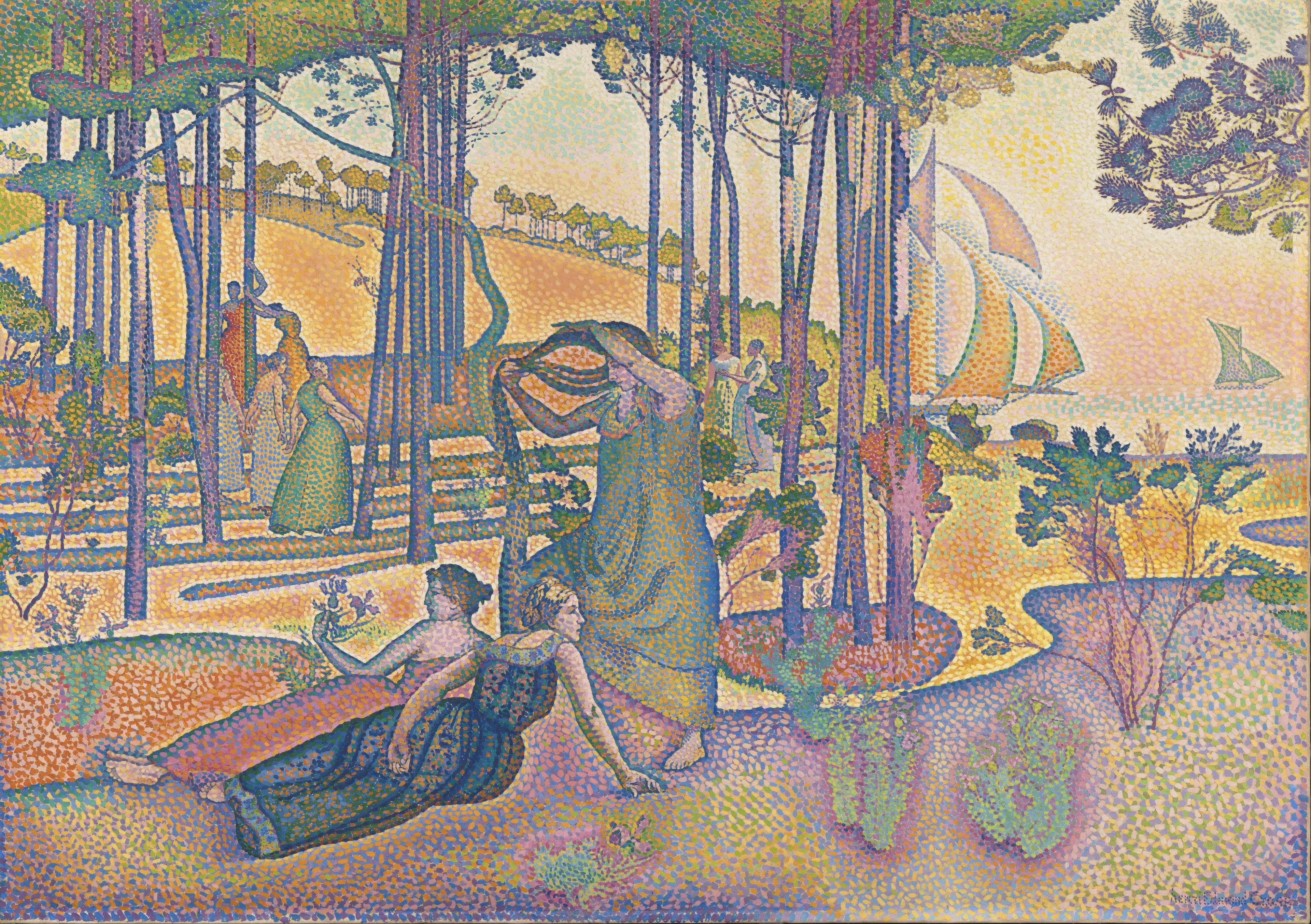
Henri-Edmond Cross pursued related experiments in southern France. In The Evening Air, made around 1893 and exhibited in 1894, he used comparatively large rectangular touches to construct an idealized scene. The painting arose from an exchange with Signac about creating a decorative tribute to the region. Its arrangement of figures and landscape also drew on the example of Puvis de Chavannes. Scientific interests and admiration for older compositional traditions could therefore coexist within the same work.[18]

Signac's book D'Eugène Delacroix au néo-impressionnisme, published in 1899, offered a sustained defense of divided color. He presented the movement as part of a longer history of painters investigating light and harmony, especially Delacroix and the Impressionists. It remains a valuable primary source, but also an advocate's argument rather than a neutral history of every painter involved.[11]

Beyond France: Belgium and Italian Divisionism

The Belgian painter Théo van Rysselberghe became an important practitioner of Divisionism, adopting the approach in the late 1880s and extending it into portraiture as well as landscape. His career demonstrates that the method could be adapted to individual sitters and social settings without sacrificing its interest in separated color. The international movement was not confined to painters making anonymous figures or distant coastal views.[19]

Anna Boch also deserves recognition as an artist, not only as a collector. An early adopter of Neo-Impressionism, she belonged to the wider network through which the approach circulated. Including her work broadens the familiar account centered almost entirely on Seurat and Signac and makes clearer that the movement's development depended on several overlapping artistic relationships.[20]

In Italy, painters including Giovanni Segantini, Angelo Morbelli, and Giuseppe Pellizza da Volpedo developed forms of Divisionism that often used elongated, thread-like strokes. Their subjects could involve social struggle, rural life, or the relationship between people and their environment. These painters shared an interest in divided color but should not all be described as imitators of French Pointillism. Italian Divisionism developed a distinct history and helped prepare the ground for Futurism.[21]

Van Gogh, Matisse, and the movement's influence

Vincent van Gogh encountered Neo-Impressionist experiments during his Paris years, from 1886 to 1888. He borrowed small, separate touches and stronger color contrasts, but combined them with other approaches. His Self-Portrait with a Straw Hat of 1887 is one example of his engagement with the new painting. It is more accurate to describe Pointillism as an influence on particular works than to classify his whole career as pointillist.[22]

Matisse's encounter with Signac and Cross in southern France in 1904 provided another important connection. Through them, he explored a brighter palette and divided touches of color. Luxe, calme et volupté, painted later that year, belongs to this phase of experimentation. His work of 1905 developed toward the freer combinations of color and brushwork associated with Fauvism. Neo-Impressionism was an important resource for that development, not the only one.[23]

The influence continued beyond the original generation. In 1959, Bridget Riley made a copy of Seurat's Bridge at Courbevoie. Studying its color relationships helped her understand possibilities that she subsequently developed in abstract painting. This is a particularly clear example of an artist learning from Seurat without adopting his subject matter or simply reproducing his dots.[24]

Pointillism and Paris: subjects, exhibitions, and collections

The movement's Paris connections extend beyond museum collections. The Seine around Asnières and La Grande Jatte supplied subjects for Seurat's major early canvases, while the city's exhibitions brought the new painting before a wider audience. Its urban entertainments supplied further material, including the fairground setting of Circus Sideshow. These are complementary parts of the story: places where artists observed modern life and places where they presented new ways of painting it.[25]

Several important works belong to the Musée d'Orsay, including paintings by Seurat, Signac, Cross, and Luce. Other major examples are held outside France. The locations below identify collections, not guarantees that a work is currently on display.[26]

Bathers at Asnières — Georges Seurat, 1884

An important precursor that Seurat later reworked. Collection: National Gallery, London.

A Sunday on La Grande Jatte — Georges Seurat, 1884–1886

Collection: Art Institute of Chicago.

Circus Sideshow — Georges Seurat, 1887–1888

Collection: Metropolitan Museum of Art, New York.

The Circus — Georges Seurat, 1891

Collection: Musée d'Orsay, Paris.

The Evening Air — Henri-Edmond Cross, circa 1893

Collection: Musée d'Orsay, Paris.

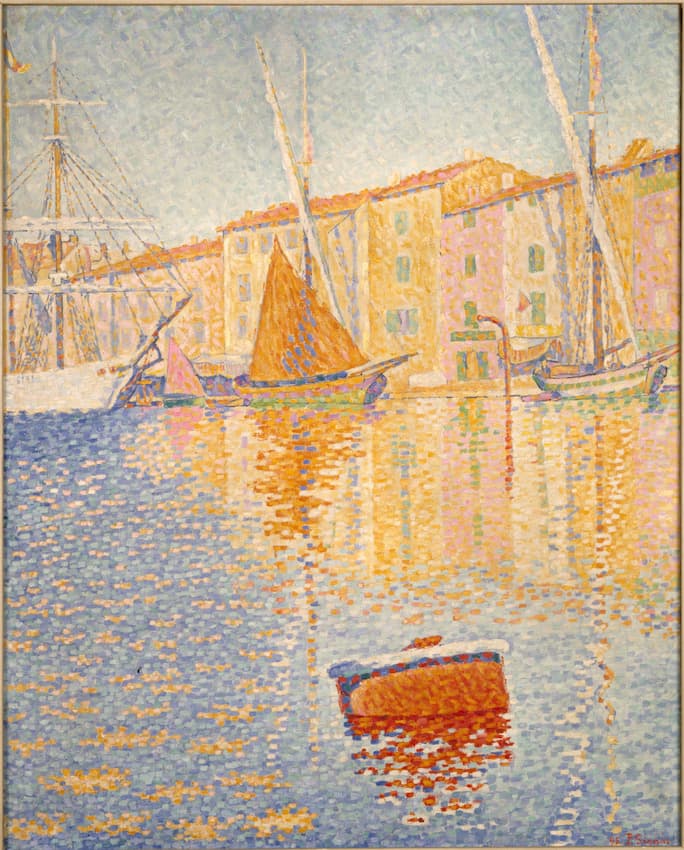
The Red Buoy — Paul Signac, 1895

Collection: Musée d'Orsay, Paris.

Major Works of Pointillism

Paintings and objects from the movement, each with the collection that holds it today. Pictures appear where the rights allow.

Seurat's A Sunday on La Grande Jatte: a large crowd in Sunday dress sits and strolls beneath trees beside the Seine, with parasols, dogs, boats, and a monkey rendered in divided color

Artwork reproduction

Painting · Pointillism

A Sunday on La Grande Jatte

Georges Seurat · 1884–1886; painted border 1888–1889 · Oil on canvas

Collection: Art Institute of Chicago

Collection locations and gallery displays can change. Check the official object record before making a special visit.

Georges Seurat turns a Sunday crowd on a Seine island into a monumental, meticulously ordered scene. Developed over two years and revised as his divided-color method took shape, A Sunday on La Grande Jatte became the defining image of Neo-Impressionism when it appeared at the final Impressionist exhibition in 1886.
Georges Seurat, A Sunday on La Grande Jatte, 1884–1886; painted border 1888–1889. Art Institute of Chicago. Image: public domain.

Seurat's Bathers at Asnières: men and boys rest beside the Seine in hazy light while boats cross the river and factory chimneys rise beyond them

Artwork reproduction

Painting · Pointillism

Bathers at Asnières

Georges Seurat · 1884; reworked circa 1886–1887 · Oil on canvas

Collection: The National Gallery, London

Collection locations and gallery displays can change. Check the official object record before making a special visit.

Georges Seurat gives working men and boys resting beside the Seine the scale and stillness of a monumental history painting. Made before his mature pointillist technique was fully established, the canvas shows how careful drawing, modern subject matter, and experiments with separated color came together in his first major composition.

Georges Seurat, Bathers at Asnières, 1884; reworked circa 1886–1887. The National Gallery, London. Image: public domain.

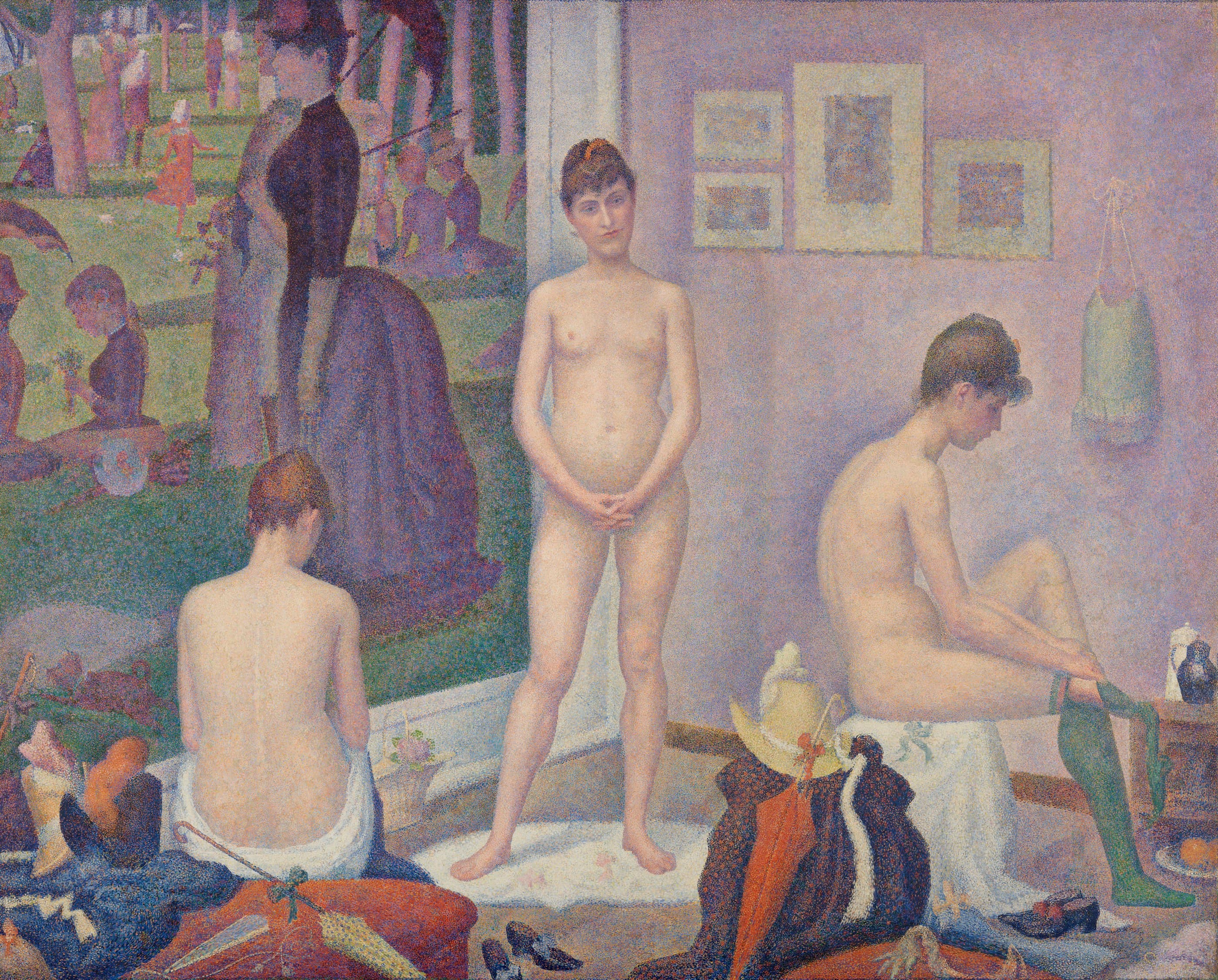
A large studio scene. On the left, part of a painted park with strolling figures hangs on the wall. Three nude young women pose in the room: one seen from behind on the left, one standing and facing us in the middle, one seated in profile on the right pulling on a green stocking. Hats, parasols, coats and shoes lie heaped on the floor, and framed pictures and a pale green garment hang on the lilac wall

Artwork reproduction

Painting · Pointillism

Models (Poseuses)

Georges Seurat · 1886–1888 · Oil on canvas

Collection: Barnes Foundation · Philadelphia, United States

Listed by the Barnes Foundation in the Main Room of the Collection Gallery, west wall, in September 2026. Check the Barnes Foundation's page before a visit.

Three young women undress, pose and dress again in a corner of Georges Seurat's studio in Paris. Behind them hangs part of his huge painting A Sunday on La Grande Jatte. Georges Seurat painted Models between 1886 and 1888, in tiny dots of colour, to show that his method could paint the nude. The Barnes Foundation in Philadelphia owns it.

Georges Seurat, Models (Poseuses), 1886–1888. Barnes Foundation. Image: public domain.

Georges Seurat's nocturnal Pointillist circus sideshow with musicians on a raised platform and a dark crowd gathered below

Artwork reproduction

Painting · Pointillism

Circus Sideshow

Georges Seurat · 1887–1888 · Oil on canvas

Collection: The Metropolitan Museum of Art

Collection locations and gallery displays can change. Check the official object record before making a special visit.

Georges Seurat applies his divided-color method to a nighttime attraction outside the Circus Corvi in eastern Paris. Musicians perform under artificial lights while an audience waits in shadow, turning the sales pitch of a fairground sideshow into a remarkably still and ordered modern spectacle.

Georges Seurat, Circus Sideshow, 1887–1888. The Metropolitan Museum of Art. Image: public domain.

Georges Seurat's Pointillist circus scene with a white horse, acrobat, ringmaster, clown, and tiered audience

Artwork reproduction

Painting · Pointillism

The Circus

Georges Seurat · 1891 · Oil on canvas

Collection: Musée d'Orsay

Collection locations and gallery displays can change. Check the official object record before making a special visit.

Georges Seurat turns a circus act into a tightly controlled experiment in motion, line, and color. A horsewoman races around the ring while acrobats spring through the air and spectators sit in rigid rows—the final, unfinished large painting of an artist who died only days after exhibiting it in 1891.

Georges Seurat, The Circus, 1891. Musée d'Orsay. Image: public domain.

Henri-Edmond Cross's Pointillist Mediterranean landscape with resting figures beneath tall trees, sailboats, and evening light

Artwork reproduction

Painting · Pointillism

The Evening Air

Henri-Edmond Cross · c. 1893 · Oil on canvas

Collection: Musée d'Orsay, Paris

The museum currently lists this painting as not on display. Check the official object record before making a special visit.

Henri-Edmond Cross's large Mediterranean scene of people resting beneath trees at the end of the day, built from broad rectangular touches of divided color. Painted around 1893, it is held by the Musée d'Orsay but is not currently on display.

Henri-Edmond Cross, The Evening Air, c. 1893. Musée d'Orsay, Paris. Image: public domain.

Paul Signac's Pointillist view of Saint-Tropez harbor with a vivid red buoy, boats, waterfront buildings, and reflected color

Artwork reproduction

Painting · Pointillism

The Red Buoy

Paul Signac · 1895 · Oil on canvas

Collection: Musée d'Orsay, Paris

The museum currently lists this painting as not on display. Check the official object record before making a special visit.

Paul Signac's 1895 view of the fishing port at Saint-Tropez, organized around a red-orange buoy against pale blue water. It belongs to the Musée d'Orsay but is not currently on display.

Paul Signac, The Red Buoy, 1895. Musée d'Orsay, Paris. Image: public domain.

Pointillism connections

Timeline

  1. 1884

    Georges Seurat shows Bathers at Asnières and begins A Sunday on La Grande Jatte, working out the divided-color method.

  2. 1884–1886

    Seurat develops La Grande Jatte through successive campaigns, adding dots over earlier brushwork rather than making one uniformly dotted surface in a single operation.

  3. 1886

    La Grande Jatte hangs at the eighth and final Impressionist exhibition in May; the critic Félix Fénéon names the movement Neo-Impressionism.

  4. 19 September 1886

    Writing in L'Art moderne, Félix Fénéon introduces the term Neo-Impressionism and helps explain the painters' ambitions beyond their conspicuous dots.

  5. 1887

    Seurat's work is exhibited with Les XX in Brussels, extending the movement's international audience and its connections with Belgian artists.

  6. 1887–1888

    Seurat paints Circus Sideshow, a nighttime scene of public entertainment, and exhibits it beside the studio interior Models in 1888.

  7. 1890

    Signac paints Félix Fénéon in profile against an invented, rhythmic background, demonstrating the decorative possibilities of divided color.

  8. 1891

    Seurat dies suddenly at thirty-one; Paul Signac becomes the movement's organizer and voice.

  9. 1892

    Signac discovers Saint-Tropez. Its harbor and surroundings become central to his continuing exploration of color.

  10. 1893–1894

    Henri-Edmond Cross creates and exhibits The Evening Air, using broad rectangular touches for a large decorative composition.

  11. 1899

    Signac publishes D'Eugène Delacroix au néo-impressionnisme, his theoretical defense of divided color.

  12. 1904

    Henri Matisse paints a pointillist summer beside Signac at Saint-Tropez, a step on the road to Fauvism.

  13. 1905

    Matisse's experiments develop toward the heightened color and freer brushwork associated with Fauvism.

  14. 1959

    Bridget Riley copies Seurat's Bridge at Courbevoie, an important step in her investigation of perception and later abstract painting.

Pointillism: frequently asked questions

What is pointillism?

A painting technique in which small, separate dots of pure color sit side by side, so the blending happens in the viewer's eye rather than on the palette. Georges Seurat developed it in Paris in the mid-1880s as a systematic, science-based successor to Impressionism.

Who invented pointillism?

Georges Seurat, working in Paris from about 1884, with Paul Signac as his closest ally and the movement's great promoter after Seurat's early death in 1891. The critic Félix Fénéon named the broader movement Neo-Impressionism in 1886.

What is the most famous pointillist painting?

A Sunday on La Grande Jatte (1884–86), Seurat's mural-sized scene of Parisians on a Seine island, first shown at the final Impressionist exhibition in May 1886 and now at the Art Institute of Chicago.

What is the difference between pointillism and divisionism?

Divisionism is the principle — dividing color into separate pure touches for the eye to mix. Pointillism is the most literal version of it, using dots. Seurat's circle preferred to speak of Divisionism or Neo-Impressionism; pointillism began as the critics' word and became everyone's.

Where can I see pointillist paintings in Paris?

The Musée d'Orsay holds Seurat's The Circus and paintings by Paul Signac and their circle. The two most famous Seurats are abroad: La Grande Jatte in Chicago and Bathers at Asnières in London.

Is Pointillism a technique or an art movement?

Strictly, it is a technique closely associated with Neo-Impressionism, the historical movement. Using Pointillism as the movement's name is common, but it can obscure the fact that Neo-Impressionist painters also used other forms of divided brushwork.

Are the dots always made with unmixed paint?

No. Signac explicitly allowed mixtures with white and neighboring colors. The important distinction is the organization of separate colored touches, not a rule that every mark must contain a single pigment.

Was Van Gogh a Pointillist?

He experimented with Neo-Impressionist color and marks, particularly in Paris, but did not use one consistent pointillist method throughout his career. The label is useful for discussing particular influences and works, not as a complete description of his art.

Is Pointillism abstract art?

The best-known historical examples represent recognizable people and places. Their colored marks can be appreciated independently, but the paintings do not abandon representation. Later artists, including Bridget Riley, drew different and sometimes abstract lessons from Seurat.

When did Pointillism end?

There is no single end date for a technique. Seurat's death in 1891 did not stop his colleagues' work, and Signac continued changing his approach for decades. Dates used to describe the original Neo-Impressionist movement should not be treated as the expiry date of painting with dots.

References

References

The sources below include histories, manifestos, scholarly research, and primary materials that informed this page. They document Pointillism, its development, and the artists and works associated with it.

  1. 1abGeorges Seurat (1859–1891) and Neo-Impressionism

    Website
    The Metropolitan Museum of Art
    Used for

    Web source consulted for documented facts and historical context presented on the Pointillism page.

    View source
  2. 2↑Neo-Impressionism: From Seurat to Paul Klee

    Website
    Musée d'Orsay
    Used for

    Web source consulted for documented facts and historical context presented on the Pointillism page.

    View source
  3. 3↑A Sunday on La Grande Jatte — 1884

    Website
    Encyclopaedia Britannica
    Used for

    Web source consulted for documented facts and historical context presented on the Pointillism page.

    View source
  4. 4abGeorges Seurat — Encyclopaedia Britannica

    Website
    Encyclopaedia Britannica
    Used for

    Web source consulted for documented facts and historical context presented on the Pointillism page.

    View source
  5. 5abcSeurat and the Making of La Grande Jatte

    Website
    Art Institute of Chicago
    Used for

    Web source consulted for documented facts and historical context presented on the Pointillism page.

    View source
  6. 6↑Georges Seurat

    Website
    The National Gallery, London
    Used for

    Web source consulted for documented facts and historical context presented on the Pointillism page.

    View source
  7. 7abcArea Dominates Edge in Pointillistic Colour

    Periodical
    i-Perception, 2018
    Used for

    Contemporary reporting or criticism used to document the historical reception and context of Pointillism.

    View source
  8. 8abSeurat's Painting Practice: Theory, Development and Technology

    Website
    The National Gallery, London, 2003
    Used for

    Web source consulted for documented facts and historical context presented on the Pointillism page.

    View source
  9. 9abBathers at Asnières — Georges Seurat

    Website
    The National Gallery, London
    Used for

    Web source consulted for documented facts and historical context presented on the Pointillism page.

    View source
  10. 10↑Georges Seurat — overview

    Website
    The Art Story
    Used for

    Web source consulted for documented facts and historical context presented on the Pointillism page.

    View source
  11. 11abD'Eugène Delacroix au néo-impressionnisme

    Nonfiction
    Wikisource, 1911
    Used for

    Published analysis and historical context used in preparing the Pointillism page.

    View source
  12. 12↑Circus Sideshow (Parade de cirque) — Georges Seurat

    Website
    The Metropolitan Museum of Art
    Used for

    Web source consulted for documented facts and historical context presented on the Pointillism page.

    View source
  13. 13↑The Clown and The Horsewoman: Two Studies for The Circus by Georges Seurat

    Website
    Musée d'Orsay
    Used for

    Web source consulted for documented facts and historical context presented on the Pointillism page.

    View source
  14. 14↑Opus 217: Portrait of M. Félix Fénéon in 1890

    Website
    Museum of Modern Art
    Used for

    Web source consulted for documented facts and historical context presented on the Pointillism page.

    View source
  1. 15↑The National Gallery, London — Late Afternoon in our Meadow (NG6689)

    Website
    Used for

    Web source consulted for documented facts and historical context presented on the Pointillism page.

    View source
  2. 16↑Inspiration, Collaboration, and Evolution: The Painting Techniques of Camille Pissarro and His Sons

    Website
    Indianapolis Museum of Art at Newfields
    Used for

    Web source consulted for documented facts and historical context presented on the Pointillism page.

    View source
  3. 17↑Paul Signac (1863–1935)

    Website
    Musée d'Orsay
    Used for

    Web source consulted for documented facts and historical context presented on the Pointillism page.

    View source
  4. 18↑L'Air du soir (Henri-Edmond Cross)

    Website
    Musée d'Orsay
    Used for

    Web source consulted for documented facts and historical context presented on the Pointillism page.

    View source
  5. 19↑Théo van Rysselberghe

    Website
    Museo Nacional Thyssen-Bornemisza
    Used for

    Web source consulted for documented facts and historical context presented on the Pointillism page.

    View source
  6. 20↑Ten Reasons to Visit Radical Harmony: Helene Kröller-Müller's Neo-Impressionists

    Website
    The National Gallery, London
    Used for

    Web source consulted for documented facts and historical context presented on the Pointillism page.

    View source
  7. 21↑Radical Light: Italy's Divisionist Painters 1891–1910

    Website
    The National Gallery, London
    Used for

    Web source consulted for documented facts and historical context presented on the Pointillism page.

    View source
  8. 22↑Vincent van Gogh (1853–1890)

    Website
    The Metropolitan Museum of Art
    Used for

    Web source consulted for documented facts and historical context presented on the Pointillism page.

    View source
  9. 23↑Luxe, calme et volupté

    Website
    Centre Pompidou
    Used for

    Web source consulted for documented facts and historical context presented on the Pointillism page.

    View source
  10. 24↑Bridget Riley: Learning from Seurat

    Website
    The Courtauld
    Used for

    Web source consulted for documented facts and historical context presented on the Pointillism page.

    View source
  11. 25↑Le Quai Saint-Michel et Notre-Dame

    Website
    Musée d'Orsay
    Used for

    Web source consulted for documented facts and historical context presented on the Pointillism page.

    View source
  12. 26↑Saint-Tropez. La Bouée rouge (Paul Signac)

    Website
    Musée d'Orsay
    Used for

    Web source consulted for documented facts and historical context presented on the Pointillism page.

    View source
  13. 27Impressionism: Art and Modernity — The Metropolitan Museum of Art

    Website
    The Metropolitan Museum of Art
    Used for

    Web source consulted for documented facts and historical context presented on the Pointillism page.

    View source
  14. 28Henri Matisse (1869–1954)

    Website
    The Metropolitan Museum of Art
    Used for

    Web source consulted for documented facts and historical context presented on the Pointillism page.

    View source
i
Why these sources are here

These references provide the documented foundation for this movement's history and interpretation. Claim-level citations remain attached to the specific claims they support.

Explore more resources