Dutch painter who worked in Delft and left fewer than forty paintings, most of them small scenes of one or two people in a quiet room lit from a window. Girl with a Pearl Earring, The Milkmaid and View of Delft are the best known.
In images
Details
Lived
1632–1675
Born
baptized 31 October 1632
Birthplace
Delft, Dutch Republic
Died
buried 15 December 1675
Place of death
Delft, Dutch Republic
Nationality
Dutch
Profession
Painter and art dealer
Major works
Girl with a Pearl Earring, The Milkmaid, View of Delft, The Art of Painting, Woman Reading a Letter, The Lacemaker, The Astronomer
Married
Catharina Bolnes · 1653–1675
Children
Maria Vermeer, Elisabeth Vermeer, Cornelia Vermeer, Aleydis Vermeer, Beatrix Vermeer, Johannes Vermeer the younger, Gertruy Vermeer, Franciscus Vermeer, Catharina Vermeer, Ignatius Vermeer
Roles
PainterArt dealer
Also known as
Jan Vermeer · Jan van der Meer van Delft · Johannes van der Meer · Vermeer of Delft
About Johannes Vermeer
Dutch painter who worked in Delft, known from fewer than forty surviving paintings
Johannes Vermeer (1632–1675) was a painter and art dealer in Delft, a town in the Dutch Republic. He was baptized there on 31 October 1632, married Catharina Bolnes in 1653, joined the painters' guild the same year, and lived in his mother-in-law's house for most of his adult life.[1][2] He painted slowly, two or three pictures a year, and fewer than forty survive.[1] Almost all of them show one or two people in a room lit by a window on the left: a maid pouring milk, a woman reading a letter, a girl turning to look over her shoulder.
He was never rich, and when war with France wrecked the Dutch art market in 1672 he fell into debt.[1] He died in December 1675 at the age of 43, leaving a widow and eleven children.[1][2] His widow told a court that worry over his debts had driven him from health to death in a day and a half.[3][4] The scientist Antoni van Leeuwenhoek was appointed to wind up his bankrupt estate.[1][2]
For almost two centuries he was little known outside the Netherlands. The French critic Théophile Thoré, writing as W. Bürger, published the first study of him in the Gazette des Beaux-Arts in 1866, and the Louvre bought The Lacemaker in 1870.[5][6] Marcel Proust made View of Delft the painting his character Bergotte dies in front of, and Salvador Dalí copied The Lacemaker at the Louvre in 1955 and built a theory of rhinoceros horns around it.[7][8]
Birth and family in Delft
Johannes Vermeer was baptized on 31 October 1632 in the Nieuwe Kerk, the Reformed church on the Market Square of Delft, a town in the province of Holland in the Dutch Republic.[1][2] The day he was born is not recorded.[1] The baptism register names his father as Reynier Janssoon and his mother as Dingnum Balthasars, the clerk's spellings for Reynier Jansz Vos and Digna Baltens.[2][1] Johannes was their second child. His sister Gertruy had been born in 1620, and no other children followed.[1]
Reynier Jansz Vos worked at three trades in turn. He earned his first living as a weaver of caffa, a fine satin. From 1629 he kept an inn on the Voldersgracht called De Vliegende Vos, The Flying Fox, and in 1631 he registered with the Delft Guild of Saint Luke as an art dealer.[1] He used the surname Vos, which means fox, before the family settled on the name Vermeer. On 1 May 1641 the family moved to a larger house and inn on the Market Square called Mechelen, and Reynier went on buying and selling paintings there.[1]
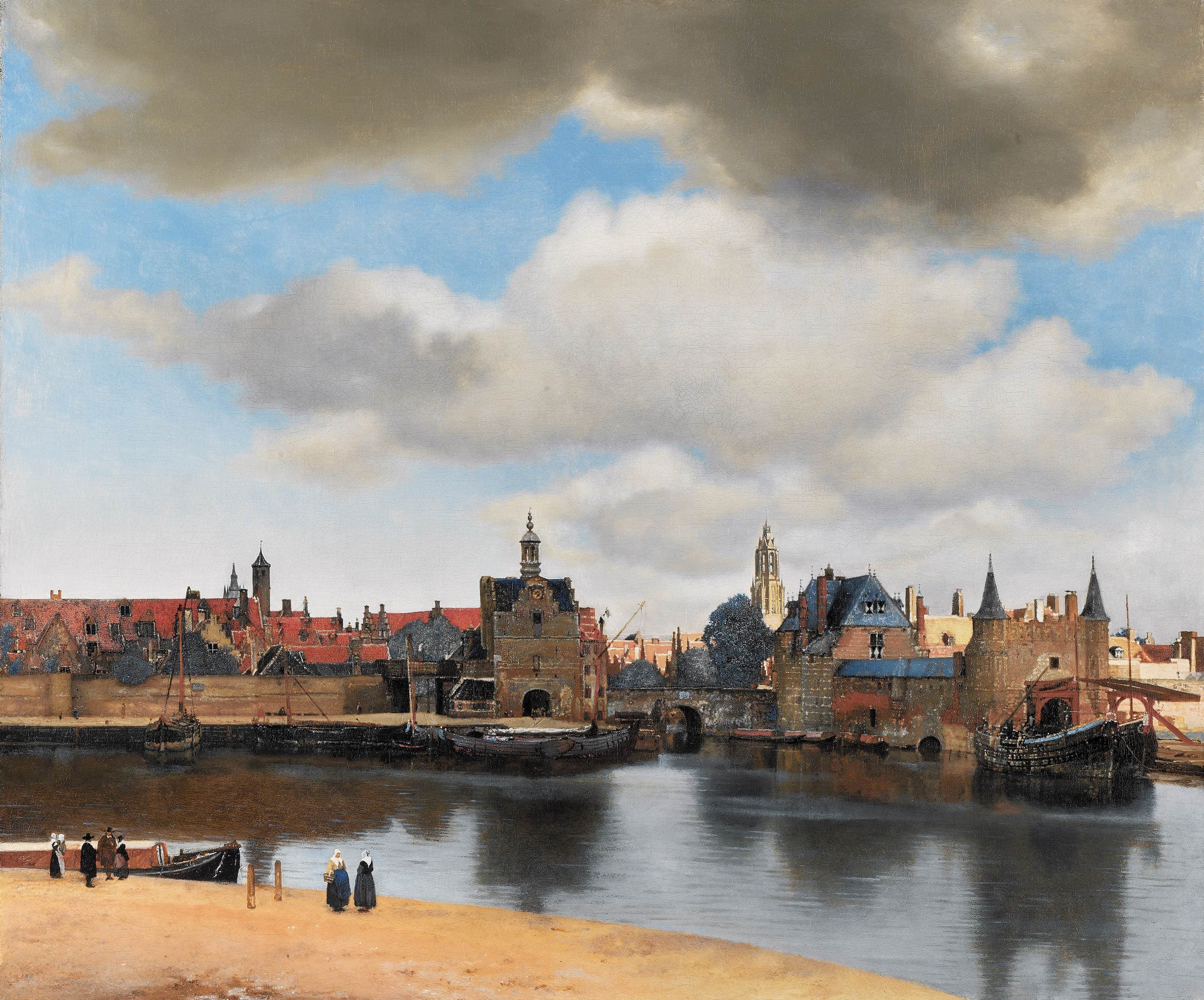
View of Delft, c. 1660–1661, oil on canvas, 96.5 by 115.7 cm (Mauritshuis, The Hague). Delft seen from the southeast across the harbor, with the tower of the Nieuwe Kerk in sunlight. Bought by the Mauritshuis at the Stinstra sale in Amsterdam on 22 May 1822. (Johannes Vermeer (Mauritshuis, The Hague), via Wikimedia Commons · Public domain)
Reynier Jansz Vos died in October 1652.[1] Johannes, who had just turned twenty, took over the picture dealing, and his mother kept running the inn. Digna Baltens tried to sell Mechelen in 1663, did not get the price she wanted, and rented it out instead.[1] She died in February 1670, and Johannes inherited the inn and went on renting it out.[1][9]
Growing up in Delft
Nothing is recorded about Vermeer's schooling.[1] What the documents give is the setting: a Protestant baptism, a childhood in an inn on the Voldersgracht and then on the Market Square, and a father who traded paintings under the same roof. The pictures his father bought and sold were the first paintings he would have seen, and the inn brought a stream of strangers through the house.
A neighbor on the Voldersgracht, the portrait painter Cornelis Rietwijck, ran a school where drawing was taught alongside other subjects, and Vermeer may have had his first drawing lessons there.[1] That is as far as the evidence goes. The historian John Michael Montias, whose 1989 book Vermeer and His Milieu recovered most of what is known about the family from Delft's notarial archives, found no document that names a teacher.[1][4]
On 12 October 1654, two years after Vermeer's father died, the city's gunpowder store exploded.[1][10] The blast, which the Dutch remember as the Delft Thunderclap, destroyed a large part of the town. Among the dead was the painter Carel Fabritius, who had joined the Delft Guild of Saint Luke in October 1652 and had trained under Rembrandt van Rijn in Amsterdam.[1][10]
Training: the teacher nobody has identified
The Delft Guild of Saint Luke registered Vermeer as a master painter on 29 December 1653.[1][11] The guild admitted only painters who had served an apprenticeship, so he trained somewhere in the years before that date. No document says where or with whom.[1] Four possibilities have been proposed, and the case for each rests on circumstance rather than on a document.
The first possibility is Leonaert Bramer (1596–1674), a Delft painter who was probably a friend of the family. Bramer witnessed the agreement that Vermeer and Catharina Bolnes drew up before a notary ahead of their marriage in April 1653.[1] He is often named as Vermeer's teacher, but his way of painting and his subjects, crowded scenes and night pieces, look nothing like Vermeer's early work.[1]
The second possibility is Carel Fabritius (1622–1654), the painter killed in the gunpowder explosion. In 1667 the Delft poet Arnold Bon published a poem in Dirck van Bleyswijck's description of the city.[1] It ends on Fabritius's death and then offers a consolation: a new painter had risen from his fire. Piet Bakker, who wrote the Leiden Collection's biography of Vermeer, thinks Fabritius is unlikely as a teacher, because the strong interest in perspective that marks Fabritius does not show up in Vermeer until years later.[1] Vermeer did own a painting by Fabritius. It was listed in his house after his death.[1]
But happily there rose from his fire / Vermeer, who, masterlike, was able to emulate him.[1]
The third possibility is Utrecht. Abraham Bloemaert (1566–1651), the leading painter in that city, was an uncle by marriage of Jan Geenz Thins, the cousin who had acted as Maria Thins's guardian.[1] An apprenticeship in Utrecht would explain why Vermeer's early pictures look like the work of the Utrecht painters who had brought Caravaggio's strong light and deep shadow back from Italy. The fourth possibility is Amsterdam. Vermeer knew the paintings of Rembrandt van Rijn and of Jacob van Loo, so he may have spent time in that city too.[1] A few days after his wedding he co-signed a document in Delft with the painter Gerard ter Borch, who lived in The Hague.[1] Ter Borch had probably come for the wedding rather than as a master seeing off a pupil.
Marriage into a Catholic family
On 5 April 1653 Vermeer and Catharina Bolnes registered their intention to marry with the Delft magistrates.[1][2] Catharina's mother, Maria Thins, refused to sign the usual consent, though she promised not to stand in the way, and the clerk crossed out and rewrote part of the entry.[2][1] The wedding took place on 20 April 1653 at Schipluiden, a village outside Delft where a Catholic ceremony could be held.[1][11]
Religion and money were the difficulty. Maria Thins (1592–1680) came from a well-off Catholic family in Gouda, and in 1622 she had married Reynier Bolnes, the owner of a brickworks.[1] The marriage broke down. She obtained a legal separation in 1641 and moved to Delft with her daughters.[12] Vermeer had been baptized a Protestant and came from an innkeeper's family, so he was both poorer and of the wrong church. He seems to have promised to become a Catholic, and the evidence suggests that he kept the promise. No Reformed baptism record survives for any of his children, and two of them were given the Catholic names Franciscus and Ignatius.[1]
Where the couple first lived is not known. By 27 December 1660, the day Vermeer buried one of his children, he gave his address as Maria Thins's house on the Oude Langendijk.[1] The street lay in the part of Delft called the Papenhoek, the Papists' Corner, next to the Jesuits' hidden church.[11] Vermeer and his family stayed in his mother-in-law's house until his death.[1] She lent him 300 guilders in 1656 and, in her will a year later, released him from paying it back.[1]
The guild and the first paintings
Vermeer joined the Guild of Saint Luke on 29 December 1653, eight months after his wedding.[1][11] He could not pay the full entry fee at once and settled the rest later. His fellow painters later elected him one of the guild's headmen, first in 1662, when he was thirty, and again in 1670.[11][9] Each term ran two years.
He started as a history painter, the branch of painting that took scenes from the Bible and from mythology and ranked highest in the guild's eyes. Two early pictures are securely his: Diana and Her Companions, now in the Mauritshuis in The Hague, and Christ in the House of Martha and Mary, in the National Galleries of Scotland in Edinburgh. A third, Saint Praxedis, signed and dated 1655, copies a picture by the Italian painter Felice Ficherelli. Scholars are divided over whether Vermeer painted it.[1] The Rijksmuseum showed it as a Vermeer in 2023, lent by the National Museum of Western Art in Tokyo.[13]
The Procuress, dated 1656 and now in the Gemäldegalerie Alte Meister in Dresden, is his first painting of everyday life.[1] It follows a picture of the same subject by the Utrecht painter Dirck van Baburen, now in the Museum of Fine Arts in Boston, which Maria Thins owned for a time. Vermeer went on to paint Baburen's picture onto the back wall of two of his own interiors, The Concert and A Young Woman seated at a Virginal.[1]
No authenticated portrait of Vermeer exists. A grinning man at the left edge of The Procuress is sometimes called a self-portrait, and so is the painter seen from behind in The Art of Painting. No document supports either identification, and there is no known likeness to check them against. Anyone who wants to know what Vermeer looked like has no reliable answer.
After The Procuress, apart from two views of Delft and two allegories, Vermeer painted interiors for the rest of his life. His output was small. Thirty-six or thirty-seven paintings are accepted as his, depending on which disputed pictures are counted, which means he finished two or three a year.[1][13] His careful technique explains part of that, but not all of it. Gerrit Dou and Jan van der Heyden painted just as minutely and left far larger bodies of work.[1]
The best-known paintings
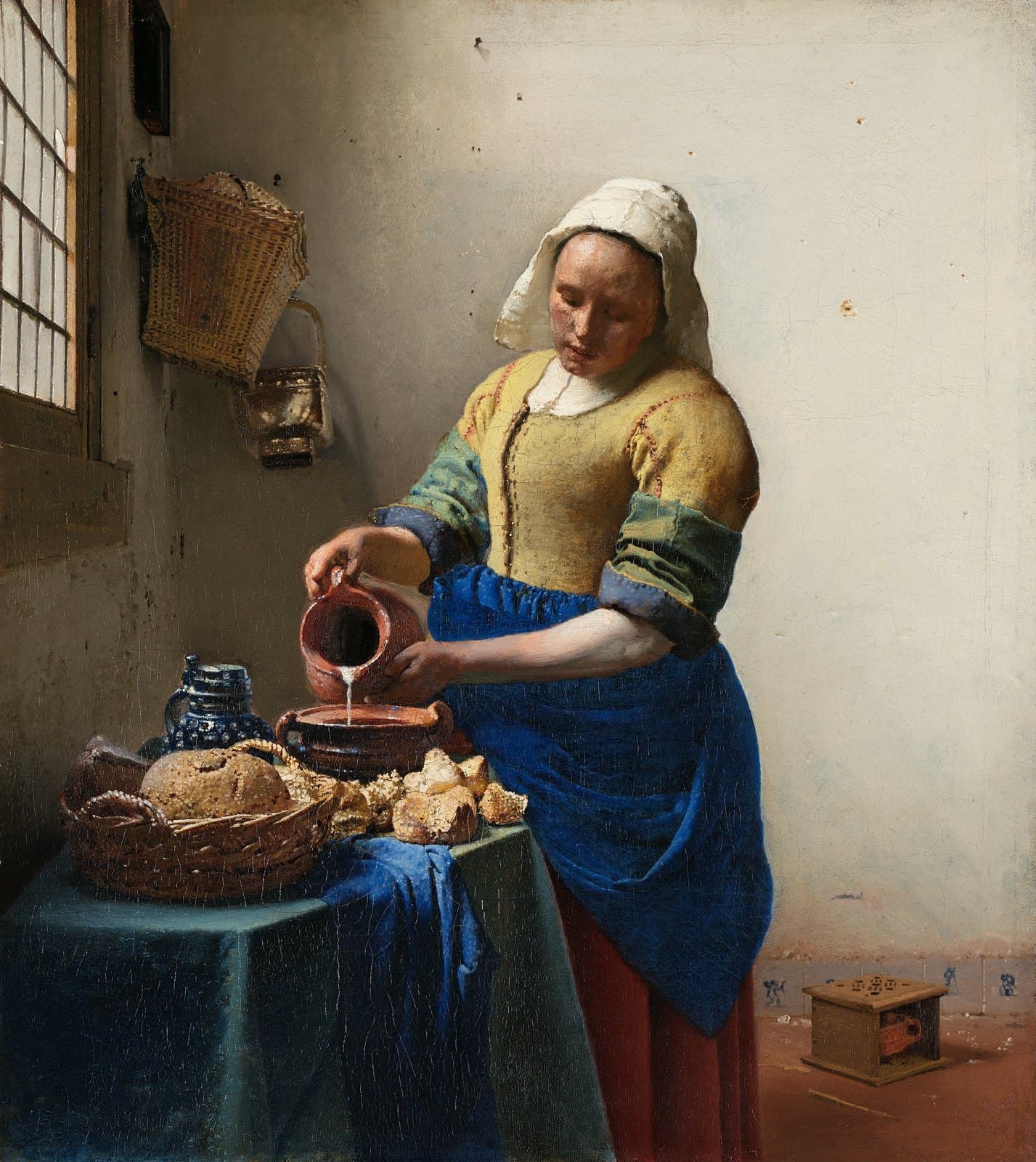
The Milkmaid, c. 1660, oil on canvas, 45.5 by 41 cm (Rijksmuseum, Amsterdam). Bought by the Rijksmuseum in 1908, with 38 other paintings from the Six family heirs, with support from the Vereniging Rembrandt. (Johannes Vermeer (Rijksmuseum, Amsterdam), via Google Arts & Culture and Wikimedia Commons · Public domain)
The Milkmaid, painted around 1660 and now in the Rijksmuseum in Amsterdam, is 45.5 by 41 cm.[14] A servant pours milk from a jug into a bowl on a table by the window, and nothing else in the room is moving. Bread sits in a basket, a foot warmer stands on the tiled floor, and the light on the bread and the basketwork is built up from hundreds of small thick dots of pale paint.[14] At the auction of the Dissius collection in Amsterdam on 16 May 1696 the picture was lot 2 and sold for 175 guilders to the Amsterdam collector Isaac Rooleeuw.[14] It came to the Rijksmuseum in 1908, bought from the heirs of the Six family with 38 other paintings for 550,000 guilders and with the support of the Vereniging Rembrandt.[14]
In September 2022 the Rijksmuseum announced what new scans of The Milkmaid had found. On the wall behind the maid's head Vermeer had sketched a rack of jugs in black paint and then left it out.[15] At the lower right he had painted a fire basket, a willow basket that held a bowl of hot coals to warm a baby or dry cloths, and then covered it with the foot warmer, the tiles and the floor.[15] The inventory of his own house lists a fire basket.[15]
View of Delft, painted about 1660 to 1661 and now in the Mauritshuis, is 96.5 by 115.7 cm.[16] It shows the town from the southeast, across a triangular harbor called the Kolk at the southern edge of the city. The Schiedam Gate stands on the left and the Rotterdam Gate on the right, with the tower of the Nieuwe Kerk between them, lit by sun. Two groups of people are talking on the near bank, the boats are moored with their sails down, and the trees are in leaf, so the season is late spring or summer.[16]
Vermeer changed the town to make the picture calmer than the view really was. He shifted the Nieuwe Kerk spire towards the center, straightened and lengthened the bridge between the two gates, and lowered the Rotterdam Gate towards the water.[16] He also picked a different technique for each surface. The rough bright roof on the right is built over coarse grains of white lead in the underpainting. The sunlit church tower carries a thick smooth layer of lead-tin yellow. The hull of the boat by the Rotterdam Gate is covered in tiny dots of paint that read from a distance as sparkling water.[16] The painting was lot 31 at the Dissius sale of 1696. The Mauritshuis bought it at the S. J. Stinstra sale in Amsterdam on 22 May 1822.[16]
Girl with a Pearl Earring, c. 1665, oil on canvas, 44.5 by 39 cm (Mauritshuis, The Hague). A tronie, a painted head of a type rather than a named sitter, bought at auction in 1881 for two guilders and thirty cents and bequeathed to the museum in 1903. (Johannes Vermeer (Mauritshuis, The Hague), via Wikimedia Commons · Public domain)
Girl with a Pearl Earring, painted about 1665 and also in the Mauritshuis, is 44.5 by 39 cm.[17] It is not a portrait of a named person. The Mauritshuis calls it a tronie, the Dutch word for a painted head that shows a type or a character, often in unusual dress, rather than a sitter who paid to be recorded.[17] Seventeenth-century Dutch women did not wear turbans, and the pearl is improbably large. Both are costume rather than a record of what someone owned.
The picture came out of obscurity at an auction in The Hague in 1881.[17] The government official Victor de Stuers spotted it on the viewing day, standing beside his friend and neighbor the collector Arnoldus Andries des Tombe. The two men agreed not to bid against each other, and Des Tombe took it for two guilders and thirty cents.[17] He lent it to the Mauritshuis the same year. He left it to the museum when he died in 1902, and it entered the collection in 1903.[17][18]
The Mauritshuis examined the painting in 2018 in a project it called The Girl in the Spotlight, and published the results in the journal Heritage Science in 2019. The canvas was primed with a warm light gray ground, probably by someone other than Vermeer.[19] On top of it he laid areas of light and shade and drew fine black outlines around the figure, then changed his mind about details as he went: the girl's ear was moved.[19] The background, long taken for flat black, turned out to be a glaze colored with indigo and yellow weld over a black underlayer.[20] The glaze has since broken down. Imaging picked out Vermeer's signature in it, and the suggestion of a folded curtain on the right.[20]
The Art of Painting, painted about 1666 to 1668 and now in the Kunsthistorisches Museum in Vienna, is 120 by 100 cm.[21] A painter sits with his back to the viewer at his easel. His model stands by the window dressed as Clio, the muse of history, with a laurel wreath, a trumpet and a book. A map of the seventeen provinces of the Netherlands hangs on the back wall under a brass chandelier, and a heavy curtain is drawn back at the left.[21] Vermeer never sold it, and after his death it was the one picture his widow tried hardest to keep out of the bankruptcy.[21][1] Count Rudolf Czernin acquired it in Vienna in 1813, Adolf Hitler bought it from the Czernin family in 1940, and after the war the Allied collecting point in Munich handed it to the Kunsthistorisches Museum on 7 November 1946.[21]
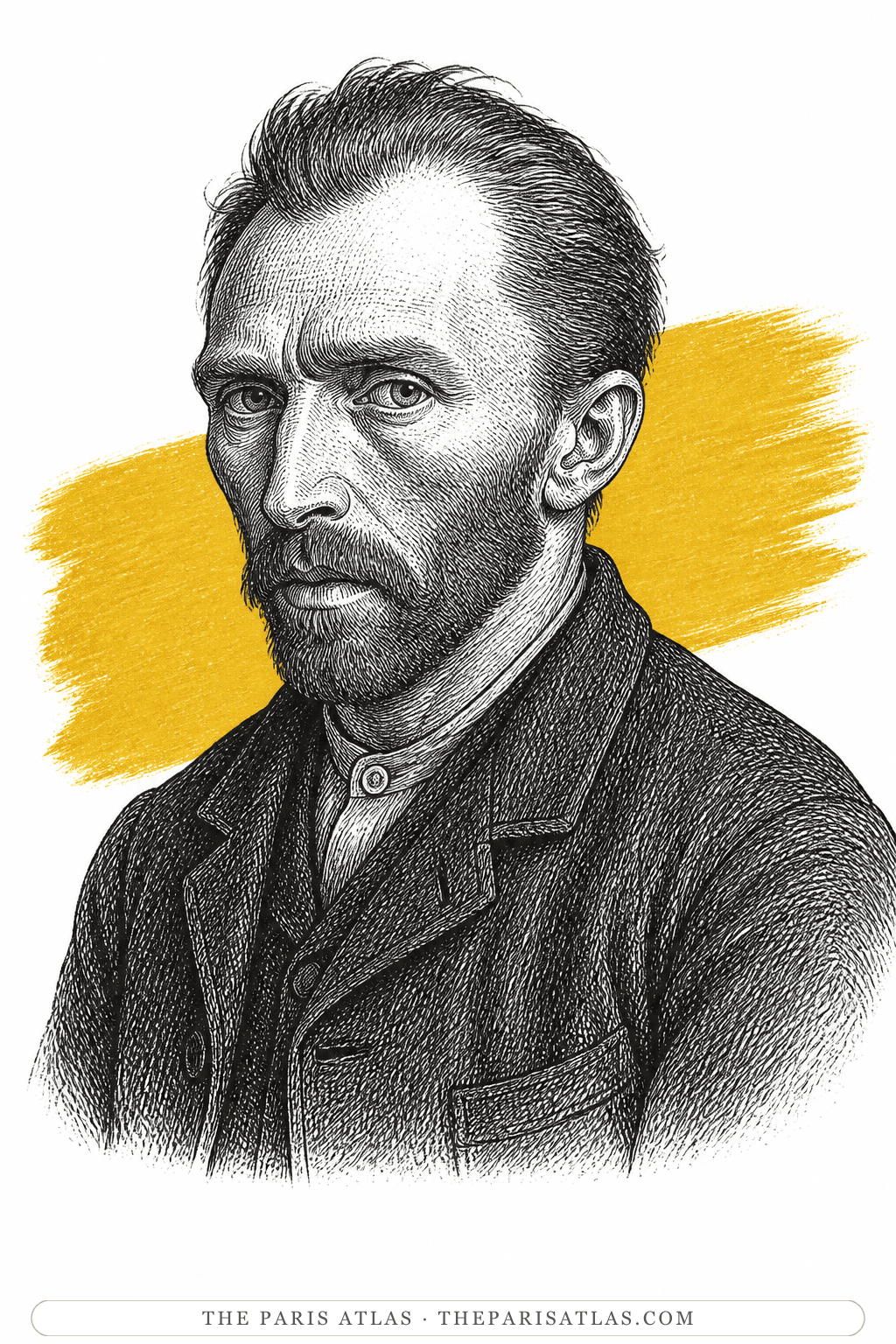
Woman Reading a Letter, painted about 1663 and in the Rijksmuseum, is 46.5 by 39 cm.[22] A young woman still in her blue night jacket stands reading a letter in morning light, with a rolled map on the wall behind her. The Rijksmuseum describes every other color in the picture as secondary to its lapis lazuli blue, and notes that Vermeer painted the woman's skin in pale gray and the shadows on the wall in light blue.[22] Adriaan van der Hoop left the painting to Amsterdam's Academie voor Schone Kunsten; the City of Amsterdam took it over in 1885 and has lent it to the Rijksmuseum ever since.[22] Writing to the painter Émile Bernard from Arles on 29 July 1888, Vincent van Gogh called Vermeer a strange painter whose palette was blue, lemon yellow, pearl gray, black and white.[23]
Rijksmuseum, Amsterdam: The Milkmaid, The Little Street, Woman Reading a Letter, The Love Letter.
Mauritshuis, The Hague: Girl with a Pearl Earring, View of Delft, Diana and Her Companions.
Musée du Louvre, Paris: The Lacemaker and The Astronomer.[6][24]
Kunsthistorisches Museum, Vienna: The Art of Painting.[21]
National Gallery, London: A Young Woman standing at a Virginal and A Young Woman seated at a Virginal.[5][25]
National Gallery of Art, Washington: Woman Holding a Balance, A Lady Writing, Girl with the Red Hat, Girl with a Flute.
The Frick Collection, New York: Officer and Laughing Girl, Girl Interrupted at Her Music, Mistress and Maid.
The Metropolitan Museum of Art, New York: Allegory of the Catholic Faith and Young Woman with a Lute, among others.
Gemäldegalerie Alte Meister, Dresden: The Procuress and Girl Reading a Letter at an Open Window.
Gemäldegalerie, Berlin: The Glass of Wine and Woman with a Pearl Necklace.
Städel Museum, Frankfurt: The Geographer.
National Gallery of Ireland, Dublin: Woman Writing a Letter, with her Maid.
National Galleries of Scotland, Edinburgh: Christ in the House of Martha and Mary.
Isabella Stewart Gardner Museum, Boston: The Concert, stolen in 1990 and still missing.[26]
How he painted
Nearly every Vermeer interior is lit by a window on the left side of the picture, and the light falls across a plain back wall onto one or two figures. The Lacemaker in the Louvre is lit from the right instead, which the Louvre calls rare in his work.[6] The rooms are small, and the same objects come back from picture to picture: a map on the wall, a table with a patterned cloth, a yellow jacket trimmed with white fur. The inventory made of his house in 1676 lists a yellow satin jacket with white fur trim, so at least some of the props were his own.
The Art of Painting, c. 1666–1668, oil on canvas, 120 by 100 cm (Kunsthistorisches Museum, Vienna). The model is dressed as Clio, the muse of history. Vermeer kept the painting, and his widow tried to keep it from his creditors in 1676. (Johannes Vermeer (Kunsthistorisches Museum, Vienna), via Google Arts & Culture and Wikimedia Commons · Public domain)
His most expensive material was natural ultramarine, a blue made by grinding the semi-precious stone lapis lazuli.[27] It cost more than any other pigment on a seventeenth-century palette. Vermeer did not save it for a few showy passages. The Rijksmuseum says that in Woman Reading a Letter every other color is secondary to the lapis lazuli blue.[22] Vermeer also took the blue into places a viewer would not think of as blue at all, such as the shadows on the wall behind the woman and the pale gray of her skin.[22] He mixed lapis lazuli into his whites as well, to give them a sheen.[28] For his brightest yellows he used lead-tin yellow, which the Mauritshuis identifies in the sunlit tower of the Nieuwe Kerk in View of Delft.[16]
The other habit that gives him away is the dot. He laid down small thick blobs of pale paint on the bread and the basket in The Milkmaid, on the hull of the boat in View of Delft, and on the threads in The Lacemaker.[14][16][6] From a few feet away those blobs read as points of light on a wet or rough surface. They also look like the soft circles that appear in an out-of-focus lens image, and that resemblance is one reason for the long argument about whether Vermeer used a lens.[29]
No drawings by Vermeer survive, and for a long time the assumption was that he worked slowly and with extreme care from the first stroke. Scans that the Rijksmuseum published on 8 September 2022 changed that. Under the paint of The Milkmaid there is an underpainting in which Vermeer blocked in the whole scene quickly in light and dark tones before he developed any detail.[15] The 2018 examination of Girl with a Pearl Earring found the same habit: light and shade laid in first, black outlines around the figure, and adjustments made along the way.[19] He worked out his perspective with a pin and a string. Tiny holes where the pin went in have been found at the vanishing points of several of his paintings.[28]
A camera obscura is a darkened box or room with a lens in one wall that throws an image of the scene outside onto a surface inside. People in the Dutch Republic knew about it, and Constantijn Huygens, secretary to the Prince of Orange, recommended it to artists.[28] The case that Vermeer used one rests on the paintings: the dot-like highlights, the blurred threads in the foreground of The Lacemaker, and the way near objects loom large in some interiors all look like effects of a lens.[29] The case against rests on the documents. No letter, inventory or contemporary account links Vermeer to such a device, and the detailed inventory of his house after his death lists none.[28][29] A projected image also helps with outlines rather than with color, because the colored light of the projection sits over the paint and makes color harder to judge, not easier.[28]
The architect Philip Steadman has argued the case for the camera obscura at length.[29] In 2013 the engineer Tim Jenison, who had never painted, reproduced Vermeer's The Music Lesson in a rebuilt room.[28] He used a small mirror held between his eye and the canvas to match one color at a time, and the film Tim's Vermeer recorded the attempt. David G. Stork, Christopher W. Tyler and the Harvard historian of science Sara J. Schechner then examined the method. The shading effect it was meant to explain turns up in many Old Master paintings made without optics. An independent artist who tried the procedure could not make it work as described. It also does not account for the dot highlights at all. Their conclusion was that it is extremely unlikely Vermeer used it.[28] Jenison's experiment shows that a device of that kind can produce a painting like a Vermeer. It does not show that Vermeer owned one.
Patrons, prices, and money
Pieter Claesz van Ruijven (1624–1674), the wealthy son of a Delft brewer, was the closest thing Vermeer had to a patron.[1] On 30 November 1657 Vermeer and Catharina Bolnes borrowed 200 guilders from him.[2] In her will of 1665 Van Ruijven's wife, Maria de Knuijt, left 500 guilders to Johannes Vermeer the painter, and to him alone rather than to the couple.[1] No commission from Van Ruijven to Vermeer is recorded anywhere.[1] John Michael Montias read the loan and the bequest as signs of a standing arrangement.[1] Piet Bakker argues against it: a fixed contract of that kind would have been famous in Delft, and Arnold Houbraken, who wrote the standard lives of the Dutch painters between 1718 and 1721, did not give Vermeer a single word.[1]
What is certain is where the paintings ended up. Van Ruijven's collection passed to his daughter Magdalena van Ruijven and then to her husband, the Delft printer Jacob Dissius.[1] On 16 May 1696 the Dissius collection was auctioned in Amsterdam with twenty-one paintings by Vermeer in it, close to half of everything he had painted. The Milkmaid was lot 2 and made 175 guilders.[14] The Lacemaker was lot 12 and View of Delft lot 31.[6][16] Girl with a Pearl Earring is probably one of three heads in the same sale that went for 36, 17 and 17 guilders.[17]
Other Delft people bought his work. The baker Hendrick van Buyten owned at least three Vermeers.[1] In the summer of 1663 a French traveler, Balthasar de Monconys, called at Vermeer's workshop and was afterward taken to the baker's house, where he was shown a Vermeer of a single figure that had cost 600 guilders. Monconys thought it was worth less than a tenth of that.[1] In 1669 Pieter Teding van Berckhout, a wealthy young man from The Hague, came to see Vermeer twice, on 14 May and 11 June.[1] He wrote that the most extraordinary and curious thing about the paintings he was shown was their perspective.[1]
Painting two or three pictures a year could not support a family on its own. Vermeer also dealt in other painters' work, as his father had.[1] On 14 January 1672 he leased the inn he had inherited, Mechelen, to a chemist named Johannes van der Meer for 180 guilders a year.[2] The loans tell the rest of the story. He borrowed 300 guilders from Maria Thins in 1656 and 200 guilders from Van Ruijven in 1657.[1][2] On 14 December 1655 he and Catharina Bolnes stood surety for a debt his late father owed to Johan van Santen.[2] When his sister Gertruy died in 1670 she left him 400 guilders, of which 148 remained after her own debts were paid.[9] In July 1675 he borrowed 1,000 guilders in Amsterdam.[30]
In 1672 France under Louis XIV and England went to war with the Dutch Republic.[1] The French army invaded, and the Dutch still call that year the Rampjaar, the disaster year. The market for paintings collapsed with everything else. Vermeer had three years left to live, and he spent them unable to sell his own work or to get back what he had paid for the paintings he was trading in.[1]
People he knew
The painters who can be placed beside Vermeer by name are few. Leonaert Bramer witnessed his marriage contract in 1653.[1] Gerard ter Borch signed a document with him days after the wedding. Carel Fabritius worked in the same guild for two years before the explosion of 1654 killed him, and Vermeer kept a Fabritius painting in his house.[1] Vermeer knew the work of Rembrandt van Rijn and of Jacob van Loo in Amsterdam, but no meeting with either is recorded. His inventory also listed a painting by Samuel van Hoogstraten, a former Rembrandt pupil who wrote about perspective and the camera obscura.[1]
In May 1672 Vermeer traveled to The Hague with the Delft painter Johannes Jordaens to give an expert opinion.[1][30] The Amsterdam dealer Gerrit van Uylenburgh had sold a group of Italian paintings to Frederick William, the Elector of Brandenburg, and the Elector's adviser, the painter Hendrick Fromantiou, had declared them fakes. Van Uylenburgh gathered painters to judge them. Vermeer and Jordaens sided with Fromantiou.[1] The statement they signed called the pictures great pieces of rubbish rather than outstanding Italian work.[30] Pieter van Ruijven, who by then lived in The Hague, probably arranged for Vermeer to be asked.[1]
Antoni van Leeuwenhoek (1632–1723), the Delft cloth merchant who ground the single lenses that made him the first person to see bacteria, was born in Delft in the same year as Vermeer.[1][2] On 30 September 1676 the city's aldermen appointed him to wind up Vermeer's bankrupt estate on behalf of the creditors.[1][2] That appointment is the only documented link between the two men. There is no evidence that they ever discussed lenses. Van Leeuwenhoek's own interest in optics is first recorded several years after the point at which he would have had to teach Vermeer anything about them.[28] The Louvre notes that the sitter in The Astronomer is sometimes said to be Van Leeuwenhoek, and that there is no proof of it.[24]
The people who shaped his daily life were his household. Maria Thins owned the house, much of the money and many of the pictures. Catharina Bolnes ran the family. Outside it, the baker Hendrick van Buyten took paintings against a bread bill, and Pieter van Ruijven lent money and bought pictures.[31] The 1676 inventory lists twelve family portraits among the fifty-eight paintings in the house, and none of them has ever been identified.[1]
Catharina, the children, and the house on the Oude Langendijk
Catharina Bolnes was born about 1631 and outlived her husband by twelve years, dying in 1687.[1] Eleven of their children were alive when Vermeer died.[1] At least three others died young and were buried in the Oude Kerk, in December 1660, July 1667 and June 1673.[32] The children's names come from later documents rather than from baptism records, because they were baptized in the Jesuits' hidden church rather than in a Reformed one.[1][32]
Maria, born about 1654, alive after 1713
Elisabeth, born about 1657
Cornelia
Aleydis, died 1749
Beatrix
Johannes, born about 1663
Gertruy, alive after 1713
Franciscus, born about 1664, alive after 1708
Catharina, alive after 1713
Ignatius, born 1672, alive after 1713
Three children who died young, buried in the Oude Kerk on 27 December 1660, 10 July 1667 and 27 June 1673[32]
The house was not always peaceful. In 1663 Catharina's brother Willem Bolnes, who lived in the house with them, pulled a knife on his mother, Maria Thins, and tried to stab her.[12] He also threatened Catharina Bolnes with a stick while she was heavily pregnant. Witnesses described the scenes to a notary, and Willem was confined to a house of correction.[12]
The inventory that a notary drew up on 29 February 1676 is the closest thing to a tour of the house.[1] It lists fifty-eight paintings, among them the twelve family portraits and works by Carel Fabritius and Samuel van Hoogstraten. It also lists things that turn up inside Vermeer's own pictures: the yellow satin jacket with white fur trim, and the fire basket he had painted into The Milkmaid and then covered over.[15] No unfinished painting appears anywhere in it.[1] Whatever he had been working on, he had stopped before he died.
What the documents show of the man
Not one sentence in Vermeer's own words survives. There are no letters, no diary, no treatise, and no recorded remark. Everything known about his character comes from notarial paperwork, guild records, two visitors' travel notes, and his widow's petitions. It is thin material, and none of it describes his personality directly.
The paperwork shows a man his fellow painters trusted, because they elected him headman of the guild twice, and a man whose opinion an Amsterdam dealer wanted badly enough to bring him to The Hague in 1672. It shows a son who took on his dead father's debts, and a son-in-law whose mother-in-law lent him money and then released him from paying it back. It shows a man who borrowed steadily for twenty years and who, in the last three, could not sell what he had. Anything past that, about his temperament, his faith or his feelings, is inference rather than record.
Death in December 1675
Vermeer died in Delft in the middle of December 1675, at the age of 43.[1][2] The exact day is not recorded. He was probably dead by 13 or 14 December, and the burial register of the Oude Kerk, the Old Church, records his burial on 15 December 1675 in a grave that Maria Thins had bought for the family.[1][2] He left Catharina with eleven children, the youngest a baby born the year before.[1]
No document gives a medical cause of death. The only account of his last days is the one Catharina Bolnes gave in April 1676, when she petitioned the High Court of Holland to be released from his debts.[1] She explained that during the war with France her husband had been able to earn very little or hardly anything at all.[1] The paintings by other masters that he had bought to trade, she added, had to be sold at a great loss.[1]
Then came the sentence about his death. In the translation John Michael Montias used, Catharina Bolnes wrote that as a result of all this, and of the great burden of his children, having no means of his own, her husband had lapsed into such decay and decadence. He had taken it so much to heart, she wrote, that as if he had fallen into a frenzy, in a day or a day and a half he had gone from being healthy to being dead.[3][4]
Historians take the petition at face value as far as it goes. It describes a sudden collapse in a man under severe financial pressure, and debt, the war and a house holding eleven children are the causes usually given. What actually killed him is unknown. Nobody wrote down what a doctor thought, if a doctor was called at all. The petition was also written to persuade a court to cancel a debt, so its account of how fast the collapse was should be read with some caution.
The estate was insolvent, and the record of the months after his death is a record of creditors. Early in 1676 Catharina Bolnes gave the baker Hendrick van Buyten two paintings, one of a woman writing a letter with her maid and one of a woman playing a cittern, against a bread debt of 617 guilders.[31] In February she sent twenty-six paintings from Vermeer's stock to the Haarlem dealer Jan Coelenbier as security for another debt, and on 24 February she signed The Art of Painting over to her mother.[1] The court's receiver treated that transfer as improper, and the painting was handed back on 23 March 1677.[1] A notary inventoried the house on 29 February 1676. The court granted her petition, and on 30 September 1676 the aldermen appointed Antoni van Leeuwenhoek to administer the estate for the creditors.[1][2]
In 1677 Catharina Bolnes petitioned the States of Holland for permission to use money from a family trust to bring up the children.[31] Maria Thins died on 27 December 1680, and Catharina Bolnes died in 1687.[12][1] The Oude Kerk still stands on the Oude Delft canal in Delft, and Vermeer lies somewhere inside it, in the family grave his mother-in-law had bought.
Forgotten, forged, and stolen
For a century and a half after the Dissius sale of 1696, Vermeer was a name that collectors in Holland knew and almost nobody else did. Arnold Houbraken's lives of the Dutch painters left him out entirely.[1] His pictures changed hands under other painters' names. View of Delft, which the Mauritshuis bought in 1822, was the one painting a visitor could reliably go and see.[16]
That visitor was Théophile Thoré, a French art critic and republican politician who saw View of Delft in The Hague in 1842 and had to look up the painter's name in the catalogue.[33] The revolution of 1848 put him briefly in power and then into exile, and he spent the 1850s traveling in England, Belgium, Germany, Holland and Switzerland, hunting paintings and documents by the man he called his sphinx.[33] Back in France, and writing under the pen name W. Bürger, he published a study called Van der Meer de Delft in three parts in the Gazette des Beaux-Arts in 1866.[5][25] He gathered far more paintings under the name than are accepted today, but the articles are the reason Vermeer became known outside the Netherlands.
Thoré bought Vermeers as well as writing about them. He owned both of the paintings of women at a virginal that are now in the National Gallery in London, and Woman with a Pearl Necklace, now in Berlin.[5][25] In the winter of 1866 to 1867 he also bought The Astronomer for the Paris collector Léopold Double.[24] Thoré died in 1869, and his collection was auctioned in Paris on 5 December 1892.[5] The two virginal paintings went to dealers there for 29,000 and 25,000 francs and reached the National Gallery in London in 1892 and 1910.[5][25] The Concert was bought at the same sale for Isabella Stewart Gardner of Boston.[34]
In 1937 a painting called The Supper at Emmaus, showing Christ breaking bread at a table, was offered as an unknown early Vermeer. Abraham Bredius, then the most respected authority on Dutch painting, examined it and declared it a Vermeer, and the Museum Boijmans in Rotterdam bought it, as the museum puts it, right under the nose of the Rijksmuseum in Amsterdam.[35][36] It was a forgery. The Dutch painter Han van Meegeren (1889–1947) had made it in 1937, on a seventeenth-century canvas, and signed it IVmeer in the upper left corner.[35] He went on to sell another fake Vermeer, Christ with the Adulteress, to Hermann Göring.[36] Arrested in 1945 and accused of selling Dutch cultural property to the enemy, Van Meegeren confessed that he had painted the pictures himself, and painted a fresh Vermeer under supervision to prove it.[36] He was convicted of forgery in 1947 and died in Amsterdam later the same year.[36][35] The Emmaus is still in the Museum Boijmans Van Beuningen in Rotterdam, catalogued under his name, oil on canvas, 118 by 130.5 cm.[35]
In the early hours of 18 March 1990 two men in police uniforms rang the intercom of the Isabella Stewart Gardner Museum in Boston and said they were answering a report of a disturbance.[26] The guard on duty broke protocol and let them in through the employee entrance. They took thirteen works. Two Rembrandts were cut out of their frames. The Concert and Govert Flinck's Landscape with an Obelisk were lifted out of theirs, and the frames were left behind. The theft has never been solved and nothing has been recovered.[26]
From 10 February to 4 June 2023 the Rijksmuseum showed twenty-eight of the surviving paintings together, the largest gathering of Vermeers ever held.[13] The Frick Collection lent all three of its Vermeers, the Louvre lent The Lacemaker, and Tokyo lent Saint Praxedis.[13] The scans of The Milkmaid were made in the museum's research for that exhibition.[15]
Vermeer in Paris: the Louvre, Proust, and Dalí
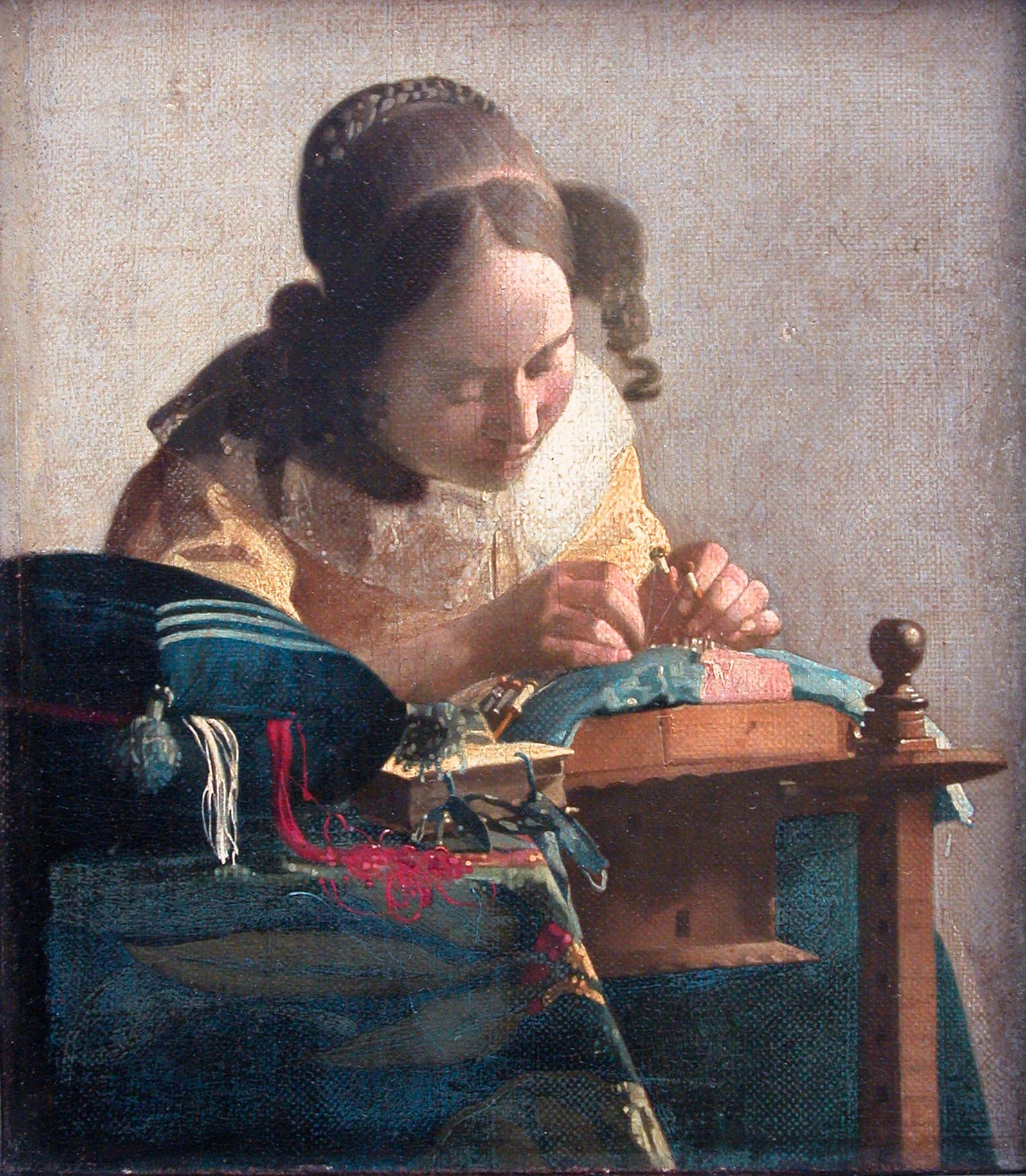
The Lacemaker, c. 1669–1670, oil on canvas mounted on panel, 24 by 21 cm (Musée du Louvre, Paris). Vermeer's smallest painting, bought by the Louvre in June 1870. (Johannes Vermeer (Musée du Louvre, Paris), via Wikimedia Commons · Public domain)
Vermeer never left the Dutch Republic, and Paris holds two of his paintings, both in the Louvre. The Lacemaker, painted about 1669 to 1670, is the smallest picture he made: 24 by 21 cm, oil on canvas glued to a wooden panel, signed I Meer at the lower right.[6] A young woman bends over her lace pillow with bobbins in her hands. A small book lies at her right, which the Louvre takes for a Bible or prayer book, and at her left a sewing bag shaped like a cushion spills colored threads.[6] Those threads are painted as loose blurs, almost out of focus against the sharp middle ground, and they are one of the details most often cited by people who think Vermeer used a lens.[29] The light comes from the right, which the Louvre calls rare in his work.[6]
The Lacemaker was lot 12 at the Dissius sale in Amsterdam in 1696 and then passed through a long line of Dutch owners.[6] By 1860 it belonged to the Rotterdam collector D. Vis Blokhuyzen, who left his collection to the city of Rotterdam. The city refused the bequest rather than pay off his heirs, and the paintings were auctioned in Paris on 1 April 1870. The Louvre bought The Lacemaker from the Paris expert and painter Eugène Féral in June 1870.[6] It hangs in room 837 of the Richelieu wing, on level 2.[6]
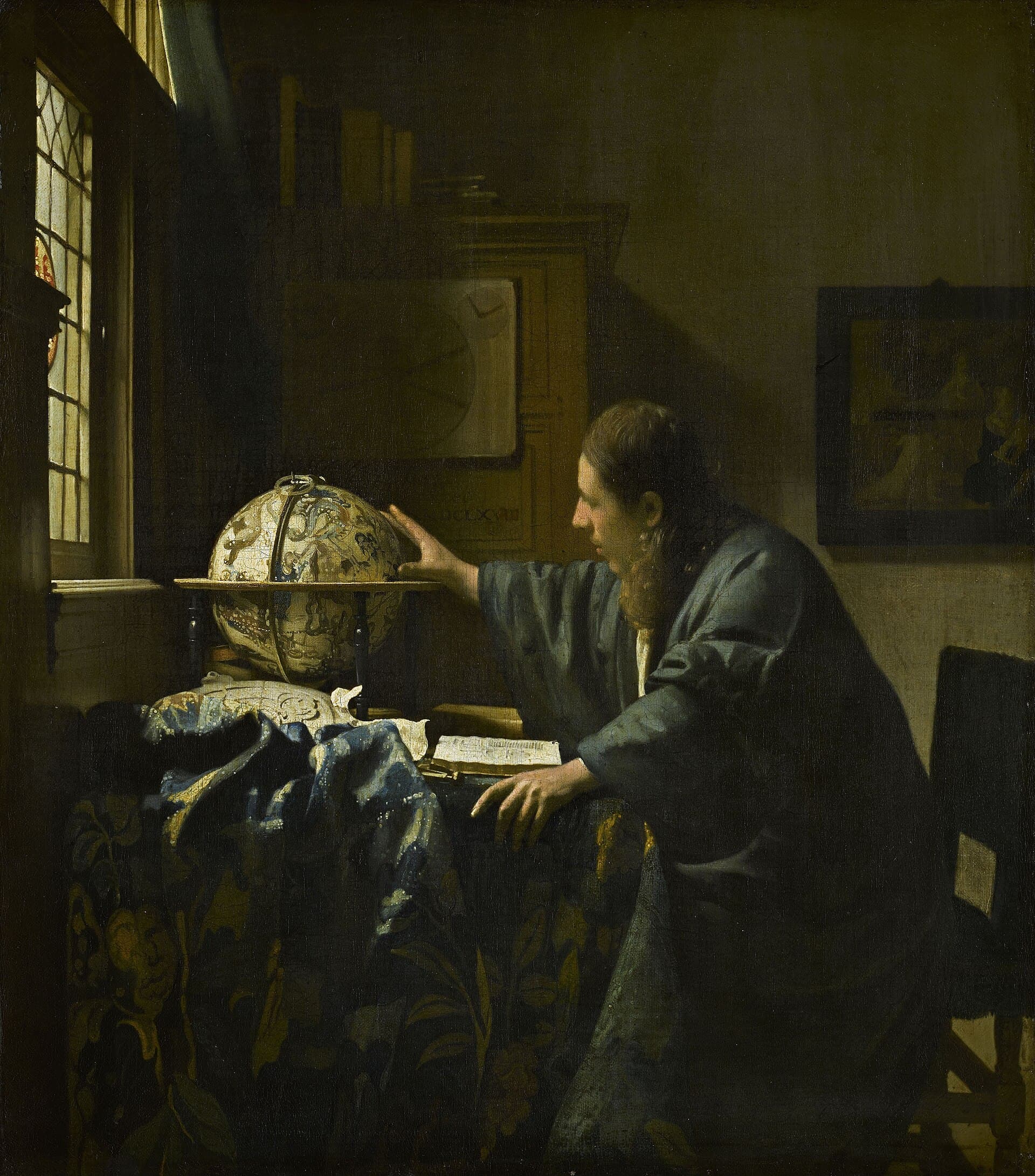
The Astronomer, signed and dated 1668, oil on canvas, 51 by 45 cm (Musée du Louvre, Paris). Seized from the Rothschild collection in 1940, recovered in 1945, and transferred to the French state in 1983 in payment of inheritance duties. (Johannes Vermeer (Musée du Louvre, Paris), via Google Arts & Culture and Wikimedia Commons · Public domain)
The Astronomer is 51 by 45 cm and signed and dated IVMeer 1668, just to the right of the globe.[24] A man in a loose gown sits at a table and reaches for a celestial globe made by Jodocus Hondius in 1600. In front of him lies Adriaan Metius's astronomy manual of 1621, open at the chapter on the stars, and a sixteenth-century compass and astrolabe lie nearby.[24] The painting on the wall behind him shows the finding of Moses. The sitter is sometimes said to be Antoni van Leeuwenhoek, but the Louvre notes that there is no proof, and that Van Leeuwenhoek was still barely known in 1668.[24]
The Astronomer reached Paris through the trade. Baron Alphonse de Rothschild bought it from the Paris dealer Léon Gauchez and owned it by 1888.[24][37] It passed to his son Édouard de Rothschild. German officials seized it from the family in 1940 for the museum Adolf Hitler planned at Linz, the Allies recovered it in 1945, and it was returned to Édouard de Rothschild in 1946.[24] His son Guy de Rothschild transferred it to the French state in 1983 in payment of inheritance duties, which is how it joined The Lacemaker in the Louvre.[24]
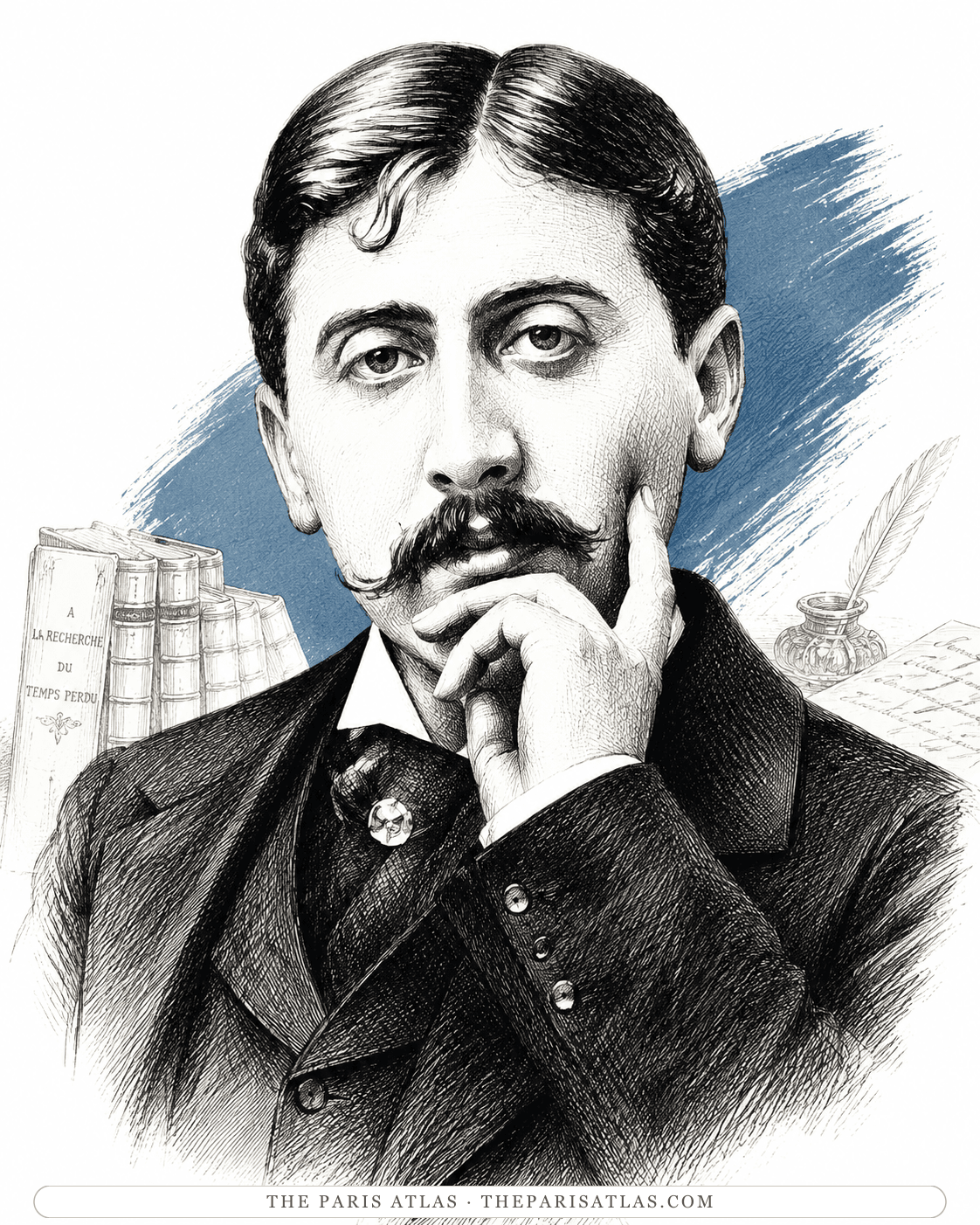
Marcel Proust traveled to the Netherlands in October 1902 and saw View of Delft in The Hague on 18 October.[38] Of everything he saw in Holland, he said, he liked that painting best. In the spring of 1921 an exhibition of Dutch painting at the Jeu de Paume in the Tuileries gardens brought it to Paris, along with The Milkmaid and Girl with a Pearl Earring.[39] The critic Jean-Louis Vaudoyer wrote about the show in the magazine L'Opinion under the title Le mystérieux Vermeer, and Proust wrote to him in May 1921 calling View of Delft the most beautiful painting in the world.[39][7]
Proust was chronically ill by then, slept in the day and rarely left the house, but he went to the Jeu de Paume with Vaudoyer to see the painting again between 18 and 24 May 1921.[7] Afterward he added a scene to the manuscript of La Prisonnière. In it a dying novelist, the fictional Bergotte, leaves his sickbed to look at View of Delft, fixes on a little patch of yellow wall, and collapses in front of the painting. The volume was published in 1923, after Proust's death.[38] Readers have argued ever since about which patch of yellow he meant.[40] The scholar Bernhard Stricker has argued that the patch as Proust describes it is not in the painting at all.[7]
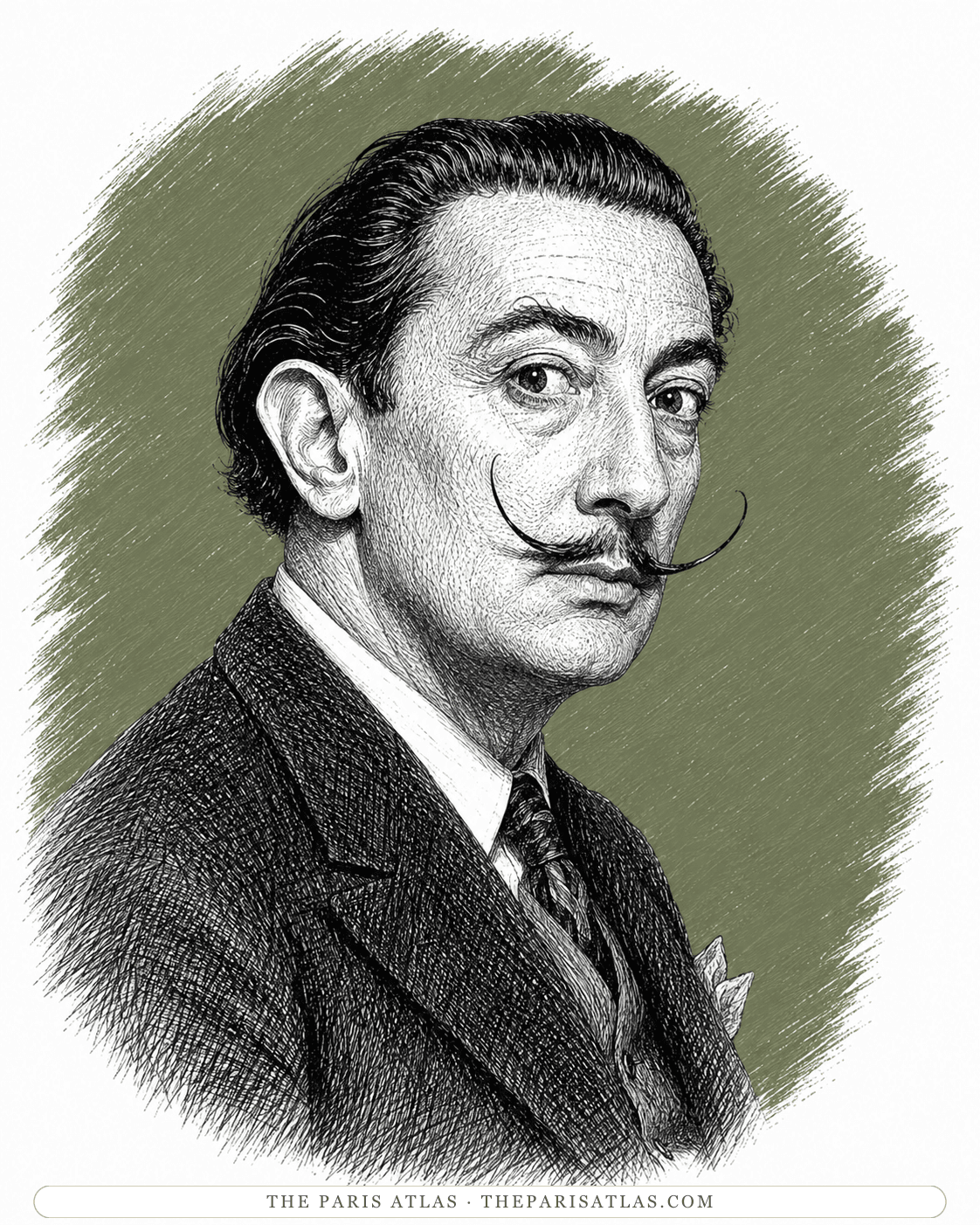
Salvador Dalí returned to The Lacemaker across his whole career. In his 1929 film with Luis Buñuel, Un Chien Andalou, a book falls open at a reproduction of it. In 1955 he set up an easel in front of the original in the Louvre and painted a copy, 23.5 by 19.7 cm, which is now in the Robert Lehman Collection at the Metropolitan Museum of Art in New York.[41][42][8] In the same year he painted the Paranoiac-critical Study of Vermeer's The Lacemaker, now in the Guggenheim Museum, in which the seated woman breaks apart into curving rhinoceros horns.[43]
Dalí had decided that Vermeer's picture was secretly built out of the spirals of a rhinoceros horn. On 30 April 1955 he set up his easel beside a rhinoceros at the Vincennes zoo while the filmmaker Robert Descharnes recorded it.[8] In December 1955 he arrived at the Sorbonne in a Rolls-Royce full of cauliflowers and lectured to about two thousand people on what he called the phenomenological aspects of the paranoiac-critical method.[44] TIME printed his conclusion: everything departs from the rhinoceros horn, everything departs from Vermeer's Lacemaker, everything ends up in the cauliflower.[44]
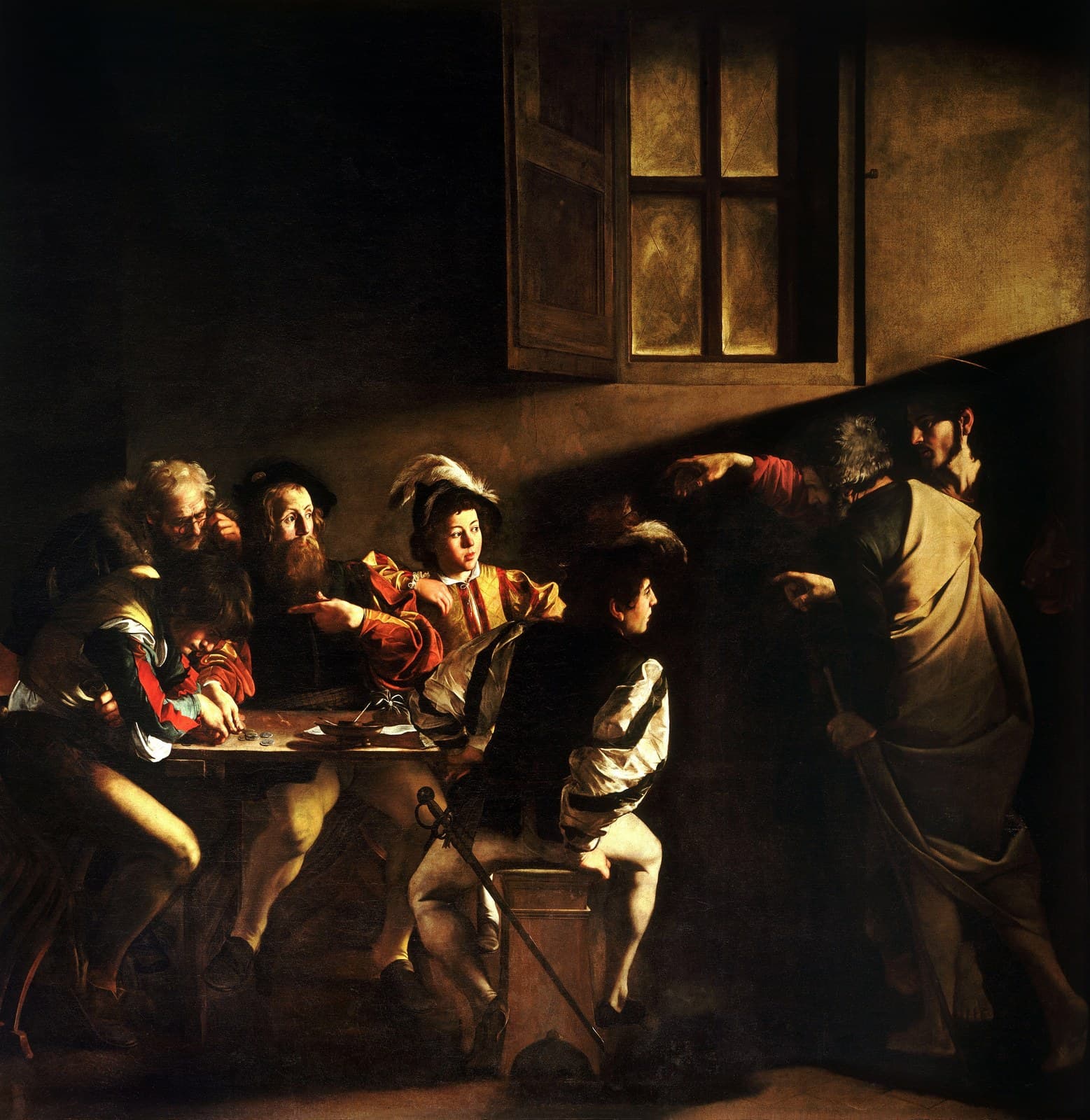
Vermeer belongs to the Dutch side of Baroque Art, the European painting of the seventeenth century. In Rome that painting meant the hard light and deep shadow of Caravaggio and the artists who followed him. Vermeer's earliest pictures follow the Utrecht painters who had brought that lighting back from Italy. He kept the strong light from one direction for the rest of his life, and used it on a maid pouring milk or a woman reading a letter instead of on a saint.
Life events
31 October 1632
Baptized in the Nieuwe Kerk, Delft, the second child of Reynier Jansz Vos, a silk weaver turned innkeeper and art dealer, and Digna Baltens.
1 May 1641
The family moves from the Voldersgracht to Mechelen, a house and inn on the Market Square, where his father continues to buy and sell paintings.
October 1652
His father dies. Vermeer, twenty, takes over the picture dealing while his mother runs the inn.
5 April 1653
Registers his intention to marry Catharina Bolnes. Her mother, Maria Thins, refuses to sign her consent but promises not to obstruct the marriage.
20 April 1653
Marries Catharina Bolnes at Schipluiden, a village outside Delft where a Catholic ceremony can be held. Leonaert Bramer had witnessed the couple's notarial agreement.
29 December 1653
Registered as a master painter in the Delft Guild of Saint Luke. He cannot pay the full entry fee at once.
12 October 1654
The Delft gunpowder store explodes and destroys a large part of the town. The painter Carel Fabritius is among the dead.
c. 1654–1655
Paints Diana and Her Companions and Christ in the House of Martha and Mary, his first secure works, both religious and mythological scenes.
14 December 1655
Stands surety with Catharina Bolnes for a debt his late father owed to Johan van Santen. Signs and dates Saint Praxedis, a copy after Felice Ficherelli whose attribution is still argued over.
1656
Dates The Procuress, his first painting of everyday life, now in Dresden. Borrows 300 guilders from Maria Thins, who later releases him from repaying it.
30 November 1657
Borrows 200 guilders from the brewer's son Pieter van Ruijven, who will own about half of everything Vermeer paints.
c. 1660
Paints The Milkmaid, now in the Rijksmuseum.
The Milkmaid, c. 1660, oil on canvas, 45.5 by 41 cm (Rijksmuseum, Amsterdam). Bought by the Rijksmuseum in 1908, with 38 other paintings from the Six family heirs, with support from the Vereniging Rembrandt. (Johannes Vermeer (Rijksmuseum, Amsterdam), via Google Arts & Culture and Wikimedia Commons)
27 December 1660
Buries a child in the Oude Kerk and gives his address as Maria Thins's house on the Oude Langendijk, in the Catholic quarter of Delft.
c. 1660–1661
Paints View of Delft, the town seen from the south across the harbor on the Schie.
View of Delft, c. 1660–1661, oil on canvas, 96.5 by 115.7 cm (Mauritshuis, The Hague). Delft seen from the southeast across the harbor, with the tower of the Nieuwe Kerk in sunlight. Bought by the Mauritshuis at the Stinstra sale in Amsterdam on 22 May 1822. (Johannes Vermeer (Mauritshuis, The Hague), via Wikimedia Commons)
1662
Elected a headman of the Guild of Saint Luke at thirty, for a two-year term.
1663
Catharina's brother Willem Bolnes attacks his mother with a knife and threatens the pregnant Catharina Bolnes with a stick. He is confined to a house of correction.
Summer 1663
The French traveler Balthasar de Monconys visits the workshop and is then shown a single-figure Vermeer at the baker Hendrick van Buyten's house that had cost 600 guilders. He thinks it worth less than a tenth of that.
c. 1663
Paints Woman Reading a Letter, the picture Vincent van Gogh will describe in 1888.
c. 1665
Paints Girl with a Pearl Earring, a tronie rather than a portrait, now in the Mauritshuis.
Girl with a Pearl Earring, c. 1665, oil on canvas, 44.5 by 39 cm (Mauritshuis, The Hague). A tronie, a painted head of a type rather than a named sitter, bought at auction in 1881 for two guilders and thirty cents and bequeathed to the museum in 1903. (Johannes Vermeer (Mauritshuis, The Hague), via Wikimedia Commons)
1665
Maria de Knuijt, Van Ruijven's wife, leaves 500 guilders to Johannes Vermeer the painter in her will.
c. 1666–1668
Paints The Art of Painting, which he keeps and never sells.
The Art of Painting, c. 1666–1668, oil on canvas, 120 by 100 cm (Kunsthistorisches Museum, Vienna). The model is dressed as Clio, the muse of history. Vermeer kept the painting, and his widow tried to keep it from his creditors in 1676. (Johannes Vermeer (Kunsthistorisches Museum, Vienna), via Google Arts & Culture and Wikimedia Commons)
1667
Arnold Bon's poem in Dirck van Bleyswijck's description of Delft says that from Fabritius's fire there rose Vermeer, who could emulate him.
1668
Signs and dates The Astronomer, now in the Louvre.
The Astronomer, signed and dated 1668, oil on canvas, 51 by 45 cm (Musée du Louvre, Paris). Seized from the Rothschild collection in 1940, recovered in 1945, and transferred to the French state in 1983 in payment of inheritance duties. (Johannes Vermeer (Musée du Louvre, Paris), via Google Arts & Culture and Wikimedia Commons)
14 May and 11 June 1669
Pieter Teding van Berckhout of The Hague visits twice and notes the extraordinary perspective of the paintings he is shown.
c. 1669–1670
Paints The Lacemaker, his smallest picture, lit from the right.
The Lacemaker, c. 1669–1670, oil on canvas mounted on panel, 24 by 21 cm (Musée du Louvre, Paris). Vermeer's smallest painting, bought by the Louvre in June 1870. (Johannes Vermeer (Musée du Louvre, Paris), via Wikimedia Commons)
1670
His mother dies and he inherits the Mechelen inn. His sister Gertruy dies the same year, leaving him 400 guilders, of which 148 remain after her own debts are paid.
1670
Elected headman of the guild for a second two-year term.
14 January 1672
Leases Mechelen, the inn on the Market Square, to a chemist named Johannes van der Meer for 180 guilders a year.
1672
France and England go to war with the Dutch Republic. The French army invades and the market for paintings collapses.
May 1672
Travels to The Hague with Johannes Jordaens to judge Italian paintings sold to the Elector of Brandenburg. The two painters call them great pieces of rubbish.
July 1675
Borrows 1,000 guilders in Amsterdam.
15 December 1675
Buried in the Oude Kerk, Delft, in the grave Maria Thins bought for the family, after dying at 43 a day or two earlier. Eleven children survive him.
Early 1676
Catharina gives the baker Hendrick van Buyten two paintings against a bread debt of 617 guilders and sends twenty-six paintings to a Haarlem dealer as security.
29 February 1676
A notary inventories the house: fifty-eight paintings, twelve of them family portraits, a yellow satin jacket with white fur trim, and no unfinished picture.
April 1676
Catharina petitions the High Court of Holland, describing how debt and the burden of the children had sent her husband from health to death in a day and a half.
30 September 1676
Antoni van Leeuwenhoek is appointed to administer the bankrupt estate for the creditors.
16 May 1696
Twenty-one Vermeers from the Dissius collection are auctioned in Amsterdam. The Milkmaid, lot 2, sells for 175 guilders to the collector Isaac Rooleeuw.
22 May 1822
The Mauritshuis buys View of Delft at the Stinstra sale in Amsterdam.
1866
Théophile Thoré, writing as W. Bürger, publishes Van der Meer de Delft in the Gazette des Beaux-Arts, the study that made Vermeer known outside the Netherlands.
June 1870
The Louvre buys The Lacemaker from the Paris expert Eugène Féral, two months after the Vis Blokhuyzen collection was auctioned in Paris.
1881
Arnoldus Andries des Tombe buys Girl with a Pearl Earring at auction in The Hague for two guilders and thirty cents. He leaves it to the Mauritshuis, which receives it in 1903.
5 December 1892
Thoré's collection is auctioned in Paris. The two virginal paintings go to dealers and reach the National Gallery in London; The Concert is bought for Isabella Stewart Gardner of Boston.
1908
The Milkmaid enters the Rijksmuseum, bought from the Six family heirs with 38 other paintings for 550,000 guilders and with support from the Vereniging Rembrandt.
May 1921
Marcel Proust leaves his bed to see View of Delft at the Dutch exhibition in the Jeu de Paume, Paris, the visit behind the death of Bergotte in La Prisonnière.
1937
The Museum Boijmans in Rotterdam buys The Supper at Emmaus as a Vermeer. Han van Meegeren confesses after the war that he painted it.
1955
Salvador Dalí copies The Lacemaker in front of the original at the Louvre and lectures at the Sorbonne on the rhinoceros horn he sees in it.
1983
Guy de Rothschild transfers The Astronomer to the French state in payment of inheritance duties, forty-three years after German officials seized it from his family. It goes to the Louvre.
18 March 1990
Two men in police uniforms steal The Concert and twelve other works from the Isabella Stewart Gardner Museum in Boston. Nothing has been recovered.
10 February to 4 June 2023
The Rijksmuseum brings twenty-eight Vermeers together in Amsterdam, the largest gathering of his work ever held.
Selected works
Cataloged from the holding institutions' records. Reproductions appear only where the rights are verified.
Johannes Vermeer painted The Milkmaid around 1660. It is a small picture, 45.5 by 41 centimetres, and it hangs in the Rijksmuseum in Amsterdam. A kitchen servant pours milk from a jug, and almost nothing else in the room moves.
A girl in a blue and yellow turban turns to look over her shoulder, lips parted, a large pearl hanging from her ear. Johannes Vermeer painted her around 1665. She is not a portrait of a named sitter but a study of a face in foreign dress. The painting sold for two guilders and thirty cents in 1881 and has belonged to the Mauritshuis in The Hague since 1903.
A man with long hair, in a loose blue robe, leans across a table in a dim room and reaches for a globe of the stars, with an astronomy book open in front of him. Johannes Vermeer signed and dated the painting 1668. The painting belonged to the Rothschild family in Paris, was seized by the Nazis in 1940, and came to the Louvre in 1983, inventory number RF 1983-28.
A young woman in a yellow bodice bends close over her lace pillow, bobbins in her fingers, while red and white threads spill from a sewing cushion in front of her. Johannes Vermeer painted it around 1669–1670. At 24 by 21 centimetres it is his smallest picture. The Louvre bought it in 1870, and it hangs in the Richelieu wing, inventory number MI 1448.
Delft seen across a harbour on a still morning, under a sky of heavy cloud, with the New Church tower lit by the sun. Johannes Vermeer painted it around 1660–1661. Marcel Proust called it the most beautiful painting in the world and set a death in front of it. The painting has belonged to the Mauritshuis in The Hague since 1822.
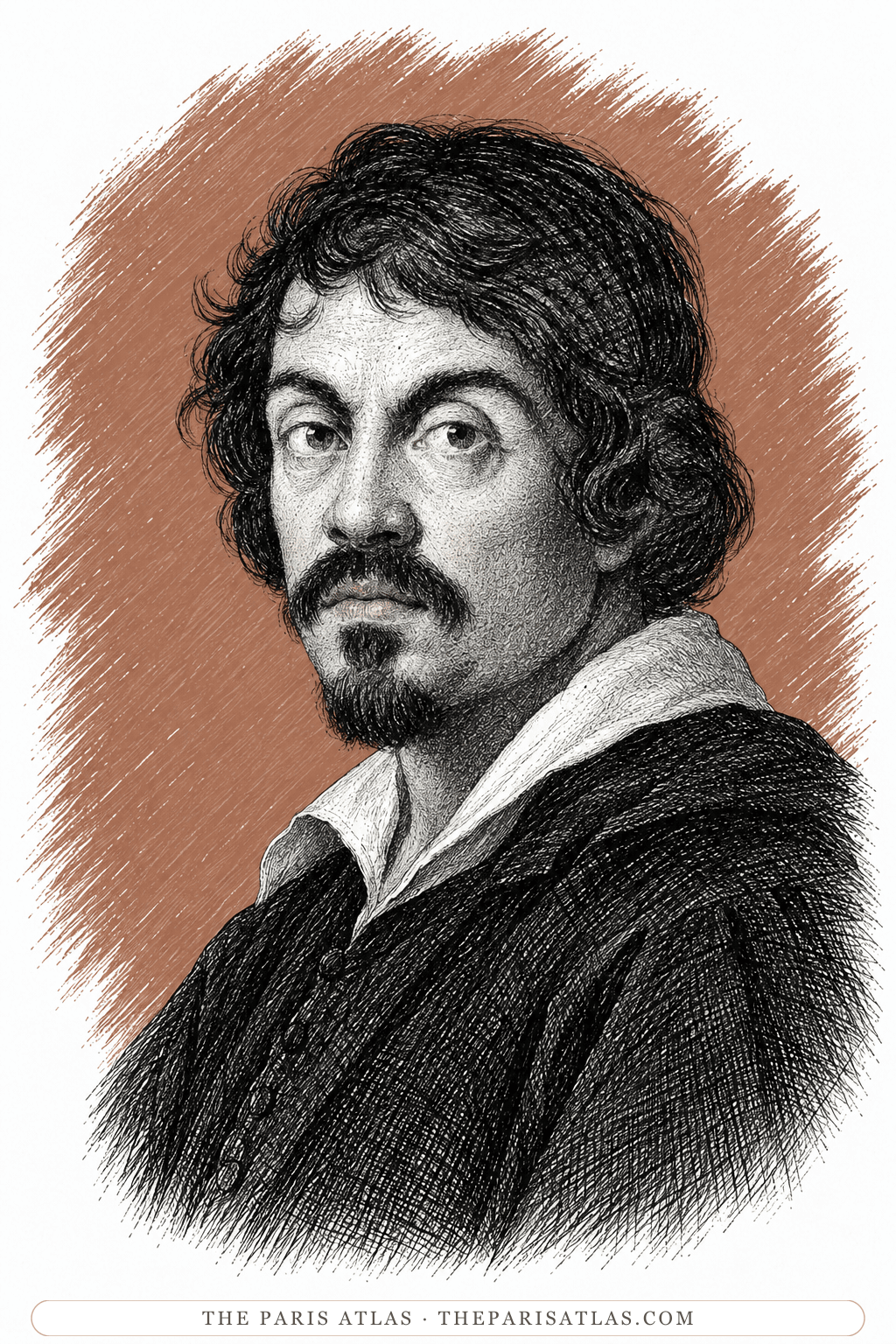
Johannes Vermeer was born in Delft in 1632, twenty-two years after Caravaggio died. The National Gallery in London says his earliest works, from the 1650s, are influenced by Caravaggio's followers in Utrecht, naming Hendrick ter Brugghen. Ter Brugghen had worked in Rome and brought the manner home, so what reached Vermeer was Caravaggio at one remove.
— Johannes Vermeer (1632 – 1675) — artist page; Caravaggio (Michelangelo Merisi) (1571–1610) and His Followers
Who Johannes Vermeer Inspired
People who found inspiration in Johannes Vermeer’s work.
Marcel Proust saw Vermeer's View of Delft at the Mauritshuis in The Hague on 18 October 1902 and liked it more than any other painting he saw in Holland. In a letter of May 1921 to the critic Jean-Louis Vaudoyer he called it the most beautiful painting in the world, and between 18 and 24 May 1921 he left his bed to see it again at the Dutch exhibition in the Jeu de Paume in Paris. He then added the scene in which the novelist Bergotte dies in front of the painting to La Prisonnière, the volume published in 1923 after Proust's death.
— Proust Ink — Marcel Proust chronology (ed. William C. Carter); Bernhard Stricker, Tout et rien. La Vue de Delft invisible de Proust (2015); Jonathan Janson, Proust and Vermeer: the 'petit pan de mur jaune'
Salvador Dalí painted a small copy of Vermeer's The Lacemaker in front of the original at the Louvre in 1955. It measures 23.5 by 19.7 cm and is now in the Robert Lehman Collection at the Metropolitan Museum of Art in New York. In the same year he painted the Paranoiac-critical Study of Vermeer's 'The Lacemaker', now in the Guggenheim Museum, in which the figure breaks into rhinoceros horns. On 30 April 1955 he painted beside a rhinoceros at the Vincennes zoo with a reproduction of the picture, and in December 1955 he told an audience of about two thousand at the Sorbonne that everything departs from the rhinoceros horn and from Vermeer's Lacemaker.
— Salvador Dalí, The Lacemaker (after Vermeer), 1955 — Robert Lehman Collection; Paranoiac-critical Study of Vermeer's 'The Lacemaker' — catalogue raisonné P 703; People, Dec. 26, 1955 (1955); Jonathan Janson, Vermeer-Related Works of Art: The Lacemaker
Writing to Émile Bernard from Arles on 29 July 1888, Vincent van Gogh asked whether he knew a painter called Vermeer who had painted a very beautiful pregnant Dutch lady. He described this strange painter's palette as blue, lemon yellow, pearl gray, black and white, and said that the arrangement of lemon yellow, pale blue and pearl gray was as characteristic of Vermeer as black, white, gray and pink were of Velázquez. The editors of the letters identify the painting as Woman Reading a Letter in the Rijksmuseum.
— Vincent van Gogh: The Letters — complete annotated edition; Johannes Vermeer, Woman Reading a Letter, c. 1663 — collection record SK-C-251
Movements
The artistic and literary currents this life ran through.
Art movement and historical period · circa 1600–1750
The Milkmaid, dated by the Rijksmuseum to about 1660, gives a woman pouring milk in a plain room the sustained attention the period more often spent on saints and monarchs. Vermeer is the reason the Baroque period cannot be defined by spectacle alone.
— Johannes Vermeer, The Milkmaid — collection record; The Milkmaid, in High Resolution
Questions about Johannes Vermeer
Who was Johannes Vermeer?
Johannes Vermeer (1632–1675) was a Dutch painter who lived and worked in Delft and is known for small, quiet pictures of people in rooms lit from a window. He also dealt in other painters' work, as his father had. About 35 of his paintings survive, among them Girl with a Pearl Earring, The Milkmaid and View of Delft. He was little known outside the Netherlands until the French critic Théophile Thoré wrote about him in 1866.
How many Vermeer paintings are there?
Thirty-six or thirty-seven, depending on which disputed pictures are counted. The Rijksmuseum put the number at 37 when it organized its 2023 exhibition, and the Leiden Collection's biography of Vermeer says 36. He painted two or three pictures a year over about twenty years, and no drawings by him survive.
What is Vermeer's most famous painting?
Girl with a Pearl Earring, painted about 1665 and hanging in the Mauritshuis in The Hague. The Mauritshuis calls it a tronie, a painted head of a type rather than a portrait of a named person, and it was bought at auction in 1881 for two guilders and thirty cents. The Milkmaid in the Rijksmuseum and View of Delft in the Mauritshuis are the other two paintings most people know.
When was Johannes Vermeer born?
The day of his birth is not recorded. He was baptized on 31 October 1632 in the Nieuwe Kerk in Delft, and babies were usually baptized within a few days of birth, so he was born in late October 1632.
Where was Vermeer from?
Delft, a town in the province of Holland in the Dutch Republic, now the Netherlands. He was baptized there, married there, painted there, and was buried there in the Oude Kerk in December 1675. There is no record that he ever left the Republic.
How did Vermeer die?
He died suddenly in Delft in mid-December 1675, aged 43, and was buried on 15 December. No document gives a medical cause. His widow, Catharina Bolnes, petitioned a court in April 1676 and described the collapse. His debts and the burden of eleven children had weighed on him so heavily, she wrote, that as if he had fallen into a frenzy he went from healthy to dead in a day or a day and a half. Historians read this as a collapse under severe financial stress, but the illness itself is unknown.
Did Vermeer use a camera obscura?
Nobody knows. The paintings show effects that look like a lens image, especially the soft dots of light on bread, boats and thread, and the device was known in the Dutch Republic. But no document links Vermeer to a camera obscura, the inventory of his house lists none, and a projected image helps with outlines rather than with color. The engineer Tim Jenison reproduced a Vermeer with a mirror device in 2013, and the scientists who examined his method concluded that it was extremely unlikely Vermeer had used it.
Where can you see Vermeer's paintings in Paris?
The Louvre has two: The Lacemaker, his smallest painting, bought in June 1870, and The Astronomer, dated 1668, which Guy de Rothschild transferred to the French state in 1983 in payment of inheritance duties. Both hang in room 837 of the Richelieu wing, on level 2. Vermeer never visited Paris himself.
What is a tronie, and why is Girl with a Pearl Earring called one?
A tronie is the Dutch word for a painted head or face that shows a type or a character, often in unusual dress, rather than a likeness of a named person who commissioned it. Girl with a Pearl Earring is a tronie because no one is recorded as having sat for it or paid for it, and because the clothes are invented. Dutch women in the 1660s did not wear turbans.
Connections and Sources
Johannes Vermeer’s connections to people, places, and works, with the sources behind each one.
The Milkmaid, dated by the Rijksmuseum to about 1660, gives a woman pouring milk in a plain room the sustained attention the period more often spent on saints and monarchs. Vermeer is the reason the Baroque period cannot be defined by spectacle alone.
— Johannes Vermeer, The Milkmaid — collection record; The Milkmaid, in High Resolution
Marcel Proust saw Vermeer's View of Delft at the Mauritshuis in The Hague on 18 October 1902 and liked it more than any other painting he saw in Holland. In a letter of May 1921 to the critic Jean-Louis Vaudoyer he called it the most beautiful painting in the world, and between 18 and 24 May 1921 he left his bed to see it again at the Dutch exhibition in the Jeu de Paume in Paris. He then added the scene in which the novelist Bergotte dies in front of the painting to La Prisonnière, the volume published in 1923 after Proust's death.
— Proust Ink — Marcel Proust chronology (ed. William C. Carter); Bernhard Stricker, Tout et rien. La Vue de Delft invisible de Proust (2015); Jonathan Janson, Proust and Vermeer: the 'petit pan de mur jaune'
Salvador Dalí painted a small copy of Vermeer's The Lacemaker in front of the original at the Louvre in 1955. It measures 23.5 by 19.7 cm and is now in the Robert Lehman Collection at the Metropolitan Museum of Art in New York. In the same year he painted the Paranoiac-critical Study of Vermeer's 'The Lacemaker', now in the Guggenheim Museum, in which the figure breaks into rhinoceros horns. On 30 April 1955 he painted beside a rhinoceros at the Vincennes zoo with a reproduction of the picture, and in December 1955 he told an audience of about two thousand at the Sorbonne that everything departs from the rhinoceros horn and from Vermeer's Lacemaker.
— Salvador Dalí, The Lacemaker (after Vermeer), 1955 — Robert Lehman Collection; Paranoiac-critical Study of Vermeer's 'The Lacemaker' — catalogue raisonné P 703; People, Dec. 26, 1955 (1955); Jonathan Janson, Vermeer-Related Works of Art: The Lacemaker
Writing to Émile Bernard from Arles on 29 July 1888, Vincent van Gogh asked whether he knew a painter called Vermeer who had painted a very beautiful pregnant Dutch lady. He described this strange painter's palette as blue, lemon yellow, pearl gray, black and white, and said that the arrangement of lemon yellow, pale blue and pearl gray was as characteristic of Vermeer as black, white, gray and pink were of Velázquez. The editors of the letters identify the painting as Woman Reading a Letter in the Rijksmuseum.
— Vincent van Gogh: The Letters — complete annotated edition; Johannes Vermeer, Woman Reading a Letter, c. 1663 — collection record SK-C-251
Johannes Vermeer was born in Delft in 1632, twenty-two years after Caravaggio died. The National Gallery in London says his earliest works, from the 1650s, are influenced by Caravaggio's followers in Utrecht, naming Hendrick ter Brugghen. Ter Brugghen had worked in Rome and brought the manner home, so what reached Vermeer was Caravaggio at one remove.
— Johannes Vermeer (1632 – 1675) — artist page; Caravaggio (Michelangelo Merisi) (1571–1610) and His Followers
References
References
The sources below include biographies, scholarly essays, interviews, and primary materials that informed this page. They reflect both the historical record and ongoing critical conversations about Johannes Vermeer and their work.
The Leiden Collection Catalogue, 3rd ed., ed. Arthur K. Wheelock Jr. and Lara Yeager-Crasselt, 2017
Used for
Piet Bakker's documented biography for the Leiden Collection, drawing on Montias: baptism, family, marriage, guild, patrons, the 1672 assessment, the estate, and the burial on 15 December 1675.
The Delft city archive's own documents: the baptism register of 31 October 1632, the marriage entry of 5 April 1653, the 1655 surety, the 1657 loan, the 1676 inventory, the burial register, and Van Leeuwenhoek's appointment.
4abcVermeer and His Milieu: A Web of Social History
Biography
Princeton University Press, 1989
Used for
The archival study behind almost every dated fact about Vermeer's family, debts and estate.
5abcdefJohannes Vermeer, A Young Woman standing at a Virginal — collection record NG1383
Website
The National Gallery, London
Used for
Collection record NG1383: in Thoré's collection by 1866, the Thoré-Bürger sale in Paris on 5 December 1892 as lot 30 at 29,000 francs to Lawrie and Co., and the gallery's purchase the same month.
6abcdefghijkLa Dentellière — Louvre site des collections
Website
Musée du Louvre
Used for
Collection record MI 1448: 24 by 21 cm, oil on canvas glued to panel, the I Meer signature, the book taken for a Bible or prayer book, the sewing bag with its blurred threads, the light from the right, the provenance from Van Ruijven to the June 1870 purchase from Eugène Féral, and room 837 in the Richelieu wing.
7abcdTout et rien. La Vue de Delft invisible de Proust
Periodical
Quaderni Proustiani, Padova University Press, 2015
Used for
Dates the Jeu de Paume visit to 18 to 24 May 1921, cites the letter to Vaudoyer calling View of Delft the most beautiful painting in the world, and argues that the patch of yellow wall Proust describes is not in the painting.
Dalí's copy made in front of the original at the Louvre and the painting session beside the rhinoceros at the Vincennes zoo on 30 April 1955, filmed by Robert Descharnes.
14abcdefJohannes Vermeer, The Milkmaid — collection record
Website
Rijksmuseum
Used for
Collection record SK-A-2344: 45.5 by 41 cm, the hundreds of dots of light, the Dissius sale of 16 May 1696 where it was lot 2 and made 175 guilders, and the 1908 purchase from the Six heirs for 550,000 guilders with 38 other paintings.
16abcdefghiJohannes Vermeer, View of Delft, c. 1660–1661 — collection record 92
Website
Mauritshuis, The Hague
Used for
The Mauritshuis's own record: 96.5 by 115.7 cm, the view from the southeast across the Kolk, the Schiedam and Rotterdam gates, the buildings Vermeer tidied, the white lead grains and lead-tin yellow, the dots on the boat hull, and the Stinstra sale of 22 May 1822.
17abcdefJohannes Vermeer, Girl with a Pearl Earring, c. 1665 — collection record 670
Website
Mauritshuis, The Hague
Used for
The Mauritshuis's own record: a tronie, 44.5 by 39 cm, the 1881 Braams sale in The Hague where Victor de Stuers and A. A. des Tombe agreed not to bid against each other, the price of two guilders and thirty cents, and the 1903 bequest.
19abcRevealing the painterly technique beneath the surface of Vermeer's Girl with a Pearl Earring using macro- and microscale imaging
Periodical
Heritage Science, volume 7, 2019
Used for
The Girl in the Spotlight examination of 2018: the warm light gray ground, the black outlines, the underlayers, and the pentimento that moved the girl's ear.
20abFading into the background: the dark space surrounding Vermeer's Girl with a Pearl Earring
Periodical
Heritage Science, volume 7, 2019
Used for
The background of Girl with a Pearl Earring: a black underlayer under a glaze of indigo and weld, now degraded, with Vermeer's signature and the suggestion of a folded curtain recovered by imaging.
21abcdeDie Malkunst — Kunsthistorisches Museum Wien, Gemäldegalerie 9128
Website
Kunsthistorisches Museum Wien
Used for
Collection record 9128: 120 by 100 cm, about 1666 to 1668, Clio, the map of the seventeen provinces, the Czernin ownership from 1813, Adolf Hitler's purchase in 1940, and the handover to Vienna on 7 November 1946.
22abcdeJohannes Vermeer, Woman Reading a Letter, c. 1663 — collection record SK-C-251
Website
Rijksmuseum
Used for
Collection record SK-C-251: c. 1663, 46.5 by 39 cm, the blue night jacket, the lapis lazuli blue that every other color is secondary to, the pale gray skin and light blue wall shadows, and the Van der Hoop bequest that reached the City of Amsterdam in 1885.
23↑Vincent van Gogh: The Letters — complete annotated edition
Website
Van Gogh Museum and Huygens ING
Used for
Letter 649 to Émile Bernard, Arles, 29 July 1888, on Vermeer's palette of blue, lemon yellow, pearl gray, black and white, with the editors identifying the painting as Woman in Blue Reading a Letter in the Rijksmuseum.
24abcdefghiL'Astronome — Louvre site des collections
Website
Musée du Louvre
Used for
Collection record RF 1983-28: 51 by 45 cm, the IVMeer 1668 signature, the Hondius globe of 1600, the Metius manual of 1621 open at the chapter on the stars, the Finding of Moses on the wall, the unproven identification of the sitter as Van Leeuwenhoek, Thoré's purchase for Léopold Double in 1866 to 1867, the sale to Alphonse de Rothschild through Léon Gauchez, the 1940 seizure, the 1946 restitution, and the dation of 1982 to 1983.
25abcdJohannes Vermeer, A Young Woman seated at a Virginal — collection record NG2568
Website
The National Gallery, London
Used for
Collection record NG2568: bought by W. Bürger at the Pommersfelden sale in 1867 for 2,000 francs, sold as lot 32 at the Thoré-Bürger sale of 5 December 1892 for 25,000 francs, and left to the gallery in the Salting Bequest of 1910.
The museum's account of 18 March 1990: the two men in police uniforms, the guard who let them in, the thirteen works, the two Rembrandts cut from their frames, The Concert and the Flinck lifted out of theirs, and the unsolved case.
David G. Stork, Christopher W. Tyler and Sara J. Schechner
Used for
Examines Tim Jenison's mirror-comparator method and concludes it is extremely unlikely Vermeer used it. Also the source for Huygens recommending the camera obscura to artists, the pinprick holes at vanishing points, the absence of any optical device in the estate inventory, and Van Leeuwenhoek's optics coming too late to have taught Vermeer.
35abcdHan van Meegeren, The Supper at Emmaus, 1937 — collection record
Website
Museum Boijmans Van Beuningen
Used for
The museum's own account: it bought the picture in 1937 as a Vermeer, right under the nose of the Rijksmuseum, and the forgery was exposed only after the war by Van Meegeren's confession. Also the dimensions, the seventeenth-century canvas, the IVmeer signature in the upper left corner, and Van Meegeren's dates, 1889 to 1947.
The Dutch exhibition at the Jeu de Paume in the spring of 1921, which also showed The Milkmaid and Girl with a Pearl Earring, and Vaudoyer's article Le mystérieux Vermeer in L'Opinion.
Contemporary report of the Sorbonne lecture: the Rolls-Royce full of cauliflowers, the two thousand listeners, the lecture title, and the sentence about the rhinoceros horn, The Lacemaker and the cauliflower.
These references anchor the page in the documented record and in the scholarly conversations around Johannes Vermeer. Every claim on this page traces back to one or more of the works listed here.



 View source