Italian painter who worked from live models straight onto the canvas, without preparatory drawings, and lit them with a single hard light against a dark ground. He killed a man in Rome in May 1606, spent his last four years as a fugitive in Naples, Malta and Sicily, and died at thirty-eight.
In images
Details
Lived
1571–1610
Born
baptized 30 September 1571
Birthplace
Milan, Duchy of Milan
Birth name
Michelangelo Merisi
Died
18 July 1610
Place of death
Porto Ercole, Tuscany
Nationality
Italian
Profession
Painter
Major works
The Calling of Saint Matthew, The Supper at Emmaus, The Death of the Virgin, The Beheading of Saint John the Baptist, David with the Head of Goliath
Roles
Painter
Also known as
Michelangelo Merisi da Caravaggio · Michelangelo Merisi · Michelangelo Amerighi da Caravaggio
About Caravaggio
Italian painter whose lighting and live-model method changed European painting after 1600
Michelangelo Merisi da Caravaggio (1571–1610) was an Italian painter who spent his working life in Rome, Naples, Malta and Sicily. He hired models off the street, posed them in a dark room under one strong light, and painted them straight onto the canvas without the weeks of preparatory drawing that were the normal first stage of the job.[1] Not one drawing can be firmly attributed to him.[2][3] The result was religious pictures in which apostles have dirty feet and saints look like the people outside the church door, and the effect on European painting was immediate.
His public career in Rome began in 1600, when two large canvases about Saint Matthew went up in the Contarelli Chapel of San Luigi dei Francesi and made his name.[4] It ended in May 1606, when he killed a young man named Ranuccio Tomassoni in a fight and had to leave the city under sentence.[5] The last four years were spent painting for new patrons in Naples, being knighted and then expelled by the Order of Saint John in Malta, moving through Sicily, and trying to buy a papal pardon with pictures.[5][6]
He died on 18 July 1610 at Porto Ercole on the Tuscan coast, aged thirty-eight, on his way back toward Rome.[5] The two seventeenth-century biographers who wrote about him both say fever, and both disliked him.[7][8] Later explanations have included syphilis, malaria, lead poisoning from his paints, an infected wound and murder.[9][10] Three of his paintings are in the Louvre in Paris, given or sold to Louis XIV between 1665 and 1671.[11][12][13] Caravaggio himself never went to France.
Born in Milan, named after a town
Ottavio Leoni, Portrait of Caravaggio, about 1621, black and white chalk on blue paper, Biblioteca Marucelliana, Florence. Leoni knew Caravaggio in Rome but drew this at least a decade after his death, so it is a recollection rather than a sitting. (Ottavio Leoni (Biblioteca Marucelliana, Florence), via Wikimedia Commons · Public domain)
Michelangelo Merisi was baptized in Milan on 30 September 1571.[14] The entry in the register of the parish of Santo Stefano in Brolo names his father as Fermo Merisi and his mother as Lucia Aratori, with a Francesco Sessa standing as godfather.[14] The record turned up in the Milan diocesan archive in February 2007.[14] It was found by Vittorio Pirami, a retired manager who had taken up archive research in his sixties, and it settled a question that had been argued over for most of a century.[14]
Until then the painter was usually said to have been born in Caravaggio, the small town about 35 kilometers east of Milan that his parents came from and that supplied the name everyone now uses for him.[5] Fermo Merisi and Lucia Aratori married there in January 1571.[14] Afterwards the family lived in the city. A younger brother, Giovanni Battista, was baptized in Milan in November 1572, and the household appears in the records of the Milan parish of Santa Maria alla Passarella from 1572 through 1577.[14]
No record of the birth itself has been found. Babies were normally baptized within a day or two, and 29 September is the feast of Saint Michael the Archangel, which is where the name Michelangelo comes from, so the birth is usually put on 29 September 1571.[14] Maurizio Calvesi proposed that date in 1985, twenty-two years before the baptismal entry appeared. He worked back from the epitaph written by Marzio Milesi, a Roman lawyer and a friend of the painter. Milesi's Latin says Caravaggio lived thirty-six years, nine months and twenty days and died on 18 July 1610.[14] Those figures point to a birth in 1573, and for decades that was the year scholars used.
Fermo Merisi worked for the Sforza marquesses of Caravaggio as a household steward who also did architectural work.[5] Giovanni Baglione, a rival painter who published the first life of Caravaggio in 1642, describes the father more plainly as a master who built houses.[7] Giovan Pietro Bellori, writing in 1672, says the boy was in Milan with his father, who was a mason, that he fell in with painters at work on frescoes, and that he wanted to handle the colors himself.[8] Fermo Merisi died while his son was young. The older biographical accounts say Caravaggio was orphaned at eleven and put into a painter's workshop in the same year.[5] The surviving contract with that workshop is dated 1584, when he was twelve.[15]
Four years with Simone Peterzano
In 1584 Caravaggio entered the Milan workshop of Simone Peterzano on a four-year contract.[15] Peterzano, born in Bergamo around 1540, claimed to have trained under Titian in Venice, and signed one of his Milan altarpieces S. Petrazanus Titiani Alumnus, meaning Titian's pupil. He had just spent four years painting frescoes and altarpieces at the charterhouse of Garegnano outside Milan.[15] His own manner mixed the plain observation of the Brescian painters with the twisting formulas of late Mannerism.
What the apprenticeship gave Caravaggio was Lombard painting rather than Roman. Painters in Milan, Bergamo and Brescia stayed closer to what was in front of them than the Florentine and Roman studios did, and he carried that habit south with him. Bellori writes that after four or five years of making portraits he quarreled with people in Milan, left, and reached Venice, where the color of the Venetian painter Giorgione so pleased him that he took it as his guide.[8] No document confirms the Venice trip. It rests on Bellori's word alone, sixty years after the fact.
There is then a gap. The contract with Peterzano ran out in 1588, and Caravaggio reached Rome at some point between 1588 and 1592.[5] Nothing certain is known about those years.
Rome, and five years of hackwork
Caravaggio arrived in Rome with the skills of a trained painter and almost no money. He settled in the Campo Marzio, a run-down quarter of inns, cheap lodgings and small picture shops.[5] His biographers describe him as needy and stripped of everything, moving from one job to another as an assistant to painters with far less talent and never staying anywhere more than a few months.[5]
One of those jobs was in the workshop of Giuseppe Cesari, called the Cavaliere d'Arpino, who was Pope Clement VIII's favorite painter and ran a large studio. Caravaggio was set to painting flowers and fruit.[5][7] Baglione says he then tried working for himself, making small pictures from his own reflection in a mirror. The first was a Bacchus holding bunches of grapes. Another showed a boy bitten by a lizard that had crawled out of the flowers and fruit. He could not find buyers, and he ended up with no money and badly dressed.[7]
The Boy bitten by a Lizard in the National Gallery in London is one of those pictures, painted in Rome in the mid-1590s and measuring 66 by 49.5 centimeters.[3] A young man with a rose behind his ear snatches his hand back from a lizard that has fastened on his finger. Cherries and plums sit in front of him beside a glass vase of water holding a rose and a sprig of jasmine, and the reflection of a room is visible in the curve of the glass. Paintings of that date almost never showed a moment of action like this one.
He also found allies. Baglione names a painter of grotesque ornament called Prospero as Caravaggio's promoter, a man who made a noise about his work everywhere he went.[7] Baglione also says that a picture dealer near San Luigi dei Francesi, one Maestro Valentino, sold a few of his canvases for him, and that this was how Cardinal Francesco Maria del Monte came to hear of him.[7]
Cardinal Del Monte and the Palazzo Madama
Francesco Maria del Monte was one of the best-informed collectors in Rome and a man of weight at the papal court. Around 1595 he bought two of Caravaggio's pictures and took the painter into his household at the Palazzo Madama, with board, lodging and an allowance.[1][5] The Metropolitan Museum of Art names the picture that did it as The Cardsharps, now in the Kimbell Art Museum in Fort Worth.[4] A well-dressed boy is being fleeced at cards by two professional cheats, and the plain background leaves nothing to look at except the hands and the faces.
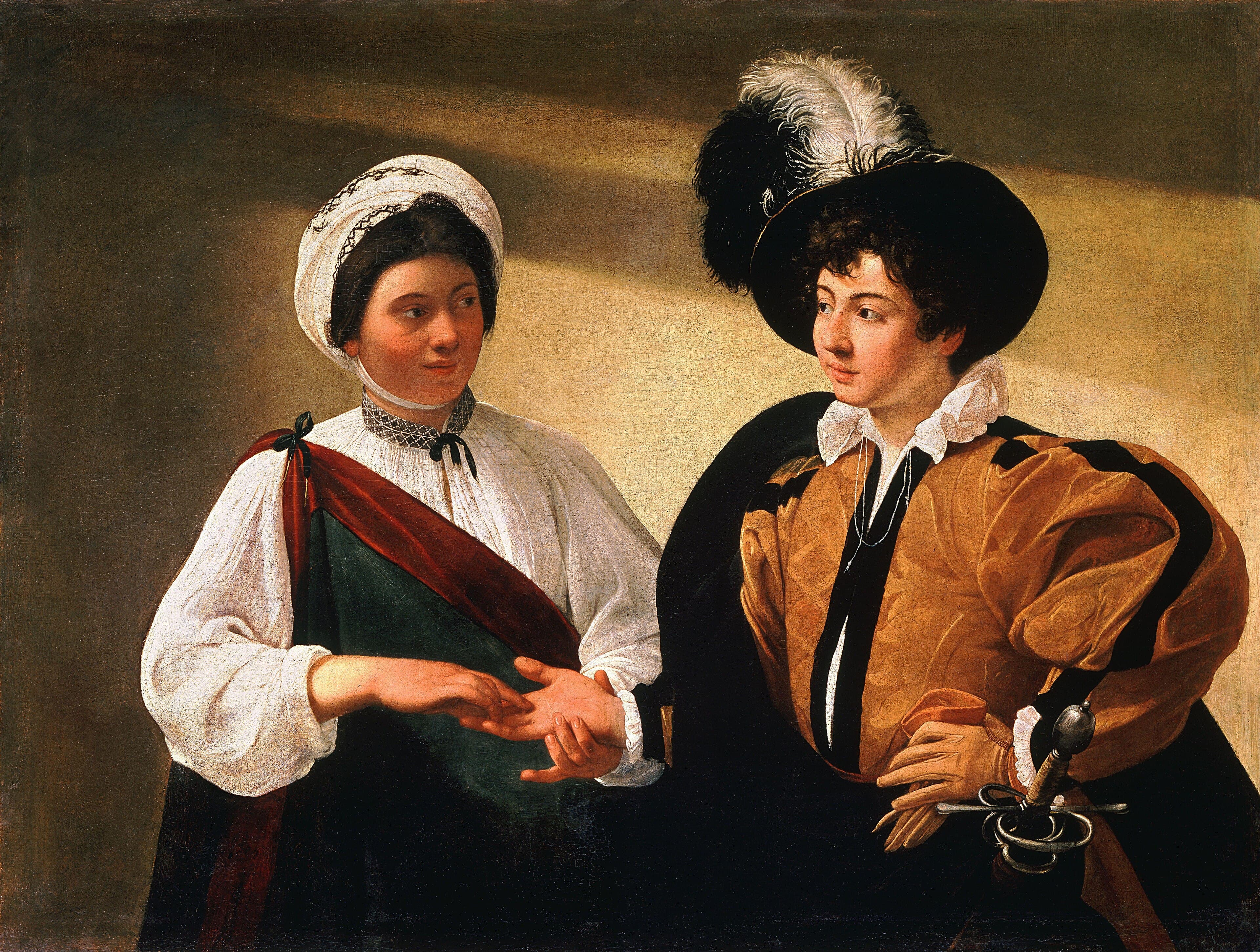
Caravaggio, The Fortune Teller, about 1595–1598, oil on canvas, 99 by 131 cm, Musée du Louvre, Paris (INV 55). Prince Camillo Pamphilj gave it to Louis XIV in 1665. (Caravaggio (Musée du Louvre, Paris); photograph by Coyau, via Wikimedia Commons · Public domain)
The Fortune Teller belongs to the same run of work and is now in the Louvre.[11] A young woman in a white blouse and headcloth holds a richly dressed boy's open palm and reads it while she looks him in the eye. Her fingers are quietly working the ring off his finger. The canvas is 99 by 131 centimeters and was painted about 1595.[11]
Bellori tells a story about how it was made. Someone showed Caravaggio the most famous antique statues so that he would study them. His only answer was to stretch out his hand toward the crowd of people in the street, meaning that nature had already supplied him with masters enough. Then, to prove the point, he called in a woman who happened to be passing, took her back to his lodgings and painted her telling a young man's fortune.[8]
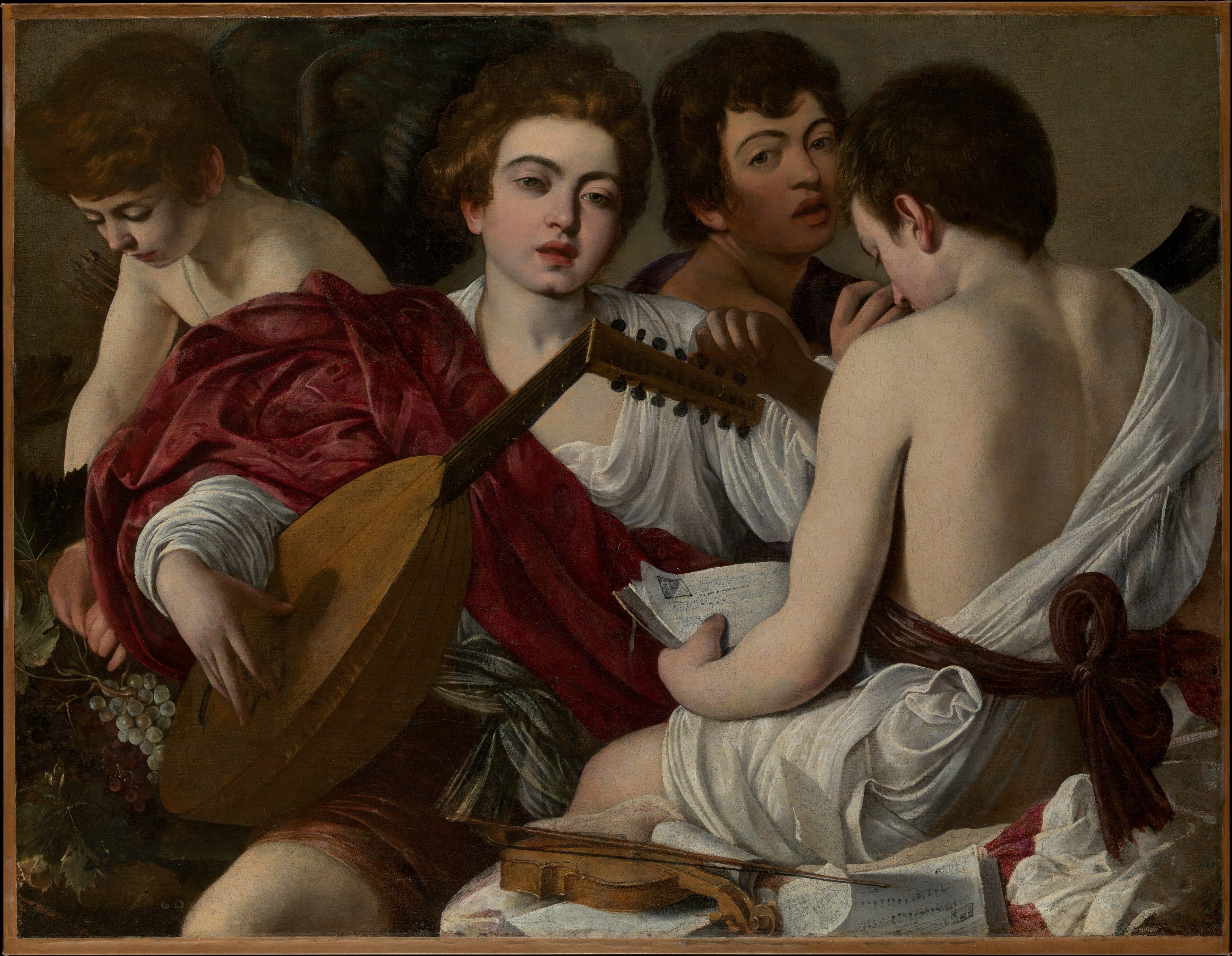
For Del Monte and the collectors around him Caravaggio painted a group of half-length pictures of boys with instruments and fruit.[5] The Musicians, dated 1597 and now at the Metropolitan Museum of Art in New York, is one of them; it measures 92.1 by 118.4 centimeters.[16] Baglione describes a Lute Player painted for the cardinal and singles out the carafe of flowers standing in water, with a window reflected in the glass and fresh dew on the petals.[7] Baglione adds that this was said to be the finest thing Caravaggio ever made.
Two other pictures from these years are among his best known. The Medusa is painted on canvas laid over a wooden jousting shield, 58 centimeters across, and shows a severed head with snakes for hair and the mouth open.[17] Baglione says Del Monte sent it as a gift to Ferdinando de' Medici, Grand Duke of Tuscany, and it hangs in the Uffizi.[7] Judith Beheading Holofernes, painted about 1598 and measuring 145 by 195 centimeters, is in the Palazzo Barberini in Rome along with the Narcissus.[17] In the Judith the young woman leans away from the work while she saws through the neck with a sword, and an old servant stands at her elbow holding a cloth ready.
The Contarelli Chapel, 1599 to 1602
In 1565 a French cleric in Rome, Matteo Contarelli, bought a chapel in San Luigi dei Francesi, the French national church. He died twenty years later with the chapel still undecorated. The executors of his will hired Giuseppe Cesari to fresco the vault, which he did between 1591 and 1593, and then the walls stood bare for six more years.[17]
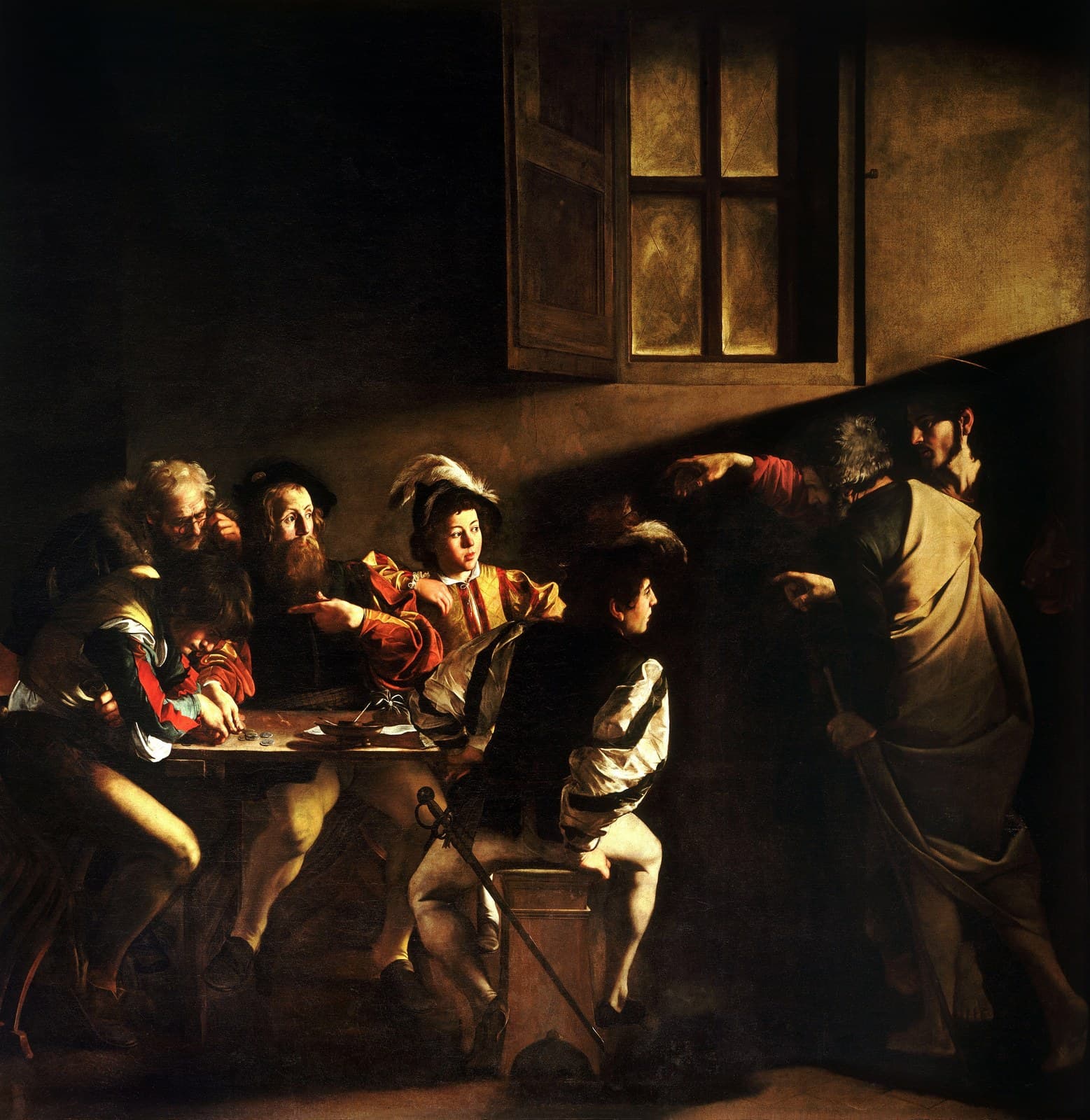
In 1599 Caravaggio signed a notarial contract for the two side walls.[17] He delivered The Calling of Saint Matthew and The Martyrdom of Saint Matthew, each about 3.2 meters square, and was paid the following year once they were in place.[17] They were the first paintings of his that anyone in Rome could walk in and look at, and they made his name.[4]
Caravaggio, The Calling of Saint Matthew, 1599–1600, oil on canvas, 322 by 340 cm, Contarelli Chapel, San Luigi dei Francesi, Rome. It is still in the chapel it was painted for. (Caravaggio (San Luigi dei Francesi, Rome), via Wikimedia Commons · Public domain)
The Calling of Saint Matthew shows five men around a table in a dark room, counting coins. They are dressed as Romans of about 1600, in feathered hats and slashed doublets, with swords at their sides. Two barefoot figures have come in from the right, and the nearer of them puts out a hand toward the table. A shaft of light crosses the bare back wall above their heads. A bearded man at the table points at his own chest. Nothing in the room announces that the event is sacred except the light and the two gestures.
Not everyone was impressed. Baglione records that the senior painter Federico Zuccari came to see the new pictures while Baglione was standing there. Zuccari asked what all the noise was about, looked at everything carefully, and said he could see nothing in them but Giorgione's idea in the panel of the saint whom Christ calls to be an apostle. Then he shrugged, turned his back and left.[7]
A third canvas followed. A separate contract of 7 February 1602 gave Caravaggio the altarpiece, after a statue ordered from the Flemish sculptor Jacob Cobaert was judged unsatisfactory.[17] His first version, Saint Matthew and the Angel, showed the evangelist as a heavy-legged laborer whose hand an angel guides across the page like a man being taught to write. It was not accepted. He painted a second version quickly and was paid for it on 22 September 1602. That painting, The Inspiration of Saint Matthew, is still above the altar.[17] Baglione says the collector Vincenzo Giustiniani took the rejected version because it was by Caravaggio.[7] It later went to the Kaiser-Friedrich-Museum in Berlin, was lost in the Second World War, and survives only in black-and-white photographs.[17]
In 1600, with the Contarelli canvases barely finished, Caravaggio signed for two more pictures, this time for the Cerasi Chapel in Santa Maria del Popolo.[17] The Crucifixion of Saint Peter and The Conversion on the Way to Damascus each measure 230 by 175 centimeters and are still on the chapel walls.[17] Baglione says an earlier pair was painted first, that the patron did not like them, and that Cardinal Sannesio took those away.[7] In the Conversion the horse takes up most of the picture, and Saul, the man who became Saint Paul, lies flat on his back underneath it.
The paintings, and where they hang now
Counts of Caravaggio's surviving paintings run from about forty to about eighty, depending on how the disputed attributions are treated.[5] Most of the famous ones are still in Rome, and several are in the churches they were painted for.
The Calling of Saint Matthew, The Martyrdom of Saint Matthew and The Inspiration of Saint Matthew, 1599 to 1602, Contarelli Chapel, San Luigi dei Francesi, Rome.[17]
The Crucifixion of Saint Peter and The Conversion on the Way to Damascus, 1600 to 1601, Cerasi Chapel, Santa Maria del Popolo, Rome.[17]
Madonna di Loreto, 1603 to 1605, 260 by 150 centimeters, Sant'Agostino, Rome.[17]
David with the Head of Goliath, Boy with a Basket of Fruit, Saint Jerome, the Madonna dei Palafrenieri and a Saint John the Baptist, Galleria Borghese, Rome.[17]
Judith Beheading Holofernes, Narcissus and a Saint Francis in Meditation, Palazzo Barberini, Rome.[17]
Saint John the Baptist, 129 by 95 centimeters, Pinacoteca Capitolina, Rome, recorded in the Mattei collection from 1602.[18]
The Entombment, 1602 to 1603, 300 by 203 centimeters, Pinacoteca Vaticana.[17]
Rest on the Flight into Egypt and Penitent Magdalene, Galleria Doria Pamphilj, Rome.[17]
The Death of the Virgin, The Fortune Teller and the portrait of Alof de Wignacourt with his page, Musée du Louvre, Paris.[13][11][12]
The Supper at Emmaus of 1601, Salome receives the Head of John the Baptist, and Boy bitten by a Lizard, National Gallery, London.[2][19][3]
Medusa, Bacchus and The Sacrifice of Isaac, Uffizi, Florence.[17]
The Cardsharps, Kimbell Art Museum, Fort Worth.[4]
The Musicians and The Denial of Saint Peter, Metropolitan Museum of Art, New York.[16][20]
The Crucifixion of Saint Andrew, 1606 to 1607, Cleveland Museum of Art, the only Caravaggio altarpiece in the United States.[21]
The Seven Works of Mercy, 1606 to 1607, 390 by 260 centimeters, Pio Monte della Misericordia, Naples.[17]
The Beheading of Saint John the Baptist and Saint Jerome Writing, Oratory of St John the Baptist, St John's Co-Cathedral, Valletta.[6]
The Burial of Saint Lucy, Santa Lucia al Sepolcro, Syracuse, with The Raising of Lazarus and the Adoration of the Shepherds in the Museo Regionale, Messina.[17]
The Taking of Christ, National Gallery of Ireland, Dublin.[17]
Nativity with Saint Francis and Saint Lawrence, formerly in the Oratory of San Lorenzo in Palermo, and no longer there.[17]
If one picture has to be called the most famous, it is The Calling of Saint Matthew. It is also among the easiest of the great ones to see, because San Luigi dei Francesi is a working church near the Pantheon rather than a museum.
How he painted
Caravaggio worked from live models and painted them straight onto the canvas.[3] That was the part of his practice his colleagues found hardest to accept. The standard method was to build a picture through drawings first, working the composition out on paper over weeks before touching the canvas. He skipped that stage, and not a single drawing can be firmly attributed to him.[2]
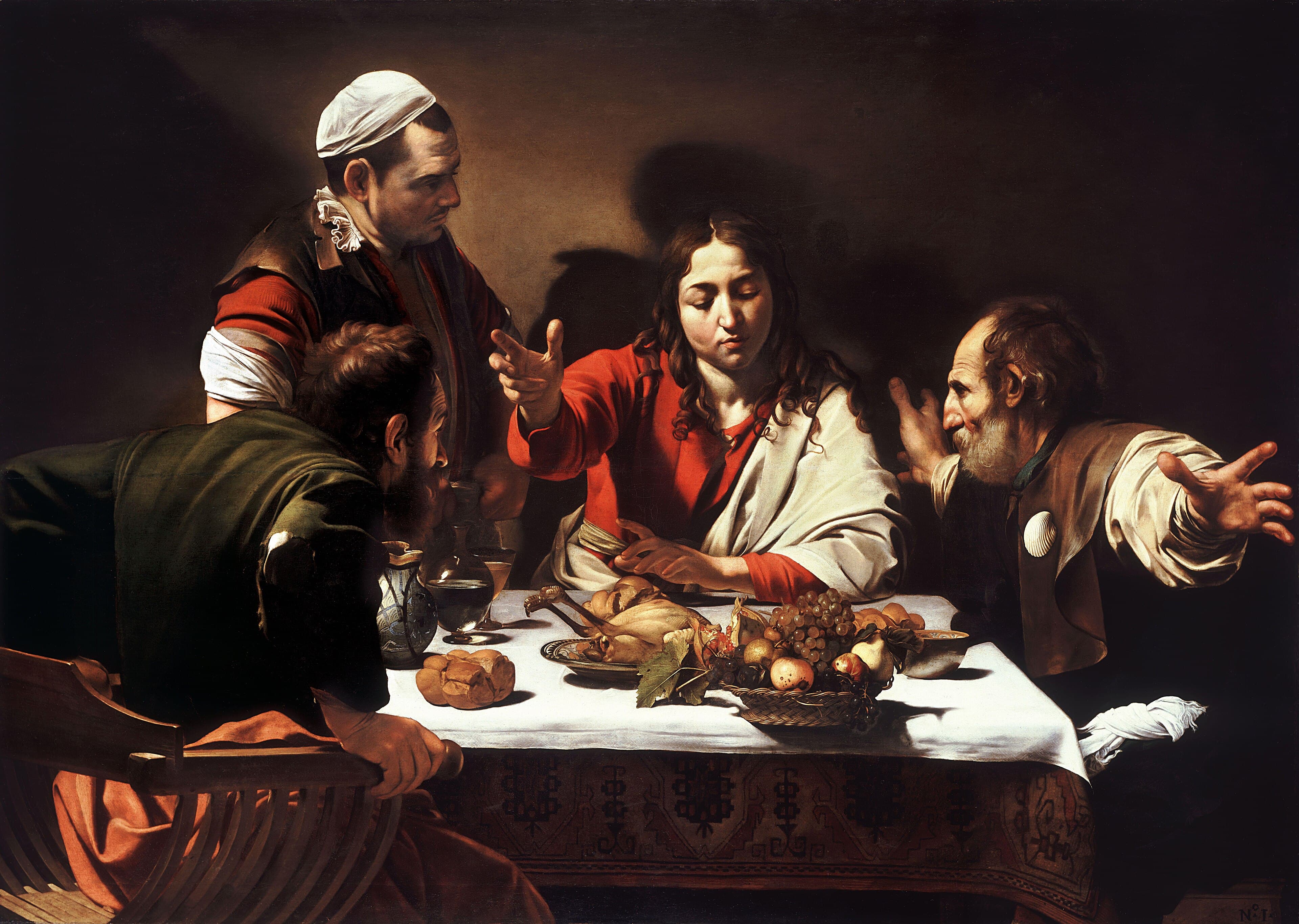
He did prepare, but on the canvas. Technical examination at the National Gallery in London has found brushed outlines in dark brown paint under the finished surface of The Supper at Emmaus, laying out the still life on the table.[2] In many of his pictures he also scored lines into the priming with something like the end of a brush handle while it was still soft. The incisions marked where figures were to go, and they would have let a model take up the same pose again the next day.[2]
The light is the other half of the method. A contemporary critic described the effect in a passage the Metropolitan Museum of Art quotes.[4] Caravaggio may have hung a lantern to one side in a shuttered studio and worked by it.[5]
A characteristic of this school is to use a focused light source from high up, without reflections, as though in a room with a window and the walls painted black. In this fashion the lit and shadowed areas are very light and very dark and give enormous three-dimensionality to the painting.[4]
He also made the ground do work. Caravaggio primed his canvases dark and left the priming showing in places, so that it served as the middle tone in the shadows instead of being mixed from paint. The National Gallery describes exactly this in the late Salome receives the Head of John the Baptist, where the dark ground is deliberately exposed.[19] Bellori noticed the same thing in 1672 in the Malta Beheading, and wrote that Caravaggio had worked with such force that he left the canvas priming standing as the half-tones.[8]
Bellori is also the source for what Caravaggio would not use. He records that vermilion and blue are not found in the figures, and that when Caravaggio did use them he damped them down, saying that they were the poison of colors.[8] He never painted a clear blue sky in a narrative picture. The background and the ground are black, black goes into the flesh, and the force of the light is confined to a few places.[8]
Bellori sums up the working relationship with the model in one line. Caravaggio, he writes, held himself so obedient to the model that he would not claim a single brushstroke as his own, saying it was not his but nature's.[8] Bellori did not mean it as praise. He goes on to say that once the model was taken away, the hand and the mind were empty.[8]
Two words get used for all this, and they do not mean the same thing. Chiaroscuro is Italian for light-dark, and describes the tonal contrast painters use to make a body look solid. Leonardo da Vinci used it that way, to give his figures roundness.[22] Tenebrism comes from tenebroso, meaning darkened, and describes a picture in which the faces and hands are picked out by highlights against a setting that is mostly dark.[23] Caravaggio used the contrast for drama rather than for roundness, and his late paintings are the standard example of tenebrism.[22][23]
Patrons, money, and the pictures that were sent back
After the Contarelli pictures Caravaggio never lacked buyers. Del Monte housed him. The Genoese banker Vincenzo Giustiniani, who lived next door to the cardinal, bought the rejected Saint Matthew and a great deal else.[7] Baglione names Ciriaco Mattei, who commissioned a Saint John the Baptist, a Supper at Emmaus and an Incredulity of Saint Thomas, and says Caravaggio got several hundred scudi out of him.[7] Cardinal Scipione Borghese, the pope's nephew, collected his work and also had the power to grant or withhold pardons.
Several altarpieces were taken down again. The Madonna dei Palafrenieri was painted for a small altar in Saint Peter's, hung briefly, and was removed by order of the cardinals in charge of the basilica. The grooms' confraternity then gave it to Cardinal Scipione Borghese, and it is in the Galleria Borghese.[7] The Madonna di Loreto in Sant'Agostino set off what Baglione calls an extreme outcry among ordinary people, because one of the two pilgrims kneeling in front of the Virgin has muddy feet and the other a torn and dirty cap.[7]
Caravaggio, The Death of the Virgin, about 1601–1606, oil on canvas, 369 by 245 cm, Musée du Louvre, Paris (INV 54). Commissioned for Santa Maria della Scala in Rome and refused by the church's clergy, it reached Paris when Louis XIV bought it in 1671. (Caravaggio (Musée du Louvre, Paris), via Wikimedia Commons · Public domain)
The largest rejection was The Death of the Virgin. Laerzio Cherubini commissioned it in 1601 for the Carmelite church of Santa Maria della Scala in Trastevere. Caravaggio finished it at the end of 1605 or the beginning of 1606, and the clergy of the church refused it.[13] Baglione's explanation is that the Virgin had been painted swollen and with her legs uncovered, with too little regard for decorum.[7] The canvas is 369 by 245 centimeters.[13] A dead woman lies on a plank bed with her feet showing and one arm hanging down, a thin gold line for a halo. Barefoot men weep around her, and a young woman sits doubled over at the foot of the bed.
It sold immediately. The picture was bought for the Duke of Mantua in April 1607, on the advice of Peter Paul Rubens, who was working in Italy at the time.[5] It was shown to the painters of Rome for a week before it went north.[5] From Mantua it passed to Charles I of England in 1627.[13] After the king's execution the Paris financier Everhard Jabach bought it, and he sold it to Louis XIV in 1671.[13]
The people around him
In 1603 the painter Giovanni Baglione took Caravaggio to court for libel, accusing him and his friends of writing and circulating obscene verses about him.[5] Caravaggio was jailed on the complaint and got out only when the French ambassador intervened.[5] Baglione went on to publish the first life of Caravaggio in 1642, thirty-two years after the painter's death, and it is one of the two seventeenth-century accounts everything else is built on.[7]
Baglione's portrait of him is not a friendly one. He calls Caravaggio satirical and haughty. He says the painter would go about running down every painter living or dead, because he thought his own work had surpassed them all. He also reports that some people held Caravaggio had ruined painting, because young men now copied a head from life without studying drawing or the depths of the art. Baglione also concedes, in the same paragraph, that Caravaggio's heads fetched higher prices than other men's history paintings.[7]
Orazio Gentileschi associated with Caravaggio from around 1600, and his own painting took on more naturalism for a few years before he returned to a more elegant manner.[24] He was one of Caravaggio's co-defendants in the 1603 libel case. His daughter Artemisia Gentileschi, born in Rome in 1593, learned to paint in her father's workshop, which is the route by which Caravaggio's way of working reached her.[25]
A younger painter known as Cecco del Caravaggio worked in the same manner and took his name from it. Giulio Mancini, writing around 1620, mentions a Francesco called del Caravaggio as an admirer and imitator, and the man behind the nickname has more recently been identified as Francesco Buoneri, a Lombard who may have come from Bergamo.
In Malta his patron was Alof de Wignacourt, the French Grand Master of the Order of Saint John, whom he painted twice.[8][12] Among the friends who outlived him were the lawyer Marzio Milesi, who wrote his epitaph, and the poet Giambattista Marino, whose portrait he painted.[14][8] Bellori quotes the verses Marino wrote for the funeral. In them Death and Nature make a cruel conspiracy against Caravaggio: Nature because his images were beating hers, and Death because for every person her scythe took, his brush made another.[8]
Models, household, and what the documents show
Caravaggio took his models from the street. The National Gallery in London puts it plainly: he used ordinary working people with irregular, rough and characterful faces as the models for his saints, and he showed them in surroundings his own contemporaries would recognize.[1][19] That is a large part of why so many of the altarpieces were sent back. A Virgin who looked like a woman from Trastevere, in a room with a plank bed in it, was not what the people paying for the picture had ordered.
The pictures he made for Del Monte's circle in the 1590s are mostly of adolescent boys, half-dressed, holding fruit or lutes and looking out at the viewer.[5] Whether they record a sexual interest as well as a pictorial one has been argued over for a long time, and nothing in the surviving documents answers it.
The documents record very little about his private life. On 29 July 1605 Caravaggio had to leave Rome for a time after wounding a man in defense of his mistress.[5] Neither Baglione nor Bellori mentions a wife or a child.[7][8] He seems to have lived the way a printed notice of 1604 describes: a fortnight of work, then a month or two out of doors with a sword and a servant.[1]
The killing of Ranuccio Tomassoni
The police record of Caravaggio's Roman years is long. In 1600 a fellow painter accused him of assault. In 1601 he wounded a soldier. In 1603 he was jailed on Baglione's libel complaint. In April 1604 he was accused of throwing a plate of artichokes in a waiter's face, and in October of that year he was arrested for throwing stones at the city guards. In May 1605 he was picked up for carrying arms without a license.[5] A sword in Rome then needed one, much as a gun does now.[1]
After a fortnight's work he will swagger about for a month or two with his sword at his side and with a servant following him, from one ball-court to the next.[1]
The same notice finishes the sentence: he was "ever ready to engage in a fight or argument, with the result that it is most awkward to get along with him."[1] It was written in 1604 and describes his behavior three years earlier.
In May 1606, in the Campo Marzio quarter of Rome, Caravaggio killed a young man named Ranuccio Tomassoni.[5] Accounts give the day as either 28 or 29 May. Baglione's version is that the quarrel began over a disputed point in a game of pallacorda, a court game played with a ball and a cord. Caravaggio and Tomassoni challenged each other and drew their weapons. Tomassoni went down, and Caravaggio thrust at him and wounded him in the fleshy part of the thigh, which killed him.[7]
Caravaggio was wounded himself and left Rome at once, taking shelter on an estate belonging to a relative of the Marquis of Caravaggio, south of the city.[5] He never went back. From that point he needed a papal pardon for the killing, and the remaining four years of his life were organized around getting one.[1]
Naples, Malta and Sicily
Caravaggio reached Naples late in 1606 or early in 1607 and stayed about a year.[5] The city lay outside Roman jurisdiction and had money in it. He painted The Seven Works of Mercy for the church of the Pio Monte della Misericordia. The canvas is 390 by 260 centimeters and packs all seven corporal works of mercy into a single crowded night scene. It is still on the altar it was made for.[17] The Crucifixion of Saint Andrew, from the same period, went to the Spanish viceroy in Naples.[21] It is now in the Cleveland Museum of Art and is the only Caravaggio altarpiece in the United States.[21]
He arrived in Malta in July 1607.[6] The island was the headquarters of the Order of Saint John, and a knighthood would improve his chances of a pardon. He painted the Grand Master, Alof de Wignacourt, twice: standing in armor with a page holding the helmet, and seated out of armor. The standing portrait, 194 by 134 centimeters, is in the Louvre.[12] On 14 July 1608 Wignacourt received him into the Order as a Knight of Obedience.[6] Bellori adds that the Grand Master hung a heavy gold chain around his neck and made him a present of two slaves.[8]
Caravaggio, The Beheading of Saint John the Baptist, about 1608, oil on canvas, roughly 3.6 meters high and 5.2 meters wide, Oratory of St John the Baptist, St John's Co-Cathedral, Valletta. His largest painting, and the one he signed, in the blood running from the severed neck. (Caravaggio (St John's Co-Cathedral, Valletta), via Wikimedia Commons · Public domain)
For the Oratory of the Order's church he painted The Beheading of Saint John the Baptist, roughly 3.6 meters high and 5.2 meters wide, the largest canvas he ever made.[6][17] The executioner has already struck once with the sword and has not finished the job. He kneels on the body, holds the head down by the hair and reaches back for the knife at his belt. A young woman bends forward with a brass basin, an old woman clutches her own head, and two prisoners watch through a barred window. Caravaggio signed this one, brushing his name into the blood running from the neck.[6]
It went wrong within weeks. By late August 1608 he was in the prison of Fort Saint Angelo after a fight with knights, and he escaped before he could be tried.[6] On 1 December 1608 the Order held a public assembly in the Oratory, in front of the Beheading, and expelled him. The record says he was thrust forth like a rotten and fetid limb, which was the formula used for every such expulsion.[6]
He landed at Syracuse in Sicily in October 1608 and worked his way north.[5] For Santa Lucia al Sepolcro in Syracuse he painted The Burial of Saint Lucy, four meters high, with the body small at the bottom of an enormous bare wall. In Messina he painted The Raising of Lazarus and an Adoration of the Shepherds, both now in the regional museum there. In Palermo he painted a Nativity for the Oratory of San Lorenzo, which is no longer in the building.[17] Bellori writes that fear drove him from town to town across the island.[8]
The attack in Naples and the death at Porto Ercole
In October 1609 Caravaggio went back to Naples.[5] Bellori says he stopped one day at the door of the Osteria del Cerriglio, that armed men closed around him, and that they handled him badly and wounded him in the face.[8] Baglione says the cuts were such that he was almost unrecognizable afterwards.[7] Word reached Rome that the famous painter was dead.[5]
Caravaggio, David with the Head of Goliath, about 1609–1610, oil on canvas, 125 by 101 cm, Galleria Borghese, Rome. The severed head is generally identified as a self-portrait. (Caravaggio (Galleria Borghese, Rome), via Wikimedia Commons · Public domain)
He kept painting through the convalescence. The Denial of Saint Peter, dated 1610 and now at the Metropolitan Museum of Art, is a small canvas, 94 by 125 centimeters, in which a servant girl points at Peter and Peter's hands come up in denial.[20] From the same months comes David with the Head of Goliath, 125 by 101 centimeters, now in the Galleria Borghese.[17] A boy in a torn white shirt holds out a severed head by the hair and looks down at it without any sign of triumph. The head is bearded and battered, and it is usually identified as Caravaggio's own face.
In July 1610 he sailed north from Naples with paintings on board, believing a pardon was close. The boat put in at Palo, on the coast north of Rome, and he was arrested there. By the time he was released the boat had gone on with his belongings and the paintings still aboard. He set off up the shore after it, reached Porto Ercole on the Tuscan coast, and died there on 18 July 1610.[5] He was thirty-eight.
He took to his bed with a malignant fever, and with no human help he died badly within a few days, exactly as he had lived badly.[7]
Misesi in letto con febre maligna, e senza aiuto humano tra pochi giorni morì malamente, come appunto male havea vivuto.
Both seventeenth-century biographers say fever.[7][8] Bellori adds a detail: Caravaggio had been walking the beach at the hottest part of a summer day, trying to catch up with the boat that carried his belongings, and he collapsed when he reached Porto Ercole.[8] Neither man was a witness, and neither was friendly.
Later explanations have multiplied. The older biographical tradition settled on pneumonia.[5] Syphilis has been proposed, and malaria, and murder, either by the Tomassoni family in revenge or by knights of the Order over the fight that had him expelled.[9] Lead poisoning from his own paints has been proposed as well, since the pigments of the period carried a great deal of lead.[10]
In June 2010 an Italian team led by Silvano Vinceti announced that it had found his bones.[10] Remains from the old San Sebastiano cemetery at Porto Ercole had been moved to an ossuary in 1956, when the site was built over.[10][9] The team examined nine sets and picked one from a tall man who died around 1610 aged between thirty-eight and forty. DNA from those bones was compared with samples from families in the town of Caravaggio who still carry the surname, and the match came out between fifty and sixty percent. The bones also held a high level of lead.[10]
Vinceti put the team's confidence at eighty-five percent, and eighty-five percent is not an identification.[10] The team's own account of the cause of death was not consistent either. The Guardian reported lead poisoning together with infected wounds and sunstroke.[10] The BBC reported the researchers saying sunstroke in a man weakened by syphilis.[9] The identification of the bones is still disputed.
In 2018 researchers from Marseille, Bologna and Verona published a letter in The Lancet Infectious Diseases arguing that Caravaggio died of sepsis caused by Staphylococcus aureus.[26] They based it on bacterial DNA recovered from the teeth of the Porto Ercole remains, which would fit a wound infected after the attack in Naples.[26] The argument depends entirely on those bones being his. A second group of researchers challenged the letter in the same journal in January 2019, and the authors replied in the same issue.[27] Nothing has settled it.
After 1610: the followers, the eclipse, and the three pictures in Paris
Caravaggio's manner spread quickly and then stopped. The painters who took it up were called the Caravaggisti. In Rome the fashion held until about the 1620s, carried by Bartolomeo Manfredi and others.[4][5] Outside Italy the Dutch painters Hendrick ter Brugghen and Gerrit van Honthorst went to Rome, learned it there, and brought it home to Utrecht, which became the northern center of it.[4] The French painters Valentin de Boulogne and Nicolas Tournier and the Spaniards Juan Bautista Maino and Jusepe de Ribera took it up as well.[4]
Through the Utrecht painters it reached Johannes Vermeer, whose earliest works of the 1650s show it, and Rembrandt van Rijn, in whose work it is visible from the 1630s.[28][29] Neither of them ever went to Italy. Peter Paul Rubens had seen the pictures himself before he left Italy in 1608, and used what he had learned in Samson and Delilah, painted for the mayor of Antwerp.[30][31]Diego Velázquez knew the work through copies while he was still an apprentice in Seville.[32]Gian Lorenzo Bernini, who was twelve when Caravaggio died, took it into the paintings he made alongside his sculpture.[33]
Then his reputation collapsed. Caravaggio never ran a workshop, so no school of pupils survived to defend him, and he never set down in writing what he thought he was doing. The two men who wrote about him were both hostile.[5] Baglione was the painter who had sued him. Bellori never met him and preferred the classical manner of the Bolognese painters.
Bellori concedes a good deal before he condemns. He grants that Caravaggio arrived at a useful moment, when painters were making figures up out of habit rather than looking at them, and that he stripped the cosmetics off color and gave painting back its blood and flesh.[8] Then he lists what was missing: no invention, no decorum, no drawing, no science of painting, and nothing left in the hand once the model was taken away.[8]
Monsieur Poussin could not bear anything of Caravaggio's, and said that he had come into the world to destroy painting.[34]
M. Poussin ne pouvoit rien souffrir du Caravage, et disoit qu'il étoit venu au monde pour détruire la Peinture.
Nicolas Poussin, the French painter who spent most of his working life in Rome, put it hardest of all. André Félibien reports the remark and then explains it: Poussin looked for nobility in his subjects, and Caravaggio let himself be carried away by the truth of nature as he found it.[34] They wanted opposite things. Poussin was born in 1594 and reached Rome in 1624, so he never met the man he was condemning.[35]
In the same passage Félibien says that Caravaggio possessed the whole art of imitating what he had in front of his eyes.[34] Anyone who looked at his portrait of the Grand Master of Malta, then in the King's Cabinet in Paris, would admit that nothing more beautiful could be done.[34] A French writer of the 1660s could go and look at a Caravaggio without leaving the city.
That portrait is one of three Caravaggios in Paris, and all three came in through the French crown. Prince Camillo Pamphilj gave The Fortune Teller to Louis XIV in 1665.[11] The portrait of Alof de Wignacourt with his page belonged to the Duke of Liancourt by 1644, passed to a collector named Oursel, and was sold to Louis XIV in 1670.[12] The Death of the Virgin, refused by the Carmelites who ordered it, went from Mantua to Charles I of England in 1627, and Everhard Jabach sold it to Louis XIV in 1671.[13] All three hang in the Grande Galerie of the Louvre. Caravaggio never set foot in France.
The recovery took three centuries. The Italian critic Roberto Longhi did more than anyone to bring it about, publishing on Caravaggio and the painters around him through the middle of the twentieth century, and the case he made has held.[21] In 2010, four hundred years after the death at Porto Ercole, an exhibition at the Scuderie del Quirinale in Rome drew 580,000 visitors.[10]
Life events
30 September 1571
Baptized in Milan, in the parish of Santo Stefano in Brolo, son of Fermo Merisi and Lucia Aratori. The birth is usually placed the day before, on the feast of Saint Michael.
Ottavio Leoni, Portrait of Caravaggio, about 1621, black and white chalk on blue paper, Biblioteca Marucelliana, Florence. Leoni knew Caravaggio in Rome but drew this at least a decade after his death, so it is a recollection rather than a sitting. (Ottavio Leoni (Biblioteca Marucelliana, Florence), via Wikimedia Commons)
November 1572
A younger brother, Giovanni Battista, is baptized in Milan. The family appears in the records of the parish of Santa Maria alla Passarella from 1572 through 1577.
1584
Enters the Milan workshop of Simone Peterzano, a painter who claimed Titian as his master, on a four-year contract.
1588–1592
Leaves Lombardy for Rome at some point in these years. Almost nothing certain is known about them.
c. 1593–1595
Poor in the Campo Marzio quarter of Rome, working as an assistant to other painters, among them Giuseppe Cesari, the Cavaliere d'Arpino, who sets him to painting flowers and fruit.
c. 1594–1595
Paints Boy bitten by a Lizard, one of the small pictures he made while trying to work for himself. It is now in the National Gallery, London.
c. 1595
Cardinal Francesco Maria del Monte buys The Cardsharps and takes Caravaggio into his household at the Palazzo Madama with board, lodging and an allowance.
c. 1595–1598
Paints The Fortune Teller, now in the Louvre in Paris.
Caravaggio, The Fortune Teller, about 1595–1598, oil on canvas, 99 by 131 cm, Musée du Louvre, Paris (INV 55). Prince Camillo Pamphilj gave it to Louis XIV in 1665. (Caravaggio (Musée du Louvre, Paris); photograph by Coyau, via Wikimedia Commons)
1597
Paints The Musicians, now at the Metropolitan Museum of Art in New York.
1598–1599
Paints the Medusa on a jousting shield, which Del Monte sends as a gift to Ferdinando de' Medici, and Judith Beheading Holofernes.
1599
Signs a notarial contract for two large canvases in the Contarelli Chapel of San Luigi dei Francesi, his first public commission.
1600
The Calling of Saint Matthew and The Martyrdom of Saint Matthew go up in the chapel and are paid for. They make his name in Rome.
Caravaggio, The Calling of Saint Matthew, 1599–1600, oil on canvas, 322 by 340 cm, Contarelli Chapel, San Luigi dei Francesi, Rome. It is still in the chapel it was painted for. (Caravaggio (San Luigi dei Francesi, Rome), via Wikimedia Commons)
1600
Signs for two more pictures, The Crucifixion of Saint Peter and The Conversion on the Way to Damascus, for the Cerasi Chapel in Santa Maria del Popolo.
1600
Accused of assault by another painter, the first surviving entry in a long police record.
1601
Paints The Supper at Emmaus for Ciriaco Mattei, now in the National Gallery, London. In the same year he wounds a soldier.
7 February 1602
Contracted for the Contarelli altarpiece after a statue ordered from Jacob Cobaert is judged unsatisfactory. His first Saint Matthew and the Angel is refused, and he is paid for the second version, The Inspiration of Saint Matthew, on 22 September.
1602–1603
Paints The Entombment, now in the Pinacoteca Vaticana.
1603
Jailed on a libel complaint by the painter Giovanni Baglione, and released after the French ambassador intervenes. Orazio Gentileschi is a co-defendant.
April 1604
Accused of throwing a plate of artichokes in a waiter's face. In October he is arrested for throwing stones at the city guards.
1603–1605
Paints the Madonna di Loreto for Sant'Agostino. Baglione says the muddy feet and dirty cap of the two pilgrims caused an outcry.
1605
Arrested in May for carrying arms without a license, and forced out of Rome for a time on 29 July after wounding a man in defense of his mistress.
1605–1606
The Madonna dei Palafrenieri is hung on a small altar in Saint Peter's and removed by order of the cardinals. The grooms' confraternity gives it to Cardinal Scipione Borghese.
Late 1605 or early 1606
Finishes The Death of the Virgin for Santa Maria della Scala in Trastevere. The clergy of the church refuse it.
Caravaggio, The Death of the Virgin, about 1601–1606, oil on canvas, 369 by 245 cm, Musée du Louvre, Paris (INV 54). Commissioned for Santa Maria della Scala in Rome and refused by the church's clergy, it reached Paris when Louis XIV bought it in 1671. (Caravaggio (Musée du Louvre, Paris), via Wikimedia Commons)
May 1606
Kills Ranuccio Tomassoni in the Campo Marzio after a quarrel over a game of pallacorda, and leaves Rome wounded and under sentence. Accounts give the day as 28 or 29 May.
Late 1606
Reaches Naples, outside Roman jurisdiction, and stays about a year.
1606–1607
Paints The Seven Works of Mercy for the Pio Monte della Misericordia, still on its altar in Naples, and The Crucifixion of Saint Andrew, now in Cleveland.
April 1607
The Death of the Virgin is bought for the Duke of Mantua on Peter Paul Rubens's advice and shown to the painters of Rome for a week before it leaves the city.
July 1607
Arrives in Malta, headquarters of the Order of Saint John, hoping a knighthood will help him win a pardon.
14 July 1608
Received into the Order of Saint John as a Knight of Obedience by the Grand Master Alof de Wignacourt, whose portrait he had painted.
1608
Paints The Beheading of Saint John the Baptist for the Oratory in Valletta, his largest canvas, and signs it.
Caravaggio, The Beheading of Saint John the Baptist, about 1608, oil on canvas, roughly 3.6 meters high and 5.2 meters wide, Oratory of St John the Baptist, St John's Co-Cathedral, Valletta. His largest painting, and the one he signed, in the blood running from the severed neck. (Caravaggio (St John's Co-Cathedral, Valletta), via Wikimedia Commons)
Late August 1608
Imprisoned in Fort Saint Angelo after a fight with knights, and escapes before he can be tried.
October 1608
Lands at Syracuse in Sicily and paints The Burial of Saint Lucy, then works in Messina and Palermo.
1 December 1608
Expelled from the Order of Saint John at a public assembly held in the Oratory, in front of the Beheading, and thrust forth in the Order's formula as a rotten and fetid limb.
October 1609
Back in Naples, attacked by armed men at the door of the Osteria del Cerriglio and badly wounded in the face. Rome hears that he is dead.
1609–1610
Paints David with the Head of Goliath, whose severed head is usually identified as a self-portrait, and The Denial of Saint Peter.
Caravaggio, David with the Head of Goliath, about 1609–1610, oil on canvas, 125 by 101 cm, Galleria Borghese, Rome. The severed head is generally identified as a self-portrait. (Caravaggio (Galleria Borghese, Rome), via Wikimedia Commons)
July 1610
Sails north from Naples with paintings meant to buy a pardon. Arrested when the boat puts in at Palo, and by his release the boat has gone on with his belongings.
18 July 1610
Dies at Porto Ercole on the Tuscan coast, aged thirty-eight, and is buried in an unmarked grave.
1665–1671
The three Caravaggios now in Paris enter the French royal collection. The Fortune Teller arrives as a gift from Prince Camillo Pamphilj in 1665, the Wignacourt portrait is bought in 1670, and The Death of the Virgin is bought from Everhard Jabach in 1671.
16 June 2010
An Italian team led by Silvano Vinceti announces that bones from the ossuary at Porto Ercole are Caravaggio's, at eighty-five percent confidence. The identification is disputed.
2018
Researchers publish a letter in The Lancet Infectious Diseases arguing that he died of sepsis caused by Staphylococcus aureus. A second group challenges it in the same journal in January 2019.
Caravaggio quotes
Verbatim, as recorded by the witnesses of the era — sources on every quotation.
“
They were the poison of colors.
erano il veleno delle tinte
— Caravaggio on vermilion and blue, as reported by Giovan Pietro Bellori in Le vite de' pittori, scultori et architetti moderni (Rome, 1672)
Selected works
Cataloged from the holding institutions' records. Reproductions appear only where the rights are verified.
Caravaggio painted The Calling of Saint Matthew between 1599 and 1600 for the Contarelli Chapel in the church of San Luigi dei Francesi in Rome, where it still hangs. It shows the moment Christ picks out a tax collector from a table of men counting money.
A dead woman lies on a plank in a bare room, her feet uncovered and her stomach distended under a red dress, while a dozen men stand round her and one woman sits bent double in front. The Louvre calls it La Mort de la Vierge and dates it to about 1601 to 1606. The church that commissioned it refused to hang it.
A young woman in a white headwrap holds a richly dressed boy's open palm and reads it, and the two of them look at each other rather than at the hand. The Louvre titles it La diseuse de bonne aventure and dates it to about 1595 to 1598. Caravaggio painted the composition twice; the second version is in Rome.
Four youths crowd into a shallow space with a lute, a violin, a horn and sheets of written music, and one of them carries a sheaf of arrows. Michelangelo Merisi da Caravaggio painted it in 1597, during the years he lived in Cardinal Francesco Maria del Monte's household. The Metropolitan Museum of Art holds it as 52.81.
Two travellers recognise the risen Christ at an inn table, one gripping his chair to stand and the other throwing both arms wide, while a basket of fruit tips over the table edge. Michelangelo Merisi da Caravaggio painted it in 1601. The National Gallery in London holds it as NG172.
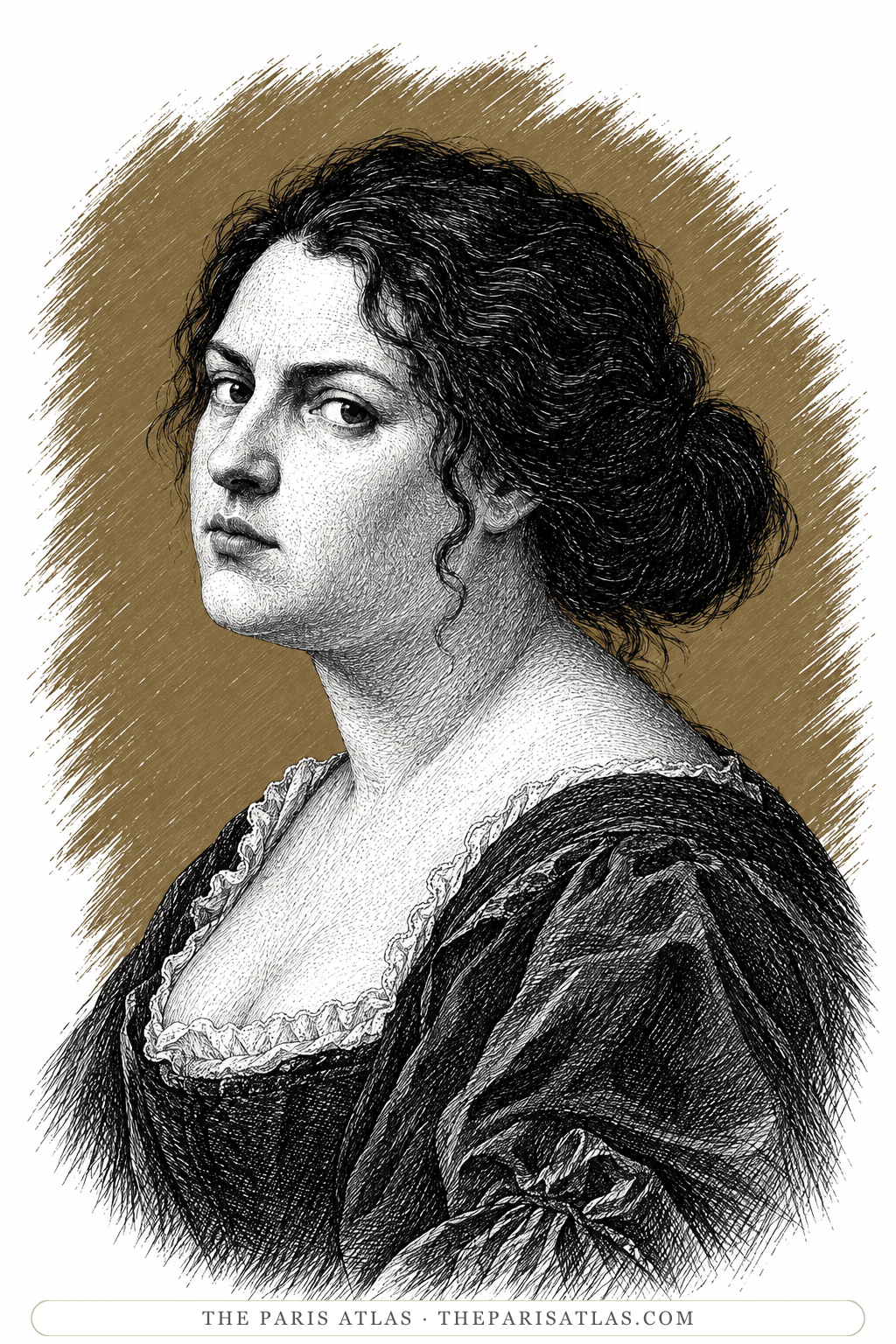
Artemisia Gentileschi was born in Rome in 1593 and trained under her father, the painter Orazio Gentileschi. The National Gallery in London records that Orazio associated with Caravaggio from around 1600 and that his own pictures took on greater naturalism under Caravaggio's influence, though that phase was short. Artemisia learned to paint inside that household, so the line runs through her father rather than through any recorded contact with Caravaggio himself.
— Orazio Gentileschi (1563 – 1639) — artist page; Artemisia Gentileschi (1593 – 1654 or later)
The kitchen scenes Velázquez painted in Seville between about 1617 and 1623 use hard side light, dark backgrounds and ordinary people as models. The Prado's biography by Enriqueta Harris calls him one of the first painters in Spain to work in the naturalism that came, directly or indirectly, from Caravaggio, and places him on the same path as Jusepe de Ribera. The link is an inference drawn from the pictures. Velázquez had never been to Italy when he painted them, and no document records him seeing a Caravaggio.
— Enriqueta Harris, Velázquez, Diego Rodríguez de Silva y (Enciclopedia del Museo del Prado); The Waterseller of Seville (English Heritage, The Wellington Collection, Apsley House); Diego Velázquez (1599 – 1660) — artist page
Gian Lorenzo Bernini was twelve when Caravaggio died in 1610, and he made his career in Rome as a sculptor. He also painted, mostly head studies and portraits, and the National Gallery in London says Caravaggio's work influenced that side of his practice. The claim is about Bernini's painting, not his marble.
— Gian Lorenzo Bernini (1598 – 1680) — artist page
Johannes Vermeer was born in Delft in 1632, twenty-two years after Caravaggio died. The National Gallery in London says his earliest works, from the 1650s, are influenced by Caravaggio's followers in Utrecht, naming Hendrick ter Brugghen. Ter Brugghen had worked in Rome and brought the manner home, so what reached Vermeer was Caravaggio at one remove.
— Johannes Vermeer (1632 – 1675) — artist page; Caravaggio (Michelangelo Merisi) (1571–1610) and His Followers
Peter Paul Rubens spent eight years working in Italy and went home to Antwerp in 1608. The National Gallery in London says that while he was there he saw Caravaggio's experiments with strongly contrasted light and shade and with deep, rich color, and that he used those methods on his return in Samson and Delilah, painted for the Antwerp mayor Nicolaas II Rockox. Caravaggio and Rubens are not recorded as having met.
— Peter Paul Rubens, Samson and Delilah (NG6461) — collection record; Peter Paul Rubens — artist page
Rembrandt never went to Italy and no document places him in front of a painting by Caravaggio. The way of lighting a scene reached him second hand, through prints and through Dutch painters who had worked in Rome: his own teacher Pieter Lastman, who was in Rome between about 1603 and early 1607 and saw Caravaggio's work there, and the Utrecht painter Gerrit van Honthorst, who spent 1610 to 1620 in Rome and came home the best known of the Dutch followers of Caravaggio. The National Gallery in London dates the result in Rembrandt's own paintings to the 1630s, when he began modeling a face out of patches of light and shadow instead of lighting one side and shading the other.
— Rembrandt (1606–1669) — artist page; Pieter Lastman — The Leiden Collection Catalogue, 4th edition; Gerrit van Honthorst (1592–1656) — artist page; Caravaggio (Michelangelo Merisi) (1571–1610) and His Followers
Movements
The artistic and literary currents this life ran through.
Art movement and historical period · circa 1600–1750
The Calling of Saint Matthew, painted in 1599–1600 for the Contarelli Chapel in San Luigi dei Francesi, put a sacred event in an ordinary-looking room lit by a single directional shaft. His naturalism could also lose him a commission: The Death of the Virgin was rejected by the clergy who ordered it, then passed through the Gonzaga collection, Charles I of England and Louis XIV.
— Caravaggio, The Calling of Saint Matthew; Caravaggio (Michelangelo Merisi) (1571–1610) and His Followers; Caravaggio, La Mort de la Vierge — collection record
Questions about Caravaggio
Who was Caravaggio?
Caravaggio was an Italian painter, born Michelangelo Merisi and baptized in Milan on 30 September 1571,[14] who died at Porto Ercole on the Tuscan coast on 18 July 1610. He painted from live models straight onto the canvas, without preparatory drawings, and lit them with one hard light against a dark ground. He is named after the Lombard town his parents came from. He worked in Rome until May 1606, when he killed a man in a fight and had to leave the city under sentence, and he painted in Naples, Malta and Sicily until his death.
Why did Caravaggio use tenebrism?
He used it to force attention onto the moment of the story and to make a painted room feel like a real one. Tenebrism, from the Italian tenebroso, meaning darkened, describes a picture in which faces and hands are picked out by highlights against a setting that is mostly dark.[23] It is a particular use of chiaroscuro, the Italian term for light-dark, which means the tonal contrast painters use to make bodies look solid. Leonardo da Vinci used that contrast for roundness; Caravaggio used it for drama. A contemporary critic described the method as a single light from high up, with no reflected light, as if in a room with one window and the walls painted black. It also suited the way he worked, because a model posed in a shuttered studio under a lantern gave him exactly that light.
How did Caravaggio die?
He died of a fever at Porto Ercole on 18 July 1610, aged thirty-eight, according to both seventeenth-century biographers.[7][8] Giovanni Baglione writes that he took to his bed with a malignant fever and died within a few days with no one to help him. Giovan Pietro Bellori adds that he had been walking the shore in full summer heat, chasing a boat that had sailed on with his belongings after he was arrested at Palo. What caused the fever is still argued over. Pneumonia, syphilis, malaria, lead poisoning from his paints and murder have all been proposed. In June 2010 an Italian team announced that bones from the ossuary at Porto Ercole were his, at eighty-five percent confidence, and in 2018 researchers used those remains to argue for sepsis caused by Staphylococcus aureus. Both claims are disputed, and the second depends on the first.
What subjects did Caravaggio paint most?
Religious subjects, and within them the moment when something violent or decisive happens. After the Contarelli Chapel canvases of 1599 to 1600 he painted almost nothing else. Beheadings recur again and again: Judith and Holofernes, David and Goliath twice, Salome with the Baptist's head twice, and the huge Beheading of Saint John the Baptist in Malta. Before that, in the 1590s, he mostly painted half-length pictures of adolescent boys with fruit and musical instruments for Cardinal Del Monte's circle, along with card games and fortune-telling scenes taken from street life.
What is Caravaggio's most famous painting?
The Calling of Saint Matthew, painted in 1599 to 1600 for the Contarelli Chapel in San Luigi dei Francesi in Rome, where it still hangs. It shows five men in contemporary hats and doublets counting coins at a table in a dark room, a shaft of light crossing the bare wall above them, and two barefoot figures who have just come in. The Death of the Virgin in the Louvre, The Supper at Emmaus in London and The Beheading of Saint John the Baptist in Valletta are the other candidates.
Where can you see Caravaggio's paintings in Rome?
Three Roman churches hold paintings in the chapels they were made for, and you can walk in and look at them. San Luigi dei Francesi has the three Saint Matthew canvases in the Contarelli Chapel. Santa Maria del Popolo has The Crucifixion of Saint Peter and The Conversion on the Way to Damascus in the Cerasi Chapel. Sant'Agostino has the Madonna di Loreto. Four museums hold most of the rest. The Galleria Borghese has David with the Head of Goliath, Boy with a Basket of Fruit, Saint Jerome, the Madonna dei Palafrenieri and a Saint John the Baptist. The Palazzo Barberini has Judith Beheading Holofernes and Narcissus. The Galleria Doria Pamphilj has Rest on the Flight into Egypt and the Penitent Magdalene. The Pinacoteca Capitolina has a Saint John the Baptist, and the Pinacoteca Vaticana has The Entombment.
Which Caravaggio paintings are in Paris?
Three, all in the Musée du Louvre, and all three entered the French royal collection under Louis XIV. The Fortune Teller was a gift from Prince Camillo Pamphilj in 1665.[11] The portrait of Alof de Wignacourt with his page was sold to the king in 1670.[12] The Death of the Virgin, refused by the Carmelite church that commissioned it, went to Mantua in 1607, then to Charles I of England in 1627, and was sold to Louis XIV by the Paris financier Everhard Jabach in 1671. All three hang in the Grande Galerie. Caravaggio never traveled to France.
Did Caravaggio really kill someone?
Yes. In May 1606, in the Campo Marzio quarter of Rome, he killed a young man named Ranuccio Tomassoni; accounts give the day as 28 or 29 May.[7] Baglione says the quarrel began over a disputed point in a game of pallacorda, that Caravaggio and Tomassoni drew their weapons, and that Caravaggio wounded Tomassoni in the thigh after he had fallen. Caravaggio was wounded himself, left the city for estates south of Rome, and never returned. He needed a papal pardon after that, and he spent the rest of his life trying to obtain one.
Connections and Sources
Caravaggio’s connections to people, places, and works, with the sources behind each one.
The Calling of Saint Matthew, painted in 1599–1600 for the Contarelli Chapel in San Luigi dei Francesi, put a sacred event in an ordinary-looking room lit by a single directional shaft. His naturalism could also lose him a commission: The Death of the Virgin was rejected by the clergy who ordered it, then passed through the Gonzaga collection, Charles I of England and Louis XIV.
— Caravaggio, The Calling of Saint Matthew; Caravaggio (Michelangelo Merisi) (1571–1610) and His Followers; Caravaggio, La Mort de la Vierge — collection record
Artemisia Gentileschi was born in Rome in 1593 and trained under her father, the painter Orazio Gentileschi. The National Gallery in London records that Orazio associated with Caravaggio from around 1600 and that his own pictures took on greater naturalism under Caravaggio's influence, though that phase was short. Artemisia learned to paint inside that household, so the line runs through her father rather than through any recorded contact with Caravaggio himself.
— Orazio Gentileschi (1563 – 1639) — artist page; Artemisia Gentileschi (1593 – 1654 or later)
The kitchen scenes Velázquez painted in Seville between about 1617 and 1623 use hard side light, dark backgrounds and ordinary people as models. The Prado's biography by Enriqueta Harris calls him one of the first painters in Spain to work in the naturalism that came, directly or indirectly, from Caravaggio, and places him on the same path as Jusepe de Ribera. The link is an inference drawn from the pictures. Velázquez had never been to Italy when he painted them, and no document records him seeing a Caravaggio.
— Enriqueta Harris, Velázquez, Diego Rodríguez de Silva y (Enciclopedia del Museo del Prado); The Waterseller of Seville (English Heritage, The Wellington Collection, Apsley House); Diego Velázquez (1599 – 1660) — artist page
Gian Lorenzo Bernini was twelve when Caravaggio died in 1610, and he made his career in Rome as a sculptor. He also painted, mostly head studies and portraits, and the National Gallery in London says Caravaggio's work influenced that side of his practice. The claim is about Bernini's painting, not his marble.
— Gian Lorenzo Bernini (1598 – 1680) — artist page
Johannes Vermeer was born in Delft in 1632, twenty-two years after Caravaggio died. The National Gallery in London says his earliest works, from the 1650s, are influenced by Caravaggio's followers in Utrecht, naming Hendrick ter Brugghen. Ter Brugghen had worked in Rome and brought the manner home, so what reached Vermeer was Caravaggio at one remove.
— Johannes Vermeer (1632 – 1675) — artist page; Caravaggio (Michelangelo Merisi) (1571–1610) and His Followers
Peter Paul Rubens spent eight years working in Italy and went home to Antwerp in 1608. The National Gallery in London says that while he was there he saw Caravaggio's experiments with strongly contrasted light and shade and with deep, rich color, and that he used those methods on his return in Samson and Delilah, painted for the Antwerp mayor Nicolaas II Rockox. Caravaggio and Rubens are not recorded as having met.
— Peter Paul Rubens, Samson and Delilah (NG6461) — collection record; Peter Paul Rubens — artist page
Rembrandt never went to Italy and no document places him in front of a painting by Caravaggio. The way of lighting a scene reached him second hand, through prints and through Dutch painters who had worked in Rome: his own teacher Pieter Lastman, who was in Rome between about 1603 and early 1607 and saw Caravaggio's work there, and the Utrecht painter Gerrit van Honthorst, who spent 1610 to 1620 in Rome and came home the best known of the Dutch followers of Caravaggio. The National Gallery in London dates the result in Rembrandt's own paintings to the 1630s, when he began modeling a face out of patches of light and shadow instead of lighting one side and shading the other.
— Rembrandt (1606–1669) — artist page; Pieter Lastman — The Leiden Collection Catalogue, 4th edition; Gerrit van Honthorst (1592–1656) — artist page; Caravaggio (Michelangelo Merisi) (1571–1610) and His Followers
References
References
The sources below include biographies, scholarly essays, interviews, and primary materials that informed this page. They reflect both the historical record and ongoing critical conversations about Caravaggio and their work.
1abcdefghMichelangelo Merisi da Caravaggio (1571–1610)
Website
The National Gallery, London
Used for
The National Gallery's life of Caravaggio: the move to Rome in 1592, Del Monte's patronage from 1595, the sword and the arrests, the flight to Naples and Malta, and the illness on the shore.
2abcdeCaravaggio, The Supper at Emmaus (NG172) — collection record
Website
The National Gallery, London
Used for
Commissioned by Ciriaco Mattei in 1601, and the technical examination that found brushed underdrawing, freehand incisions in the priming, and very few changes of mind.
3abcdCaravaggio, Boy bitten by a Lizard (NG6504) — collection record
Website
The National Gallery, London
Used for
About 1594 to 1595, 66 by 49.5 centimeters, and the account of Caravaggio painting directly onto the canvas from live models instead of preparing on paper.
4abcdefghiCaravaggio (Michelangelo Merisi) (1571–1610) and His Followers
Website
The Metropolitan Museum of Art
Used for
Keith Christiansen's essay for the Metropolitan Museum of Art: The Cardsharps and Del Monte's patronage, the unveiling of the Contarelli canvases in 1600, the contemporary critic's description of the single high light source, and the followers who carried the manner across Europe.
Used for the Campo Marzio years, the loss of his father, the Cesari workshop, the police record of 1600 to 1605, the studio lantern, the sale of The Death of the Virgin to the Duke of Mantua in April 1607 on Rubens's advice, and the spread of Caravaggism.
The Order's own account: arrival in Malta in July 1607, the knighthood of 14 July 1608, the imprisonment in Fort Saint Angelo in late August, the escape, and the expulsion on 1 December 1608 in front of the Beheading. Also the dimensions of the Beheading and of Saint Jerome Writing.
7abcdefghijklmnopqrstuvwxyLe vite de' pittori, scultori et architetti (Rome, 1642) — Life of Michelangelo da Caravaggio
Biography
Andrea Fei, Rome, 1642
Used for
The first published life, written by the painter who had sued him: the early pictures made with a mirror, Maestro Valentino and Del Monte, the Lute Player carafe, the Medusa sent to Florence, Zuccari's dismissal of the Contarelli canvases, the removal of the Madonna dei Palafrenieri, the outcry over the Madonna di Loreto, the refusal of The Death of the Virgin, the killing of Ranuccio Tomassoni, and the death at Porto Ercole.
8abcdefghijklmnopqrstuLe vite de' pittori, scultori et architetti moderni (Rome, 1672) — Life of Michelangelo Merisi da Caravaggio
Biography
Mascardi, Rome, 1672
Used for
The second seventeenth-century life: the Milan childhood, the disputed Venice trip, the crowd-in-the-street anecdote behind The Fortune Teller, the black grounds and the poison of colors, the exposed priming in the Malta Beheading, Wignacourt's gold chain, the description of the Beheading, the attack at the Osteria del Cerriglio, the death, Marino's funeral verses, and Bellori's own verdict.
9abcdChurch bones 'belong to Caravaggio', researchers say
Periodical
BBC News, 16 June 2010, 2010
Used for
The same announcement reported differently: a man aged between thirty-eight and forty who died about 1610, remains exhumed from the built-over cemetery in 1956, and the team's stated conclusion of sunstroke in a man weakened by syphilis.
10abcdefghThe mystery of Caravaggio's death solved at last – painting killed him
Periodical
The Guardian, 16 June 2010, 2010
Used for
The June 2010 announcement: Silvano Vinceti's team, the nine sets of bones, the DNA match of fifty to sixty percent with surname families in the town of Caravaggio, the lead levels, the eighty-five percent confidence, and the 580,000 visitors to the Quirinale exhibition.
13abcdefgCaravaggio, La Mort de la Vierge — collection record
Website
Musée du Louvre
Used for
Commissioned by Laerzio Cherubini in 1601 for Santa Maria della Scala, refused by the clergy, 369 by 245 centimeters, and the passage from Mantua in 1607 to Charles I in 1627 to Everhard Jabach and Louis XIV in 1671.
14abcdefghijCaravaggio da Milano — the discovery of the painter's baptismal record
Periodical
Il Sole 24 Ore, 2007
Used for
The 2007 discovery of the baptismal entry of 30 September 1571 in the register of Santo Stefano in Brolo, the wording of that entry, the marriage of Fermo Merisi and Lucia Aratori in January 1571, the baptism of Giovanni Battista in November 1572, and Marzio Milesi's epitaph.
Peterzano's dates, his claim to have trained under Titian and the Titiani Alumnus signature, the Garegnano frescoes of 1578 to 1582, and Caravaggio's four-year contract of 1584.
Catalogue of the paintings with dates, dimensions and current locations, and the account of the Contarelli and Cerasi chapel commissions and their contracts.
18↑Caravaggio, San Giovanni Battista — collection record
Website
Musei Capitolini, Rome
Used for
Saint John the Baptist, 129 by 95 centimeters, with the Mattei collection recorded from 1602, and the museum's own birth and death places: Milan 1571, Porto Ercole 1610.
21abcdCaravaggio, The Crucifixion of Saint Andrew (1976.2) — collection record
Website
The Cleveland Museum of Art
Used for
The Crucifixion of Saint Andrew, 1606 to 1607, 202.5 by 152.7 centimeters, first owned by the Spanish viceroy in Naples, and the only Caravaggio altarpiece in the United States.
Used for Orazio Gentileschi's association with Caravaggio from around 1600 and the few years in which his own painting turned naturalistic before he returned to a more elegant manner.
26abDid Caravaggio die of Staphylococcus aureus sepsis?
Periodical
The Lancet Infectious Diseases 18(11), p. 1178, 2018
Used for
The 2018 letter by Michel Drancourt and colleagues arguing for sepsis from Staphylococcus aureus, based on bacterial DNA recovered from the teeth of the Porto Ercole remains.
34abcdEntretiens sur les vies et sur les ouvrages des plus excellens peintres anciens et modernes, vol. 3
Biography
Trevoux, Imprimerie de S.A.S., 1725
Used for
Volume 3 carries Poussin's remark that Caravaggio came into the world to destroy painting, Félibien's explanation of the hostility, and his own praise of the Wignacourt portrait, which he had seen in the King's Cabinet in Paris.
These references anchor the page in the documented record and in the scholarly conversations around Caravaggio. Every claim on this page traces back to one or more of the works listed here.






 View source