The Paris AtlasCharting the artists, works, and places worth returning to.

In their own words

Mark Twain quotes

26 quotations, each verified against its source and credited to the work it comes from — the wording as Mark Twain wrote or said it, not as the internet passes it around. Page 1 of 2.

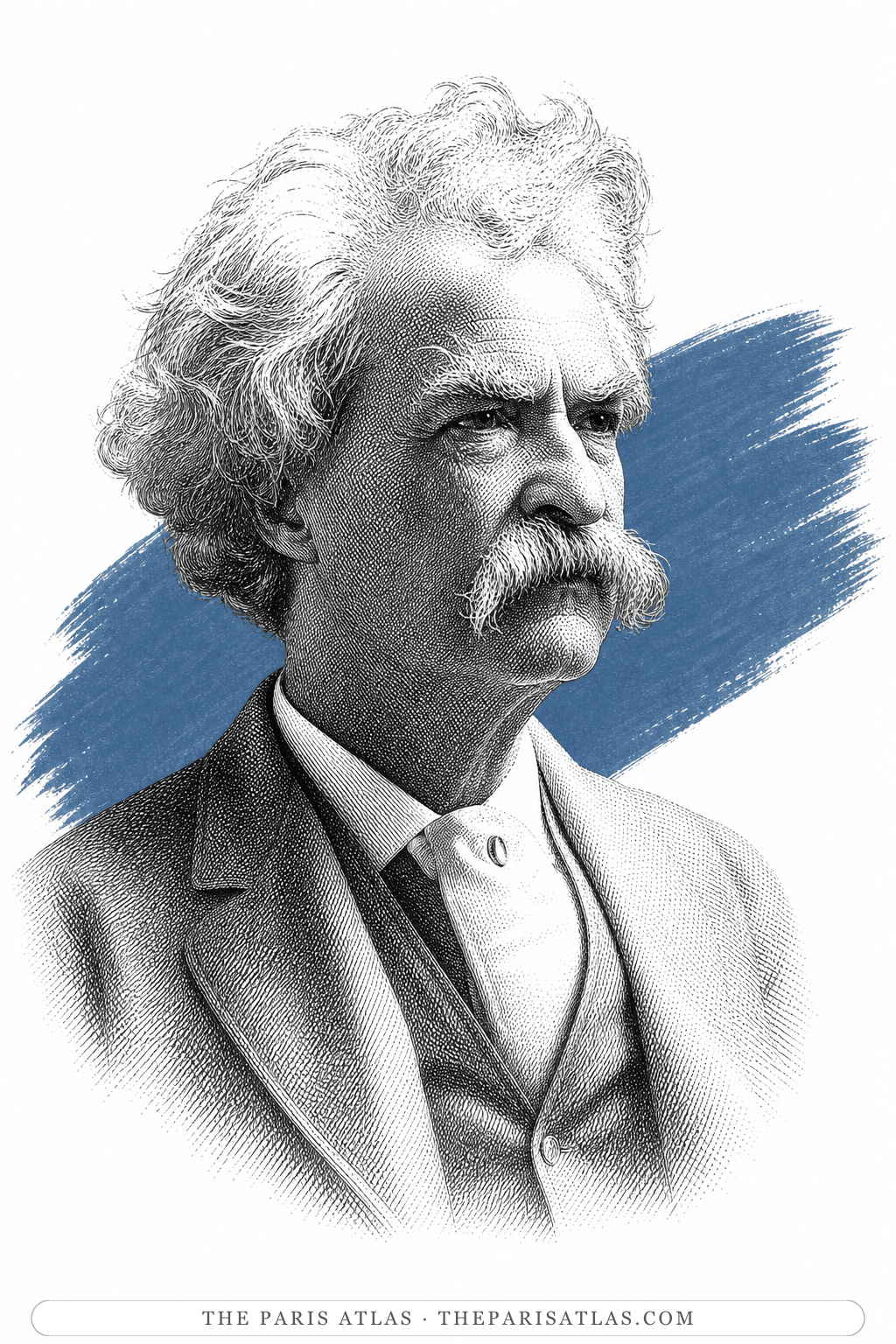
Illustrated portrait of Mark Twain
Pen-and-ink illustration of manuscript pages and a riverboat seen from a Mississippi cabin

How these quotes were checked

How we decide whether a quote is genuine

Mark Twain is the most misattributed writer in English: when an American sentence is funny and nobody knows who wrote it, it becomes his. The lines in this collection are verified against the books themselves — The Innocents Abroad, Pudd'nhead Wilson and Following the Equator in their complete texts — or against the documented print record.

Two of the internet's favorite “Twain” lines belong to other people, and his most famous real quip is almost always misquoted. All three cases are documented below.

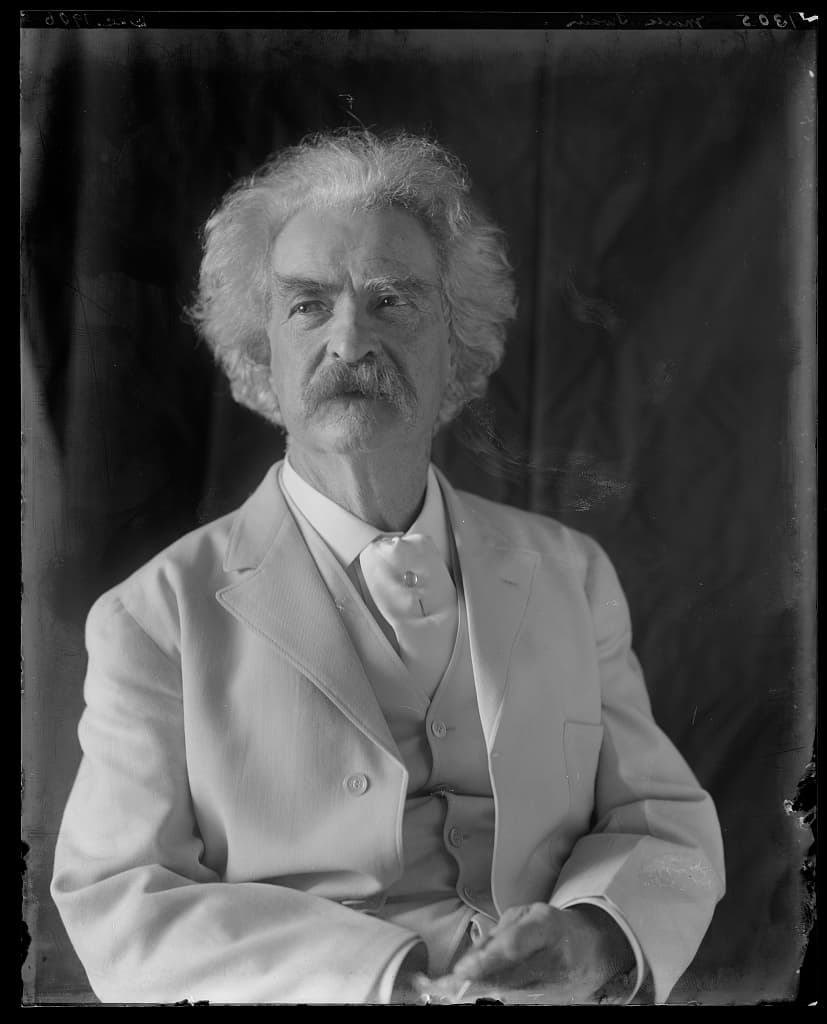
Mark Twain seated in a light suit for photographer Frances Benjamin Johnston in 1906, with his white hair and moustache brightly lit against a dark ground
Frances Benjamin Johnston’s 1906 portrait of Samuel Clemens — Mark Twain in the white suit that became his last public uniform. Frances Benjamin Johnston / Library of Congress. Public domain (US).

Three famous Mark Twain quotes, fact-checked

A sentence linked to Mark Twain may be exact, shortened, remembered by someone else, or unsupported. Each label below explains what the available evidence actually proves.

Misattributed

“It is better to keep your mouth closed and let people think you are a fool than to open it and remove all doubt.”

The earliest known appearance of this saying is Maurice Switzer's 1907 book Mrs. Goose, Her Book. No version appears anywhere in Twain's writings, and the attribution to him arrived later and stuck because it sounds like him.

  • — Garson O'Toole, Quote Origin: Better to Remain Silent and Be Thought a Fool than to Speak and Remove All Doubt (Quote Investigator) (2010)

Misattributed

“I have never let my schooling interfere with my education.”

The novelist and essayist Grant Allen published this maxim in 1894 and repeated it in at least three of his novels. The earliest attribution to Twain appears in 1907, with no source in Twain's own writings.

  • — Garson O'Toole, Quote Origin: Never Let Schooling Interfere With Your Education (Quote Investigator) (2010)
Common paraphrase

“Reports of my death have been greatly exaggerated.”

What Twain actually wrote, in a note to the journalist Frank Marshall White in 1897, was plainer: “The report of my death was an exaggeration.” Newspapers added “greatly” within days, and his biographer Albert Bigelow Paine later embellished it to “grossly exaggerated.” The joke is real; the famous wording is not his.

  • — Garson O'Toole, Quote Origin: Reports of My Death Are Greatly Exaggerated (Quote Investigator) (2024)
Travel is fatal to prejudice, bigotry and narrow-mindedness, and many of our people need it sorely on these accounts. Broad, wholesome, charitable views of men and things can not be acquired by vegetating in one little corner of the earth all one's lifetime.
— Mark Twain, The Innocents Abroad (1869), from the book's conclusion
The report of my death was an exaggeration.
— Mark Twain, note to the journalist Frank Marshall White, printed in the New York Journal, 2 June 1897
Courage is resistance to fear, mastery of fear — not absence of fear.
— Mark Twain, Pudd'nhead Wilson (1894), the maxim heading chapter 12
Truth is stranger than fiction, but it is because Fiction is obliged to stick to possibilities; Truth isn't.
— Mark Twain, Following the Equator (1897), from Pudd'nhead Wilson's New Calendar
Man is the Only Animal that Blushes. Or needs to.
— Mark Twain, Following the Equator (1897), the maxim heading chapter 27
If you tell the truth you don't have to remember anything.
— Mark Twain, notebook entry, 1894
You can't pray a lie
— Huck in Mark Twain's Adventures of Huckleberry Finn (1884–1885)
All right, then, I'll go to hell
— Huck in Mark Twain's Adventures of Huckleberry Finn (1884–1885)
What do you call work?
— Tom Sawyer in Mark Twain's The Adventures of Tom Sawyer (1876)
The truth is always respectable.
— Potter's lawyer in Mark Twain's The Adventures of Tom Sawyer (1876)
This book is a record of a pleasure trip.
— Mark Twain, The Innocents Abroad (1869)
Travel is fatal to prejudice, bigotry and narrow-mindedness
— Mark Twain, The Innocents Abroad (1869)
I am an American. I was born and reared in Hartford, in the State of Connecticut—anyway, just over the river, in the country.
— Hank Morgan · Hank Morgan in Mark Twain's A Connecticut Yankee in King Arthur's Court (1889)
“Bridgeport?” said I, pointing. “Camelot,” said he.
— Hank Morgan · Hank Morgan in Mark Twain's A Connecticut Yankee in King Arthur's Court (1889)
There were two “Reigns of Terror,” if we would but remember it and consider it; the one wrought murder in hot passion, the other in heartless cold blood; the one lasted mere months, the other had lasted a thousand years
— Hank Morgan · Hank Morgan in Mark Twain's A Connecticut Yankee in King Arthur's Court (1889)
What this folk needed, then, was a Reign of Terror and a guillotine, and I was the wrong man for them.
— Hank Morgan · Hank Morgan in Mark Twain's A Connecticut Yankee in King Arthur's Court (1889)
The question as to whether there is such a thing as divine right of kings is not settled in this book. It was found too difficult.
— Mark Twain, preface to A Connecticut Yankee in King Arthur's Court (1889)
He sleepeth now—and shall sleep thirteen centuries. I am Merlin!
— Merlin · Merlin in Mark Twain's A Connecticut Yankee in King Arthur's Court (1889)
I wanted to say a Yankee mechanic's say against monarchy and its several natural props
— Mark Twain, letter to his London publishers, quoted in Albert Bigelow Paine, Mark Twain: A Biography (1912), Chapter CLXXII
It may have happened, it may not have happened: but it COULD have happened.
— Mark Twain, The Prince and the Pauper (1881)
The world is made wrong; kings should go to school to their own laws, at times, and so learn mercy.
— Edward · Edward in Mark Twain's The Prince and the Pauper (1881)
Then shall the king’s law be law of mercy, from this day, and never more be law of blood!
— Tom Canty · Tom Canty in Mark Twain's The Prince and the Pauper (1881)
To crack nuts with!
— Tom Canty · Tom Canty in Mark Twain's The Prince and the Pauper (1881)
I do not know you, woman!
— Tom Canty · Tom Canty in Mark Twain's The Prince and the Pauper (1881)
And so I am become a knight of the Kingdom of Dreams and Shadows!
— Miles Hendon · Miles Hendon in Mark Twain's The Prince and the Pauper (1881)

From the books

Every book with a quote collection of its own, each line verified against the text.

Questions about Mark Twain quotes

Did Mark Twain say “reports of my death have been greatly exaggerated”?

Almost. In 1897, answering a rumor that he was dying in London, he wrote: “The report of my death was an exaggeration.” The word “greatly” was added by newspapers retelling the story, and “grossly exaggerated” came from his biographer after his death.

Did Mark Twain say it is better to keep your mouth closed and be thought a fool?

No. The earliest appearance of that saying is Maurice Switzer's 1907 book Mrs. Goose, Her Book, and nothing like it appears in Twain's writings.

Did Mark Twain say “I have never let my schooling interfere with my education”?

No. Grant Allen, a British novelist and essayist, published the maxim in 1894 and reused it for years; it was first pinned on Twain in 1907.

What did Mark Twain say about travel?

From the conclusion of The Innocents Abroad (1869): “Travel is fatal to prejudice, bigotry and narrow-mindedness, and many of our people need it sorely on these accounts.” The next sentence continues the thought: broad views cannot be acquired “by vegetating in one little corner of the earth all one's lifetime.”

Where do Twain's one-line maxims come from?

Mostly from two books: each chapter of Pudd'nhead Wilson (1894) opens with a maxim from “Pudd'nhead Wilson's Calendar,” and Following the Equator (1897) continues the device as “Pudd'nhead Wilson's New Calendar.” “Courage is resistance to fear” and “Man is the Only Animal that Blushes. Or needs to.” are both chapter headings.

Did Mark Twain really say “if you tell the truth you don't have to remember anything”?

Yes — it is an entry in the notebook he kept in 1894, published in Mark Twain's Notebook in 1935.

References

References

The sources below are the editions, archives, and full-text searches used to verify the quotations on this page. Every line was checked against one or more of them before it appeared here.

  1. 1Project Gutenberg complete texts of The Innocents Abroad (#3176), Following the Equator (#2895) and Pudd'nhead Wilson (#102)

    Website
    Mark Twain
    Used for

    Web source consulted for documented facts and historical context presented on the Mark Twain page.

    View source
  2. 2Quote Origin: Reports of My Death Are Greatly Exaggerated (Quote Investigator)

    Website
    Garson O'Toole, 2024
    Used for

    Web source consulted for documented facts and historical context presented on the Mark Twain page.

    View source
  3. 3Quote Origin: Better to Remain Silent and Be Thought a Fool than to Speak and Remove All Doubt (Quote Investigator)

    Website
    Garson O'Toole, 2010
    Used for

    Web source consulted for documented facts and historical context presented on the Mark Twain page.

    View source
  1. 4Quote Origin: Never Let Schooling Interfere With Your Education (Quote Investigator)

    Website
    Garson O'Toole, 2010
    Used for

    Web source consulted for documented facts and historical context presented on the Mark Twain page.

    View source
  2. 5HathiTrust author-scoped full-text searches for Mark Twain quote verification, 30 August 2026

    Website
    Used for

    Web source consulted for documented facts and historical context presented on the Mark Twain page.

    View source
i
Why these sources are here

Verification is the point of this collection: a quotation is listed only when its wording has been checked against the sources above, and the attribution notes record what each check found about the famous lines that failed.

Explore more resources

Newsletter

Join our newsletter

New stories about art, literature and famous places around the world.

Unsubscribe anytime.