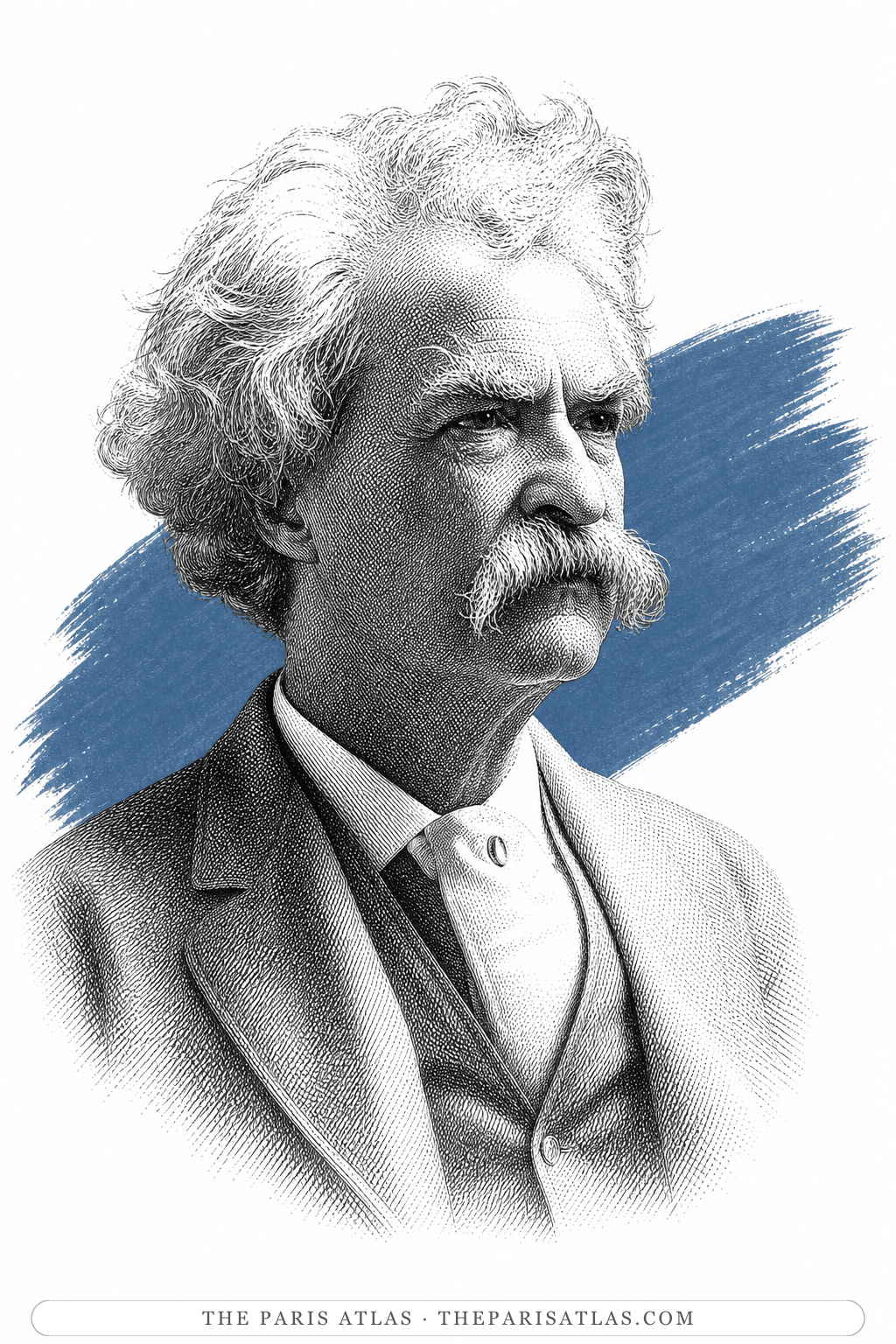

Adventures of Huckleberry Finn
Huck takes over the narration, and Tom's fondness for elaborate games acquires more troubling consequences.
Read our take
by Mark Twain
A boy turns punishment into play, then discovers dangers that cannot be settled by make-believe.
Mark Twain's 1876 novel follows Tom Sawyer in St. Petersburg, a fictional Missouri town beside the Mississippi. School, church, courtship and household rules give Tom opportunities to perform for an audience. A witnessed murder and a frightening stay in a cave test the courage beneath his showing off. The story later continues through a different narrator in Adventures of Huckleberry Finn.
The opening adventures make desire contagious. Tom persuades other boys to pay for the privilege of whitewashing a fence. A punishment becomes desirable once he presents it as a rare skill. The adults who distribute prizes and distinctions are often caught in similar games of appearance.
Twain's third-person narrator moves between a child's immediate feelings and an adult's amused recollection. Tom can suffer intensely over a small humiliation, then turn his suffering into a scene he hopes somebody will notice. Affection and vanity frequently occupy the same gesture.
The novel also asks who receives a welcome. Huck's apparent freedom attracts boys whose mothers exclude him. Becky must negotiate the rivalry that Tom mistakes for romance. By the ending, money and public recognition have changed the children's position without ending their appetite for games.
Tom and Huck know that Muff Potter has been falsely accused of murder. Tom eventually testifies in court, clearing Potter while exposing himself to the killer's retaliation.
At a picnic, Tom and Becky become separated from the other children inside a cave. Tom uses a kite string to explore passages while preserving a way back. He finds an exit, and the children return to their anxious families.
Huck has meanwhile warned the Welshman of a planned attack on the Widow Douglas. Tom and Huck later recover hidden treasure and become wealthy local celebrities.
The widow takes Huck in, but he finds her rules unbearable. Tom persuades him to return by making respectability a condition of joining a pretend robber band. The final joke leaves conformity tangled with rebellion.
Tom escapes whitewashing by making the job look difficult to obtain. The boys pay for the privilege of doing his punishment, turning a fence into an object of desire without changing the work itself. The narrator draws out the joke: whether an activity feels like labor or pleasure depends partly on who controls access to it.
The Sunday-school prize develops the same problem. Tom trades for the tickets that supposedly demonstrate biblical learning, then cannot answer the judge's questions. Adults recognize the outward signs of achievement as readily as children mistake scarcity for value. Tom's ingenuity exposes a weakness in their institutions as well as a weakness in his character.
Tom borrows identities from adventure stories: pirate, soldier, lover, robber. These roles let him imagine the admiration that an ordinary schoolboy cannot command. His return at his own funeral makes the whole community an audience, although its pleasure depends on the grief he has allowed Aunt Polly to endure.
The trial changes the terms. Speaking for Muff Potter puts Tom in danger from a killer who can retaliate. He gains public admiration, but the following nights bring fear rather than triumphant satisfaction. Twain makes an act of courage consequential beyond the moment when people applaud it.
Inside the cave, Tom and Becky cannot end their predicament by abandoning a role. Their candles and food diminish, and exhaustion limits what either child can do. Becky's saved piece of cake, intended as a keepsake of a pretend wedding, becomes a small practical resource against hunger.
Tom eventually uses kite string to explore without losing his route back. An object from play now supports careful work. The escape does not require him to stop being imaginative; it requires imagination to answer to physical circumstances and another person's needs. Becky's slower recovery also prevents the danger from disappearing the instant Tom can tell a good story about it.
Other boys envy Huck because he escapes school and domestic rules, but the novel also shows the price of exclusion. His warning saves the Widow Douglas, and the Welshman's welcome gives him a kind of recognition that his supposed freedom has not supplied.
The ending makes acceptance conditional. Wealth brings status, while the widow's care brings schedules and clothes Huck cannot bear. Tom gets him to return by making respectable membership a requirement for their imaginary robber band. The final joke binds rebellion to conformity: even a game about living outside the rules acquires a rule about who may belong.
Chapters II and IV on value and rewards; XXIII–XXIV on testimony; XXXI–XXXII on the cave; XXIX–XXX and XXXIV–XXXV on Huck's reception.
What do you call work?
The truth is always respectable.
The whitewashing episode shows how a storyteller can manufacture demand. Its small bargains make an unusually clear comedy of status and persuasion.
Showing off, protecting Becky and speaking in court expose Tom to very different risks. The book gives readers grounds for distinguishing them.
Huck's reception changes when he becomes useful and wealthy. His difficulty accepting the widow's routine keeps the happy ending open to question.

Aunt Polly's inventive nephew, whose wish to impress others can produce both cruelty and courage.

The judge's daughter, whose pride and affection complicate Tom's idea of romance.

An excluded boy whose freedom attracts Tom and whose kindness earns the widow's gratitude.
June 1876
Chatto & Windus publishes the novel in London before the authorized American edition.
December 1876
The American Publishing Company issues the first American edition in Hartford.
2021
University of California Press issues the selected 312-page Mark Twain Library hardcover in September.

Huck takes over the narration, and Tom's fondness for elaborate games acquires more troubling consequences.
Read our take
Twain's travel narrative also makes social performance and disappointed expectations material for comedy.
Read our take
Hughes approaches childhood, schooling and the judgments of a town through a Black boy growing up in Kansas.
Read our takeIt follows a boy's schemes, friendships and dangers in a fictional Missouri town. Comic episodes about school and church lead into a murder trial, a cave ordeal and a discovery of treasure.
The British edition appeared in June 1876 from Chatto & Windus. The American Publishing Company's authorized US edition followed in December of the same year.
No. A third-person narrator tells the story with an adult's recollective humor. Huck becomes the first-person narrator of Adventures of Huckleberry Finn.
The Missouri town in this novel is fictional and draws on Twain's experience of Hannibal. It is not the Russian city of the same name.
Her regular meals, clean clothes and expectations of proper behavior make him feel confined. His resistance continues even after he has acquired money and public approval.
The 312 pages and ISBN 9780520343634 belong to the University of California Press hardcover issued in September 2021. They do not describe the first editions' pagination.
Explore authors with a similar voice, perspective, and influence.

The doctor of the Paris slums who wrote the century's blackest, funniest novel — and changed the sound of French prose.
View author
The Brooklyn dropout who arrived in Paris broke at thirty-eight and wrote the exuberant, banned books that ended American censorship.
View author
The author of Frankenstein, who first saw Paris at sixteen as a runaway. In the summer of 1814 she crossed from England to Calais with the poet Percy Bysshe Shelley and her stepsister Claire Clairmont, spent a week trapped in an expensive Paris hotel with no money, then bought a donkey and walked south-east across a France still wrecked by the Napoleonic wars. That journey became her first published book. Two years later, on a lake in Switzerland, she began her second.
View authorThe sources below include the primary text, editions, scholarship, archival materials, and other records that informed this page. They document The Adventures of Tom Sawyer, its publication, and its place in literary history.


The primary text represented by this page, used for descriptions of the work’s contents and for any quoted passages shown here.
Primary text for the selected character readings, plot account and quotations. References are to chapters, not the selected modern edition's pages.
British June 1876 and American December 1876 publication, publishers, and differing first-edition printings.
Selected hardcover ISBN, 312-page extent, September 2021 issue and editorial credits.
Twain's Hannibal childhood and the place of the 1876 novel in his career.
The primary text is the baseline reference for every book page. Additional references document publication history, interpretation, and historical context where that evidence is available.
 Explore more resources