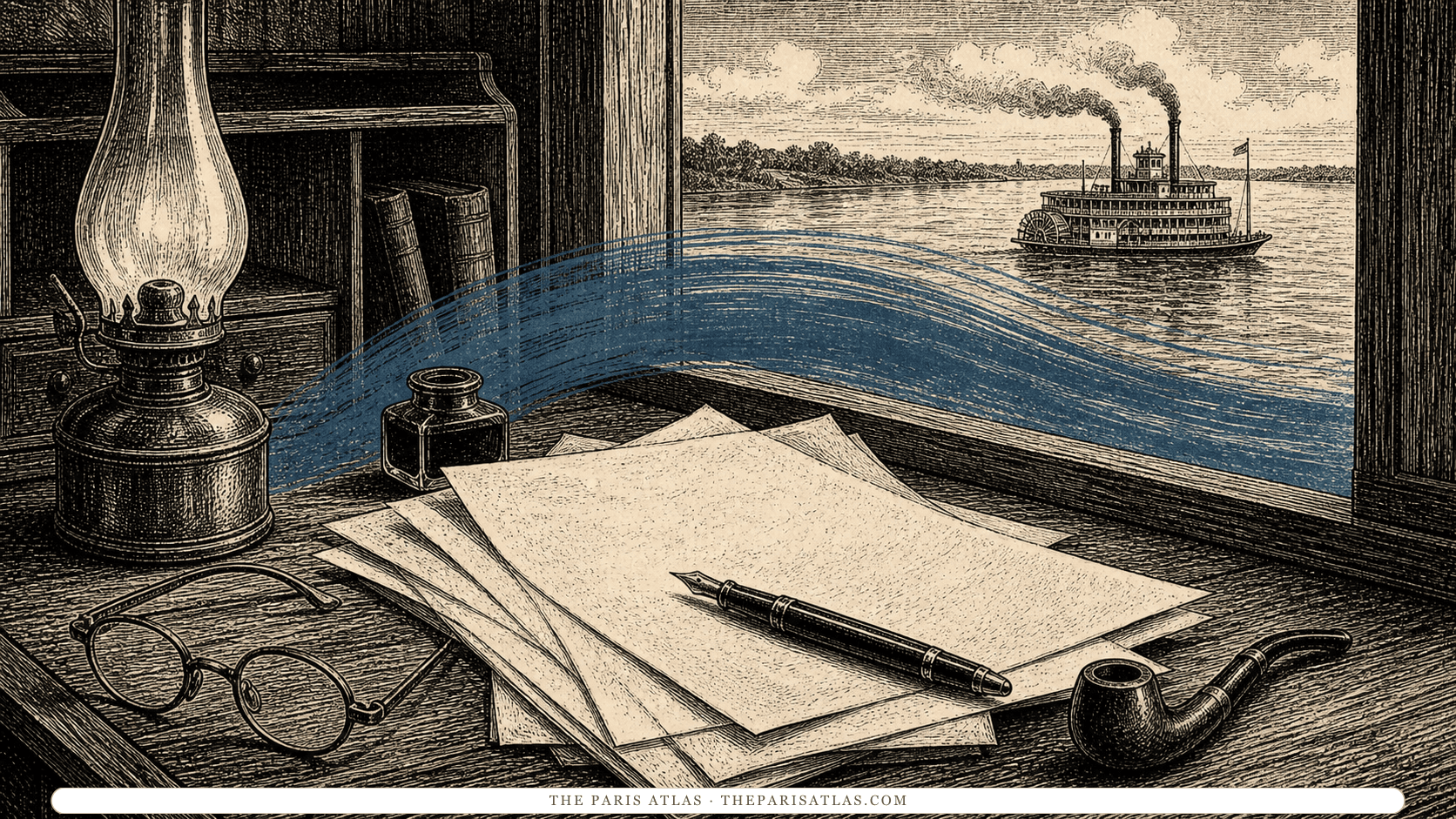
The Innocents Abroad
How Mark appears in its pages: The first-person traveler, whose confident comic judgments coexist with curiosity, impatience and changing memories.
Read the character guideThe Missouri newspaperman who became America's most famous writer, and whose first book made its reputation partly out of Paris: in 1867 he arrived with a shipload of American tourists, renamed his guide Ferguson, watched the high-kicking can-can through his fingers and wrote it all down. He kept coming back — and was living in Paris in the mid-1890s, broke, while finishing the novel he considered his best, Personal Recollections of Joan of Arc.
Mark Twain was the pen name of Samuel Langhorne Clemens, born in Florida, Missouri, on 30 November 1835 and raised in Hannibal on the Mississippi.[1] He was a printer, a riverboat pilot and a newspaperman before he was a writer of books, and the book that made him — The Innocents Abroad, published in 1869 — came out of a steamsh[2]ip excursion to Europe and the Holy Land that a newspaper paid him to write about. Paris is one of its set pieces: a chapter and a half of guides, barbers, cathedrals and dancing, written by a man determined not to be impressed by anything simply because Europe told him to be.
He was never a Paris resident in the way the American writers who came after him were. He was a visitor who kept returning. The family travelled through Europe in 1878 and 1879, and again from 1891, when the failure of his investments — and soon of his publishing house — sent the Clemenses abroad to live more cheaply. By his own account, the round-the-world lecture tour he undertook in 1895 to pay his creditors began from Paris, 'where we had been living a year or two' — the opening line of Foll[3]owing the Equator, the book he wrote about that tour. Those were the years of Personal Recollections of Joan of Arc — the book he told friends, at seventy-three, that he liked best of everything he had written.
Samuel Clemens was born on 30 November 1835 in Florida, Missouri, the sixth of seven children, and moved to Hannibal on the Mississippi when he was four. He had been a printer, a Mississippi riverboat pilot and a newspaperman before he was an author of books. In 1867 he arrived in New York and signed up for something new: a steamship tour of Europe and the Holy Land aboard the Quaker City, with the letters he sent back paid for by a newspaper.
The letters became The Innocents Abroad, published in 1869 by the American Publishing Company of Hartford, sold door to door by subscription rather than in bookshops, and stuffed with two hundred and thirty-four illustrations. It was a bestseller and it fixed his voice for the rest of his life: the American abroad who refuses to be awed, who describes what is actually in front of him, and who is funniest when the guidebook is most solemn.
The Paris chapters are the comic heart of the book. The party hired a guide whose card gave his name as A. Billfinger — a name they refused, on the grounds that it was unpronounceable and unromantic — and renamed him Ferguson on the spot. Every guide afterwards, in every city of the tour, is also called Ferguson, and the joke becomes the book's method: the traveller declines to take Europe on Europe's terms.
They arrived in the year of the great Paris Exposition — the world's fair of 1867 — and saw, in the street, the French emperor Napoleon III riding with the Ottoman sultan Abdul Aziz while the crowd swung their hats and shouted. Twain was shaved by a Paris barber and turned three minutes of it into a small massacre — the man 'lathered my face for ten terrible minutes and finished by plastering a mass of suds into my mouth', and then 'the first rake of his razor loosened the very hide from my face and lifted me out of the chair'. And he went to the Jardin Mabille, the open-air dance garden where the high-kicking can-can was danced, and produced the line that generations of readers have quoted back at him.
I placed my hands before my face for very shame. But I looked through my fingers.
Twain's Paris was never a home in the way it was for the Americans who followed him there in the 1920s; it was a place he passed through repeatedly, over forty years. He and his family travelled Europe in 1878 and 1879 — Heidelberg, the Alps, Italy, Munich — during the seventeen years the Clemenses were otherwise settled in their Hartford house, where Tom Sawyer, Huckleberry Finn and Life on the Mississippi were written.
The later European years were forced on him. Twain had poured money into a doomed automatic typesetting machine and into a publishing firm that failed; in 1891, trying to economize and pay what he owed, he moved the family to Europe, and between 1891 and 1895 they lived in Germany, France and Italy. In 1894 he filed for bankruptcy. He was almost sixty, the most famous writer in America, and broke.
Following the Equator, the travel book he wrote out of what came next, opens with a plain statement of where he was living: 'The starting point of this lecturing-trip around the world was Paris, where we had been living a year or two. We sailed for America, and there made certain preparations.' The lecture tour of 1895 and 1896 took him around the globe in front of paying audiences, and the point of it was to clear his debts, which it did.
The book he was finishing in those years was the one he cared most about. Personal Recollections of Joan of Arc — the life of the fifteenth-century French peasant girl who led an army and was burned as a heretic, told in the voice of an invented page who had served her — was begun at the Villa Viviani outside Florence, serialized anonymously in Harper's Magazine through 1895, and published under his own name by Harper & Brothers in 1896. He kept the anonymity deliberately: the name Mark Twain promised jokes, and this book was not one.
Readers have never agreed with him about it, which he knew. On his seventy-third birthday, about eighteen months before he died, he wrote: 'I like the Joan of Arc best of all my books; & it is the best; I know it perfectly well.' He added that it had given him 'seven times the pleasure afforded me by any of the others: 12 years of preparation and two years of writing'. Those two years of writing belong to the European exile whose final base, by his own account, was Paris — the city he had first written about, thirty years earlier, as a tourist renaming his guide.
The world tour paid the creditors, and the loss that followed was not financial: his daughter Susy died of meningitis on 18 August 1896. The last years brought honours and a darker body of work, and the line about him that everyone now quotes came from another writer entirely — Ernest Hemingway, in Green Hills of Africa in 1935, telling an Austrian in a safari camp that all modern American literature comes from one book by Mark Twain called Huckleberry Finn.
Clemens died on 21 April 1910, aged seventy-four, and was buried in his wife's family plot at Woodlawn Cemetery in Elmira, New York. Halley's Comet, which had been in the sky the year he was born, was visible again.
Born Samuel Langhorne Clemens on 30 November in Florida, Missouri, the sixth of seven children.
The family moves to Hannibal, on the Mississippi, when he is four.
Arrives in New York and signs on for the Quaker City steamship excursion to Europe and the Holy Land; in Paris he renames his guide Ferguson and watches the can-can through his fingers.
The Innocents Abroad is published in Hartford by the American Publishing Company — sold by subscription only, with 234 illustrations — and makes him famous.
The Hartford years, in the house where Tom Sawyer, Huckleberry Finn and Life on the Mississippi are written.
Travels in Europe with his family — Heidelberg, the Alps, Italy, Munich.
Moves the family to Europe to economize and pay off his debts; they live in Germany, France and Italy until 1895.
His publishing firm fails and he files for bankruptcy.
Joan of Arc is serialized anonymously in Harper's Magazine; the round-the-world lecture tour to pay his creditors starts out from Paris, 'where we had been living a year or two'.
Personal Recollections of Joan of Arc is published under his own name by Harper & Brothers; his daughter Susy dies of meningitis on 18 August.
On his seventy-third birthday he writes: 'I like the Joan of Arc best of all my books; & it is the best; I know it perfectly well.'
Dies on 21 April, aged seventy-four; buried at Woodlawn Cemetery in Elmira, New York.
Travel is fatal to prejudice, bigotry and narrow-mindedness, and many of our people need it sorely on these accounts. Broad, wholesome, charitable views of men and things can not be acquired by vegetating in one little corner of the earth all one's lifetime.
The report of my death was an exaggeration.
Courage is resistance to fear, mastery of fear — not absence of fear.
How Mark appears in its pages: The first-person traveler, whose confident comic judgments coexist with curiosity, impatience and changing memories.
Read the character guide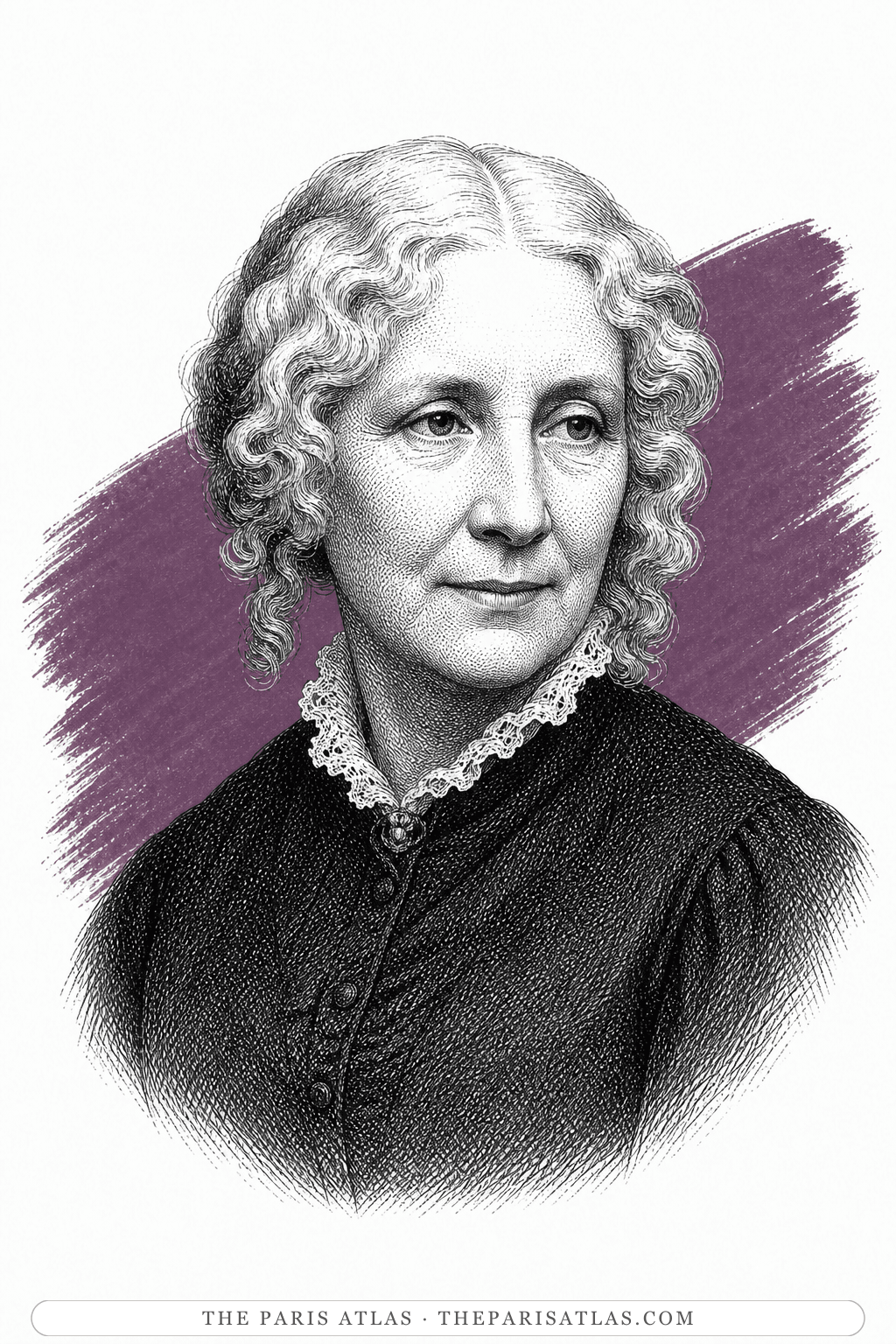
Met · 1874
They were neighbours. Both households belonged to Nook Farm, a Hartford enclave of well-off reformers and writers: Stowe moved into the brick cottage at 77 Forest Street in 1873, and Samuel Clemens and his wife — who had first rented a house from Stowe's sister and brother-in-law — moved into the one they had built next door in 1874. The connection ran through the Beecher family before either arrived: Stowe's brother Henry Ward Beecher helped Clemens negotiate terms for The Innocents Abroad and introduced him to his future wife's family, and another brother, Thomas Beecher, performed the marriage. The two families socialised regularly at neighbourhood parties for the rest of Stowe's life. Both houses are museums today.
Met · 1889
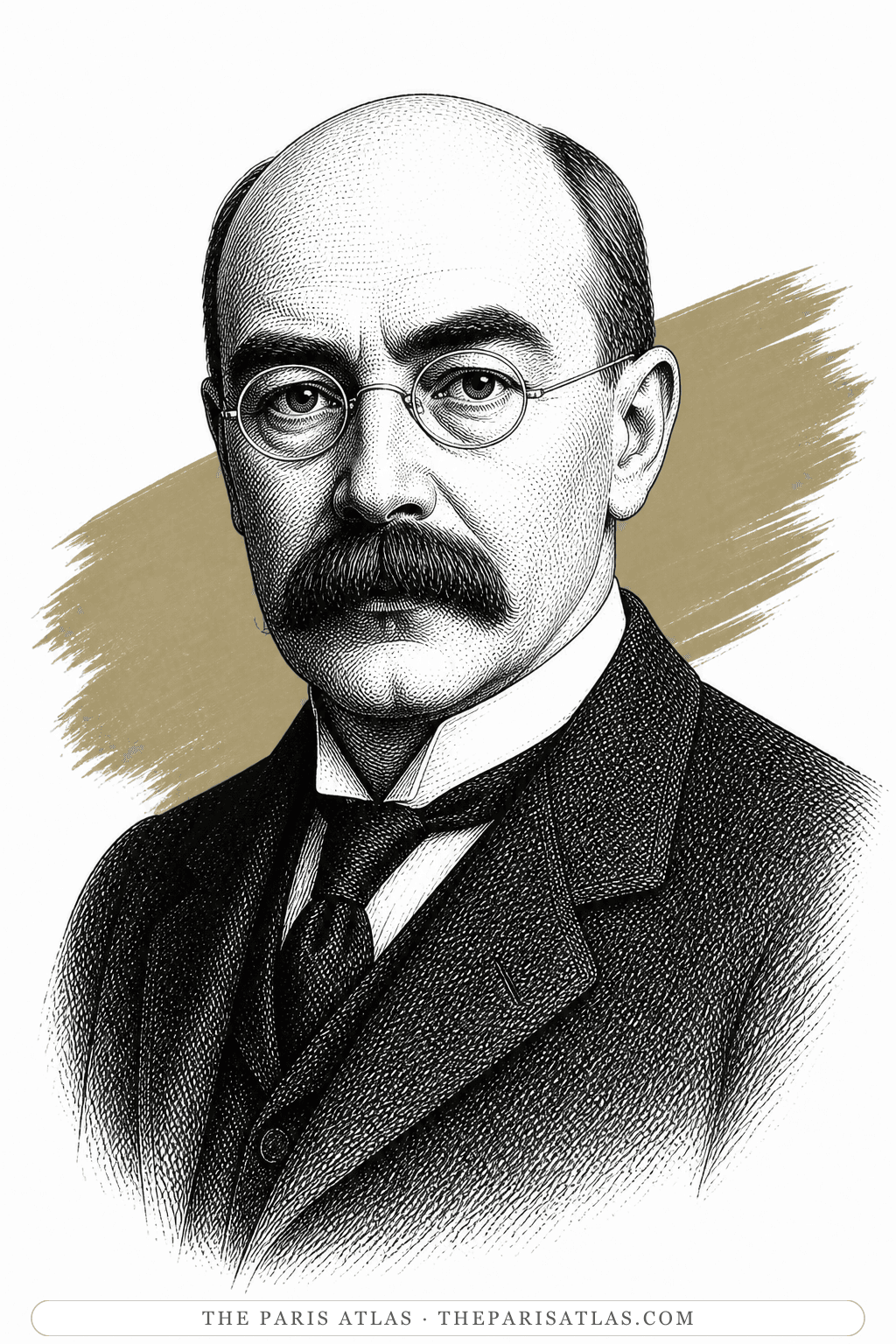
On the American leg of his 1889 journey home from India, the twenty-three-year-old Kipling went looking for Mark Twain, was sent to Buffalo, Hartford and Portland by people who were sure they knew, and finally ran him down at Elmira in upstate New York — up a hill, in an ivy-covered house nobody could direct him to. They talked for more than two hours over two cigars. The piece Kipling filed opens by informing his readers in India that they are a contemptible lot, because he has shaken Mark Twain's hand and they have not.
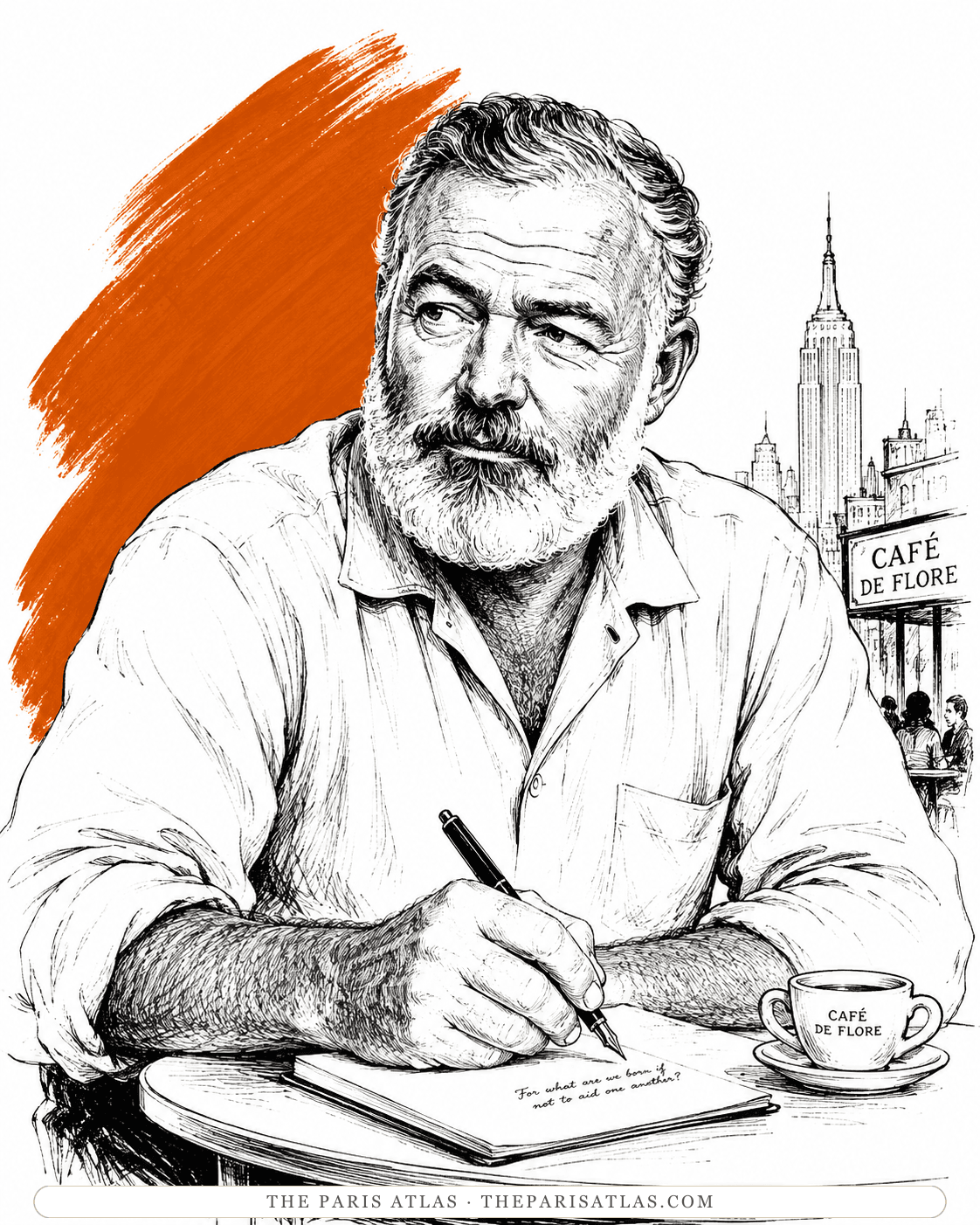
Hemingway made the debt explicit in Green Hills of Africa, in the campfire conversation where an Austrian named Kandisky presses him on American writing: all modern American literature, he answers, comes from one book by Mark Twain called Huckleberry Finn. It is the most quoted verdict in American letters, and it is a writer naming his own source.

Vonnegut claimed the kinship himself, noting that both he and Mark Twain were pessimists about humanity, skeptics about religion, and, through the Civil War and his own German name, "associated with the enemy in a major war". What he took is the method: humour aimed at the largest questions. His New York Times obituary drew the same comparison.
An American pleasure voyage becomes a comedy about tourists, famous sights and the expectations they bring with them.

A boy turns punishment into play, then discovers dangers that cannot be settled by make-believe.

A beggar boy and the Prince of Wales swap clothes for a joke, and a palace guard throws the real prince out into the streets of Tudor London.

On a journey down the Mississippi, Huck's loyalty to Jim comes into conflict with what he has been taught is right.

A Hartford factory boss wakes up near Camelot in the year 528, fakes a miracle with an eclipse, and tries to bring the nineteenth century to King Arthur's England.
For a time, yes — though he is better described as a visitor who kept returning than as a Paris resident. He first saw the city in 1867 as a tourist on the Quaker City steamship excursion, travelled in Europe with his family in 1878 and 1879, and moved the family abroad in 1891 to live more cheaply after his investments failed; between 1891 and 1895 they lived in Germany, France and Italy. He opens Following the Equator by saying that his 1895 round-the-world lecture tour started from Paris, 'where we had been living a year or two'.
The Paris chapters of The Innocents Abroad (1869), his first and best-selling book. They contain the guide the party refused to call Billfinger and renamed Ferguson; a barber who 'lathered my face for ten terrible minutes'; the crowd watching the French emperor Napoleon III ride out with the Ottoman sultan Abdul Aziz during the great Exposition, the world's fair of 1867; and the can-can at the Jardin Mabille, which produced his most quoted sentence about the city: 'I placed my hands before my face for very shame. But I looked through my fingers.'
Nobody. In The Innocents Abroad the party hires a Paris guide whose card reads A. Billfinger, decide the name is impossible, and rename him Ferguson. The joke sticks: every guide in every city for the rest of the book is a Ferguson too. It is Twain's running demonstration that the American traveller will not be managed by Europe — and it is why 'Ferguson' still turns up as shorthand for a tour guide in American writing.
He put a fortune into a mechanical typesetting machine that never worked commercially and into a publishing firm that collapsed. In 1891 he moved his family to Europe to cut costs and repay what he owed; the publishing house failed in 1894 and he filed for bankruptcy. To clear the debts he undertook a round-the-world lecture tour in 1895 and 1896, which succeeded — he paid his creditors in full.
Personal Recollections of Joan of Arc (1896) — not Huckleberry Finn. On his seventy-third birthday he wrote: 'I like the Joan of Arc best of all my books; & it is the best; I know it perfectly well,' adding that it had given him 'seven times the pleasure afforded me by any of the others: 12 years of preparation and two years of writing'. He began it at the Villa Viviani outside Florence and had it serialized anonymously in Harper's Magazine through 1895, because his own name promised comedy and the book is not comic.
Yes — a historical novel about Joan of Arc, the fifteenth-century French peasant girl who led an army against the English and was burned as a heretic at nineteen. Twain narrates it in the voice of an invented page and secretary who served her and is writing in old age. It appeared anonymously in Harper's Magazine during 1895 and as a book under Twain's name, published by Harper & Brothers, in 1896.
He died on 21 April 1910 at seventy-four and was buried in his wife's family plot at Woodlawn Cemetery in Elmira, New York. Halley's Comet had been in the sky the year he was born in 1835 and was visible again the year he died.
Influenced
Hemingway made the debt explicit in Green Hills of Africa, in the campfire conversation where an Austrian named Kandisky presses him on American writing: all modern American literature, he answers, comes from one book by Mark Twain called Huckleberry Finn. It is the most quoted verdict in American letters, and it is a writer naming his own source.
Influenced
Vonnegut claimed the kinship himself, noting that both he and Mark Twain were pessimists about humanity, skeptics about religion, and, through the Civil War and his own German name, "associated with the enemy in a major war". What he took is the method: humour aimed at the largest questions. His New York Times obituary drew the same comparison.
Met · 1874
They were neighbours. Both households belonged to Nook Farm, a Hartford enclave of well-off reformers and writers: Stowe moved into the brick cottage at 77 Forest Street in 1873, and Samuel Clemens and his wife — who had first rented a house from Stowe's sister and brother-in-law — moved into the one they had built next door in 1874. The connection ran through the Beecher family before either arrived: Stowe's brother Henry Ward Beecher helped Clemens negotiate terms for The Innocents Abroad and introduced him to his future wife's family, and another brother, Thomas Beecher, performed the marriage. The two families socialised regularly at neighbourhood parties for the rest of Stowe's life. Both houses are museums today.
Met · 1889
On the American leg of his 1889 journey home from India, the twenty-three-year-old Kipling went looking for Mark Twain, was sent to Buffalo, Hartford and Portland by people who were sure they knew, and finally ran him down at Elmira in upstate New York — up a hill, in an ivy-covered house nobody could direct him to. They talked for more than two hours over two cigars. The piece Kipling filed opens by informing his readers in India that they are a contemptible lot, because he has shaken Mark Twain's hand and they have not.
The sources below include biographies, scholarly essays, interviews, and primary materials that informed this page. They reflect both the historical record and ongoing critical conversations about Mark Twain and their work.

Life summary from the museum in his Hartford house.

The first edition of the book containing the Paris chapters.
Opens with his own statement that the 1895 tour began from Paris.
Web source consulted for documented facts and historical context presented on the Mark Twain page.
Web source consulted for documented facts and historical context presented on the Mark Twain page.
Web source consulted for documented facts and historical context presented on the Mark Twain page.
Web source consulted for documented facts and historical context presented on the Mark Twain page.
Web source consulted for documented facts and historical context presented on the Mark Twain page.
Dated chronology from the museum in Hannibal.
Scholarly account of the Joan of Arc novel and his verdict on it.
The 1896 Harper & Brothers first edition.
Hemingway's judgement on Huckleberry Finn, delivered in the safari camp conversation.
These references anchor the page in the documented record and in the scholarly conversations around Mark Twain. Every claim on this page traces back to one or more of the works listed here.
 Explore more resources