The Paris AtlasCharting the artists, works, and places worth returning to.
  • Painter
  • Illustrator
· French · 1867–1947

Pierre Bonnard

French painter, printmaker and illustrator whose intimate rooms, Paris streets, gardens and bathing figures transformed everyday life into complex fields of color, memory and perception.

In images

Details

Lived
1867–1947
Born
3 October 1867
Birthplace
Fontenay-aux-Roses, France
Birth name
Pierre Eugène Frédéric Bonnard
Died
23 January 1947 · aged 79
Place of death
Le Cannet, France
Nationality
French
Profession
Painter, printmaker, illustrator, and photographer
Major works
France-Champagne (1891), La Revue blanche (1894), The Open Window (1921), The Bathroom (1932), The Almond Tree in Blossom (1946–1947)
Married
Marthe de Méligny (Maria Boursin) · 1925–1942
Roles
PainterIllustrator

About Pierre Bonnard

Pierre Bonnard spent much of his career painting things that hardly sound like the material of revolutionary art: a woman taking a bath, a breakfast table, a dog under a chair, a window looking onto a garden, or pedestrians crossing a Paris street. Yet he made those ordinary scenes increasingly difficult to see in an ordinary way. A person might nearly disappear into wallpaper, a mirror could reveal a figure before the viewer noticed the figure herself, and a door or window might open a second picture inside the first.

Bonnard began as one of the Nabis, young Paris artists who rejected conventional academic perspective and treated a painting as a deliberately constructed surface of shapes and color. Fascinated by Japanese prints, he became known as the Nabi très japonard, the especially Japanese Nabi. He eventually moved beyond the group's short existence and spent nearly sixty years developing a personal kind of painting in which what he remembered mattered as much as what he saw.

His life moved between Paris, Normandy and the Mediterranean coast, but Paris remained fundamental. It was where he studied, joined the Nabis, saw Japanese prints, made his breakthrough poster, entered the world of La Revue blanche, met Marthe de Méligny, exhibited his work and learned to find subjects in the apparent disorder of modern city life. Even after southern light transformed his later colors, the habits he developed in Paris—watching, remembering, cropping and rearranging—never disappeared.

From law school to the Académie Julian

Pierre Eugène Frédéric Bonnard was born on 3 October 1867 in Fontenay-aux-Roses, just south of Paris. He came from a comfortable bourgeois family, and his father expected him to enter a respectable profession. Bonnard initially followed that path, studying law and obtaining his degree in the late 1880s while also attending the Académie Julian, a private Paris art school where a very different future was taking shape.[1]

At the Académie Julian he met Paul Sérusier, Maurice Denis, Henri-Gabriel Ibels and Paul Ranson. After entering the École des Beaux-Arts in 1889, he also became close to Édouard Vuillard and Ker-Xavier Roussel. These artists formed the Nabis—from a Hebrew word meaning prophets—and, inspired by the lessons Paul Gauguin had given at Pont-Aven, sought painting built from simplified shapes, flat color and decoration rather than conventional depth and modeling. By 1891, art had finally defeated the legal career.[2]

The Japanese revelation

In the spring of 1890, Bonnard encountered a large display of Japanese prints at the École des Beaux-Arts. Ukiyo-e offered a completely different way of organizing an image from the academic European tradition: figures could be cropped by the edge, large areas remain flat, perspective compress, and patterns matter as much as bodies. Félix Fénéon called the enthusiastic young painter the Nabi très japonard.[3]

The influence is visible in the tall formats, flattened spaces, unexpected cropping and decorative patterns of Bonnard's 1890s work. He was not simply copying Japanese pictures. What interested him was the freedom they offered: a painting no longer had to behave like a carefully constructed window onto believable three-dimensional space. The picture's surface could announce itself, a discovery that remained useful long after the Nabi period.

A poster on the streets of Paris

Bonnard's first major public success arrived in 1891 with an advertisement for France-Champagne. The color lithograph showed a woman lifting a glass while champagne bubbles and large lettering spread across a dramatically flattened composition. The poster appeared on Paris streets and was immediately noticed; Toulouse-Lautrec admired it, and its success helped launch Bonnard professionally.[1]

The commission introduced him to color lithography, which became an important part of his career. Printmaking offered what gallery painting could not: his images circulated through streets, magazines, books, theater programs and sheet music. Bonnard consequently moved across categories that later histories separate too neatly—painter, poster designer, illustrator and printmaker—and completed more than 120 editioned graphic projects.

For the Nabis, that movement between painting and everyday visual culture made sense. They wanted art to spread beyond easel painting into screens, posters, books, furniture and decoration.

Paris becomes a subject

Bonnard was fascinated by the visual accidents of Paris. He watched people move through streets, cafés, parks and theaters and painted Place Clichy, the Bois de Boulogne, the Opera and the increasingly busy public life of the city. His views can feel almost photographic in their sudden cropping, but the spaces are rarely straightforward: figures overlap, pedestrians disappear into pattern, and dogs enter at the edge of the scene.

Around 1900, Bonnard's studio stood near Place Clichy on rue de Douai. His triptychs of the square show omnibuses, delivery carts and pedestrians crossing what was then one of the centers of bohemian northern Paris. Musée d'Orsay describes this urban work as a radical response to contemporary life, attentive to the mechanical rhythm of pedestrians and the humor created when human movement collides with modern parks and streets.[3]

This is not the Paris of grand boulevards and official monuments. Bonnard tended to notice the peripheral thing instead: a passing woman, a dog, a corner, a reflection or a head cut by the frame.

La Revue blanche

Bonnard's social and intellectual world expanded through *La Revue blanche, one of the most important avant-garde literary and artistic magazines of 1890s Paris. Founded by the Natanson brothers, it brought together progressive writers, critics and artists. Bonnard became close to Thadée Natanson and his wife Misia*, a central figure in Paris artistic society and a model and friend to Bonnard and Vuillard.[4]

Bonnard's celebrated 1894 poster shows Misia wrapped in an enormous dark cape while the magazine's title passes behind her. The design again demonstrates what Japanese prints had taught him: silhouettes and flat shapes could carry an image without conventional modeling.

The Natanson circle also brought Bonnard into contact with theater, literature and figures such as Alfred Jarry. Bonnard's brother-in-law, the composer Claude Terrasse, worked with Jarry, and Bonnard became involved in the strange theatrical world around Ubu roi. Jarry's humor and critical distance suited Bonnard's own tendency to hide odd details inside apparently pleasant pictures.

Meeting Marthe

In 1893, Bonnard met the woman who became the central figure in his private life and in hundreds of his works. Her real name was Maria Boursin, but she called herself Marthe de Méligny; Bonnard knew her by that name for decades. She became his companion, model and eventually his wife.

Marthe appears reading, dressing, eating, standing beside a window, lying in bed, washing and bathing. Yet the paintings are not simply a diary of one woman's appearance. Bonnard repeatedly transformed her through memory: a figure might be partly visible, reflected in glass, dissolved into wallpaper or reduced to a pale body surrounded by colored tiles and water. Musée d'Orsay stresses that Marthe was not the only nude model and that Bonnard's recurring female figure gradually became an artistic type rather than a straightforward portrait.

The domestic interior

Bonnard became particularly interested in interiors during the 1890s. Nothing necessarily happens in these rooms: someone sits under a lamp, a meal is taking place or a figure stands near a mirror. Yet the atmosphere can be surprisingly tense, suggesting affection and intimacy but also loneliness, eroticism and failures of communication between people sharing the same space.

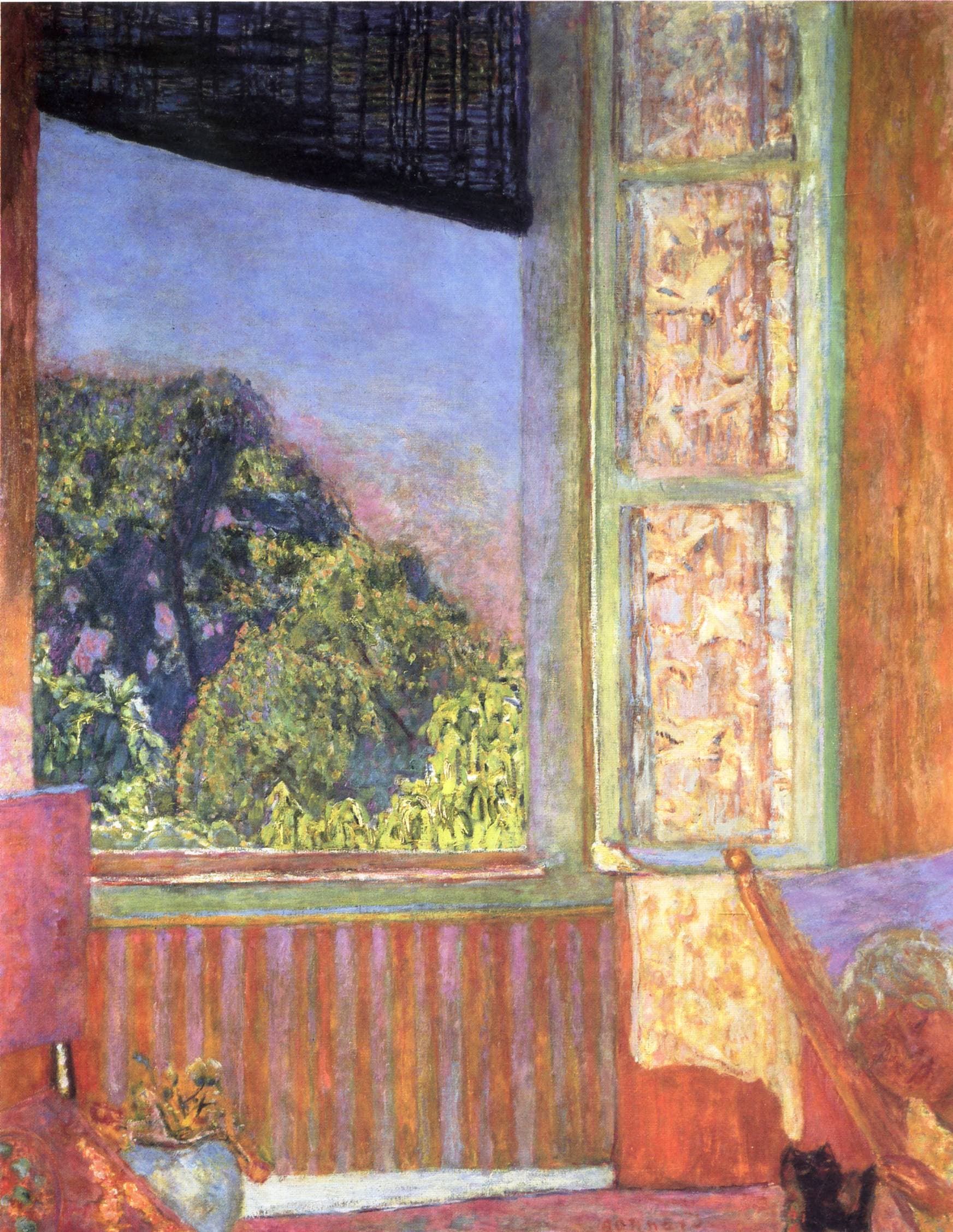
He complicated these scenes through framing. Doorways divide figures, mirrors produce unexpected bodies, tables push into the foreground, and a person can be present for several seconds before the viewer notices them. In *The Open Window* (1921), for example, the outside landscape initially dominates; only later do the black cat and human figure near the edge become apparent. That delayed recognition is one of the pleasures of Bonnard's domestic world.

Photography

Bonnard was also an enthusiastic amateur photographer. He acquired a small Kodak camera in the early 1890s and photographed his family, Marthe, vacations and ordinary domestic life. His sister Andrée, brother-in-law Claude Terrasse and their children appear repeatedly, while Marthe appears clothed and nude.

The photographs belonged partly to family memory rather than an independent art practice, but they also preserved accidental postures and compositions that Bonnard could reshape in paint. The relationship was not one-way: Marthe photographed Bonnard as well, including nude photographs made while he was working on illustrations for Daphnis and Chloe. Photography helps explain the unusual framing of his paintings, but memory was always allowed to interfere.

Books and prints

Bonnard's graphic work reached one of its high points through his collaboration with dealer and publisher Ambroise Vollard. In 1900, Vollard published Paul Verlaine's *Parallèlement with 109 lithographs by Bonnard printed in soft rose. Rather than confining illustrations to neat rectangles beside the poems, Bonnard allowed figures and lines to drift around and between the text, making the book a landmark modern livre de peintre* in which image and typography become one object.

He followed it in 1902 with illustrations for Longus's *Daphnis and Chloe*. These books show that Bonnard's decorative instincts were not a temporary Nabi phase. He continued thinking about how images inhabit surfaces, pages and architectural spaces throughout his career.

Beyond the Nabis

The Nabis functioned as a coherent Paris circle mainly from the late 1880s through the end of the 1890s. By the new century its members were following individual paths, and Bonnard never replaced the group with another movement. That independence eventually made him difficult to fit into standard histories of modern art: Fauvism, Cubism, abstraction, Dada and Surrealism appeared around him while he remained committed to recognizable figures, landscapes and rooms.

But he did not remain stylistically frozen. His color became progressively more intense and his space increasingly unstable. Instead of joining the avant-garde by abandoning ordinary subjects, he transformed those subjects until they could hold increasingly complex visual experiences.

Discovering the Mediterranean

An important change began with Bonnard's visits to southern France. He traveled to Saint-Tropez in the early twentieth century and in 1909 spent an extended period there as the guest of Henri Manguin. Mediterranean light and color overwhelmed him; Musée d'Orsay records his delighted response to yellow walls, sea and reflections, which seemed like an encounter with the Arabian Nights.

From then on, Bonnard returned regularly to Saint-Tropez, Grasse, Antibes, Cannes and Le Cannet. The stronger light brought yellows, oranges, blues and violets into his painting with increasing intensity. He did not abandon the north; instead, his life developed two poles, the misty greens and river landscapes of Normandy and the saturated color of the Mediterranean.

Ma Roulotte and Monet

In 1912, Bonnard bought a house at Vernonnet on a hillside overlooking the Seine and called it *Ma Roulotte. The house lay close to Claude Monet's Giverny*, and Bonnard visited the older painter. Their gardens differed markedly: Monet deliberately constructed Giverny as a highly organized artistic environment, while Bonnard allowed the property around Ma Roulotte to remain much wilder.

From the house and garden Bonnard painted the river valley, terraces and vegetation as overlapping fields of color, with figures floating inside the landscape rather than standing clearly apart. His friendship with Monet was part of a broader relationship with an older generation. Bonnard did not reject Impressionism, but he was less interested in immediate optical appearance than in what remained after a scene had been remembered.

A crisis in painting

Between roughly 1913 and 1915, Bonnard experienced a period of artistic doubt. He later explained that color had begun carrying him so far that he feared sacrificing form. The crisis shows that his increasingly intense color was not effortless: he continually tried to balance color, structure and recognizable space.

By the later 1910s, he had regained that balance. The paintings became richer without losing the strange architecture of tables, windows, figures and walls that held them together.

Painting from memory

Bonnard generally did not place an easel before Marthe, a table or a landscape and copy what he saw. He made rapid sketches, sometimes photographs, and worked later from memory. MoMA notes that he pinned pieces of unstretched canvas directly to the wall, often developing several paintings at once.

The method gave him freedom. A stretcher already defines the exact rectangle of a finished painting, while Bonnard wanted to change the boundaries. He could tack a larger canvas to the wall, paint within it, decide later where its edges should fall and continue reworking a picture for years.

This is why calling Bonnard an Impressionist can be misleading. The paintings may look spontaneous, but many are carefully reconstructed memories rather than immediate records of a fleeting visual moment. Memory altered color, combined moments and rebuilt composition.

Marriage, Renée Monchaty and a complicated private life

Bonnard and Marthe lived together for more than thirty years before marrying in Paris on 13 August 1925. A few weeks later, Renée Monchaty, a younger woman with whom Bonnard had been having a relationship and whom he had also painted, died by suicide. The episode complicates a body of work often described simply as peaceful domestic intimacy.

Bonnard later continued working on *Young Women in the Garden*, a painting containing both Marthe and Renée. He had begun it in the early 1920s and returned to it more than twenty years later, after both relationships had become part of memory. The paintings can be visually beautiful without being emotionally uncomplicated; rooms glowing with orange and violet may contain histories of jealousy, illness, attachment and loss.

The bathroom paintings

After the marriage, the bathroom became one of the defining spaces of Bonnard's mature work. Marthe spent long periods bathing, and he repeatedly painted her in the bath or at her toilette. Rather than simply portraying a nude body, Bonnard allowed the figure, water, tiled floors, patterned walls and mirrors to dissolve into colored reflections.

These paintings turn an ordinary domestic space into something almost hallucinatory. MoMA's *The Bathroom* (1932) demonstrates the intensely private character of this world and the museum emphasizes that Bonnard reconstructed the scene from memory with small sketches rather than painting directly from the model.

Le Bosquet

In 1926, Bonnard bought a modest house on the hills above Le Cannet, near Cannes, and called it *Le Bosquet*. He installed a bathroom for Marthe and made additions including an atelier. From its windows and terraces he looked across gardens, rooftops and the Mediterranean landscape.

Bonnard continued dividing his time among Paris, Normandy and the south for years, but Le Bosquet became increasingly important and during the Second World War he remained there almost continuously. Musée Bonnard estimates that he produced more than 300 works connected with Le Cannet, ranging from interiors and garden views to wider landscapes.

Matisse

One of the most important friendships of Bonnard's later life was with Henri Matisse. They had known one another for years, but their relationship deepened as both spent increasing time in southern France. Matisse visited Bonnard, and the two maintained regular correspondence from 1925 onward.

Their art could appear very different, yet each took color extremely seriously. Neither regarded it as something applied afterward to describe an already established object; color itself could construct the picture. The friendship mattered particularly as Bonnard seemed increasingly detached from fashionable Paris movements. Matisse understood what he was doing even when critics dismissed him as a survivor of an earlier period.

War and loss

When the Second World War began, Bonnard remained at Le Cannet. The years brought significant personal losses: his longtime friend Édouard Vuillard died in 1940, and Marthe died at Le Bosquet on 26 January 1942. Bonnard continued painting.

The familiar house now contained absence as much as presence. Marthe could still appear in paintings developed from earlier sketches and memories, and the rooms she had inhabited remained central subjects. This ability to paint people no longer physically present makes memory especially important in Bonnard's art: the picture did not require the model to remain alive, or even nearby, because its source was increasingly the accumulated image he carried in his mind.

The final almond tree

One of Bonnard's final subjects was remarkably simple: an almond tree flowering outside Le Bosquet. *The Almond Tree in Blossom was begun in 1946 and completed in 1947*, and Centre Pompidou identifies it as the last painting he completed. Pale blossoms spread across blue, yellow, white and pink; the tree becomes an explosion of spring rather than a solemn meditation on approaching death.

Photographs taken by Brassaï in 1946 show the elderly Bonnard working at Le Bosquet with several canvases pinned directly to the wall, including The Almond Tree in Blossom. Even in his final months, he used the unconventional method developed over decades. Bonnard died at Le Cannet on 23 January 1947, aged seventy-nine, and was buried beside Marthe in the cemetery of Notre-Dame-des-Anges. Retrospectives followed quickly in Paris and New York.

Pierre Bonnard and Paris

Bonnard's later career can easily become associated with the Mediterranean because the paintings of Le Cannet are so luminous, but Paris formed the artist who made them. He studied at the Académie Julian and École des Beaux-Arts; an exhibition of Japanese prints changed how he saw images; the France-Champagne poster appeared on city walls; his friendship with Vuillard, Sérusier, Denis and Ranson developed into the Nabis; and La Revue blanche connected him with Misia and Thadée Natanson and the intellectual life of the 1890s.

Paris also became a subject. Place Clichy, the Opera, the Bois de Boulogne, cafés, streets and apartments entered his paintings and prints. Bonnard learned to see the city not as monuments but as a flow of passing figures, advertisements, animals, shopfronts, reflections and visual accidents. Even when he moved away, he maintained studios and professional connections in the capital, where paintings were exhibited, books printed, dealers visited and friendships sustained.

The Mediterranean changed his colors. Paris had already changed his way of looking.

Bonnard's place in modern art

Bonnard has sometimes been difficult to fit into the standard story of twentieth-century modernism. He did not become a Cubist, abstract painter or Surrealist. He continued painting tables, baths, gardens, women, dogs and windows while other artists dismantled the visible world altogether. For a time, that could make his work appear conservative.

His real experimentation took place inside perception itself. He questioned how much a painting should resemble what the eye sees at one instant, allowed memory to change color, distorted perspective, moved important information toward the edges and constructed scenes from different moments rather than pretending to represent one frozen glance.

A bathroom remains a bathroom, a breakfast a breakfast and a window a window. But after Bonnard rearranges them through memory, color and time, none remains quite as ordinary as it first appeared.

Life events

  1. 1867

    Born in Fontenay-aux-Roses on 3 October.

    — Pierre Bonnard — biography and chronology

  2. 1886–1887

    Completes law studies while attending the Académie Julian, where he meets Paul Sérusier, Maurice Denis, Henri-Gabriel Ibels and Paul Ranson.

    — Pierre Bonnard — biography and chronology

  3. 1889

    Enters the École des Beaux-Arts, becomes close to Édouard Vuillard and Ker-Xavier Roussel and joins the emerging Nabis.

    — Pierre Bonnard — biography and chronology; Nabis: Bonnard, Vuillard, Maurice Denis, Vallotton (1888–1900)

  4. 1890

    Encounters Japanese prints at a major Paris exhibition and becomes so associated with ukiyo-e composition that he earns the nickname Nabi très japonard.

    — Pierre Bonnard: Peindre l'Arcadie

  5. 1891

    Exhibits at the Salon des Indépendants; his *France-Champagne* poster appears on Paris streets and becomes his first major commercial success.

    — Pierre Bonnard — biography and chronology; France-Champagne; Poster: France-Champagne

  6. 1893

    Meets Maria Boursin, who calls herself Marthe de Méligny and becomes his longtime companion and recurring model.

    — Pierre Bonnard — biography and chronology

  7. 1893–1894

    Becomes closely involved with *La Revue blanche* and the Natanson circle; Misia Natanson becomes an important friend and subject.

    — Pierre Bonnard — biography and chronology; Misia, Queen of Paris

  8. 1894

    Creates his celebrated poster for *La Revue blanche*.

    — La Revue blanche; Poster: La Revue blanche

  9. 1896

    Holds his first solo exhibition at Durand-Ruel in Paris.

    — Pierre Bonnard — biography and chronology

  10. Late 1890s

    Works across painting, lithography, theater, posters and illustration and becomes associated with the literary circle around Alfred Jarry and Claude Terrasse.

    — Pierre Bonnard: Peindre l'Arcadie

  11. Circa 1900

    Works from a studio near Place Clichy on rue de Douai and makes compressed images of Paris traffic, signage and pedestrians.

    Montmartre, one of Bonnard's compressed Paris street scenes, turns traffic and signage into a field of color. (Pierre Bonnard; photograph by Didier Descouens, Fondation Bemberg)

    — The Place Clichy, Paris

  12. 1900

    Ambroise Vollard publishes Verlaine's *Parallèlement* with 109 lithographs by Bonnard, a landmark of modern illustrated-book design.

    — Parallèlement, illustrated by Pierre Bonnard

  13. 1902

    Illustrates *Daphnis and Chloe* by Longus for Vollard.

    — Daphnis and Chloe, illustrated by Pierre Bonnard

  14. 1904–1909

    Travels increasingly through southern France; a long 1909 visit with Henri Manguin has a major effect on his use of color.

    — Pierre Bonnard — biography and chronology; Pierre Bonnard: Peindre l'Arcadie

  15. 1912

    Buys *Ma Roulotte* at Vernonnet on the Seine, near Monet's home at Giverny.

    — Pierre Bonnard — biography and chronology; Pierre Bonnard: Peindre l'Arcadie

  16. 1913–1915

    Experiences a period of doubt about the balance between intense color and pictorial form before developing a new equilibrium.

    — Pierre Bonnard — biography and chronology

  17. 1917–1918

    Works in the south, where Henri Matisse visits him; their friendship becomes increasingly important.

    — Pierre Bonnard — biography and chronology

  18. 1921–1922

    Begins *Young Women in the Garden*, containing Marthe and Renée Monchaty, and continues reworking it for more than two decades.

    — Bonnard's Worlds — digital press kit

  19. 1924

    Receives a major retrospective at Galerie Druet in Paris, visits Monet at Giverny and attracts the attention of American collector Duncan Phillips.

    — Pierre Bonnard — biography and chronology; Bonnard's Worlds — digital press kit

  20. 1925

    Marries Marthe de Méligny in Paris on 13 August after more than thirty years together; Renée Monchaty dies by suicide several weeks later.

    — Pierre Bonnard — biography and chronology; Bonnard's Worlds — digital press kit

  21. 1925 onward

    Maintains regular correspondence with Henri Matisse.

    — Pierre Bonnard — biography and chronology

  22. 1926

    Buys *Le Bosquet* at Le Cannet and begins dividing his time among the Mediterranean, Paris and Normandy.

    — Pierre Bonnard — biography and chronology; Bonnard at Le Cannet and Le Bosquet

  23. 1928

    Holds his first New York exhibition, strengthening his international reputation.

    — Pierre Bonnard — biography and chronology

  24. 1930

    The Phillips Collection presents Bonnard's first solo museum exhibition in the United States.

    — Bonnard's Worlds — digital press kit

  25. 1930s

    Produces celebrated interiors and bathroom paintings, increasingly constructing compositions from drawings and memory rather than direct observation.

    Bonnard's 1933 self-portrait, a deliberately spare image from a painter famous for saturated domestic color. (Pierre Bonnard; photograph by Didier Descouens, Fondation Bemberg)

    — The Bathroom; Bonnard's drawings and memory; Pierre Bonnard: Peindre l'Arcadie

  26. 1939–1947

    Spends the war and final years primarily at Le Cannet, painting interiors, landscapes, self-portraits and garden views.

    — Pierre Bonnard — biography and chronology

  27. 1940

    His close friend Édouard Vuillard dies.

    — Pierre Bonnard — biography and chronology

  28. 1942

    Marthe dies on 26 January at Le Cannet; Bonnard continues returning to earlier images and memories of her.

    — Pierre Bonnard — biography and chronology

  29. 1945–1946

    Revisits long-unfinished paintings including *Young Women in the Garden* while developing increasingly intense late interiors and landscapes.

    — Bonnard's Worlds — digital press kit

  30. 1946–1947

    Paints *The Almond Tree in Blossom* at Le Bosquet, identified by Centre Pompidou as his final completed painting.

    — L'Amandier en fleurs; Bonnard working at Le Bosquet in 1946

  31. 1947

    Dies at Le Cannet on 23 January, aged seventy-nine, and is buried beside Marthe; memorial exhibitions follow in Paris and New York.

    — Pierre Bonnard — biography and chronology

Selected works

Cataloged from the holding institutions' records. Reproductions appear only where the rights are verified.

Paintings

Bonnard's Dining Room in the Country: a round table under a pale blue cloth holds dishes of fruit in front of a blue-gray door and a wide open window, with a red-orange room on the left, a green garden and the hills of the Seine valley beyond, and a woman in a red blouse leaning on the sill at the right

Artwork reproduction

Painting

Dining Room in the Country

1913 · Oil on canvas

A round table under a pale blue cloth fills the front of a country dining room, and an open door and window let the garden straight in. Pierre Bonnard painted the room at Ma Roulotte, the house above the Seine at Vernonnet he had bought the year before. Marthe de Méligny leans in at the windowsill on the right in a red blouse, and a ginger cat sits on a slatted seat below her. The canvas is just over two meters wide and belongs to the Minneapolis Institute of Art.

Minneapolis Institute of Art

Pierre Bonnard, Dining Room in the Country, 1913. Minneapolis Institute of Art. Image: public domain.

Bonnard's portrait of Ambroise Vollard: a bald, bearded man in a dark suit sits hunched with his eyes lowered and a grey-brown tabby cat on his lap, in front of brown wainscot, with framed paintings above him and large blank canvases in grey-lilac and salmon-pink stacked at the right

Artwork reproduction

Painting

Portrait of Ambroise Vollard with a Cat

c. 1924 · Oil on canvas

Ambroise Vollard sits in the middle of a room crowded with pictures, a small tabby cat on his lap. Pierre Bonnard painted the Paris dealer bald, bearded and hunched, his eyes lowered, in a dark suit that goes almost black against the woodwork behind him. The Petit Palais says the cat was a device Bonnard thought up to stop his sitter falling asleep. Vollard's heirs gave the canvas to the City of Paris in 1950.

Petit Palais, musée des Beaux-Arts de la Ville de Paris

Pierre Bonnard, Portrait of Ambroise Vollard with a Cat, c. 1924. Petit Palais, musée des Beaux-Arts de la Ville de Paris. Image: CC0.

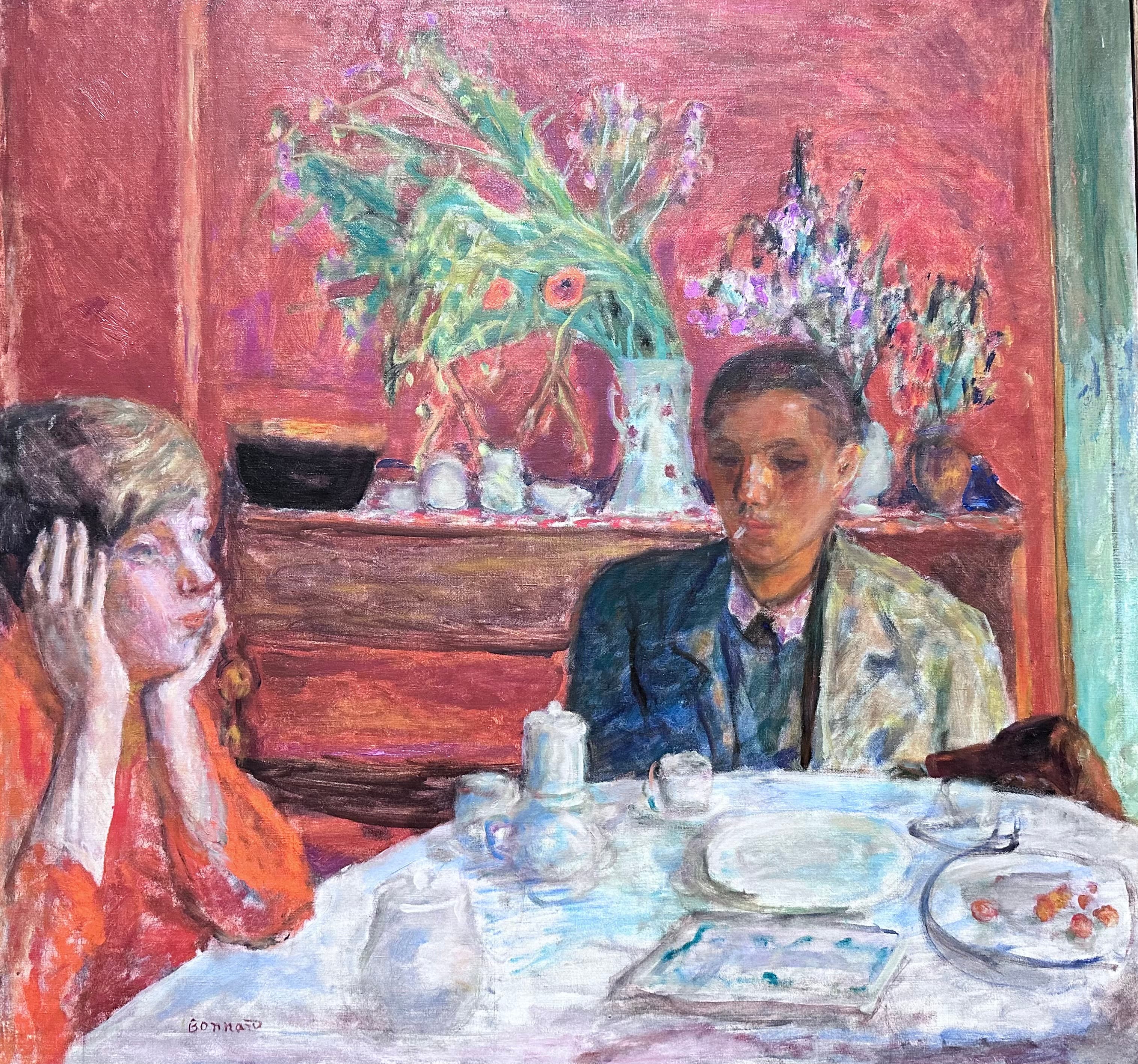
Bonnard's The Dessert: a woman in orange holds her head in both hands at the left of a white-clothed table while a young man with a cigarette sits at the right, a coffee pot between them, a white dish of small orange-red fruits and a dog's head at the right, and two bouquets on a sideboard against a rose-red wall

Artwork reproduction

Painting

The Dessert

1921 · Oil on fabric

Two people sit at a dining table at the end of a meal. Pierre Bonnard painted a woman holding her head in both hands and a young man with a cigarette in his mouth, a coffee pot between them and a white dish of small orange-red fruits at the right. The Cleveland Museum of Art calls the woman the artist's wife, Marthe, and says the young man has been identified as Ari Redon, son of the painter Odilon Redon. A dachshund, the Bonnard family pet Poucette, is just visible at the edge of the table. The canvas is almost square and entered the collection in 1949.

Cleveland Museum of Art

Pierre Bonnard, The Dessert, 1921. Cleveland Museum of Art. Image: public domain.

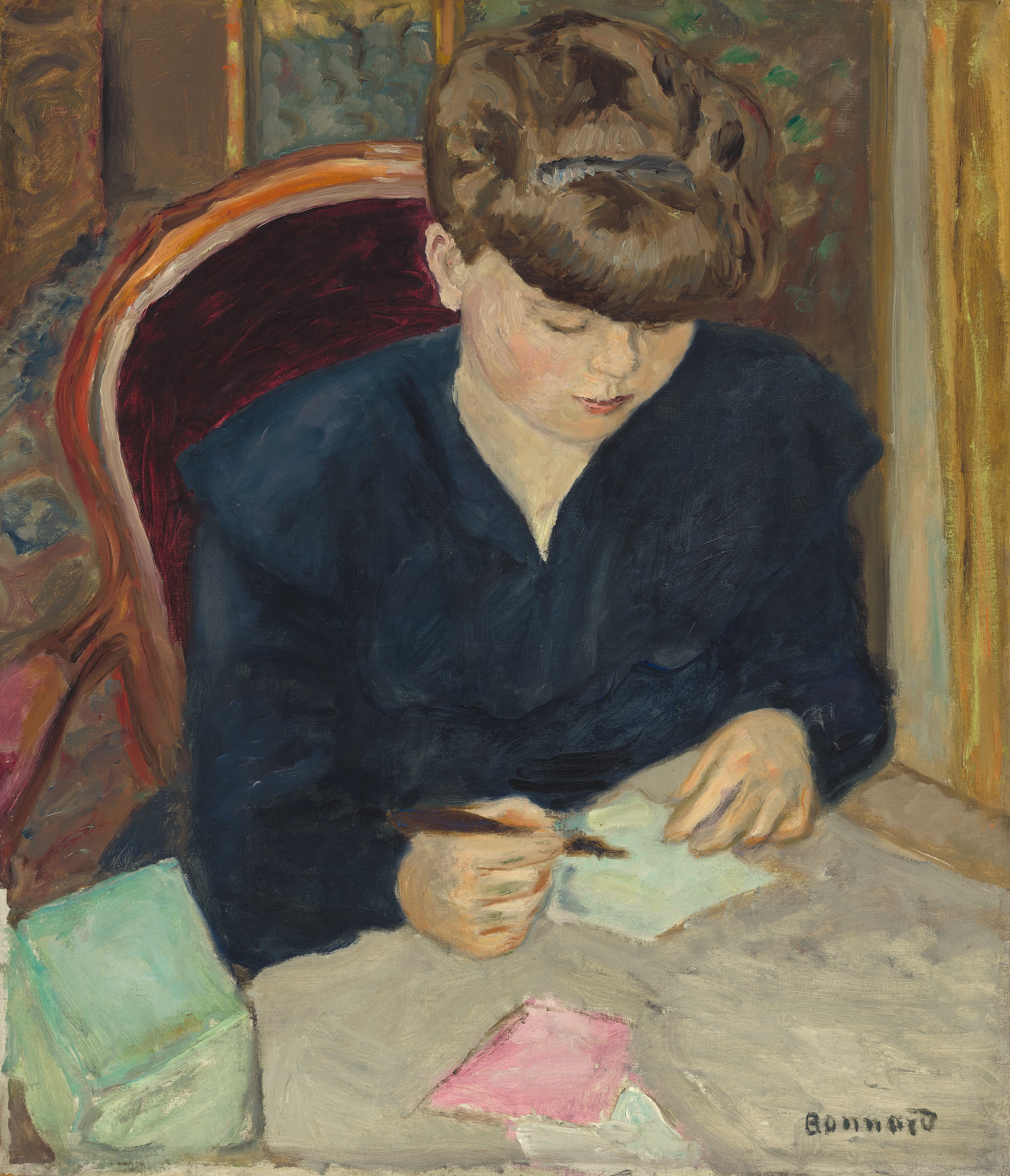
Bonnard's The Letter: a young woman in a dark blue dress bends over a pale blue-green sheet of paper on a warm grey table, a pen in her right hand and her left hand flat on the page, with piled brown hair, a crimson chair back behind her and a mint-green book at the lower left

Artwork reproduction

Painting

The Letter

c. 1906 · Oil on canvas

A young woman bends over a sheet of pale blue-green paper with a pen in her right hand. Pierre Bonnard painted her from slightly above, in a dark blue dress, at a warm grey table, with the curved frame and crimson back of a chair behind her. Bernheim-Jeune bought the canvas from him in Paris in 1906 and sold it to the collector Alexandre Natanson. It reached the National Gallery of Art in Washington in 1963 with the bequest of Chester Dale.

National Gallery of Art

Pierre Bonnard, The Letter, c. 1906. National Gallery of Art. Image: public domain.

Bonnard's The Open Window: a wide open window with a near-black blind across the top, lilac-blue sky and a mass of green foliage beyond, framed by a red-orange wall, a pale green sill and a striped panel below, with a pale blue vase of yellow flowers at the lower left and a dark cat at the lower right

Artwork reproduction

Painting

The Open Window

1921 · Oil on canvas

A window and what can be seen through it hold the centre of this canvas. Pierre Bonnard painted the view from a room in his house in Normandy: a dark blind across the top, lilac-blue sky, and a great mass of trees and flowering shrubs. The room itself is reduced to red-orange wall, a striped panel below the sill and a hinged shutter on the right. Duncan Phillips bought the painting in 1930, and it is one of the best-known works at The Phillips Collection in Washington.

The Phillips Collection, Washington, D.C.

Pierre Bonnard, The Open Window, 1921. The Phillips Collection, Washington, D.C.. Image: public domain.

People Pierre Bonnard Knew

Relationships with other people, with sources for each connection.

Illustrated portrait of Henri Matisse

Henri Matisse

  • Painter

Met · 1911

Bonnard and Matisse exhibited together in 1911, became close friends, visited one another in southern France, and maintained regular correspondence from 1925.

— Pierre Bonnard — biography and chronology

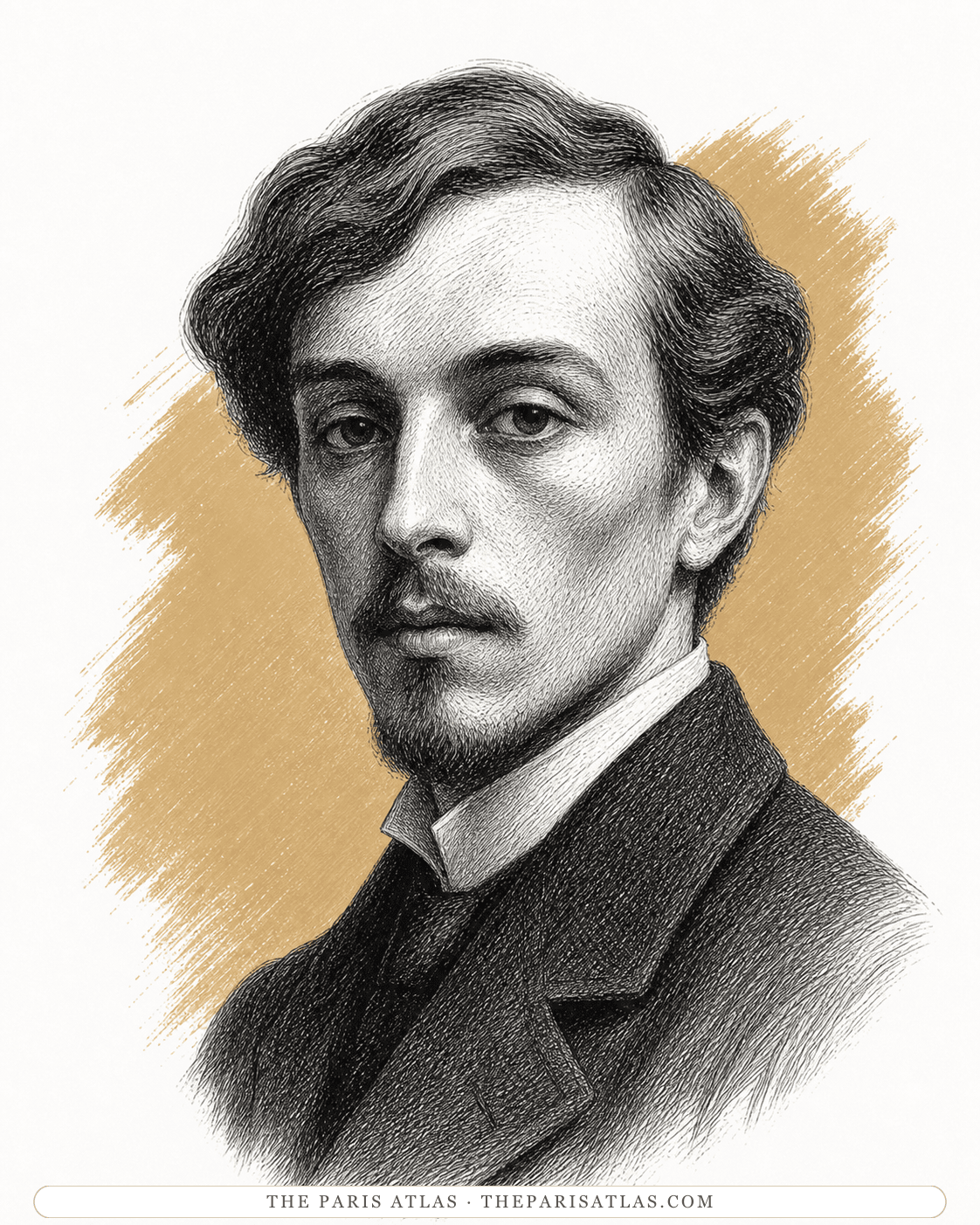
Illustrated portrait of Édouard Vuillard

Édouard Vuillard

  • Painter
  • Printmaker

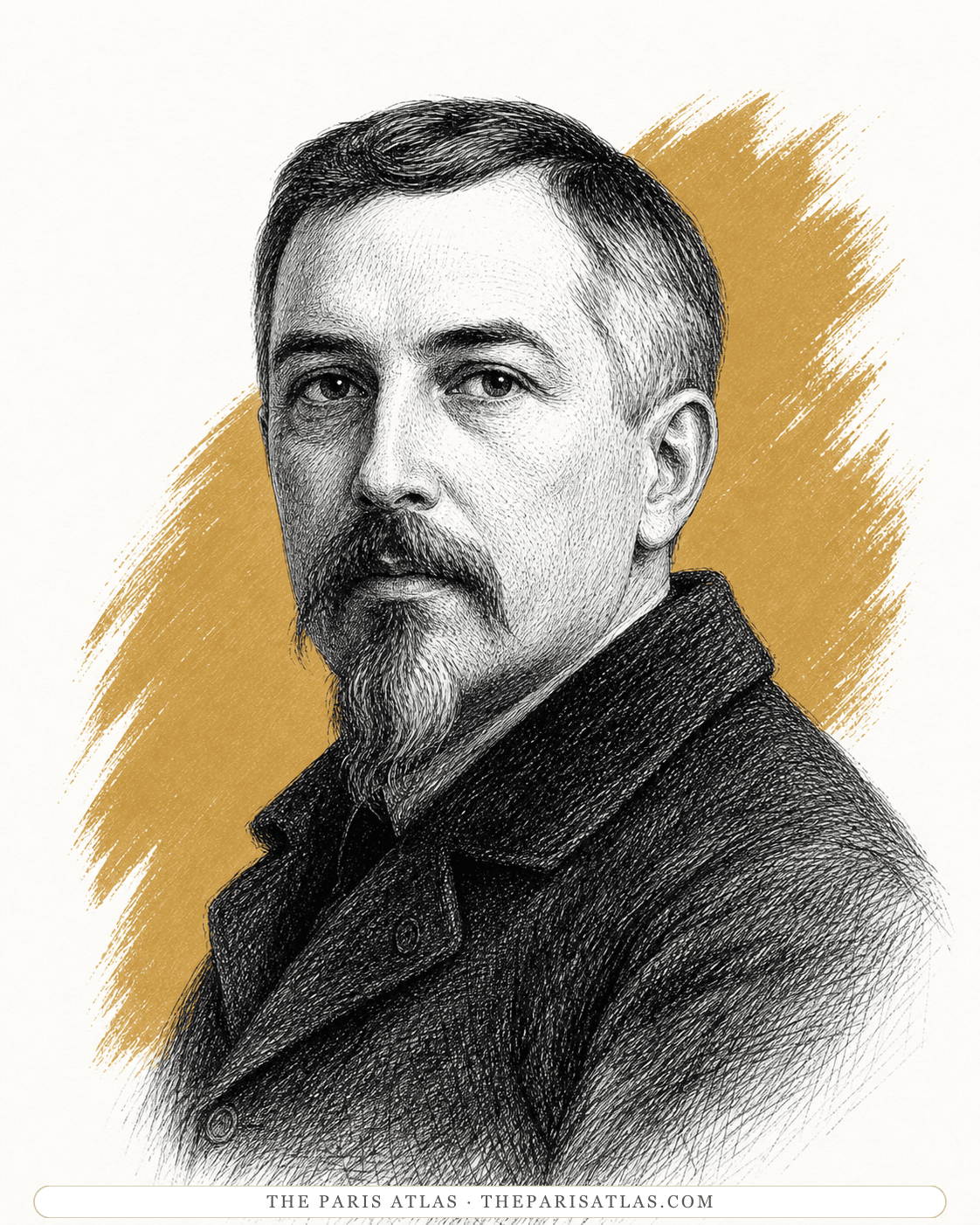
Collaborated with · 1889

Bonnard and Vuillard met in the Nabis and maintained a close artistic friendship for the rest of Vuillard's life.

— Pierre Bonnard — biography and chronology

Illustrated portrait of Maurice Denis

Maurice Denis

  • Painter
  • Author

Collaborated with · 1889

Bonnard and Denis worked together in the Nabis, the Paris group that treated painting as an ordered surface of color and line.

— Pierre Bonnard — biography and chronology

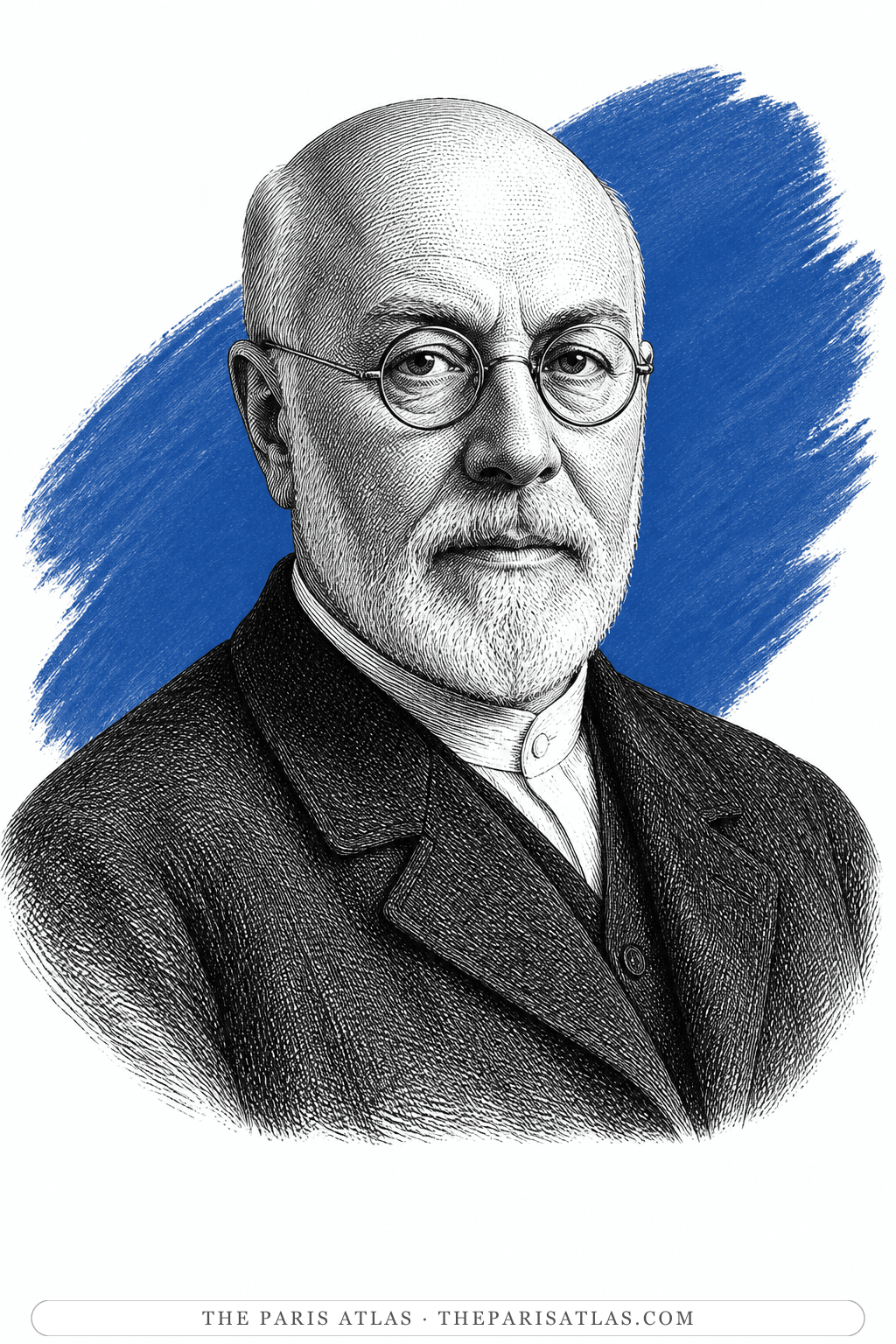
Illustrated portrait of Ambroise Vollard

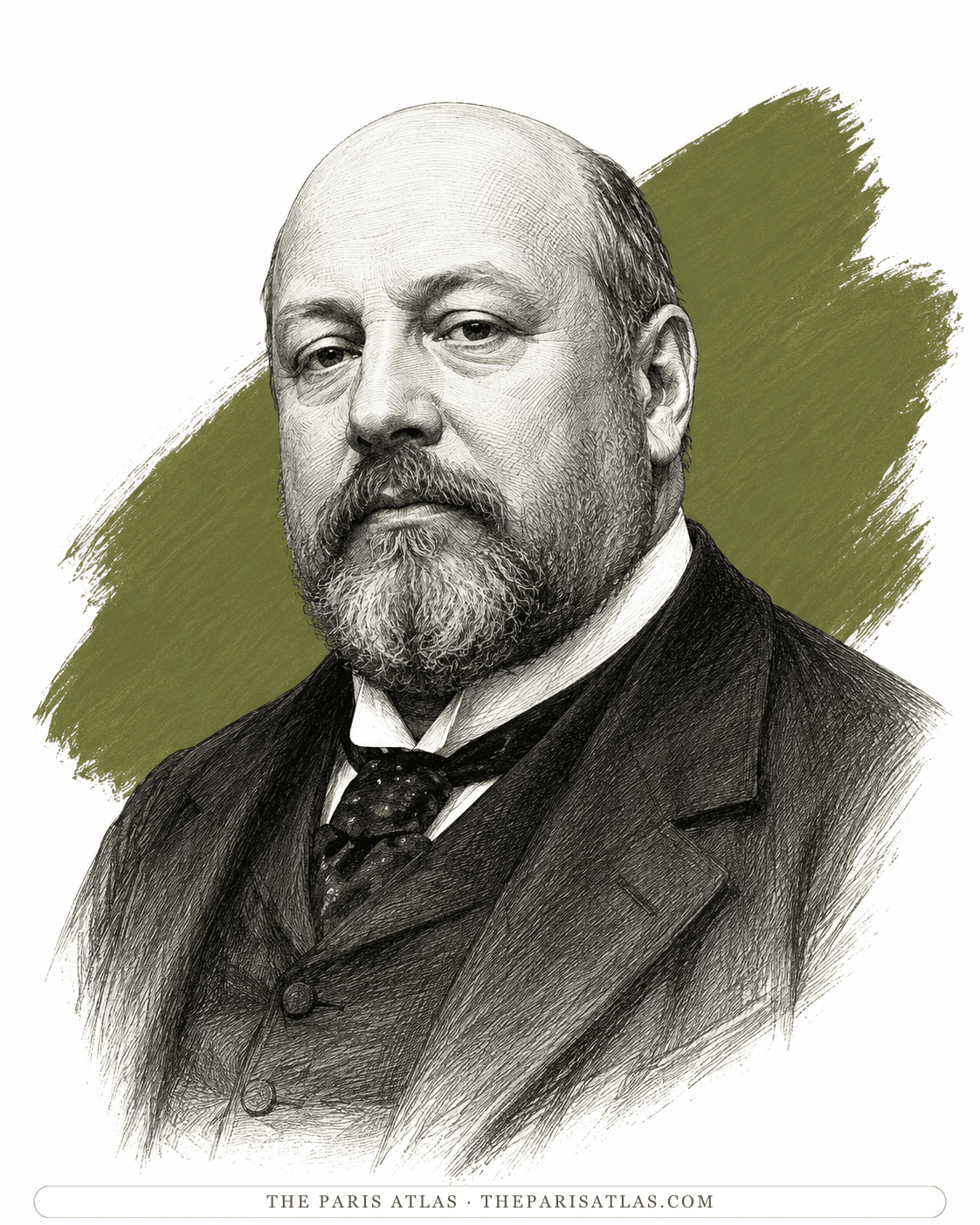
Ambroise Vollard

  • Art dealer
  • Publisher

Collaborated with · 1900

Vollard published Bonnard's landmark illustrated edition of Verlaine's Parallèlement in 1900 and Daphnis and Chloe in 1902, allowing image and typography to share the page.

— Parallèlement, illustrated by Pierre Bonnard; Daphnis and Chloe, illustrated by Pierre Bonnard

Illustrated portrait of Claude Monet

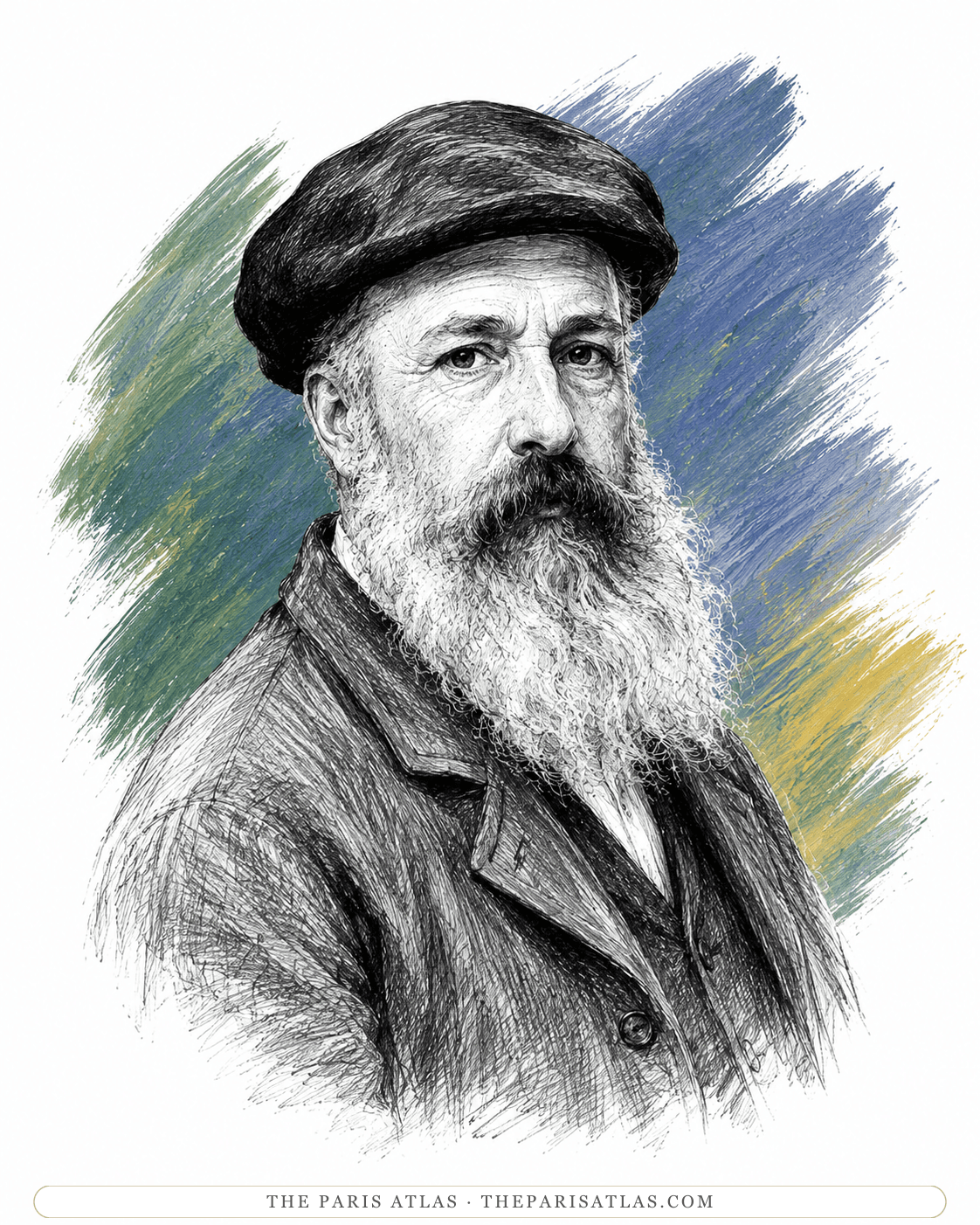
Claude Monet

  • Painter

Met · 1912

After buying Ma Roulotte at nearby Vernonnet, Bonnard visited Monet at Giverny; the two painters shared a sustained interest in gardens and perception while organizing their landscapes very differently.

— Pierre Bonnard — biography and chronology; Pierre Bonnard: Peindre l'Arcadie

Movements

The artistic and literary currents this life ran through.

A nude young man stands on a rocky ledge holding a long red-shafted spear upright. A sphinx with a young woman's head and bare torso, a tawny lion's body and large blue-grey wings has sprung against his chest, its front paws hooked into him, staring up into his face while he looks steadily down at her. On the ledge below lie a pale human foot, scattered fingers, a red cloth and a gold crown; a narrow rocky gorge and grey sky fill the background, with an ornamented urn on a column at the right.

Art & literary movement · circa 1860–1910

Symbolism

Bonnard was a founding member of the Nabis, the group of Academie Julian students who formed in the autumn of 1888 around Serusier's interpretation of Gauguin's Symbolism.

— The Nabis and Decorative Painting

Pierre Bonnard’s Places

The cataloged places connected to Pierre Bonnard — through the books, and through the documented record.

Places you can enter today appear first, followed by addresses to see from outside and sites that have vanished.

Connections and Sources

Pierre Bonnard’s connections to people, places, and works, with the sources behind each one.

Met · 1911

Henri Matisse

Bonnard and Matisse exhibited together in 1911, became close friends, visited one another in southern France, and maintained regular correspondence from 1925.

— Pierre Bonnard — biography and chronology

Collaborated with · 1889

Édouard Vuillard

Bonnard and Vuillard met in the Nabis and maintained a close artistic friendship for the rest of Vuillard's life.

— Pierre Bonnard — biography and chronology

Collaborated with · 1889

Maurice Denis

Bonnard and Denis worked together in the Nabis, the Paris group that treated painting as an ordered surface of color and line.

— Pierre Bonnard — biography and chronology

Studied at · 1889

École des Beaux-Arts

Bonnard was admitted to the École des Beaux-Arts in 1889, where he met Ker-Xavier Roussel and Édouard Vuillard while taking part in the emerging Nabis circle.

— Pierre Bonnard — biography and chronology

Collaborated with · 1900

Ambroise Vollard

Vollard published Bonnard's landmark illustrated edition of Verlaine's Parallèlement in 1900 and Daphnis and Chloe in 1902, allowing image and typography to share the page.

— Parallèlement, illustrated by Pierre Bonnard; Daphnis and Chloe, illustrated by Pierre Bonnard

Frequented

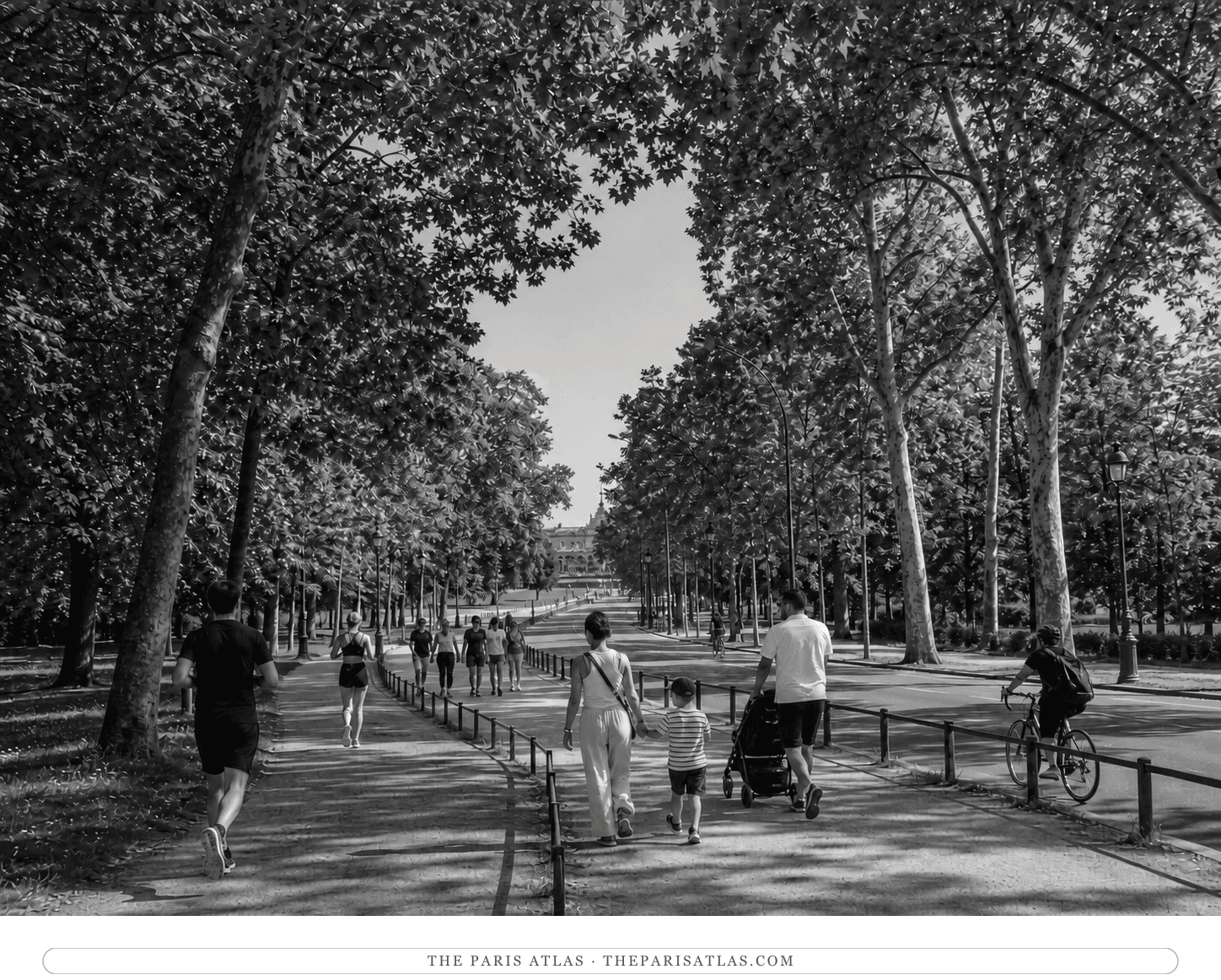
Bois de Boulogne

The Bois de Boulogne belonged to Bonnard's recurring Paris subjects, where he studied the rhythms, encounters and visual accidents of modern public life.

— Pierre Bonnard: Peindre l'Arcadie

Frequented · 1900

Place de Clichy

Bonnard worked from a nearby rue de Douai studio and repeatedly observed and painted the square's omnibuses, carts, advertisements and pedestrians around 1900.

— The Place Clichy, Paris

Met · 1912

Claude Monet

After buying Ma Roulotte at nearby Vernonnet, Bonnard visited Monet at Giverny; the two painters shared a sustained interest in gardens and perception while organizing their landscapes very differently.

— Pierre Bonnard — biography and chronology; Pierre Bonnard: Peindre l'Arcadie

Associated with · 1888

Symbolism

Bonnard was a founding member of the Nabis, the group of Academie Julian students who formed in the autumn of 1888 around Serusier's interpretation of Gauguin's Symbolism.

— The Nabis and Decorative Painting

References

References

The sources below include biographies, scholarly essays, interviews, and primary materials that informed this page. They reflect both the historical record and ongoing critical conversations about Pierre Bonnard and their work.

  1. 1abPierre Bonnard — biography and chronology

    Website
    Musée Bonnard
    Used for

    Primary official biography and detailed chronology for Bonnard's life, training, relationships, homes and exhibitions.

    View source
  2. 2↑Nabis: Bonnard, Vuillard, Maurice Denis, Vallotton (1888–1900)

    Website
    Musée d'Orsay
    Used for

    Institutional exhibition history of the Nabis and their decorative approach to modern painting.

    View source
  3. 3abPierre Bonnard: Peindre l'Arcadie

    Website
    Musée d'Orsay
    Used for

    Major retrospective research covering Japanese prints, Paris, Marthe, photography, interiors and Mediterranean color.

    View source
  4. 4↑Misia, Queen of Paris

    Website
    Musée d'Orsay
    Used for

    Institutional source for Misia Natanson and the *La Revue blanche* circle.

    View source
  5. 5Bonnard at Le Cannet and Le Bosquet

    Website
    Musée Bonnard
    Used for

    Institutional history of Bonnard at Le Cannet and Le Bosquet, including the scale of his work there.

    View source
  6. 6Pierre Bonnard (1867–1947)

    Website
    Musée d'Orsay
    Used for

    Musée d'Orsay artist authority record.

    View source
  7. 7Pierre Bonnard, photography, cinema and Marthe

    Website
    Musée d'Orsay
    Used for

    Museum source for Bonnard's photography, cinema interests and depictions of Marthe.

    View source
  8. 8L'Amandier en fleurs

    Official record
    Centre Pompidou
    Used for

    Museum collection record identifying *The Almond Tree in Blossom* as Bonnard's final completed painting.

    View source
  9. 9Pierre Bonnard

    Website
    The Museum of Modern Art
    Used for

    MoMA artist record and broad overview of Bonnard's career.

    View source
  10. 10France-Champagne

    Official record
    Museum of Modern Art
    Used for

    Museum record for the breakthrough *France-Champagne* poster.

    View source
  11. 11La Revue blanche

    Official record
    Museum of Modern Art
    Used for

    Museum record for Bonnard's *La Revue blanche* poster.

    View source
  12. 12Bonnard's unstretched canvas

    Website
    Museum of Modern Art
    Used for

    Detailed account of Bonnard's practice of pinning unstretched canvas to the wall and determining its edges later.

    View source
  1. 13Bonnard's drawings and memory

    Website
    Museum of Modern Art
    Used for

    Museum account of Bonnard's use of drawings and memory rather than direct observation.

    View source
  2. 14Bonnard working at Le Bosquet in 1946

    Archive
    Museum of Modern Art
    Used for

    Archival photographs of Bonnard working at Le Bosquet in 1946.

    View source
  3. 15The Bathroom

    Official record
    Museum of Modern Art
    Used for

    Collection record for *The Bathroom* and Bonnard's memory-based working method.

    View source
  4. 16Pierre Bonnard: The Graphic Art

    Exhibition catalogue
    Metropolitan Museum of Art
    Used for

    Museum publication on Bonnard's extensive poster, print, book and journal work.

    View source
  5. 17Parallèlement, illustrated by Pierre Bonnard

    Official record
    Metropolitan Museum of Art
    Used for

    Collection record for Bonnard's 109 lithographs surrounding Verlaine's text in *Parallèlement*.

    View source
  6. 18Daphnis and Chloe, illustrated by Pierre Bonnard

    Official record
    Metropolitan Museum of Art
    Used for

    Collection record for Bonnard's illustrations to *Daphnis and Chloe*.

    View source
  7. 19La Revue blanche

    Official record
    Metropolitan Museum of Art
    Used for

    Additional museum record for the *La Revue blanche* poster and its sitter.

    View source
  8. 20Poster: France-Champagne

    Official record
    National Gallery of Art
    Used for

    National Gallery of Art record for the *France-Champagne* poster.

    View source
  9. 21Poster: La Revue blanche

    Official record
    National Gallery of Art
    Used for

    National Gallery of Art record for the *La Revue blanche* poster.

    View source
  10. 22The Open Window

    Official record
    The Phillips Collection
    Used for

    Collection record explaining the delayed recognition and layered perception in *The Open Window*.

    View source
  11. 23Bonnard's Worlds — digital press kit

    Exhibition catalogue
    The Phillips Collection
    Used for

    Exhibition research on Marthe, Renée Monchaty, *Young Women in the Garden* and Bonnard's reconstruction of memory.

    View source
  12. 24The Place Clichy, Paris

    Official record
    Norton Simon Museum
    Used for

    Museum record documenting Bonnard's rue de Douai studio and paintings of Place Clichy.

    View source
i
Why these sources are here

These references anchor the page in the documented record and in the scholarly conversations around Pierre Bonnard. Every claim on this page traces back to one or more of the works listed here.

Explore more resources