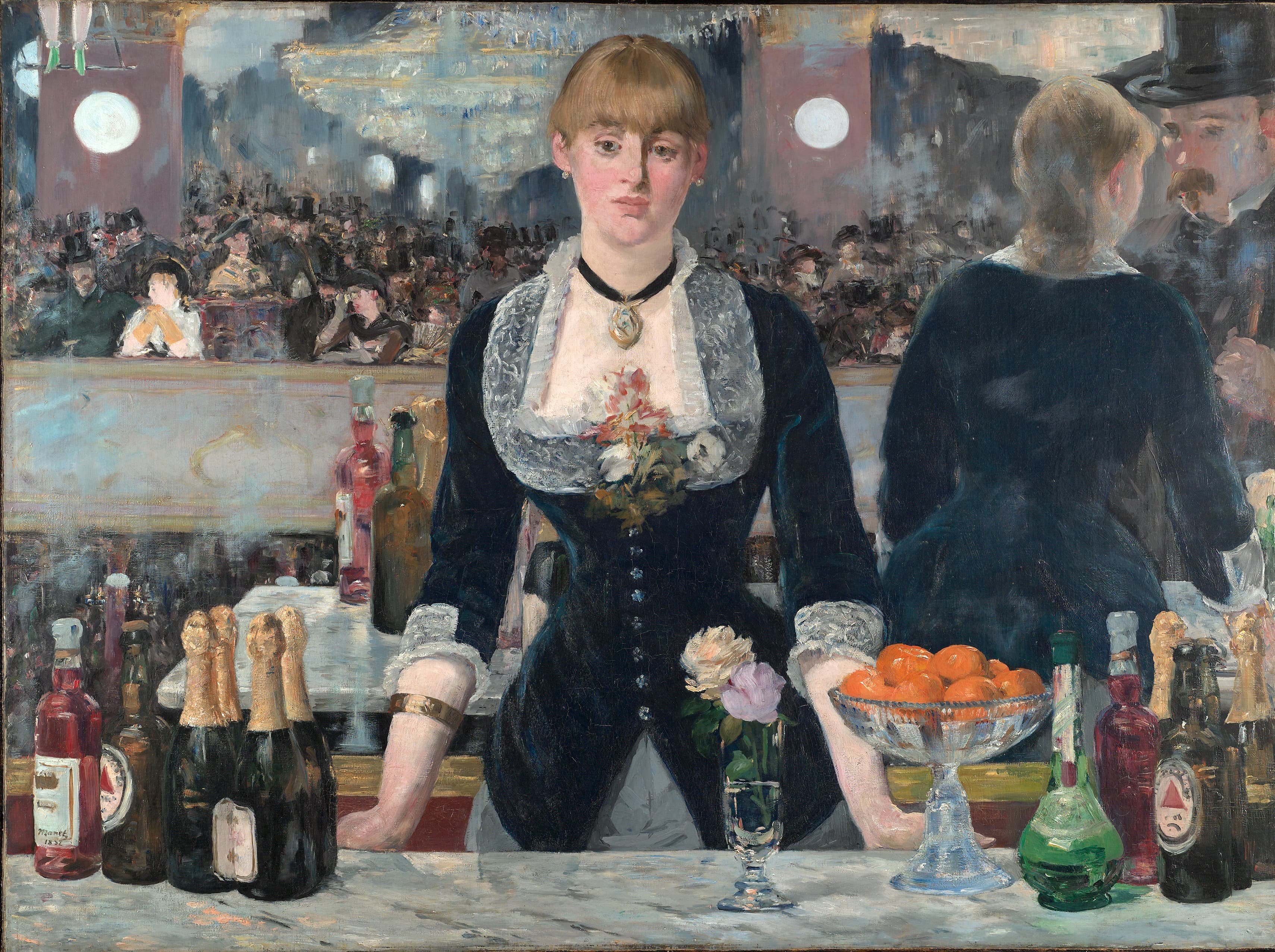
A Bar at the Folies-Bergère
Édouard Manet's last major painting shows a barmaid facing the viewer across a marble counter. A large mirror behind her reflects the crowded Folies-Bergère and a customer positioned at the right.
- 1882
- Oil on canvas
About Édouard Manet
A worker in front of a crowd
Édouard Manet places the barmaid at the center of A Bar at the Folies-Bergère. Her hands rest wide apart on the counter. The bottles, fruit bowl, and flowers occupy the space between her and the viewer.
Behind her, a mirror reflects balconies filled with spectators. The difference in scale makes her face and hands easy to examine while the customers become a dense background of hats and small strokes.
The painting permits a reading of distance or fatigue in her expression, but it does not establish what the sitter was feeling. Her still pose is visibly different from the busy scene behind her.
Why the mirror is difficult to reconcile
The barmaid's reflected back appears well to the right of her frontal figure. A man in a top hat faces the reflection near the right edge. Bottles also occupy different-looking positions in the reflected counter.
In A Bar at the Folies-Bergère, the displaced reflections of the barmaid, customer, and bottles make the viewer's position difficult to explain. The Courtauld treats these inconsistencies as part of the painting's ambiguity.
The mirror also makes the audience visible without turning the barmaid around. Manet can show the person serving and the people being entertained in the same view.
A real employee, a studio painting
The Courtauld identifies the model as Suzon, a barmaid who worked at the Folies-Bergère. Manet made preparatory sketches at the venue, but painted the finished canvas in his studio, where she posed.
Small green boots near the upper-left corner belong to an unidentified aerial performer. The customer beside Suzon's reflection and the surrounding spectators are also unnamed. The cropped performer is one of the clearest clues that the room is a place of entertainment, rather than an ordinary café.
The last major canvas
Manet exhibited the painting at the Salon in 1882. He died the following year. Compared with Olympia, the later work gives a frontal female figure a much denser public setting.
The painting belongs to the Samuel Courtauld Trust and is held at the Courtauld Gallery.
Close reading
Reading the work, detail by detail
Separate the objects on the real counter from the forms in the mirror. The painting includes a still life, a figure, and a crowded entertainment venue within one view.
1.Suzon faces forward
The face occupies the middle of the picture. Small differences around the eyes and mouth give it a reserved expression, without establishing a single account of her thoughts.
2.Her reflected back shifts to the right
The mirror places the barmaid's back far from her frontal figure. The customer's head appears beside it at the edge, complicating the viewer's apparent position.
3.The performer is mostly outside the frame
Only the boots and part of the legs are visible. This small crop identifies activity above the spectators without showing the full act.
4.Labels face the viewer
The bottle shapes and pale labels are clearly separated. Their close placement at the edge makes the bar's merchandise part of the foreground encounter.
5.Oranges fill a transparent bowl
Bright fruit gives the lower-right area a concentrated warm color. Pale lines describe the glass, while the counter remains visible through parts of it.
6.The audience becomes small strokes
Faces, hats, and clothing gather into a dense band. Their reduced detail makes the barmaid's larger, still figure more prominent.
Timeline
1882
Manet completed A Bar at the Folies-Bergère and exhibited it at the Salon in 1882.
1926
Samuel Courtauld bought A Bar at the Folies-Bergère in 1926.
1934
In 1934, A Bar at the Folies-Bergère entered the Samuel Courtauld Trust through Samuel Courtauld's gift.
Where to see it
The Courtauld Gallery, London
Somerset House, Strand, London WC2R 0RN, United Kingdom
Displays and loans can change. Check whether this work is on view before making a special trip.
Plan your visit on the museum’s official website (opens in a new tab)Frequently asked questions
Who is the woman in the painting?
The Courtauld identifies her as Suzon, an employee of the Folies-Bergère who posed for Manet.
Is the background a mirror?
The mirror reflects the audience, the barmaid's back, and a customer at the right.
Did Manet make a mistake in the reflection?
The reflected arrangement is difficult to reconcile with the frontal view. Calling it a simple mistake goes beyond what the composition establishes.
What are the green shapes at the top left?
The green shapes are an aerial performer's boots, cropped by the upper edge.
Where is the original?
A Bar at the Folies-Bergère is held at the Courtauld Gallery as accession P.1934.SC.234.
More by Édouard Manet
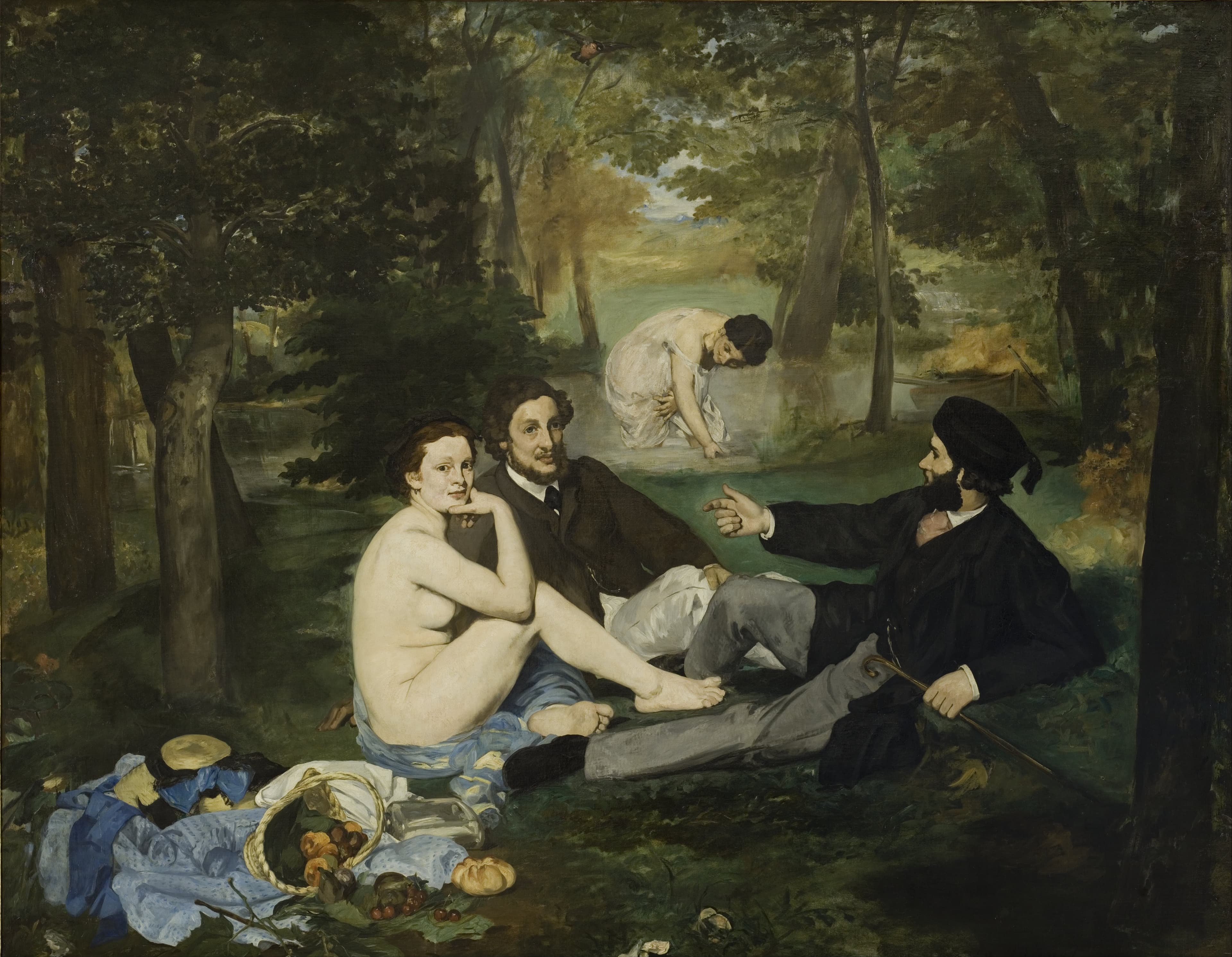
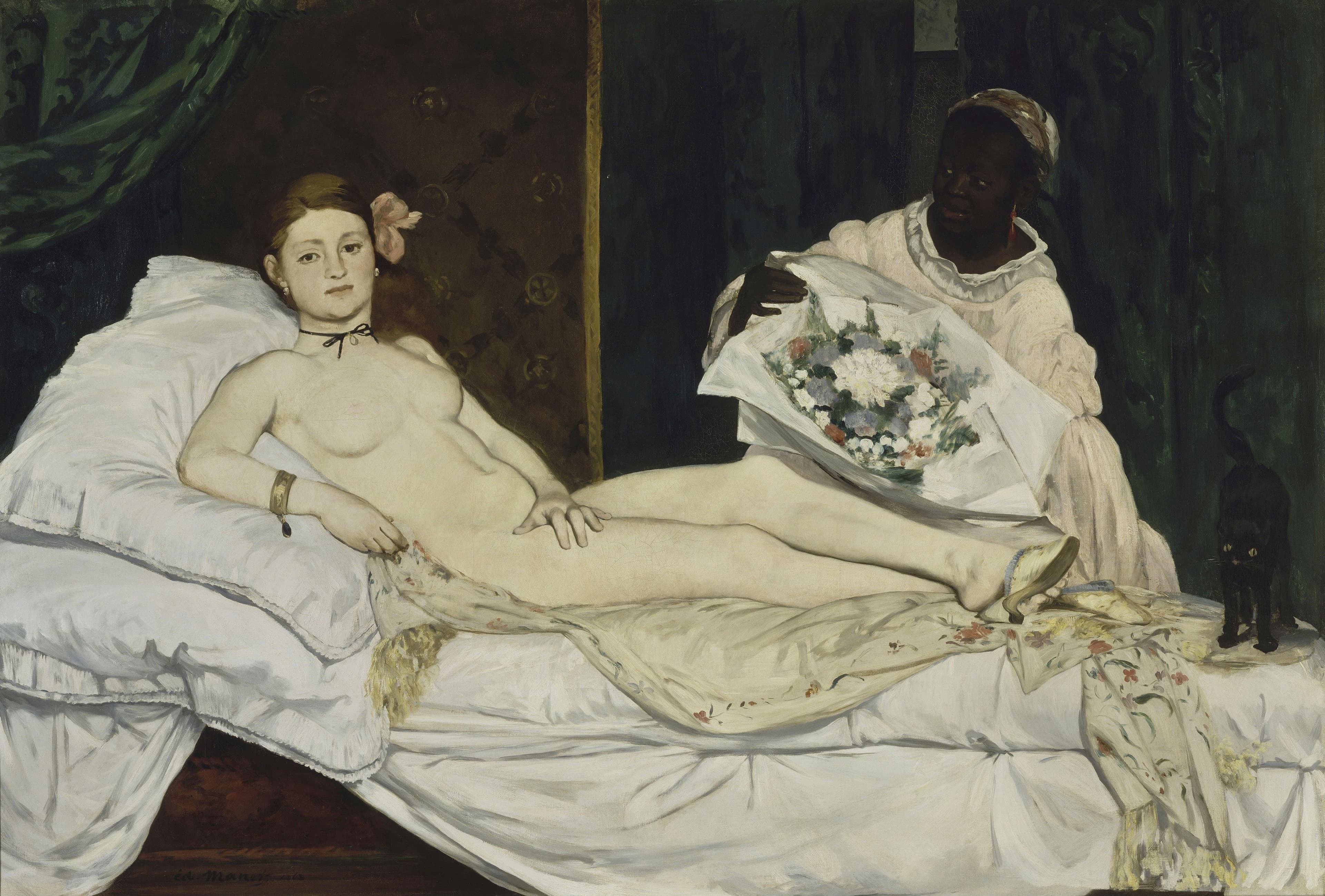


If you like Édouard Manet
Explore painters from the same movements and circles.
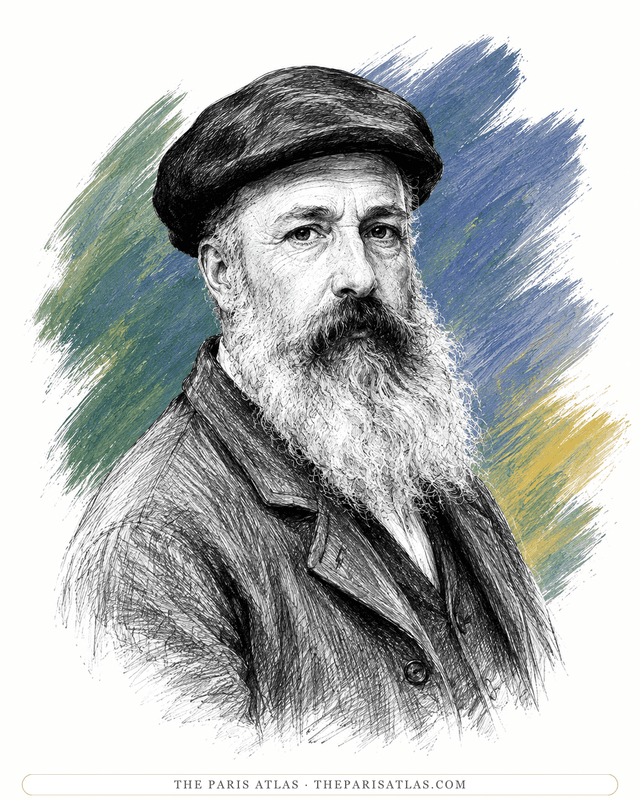
Claude Monet
Impressionist painter whose late Water Lilies cycle fills the Orangerie's two oval rooms — a gift to France offered the day after the 1918 Armistice and installed to his design.
View artist
Tarsila do Amaral
Brazilian painter who spent the 1920s moving between São Paulo and Paris, studied Cubism under André Lhote, Albert Gleizes and Fernand Léger, and used what she learned to paint Brazilian towns, railways, plants and bodies. Her 1928 painting Abaporu prompted the manifesto that gave the Anthropophagic movement its name.
View artist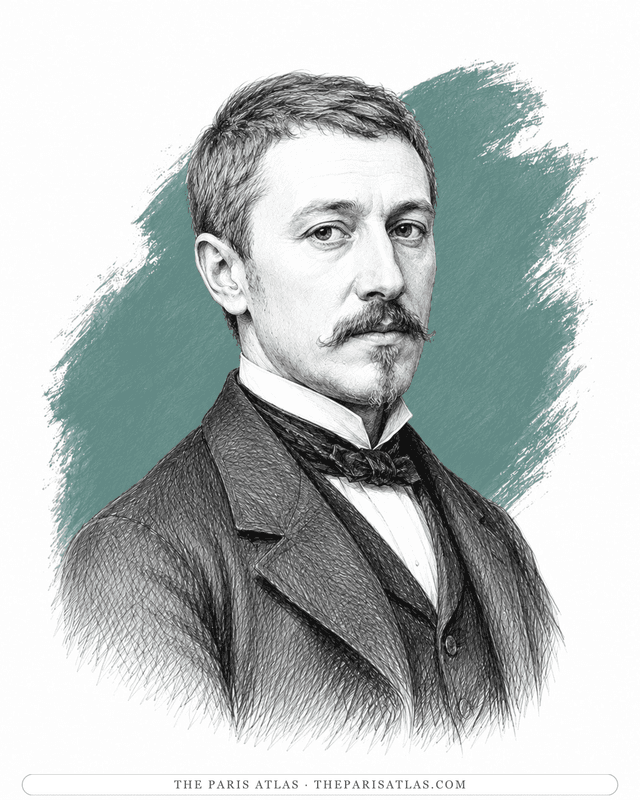
Gustave Caillebotte
Painter of Haussmann's geometry and the group's organizer-financier; his bequest of Impressionist paintings forced the French state to take the movement in.
View artist
References
The sources below include collection records, catalogues, scholarly research, and primary materials that informed this page. They document A Bar at the Folies-Bergère, its making, and its place in cultural history.


1A Bar at the Folies-Bergère: public-domain reproduction
WebsiteWikimedia CommonsUsed forThe reproduction is the primary visual source for the close-reading details; rights metadata is preserved separately.
2A Bar at the Folies-Bergère: mirror, model, and setting
WebsiteThe CourtauldUsed forWeb source consulted for documented facts and historical context presented on the A Bar at the Folies-Bergère page.
 View source
3A Bar at the Folies-Bergère: collection record
WebsiteThe CourtauldUsed forWeb source consulted for documented facts and historical context presented on the A Bar at the Folies-Bergère page.
4Édouard Manet (1832–1883) — The Metropolitan Museum of Art
WebsiteThe Metropolitan Museum of ArtUsed forManet's late career and Salon exhibitions.
These references provide the documented foundation for this work's history and interpretation. Claim-level citations remain attached to the specific claims they support.
 Explore more resources