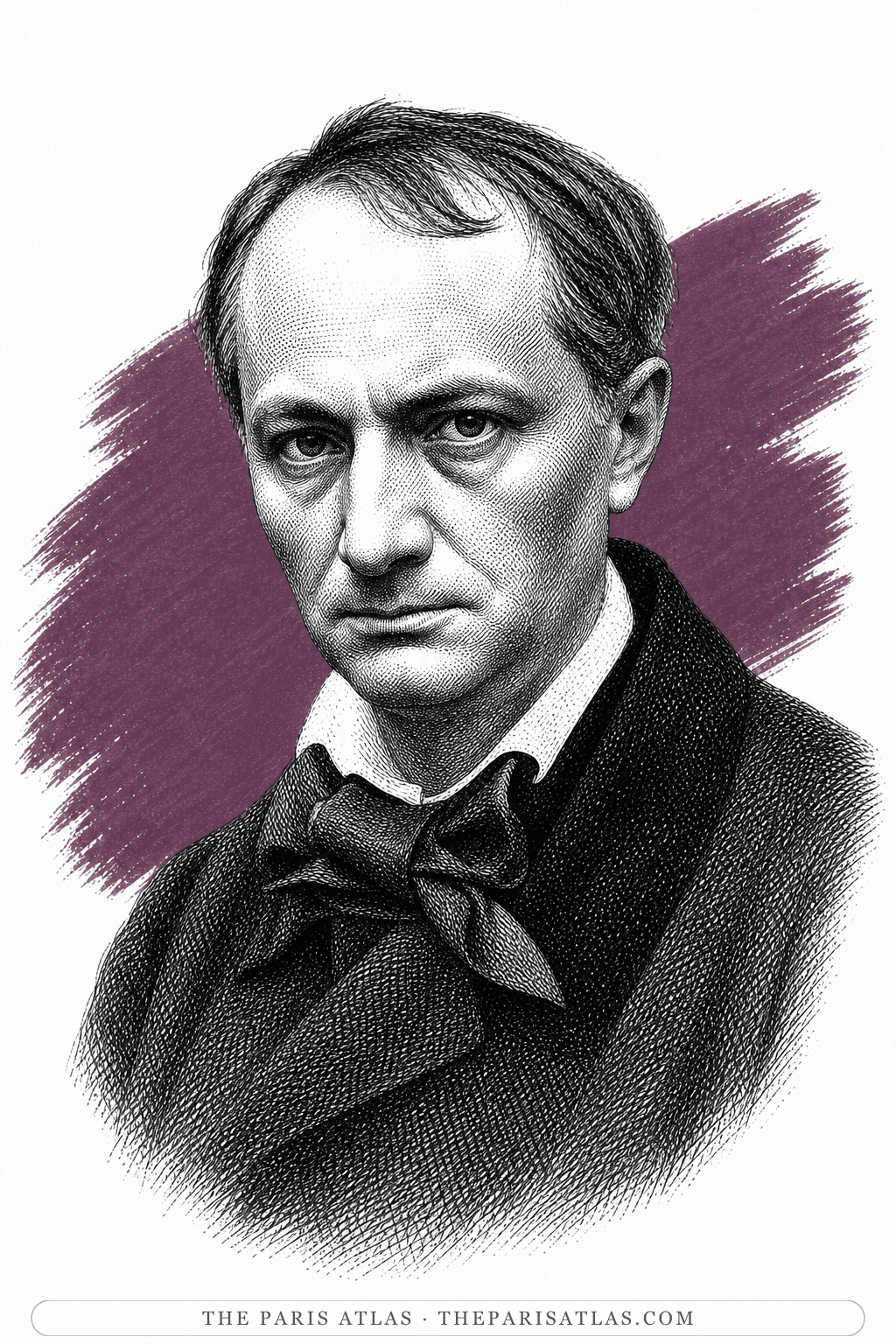
Depicts · 1862
Charles Baudelaire
The National Gallery places Charles Baudelaire in profile between Théophile Gautier and Henri Fantin-Latour, and calls him perhaps the greatest influence on Manet in the 1860s.

A crowd stands and sits under chestnut trees in the Tuileries Gardens, waiting for one of the twice-weekly concerts given there. Édouard Manet put his friends and his own family into the throng and left most of the other faces as thick dabs of paint. Émile Zola, who saw it on show in 1863, counted perhaps a hundred people in it. The painting was Manet's first large picture of contemporary Paris, and it never went to the Salon.
The Tuileries Gardens fill the canvas from edge to edge. Dark trunks rise through the crowd, and the foliage closes overhead except for one ragged opening of pale blue sky at the top centre. Below that canopy the people are packed into a band that runs the full width of the picture, thinning into a blur towards the back.
Two women in pale cream crinolines, wide skirts held out by hoops, sit together left of centre, both in blue bonnets tied with blue ribbon. One of the women wears a black veil spotted with dots, painted over her finished face. A dark green folded fan stands between the two women where their skirts merge into one unbroken area of cream.
In front, two small children play on the bare earth. One child stands in a white dress with a red sash and a red band in her hair. The other child crouches in a green tartan wrap and reaches for two small teal pails on the ground. Behind the children the garden's iron chairs are drawn in bare lines of ochre, with heart-shaped backs and scrolls at the centre of each back.
Despite the title, Édouard Manet left the musicians out, and the National Gallery notes it is not clear whether the concert has begun.[1]
The National Gallery dates the canvas 1862. Théodore Duret, who knew Manet and published a catalogue of his work, put it at 1861 and said Manet made open-air studies in the Tuileries that year to compose it.[2] Duret also explains why the crowd is there: the Emperor held court at the Tuileries palace, and music played twice a week in the garden drew a fashionable public.[2]
The National Gallery identifies much of the gathering by name. Manet himself stands at the far left holding a cane, his body cut by the edge of the canvas. The man in front, who partly hides him, is the animal painter Comte Albert de Balleroy, with whom Manet had shared a studio.[1]
The novelist Champfleury, a defender of Realism, stands behind and between Manet and Comte Albert de Balleroy. The bearded critic, poet and sculptor Zacharie Astruc is seated close by, with the journalist Aurélien Scholl above him. The composer Jacques Offenbach sits further right in glasses and a moustache, between the artist's brother Eugène Manet and the painter Charles Monginot.[1]
Near a tree above the seated women are the painter Henri Fantin-Latour, who looks straight out of the picture, and the editor Baron Taylor, a promoter of Spanish art. Théophile Gautier leans against a trunk in a brown suit and a full beard. Seen in profile between them is Charles Baudelaire. The painter Frédéric Bazille is in the crowd as well.[1]
The National Gallery identifies the two seated women as the wife of Jacques Offenbach and the hostess at whose salon Manet had met both Frédéric Bazille and Charles Baudelaire.[1]
Manet had recently copied in the Louvre a painting then thought to be by Diego Velázquez, The Little Cavaliers, which shows an imagined meeting of seventeenth-century Spanish artists. Two of the men in The Little Cavaliers, thought at the time to be Velázquez and Bartolomé Esteban Murillo, stand in much the position Manet gives himself and Comte Albert de Balleroy.[1]
The National Gallery also compares the picture with Las Meninas in Madrid, where Velázquez sets the viewer in the place of the king and queen he is painting. Manet uses the same device by putting the viewer where the musicians would stand.[1]
Standing at the fringe of the gathering rather than inside it, Manet is in the scene and slightly apart from it. The National Gallery reads that position as the one Charles Baudelaire described for the stroller (the flâneur) who belongs to the crowd and watches it from a distance.[1]
The painting was never submitted to the Salon. Manet showed it in March 1863 with thirteen other canvases at Louis Martinet's gallery on the boulevard des Italiens, his first solo exhibition.[1] Émile Zola, writing four years later, put the number of canvases at fourteen and said their appearance caused a riot, with whistling and jeering.[3]
Théodore Duret also counted fourteen canvases and named five of them, La Musique aux Tuileries among them. Duret reported that the show had no success at all, and that visitors found nothing in it but bariolage, a word for a gaudy clash of colours. Duret attributes the term to Paul Mantz, writing in the Gazette des beaux-arts.[2]
Duret points to one further consequence. By putting people out of temper, the Martinet exhibition helped bring about the Salon jury's refusal of Le Déjeuner sur l'herbe a few weeks later.[2]
Zola named two pictures as the ones that set the powder alight: Le Ballet espagnol and La Musique aux Tuileries. He then reported what one visitor did about it.[3]
“Un amateur exaspéré alla jusqu'à menacer de se porter à des voies de fait, si on laissait plus longtemps dans la salle de l'exposition la Musique aux Tuileries.”
An exasperated art lover, Zola wrote, went so far as to threaten violence if Music in the Tuileries were left in the exhibition room any longer. Zola said he understood the anger, and then explained it: a hundred people perhaps, moving in the sun, each one a simple patch, barely determined, in which the details turn into lines or black dots.[3]
Zola's answer to the angry visitor was a matter of distance. He would have asked the man to stand further back, from where the patches would have come alive and the crowd would have begun to talk.[3]
In May 1867 Manet put around fifty of his paintings, Music in the Tuileries Gardens among them, in a pavilion he paid for beside the Universal Exhibition.[1] Of the fourteen canvases shown at Martinet's in 1863, Zola counted eight on the walls again in 1867.[3]
The National Gallery describes the method as a mass of dabs and touches of colour, without half-tones or strong contrasts of light and shade (chiaroscuro). The figures are spread across the picture in a horizontal band, like a frieze, with no focal point. Only a few faces are brought into focus. The rest are flat, without shading, and towards the back simply a blur, with figures cropped at both side edges.[1]
Émile Zola built his whole account of Manet on the same observation. He named Manet, Camille Corot and Gustave Courbet as the only modern painters who consistently obeyed what he called the law of values, the relation of light to dark, in their figures. The law, as Zola stated it, means starting from a lighter note than nature and keeping the whole scale of tones in step.[3]
A head against a wall, Zola wrote, becomes no more than a patch that is more or less white on a ground that is more or less grey. The clothes beside the face become another patch of blue or brown set next to it. Zola's summary of the painter was four words: he sees blond, and he sees in masses.[3]
The black paint here makes shapes rather than shadows. The coats and top hats are painted as flat silhouettes, and the man standing right of centre is a single unbroken black shape above pale cream trousers.
The National Gallery's record of past owners (the provenance) has the baritone Jean-Baptiste Faure acquiring the painting around 1882, a year before Manet's death. Faure lent it to the memorial exhibition in Paris in 1884 and sold it to the dealer Paul Durand-Ruel in 1898.[1]
Durand-Ruel lent it to the Grafton Galleries in London in early 1905, to the Salon d'Automne in Paris that autumn, and to Belfast in 1906. Sir Hugh Lane bought it from him that same year, and it went on loan to the Municipal Gallery in Dublin between 1908 and 1913.[1]
Lane died in 1915 and the painting came to London under his bequest of 1917. The painting was transferred from the Tate Gallery to the National Gallery in 1950. The National Gallery holds it in partnership with the Hugh Lane Gallery in Dublin, and it spent 2019 to 2026 on long loan there.[1]
Close reading
Émile Zola defended the picture by telling an angry visitor to stand further back. Close up, the picture does the opposite of settling down. The faces come apart into thick dabs, the garden chairs turn out to be drawn in single unshaded lines of ochre, and the black coats stop describing cloth and become flat shapes. Working across the canvas in close view shows a crowd built out of patches, with only a handful of heads brought into focus.
1.The painter is sliced by his own left margin
Two bearded men in black top hats hold the far left. The outer man is cut down the middle by the canvas edge, so only half his coat and half his face survive. The National Gallery identifies him as Édouard Manet, and the man in front, shown in full, as the animal painter Comte Albert de Balleroy. Manet's reddish beard and white collar are painted in a handful of strokes.
2.Two pale gloves, two thin canes
Each of the two men at the left carries a cane, and each hand is gloved in buff. The gloves are painted with three or four strokes and no drawn fingers. The canes are thin lines of ochre laid straight over the dark coat and the trousers behind. The gloves and the canes are the only things in that corner lighter than the coats.
3.A blue bow tied under the chin
The nearer of the two seated women looks slightly to her left, her face turned out of the shade. Her bonnet is blue with a pale lining, and the ribbon is tied in a broad bow under her chin with two long ends down her chest. The face has almost no shading, only a flat pale oval with the features set into it in a few dark marks.
4.The veil was flicked on after the face was done
The second woman wears a black net veil over her face, and the dots of the net are separate black marks scattered across the already finished face. Her eyes, nose and mouth are painted underneath and show through the dots. A blue rosette sits at the side of her bonnet, with a blue ribbon tied at the throat. The veil is perhaps twenty dabs in all.
5.A green fan where two skirts become one
A folded fan stands upright between the two women, dark green with a bone-coloured outer stick catching the light. A grey-white gloved hand closes on the fan at the base. Manet gives no boundary between the two women's skirts here. The cream of the skirts runs on unbroken from one woman to the other, so the fan and the glove sit in a single area of pale paint.
6.A red sash and a face left unpainted
The standing child wears a white dress with short puffed sleeves, a red sash at the waist with one long end hanging down her side, and a red band in her brown hair. Her face is left as a pale oval with two dark dabs and a smudge of shadow. At this small scale she has no features at all, and the red of the sash is the strongest note in the lower half of the canvas.
7.Two teal pails on the bare earth
The second child crouches with her back to the viewer, blonde curls above a white dress. A dark green tartan wrap flecked with red covers her shoulders. Her bare arm reaches down to the ground, holding something small and pale. Two teal pails with pale rims stand on the earth beside her, one with a thin dark handle lying across the dirt.
8.The canopy opens once
One irregular patch of pale blue paint is the whole of the sky. Dark green and olive foliage closes around it on every side, feathering into the blue of the sky where the brush was dragged. No leaf is drawn anywhere in the canopy. The trees are flat patches of three or four greens, and the trunks are bands of near-black painted straight down through the crowd.
9.A coat with nothing inside it
The man standing right of centre is seen in profile, in a black top hat above a brown beard. His frock coat is one unbroken black shape. The coat has no folds, no buttons and no highlight anywhere, so the arm and the back exist only as an outline against what is behind them. Below the coat the cream trousers are almost as plain.
10.Where the heads stop being heads
Behind the front row of figures the drawing stops. Black top hats become plain rectangles with one lighter stroke for the brim, and faces become dabs of pink and cream with a single dark mark for an eye socket. A bearded man in a pale grey round hat with a wide brim is one of the last heads given features. A bright red dab sits beside him, and a yellow straw bonnet below. The heads in this middle distance are what Émile Zola described as figures reduced to patches, in which the details turn into lines and black dots.
11.The garden chairs are pure line
The public chairs of the garden are drawn in line rather than shaded into solid form. Each back is a heart shape closed by two scrolls that curl inward to meet at the middle, with a second pair of scrolls at the foot. The whole frame is one continuous ochre line of a single unvarying tone. The dark paint behind stands for the gaps between the bars, so the metal gets no shadow of its own.
12.A parasol made of two flat tones
A closed parasol lies on the ground at the right. Manet gives the parasol two tones and nothing else: a grey-brown side and a pale grey-white side, split by a straight edge. A thin dark rib runs down the join and the stick continues onto the earth. Beside the parasol a black shoe with a pale sole shows under cream trousers.
13.The colour is loudest where the canvas cuts people off
The right margin carries the strongest colour in the picture. Blue bonnets, a bright red bonnet trim, a red shawl, orange-gold trim and a pale pink parasol are packed together within a few inches. Faces here are cut in half by the canvas edge, and so is the parasol. No object or figure leads the eye back into the picture. The crowd simply stops at the edge.
14.The signature sits on the gravel
The signature reads éd. Manet in dark cursive, low in the right corner. The name is written directly on the olive-brown of the garden path, under the thin ochre legs of a garden chair. The canvas weave shows through the paint of the path here. Manet put his name at the opposite corner from the figure of himself cut in half at the left edge.
15.A ball left in the bottom corner
A small ball lies on the earth at the extreme lower right, tucked behind a chair leg. The ball is painted in three vertical bands: dark green at the left, cream-white in the middle, red at the right. Six or seven strokes make the whole ball. The ball is the only object in the picture that belongs to the children in the foreground rather than to the adults.
1862
Painted, Manet's first large canvas of contemporary Parisian life.
1863
Shown in March at Louis Martinet's gallery on the boulevard des Italiens, with thirteen other canvases, in Manet's first solo exhibition.
1867
Hangs in the pavilion Manet built at his own expense beside the Universal Exhibition, among some fifty of his paintings.
1882
Likely bought by the baritone Jean-Baptiste Faure, a year before Manet's death.
1898
Sold by Faure to the dealer Paul Durand-Ruel.
1906
Bought from Durand-Ruel by Sir Hugh Lane, who lends it to the Municipal Gallery in Dublin from 1908.
1917
Comes to London under the Lane Bequest; transferred from the Tate Gallery in 1950 as NG3260.
The National Gallery, London
Trafalgar Square, London WC2N 5DN, United Kingdom
The National Gallery lists the painting in Room 41. The painting is shared with the Hugh Lane Gallery in Dublin under the Lane Bequest and was on long loan there from 2019 to 2026, so confirm where it is before travelling.
Plan your visit on the museum’s official website (opens in a new tab)The National Gallery in London, inventory number NG3260, which lists it in Room 41. The picture is held in partnership with the Hugh Lane Gallery in Dublin under Sir Hugh Lane's bequest and travels there on long loan, so check before a visit.
No. Manet showed it in March 1863 at Louis Martinet's gallery on the boulevard des Italiens, alongside thirteen other canvases, and again in 1867 in a pavilion he built beside the Universal Exhibition.
Manet's friends and family. The National Gallery names Manet himself at the far left, Comte Albert de Balleroy, Champfleury, Zacharie Astruc, Aurélien Scholl, Jacques Offenbach, Eugène Manet, Charles Monginot, Henri Fantin-Latour, Baron Taylor, Théophile Gautier, Charles Baudelaire and Frédéric Bazille.
Émile Zola reported that a visitor threatened violence unless it was taken off the wall. Zola put the anger down to the way it was painted: a crowd of perhaps a hundred people in which each figure is a simple patch, barely determined.
Manet left them out. The National Gallery notes that the band is not shown and that it is not clear whether the concert has started; the viewer stands roughly where the musicians would be.
The National Gallery dates it 1862. Théodore Duret, who knew Manet and published a catalogue of his work in 1902, dated it 1861 and said Manet worked it up from open-air studies made in the garden that year.
Théodore Duret reported that visitors to the 1863 exhibition found nothing in Manet's canvases but bariolage, a gaudy clash of colours, and credited the word to Paul Mantz in the Gazette des beaux-arts. Émile Zola wrote that one visitor threatened violence unless the painting was taken down.
76.2 by 118.1 centimetres, about two and a half feet high by just under four feet wide. Émile Zola, describing it in 1867, put the crowd inside that space at perhaps a hundred people.
Depicts · 1862
The National Gallery places Charles Baudelaire in profile between Théophile Gautier and Henri Fantin-Latour, and calls him perhaps the greatest influence on Manet in the 1860s.
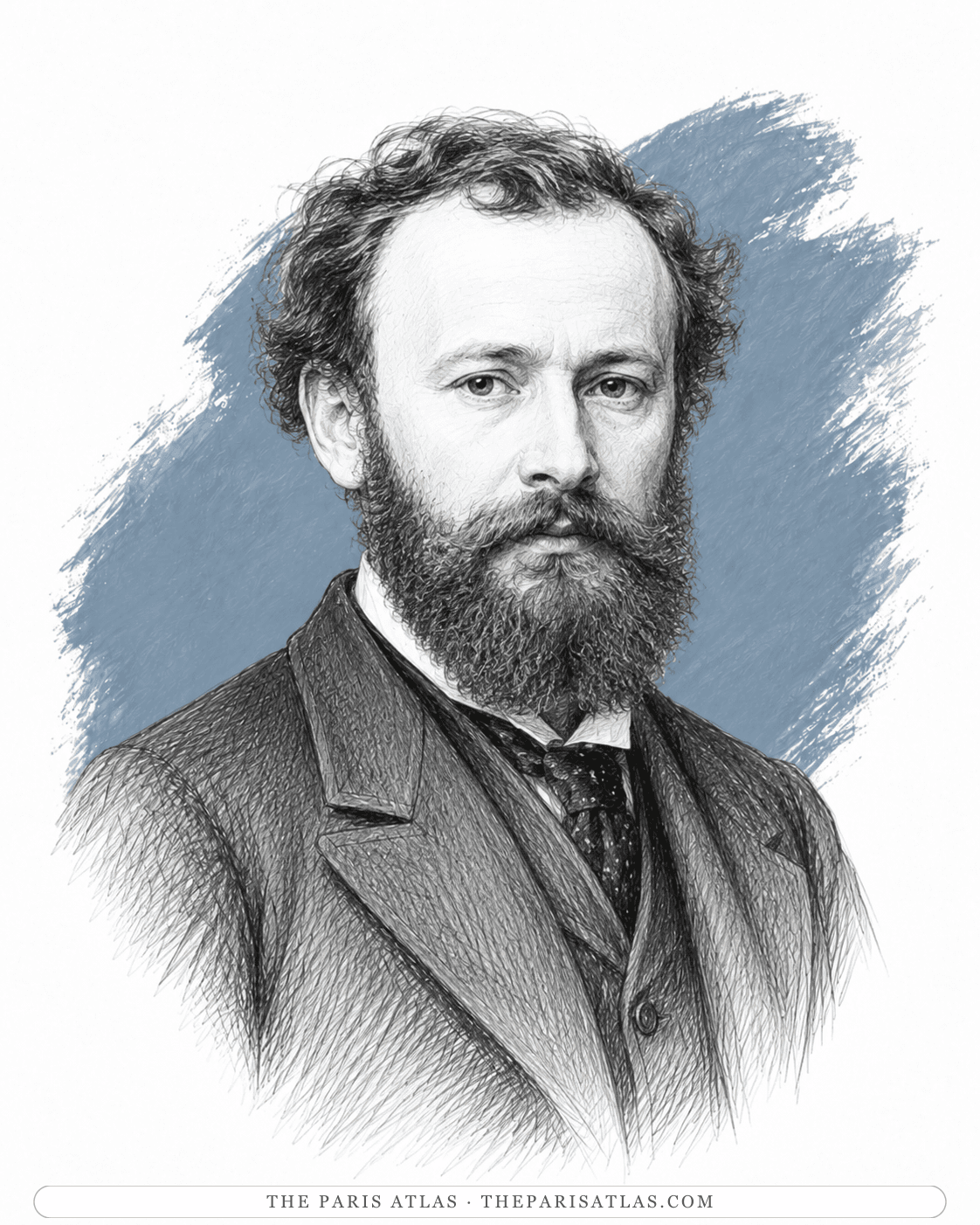
Depicts · 1862
The National Gallery identifies the painter himself at the far left of the canvas, holding a cane, his body cut by the edge of the picture and partly hidden by the animal painter Comte Albert de Balleroy.
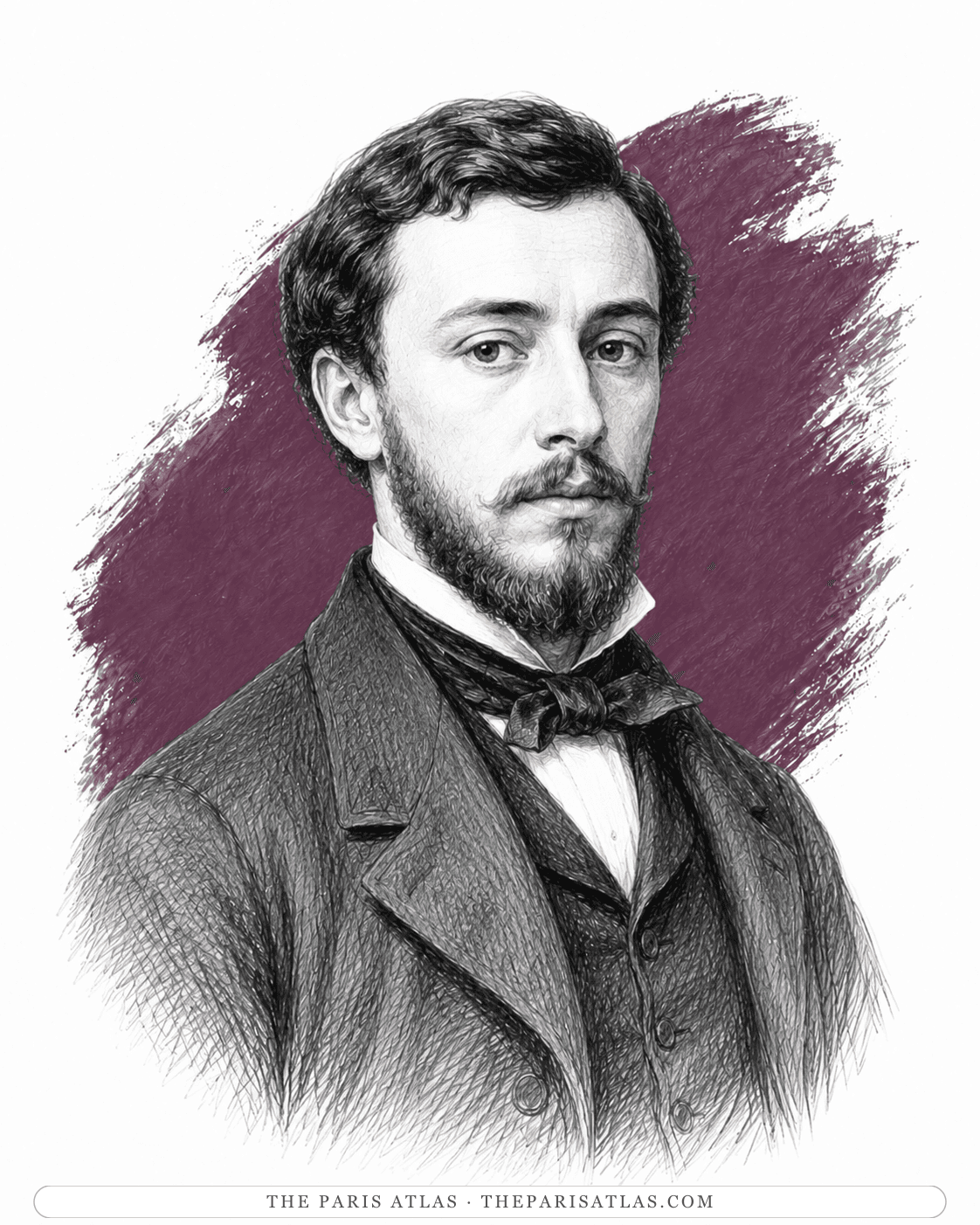
Depicts · 1862
The National Gallery names Frédéric Bazille among the figures in the crowd, alongside Charles Baudelaire; Manet had met both at the salon of the hostess seated in the foreground.
Explore painters from the same movements and circles.
Impressionist painter whose late Water Lilies cycle fills the Orangerie's two oval rooms — a gift to France offered the day after the 1918 Armistice and installed to his design.
View artist
Brazilian painter who spent the 1920s moving between São Paulo and Paris, studied Cubism under André Lhote, Albert Gleizes and Fernand Léger, and used what she learned to paint Brazilian towns, railways, plants and bodies. Her 1928 painting Abaporu prompted the manifesto that gave the Anthropophagic movement its name.
View artist
Painter of Haussmann's geometry and the group's organizer-financier; his bequest of Impressionist paintings forced the French state to take the movement in.
View artistThe sources below include collection records, catalogues, scholarly research, and primary materials that informed this page. They document Music in the Tuileries Gardens, its making, and its place in cultural history.

The reproduction is the primary visual source for the close-reading details; rights metadata is preserved separately.
These references provide the documented foundation for this work's history and interpretation. Claim-level citations remain attached to the specific claims they support.
 Explore more resources


.jpg) View source
View source