
Animal Farm
Both books show social control becoming ordinary through repeated language, though Huxley’s citizens are conditioned to enjoy the system rather than merely fear it.
Read our take
A society gives up freedom willingly because comfort, entertainment, and chemical happiness feel easier.
Huxley imagines social control maintained less by terror than by pleasure, distraction, conditioning, and the removal of serious discomfort.
In the World State, babies are manufactured in laboratories, conditioned for predetermined social castes, and taught from infancy to want exactly what keeps the system stable. Family, monogamy, solitude, religion, old books, and uncontrolled grief have been removed. Citizens consume constantly, take the drug soma whenever discomfort appears, and repeat slogans assuring them that everyone belongs to everyone else.
Bernard Marx is an Alpha psychologist who feels physically and socially out of place. During a trip with Lenina Crowne to a reservation where people still age, marry, bear children, and practice religion, he meets John, a young man raised outside the World State by a woman who originally came from it. John learned much of his language and moral imagination from Shakespeare. Bernard brings John and his mother Linda back to London, expecting their presence to improve his own status.
The experiment becomes a collision between two forms of unhappiness. The World State has nearly eliminated pain by eliminating freedom, deep attachment, and difficult art. John longs for moral purity and heroic feeling but is unable to live comfortably either inside the controlled society or outside it. Huxley’s novel asks whether happiness is still human when every disruptive desire has been designed away.
The novel opens at the Central London Hatchery and Conditioning Centre. The Director explains how embryos are created, divided through the Bokanovsky Process, chemically altered, and assigned to castes ranging from Alpha to Epsilon. Children are conditioned through electric shocks, sleep-teaching, and repeated slogans to accept their social position, consume new products, dislike nature unless it requires equipment, and avoid exclusive relationships.
Lenina Crowne discusses her romantic life with her friend Fanny and agrees to visit a Savage Reservation in New Mexico with Bernard Marx. Bernard is an Alpha but is shorter than expected and painfully conscious of rumors that alcohol entered his blood surrogate before birth. He dislikes casual public sexuality and wants private experience, although his dissatisfaction is mixed with resentment and a desire for approval. His friend Helmholtz Watson is socially successful but frustrated because official propaganda gives his literary talent nothing worth saying.
At the reservation, Bernard and Lenina encounter poverty, aging, pregnancy, religion, dirt, and physical suffering—everything their society hides. They meet Linda, a Beta woman who came from the World State years earlier and was stranded after becoming pregnant. Her son John is the biological child of the Director. John has grown up rejected by the reservation community, ashamed of his mother’s sexual behavior, and enthralled by the battered volume of Shakespeare from which he has learned to understand love, honor, jealousy, and death.
Bernard brings Linda and John to London just as the Director prepares to exile him. Linda publicly identifies the Director as John’s father, an obscenity in a society where parenthood is treated as disgusting. The humiliated Director resigns. John becomes a celebrity known as “the Savage,” and Bernard enjoys parties, invitations, and sexual attention because he controls access to him. Helmholtz, by contrast, forms a sincere friendship with John through their shared interest in language.
John is fascinated by Lenina but interprets desire through Shakespearean ideals. Lenina has been conditioned to treat sex as casual and becomes confused by his distance. When she finally offers herself directly, John responds with panic, insults, and violence because he cannot reconcile his idealized love with sexual appetite. Linda meanwhile retreats into a nearly continuous soma holiday, encouraged by doctors even though they admit the dosage will shorten her life.
Linda dies in a hospital while children are being conditioned not to fear death. John’s grief shocks the staff. He then sees workers receiving their daily soma ration and tries to throw the drug away, urging them to choose freedom. Bernard and Helmholtz arrive during the resulting disturbance. Helmholtz helps John, while Bernard hesitates. Police restore order through soothing voices, synthetic music, and clouds of soma vapor.
Mustapha Mond, the Resident World Controller for Western Europe, interviews John, Bernard, and Helmholtz. He reveals that he understands forbidden science, religion, history, and Shakespeare but chooses stability over them. Bernard is sent to Iceland and reacts with terror; Helmholtz welcomes exile to the Falkland Islands because hardship may give him something real to write. John demands the right to suffer, desire, age, and make moral choices. Mond allows him to leave but refuses to let him escape the society’s attention completely.
John moves into an abandoned lighthouse and tries to purify himself through hard labor, fasting, prayer, and self-punishment. He wants solitude, but a reporter films him whipping himself. The footage becomes entertainment, and crowds arrive to watch the “Savage” perform his suffering.
Lenina appears among the spectators. John’s desire and hatred collide, and he strikes at her with the whip while the crowd imitates him and turns the scene into a collective sexual frenzy. Soma, chanting, violence, and spectacle overwhelm the moral discipline he was trying to construct. Huxley does not describe the entire night clearly; the confusion is part of John’s loss of control.
The following morning, John remembers what happened and is consumed by shame. When visitors enter the lighthouse, they find that he has hanged himself. The novel ends with the movement of his body turning slowly in different directions, reducing the philosophical conflict to a final physical image.
John’s death does not disrupt the World State. Bernard and Helmholtz have been exiled, Linda is dead, and Mond remains in authority. The system absorbs John first as a novelty and then as entertainment. His tragedy exposes its emptiness without producing an organized alternative.
The World State has removed war, severe poverty, unwanted pregnancy, and much ordinary anxiety. Huxley makes that achievement real enough to complicate the criticism. The cost is that citizens cannot choose difficult loyalties, pursue dangerous truth, or experience unhappiness as part of a life they direct themselves.
The state does not rely mainly on punishment. It trains people to desire consumption, caste identity, casual sex, and soma. Citizens often police themselves because social control arrives as preference. Huxley’s most lasting warning is that domination can feel pleasant when power shapes the appetite before the person recognizes it as an appetite.
People are taught that repairing possessions, enjoying unprofitable nature, or spending time alone threatens society. Continuous consumption keeps production moving and discourages reflection. The economic slogan replaces older moral systems: buying is not merely permitted but treated as a responsibility.
Shakespeare gives John language for experiences the World State cannot tolerate: tragic love, jealousy, sacrifice, beauty, and death. Mond understands great art but bans it because genuine tragedy requires unstable conditions and powerful attachments. The novel asks whether art can remain great when society permits only safe feeling.
The World State is sexually permissive but emotionally restrictive. Exclusive love is dangerous because it creates a loyalty stronger than generalized social belonging. John’s opposite mistake is to divide Lenina into an ideal woman or a corrupt sexual body. Neither system gives the pair a healthy language for desire and mutual recognition.
Scientific research is celebrated only when it preserves stability. Mond suppresses discoveries that may disrupt social order and admits that he chose administrative power over free inquiry. Huxley distinguishes scientific technique, which the state uses constantly, from open science, which could challenge its assumptions.
Bernard, Helmholtz, John, and Linda are outsiders for different reasons. Bernard wants approval more than he admits; Helmholtz wants meaningful work; Linda wants the comforts of the World State; John wants a moral community that has never truly accepted him. Their differences prevent “outsider” from becoming a single heroic identity.
Huxley writes with cool satire, rapid shifts in viewpoint, and an ear for slogans that sound ridiculous until their logic becomes familiar. The early hatchery tour gives scientific and economic horror the tone of an efficient educational demonstration. Huxley often lets officials explain the system in cheerful language rather than interrupting to announce that it is evil.
Several chapters use a cinematic, contrapuntal structure, cutting among conversations, memories, rituals, and repeated phrases so that one scene comments on another. Shakespeare’s rich, emotionally extreme language stands against the World State’s simplified slogans. John’s quotations can sound magnificent, inappropriate, or both, because he is trying to force an old tragic vocabulary onto circumstances no one else understands.
The prose is more talkative and intellectual than Orwell’s. Characters frequently debate ideas directly. Yet Huxley also knows when to finish an argument with an image: identical bottles moving down a line, Linda drugged in bed, children eating sweets around the dying, or John’s feet turning at the end.
Modern English editions may include Huxley’s 1946 foreword, which is historically useful but was written fourteen years after the novel and should not be mistaken for part of the original fiction. Some classroom editions add notes explaining Fordism, Pavlovian conditioning, Shakespearean quotations, eugenics, and interwar debates about mass production.
Translations must solve two recurring problems: the caste vocabulary and the repeated conditioning slogans. The English title comes from Shakespeare’s The Tempest. Other languages sometimes use titles that emphasize an ideal world or the best possible world rather than translating the phrase literally. Readers of non-English editions should check the translator because the slogans do not carry identical rhythms across languages.
The 1956 CBS Radio Workshop adaptation is especially notable because Huxley introduces and narrates it. It compresses the novel into two broadcasts and offers a useful record of how the author presented the story, but its dialogue and framing are adapted for radio.
Television films released in 1980 and 1998 alter character emphasis and simplify the ending in different ways. They should be described separately rather than treated as one adaptation tradition.
The 2015 stage version, adapted by Dawn King, reworks the story for performance and adds theatrical solutions to the World State’s conditioning system.
The 2020 Peacock series uses Huxley’s world and several character names but expands and changes the plot substantially. It is not a visual transcription of the novel and should never be used to supply a character fate missing from Huxley’s ending.
A useful counterpoint to Orwell's systems of force and fear.
Pleasure and distraction complicate the familiar picture of a dictatorship sustained only by punishment.
The novel asks what people lose when discomfort and difficult choices are removed from life.

John is Linda and the Director’s biological son, raised on the reservation and educated emotionally through Shakespeare.

Bernard is an Alpha-Plus psychologist who feels physically inferior and socially excluded.

Lenina is a Beta worker at the Hatchery who follows most social expectations and uses soma when emotions become difficult.

Helmholtz is a physically impressive Alpha lecturer and propaganda writer whose talent has outgrown the trivial work permitted by the state.

Mond is the Resident World Controller for Western Europe.

Linda is a Beta woman who was stranded on the reservation while pregnant with John.

The Director is a senior administrator who teaches the horror of family while concealing that he once lost a pregnant companion on the reservation.

Henry is an Alpha administrator and one of Lenina’s regular sexual partners.

Fanny is Lenina’s friend and workplace confidante.

Popé is a man from the reservation who becomes Linda’s lover and brings her mescal.

Mitsima is an older man on the reservation who teaches John practical skills such as pottery and craftwork.

Darwin Bonaparte is the filmmaker who records John whipping himself at the lighthouse.
1931
Huxley writes the novel, much of it while living in Sanary-sur-Mer in southern France.
February 1932
Chatto & Windus publishes the first British edition.
1932
Harper & Brothers publishes the first United States edition.
1946
Huxley writes a new foreword reflecting on the book after World War II.
1956
CBS Radio Workshop broadcasts a two-part adaptation introduced and narrated by Huxley.
1958
Huxley publishes Brave New World Revisited, a nonfiction reassessment of the novel’s concerns.
1980
A television film adaptation is broadcast.
1998
A second television film adaptation appears.
2015
Dawn King’s stage adaptation begins a United Kingdom tour.
2020
Peacock releases a television series loosely based on the novel; it is canceled after one season.
Both books show social control becoming ordinary through repeated language, though Huxley’s citizens are conditioned to enjoy the system rather than merely fear it.
Read our take
Orwell imagines scarcity, surveillance, and torture; Huxley emphasizes pleasure, conditioning, and consumption.
Read our take
Zamyatin’s mathematically ordered state, numbered citizens, scheduled sex, and rebellious outsider provide an important earlier model.
Read our take
Bradbury likewise asks what happens when mass entertainment and social preference help censorship succeed.
Read our take
Le Guin builds a more balanced comparison between competing societies and asks whether any social ideal can avoid hardening into custom.
Read our takeThe phrase comes from Miranda in Shakespeare’s The Tempest. John repeats it with hope when he imagines London, then with bitter irony after seeing what the World State actually is. The title captures both wonder and the danger of admiring a society before understanding it.
He is the central viewpoint early in the novel, but John becomes the emotional and philosophical center after arriving in London. The shift is deliberate: Bernard appears rebellious until the story introduces someone whose rejection of the system costs much more.
Soma is the state-provided drug used to remove anxiety, grief, anger, and social discomfort without an obvious hangover. It helps keep citizens content and prevents painful feelings from developing into reflection or resistance.
The World State manufactures children and treats family attachment as unstable, exclusive, and socially dangerous. Words connected with biological parenthood produce embarrassment because citizens have been conditioned to associate them with primitive bodily life.
Shakespeare is the most important book available to him while growing up. Its language gives him ways to imagine love, honor, betrayal, beauty, and death. It also limits him because he sometimes forces dramatic ideals onto people who do not share that moral framework.
She is strongly attracted to him and makes unusual efforts to sustain his interest. Whether that feeling is “love” in John’s sense is uncertain because her society has discouraged exclusive emotional attachment. The tragedy is not that she feels nothing, but that the two lack a shared language for what they feel.
He explains that islands are useful places for intelligent and dissatisfied people who cannot fit comfortably into the World State. Exile removes them from the stable population without wasting their abilities. It is also evidence that the regime can be flexible when its control is not threatened.
He is trying to punish and purify himself for desire, anger, and the comfort he associates with the World State. The act draws on his religious experiences at the reservation and his own harsh ideals. Once filmed, it becomes exactly the entertainment he hoped to escape.
Both are exiled. Bernard is sent to Iceland after begging not to go; Helmholtz chooses the Falkland Islands because he wants a difficult environment in which serious writing may be possible. The novel does not show their later lives.
Huxley makes it disturbing partly by giving it genuine achievements: material abundance, stability, and the reduction of many forms of suffering. The novel’s argument concerns what has been sacrificed to secure those benefits and who has the right to make that trade for everyone.
Explore authors with a similar voice, perspective, and influence.
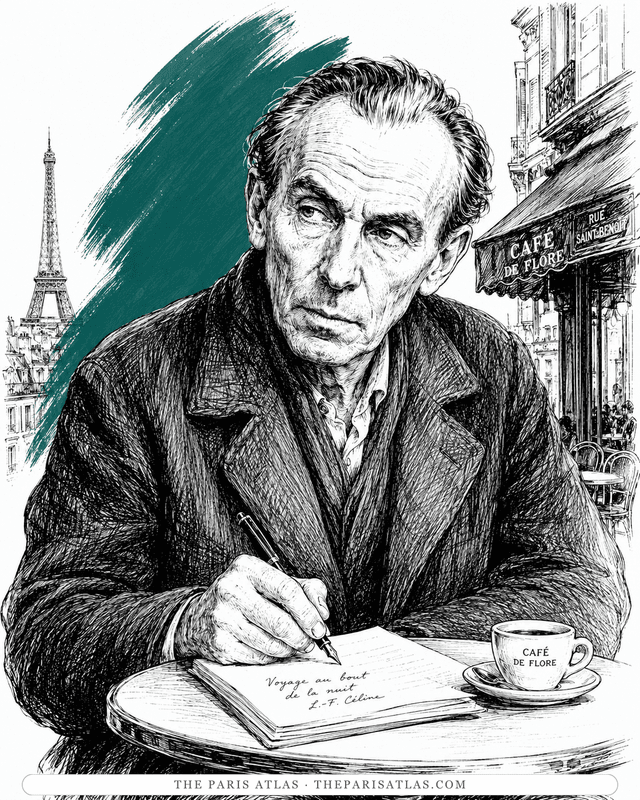
The doctor of the Paris slums who wrote the century's blackest, funniest novel — and changed the sound of French prose.
View author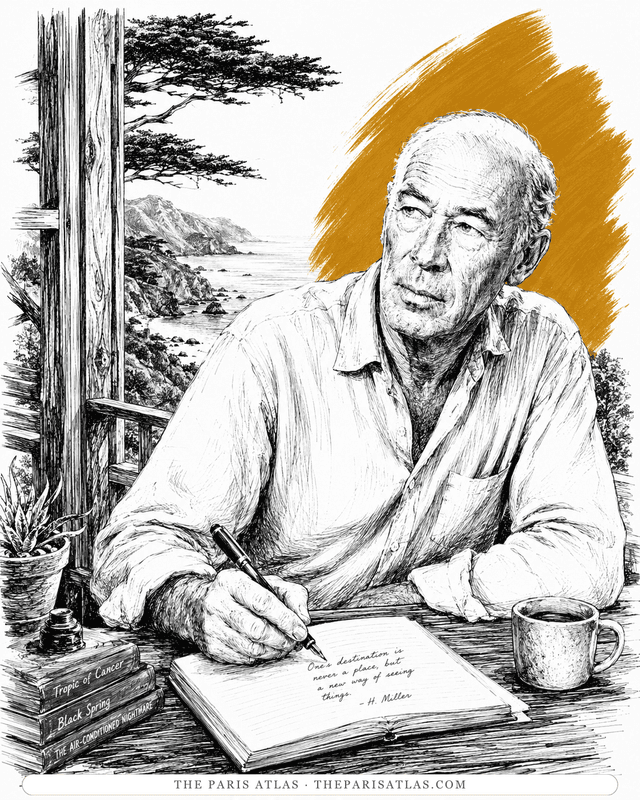
The Brooklyn dropout who arrived in Paris broke at thirty-eight and wrote the exuberant, banned books that ended American censorship.
View author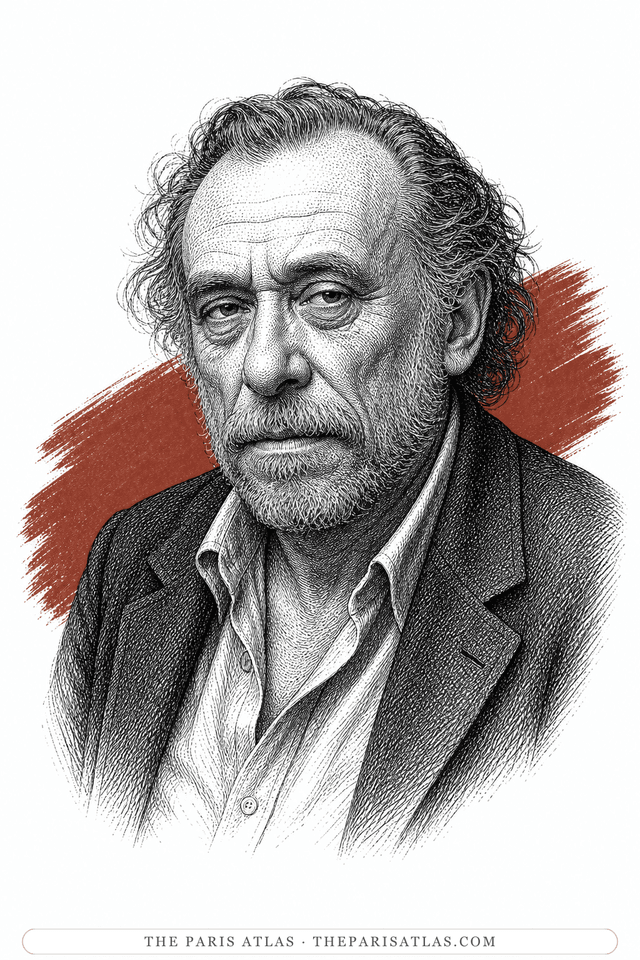
American poet and novelist of Los Angeles rooming houses, racetracks and the post office, who quit his job to write when a publisher offered him a hundred dollars a month. He came to Paris once, in September 1978, drank his way through a live television book programme and walked off the set — and French television has been replaying it ever since.
View authorThe sources below include the primary text, editions, scholarship, archival materials, and other records that informed this page. They document Brave New World, its publication, and its place in literary history.

Open Library ISBN catalogue used to verify the title, ISBN, and publication metadata.
Google Books catalogue record used to cross-check the title and edition metadata.
Internet Archive ISBN catalogue used to cross-check the edition and its availability in library holdings.
Library of Congress books catalogue used to cross-check the bibliographic record by ISBN.

HarperCollins publishing-history feature; verifies the novel’s place in Huxley’s career and 1932 publication.
Publisher author page; verifies author bibliography and context.
Penguin edition page; verifies modern edition details.
Theatre source for the 2015 Dawn King adaptation.
Secondary chapter and character cross-check; useful for plot sequence and quotations’ context.
Publication and adaptation cross-check; should be used alongside publisher and production sources rather than alone.
The primary text is the baseline reference for every book page. Additional references document publication history, interpretation, and historical context where that evidence is available.
 Explore more resources