

Animal Farm
Both works show new regimes changing language and social roles until domination appears natural.
Read our take
One woman remembers freedom while authoritarian rules become ordinary through repetition, fear, and religious language.
Offred remembers life before Gilead, making every surrendered right and altered word visible. The novel traces how the unthinkable becomes routine one step at a time.
The woman called Offred lives in the Republic of Gilead, a theocratic state that replaced the United States after a coup. Because declining fertility has made pregnancy politically valuable, Gilead assigns fertile women as Handmaids to powerful households. Offred’s name marks possession: she belongs to a Commander whose first name may be Fred. Her real name is withheld.
Each month, Offred is required to participate in the Ceremony, in which the Commander attempts to impregnate her while his Wife, Serena Joy, holds her. Outside that ritual, Offred shops with another Handmaid, remembers the husband and daughter taken from her, and reconstructs the stages by which women lost money, work, legal identity, and control over their bodies.
Her account is not a clean diary written safely after escape. It is a story assembled from memory, secrecy, wordplay, and uncertainty. Atwood follows what authoritarian rule does inside a household and inside one person’s language. The final academic section reveals that Offred’s voice survived, but refuses to give readers the simple reassurance of knowing whether she did.
Offred sleeps in a room whose window will not open fully and whose chandelier has been removed after the previous Handmaid used it to die by suicide. She lives with the Commander, Serena Joy, the household Marthas Rita and Cora, and Nick, the chauffeur. During shopping trips, she walks with Ofglen. The women speak in approved phrases while watching bodies displayed on the Wall as warnings.
Memories interrupt the present. Before Gilead, Offred lived with Luke and their daughter, worked at a library, and had a complicated relationship with her feminist mother. After staged attacks killed political leaders, the new regime suspended the Constitution. Women’s bank accounts were transferred to male relatives, and women were dismissed from jobs. Offred, Luke, and their daughter tried to escape across the Canadian border. They were caught; Luke’s fate became unknown, and their daughter was taken.
At the Red Center, Aunts trained captured women to accept the Handmaid system. Aunt Lydia taught them that the old world had given women dangerous freedom and that Gilead offered protection. Offred became friends with Moira, who repeatedly resisted and once escaped by stealing an Aunt’s clothing. Janine was pressured into blaming herself for a gang rape and became an example of how humiliation could be turned into obedience.
In the present, Offred undergoes the monthly Ceremony. The household then waits to see whether she is pregnant. The Commander secretly summons her to his office, where he asks her to play Scrabble, lets her read forbidden magazines, and seeks emotional intimacy outside the ritual he helps enforce. Offred gains small privileges and information but remains unable to refuse him safely.
Ofglen reveals that she belongs to a resistance network called Mayday. She helps Offred understand that some Eyes, servants, and officials may be working against Gilead. Meanwhile, Serena Joy proposes that the Commander may be infertile and arranges for Offred to sleep with Nick. The plan is illegal but common enough to expose the hypocrisy beneath Gilead’s public rules.
The Commander takes Offred to Jezebel’s, a secret club where powerful men keep women in sexual service while pretending Gilead has eliminated such behavior. Offred finds Moira there. Moira had escaped the Red Center but was captured and offered the choice between Jezebel’s and the Colonies. Her earlier defiance has been worn down, though Offred’s memory may not contain the whole story of what happened to her.
Offred begins a repeated sexual relationship with Nick that goes beyond Serena’s single arrangement. She feels desire and tenderness, and the relationship makes her less focused on escape. At a public Salvaging, Handmaids witness executions and are then encouraged to kill a man presented as a rapist. Ofglen tells Offred that he was actually a resistance member and attacks him first to end his suffering quickly.
The next shopping day, a different Ofglen appears. She quietly tells Offred that the former Ofglen killed herself when the Eyes came for her. Serena then confronts Offred with evidence from the visit to Jezebel’s. Before the household can determine what to do, a black van arrives. Nick tells Offred that the men are Mayday and that she should go with them, but she cannot know whether he is saving her or delivering her to the state.
Offred steps into the van. She describes the movement as entering darkness or light because she does not know whether she is being arrested or rescued. The main narrative ends without confirming her destination, Luke’s fate, Nick’s true allegiance, or whether she ever sees her daughter again.
The book then jumps more than two centuries ahead to an academic conference on Gileadean studies. Scholars have transcribed Offred’s account from cassette tapes found in a footlocker. Professor Pieixoto explains efforts to identify the Commander and Nick, but the historical record remains incomplete.
The academics speculate that the Commander may have been Fred Waterford or B. Frederick Judd. Neither identification is certain. They focus on elite male figures because those records survived, while Offred’s actual name and fate remain inaccessible. Their jokes and detached language show that sexism can persist even in a society studying Gilead as a vanished regime.
The existence of the conference proves that Gilead did not last forever and that Offred’s voice survived in some form. It does not prove that she personally escaped. The ending preserves both political hope and individual uncertainty.
Gilead treats fertility as a national resource rather than a person’s capacity. The Ceremony, birth rituals, naming system, and household hierarchy separate pregnancy from consent. Atwood shows how a government can call coercion sacred when it needs moral language to disguise ownership.
Offred remembers freedom disappearing through a sequence of administrative acts: frozen accounts, lost jobs, altered laws, checkpoints. The coup succeeds partly because each change arrives as something temporary or already decided. Her memories challenge the comforting belief that people will always recognize the final boundary in time to resist it.
“Ceremony,” “Salvaging,” “Particicution,” and “Unwomen” turn force into ritual or category. Offred survives partly by noticing puns, forbidden signs, scraps of Latin, and double meanings. Private language becomes a place where the official definition is not the only one.
Gilead is ruled by men, but Aunts and Wives receive limited authority over other women. Serena Joy is constrained by the system she once helped promote, yet she uses her position against Offred. Atwood avoids a simple division between male oppressors and female victims without obscuring who controls the state.
Offred tells scenes more than once, revises details, and admits when she is reconstructing. That does not make her account worthless. It shows how trauma, secrecy, and oral storytelling work. The desire for a perfectly documented victim can become another way of refusing testimony.
Offred’s relationship with Nick may be love, strategy, escape, or all three. It gives her pleasure and a temporary sense of choice, but it also reduces her urgency to resist. The novel treats private happiness under oppression as real without pretending it is politically simple.
The Historical Notes shift attention from Offred’s body to the archive. Scholars can debate Commanders more easily than they can recover the woman whose voice created the text. The joke is uncomfortable: even after Gilead, institutions may still consider powerful men more historically important than the people they controlled.
Atwood writes in a close first-person voice built from observation, memory, wordplay, and self-correction. Offred notices colors, household objects, flowers, smells, clothing, and the small physical arrangements of power. Her language can be lyrical, bitterly funny, or blunt within a few lines because private thought is the one place where Gilead has not achieved complete uniformity.
The structure is nonlinear. Present routines trigger memories of Luke, Moira, the Red Center, and the coup. Offred sometimes offers more than one version of a scene, reminding readers that the account has been composed rather than recorded in real time. The Historical Notes then replace her intimate voice with academic performance, creating a deliberate shock in tone.
The first Canadian edition was published by McClelland & Stewart in 1985. United States and United Kingdom editions followed, and modern editions differ mainly in introductions, notes, cover framing, and whether they are marketed through the television series.
Atwood’s 2017 special-edition audiobook adds multiple voices and Historical Notes material, while Renée Nault’s 2019 graphic novel is an adaptation, not an illustrated edition of every sentence. The 2022 “unburnable” copy was an art and advocacy object rather than a standard text for reading.
Translations must address Gilead’s biblical vocabulary, the possessive Handmaid names, puns such as “Mayday,” and the false-Latin phrase in Offred’s room. Translator names should be visible because wordplay is central to the novel.
The 1990 film, directed by Volker Schlöndorff from a screenplay by Harold Pinter, stars Natasha Richardson, Faye Dunaway, and Robert Duvall. It makes Offred’s story more externally decisive and should not be used to explain the book’s ambiguous ending.
Poul Ruders’s opera, first staged in 2000, uses music and doubled identities to translate Offred’s memory structure into performance.
The Hulu television series, launched in 2017, stars Elisabeth Moss and continues far beyond the events of the novel. It names the protagonist June and gives definite futures to many characters. Those are television choices. In the novel, the narrator’s original name is not confirmed and her fate remains open.
Renée Nault’s 2019 graphic novel preserves the novel’s basic story while using color and visual repetition to represent Gilead. It remains a distinct adaptation with its own pacing and omissions.
Atwood expands Animal Farm's sequence of small accepted abuses into an entire social order.
Offred’s recollections let readers compare Gilead’s rules with the life that preceded them.
Altered words and everyday routines make the regime’s control visible at an intimate scale.

Offred is the narrator and a Handmaid assigned to the Commander’s household.

The Commander is a senior Gilead official who performs the Ceremony with Offred.

Serena Joy is the Commander’s Wife and a former public advocate for traditional female roles.

Nick is the Commander’s chauffeur and household servant.

Ofglen is Offred’s original shopping partner and a member of Mayday.

Moira is Offred’s friend from before Gilead and the Red Center.

Luke is Offred’s husband from before Gilead and the father of her daughter.

Offred’s daughter is taken after the failed escape and placed with another family.

Aunt Lydia trains Handmaids at the Red Center.

Janine is a Handmaid trained with Offred and Moira.

Rita is a Martha in the Commander’s household.

Cora is the other Martha in the household.

Offred’s mother was a feminist activist who campaigned for reproductive rights before Gilead.

Pieixoto is the keynote scholar in the Historical Notes.
1984–1985
Atwood writes much of the novel while living in West Berlin and during later travels.
17 April 1985
McClelland & Stewart publishes the first Canadian edition.
1986
A United States edition appears; the novel is shortlisted for the Booker Prize.
1987
It wins the first Arthur C. Clarke Award.
1990
Volker Schlöndorff’s film adaptation is released.
2000
Poul Ruders’s opera premieres.
2017
Hulu launches the television adaptation.
2019
Renée Nault’s graphic-novel adaptation and Atwood’s sequel The Testaments are published.
2022
Penguin Random House produces an “unburnable” display edition for a censorship campaign.
2025
Hulu’s series concludes after six seasons; its expanded story should remain separate from the novel’s canon.
Both works show new regimes changing language and social roles until domination appears natural.
Read our take
Offred’s private record and uncertain archive parallel Winston’s struggle to preserve truth under surveillance.
Read our take
Abdel Aziz likewise shows authoritarian power working through paperwork, official denial, and the long exhaustion of ordinary people.
Read our take
Huxley manages reproduction through laboratories and pleasure; Gilead uses households, scripture, and terror.
Read our take
Both novels use intimate first-person testimony to reveal a society claiming authority over sex and the body.
Read our take
Le Guin offers a contrasting political novel concerned with freedom, custom, gender, and how ideals become institutions.
Read our takeThe novel never confirms it. “June” can be inferred from a list of women’s names at the Red Center, but Atwood leaves the inference unverified. The television series adopts June as fact; the book does not.
It means “of Fred,” marking the Handmaid as belonging to a Commander whose first name may be Fred. The system removes her prior name and replaces identity with temporary household ownership.
No. Gilead controls significant territory but is fighting wars, and resistance exists inside and outside its borders. The novel’s geography is deliberately incomplete because Offred has limited access to news.
It is a monthly state-sanctioned sexual ritual based on Gilead’s reading of the biblical story of Rachel and Bilhah. The Wife holds the Handmaid while the Commander attempts impregnation. The religious name does not change the absence of consent.
The novel does not confirm a pregnancy. She has sex with Nick repeatedly and believes pregnancy may be possible, but the van arrives before the outcome is known.
He may be both. The Historical Notes suggest that some Eyes also worked with Mayday. His final claim that the van is safe cannot be verified from Offred’s perspective.
She dies by suicide when the authorities come for her, according to the replacement Ofglen. She does so to avoid interrogation that could expose other resistance members.
They are polluted labor zones where people classified as Unwomen clean toxic waste and perform other deadly work. Being sent there is effectively a delayed death sentence.
It proves that her recorded testimony survived and that Gilead later ended. It does not prove that Offred lived long after entering the van. The tapes could have been recorded during a brief escape or hidden before recapture.
It is Atwood’s 2019 sequel set more than a decade later. It provides additional information about Gilead and some characters, but a page devoted to The Handmaid’s Tale should distinguish what the first novel establishes from what the sequel later adds.
Explore authors with a similar voice, perspective, and influence.

American novelist and composer whose expatriate fiction explores dislocation, unstable intimacy, fatalism, and North Africa.
View author
The doctor of the Paris slums who wrote the century's blackest, funniest novel — and changed the sound of French prose.
View author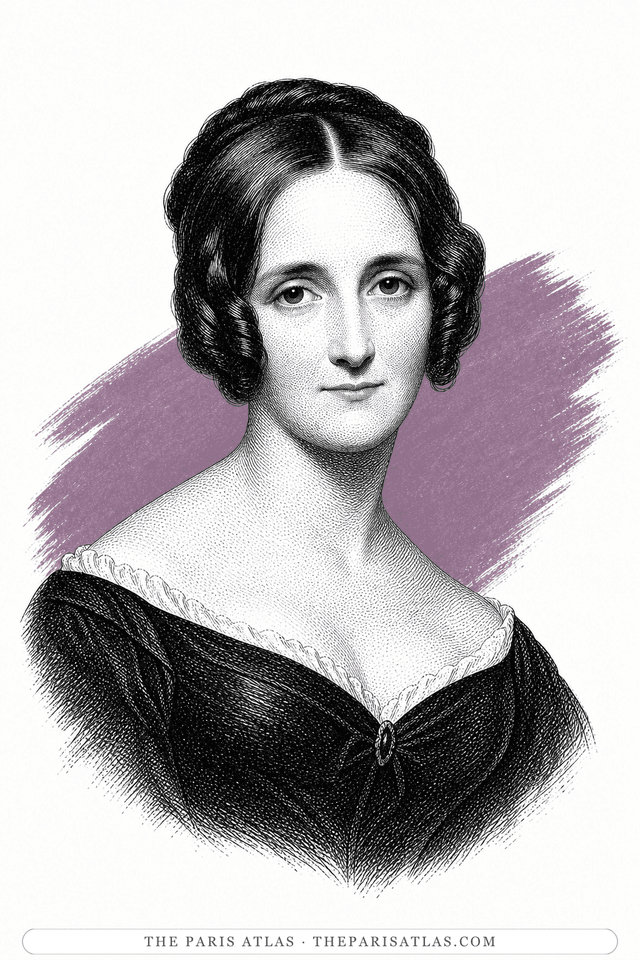
The author of Frankenstein, who first saw Paris at sixteen as a runaway. In the summer of 1814 she crossed from England to Calais with the poet Percy Bysshe Shelley and her stepsister Claire Clairmont, spent a week trapped in an expensive Paris hotel with no money, then bought a donkey and walked south-east across a France still wrecked by the Napoleonic wars. That journey became her first published book. Two years later, on a lake in Switzerland, she began her second.
View authorThe sources below include the primary text, editions, scholarship, archival materials, and other records that informed this page. They document The Handmaid's Tale, its publication, and its place in literary history.


Open Library ISBN catalogue used to verify the title, ISBN, and publication metadata.
Google Books catalogue record used to cross-check the title and edition metadata.
Internet Archive ISBN catalogue used to cross-check the edition and its availability in library holdings.
Library of Congress books catalogue used to cross-check the bibliographic record by ISBN.

Publisher reading guide; verifies themes, questions, and novel context.
Booker Prize archive; verifies publication, prize history, and book overview.
Booker reading guide; provides reputable context and discussion framing.
Publisher page; verifies Renée Nault’s graphic adaptation.
Publisher announcement; verifies the 2022 unburnable edition project.
Hulu press page; verifies the television adaptation and seasons; do not use it as evidence for novel-only facts.
Secondary plot and character cross-check; useful for sequence and motifs.
Publication and adaptation cross-check; use alongside publisher and prize sources.
The primary text is the baseline reference for every book page. Additional references document publication history, interpretation, and historical context where that evidence is available.
 Explore more resources