London: A Pilgrimage
by Gustave Doré
The 1872 portrait of Victorian London in 180 Doré engravings, with text by the journalist Blanchard Jerrold — dock labour, race days, slum courts, railway viaducts and the Newgate exercise yard that Vincent van Gogh later painted.
- 1872
- Wood engravings after Doré's drawings
About Gustave Doré
Four years walking London
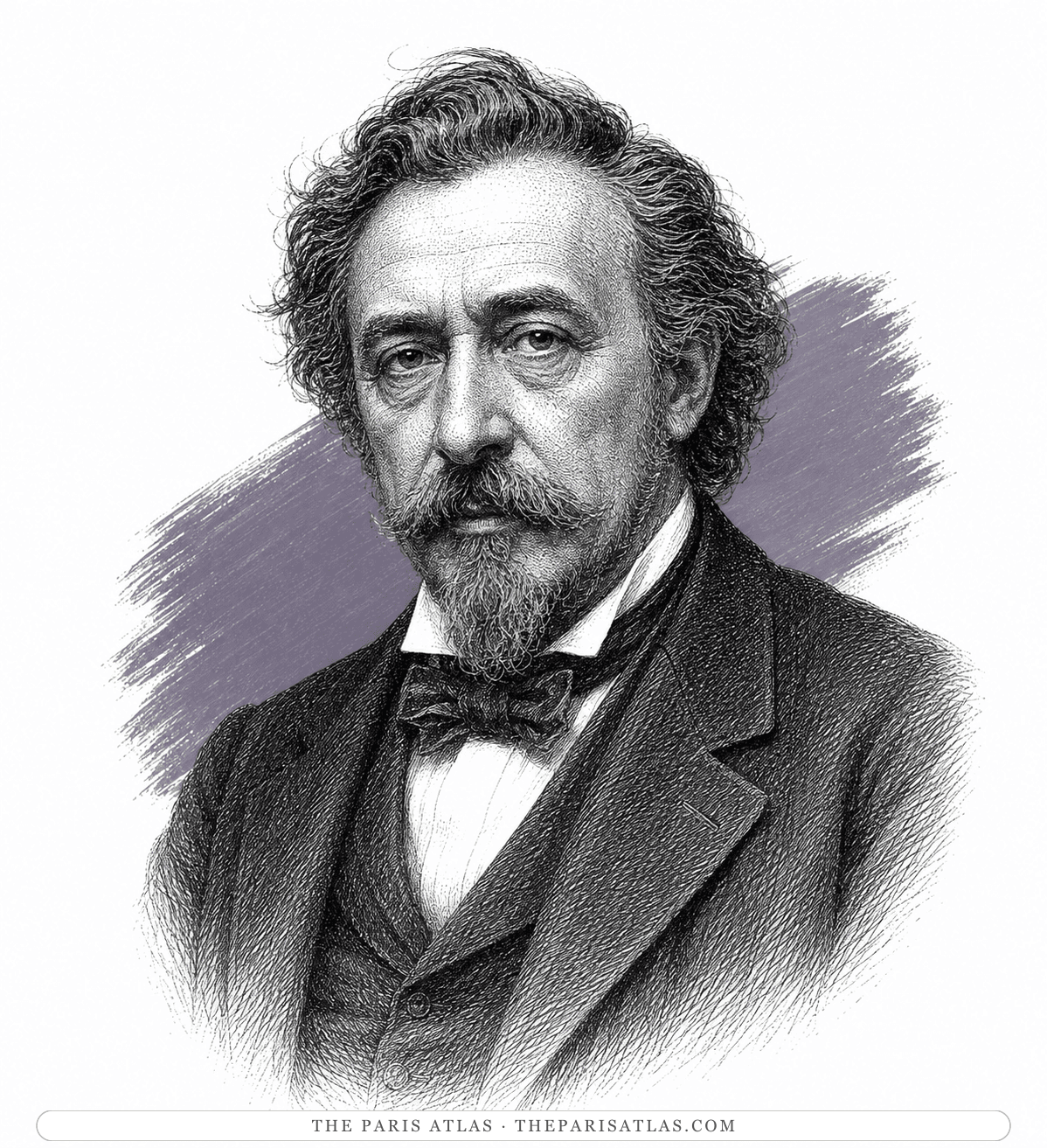
The journalist Blanchard Jerrold proposed the project to Doré in 1869: a complete portrait of London, high and low, made together on foot. They toured docks at dawn and night shelters after midnight, sometimes with police escorts, and the folio appeared in 1872 with 180 wood engravings and Jerrold's text.
Doré was by then the most famous illustrator alive, and the book was conceived on the scale of his classics: London treated as an epic subject, from Derby Day crowds to the underside of the bridges.
The city at work and the city in shadow
The plates alternate spectacle and abyss. Ludgate Hill jammed with traffic, the boat race, flower girls and opera crowds fill one register. Against them stand dock labourers heaving cargo, families asleep under viaduct arches, and the packed lodging houses of Whitechapel. Over London by Rail, with its back-to-back yards stacked beneath a passing train, became one of the most reproduced city images of the century.
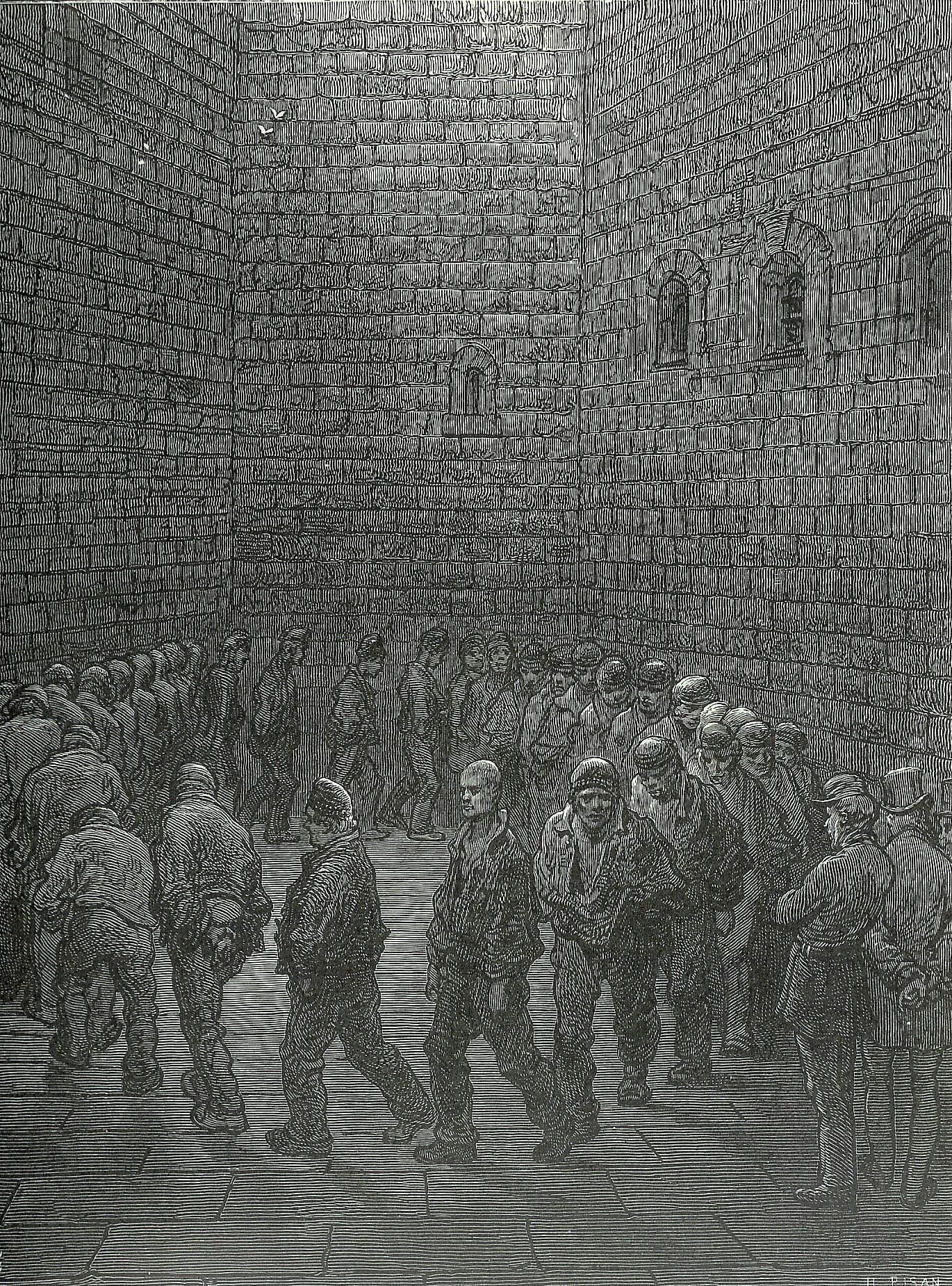
The most consequential plate shows the exercise yard at Newgate prison: a ring of prisoners circling a stone pit. Vincent van Gogh, who knew the book from his years in England, painted his Prisoners' Round from it in 1890, in the last year of his life.
Praised, attacked, and permanent
English critics of the 1870s complained that Doré had darkened the city — that the slum plates leaned on imagination rather than reporting. The complaint faded; the images did not. When the Victorian city is pictured now — in histories, on screen, in every fog-and-gaslight London of fiction — the visual source is this book more than any other.
Close reading
Reading the work, detail by detail
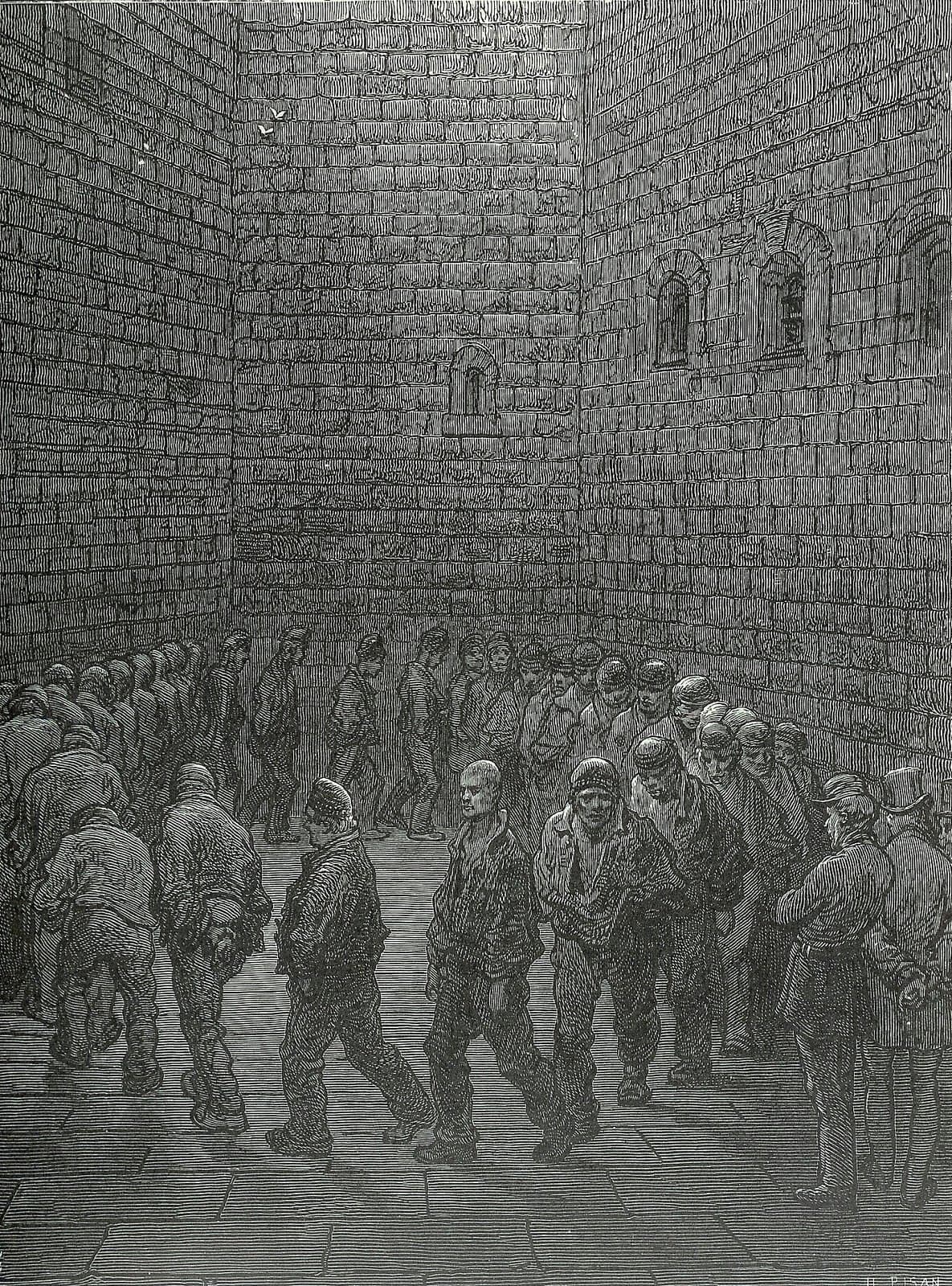
The Newgate exercise-yard plate turns prison routine into a closed geometry. The details show repeated bodies, the stone pit, and the overhead structure producing a system in which movement never becomes escape.
1.The prisoners walk as one closed circuit
Near-identical dark figures follow one another with heads lowered and spacing enforced. Walking, normally a means of travel, has been converted into repetition that returns every body to where it began.
2.The empty center organizes every occupied body
The central masonry prevents the walkers from crossing the yard or meeting face to face. Empty space functions as an instrument of control, fixing the route more effectively than a visible guard.
3.Architecture closes over the circular movement
Vertical walls and repeated openings rise above the bowed procession. Doré makes the built enclosure feel larger than any inmate and gives the routine below the inevitability of a machine.
4.The windows turn architecture into surveillance
Rows of dark openings overlook the circular walk. Even without a clearly visible guard, the building makes observation feel continuous and gives the prisoners no truly private direction to face.
5.Repeated coats reduce people to a regulated pattern
Hats, coats, and lowered heads recur around the circle. Individual differences remain, but the repeated dress and spacing show how the institution tries to make separate lives conform to one routine.
6.The ground records a route with no destination
The path curves back toward itself instead of leading out of the yard. Its visible wear turns repetition into evidence: the men have walked this circuit before and will be made to walk it again.
Where to see it
A viewing location has not yet been listed for this work.
Frequently asked questions
What is London: A Pilgrimage?
An illustrated portrait of London published in 1872: 180 wood engravings by Gustave Doré with text by the journalist Blanchard Jerrold. Doré and Jerrold began the project in 1869 and toured the city together, from society events to docks, prisons and night shelters.
What are the most famous plates in London: A Pilgrimage?
Over London by Rail, with terraced yards stacked under a railway viaduct; the Newgate prison exercise yard; the Whitechapel lodging-house and slum-court scenes; and the dockside labour plates. Together they built the standard image of the Victorian city.
Which Van Gogh painting comes from this book?
The Prisoners' Round (1890). Vincent van Gogh painted it directly from Doré's plate of the Newgate exercise yard, translating the grey engraving into blue-green oil while a patient at the asylum in Saint-Rémy.
Was London: A Pilgrimage criticized?
Yes. Contemporary English reviewers accused Doré of exaggerating the city's misery and of drawing from imagination rather than observation. The criticism did not stick to the images, which became the era's defining picture of London.
Where can I see London: A Pilgrimage today?
The engravings are in the public domain and widely available in modern reprints and complete online scans; rare-book libraries and the collectors' market hold the 1872 folio itself.
More by Gustave Doré
If you like Gustave Doré
Explore painters from the same movements and circles.

Tarsila do Amaral
Brazilian painter who spent the 1920s moving between São Paulo and Paris, studied Cubism under André Lhote, Albert Gleizes and Fernand Léger, and used what she learned to paint Brazilian towns, railways, plants and bodies. Her 1928 painting Abaporu prompted the manifesto that gave the Anthropophagic movement its name.
View artist
Arman
French-American artist, lifelong friend of Yves Klein, and a founder of New Realism.
View artist
Jean Arp
Strasbourg-born sculptor and poet — Hans in German, Jean in French, both all his life — who co-founded Dada at the Cabaret Voltaire in 1916, composed collages by dropping torn paper 'according to the laws of chance', and settled at Meudon outside Paris in a house his wife Sophie Taeuber-Arp designed.
View artist
In images
References
The sources below include collection records, catalogues, scholarly research, and primary materials that informed this page. They document London: A Pilgrimage, its making, and its place in cultural history.


1Doré's London
WebsitePeter HarringtonUsed forWeb source consulted for documented facts and historical context presented on the London: A Pilgrimage page.
2Gustave Doré
WebsiteWikipediaUsed forWeb source consulted for documented facts and historical context presented on the London: A Pilgrimage page.
3La vie de Gustave Doré : une chronologie
WebsiteBnF EssentielsUsed forWeb source consulted for documented facts and historical context presented on the London: A Pilgrimage page.
4Gustave Doré — Encyclopaedia Britannica
WebsiteEncyclopaedia BritannicaUsed forWeb source consulted for documented facts and historical context presented on the London: A Pilgrimage page.
These references provide the documented foundation for this work's history and interpretation. Claim-level citations remain attached to the specific claims they support.
 Explore more resources