
Giovanni's Room
A later 1950s classic about male desire, denial, heterosexual expectation, and destructive self-deception.
Read our take
by Gore Vidal
A young man carries one attachment through a world determined to make him live as someone else.
Jim Willard knows whom he desires, but the life around him expects conventional heterosexuality. Vidal follows the damage created when masculinity is built around denying what a man already knows about himself.
As a teenager in Virginia, Jim spends a private weekend with his older friend Bob Ford, and the two have sex. For Jim the experience becomes his ideal of love; for Bob it is easier to classify as youthful experimentation before moving into conventional adulthood. Bob leaves for the merchant marine. Jim follows a wandering path of his own, partly because he hopes mobility will eventually lead him back to Bob.[1]
Jim’s travels introduce him to different versions of gay life. In Hollywood he becomes the lover of movie star Ronald Shaw, whose public career depends on concealment. He later becomes involved with writer Paul Sullivan, whose cynical, self-dramatizing view of love differs sharply from Jim’s stubborn romanticism. A trip with Paul and Maria Verlaine forces Jim to recognize that he cannot manufacture heterosexual desire simply because a woman is available and sympathetic.[1]
World War II brings Jim into the military and then back to New York after illness leads to his discharge. He grows more knowledgeable about gay social life but does not loosen his fixation on Bob. When he learns Bob has married, the fantasy of a future reunion is threatened but not abandoned. Their eventual meeting produces the devastating climax, whose exact outcome depends on whether one reads Vidal’s 1948 original or his 1965 revision.[1]
A young American spends years carrying his love for another man through travel, war, and the demand that he conform.
Jim Willard grows up in Virginia as a physically confident, talented tennis player who is less interested in girls than his friends expect. His closest friend is Bob Ford, a year older. Before Bob leaves school, they spend time together in an isolated cabin and their friendship becomes sexual. Jim experiences the encounter as emotional completion. Bob enjoys the intimacy but insists that it cannot define them and soon joins the United States Merchant Marine.
Unable to accept Bob’s departure as the end of their relationship, Jim leaves home and goes to sea as a cabin boy. In Seattle, fellow seaman Collins arranges a double date with women. Jim cannot force himself into a successful heterosexual encounter. When Collins calls him queer, the insult compels Jim to consider a label he has resisted, but Jim leaves rather than confront what it may mean.
In Los Angeles Jim works as a hotel tennis instructor. A bellboy named Leaper introduces him to Hollywood actor Ronald Shaw, born George Cohen. Ronald is famous, handsome, older than Jim, and discreetly gay. He becomes Jim’s lover and gives him comfort, money, and entry into a closeted social scene. Jim likes Ronald but cannot love him because he continues to treat Bob as the only possible love of his life.
Jim then meets Paul Sullivan, a twenty-eight-year-old novelist, leaves Ronald, and goes with Paul to New Orleans. Paul cultivates emotional suffering as if it proves seriousness. He introduces Jim to Maria Verlaine, and the three travel to the Yucatán. Maria’s interest in Jim creates the betrayal Paul expects, but Jim cannot respond sexually. The failure clarifies that attraction to men is not something he can overcome by meeting the right woman.
During World War II, Jim enters the Army and is stationed at a cold Colorado base. Sergeant Kervinski is attracted to him, while Jim desires the younger corporal Ken Woodrow, who does not return his interest. Jim still distances himself from gay men whose mannerisms are visible to others. Rheumatoid arthritis leads to his discharge.
Back in New York, Jim becomes more accustomed to gay bars and social networks. Ronald’s studio has forced him into a public marriage with a lesbian woman as mutual camouflage. Paul and Jim reconnect through loneliness and familiarity. Jim has gained experience without revising the story he tells himself: Bob remains the lost ideal who will make every later relationship secondary.
Jim finally learns that his father has died and that Bob has married. Instead of accepting the difference between memory and Bob’s actual life, he clings harder to reunion. When they later meet in New York, they drink and return to Bob’s hotel room. Jim makes a sexual advance. Bob reacts with panic and disgust at being interpreted as homosexual, and the encounter becomes violent.
There are two canonical published endings. A summary saying Jim kills Bob is accurate for the 1948 edition but wrong for the 1965 revision and many later editions. A summary saying Jim rapes Bob without mentioning the earlier murder leaves out a crucial part of the book’s publication history.
In the 1948 original, Jim overpowers Bob and strangles him to death. The murder turns Jim’s obsessive romantic idealization into literal destruction. He cannot make the adult Bob match his memory, so he destroys the person who has contradicted it.
In the 1965 revised edition, Jim overpowers and rapes Bob, then leaves him alive. Vidal said he had come to regard the strangling as melodramatic. The revision is not a happy alternative: it replaces murder with sexual violence and makes Jim’s attempt to force possession and meaning onto Bob horrifying in another way.
Neither ending should be reduced to the idea that homosexuality itself is punished. Vidal emphasized what he called the romantic fallacy. Jim has spent years trying to recreate an idyll that existed largely in his own interpretation. The catastrophe grows from obsession, denial of change, and an attempt to make another person obey a memory.
The romantic fallacy: Jim transforms one adolescent experience into a complete theory of his future. Because he remembers the cabin as perfect, he assumes Bob is his destined partner and treats every later relationship as provisional. Vidal critiques not first love itself but the belief that memory creates a contract another person must keep.
Ordinary masculinity and gay identity: Jim is an athlete and resists period stereotypes of gay men as visibly effeminate. That was culturally disruptive in 1948. Yet his pride in masculinity also becomes a prejudice, because he distances himself from gay men he considers obvious or stereotypical.
Closeted social worlds: Ronald Shaw’s Hollywood life demonstrates the institutional cost of disclosure. His public image is a commercial product, and even marriage becomes camouflage. New York bars, Hollywood parties, ships, and the military each produce different forms of coded recognition.
Desire versus identity labels: Jim has sex with men long before he understands himself through a homosexual identity. He treats Bob as an exception and later partners as temporary. Vidal uses the distance between behavior and self-definition to show how identity is learned socially as well as felt privately.
War and mobility: shipping, military service, wartime migration, and cities give Jim access to wider gay worlds. Movement also lets him avoid settling into any relationship or identity that would challenge his Bob-centered fantasy.
Misogyny and heterosexual proof: male characters often treat women as tests, camouflage, threats, or symbols. Jim’s failed encounter with Maria matters because it removes one of his remaining explanations: heterosexuality cannot be chosen by effort.
Revision and changing literary ethics: the 1965 rewrite altered more than vocabulary; it changed the moral mechanics of the climax. Reading both conclusions shows an author reinterpreting his own earlier work as social and literary conditions changed.
Vidal’s prose is direct, cool, and fast-moving. Instead of giving Jim a heavily confessional first-person voice, the third-person narration follows him across social environments and lets his repeated choices reveal the limits of his self-knowledge. Dialogue is often dry and unsentimental.
The novel has an episodic, journey-like structure. Virginia, shipboard life, Hollywood, New Orleans and the Yucatán, the Army, and New York each introduce another social version of sexuality. Jim changes environments more readily than he changes his central belief about Bob.
The 1965 revision tightened the prose and changed material beyond the last pages. Readers discussing the style should identify whether they are reading the 1948 text or a later revised edition.
E. P. Dutton published the 314-page first edition in New York in 1948. John Lehmann issued an early British edition in 1949. Paperback editions kept the novel circulating through the 1950s, when gay-themed fiction often struggled to reach a wide audience.
E. P. Dutton published The City and the Pillar Revised in 1965. The Google Books record lists 249 pages. Vidal tightened the novel and changed the final violence from murder to rape. Ballantine issued a revised paperback in 1979, Random House included the revised work in a 1995 collection, and Vintage International published a 240-page edition in 2003, ISBN 9781400030378.
The novel has appeared in many languages, including the Spanish title La ciudad y el pilar de sal. Because translators may have worked from either the 1948 original or the post-1965 revision, readers should verify which English text a translation follows before making claims about its ending.
No major produced direct feature-film or television adaptation was verified. Vidal’s later screenplay work on Ben-Hur is sometimes discussed beside his treatment of male relationships, but Ben-Hur is not an adaptation of this novel.
Its protagonist is not confused about his desire; the damage comes from building no honest life around it.
Jim’s story gives readers room to examine how an attachment can shape later choices.
The novel separates male desire from the social expectations that make it difficult to acknowledge.

A Virginia athlete whose adult life is organized around one teenage memory of Bob.

Jim’s teenage best friend, who does not give their encounter the lasting meaning Jim assigns it.

A closeted Hollywood star who becomes Jim’s older lover.

A young novelist whose cultivated suffering offers Jim another unhealthy model of love.

A worldly woman whose interest in Jim clarifies that he cannot manufacture heterosexual desire.

A fellow seaman whose insult forces Jim to confront a label he has avoided.

A knowing hotel bellboy who connects Jim to Ronald Shaw’s circle.

An Army sergeant attracted to Jim while he and Jim navigate military secrecy.

A young corporal whose lack of interest repeats Jim’s pattern of unreturned desire.

The conventional Virginia family Jim leaves behind while pursuing Bob’s memory.

The broader urban network of actors, writers, patrons, and marriages of convenience around Jim.
1948
E. P. Dutton publishes the 314-page first edition in New York.
1949
John Lehmann publishes an early British edition.
1965
E. P. Dutton publishes The City and the Pillar Revised, with tightened prose and a different ending.
1979
Ballantine publishes a revised paperback edition.
1995
Random House publishes The City and the Pillar and Seven Early Stories, based on the revised work.
2003
Vintage International publishes the 240-page edition with ISBN 9781400030378.
A later 1950s classic about male desire, denial, heterosexual expectation, and destructive self-deception.
Read our take
A British novel of gay love under criminalization that offers a strikingly different moral and emotional possibility.
Read our take
Published one year later in Japan and similarly concerned with desire, identity, and performing heterosexual normality.
Read our takeE. P. Dutton published the first edition in New York in 1948; the Dutton edition ran to 314 pages.
Vidal substantially revised the book, tightened the prose, and changed the ending. It is not merely a reprint.
After Bob rejects Jim’s advance and they fight, Jim strangles Bob to death.
Jim overpowers and rapes Bob, then leaves him alive. Vidal replaced the murder because he came to regard it as too melodramatic.
He has relationships with both, but he refuses to give either the significance he assigns Bob. His fixation keeps later partners emotionally secondary.
He attempts heterosexual situations, most importantly with Maria Verlaine, but learns that attraction cannot be manufactured by effort or expectation.
It presented a masculine, athletic gay male protagonist as central and socially recognizable at a time when mainstream American fiction commonly relied on stereotypes or peripheral roles.
No. Bob violently rejects Jim’s interpretation of their teenage encounter as evidence of an enduring homosexual bond.
No major produced direct film or television adaptation was verified.
Many later editions derive from Vidal’s revised text, but readers should check the copyright or edition page because the publication history is essential to the ending.
Explore authors with a similar voice, perspective, and influence.

Author of The Sun Also Rises and A Moveable Feast; his pared-down style, developed in 1920s Paris, became the most imitated in American prose.
View author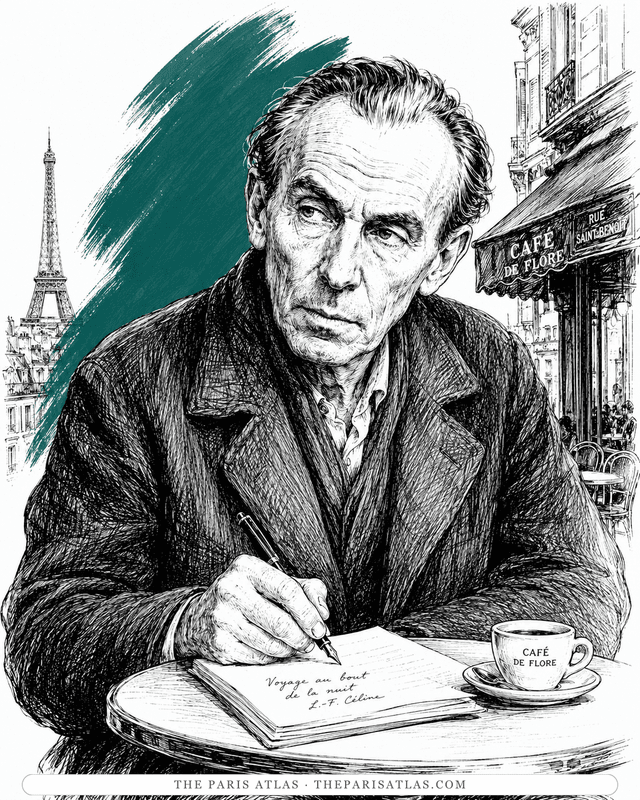
The doctor of the Paris slums who wrote the century's blackest, funniest novel — and changed the sound of French prose.
View author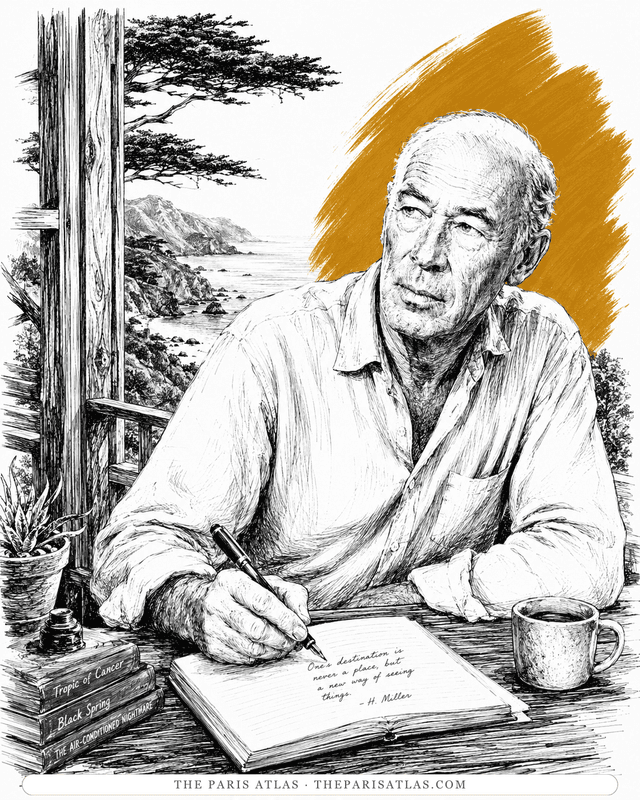
The Brooklyn dropout who arrived in Paris broke at thirty-eight and wrote the exuberant, banned books that ended American censorship.
View authorThe sources below include the primary text, editions, scholarship, archival materials, and other records that informed this page. They document The City and the Pillar, its publication, and its place in literary history.


Google Books catalogue record used to cross-check the title and edition metadata.
Internet Archive ISBN catalogue used to cross-check the edition and its availability in library holdings.
Library of Congress books catalogue used to cross-check the bibliographic record by ISBN.
Library record for the 1948 edition.
Publisher record for the revised modern edition.
Critical discussion of the novel’s publication history and revisions.

University source used to distinguish the two published endings.
The primary text is the baseline reference for every book page. Additional references document publication history, interpretation, and historical context where that evidence is available.
 Explore more resources