

The Dud Avocado
by Elaine Dundy
A pink-haired American charges through 1950s Paris in pursuit of freedom, theater, sex, and every bad decision that promises a good story.
- 1958
The story, briefly
Spoiler-freeSally Jay Gorce has two years in Paris paid for by a wealthy uncle and no intention of spending them sensibly. Her comic adventures among lovers, actors, artists, and expatriates eventually reveal that performance and freedom can hide real danger.
The story, in more detail
Sally Jay Gorce is a twenty-one-year-old American in Paris with two years of freedom paid for by a wealthy uncle and absolutely no intention of wasting them on good behavior. She dyes her hair pink, goes to parties, falls into affairs, lies when convenient, gets mixed up with actors and artists, and treats Paris as both a playground and a proving ground.[1]
The novel is comic before it is romantic. Sally Jay wants to experience everything, but she is not naïve in any simple sense. She is observant, theatrical, vain, funny, and often aware that she is making a mess while continuing anyway.[1]
Elaine Dundy’s first-person prose is the real attraction: fast, witty, slangy, and full of comic timing. The book belongs to the tradition of Americans abroad, but Sally Jay is not quietly absorbing European culture. She is crashing into it at full speed.[1]
The full plot
Sally Jay has been in Paris for three months when she runs into Larry Keevil, an American actor and aspiring director she knew from summer theater in the United States. Their reunion convinces her that she is in love with him, and she auditions for the experimental plays he is casting so that she can stay close to him.[1]
Her new pursuit means ending her affair with Teddy Visconti, a charming, middle-aged Italian diplomat who is married and also has a long-term mistress. Sally expects him to accept the breakup casually, but Teddy’s wife has left him and he had begun imagining that he might marry Sally instead.[1]
Larry and Sally circle each other through rehearsals, parties, and a drunken opening night. When Larry disappears again, Sally takes modeling work with the young American painter Jim Breit and begins another relationship. She still prefers the excitement and theatrical danger that Larry seems to promise.[1]
Larry persuades Sally to join him, Missy, and the Canadian Baxter on a trip to the Côte d’Argent. A film production recruits Baxter, while Sally and Larry accept work as extras and discover that proximity to the movies is less glamorous than they imagined.[1]
During the trip Sally learns that Larry has been exploiting women, that his former girlfriend Lila worked for him, and that he stole Sally’s passport for an illegal scheme. After she sees him assault Lila, the romantic performance collapses and Sally escapes back to Paris.[1]
In Paris she finds that Jim has married her young friend Judy. A letter from Uncle Roger confirms that Larry misused her passport and confessed. Sally leaves France, briefly plans to pursue acting in Hollywood, and then settles into work as a librarian in New York, where a different relationship unexpectedly finds her.[1]
How it ends — spoilers ahead
Sally Jay does not reconcile with Larry. His theft, violence, and effort to exploit her destroy the idea that he represents romantic or artistic freedom.
Back in the United States, Sally abandons her Hollywood plan and becomes a librarian in New York. Maximilian Ramage, a sophisticated photographer she met in Paris, finds her there and tells her that he has been looking for her because he loves her.
Sally and Max decide to marry and leave for Japan. The ending is deliberately happy and more conventional than much of the novel, but it does not domesticate Sally into a different personality: she chooses another leap into experience, this time with clearer knowledge of what danger can look like.
Themes and analysis
Freedom abroad
Paris gives Sally Jay distance from American expectations and permission to experiment. Her uncle’s money makes that freedom materially possible, which also raises the question of how much risk she can take because someone else has financed the landing.
In the shop-window passage quoted by Terry Teachout, Sally Jay enjoys knowing that nobody knows her whereabouts, yet finds herself reflected in the glass. Escaping other people’s gaze becomes a comic encounter with her own. She catches herself grinning before explaining why, so freedom appears as a visible, slightly foolish expression rather than a grand declaration. The reflection lets the narrator stand outside her own excitement long enough to laugh at it.
Performance
Nearly everyone performs socially, romantically, or literally through theater. Sally’s quick costume changes and comic stories are part of her charm, but Larry’s performance conceals exploitation and violence.
Youth and consequences
The book enjoys Sally Jay’s recklessness without pretending that freedom makes her immune to harm. Her mistakes cost her relationships, expose other people’s cruelty, and force her to revise what she considers adventurous.
American identity
Sally discovers herself partly by seeing how American habits look from Europe. She is both proud of her independence and conscious that Europeans read her as a recognizable kind of energetic, wealthy, inexperienced American abroad.
Sex and double standards
Sally pursues desire directly, which made the novel unusually candid in 1958. Dundy also shows the unequal risks beneath that freedom: the men around Sally often expect access, secrecy, or forgiveness that women cannot safely demand in return.
Comedy as self-knowledge
Sally Jay’s ability to laugh at herself prevents the book from becoming a simple celebration of irresponsibility. Her jokes let her recognize embarrassment and failure without surrendering her appetite for life.
The moral awakening Teachout quotes turns on the correction “or rather.” Sally first describes taking a moral stand as something she could do, then decides it is something she cannot avoid. Her freedom to try different roles meets an obligation she cannot shrug off as another adventure. The sentence preserves her confusion instead of presenting a finished education. Its self-interruption lets us hear judgment forming: the comic narrator’s quick revisions can also register a serious change in what she will accept.
Writing style
Dundy writes in a quick first-person voice full of slang, exaggeration, comic reversals, and sudden flashes of insight. Sally Jay sounds like a person telling the story after surviving it, still delighted by how absurd everyone was.
The prose is light without being empty. It captures clothes, rooms, gestures, and social embarrassment precisely while keeping the story moving at the speed of Sally’s changing plans.
Editions and translations
The novel was written in English. The 2007 NYRB Classics reissue is the easiest modern edition to identify; it includes an introduction by Terry Teachout and a later afterword by Elaine Dundy.
Major adaptations
No major screen adaptation has displaced the novel. Its reputation still depends on Sally Jay’s first-person voice, whose speed and timing would be difficult to reproduce simply by filming the events.
Why we recommend it
Freedom in France, played as comedy
Sally Jay embraces sex, parties, and bad decisions with the same appetite she brings to theater and travel.
A voice that feels startlingly modern
Her slang, candor, self-mockery, and speed make the novel feel much less dutiful than many expatriate classics.
A comic education with real stakes
The book lets Sally enjoy recklessness while showing the moment when dangerous performance stops being funny.
What this book explores
The people in its pages

Sally Jay Gorce
The pink-haired American narrator who treats Paris as an experiment in freedom and learns that comic recklessness does not make her invulnerable.

Larry Keevil
Sally Jay’s old summer-theater acquaintance, whose experimental productions and romantic intensity hide theft, violence, and exploitation.

Maximilian Ramage
A sophisticated photographer Sally meets in Paris who later finds her in New York and offers the novel’s unexpected final romance.
Also in the book

Teddy Visconti
The married Italian diplomat Sally dates early in Paris, whose wounded response to their breakup complicates her belief that every affair can remain casual.

Jim Breit
A young American painter who offers Sally affection and a less theatrical relationship while Larry is absent.

Judy
Sally’s sheltered young American friend in Paris, whose later marriage to Jim closes one route Sally assumed would remain available.

Lila
Larry’s former girlfriend, whose treatment reveals the violence and exploitation hidden beneath his theatrical charm.
Bring it to book club
- Is Sally Jay genuinely free or just temporarily protected by money?
- How does Paris change what she thinks is possible?
- Why is theater such a fitting social world for the novel?
- Does Larry understand Sally Jay better than she understands him?
- Which mistakes actually change her?
- How does the novel handle sexual double standards?
- Is the ending too conventional?
- What makes Sally Jay’s voice feel modern?
Timeline
1958
Victor Gollancz publishes the first British edition; E. P. Dutton publishes the American edition.
Late 1950s
The novel becomes a bestseller and cult success, praised especially for Sally Jay’s comic voice.
2007
NYRB Classics reissues the novel with an introduction by Terry Teachout and a new afterword by Elaine Dundy.
2018
Virago Modern Classics issues a new British paperback edition.
Book editions
Hardcover
- Hardcover
- Victor Gollancz
- 1958
Hardcover
- Hardcover
- E. P. Dutton
- 1958

- Paperback
- NYRB Classics
- 2007
- 9781590172322
Paperback
- Paperback
- Virago Modern Classics
- 2018
Reader reviews
Readers may also like


The Dud Avocado: frequently asked questions
Why is it called The Dud Avocado?
Near the end, a friend compares American girls to avocados: polished outside, tender inside, and green. Sally calls herself a dead avocado; Max mishears her as a ‘dud avocado,’ and the phrase becomes a comic description of her bruised but still living self.
Is Sally Jay based on Elaine Dundy?
The novel draws from Dundy’s experiences as a young American in Europe, but Sally Jay is fictional.
Is it a romance?
Partly, but it is equally a comic coming-of-age novel about freedom abroad, performance, and the danger hidden inside one of Sally’s romantic fantasies.
Why is Sally Jay in Paris?
Her wealthy uncle Roger finances two years abroad, giving her unusual freedom to live independently.
Does she end up with Larry?
No. Sally discovers that Larry stole her passport, meant to exploit her, and is violent toward Lila. She leaves him and later agrees to marry Maximilian Ramage.
Is the book feminist?
It predates later second-wave terminology, but its candid female narrator and treatment of sexual freedom have made it important to many feminist readers.
Is it similar to Bonjour Tristesse?
Both center young women in France, but Dundy is much more comic and extroverted.
Is the prose difficult?
No. Its speed, slang, and humor are major attractions.
If you like Elaine Dundy
Explore authors with a similar voice, perspective, and influence.
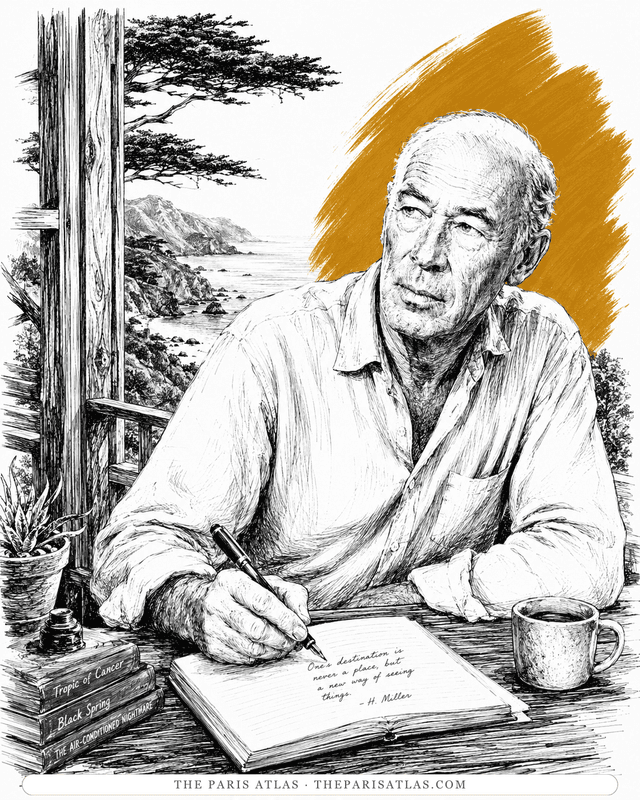
Henry Miller
The Brooklyn dropout who arrived in Paris broke at thirty-eight and wrote the exuberant, banned books that ended American censorship.
View author
André Breton
Wrote the Surrealist manifestos and decided who belonged to the movement. Dalí joined in 1929 and was expelled ten years later, by which time Breton had renamed him Avida Dollars.
View author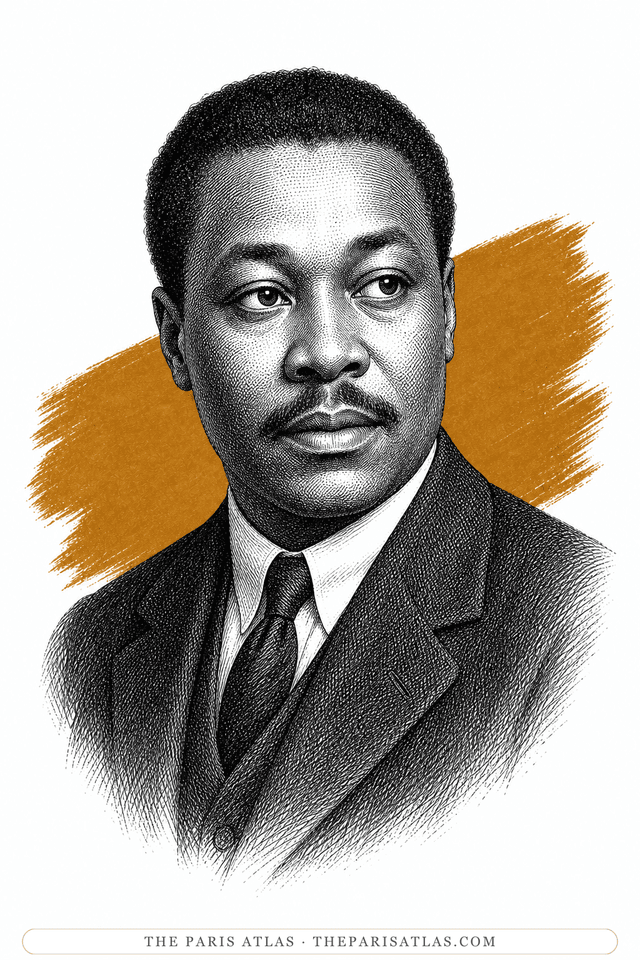
Claude McKay
Jamaican-born poet and novelist, and one of the essential writers of the Harlem Renaissance. He arrived in Paris from Moscow in 1923 and stayed in France until 1928, writing Home to Harlem there — and forming a low opinion of the rich, white expatriate scene that dominates most accounts of the period. His Paris is the same years as Hemingway's and almost nothing like it.
View author
References
References
The sources below include the primary text, editions, scholarship, archival materials, and other records that informed this page. They document The Dud Avocado, its publication, and its place in literary history.


2Elaine Dundy
Official recordThe New York Review of BooksUsed forBiographical context for Dundy and the novel’s autobiographical background.

3The Dud Avocado
WebsiteHachette UKUsed forPublisher evidence for the novel’s continued British publication.
4The Dud Avocado — 1958 edition record
Official recordGoogle BooksUsed forBibliographic record for the 1958 edition and searchable evidence for the character roster.
5The Dud Avocado — contemporary review
PeriodicalKirkus Reviews, 1958Used forContemporary review used to verify the actual ending, Larry’s passport theft, and Max’s final role.
6Introduction to The Dud Avocado — reproduced with permission as ‘Not for chicks only’
WebsiteMaud Newton, 2007Used forIntroduction reproduced with permission, used as the explicit intermediary for two close readings.
i
Why these sources are here
The primary text is the baseline reference for every book page. Additional references document publication history, interpretation, and historical context where that evidence is available.
 Explore more resources