

Bonjour Tristesse
The obvious companion in brevity, coolness, youth, sexual freedom, and emotional consequence.
Read our take
A young Paris student agrees to a temporary affair and learns that emotional detachment cannot be guaranteed in advance.
Dominique, bored with university life and her boyfriend, begins an affair with an older married man whose confidence about its limits proves easier to sustain than her own.
Dominique is a young university student in Paris who is intelligent, bored, and unconvinced that conventional romance deserves the seriousness other people give it. She is dating Bertrand, but her attention shifts when she meets his uncle Luc, an older married man.
Dominique and Luc begin an affair with an explicit understanding that it will remain temporary. Both think they are sophisticated enough to enjoy desire without pretending it means forever. Emotional detachment works better as an idea than as an experience.
Françoise Sagan was still very young when she wrote the novel, her second after Bonjour Tristesse. Her style is cool, short, and deceptively simple. She is interested in boredom, desire, self-knowledge, and the embarrassment of discovering that one has feelings after all.
Dominique studies in Paris and spends time with her boyfriend Bertrand and their student circle. She is fond of him but already restless inside the relationship.
Through Bertrand she meets Luc, Bertrand’s older uncle. Luc is married to Françoise and carries the confidence of an adult who believes he understands affairs and their limits.
Dominique and Luc become attracted to each other. Their affair begins with the agreement that it will be pleasurable, discreet, and temporary. Dominique initially enjoys the sense of maturity and freedom.
They travel, meet in private, and build a relationship organized around borrowed time. Dominique becomes more emotionally attached than she expected, while Luc remains clearer about the boundaries of what he is willing to change.
The affair ends. Dominique must return to ordinary life and confront the fact that being modern, intelligent, or sexually free does not protect a person from grief.
Luc does not leave his wife to build a future with Dominique. The affair remains what he said it would be.
Dominique suffers, but Sagan does not turn the pain into a permanent catastrophe. She begins to understand that heartbreak can be real without making the rest of life impossible.
The ending returns her to a cooler emotional register, but she is no longer quite the person who believed detachment could be guaranteed in advance.
Boredom is not trivial in Sagan. It creates the space in which Dominique goes looking for intensity, then makes novelty feel like proof that she is living more honestly.
The French opening reproduced by Hachette makes Dominique’s boredom less complete than it sounds. While Bertrand discusses a lecture, she watches a record rise toward the stylus and imagines its contact as the tender touch of a cheek. The machine receives the intimate attention that the conversation does not. Her account slows down to follow this small movement, finding something almost human in an ordinary mechanism. The remembered detail complicates her pose of indifference: she may be bored by the afternoon’s company, but the telling reveals a readiness to notice and imagine touch.
The novel treats an affair without conventional moral panic, but it does not pretend freedom eliminates consequences. Dominique can choose the relationship without controlling its emotional result.
Luc’s greater age gives him emotional and social advantages Dominique initially underestimates. He already knows how to separate an affair from the rest of his life.
Dominique repeatedly believes she understands her feelings before experience proves otherwise. Her intelligence makes those mistakes more articulate, not less painful.
Cafés, apartments, cars, travel, and student life create a world where old rules feel optional. Paris gives the affair a casual public surface even when its private effects become serious.
Two people can enter the same affair under the same agreement and still leave it with different wounds. Consent to a temporary arrangement does not make attachment arrive equally.
Sagan’s prose is clean, quick, cool, and lightly ironic. She does not overexplain emotion; small gestures and abrupt admissions carry much of the weight.
The style feels sophisticated without becoming academic. Dominique’s intelligence does not save her from ordinary pain, and Sagan’s dry amusement keeps the novel from becoming melodrama.
A passage quoted by Nathalie Morello gives that restraint a concrete form. On her way to Luc’s, Dominique dreads having to talk, be pleasant and recreate herself in other people’s eyes; she would rather eat alone and turn a mustard pot in her hands. The small object makes solitude an imaginable pleasure, not merely an absence of company. Her repeated “vague” loosens the sentence after the list of social duties. Morello reads the withdrawal as relief from having to exist for others; the contrast between those duties and the idle hand movement lets Sagan show the effort of sociability without a long explanation.
English readers may encounter translations by Anne Green, Irene Ash, and Heather Lloyd. Earlier British translations can reflect editorial cuts or period conventions, so the translator should always be identified.
The 1958 film A Certain Smile, starring Christine Carère, turns Sagan’s novel into a glossy international romance. Its cinematic presentation should be distinguished from the book’s first-person emotional perspective.
Dominique can analyze the affair more easily than she can control what it means to her.
Cafés and student life provide freedom, boredom, and public ease rather than a sentimental travel fantasy.
Sagan lets small gestures and admissions expose the imbalance between the lovers.

The young Parisian narrator who wants experience without emotional captivity and discovers that she cannot fully control what an affair means to her.

Bertrand’s older married uncle and Dominique’s lover, whose charm and experience help him keep the affair within limits she cannot sustain.

Dominique’s young boyfriend and Luc’s nephew, whose presence makes the affair a betrayal as well as an experiment.

Luc’s self-possessed wife, whose presence prevents Dominique from imagining that Luc is simply waiting to escape a dead marriage.

The young people around Dominique who give the novel its social texture of cafés, university routines, talk, and restless Parisian possibility.
1956
Julliard publishes Un certain sourire in France.
1956
English translations by Anne Green and Irene Ash appear.
1958
A film adaptation starring Christine Carère is released.
2013
Heather Lloyd publishes a modern English translation.

The obvious companion in brevity, coolness, youth, sexual freedom, and emotional consequence.
Read our take

Desire challenges the conventional futures available to its characters.
Read our take

She is attached to him but already restless, which makes the question less simple than yes or no.
Yes. He is married to Françoise.
No.
Sagan drew from the social and emotional world she knew, but Dominique is fictional.
Yes in brevity, coolness, youth, sexual freedom, and emotional consequence, although A Certain Smile is set more firmly in Parisian student life.
No. Sagan is more interested in feeling than punishment.
The title points toward emotional ambiguity, social performance, and the small expressions by which people hide or reveal what they know.
It is painful, but not tragic in the catastrophic sense.
Explore authors with a similar voice, perspective, and influence.

French Algerian novelist, essayist, journalist and playwright who used the absurd and revolt to ask how people should live without false consolation.
View author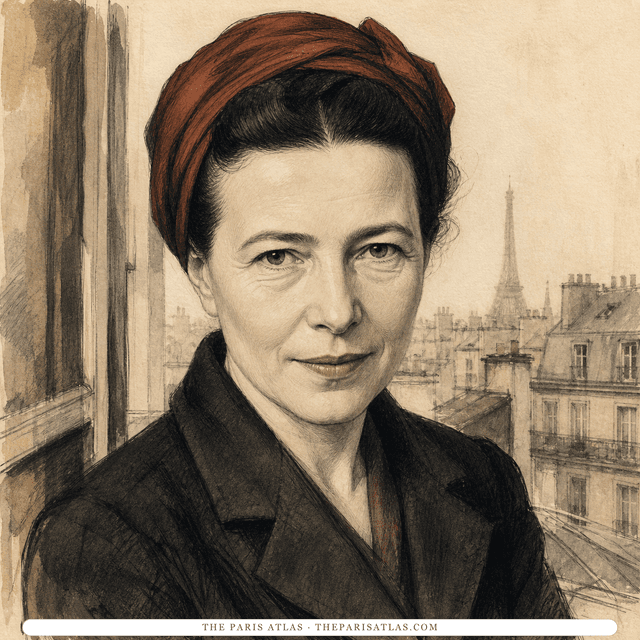
French writer and philosopher whose novels, memoirs, and social analysis examined freedom, gender, responsibility, aging, and the material conditions that shape a life.
View author
American novelist and composer whose expatriate fiction explores dislocation, unstable intimacy, fatalism, and North Africa.
View authorThe sources below include the primary text, editions, scholarship, archival materials, and other records that informed this page. They document A Certain Smile, its publication, and its place in literary history.


The primary text represented by this page, used for descriptions of the work’s contents and for any quoted passages shown here.

Publisher evidence for the novel and its continuing English publication.
French national-library evidence for the original edition.
Institutional context for Sagan’s early career and reception.
Publisher context for the companion novel and Sagan’s early work.
Publisher’s French opening extract, used for the record-player close reading; not a full audiobook inspection.

Doctoral study quoting the mustard-pot passage on p. 72; used as the explicit intermediary for the writing-style analysis.
The primary text is the baseline reference for every book page. Additional references document publication history, interpretation, and historical context where that evidence is available.
 Explore more resources