Early life in Newark and Paterson
Irwin Allen Ginsberg was born in Newark, New Jersey, on 3 June 1926, the younger son of Louis Ginsberg and Naomi Levy Ginsberg.[1] The family soon settled in nearby Paterson, an industrial city of mills, factories, rail lines and working-class neighborhoods that later became part of his imaginative landscape. His older brother, Eugene, eventually became a lawyer and used the surname Brooks. The household was Jewish, literary and politically engaged, but it was not harmonious. Louis was a high-school teacher and a published lyric poet who preferred traditional meter, rhyme and carefully shaped forms. Naomi was a committed political radical who supported the Communist Party, took her sons to meetings and interpreted the world through class conflict and the hope of social revolution.
The differences between his parents gave Ginsberg two models that remained active in his work. From his father came the understanding that poetry was a craft requiring reading, memory and technical discipline. From his mother came sympathy for workers, political outsiders and people excluded by respectable society, along with a distrust of concentrated economic and governmental power. Ginsberg eventually rejected Louis's conservative taste in verse, but he never rejected the serious literary education that his father represented. Nor did he become an orthodox Communist like Naomi. His mature politics remained eclectic, suspicious of party discipline and shaped as much by pacifism, personal liberty and spiritual experiment as by the organized left.
Naomi's recurring mental illness had the deepest effect on the family. She experienced paranoia, delusions and repeated hospitalization, and Allen was exposed from childhood to crises that frightened him while also making him feel responsible for her safety. At times he accompanied her through disorienting journeys and witnessed the strain her illness placed on Louis and Eugene. He later had to confront the fact that decisions about her institutional treatment, including a lobotomy, had been made within a family and medical system that offered few humane alternatives. This history gave him firsthand knowledge of psychiatric institutions long before he entered one himself, and it helps explain why madness in his poetry is never merely a fashionable metaphor. It can signify visionary refusal of conformity, but it also represents fear, suffering, bodily vulnerability and the damage done within families.
Ginsberg began imagining himself as a writer at an unusually early age. A diary now held in his Stanford archive records the eleven-year-old's conviction that he would become some kind of genius, probably in literature. The claim was grandiose, but it was accompanied by serious reading. Edgar Allan Poe first fascinated him, and Walt Whitman eventually became his central American predecessor. Whitman offered a poetry that was democratic, sexual, urban, bodily and expansive, and his celebrations of male companionship gave Ginsberg a nineteenth-century ancestor for desires that mid-century culture treated as shameful or pathological. A second decisive influence lived close to Paterson: physician-poet William Carlos Williams, whose work demonstrated that modern poetry could emerge from New Jersey streets, local speech and precisely observed objects rather than from inherited European grandeur. Williams later encouraged the younger poet and helped introduce him to writers on the West Coast.
Columbia University and the first Beat circle
Ginsberg entered Columbia University on scholarship in 1943, when he was seventeen. He initially imagined using his education for a political career and wrote that he hoped to become an "honest revolutionary labor lawyer." Columbia instead redirected him toward literature and toward a group of friendships that would shape postwar American writing. His professors included the poet Mark Van Doren, the critic Lionel Trilling and the art historian Meyer Schapiro. Van Doren was especially important because he combined intellectual authority with a willingness to listen to the young Ginsberg's literary enthusiasms and later visionary claims. Even when Ginsberg's behavior became erratic, several professors recognized the seriousness of his reading and ambition.
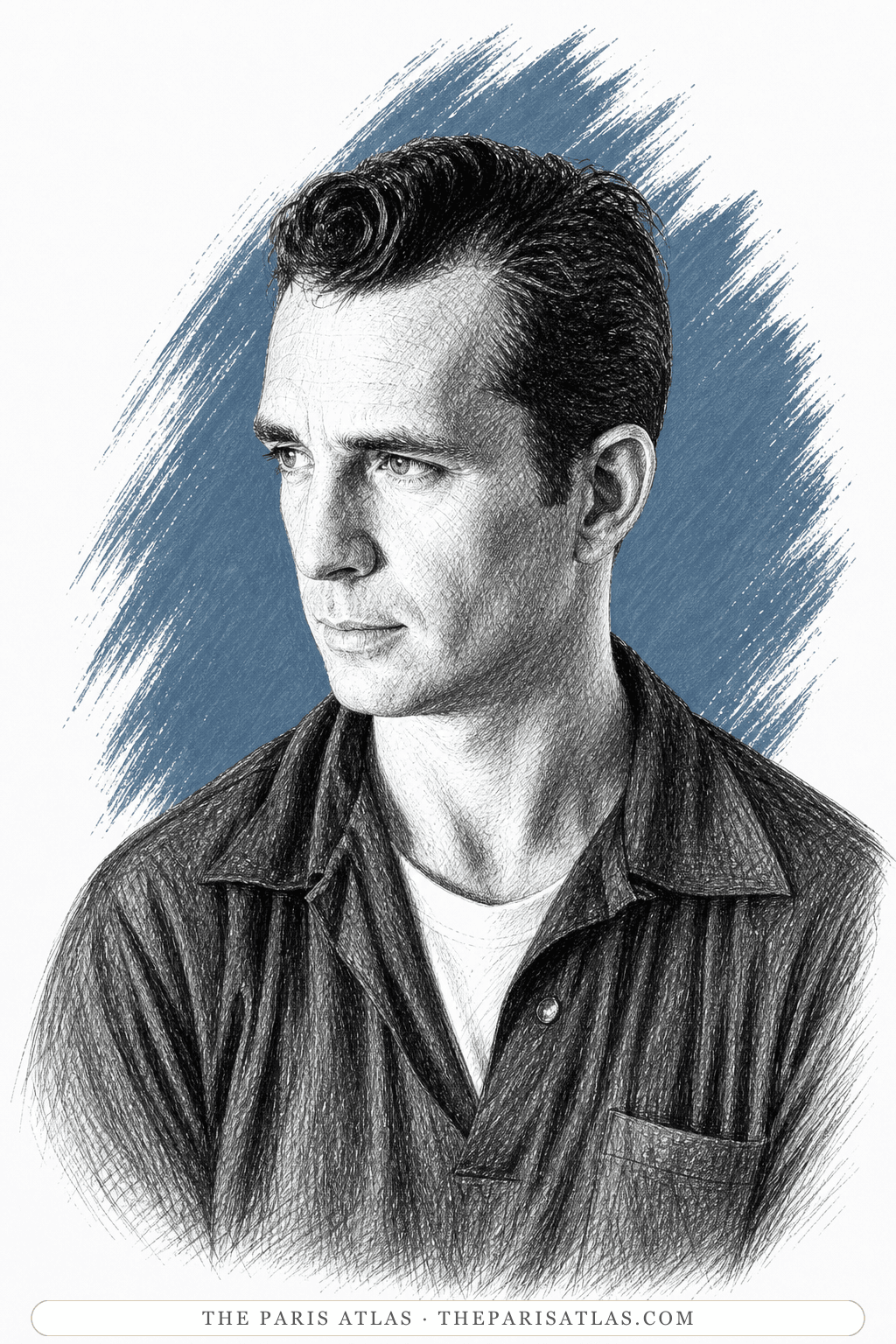
The education outside the classroom proved even more consequential. Ginsberg met Lucien Carr, a charismatic Columbia student who introduced him to Jack Kerouac, a former Columbia football player already committed to becoming a novelist.[2] Through the same network he encountered three more. William S. Burroughs was an older Harvard-educated writer with interests in crime, drugs, anthropology and systems of power. John Clellon Holmes later wrote one of the first Beat novels. Herbert Huncke was a Times Square hustler and storyteller whose experience of urban criminal life fascinated the younger writers. Neal Cassady, a restless, self-educated Westerner with extraordinary conversational energy, entered the circle soon afterward. These figures did not yet constitute a literary movement, and their later styles differed radically, but they shared a sense that conventional postwar culture excluded important forms of experience.
Carr, Ginsberg and Kerouac discussed what they called a "New Vision," a loose set of ideas about art, self-knowledge and the rejection of inherited restraint. The phrase never became a coherent manifesto. Its importance lies instead in the permission it gave the young writers to treat intense personal experience, sexuality, crime, intoxication, spiritual revelation and marginal social worlds as literary material. Kerouac moved toward improvisatory prose and the rhythms of spoken narrative; Burroughs developed a colder satire of addiction, bureaucracy and control; Ginsberg sought a form of visionary lyric poetry. Their common ground was less a shared style than the conviction that literature should tell truths respectable institutions preferred not to hear.
The circle was marked by danger as well as creative excitement. In August 1944, Carr killed David Kammerer after a confrontation in Riverside Park, confessed and later pleaded guilty to manslaughter. Ginsberg did not participate in the killing, but the case drew him into a grim mixture of loyalty, secrecy, sexuality and criminal law that complicated later romantic accounts of the Beats' beginnings. His Columbia career was repeatedly interrupted as well. He was suspended in a notorious episode after writing "Butler has no balls" in the grime of his dormitory window, a reference to university president Nicholas Murray Butler, and Columbia records that he was twice removed from the college. These disciplinary problems coexisted with intense study, prize-winning student poetry and continued respect from important teachers. He ultimately graduated in 1948 with an A-minus average.
Periods away from Columbia broadened his experience beyond the university. He worked ordinary jobs and served in the Merchant Marine, including a 1947 voyage aboard the S.S. John Blair. Ports, ships, highways, bus terminals, rail yards and cheap rooms later entered his poems not as decorative scenery but as the physical structure of modern life. Ginsberg's mature poetry would repeatedly move through such transitional spaces, treating transportation, labor and urban infrastructure as material capable of carrying spiritual and political meaning.
Vision, sexuality and psychiatric confinement
In 1948, shortly after leaving Columbia, Ginsberg underwent the experience he later called his "Blake vision." While reading William Blake in a Harlem apartment, he heard a voice that he understood as Blake's reciting poems including "Ah! Sunflower" and "The Sick Rose." He maintained that he had taken no drugs before the event. What mattered to him was the sudden conviction that visionary consciousness did not reveal a remote supernatural world. It disclosed the depth already present in ordinary reality. He spent years trying to understand and sometimes recover that perception, first through poetry and later through psychoactive drugs, meditation and religious practice.
The vision occurred during a period in which Ginsberg was also struggling with his sexuality. He had fallen intensely in love with Neal Cassady, whose charisma, restless speech and movement through the American West became central to Beat mythology. Their sexual relationship was intermittent and emotionally unequal. Cassady was primarily oriented toward women and offered Ginsberg neither the stability nor the exclusivity he desired. Ginsberg nevertheless made him a major figure in letters, poems and photographs, while Kerouac transformed him into Dean Moriarty in On the Road. The relationship forced Ginsberg to confront homosexual desire at a time when same-sex relations were criminalized, professionally dangerous and classified by American psychiatry as illness.
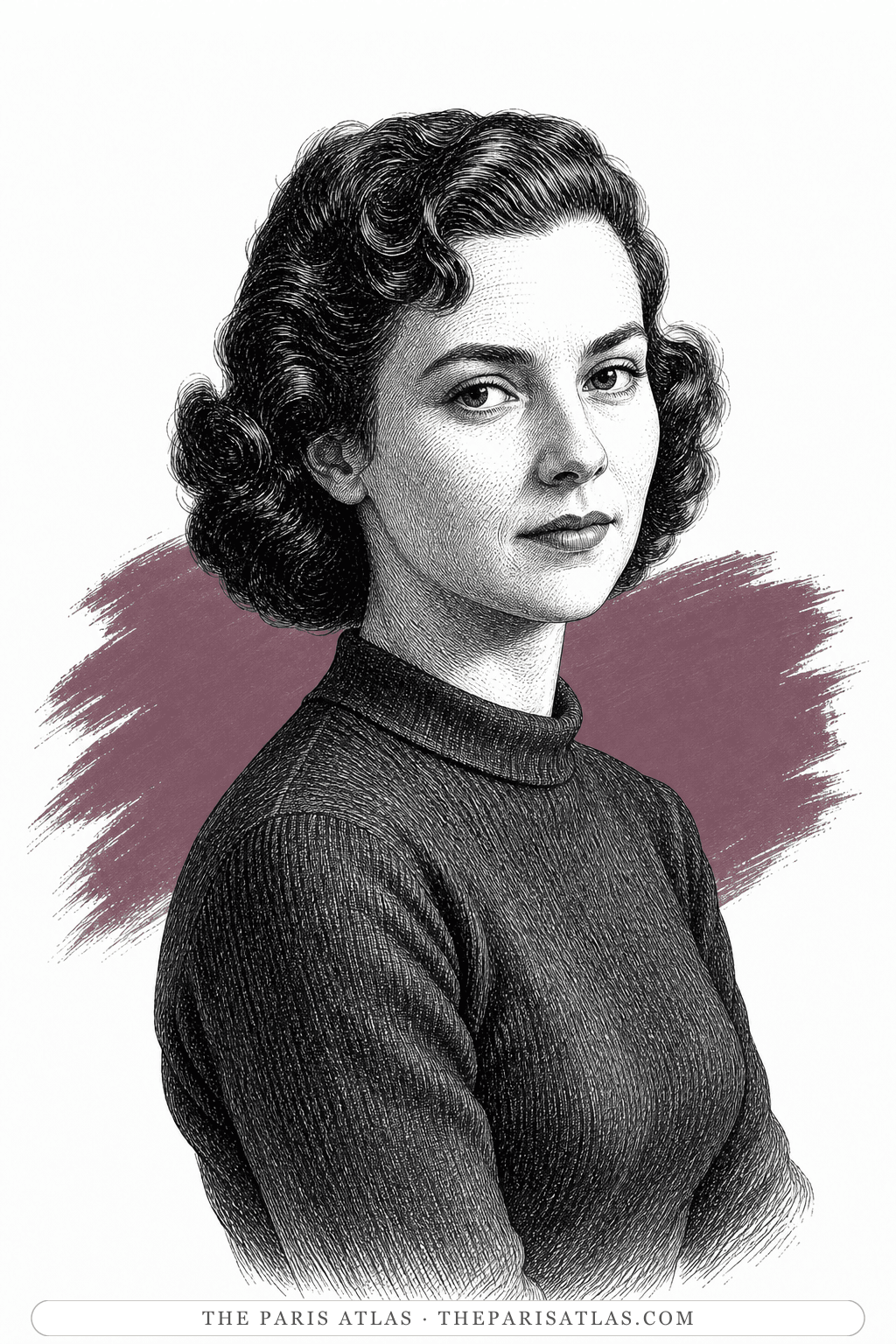
He briefly attempted to construct a conventionally heterosexual life, including a relationship with the poet Elise Cowen, a Barnard graduate connected to the Columbia Beat community. Their relationship is often treated only as a footnote to Ginsberg's self-acceptance. Cowen was a serious and troubled poet, and her own work has become increasingly important to scholarship on women in the Beat circle. Ginsberg's inability to sustain the expected heterosexual role did not make the relationship unreal. It showed how strongly both people were living under social and psychological pressures that the male-centered story of the Beats often obscured.
A separate crisis brought Ginsberg into direct contact with psychiatric authority. After stolen goods belonging to an acquaintance were stored in his apartment, he faced possible prosecution and entered the New York State Psychiatric Institute as part of the legal resolution. He remained there for approximately eight months. At the institute he met Carl Solomon, a young intellectual undergoing psychiatric treatment, including electroconvulsive therapy.[3] Solomon introduced him to writers such as Jean Genet and Antonin Artaud and became the dedicatee of Howl. Ginsberg recognized in him not an anonymous patient but a literary mind confined within an institution, and the poem's later refrain "I'm with you in Rockland" turned their friendship into an assertion of solidarity.
The hospitalization cannot be reduced to a simple story in which a sane rebel was punished by a conformist society. Ginsberg had genuine psychological distress, feared that his visions and sexuality indicated illness, and needed a workable way to live. At the same time, his mother's history and Solomon's treatment made him deeply suspicious of the power psychiatry possessed to define unacceptable behavior. A therapist later encouraged him to stop constructing his life around conventional expectations and to pursue the work and relationships he actually wanted. That permission became part of the path toward Howl, but the deeper result was a lifelong refusal to draw an easy line between visionary experience, mental suffering and institutional judgment.
San Francisco, Peter Orlovsky and the making of Howl
Ginsberg moved to San Francisco in 1954 and entered a literary culture already in motion. The San Francisco Renaissance included poets such as Kenneth Rexroth, Robert Duncan, Jack Spicer, Madeline Gleason and Lawrence Ferlinghetti. Younger writers including Gary Snyder, Philip Whalen and Michael McClure were bringing new attention to Asian literature, anarchism, ecology and oral performance. William Carlos Williams supplied introductions, but Ginsberg's arrival did not create this scene and the San Francisco poets were never merely a western branch of the Beats. The importance of the encounter lay in the contact it established between the New York circle and an independent West Coast avant-garde.
San Francisco also brought Ginsberg the most durable romantic relationship of his life. In 1954 he met Peter Orlovsky, a young former soldier then associated with the painter Robert LaVigne. Ginsberg later recalled seeing LaVigne's large nude portrait of Orlovsky before meeting its subject and experiencing an immediate emotional shock. The two soon became lovers and marked their partnership with a private commitment ceremony in 1955. Their relationship was non-monogamous, sometimes turbulent and interrupted by periods of separation, but it endured until Ginsberg's death in 1997. Orlovsky became a poet, traveler and public figure in his own right, and the visibility of their partnership was significant in an era when openly gay domestic life could carry serious legal and professional consequences.
Ginsberg was simultaneously trying to free his poetry from several incompatible models. His early poems often used the rhyme and meter favored by his father or the short, object-centered line associated with Williams. Neither form could fully contain the crowded social and visionary material he wanted to write. Whitman offered the expansive catalogue; Blake offered prophetic address; biblical rhetoric and Melville supplied long syntactic movement; blues and bebop demonstrated how a phrase could extend, vary and gather pressure without falling into mechanical regularity. Ginsberg began composing lines organized less by fixed meter than by breath, grammatical momentum and the duration of a spoken thought.
The resulting poem, Howl, was shaped through both improvisation and revision. Its first section gathers a generation into a sequence of clauses linked by the repeated word "who": artists, addicts, psychiatric patients, queer men, wanderers, students and spiritual seekers. Part II names the destructive system "Moloch," turning an ancient name associated with sacrifice into a modern image of militarism, money, industry, bureaucracy and emotional deadness. Part III addresses Carl Solomon in confinement, while the "Footnote to Howl" tries to recover sacred value from everything the earlier poem has shown as damaged or degraded. The poem sounds as though it is being discovered in the moment of speech, but surviving drafts show deliberate construction, rearrangement and testing aloud.
On 7 October 1955, Ginsberg read the first part of Howl at the Six Gallery at 3119 Fillmore Street.[4] Kenneth Rexroth served as master of ceremonies, and the other readers were Gary Snyder, Michael McClure, Philip Whalen and Philip Lamantia. Kerouac attended but did not read, instead passing wine and shouting encouragement. The audience's response helped turn a local reading into a foundational event in Beat history. Lawrence Ferlinghetti, poet and cofounder of City Lights Books, quickly asked to publish the poem, and Howl and Other Poems appeared in 1956 as the fourth volume in the City Lights Pocket Poets series.
The Six Gallery reading and City Lights edition gave Ginsberg a public form for experiences that had previously seemed private, shameful or clinically suspect. The poem did not simply reject the 1950s from outside; it recorded people trying to live within American cities, universities, hospitals and economies that had no stable place for them. Its anger was therefore inseparable from attachment. Ginsberg's speakers denounce America while wanting recognition from it, and the poem's final movement depends less on destruction than on companionship and the recovery of holiness.
Naomi Ginsberg and the writing of Kaddish
Ginsberg's mother died in 1956, while he was preparing to return to sea in the Merchant Marine. He did not attend the funeral and learned that the small gathering at the graveside had not included the ten Jewish men traditionally required to form a minyan for the public recitation of the mourner's Kaddish. The absence troubled him, but the poem that eventually answered it was not written immediately. The emotional and formal problem was larger than a conventional elegy. He had to mourn a mother he loved, feared and sometimes wished to escape, while also confronting the medical institutions and family decisions that had shaped her final years.
Howl had already drawn on the language of madness, but it did so by transforming numerous friends and experiences into a generational myth. Kaddish required a different kind of honesty. Naomi could not remain a symbolic victim of society; she had to appear as a specific person—a Russian-born immigrant, schoolteacher, Communist idealist, mother, psychiatric patient and aging body. The poem records childhood rooms, political conversations, delusions, hospital visits, family embarrassment and moments of tenderness without forcing them into a consoling story. It neither romanticizes her illness nor allows clinical diagnosis to exhaust her identity.
Ginsberg began the poem in Paris in December 1957 and continued it in New York through 1959. Its published dating—"Paris, December 1957—New York, 1959"—makes geography part of the poem's history. From a cheap room on the Left Bank, he reconstructed Paterson, Newark, American hospitals and the intimate disorder of his childhood. The distance of exile appears to have made sustained memory possible. He later described the growing work to Ferlinghetti as a large structure of narrative, lamentation, chant and hymn, and he continued revising it by reading it aloud before City Lights published Kaddish and Other Poems in 1961.
The title invokes the Jewish prayer for the dead, but Ginsberg does not simply reproduce the liturgy. He creates a personal counter-ritual from memory, direct address, bodily description and the repeated effort to bless what cannot be repaired. Judaism supplies the formal occasion, while Shelley, Blake, Buddhist ideas, popular music and modern psychiatric history enter the poem's emotional world. The result is not a tidy synthesis of religions. It is the record of a consciousness searching several traditions for language adequate to grief.
Kaddish expanded Ginsberg's achievement beyond the public controversy surrounding Howl. Its long line is still capable of prophecy and accumulation, but here it carries family history rather than a manifesto for a generation. The poem's refusal to idealize either mother or son gives it unusual moral and psychological complexity. Ginsberg admits fear, disgust, guilt, impatience and helpless love, and the specificity of those emotions prevents the work from becoming a generalized statement about mental illness. For many readers, Kaddish remains his deepest poem because it applies the formal freedom of Howl to a subject from which public performance offered no escape.
Paris and the Beat Hotel
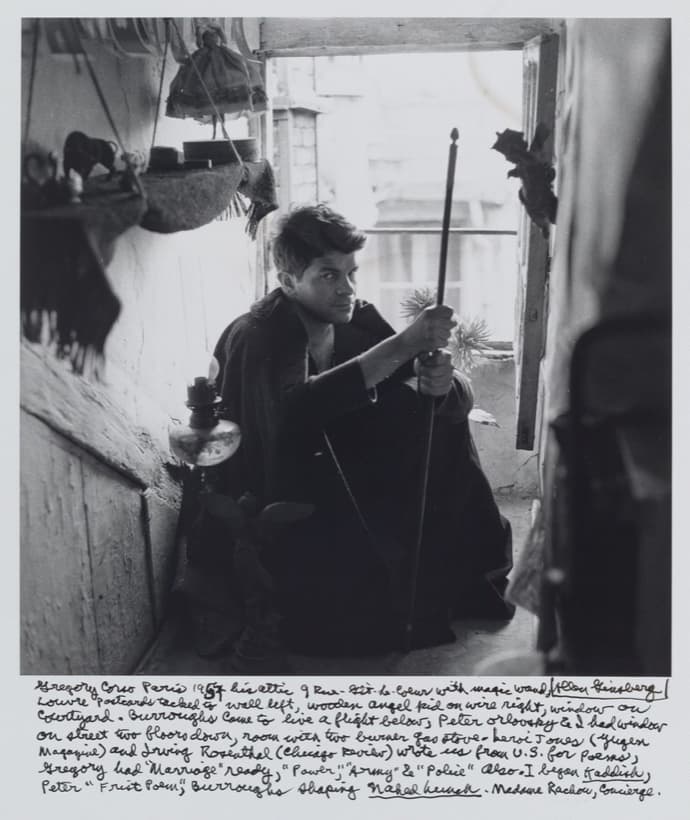
Ginsberg, Orlovsky and Gregory Corso settled in Paris in the autumn of 1957. Their base became the inexpensive residence at 9 rue Gît-le-Cœur, a narrow street running from the rue Saint-André-des-Arts toward the Seine.[5] The building was operated by Madame Rachou and had no celebrated literary identity when the Beats arrived. It was known formally as the Hôtel Rachou and acquired the nickname Beat Hotel from its residents and visitors. Its low rents, tolerant management and primitive facilities made it suitable for people who had little money and irregular habits. Rooms were small, plumbing was limited and artists used the building as lodging, studio, office and social club.
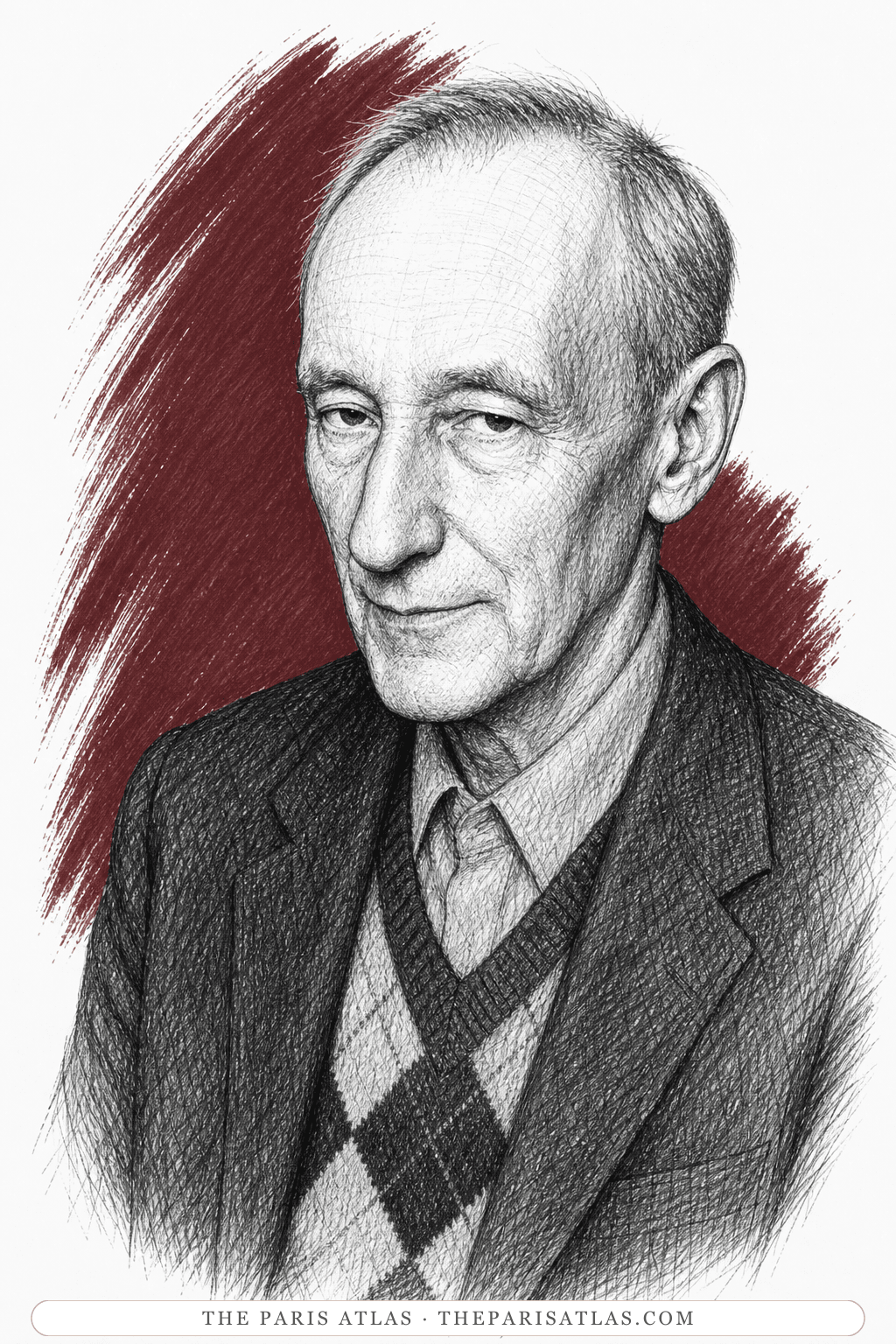
The address became important because several major works developed within a few rooms of one another. Ginsberg began Kaddish there and wrote Paris poems including "At Apollinaire's Grave." Corso worked on poems such as "Bomb" and "Marriage," combining classical learning with anarchic humor and typographical experiment. Burroughs arrived with the material of Naked Lunch. He later worked with the artist Brion Gysin and the technician Ian Sommerville on cut-ups, tape experiments and the "Dreamachine." Peter Orlovsky wrote and participated in the daily exchanges that made the hotel a collective workshop. The residents did not share one method, but proximity allowed manuscripts, theories and practical assistance to circulate continuously.
Photographer Harold Chapman, who lived in the building for years, provided the most vivid visual record of this environment. His photographs show cramped rooms, peeling walls, beds used as desks and writers moving through nearby streets and cafés. One of the best-known images depicts Ginsberg and Orlovsky seated back-to-back on a double-sided bench in the Place Saint-Germain-des-Prés in the winter of 1957. Chapman recalled that Ginsberg translated street names and pointed out architecture during their walk, a small detail that complicates the stereotype of the Beats as Americans indifferent to the city around them.
The group also participated in the postwar literary life of the Left Bank. George Whitman's bookshop at 37 rue de la Bûcherie was then called Le Mistral; only later did it take the name Shakespeare and Company. It should therefore not be confused with Sylvia Beach's prewar shop, which had published James Joyce's Ulysses. Whitman welcomed itinerant readers and writers, and the shop became a meeting place for expatriates, students and members of the Beat circle. Maurice Girodias's Olympia Press represented another part of this literary ecosystem, publishing English-language books that conventional British and American firms considered legally or commercially dangerous, including the first complete edition of Naked Lunch in 1959.
Paris coincided with the Beats' sudden transformation into a media phenomenon. Kerouac's On the Road appeared in September 1957, and the Howl judgment followed in October. Ginsberg was therefore absent from the United States while journalists were constructing the public image of the Beat Generation. Unlike Kerouac, who often felt trapped and misrepresented by publicity, Ginsberg proved able to use attention strategically. From abroad he followed the obscenity case, corresponded with Ferlinghetti and continued promoting his friends. Yet Paris also gave him temporary distance from the public role that was forming around him.
That distance is central to the city's meaning in his life. He arrived as the controversial author of Howl, a poem already becoming a symbol of generational rebellion, and began a work about his mother that could not be sustained by public mythology. The Paris period therefore did more than add another bohemian address to Beat tourism. At 9 rue Gît-le-Cœur, Ginsberg participated in the collective development of Naked Lunch and Corso's poetry while turning toward the most private history of his own life. The Beat Hotel was both a workshop shared by friends and the place where his public voice learned to carry intimate grief.
Counterculture, protest and the Vietnam War
Ginsberg became one of the most recognizable poets in the American counterculture, but he was older than many of the young people who gathered in San Francisco during the Summer of Love. His presence created continuity between the Beats of the 1950s and the hippie movement of the 1960s. At the Human Be-In in Golden Gate Park on 14 January 1967, he appeared alongside Timothy Leary, Gary Snyder, Lawrence Ferlinghetti, political activists and major San Francisco rock bands.[6] The event joined poetry, music, psychedelics, spiritual practice and protest before a mass audience and helped establish the public image of the emerging counterculture.
His approach to protest emphasized nonviolence, theater and the management of public images. Ginsberg helped popularize the phrase "flower power" and proposed that demonstrators answer armed authority with flowers, chanting, music, humor and calm behavior. The strategy could seem naïve, but it rested on a practical recognition that political confrontations were also media events. A photograph of a demonstrator offering a flower to a soldier could expose the disproportion between peaceful dissent and militarized response more clearly than another image of reciprocal aggression.
At the March on the Pentagon on 21 October 1967, Ginsberg chanted mantras during the theatrical attempt to "exorcise" the building and symbolically levitate it.[7] The organizers did not possess a single understanding of the ritual: for some it was satire, for others spiritual action, and for the press an irresistible spectacle. Ginsberg believed the event weakened the symbolic authority of the military by making it available to ridicule and imaginative transformation. His combination of mantra, absurdity and protest was characteristic of a politics that tried to change emotional atmosphere as well as policy.
He carried the same methods into the violence surrounding the 1968 Democratic National Convention in Chicago. Police attacked and tear-gassed antiwar demonstrators, and Ginsberg attempted to use controlled breathing and chanting to reduce panic within crowds. He later testified for the defense in the Chicago Seven trial. Whether chanting could alter the outcome of a confrontation involving organized police violence was uncertain, but the practice shows how completely his poetic, spiritual and political activities had merged. Breath was simultaneously a formal measure, a meditation technique and a means of collective self-control.
Ginsberg's activism was not limited to Vietnam. He protested censorship, nuclear weapons, environmental destruction, the war on drugs and American intervention in Latin America. In 1978, he and Orlovsky were arrested after occupying railroad tracks used by the Rocky Flats nuclear weapons plant in Colorado, part of a campaign against plutonium production, radioactive waste and official secrecy. Poems such as "Plutonian Ode" addressed nuclear danger in a language that combined scientific vocabulary, prophetic denunciation and Buddhist awareness. Others, including "Homework," used comic fantasy rather than solemn prophecy to imagine washing pollution and political violence from the earth.
Naropa, teaching and the preservation of poetic traditions
In 1974, Ginsberg and the poet Anne Waldman helped establish the Jack Kerouac School of Disembodied Poetics at Naropa Institute in Boulder, Colorado, under the broader guidance of Chögyam Trungpa. Writers including Diane di Prima and John Cage participated in the early Naropa community. The deliberately playful name acknowledged both practical poverty—the school initially lacked much of the ordinary equipment of an academic department—and a lineage of dead writers whose voices remained active in teaching. Waldman later explained that its faculty and inspirations were "disembodied" because they were peripatetic, absent or long gone.
The school joined literary study with contemplative practice. Ginsberg described the exchange as a way to teach meditators about poetic voice and poets about awareness. Its curriculum did not simply celebrate spontaneous expression. Students read Blake, Whitman, Ezra Pound, Williams, Gertrude Stein, Kerouac, Buddhist texts and many other traditions, while also attending to breath, performance, composition and the social history of experimental writing. Naropa became an important archive of living voices because classes and readings were extensively recorded.
Ginsberg's emergence as a professor can appear surprising only when his anti-establishment image is mistaken for anti-intellectualism. He had always been a scholar, annotator and teacher. In 1986–87 he returned to Columbia as a visiting professor, and in 1986 he joined Brooklyn College as a distinguished professor of English and creative writing, teaching almost until his death. Students encountered a demanding literary historian who could discuss meter, etymology, manuscript variants, Buddhist doctrine, song and performance with equal seriousness.
Teaching also allowed Ginsberg to preserve histories that academic institutions had once ignored. By the 1980s, many Beat figures were dead or in declining health, and the movement was vulnerable to caricature. Ginsberg used classrooms, interviews, annotated photographs, collected editions and archives to distinguish the actual writers from the commercial "beatnik" image. He did not merely institutionalize rebellion. He helped create the documents through which later readers could examine the movement critically rather than receiving it as legend.
Photography, music and artistic collaboration
Ginsberg's photography developed from the same documentary instinct as his poetry. He began with inexpensive cameras in the 1950s, making informal portraits of friends in apartments, streets, cars and temporary rooms. These images are valuable because their subjects had not yet become historical characters. Kerouac appears distracted or playful rather than monumental; Burroughs appears within the domestic space of friendship and sexual intimacy; Cassady is seen among cars, spouses and lovers; Solomon appears as a person with a life after the psychiatric institution.
In the 1980s, Ginsberg returned systematically to old negatives and resumed photographing. He made new prints and wrote extensive captions beneath them, identifying dates, places, relationships, books in progress and what later happened to the people shown. The captions transform the pictures into collaborations between the moment of exposure and decades of subsequent memory. They are factual but not impersonal, often containing gossip, affection, grief and retrospective correction. The National Gallery of Art's 2010 exhibition Beat Memories, the first major museum exhibition devoted to his photography, presented portraits from the early "drugstore" prints through the 1980s and 1990s.
He sometimes described this approach as "snapshot poetics." The phrase did not mean that art should be careless. It meant that an artist should recognize when a particular perception already contains sufficient form. A photograph can preserve the exact arrangement of bodies before fame or death alters its meaning; a poem can record a motel room, a radio bulletin or the expression on a friend's face before recollection becomes generalized. Ginsberg's enormous archive extends this principle. He saved manuscripts, letters, notebooks, recordings, photographs, flyers and mundane objects because the material life surrounding literature was itself historically meaningful.
Music provided another field of collaboration. Ginsberg sang, chanted and played harmonium at readings, recorded settings of Blake and his own poems, and worked with musicians from folk, rock, punk and contemporary classical traditions. He appeared within Bob Dylan's circle, performed on "Ghetto Defendant" with the Clash and collaborated with composer Philip Glass on Hydrogen Jukebox, a music-theater work built from poems spanning several decades. These projects did not represent a poet abandoning the page. They made explicit what had always been present in his work: rhythm, breath, repetition and the human voice were compositional structures, not merely methods of presenting a finished text.
Literary friendships, love and the work of advocacy
Ginsberg's career cannot be separated from the relationships through which it developed. Jack Kerouac remained a foundational friend from the Columbia years until Kerouac's death in 1969. Ginsberg recognized the scale of Kerouac's ambition long before On the Road found a publisher, circulated manuscripts and tried to explain his method to skeptical editors. Kerouac, in turn, encouraged Ginsberg to trust spoken cadence, personal memory and the energy of first perception. Their later political paths diverged: Ginsberg became an increasingly visible antiwar activist, while Kerouac resented the counterculture's appropriation of the Beat label and moved toward political conservatism. The disagreement did not erase the literary intimacy of their early years or Ginsberg's lifelong defense of Kerouac as a disciplined writer rather than a mascot for reckless travel.
William S. Burroughs remained equally important in a different way. His intellectual detachment, fascination with control systems and willingness to explore grotesque material offered a counterweight to Ginsberg's emotional openness. Ginsberg helped edit, type, arrange and promote Burroughs's work in New York, Tangier and Paris, and continued arguing for its importance after their sexual relationship ended. Burroughs could find Ginsberg's enthusiasm excessive, while Ginsberg sometimes resisted Burroughs's coldness, but the friendship lasted for decades. Their correspondence and photographs make clear that Beat literary history was shaped through practical care as well as artistic theory.
Gregory Corso inspired another form of loyalty. Ginsberg saw extraordinary talent in a poet whose poverty, addiction and erratic behavior repeatedly interfered with publication and stability. He introduced Corso to readers, praised him with extravagant conviction and helped preserve the seriousness of work that could otherwise be dismissed as charming improvisation. Corso did not always welcome Ginsberg's managerial energy, and their friendship included conflict, but Ginsberg's advocacy helped secure his place among the major Beat poets.
Peter Orlovsky occupied a different position from these literary friendships because he was Ginsberg's principal partner for more than forty years. They traveled together, lived together intermittently, exchanged letters, participated in demonstrations and cared for members of Orlovsky's family. Both had other sexual relationships, and periods of illness, addiction and separation placed heavy strain on the partnership. It was nevertheless the closest approximation to marriage in Ginsberg's adult life. He named Orlovsky openly in poetry and public records, making their bond visible rather than translating it into coded literary friendship.
Ginsberg's instinct to promote others extended well beyond the best-known male Beats. He supported poets, musicians, small magazines, political pamphleteers and younger writers who sent him work from around the world. He worked with Anne Waldman and Diane di Prima at Naropa, maintained contact with Gary Snyder and Joanne Kyger, encouraged international avant-garde movements and brought unfamiliar writers to the attention of American publishers. This generosity could become intrusive; Ferlinghetti sometimes resisted his assumption that every new enthusiasm required immediate publication. Yet the scale of the archive confirms that cultural brokerage was one of Ginsberg's major achievements. He did not simply belong to a movement. He built and preserved many of the connections by which the movement became visible.
Later poetry and public recognition
Ginsberg continued publishing prolifically after The Fall of America. Collections including Mind Breaths, Plutonian Ode, White Shroud and Cosmopolitan Greetings show a poet moving among political documentary, Buddhist observation, comedy, elegy and the ordinary inconveniences of aging. The later poems are often less rhetorically overwhelming than Howl, but their plainness is deliberate. He increasingly favored a mind observing its own habits in real time, recording travel, bodily change, friendship, news and mortality without requiring every perception to become a revelation.
Some later works retained the scale of public witness. "September on Jessore Road," written after Ginsberg visited refugee camps during the Bangladesh Liberation War, attempted to direct attention toward mass displacement and suffering that received inadequate Western response. "Plutonian Ode" confronted the language and material history of nuclear weapons. Other poems turned toward deceased friends, his father, Orlovsky, domestic routines and the aging body. The prophetic and documentary modes were not opposites; both emerged from the belief that public history entered consciousness through specific images and sounds.
Institutional recognition accumulated around a writer who had once been associated with obscenity prosecutions and psychiatric confinement. The Fall of America received the 1974 National Book Award for Poetry. Ginsberg was elected to the American Academy and Institute of Arts and Letters, received the Robert Frost Medal and was appointed a Chevalier de l'Ordre des Arts et des Lettres by France in 1993. Cosmopolitan Greetings: Poems 1986–1992 was a finalist for the 1995 Pulitzer Prize in Poetry. These honors did not erase his countercultural identity, but they showed how completely the American literary institutions that had once treated Beat writing as marginal had absorbed him into the canon.
He remained highly visible in the East Village, at Naropa, in university classrooms and at international readings. The older Ginsberg could appear simultaneously as celebrity, neighborhood resident, Buddhist practitioner, political demonstrator and meticulous literary historian. He continued making recordings, taking photographs, writing poems and answering correspondence at a pace that contributed to the extraordinary size of his archive. Stanford acquired the principal collection in 1994; it eventually grew to roughly 1,350 linear feet of manuscripts, notebooks, letters, photographs, recordings, printed matter and personal material. The archive preserves not only Ginsberg's career but a vast documentary record of twentieth-century underground culture.
Legacy
Ginsberg changed American poetry first by enlarging what it could admit. Psychiatric hospitals, homosexual desire, drugs, political protest, family shame, machinery, advertising, religious vision and ordinary street speech could occupy the same poem without being arranged according to conventional standards of decorum. This expansion was not merely thematic. His long line, catalogues, repetitions and public performances gave excluded experience a form capable of being heard by large audiences.
He also changed the social role available to a poet. Ginsberg acted as publisher's scout, publicist, archivist, teacher, photographer, political demonstrator and performer without treating those activities as distractions from writing. His example helped restore the poetry reading to the center of literary culture and connected print poetry with music, protest and recorded sound. At the same time, the scale of his public personality created a lasting critical problem: the historical celebrity can obscure both the disciplined craft of the major poems and the unevenness of the enormous body of later work.
His legacy as a gay writer is similarly substantial and contested. Ginsberg made male homosexual desire explicit in major American poetry before such openness was professionally safe, and his visible partnership with Orlovsky offered an alternative to the secrecy expected of earlier generations. His defense of NAMBLA remains a major controversy and should not be treated as representative of the broader gay liberation movement. Both histories belong in the record: his importance to queer literary visibility and the criticism generated by an organization he chose to support.
The Beat Generation's endurance also owes much to his work as a preserver. His photographs show its participants before fame, his captions identify the circumstances later myths erased, and his correspondence documents the practical labor of getting books written and published. The Stanford archive, highlighted in a major centenary exhibition in 2026, reveals a writer who saved almost everything and who understood that underground culture would need its own record. Because of that preservation, later scholars can examine the Beats as a network of actual people rather than accepting the mythology Ginsberg himself sometimes helped create.
His strongest poems remain powerful because they combine scale with specificity. Howl makes a generation audible through individual bodies and places. Kaddish makes family grief historical without turning it into abstraction. "Wichita Vortex Sutra" records political language as part of the environment. The late poems make fame and mortality ordinary enough to observe. Beneath the familiar image of the bearded prophet was a serious technician preoccupied with one durable question: how could the movements of consciousness—private, social, bodily and historical—be carried into the human voice without losing their pressure?






 View source